Before you can successfully bring AI into your business, you need to lay the groundwork. It's a three-part process that starts with pinpointing your biggest business headaches, moves to checking if your data is ready for the job, and ends with setting crystal-clear, measurable goals. This simple framework stops you from just chasing the latest AI trend and makes sure every dollar you invest is aimed at a real, tangible result.
Laying the Foundation for AI Success
Jumping into artificial intelligence without a solid plan is like trying to build a house without a blueprint. The hype around AI is real, but a successful rollout depends entirely on careful prep work. Before you even think about choosing a tool or writing a single line of code, you have to ground your strategy in the day-to-day reality of your business.
This foundational work might not be the most exciting part, but I've seen firsthand that it's the single biggest factor in getting a positive return on your AI investment.
Find Your Key Business Challenges
The first thing to do is a real, honest needs assessment. Don't start by asking, "What cool things can AI do?" Instead, ask, "What are our most frustrating, time-sucking business problems?" This simple shift in perspective puts the focus where it belongs: on solutions, not just technology.
Think about the repetitive, manual tasks that eat up your team's day. Is your customer support team buried under a mountain of the same five questions? Are your salespeople spending more time on data entry than on actually selling? Maybe your inventory management is a mess, leading to costly stockouts or overstocked shelves.
These are perfect problems for AI to solve. For example, a small retail shop struggling with inventory could use an AI tool to predict demand and keep stock levels just right. A marketing agency could automate the grunt work of sifting through campaign data to quickly spot what's working and what's not.
The goal isn't just to "use AI." It's to solve a specific, nagging problem that's hitting your bottom line. When you focus on a clear challenge, you create a simple benchmark for success and make it much easier to get your team on board.
Once you’ve identified a few high-impact problems, the next question is a big one: do you have the right fuel to power an AI solution? I'm talking about your data.
Evaluate Your Data Readiness
AI is only as smart as the data it learns from. You might be sitting on a mountain of information, but is it organized, clean, and actually accessible? I've seen too many projects stumble because the data was a complete mess—incomplete, siloed in different systems, or just plain wrong.
Take a moment for an honest look at your data infrastructure. It's a non-negotiable step.
To figure out where you stand, use this simple checklist. It's a quick way to gauge your readiness before you commit to a specific AI project.
Your Business AI Readiness Checklist
This quick assessment will help you identify your readiness level across key areas before starting an AI implementation.
| Readiness Area | Key Questions to Ask | Success Indicator |
| Data Quality | Are our customer records, sales figures, and operational logs accurate and consistent? Do we have a lot of errors or duplicates? | Data is largely clean, with minimal errors and a clear process for maintaining accuracy. |
| Data Accessibility | Is our data in one central place (like a CRM or data warehouse), or is it scattered across dozens of spreadsheets and old systems? | Key data sources are connected or consolidated, making them easy for an AI tool to access. |
| Data Volume | Do we have enough historical data for an AI to learn from? (e.g., months or years of past customer behavior). | You have a substantial, relevant dataset that reflects the problem you're trying to solve. |
| Data Governance | Do we have clear rules about who can access data and how it can be used? Do we have a handle on data privacy? | Policies are in place to ensure data is handled securely, ethically, and in compliance with regulations. |
Looking at this table, you might realize you have some work to do. That's perfectly normal. Getting your data house in order is often the toughest part, but it's essential. For a great starting point, check out these knowledge management best practices. They offer a solid framework for structuring your company’s information, which is a huge step in the right direction.
This whole process can be boiled down to a simple, three-part flow.
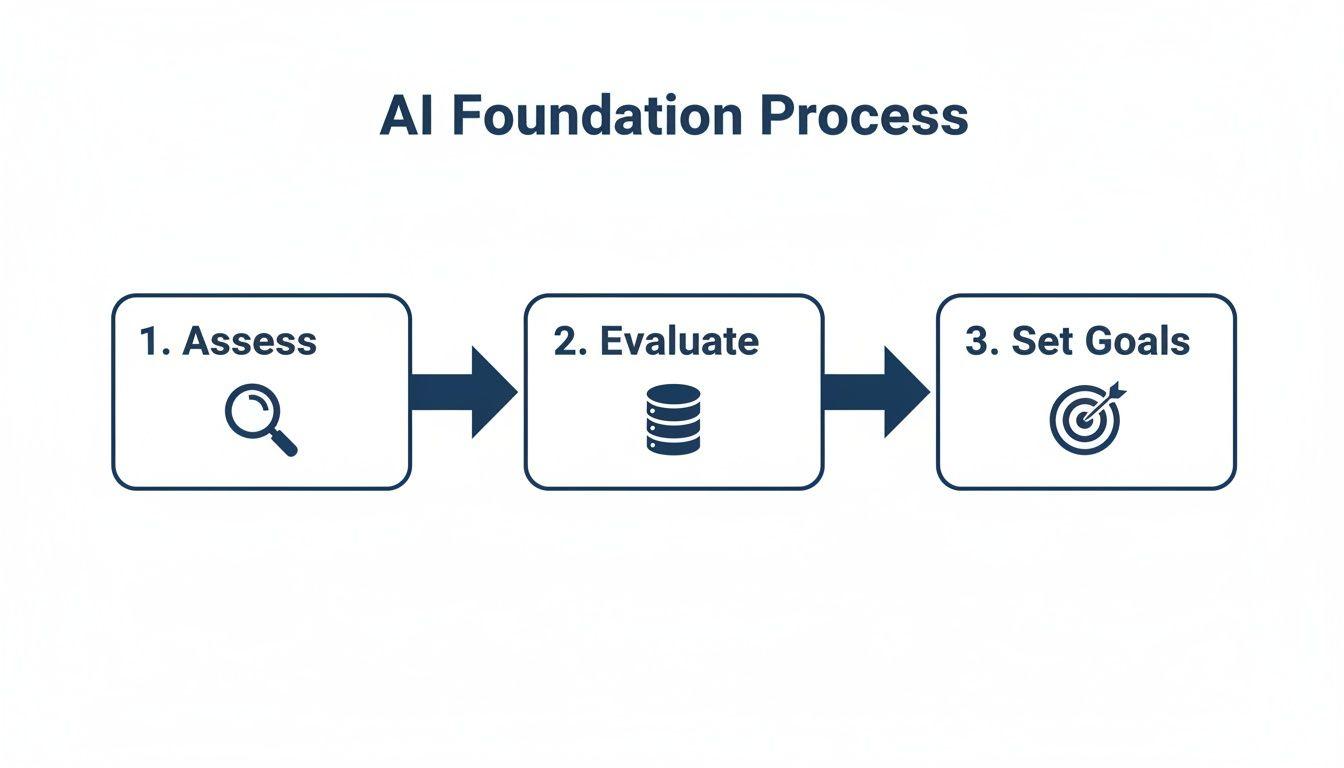
As you can see, a methodical approach—assessing needs, evaluating data, and setting goals—is the most reliable path to getting real value from AI.
Set Clear and Measurable Goals
Alright, you’ve identified a clear problem and you know where your data stands. The final foundational piece is defining exactly what success will look like. Fuzzy goals like "improve efficiency" or "boost productivity" are impossible to track and will leave you wondering if your investment paid off.
You need to set SMART goals—Specific, Measurable, Achievable, Relevant, and Time-bound.
So, instead of a vague goal like "improve customer support," a much better one is: "Reduce customer ticket resolution time by 30% within the next six months" by implementing an AI-powered chatbot.
Rather than just "increase sales," aim to "generate 15% more qualified leads per quarter" by using an AI tool to analyze website visitor behavior. These concrete targets give you a clear finish line and make it incredibly simple to calculate your return on investment down the road.
Choosing the Right AI Tools and Partners
Once you’ve nailed down the problem you want to solve and confirmed your data is in good shape, it’s time to wade into the AI marketplace. Let's be honest—it can feel like a maze of jargon and flashy promises. But making the right choice here is what separates a successful AI initiative from an expensive distraction. The trick is to find a tool, and more importantly, a partner, that genuinely fits what you're trying to accomplish.
Broadly speaking, you'll find two types of solutions out there. First, you have the plug-and-play SaaS products. Think AI chatbots for your website or smart email marketing platforms. They're built for common business problems, get you up and running fast, and are usually the best place for a small or midsize business to start.
Then you have the more heavy-duty stuff: customizable AI platforms and frameworks. These give you a ton of flexibility and power, but they demand real technical know-how to implement and manage. This route makes sense when you have a truly unique, complex challenge that an off-the-shelf tool just can't handle.
Distinguishing Hype from Reality
The AI world is overflowing with bold claims. To see past the marketing fluff, you need to go in with a sharp set of questions. When you're talking to a potential vendor, don't get mesmerized by what the AI can do. Focus on how it will actually plug into your day-to-day operations.
Think of it less like buying software and more like hiring a key employee. The relationship you have with your vendor is just as crucial as the technology itself.
Here are the non-negotiables to ask every single vendor you vet:
- Integration Capabilities: How well does your tool play with our existing systems, like our CRM or marketing platform? An AI tool that lives on an island creates more manual work, defeating the whole purpose.
- Data Privacy and Security: Where does our data live, and who can see it? What security certifications do you have? This isn't just a feature; it's a fundamental requirement, especially if you're handling customer information.
- Support and Training: What does onboarding look like? Do we get a dedicated person to call when things go wrong? A powerful tool is worthless if your team is too intimidated to use it.
- Scalability and Pricing: Can you explain your pricing model in simple terms? Will our costs balloon unexpectedly as we use it more? You need predictable expenses, not a surprise bill at the end of the month.
A true partner is invested in your success, not just in making a sale. They’ll be upfront about their tech's limitations and work with you to make implementation a success. If they just want to close the deal and vanish, walk away.
Prioritizing Privacy-First Solutions
In the sprint to adopt AI, it’s all too easy to let data privacy slide into the "we'll figure it out later" pile. That's a massive mistake. A single data breach can wreck your reputation and land you in serious legal hot water. This is exactly why a privacy-first approach isn't just nice to have—it's essential.
Privacy-first tools are built from the ground up to safeguard your information. For example, platforms like 1Chat create a secure, private space for your team to use powerful AI models without your company's sensitive data being fed back into public training sets. For any business, that's a game-changer.
Here's an example of how a platform can offer access to multiple AI models from one clean, secure dashboard.
This kind of setup makes it easy for your team to pick the best model for the job without ever having to worry about data security. If you're looking for a solid starting point, checking out a curated list of the best AI tools for small business can help you quickly compare options that align with your needs and budget.
Ultimately, your goal is to build an AI toolkit that's not only powerful but also trustworthy and secure. By asking the tough questions now and putting privacy at the top of your list, you'll avoid major headaches and build an AI strategy that’s built to last.
Running a Smart Pilot Program
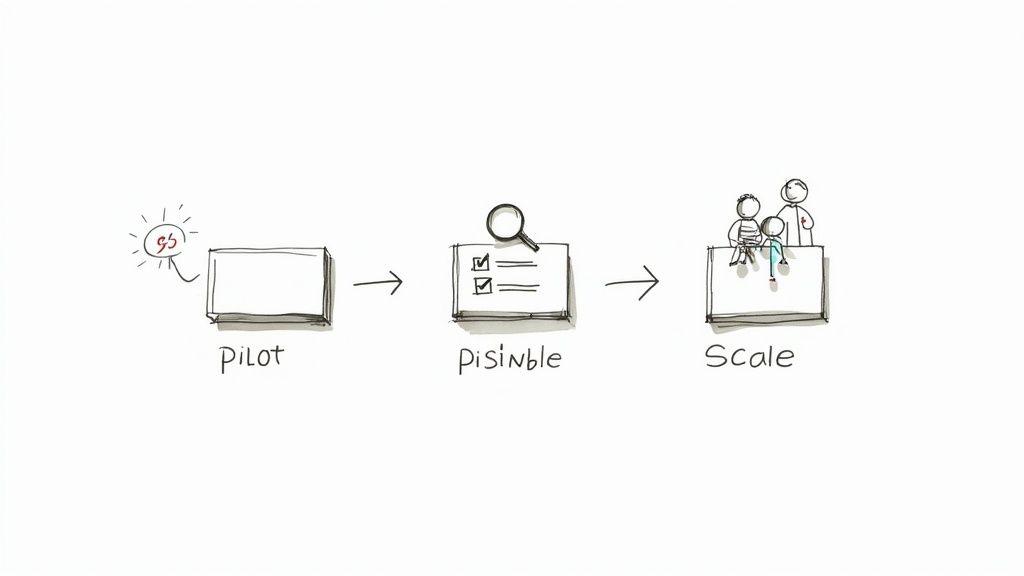
Once you've picked your AI tool, the urge to roll it out to everyone is strong. Resist it. Going all-in from day one is a high-risk gamble that almost never pays off. Instead, a well-planned, controlled pilot program is your secret weapon.
Think of it as a dress rehearsal. This is your chance to test the tech in a real-world but low-stakes environment, get honest feedback, and smooth out the rough edges before a full launch. This approach minimizes disruption and gives you the hard data you need to justify a company-wide rollout.
Selecting the Perfect Pilot Project
Your first move is to pick the right project for your test run. You're looking for that perfect balance: a project with high visibility and low complexity. You want something that gets noticed if it succeeds but won't grind operations to a halt if it stumbles.
For example, instead of trying to overhaul your entire sales CRM with an AI forecaster, think smaller. A great pilot could be deploying an AI chatbot to handle after-hours customer questions on your website. It’s a self-contained problem with a clear goal: cut down response times and capture leads while your team is offline.
This type of project is perfect because it’s:
- Easy to measure: You can track the number of queries handled, customer satisfaction, and new leads without much effort.
- Low-risk: It supports your existing team rather than replacing a core function right away.
- Quick to show value: You'll see the impact on customer engagement in weeks, not months.
Choosing the right pilot is all about building early momentum and getting your key people excited.
Your pilot isn’t about proving the AI works in a perfect lab. It’s about seeing how it holds up in the messy reality of your business, with your team and your customers.
Defining What Success Looks Like
Before you hit "go," you need to know what a win looks like. Vague goals like "see if it's helpful" are useless. Your success metrics must tie directly back to the business problem you’re trying to solve.
If your pilot is a customer support chatbot, your Key Performance Indicators (KPIs) could be:
- Ticket Deflection Rate: What percentage of common questions can the bot answer on its own? A goal of a 25% deflection rate is a great place to start.
- Customer Satisfaction (CSAT) Score: Are customers happy after talking to the bot? A simple "Was this helpful?" survey can give you this insight.
- Time to Resolution: How fast are problems being solved? Compare the bot's speed to your human-only baseline.
Tracking these numbers gives you concrete data, so you can evaluate the pilot's performance without guesswork. For many companies, a good AI chatbot for small business is the ideal entry point, offering a low-barrier pilot with clear, measurable results.
Gathering Feedback and Making Adjustments
Data tells you what is happening, but your people tell you why. Your pilot needs a small group of dedicated users—I recommend a mix of early adopters and healthy skeptics—to give you honest, constructive feedback.
This group isn't just using the tool; they're your co-pilots. Create a simple way for them to share their thoughts, like a dedicated Slack channel or a quick weekly check-in.
Be sure to ask specific questions:
- Where did you get stuck?
- What feature saved you the most time?
- Did it integrate smoothly with our other software?
- What's the one thing you'd change to make it better?
This kind of feedback is gold. It uncovers friction points that raw data can’t see. After a set timeframe—usually 30 to 90 days—bring all your data and feedback together. Figure out what worked, what didn't, and what needs a little tweaking. This cycle of testing, learning, and refining is the key to a successful implementation. It ensures your big launch is built on proven success, not just wishful thinking.
Getting Your Team On Board with AI

Let's be honest: the most powerful AI tool in the world is useless if your team is skeptical, confused, or actively resisting it. At its core, bringing AI into your business is a people-first challenge, not a tech one. It’s all about change management, and that means you need to lead with empathy, communicate clearly, and genuinely empower your employees.
Ignoring the human side of this equation is the fastest way to see your AI investment fail. You have to get ahead of the rumors, tackle fears head-on, and prove that AI is here to help your team, not replace them.
It’s All About the “Why”
Before you even think about scheduling a single training session, you need to have a real conversation about why you're doing this. Your team needs to understand the business problems you’re trying to solve. Don't just announce a new chatbot. Explain that it's being brought in to field the same repetitive questions over and over, freeing up the customer support team to focus on the tricky, high-value problems where they can really shine.
Frame the whole thing around what's in it for them.
- Less tedium: "This is going to automate the mind-numbing data entry that eats up hours of your week."
- Smarter work: "This tool will surface the insights you need to close bigger deals, faster."
- Better balance: "By letting AI handle routine after-hours tasks, we can cut back on those weekend support shifts."
When your team starts seeing AI as a tool that makes their jobs better, that skepticism quickly turns into curiosity. That mindset shift is absolutely critical.
Taming the Fears and Building Trust
Look, the elephant in the room with any AI conversation is job security. You have to tackle it directly and honestly. Reassure everyone that the goal is to augment their skills, not replace their roles. Show them exactly how AI will take over the boring, repetitive parts of their jobs, freeing them up for the more creative, strategic, and frankly, more human work.
True AI adoption happens when your team stops seeing it as a machine that might replace them and starts seeing it as a co-pilot that makes them better at their jobs. The goal is to build champions, not just users.
One of the best ways to build confidence is to showcase small, early wins. Did the pilot program in marketing cut down their administrative work by 30%? Shout it from the rooftops. Better yet, let the team members involved tell the story in their own words. Hearing it from a peer is infinitely more powerful than any announcement from leadership.
Training That Actually Works
A one-and-done webinar isn't going to cut it. Effective training needs to be an ongoing process that builds both skills and confidence over time. Think hands-on, role-specific, and flexible enough for different learning styles.
Try a mix of approaches:
- Start with the Basics: Run a few foundational workshops. Explain what AI is (and isn't) in plain English and demo the specific tool you've chosen.
- Get Role-Specific: A marketer and a finance analyst need to learn very different things. Create focused sessions that show people how to use the AI for tasks they actually do every day.
- Offer Ongoing Help: Make it easy to get answers. Set up a dedicated Slack channel, offer "office hours" with an AI expert, or build a library of quick, two-minute video tutorials.
The move to AI is happening fast. In 2024, 78% of organizations reported using AI in at least one business function, a huge leap from around 55% in 2023. These numbers show how urgent it is to get your team skilled up. But, as you can learn from the current state of AI adoption, many of these initiatives get stuck in one department and never spread.
Finally, you need to create a feedback loop. Give your team a voice. Regular check-ins and surveys do more than just make people feel heard—they give you priceless insights to fine-tune your rollout. When people feel like they are part of the process, they become champions for its success.
Measuring the Real-World Impact of AI
Okay, your pilot program is wrapped up, and the team seems to like the new tool. That's a great start. But now you’ve got to answer the one question every executive and stakeholder is going to ask: “So, was it worth it?”
To answer that well, you need more than just good vibes and a few positive anecdotes. You need to prove the value of your AI investment with hard data. This isn't just about justifying the initial cost; it's about building the business case to keep going and making this a core part of how you operate. The numbers you pull together now will be the foundation for taking this from a small experiment to a company-wide advantage.
Moving Beyond Fuzzy Metrics
First things first: you have to tie your measurements directly back to the goals you set on day one. If you wanted to slash the time your team spends on manual data entry, a metric like "team sentiment" just won't cut it. You need to zero in on the key performance indicators (KPIs) that actually reflect that original business pain point.
We're measuring outcomes here, not just outputs. An AI can spit out a thousand reports, but if none of them lead to better decisions or real cost savings, who cares?
To get this right, you absolutely must have a baseline. Before you even flipped the switch on the AI, you should have been collecting performance data. That pre-AI snapshot is your benchmark—the "before" picture. Without it, you’re just guessing at how much of an impact you've actually made.
The KPIs That Actually Matter
The specific metrics you track will depend entirely on the problem you're solving, but they almost always fall into one of these buckets.
Here are a few real-world examples to get you thinking:
- Productivity and Efficiency: This is usually the easiest win to spot. Are you tracking things like time saved per task, the reduction in manual errors, or simply the number of processes automated? A sales team, for instance, might see a 20% decrease in time spent logging calls. That's real time they can now spend selling.
- Hard Cost Savings: Look for the direct impact on your bottom line. Did you see reduced overtime hours for your support staff? Lower operational costs from smarter logistics? Maybe you even canceled a few software subscriptions because the AI tool now handles that function.
- Revenue and Growth: This is the holy grail. Can you draw a straight line from the AI to more money coming in the door? You’d want to track things like lead conversion rates, average deal size, or customer lifetime value. An AI recommendation engine on your website is a perfect example—you can directly measure its impact on the average order value.
- The Customer Experience: Don't forget how your customers feel. Happier customers are a sure sign you're on the right track. Use hard numbers like Customer Satisfaction (CSAT) scores, Net Promoter Score (NPS), and first-contact resolution rates to quantify just how much better your service has become.
The most convincing story you can tell is one backed by numbers. When you can walk into a meeting and say, "Our AI pilot cut customer ticket resolution time by 40%," you've graduated from a promising idea to a proven business asset.
How to Tell a Compelling ROI Story
Once you’ve got your data, the final step is to weave it into a narrative that actually resonates with your stakeholders. Please, don't just dump a spreadsheet on them. Tell the story of the change. A simple "before and after" format is incredibly powerful because it makes the impact immediate and obvious.
It’s also crucial to set realistic expectations. The economic upside of AI can be massive—many firms see productivity gains in the 25–55% range for certain tasks. For generative AI specifically, adopters often report a median ROI around $3.70 for every $1 invested. But it’s not always a home run. Those impressive stats are often balanced by high failure rates for pilots that never quite deliver at scale. To get a better sense of the landscape, you can discover more insights on AI adoption statistics.
A solid ROI presentation should always include these five elements:
- A quick recap of the original problem: Remind everyone what you were trying to fix.
- The baseline data: Show them the "before" state to set the scene.
- The post-AI results: Present the new numbers, clearly highlighting the improvement.
- The financial calculation: Turn those performance gains into a clear dollar figure.
- The human element: Back up the data with real quotes and feedback from the team who used the tool.
By measuring your impact this carefully and presenting it clearly, you create a powerful feedback loop. This data doesn't just prove your project was a success; it gives you the insights needed to make even smarter decisions on your AI journey.
Answering Your Top Questions About AI Implementation
Diving into your first AI project is exciting, but it’s completely normal to have a lot of questions. In my experience, getting a handle on the common sticking points ahead of time can save you a world of headaches down the road.
Let’s tackle some of the most frequent questions I hear from business leaders who are just starting their AI journey.
What Are the Biggest Mistakes People Make?
The most common trap I see is treating AI like a magic bullet. Leaders get excited about the technology but haven't clearly defined a specific business problem they want to solve. They hope the AI will just "find" value, which is a recipe for a stalled project and a burned budget.
Another classic mistake is underestimating the importance of your data. An AI model is only as smart as the data it’s trained on. If your data is a mess—disorganized, incomplete, or stuck in different systems—your results will be mediocre at best. Garbage in, garbage out. It’s a cliché for a reason.
Finally, don’t forget the people. You can have the best technology in the world, but if you don't bring your team along for the ride, it’s doomed. Failing to explain why the change is happening or providing proper training will lead to resistance and tank your adoption rates.
What's a Realistic Budget for an AI Project?
For a small or midsize business, thinking about an AI budget goes way beyond the monthly software fee. You have to consider the total cost of ownership, which includes a few key things that often get missed.
- Getting Your Data Ready: This can be a huge, and often surprising, upfront cost. If you've got years of data that needs to be cleaned up, labeled, and structured, you'll need to budget for the tools or people to do it.
- Integration Work: Does the AI tool need to talk to your CRM, accounting software, or other core systems? Custom integration isn't always plug-and-play and can add a significant amount to the initial bill.
- Training and Support: It’s critical to set aside funds to properly train your team and for any ongoing support contracts with the vendor. This is what ensures you actually get value from your investment.
- Upkeep and Maintenance: AI isn't a "set it and forget it" tool. Models need to be monitored and sometimes retrained to maintain their accuracy. Think of it as ongoing maintenance, not a one-off purchase.
A good rule of thumb is to look past the sticker price. These related costs can easily add up to 30-50% of the total first-year investment. Factoring them in from the start is the best way to avoid nasty surprises and keep your project on track.
How Do We Handle Data Security and Privacy?
This is non-negotiable. Data security isn't a "nice-to-have"; it's the bedrock of any successful AI project. You're potentially feeding your most valuable company and customer data into these systems, so privacy has to be your top concern.
The single most important decision you can make is to choose tools built with privacy at their core. A platform like OneChat, for instance, is specifically designed to give you access to powerful AI models inside a secure, private bubble. This is key because it stops your company's confidential information from being absorbed into public models—a massive risk with free or consumer-focused AI tools.
When you're talking to vendors, don't be shy about asking the tough questions:
- Where is our data actually stored, and who can access it?
- What kind of encryption do you use for data in transit and at rest?
- Can you prove compliance with regulations like GDPR or CCPA?
Making data security a deal-breaker in your vendor selection process builds a foundation of trust from the very beginning. It protects your business, your customers, and ensures your AI strategy is both effective and responsible.