You're staring at the cursor, rewriting the first sentence for the fifth time. The body of your essay, report, post, or email is half clear in your mind, but the opening feels impossible. If that sounds familiar, you're not bad at writing. You're running into the hardest part first.
Introductions are often thought to be hard because they need to sound impressive. Usually, they're hard because they need to do several jobs at once. They have to catch attention, give just enough background, make the main point clear, and help the reader trust where the piece is going.
The good news is that learning how to write an introduction doesn't require one rigid formula. It helps more to understand what an introduction is trying to accomplish, then choose a structure that fits your context. That's what makes the skill transferable. You can use it for an academic essay, a business memo, a blog post, or even a professional email.
Why Your First Paragraph Is the Most Important
A student opens a blank document for an argumentative essay and tries to write something “smart.” A manager starts a report and leads with three vague sentences about how “communication matters in today's workplace.” A freelancer drafts a blog post and keeps deleting the first line because nothing sounds strong enough.
These are different writers, but they're stuck in the same spot. They're treating the introduction like decoration instead of direction.
Your first paragraph matters because it answers the reader's first question: What am I about to read, and why should I care? If the answer is fuzzy, the rest of the piece has to work much harder. If the answer is clear, the body becomes easier to write because you've already chosen your angle.
The old 5Ws and H framework is still useful here. Writers often think about who, what, when, where, and why, but how does special work in an introduction. Merriam-Webster defines how in terms of manner, method, or means, which helps explain why strong openings often tell readers how something works, happens, or will be approached before diving into details in Merriam-Webster's entry on “how”.
Practical rule: If your first paragraph helps the reader understand your method, angle, or direction, you're already ahead.
That's also why introductions feel easier when you stop chasing the “perfect first sentence” and start building the paragraph in parts. If you need a topic before you can even begin, it helps to generate strong argumentative prompts so you're not forcing an introduction onto an idea that's still blurry.
A strong opening doesn't come from magic. It comes from making a few clear choices.
The Four Essential Parts of Any Great Introduction
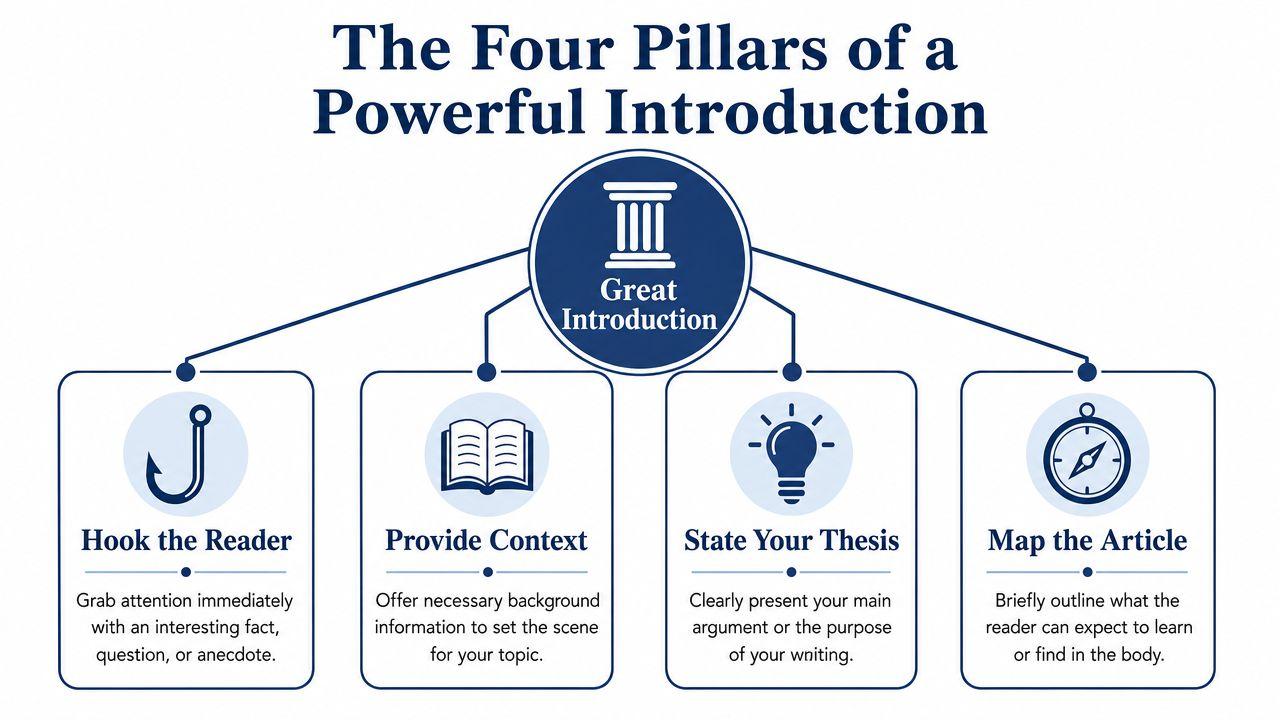
Most effective introductions do four jobs. They hook the reader, provide context, state the main point, and map what comes next. You don't need every part to be the same length, and you won't always use all four with equal weight, but you should know what each one is for.
Hook the Reader
A hook gives the reader a reason to keep going. That doesn't mean it has to be dramatic. It just needs to create interest.
Good hooks often do one of these things:
- Name a real tension. “Teams don't struggle because they lack ideas. They struggle because no one agrees on the next step.”
- Ask a focused question. “Why do so many capable writers freeze on the first paragraph?”
- Start with a short moment. “By the time she reached sentence three, she had already deleted sentence one twice.”
A weak hook is usually broad, empty, or disconnected from the topic. “Since the beginning of time, humans have communicated” sounds formal, but it doesn't help the reader.
Provide Context
Context orients the reader. It gives the minimum background needed to understand the topic and your angle.
For academic writing, context often works best as a broad-to-specific funnel. Academic guidance from Hanover recommends moving from the general topic to key terms, prior literature, the gap, and then the present study's aim or hypothesis in its research introduction guidance. That same idea works outside research too. Start wide enough to locate the topic, then narrow fast.
Try this contrast:
- Too little context: “Remote work has changed everything.”
- Better context: “As more teams rely on shared documents, chat, and asynchronous updates, small communication problems can turn into repeated project delays.”
The second version gives the reader a situation, not just a claim.
State Your Thesis
Your thesis is the sentence that tells the reader your main point, purpose, or claim. In a blog post, it may sound like a promise. In an essay, it may sound like an argument. In a report, it may sound like a finding or recommendation.
Examples:
- Essay thesis: “School uniforms should remain optional because they can improve consistency without solving the deeper causes of distraction or inequality.”
- Business purpose statement: “This report recommends a simpler approval process to reduce delays in weekly client handoffs.”
- Blog thesis: “The easiest way to write an introduction is to build it around purpose, not pressure.”
If the reader reaches the end of the first paragraph and still doesn't know your point, the introduction hasn't finished its job.
Map What Comes Next
A roadmap tells the reader what kind of support is coming. It doesn't need to sound mechanical. It just needs to create expectation.
For longer pieces, a sentence like this helps: “I'll compare three common opening styles, show where each works best, and give you a quick revision checklist.” For shorter writing, the map may be implied by the order of your sentences.
One extra piece matters here. Strong academic writing guidance often emphasizes the motive or “so what?” sentence. Brandeis highlights that introductions become more effective when they explain why the topic is interesting, nonobvious, or contestable in its guidance on introductory paragraphs. That idea belongs inside your thesis or roadmap.
A complete introduction doesn't just say what the topic is. It tells the reader why this topic deserves attention now.
A simple template you can adapt looks like this:
- Hook with a problem, question, or moment
- Context that narrows the situation
- Thesis that states your point
- Roadmap that previews the direction
If you draft those four parts separately, you'll usually get a stronger introduction than if you chase one perfect opening line.
Introduction Examples for Different Contexts
The same principles work across genres, but the tone and shape change. An academic essay usually needs a narrower, evidence-aware opening. A business report needs direct purpose. A blog post needs clarity and momentum. A professional email often skips the hook and gets to context fast.
Side-by-Side Examples
Here's how the structure adapts.
| Context | Primary Goal | Hook Style | Thesis/Purpose Statement |
| Academic essay | Present an arguable claim | Focused tension or question | A clear, debatable thesis |
| Business report | State purpose and recommendation | Direct problem statement | A concise recommendation or finding |
| Blog post | Keep readers engaged and oriented | Relatable problem or question | A practical promise to the reader |
| Professional email | Save time and set action | Immediate context | A direct request, update, or purpose |
Now look at the openings.
Academic Essay Example
Classroom participation is often treated as a simple measure of engagement, but speaking frequently and learning thoroughly aren't always the same thing. In many courses, participation grades reward speed and confidence more than preparation or reflection. Participation should be assessed more flexibly because rigid grading can disadvantage thoughtful students whose strengths appear in other forms.
Why it works: it starts broad, narrows to a specific tension, and ends with a clear claim. That broad-to-specific movement fits the academic funnel described earlier.
Business Report Example
“Recent project delays have created confusion across design, sales, and support. Review of internal workflows shows that handoffs often stall when approval ownership is unclear. This report recommends a simplified approval path and a shared update process to reduce missed deadlines.”
Why it works: no filler, no dramatic hook, no wasted setup. The reader knows the problem and the purpose immediately.
Blog Post Example
“You know the feeling. The topic is chosen, your notes are ready, and the first paragraph still won't cooperate. A strong introduction gets easier once you stop trying to impress the reader and start helping them orient quickly. This guide shows how to open with clarity, build context, and lead naturally into your main point.”
Why it works: it sounds human, identifies the reader's frustration, and promises a useful result.
Professional Email Example
“Hi team, I'm writing to confirm the revised timeline for the client presentation. Because feedback from legal came in later than expected, we need to shift the final review to Thursday. I've listed the updated deadlines below so everyone can prepare materials in time.”
Why it works: the purpose appears right away, and the reader knows what action or information follows.
Different formats need different levels of ceremony. An email rarely needs a dramatic hook. A blog post usually benefits from one.
When you want more writing models across formats, the examples and resources collected on the 1chat blog can help you compare tone and structure before drafting your own opening.
A useful question to ask is not “What's the best introduction?” but “What does this reader need in the first paragraph?” That shift makes your writing more adaptable.
Common Introduction Mistakes and How to Fix Them
Most weak introductions don't fail because the writer lacks intelligence. They fail because the writer is following habits that sound “writerly” but don't help the reader.
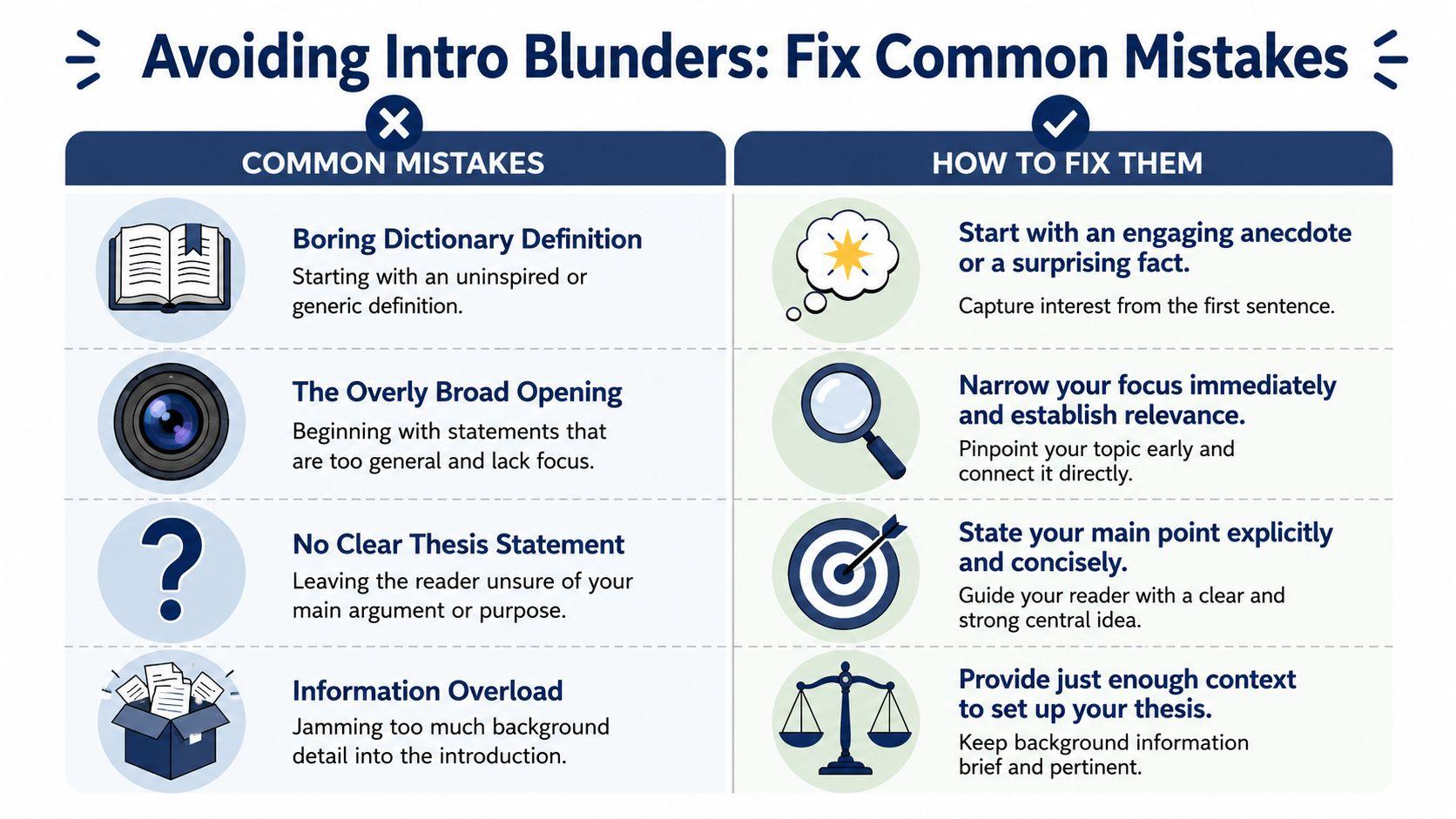
Mistake One: The Dictionary Definition Opening
Before: “Success is defined as the accomplishment of a goal.”
This feels safe, but it rarely creates interest. It also delays your real point.
After: “The desire for success is common, yet its definition is frequently adopted from others.”
This revision starts with tension. If you want help seeing how a tiny story can do this job better than a flat definition, this guide to using anecdote in a sentence is a practical reference.
Mistake Two: The Overly Broad Opening
Before: “Technology has changed the world in many ways.”
The problem isn't that it's false. The problem is that it could introduce almost anything.
After: “As teachers rely more on digital assignments, they have to decide whether convenience is worth the loss of handwritten feedback.”
The fix is to narrow the lens early.
Mistake Three: No Clear Main Point
Before: “There are many sides to the issue of school lunches.”
The reader still doesn't know what you think or what the paper will do.
After: “Schools should offer free lunch to all students because universal access reduces stigma and makes support easier to deliver.”
Even if your piece is exploratory, the reader needs a clear purpose sentence.
Mistake Four: Information Overload
Many writers dump too much background into the opening because they're afraid the reader won't understand. Usually, that creates the opposite problem. The reader gets buried before reaching the point.
Grammarly advises one to three sentences of context, with introductions generally three to six sentences total, but also notes that the right amount depends on audience and genre in its introduction writing guide.
Use that as a working rule, not a law.
- If your reader already knows the basics, cut background fast.
- If your topic uses unfamiliar terms, define only what the thesis needs.
- If the explanation takes a full paragraph, move part of it into the body.
For quick writing help, some people also draft a rough opening with an AI tool and then revise it for specificity. If you do that, treat the output like clay, not a finished answer. Tools such as 1chat's FAQ and feature overview describe ways people use AI chat to generate paragraph drafts, but the final introduction still needs your judgment.
Cut any sentence that doesn't help the reader reach your main point faster.
A Quick Checklist for Revising Your Introduction
Most introductions improve more in revision than in first draft. That's normal. Once you know what your full piece says, you can shape the opening to match it.
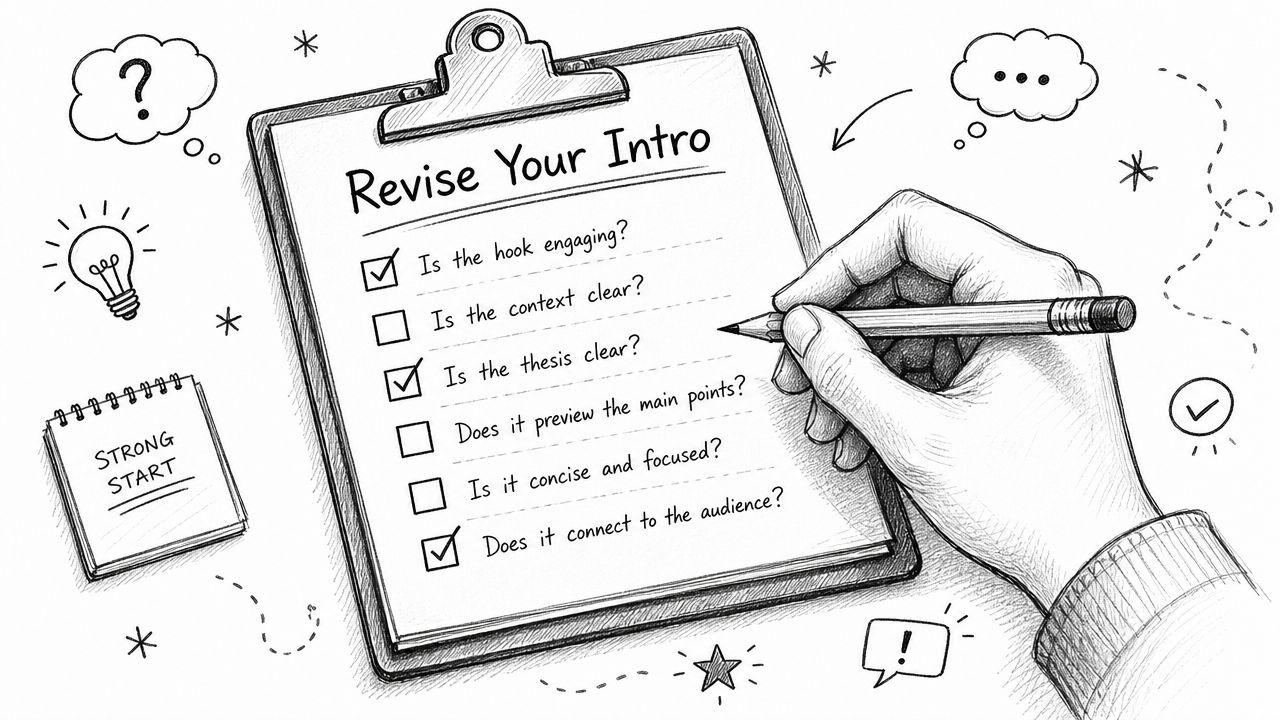
Use this checklist before you submit or publish:
- Does the first sentence earn the second? If the opening is vague, generic, or stale, rewrite it.
- Can the reader identify the topic quickly? Don't make them guess what the piece is about.
- Is the main point clear in the first paragraph? If not, strengthen the thesis or purpose statement.
- Have you included only the background the reader needs right now? Save extra explanation for later.
- Does the introduction show why the topic matters? Add a “so what?” line if the stakes feel thin.
- Does the tone fit the context? A report, blog post, and email should not sound identical.
- Does the body deliver what the introduction promises? If not, revise one or the other.
A fast test helps too. Read only your introduction and ask, “Would I trust this writer to guide me?” If the answer is no, the problem is usually one of clarity, not style.
Get Started Now with These Introduction Prompts
A strong introduction reduces uncertainty for the reader. That fits the way Cambridge describes how as asking about way, method, state, and degree in the Cambridge English Dictionary entry for “how”. Good openings do that same work. They quickly tell the reader how to understand what follows.
If you're stuck, don't wait for inspiration. Start with a fill-in-the-blank prompt and revise from there. If you want broader article craft help after this step, this guide on how to write high-quality articles is a useful companion.
Try one of these:
- For a persuasive essay
“Many people assume that [common view], but a closer look at [topic] shows that [your thesis].” - For an academic paper
“[Broad topic] has received growing attention because [brief context]. Yet [gap or tension]. This paper argues that [main claim].” - For a business report
“[Problem] has affected [team, process, or outcome]. This report examines [focus] and recommends [solution or action].” - For a blog post
“If you've ever struggled to [reader problem], the issue may not be [common assumption]. It's often [main insight].” - For a professional email
“I'm writing to [purpose]. Because [brief context], we need to [action or decision].” - For a reflective or personal piece
“I used to think [old belief]. Then [turning point]. That experience changed how I understood [topic].”
You don't need a perfect opening. You need a useful one. Draft the hook, add the minimum context, state the point, and show the path forward. Then revise for sharpness.
If you keep a writing toolkit, it can help to save prompt libraries and drafting resources in one place, including references like the 1chat sitemap of writing-related pages for future use.
The fastest way to get better at introductions is to write several, not worship one. Pick a prompt above, draft a first paragraph in five minutes, and improve it after the body is done. That's how strong openings are built.