It's 4:40 p.m. The homepage line is still a placeholder, three customer emails sit half-written, and a social post has to go out before you close the laptop. A chatbot can fill every blank in under a minute. That speed is real, and it is also the easiest way to ship a message you wouldn't say out loud to a customer.
AI for copywriting works best as a drafting partner, not a stand-in for the person who knows the offer. Think of it the way you'd use a fast junior on a deadline. They can gather notes, sketch angles, and rough a paragraph. You still decide what is true, what sounds like the brand, and what is allowed to leave the building.
This guide is for a small-business owner, a lean team, a parent helping with a family project, or a student who wants help without handing over the argument. You'll see when polished prose fails commercially, how much authorship to keep, and how to pick a workspace that doesn't treat private text as casual chat fodder. Nothing here promises undetectable or fully automatic copy.
Why AI for Copywriting Feels Faster Than It Is
A shop owner has a homepage line to write, three customer emails to finish, and a social post due before closing. A model can produce a draft for each in moments. The first version arrives quickly; deciding whether the wording is accurate, useful, and consistent takes longer.
That gap is the true measure of speed. AI can shorten the time spent starting and sorting ideas, while review remains part of the work. A polished sentence is like a neatly wrapped parcel: the finish tells you nothing about whether the contents are right.
A 2026 survey of 573 copywriters reports that 74% used AI in their work, compared with 59% in 2024. The survey also reports use for research and information gathering (61%), idea generation (52%), outlines (39%), and first drafts (28%). 28% said AI-generated content appeared in final drafts delivered to clients.
What the survey is really saying
These figures suggest that AI is more common in preparation than in client-ready copy. That distinction matters: generating options can save time, but a person still has to decide which claims are accurate and which words belong to the brand.
Fluent prose can still target the wrong buyer, invent a benefit, or sound like every other business in the category.
For a shop owner, the practical test might be three descriptions of a weekend class: one for the website, one for a social caption, and one for a parent who is new to the business. Review each against the actual price, date, and experience. A joke that reads well on screen may still feel wrong for the instructor.
The same check applies in a family or classroom. A student can receive a tidy paragraph before working out what they think. A parent helping with wording can unintentionally replace a child's voice. Human authorship should stay visible: AI may help organize or clarify a student's ideas, while the student supplies the reasoning and final choices.
For a small team, consistency is another practical measure. If several people ask separate chats for copy about the same offer, they may end up making slightly different promises. Shared facts and human review help keep those messages aligned.
The useful question is not whether AI sounds polished. It is whether it reduces drafting time without increasing correction time or weakening the message. Use it to get past the blank page, then keep a person responsible for the claims, voice, and final copy.
What AI for Copywriting Actually Does
A model drafts, rewrites, summarizes, and adapts language from the instructions and source material you give it. It does not sit in on your sales calls, and it does not know which customer complaint costs you money. Treat it as a fast junior who has read a huge library and has never stood in your buyer's kitchen.
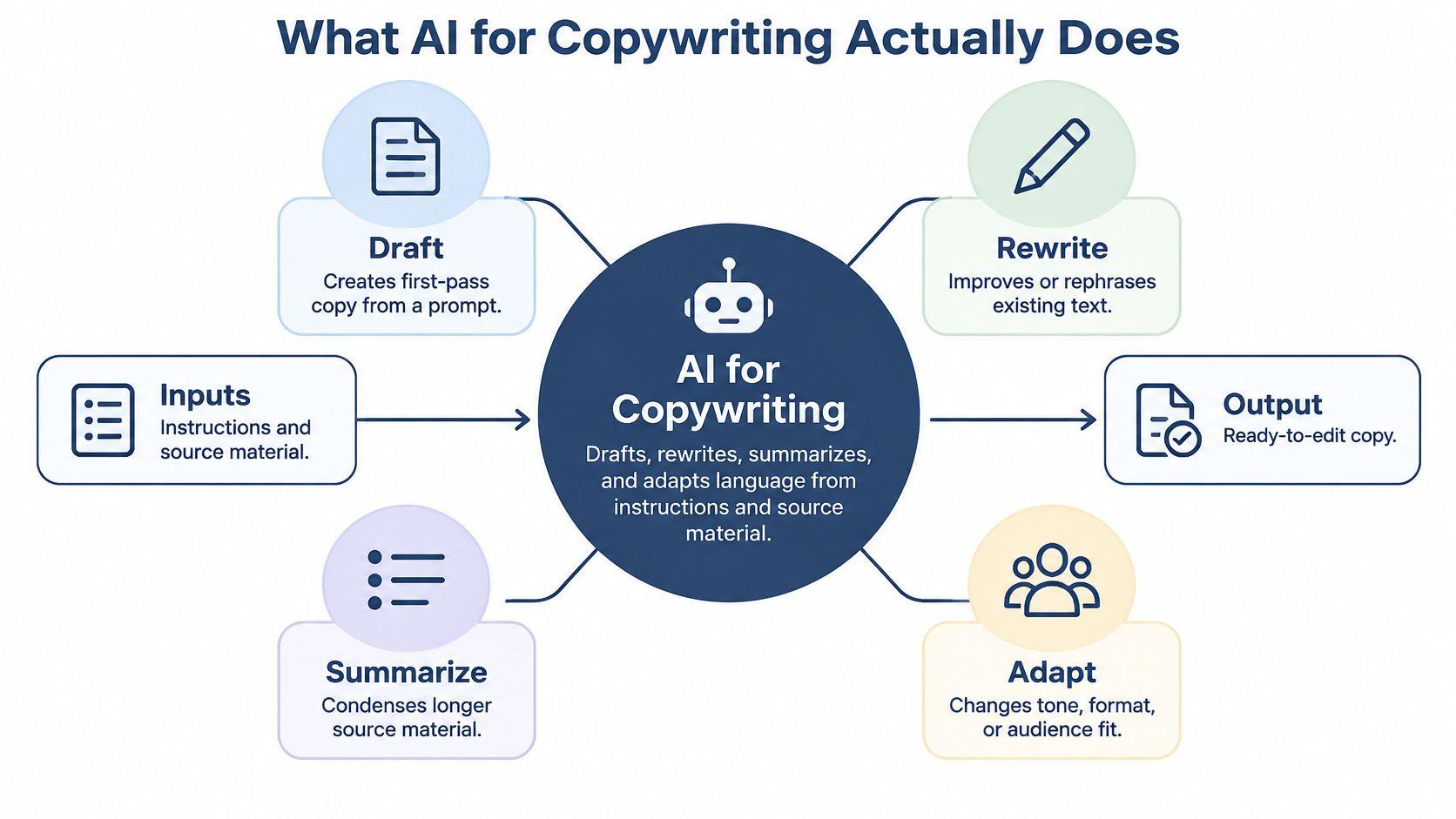
Four jobs, one transformation system
Draft means a first pass from a prompt. You might ask for a homepage sentence from a short product note. The sentence is a starting block, not a strategy.
Rewrite means a new shape for text you already have. You paste a stiff paragraph and ask for plainer words, or you ask for the same offer in half the length.
Summarize means compression. A long FAQ, a call transcript, or a product sheet becomes a few lines you can use in an email. You still have to check that the short version didn't drop a limit or a price.
Adapt means a change of tone, format, or audience. The same class offer can become a text to past students and a caption for people who have never heard of you. Adaptation includes transcreation, which is more than swapping words into another language. Tone and cultural meaning have to travel too.
That last job is why smaller teams started paying attention. IBM's Institute for Business Value reported in December 2023 that three out of four chief marketing officers expected their organizations to use generative AI for content creation by 2025, and 51% expected to use it for content transcreation. Those figures came from 110 U.S. CMOs surveyed in September and October 2023, plus 300 U.S. executives surveyed in May 2023. For a company that can't hire a separate writer, editor, and localization specialist, one workflow suddenly covered jobs that used to be three invoices.
What stays with you
The model transforms language. It does not choose your position in the market. These calls stay human:
- Positioning: which difference you lead with, and which you refuse to mention.
- Factual review: prices, dates, ingredients, guarantees, and anything a regulator or a refund desk would question.
- Brand voice: the words you always use, and the ones that would sound fake in your mouth.
- Cultural fit: whether a joke, a metaphor, or a translated line lands for that audience.
If you need a place to practice landing-page variants before you judge them, guides that find landing page copy generators are a useful next read. Use them to see how a prompt turns into a block of text. Then bring the block back to the four human jobs above. The tool can change the words. It can't decide whether the offer is honest.
Where AI Copy Helps and Where It Falls Short
Smooth copy is not the same thing as copy that earns its cost. A sentence can sound finished and still lose to a plainer line that names a real reason to buy.
A 2025 advertising study compared AI-generated and human-written ads and found that human copy outperformed AI in 9 of 12 cost-effectiveness tests and 5 of 12 click-through-rate tests. AI stayed competitive in the other scenarios. That is a mixed record, not a verdict that machines can't write ads, and not a reason to hand them the campaign.
A small-business split of labor
Use the model where volume and structure do the heavy lifting. Keep a person where judgment changes what the business is willing to promise.
| Copy task | Default owner | Decide with |
| Variant generation (email subject, caption, headline options) | AI draft, human pick | Editing time, then qualified conversions on the live send |
| Localization or audience adaptation | AI first pass, human cultural check | Whether the adapted line still matches the offer, plus reply quality |
| Offer claims (price, guarantee, results) | Human | Refund rate, complaints, and whether every claim has a proof point |
| Brand storytelling | Human, with AI only for alternates | Brand-fit review and whether a stranger could tell you from a competitor |
Pleasant prose is a weak referee. A fair test holds the offer, the audience slice, and the spend or send rules steady, then reads the metric you chose before anyone admired the draft. Word count and "it sounds human" don't belong on that list. Qualified conversion rate, cost per acquisition, refund rate, brand-lift signals, and editing time do.
Why the winner changes
Results move with the product and with how well the audience already knows you. A familiar buyer may respond to a short, specific reminder that a model can vary all afternoon. A cold buyer looking at a high-trust purchase, a health claim, or a story only your founder can tell, is a worse place to let generated copy lead.
The commercial question isn't whether the paragraph sounds polished. It's whether a small team cut workload without sanding off the thing that makes the offer distinct. Hybrid use fits that question. Full autopublish doesn't.
A Practical Workflow and Prompt Pattern
Run one job in two stages. First the model makes options, summaries, or tone shifts. Then a person, or a short checklist, is the gate. Nothing goes to a customer, a teacher, or a family group chat until that gate is done.
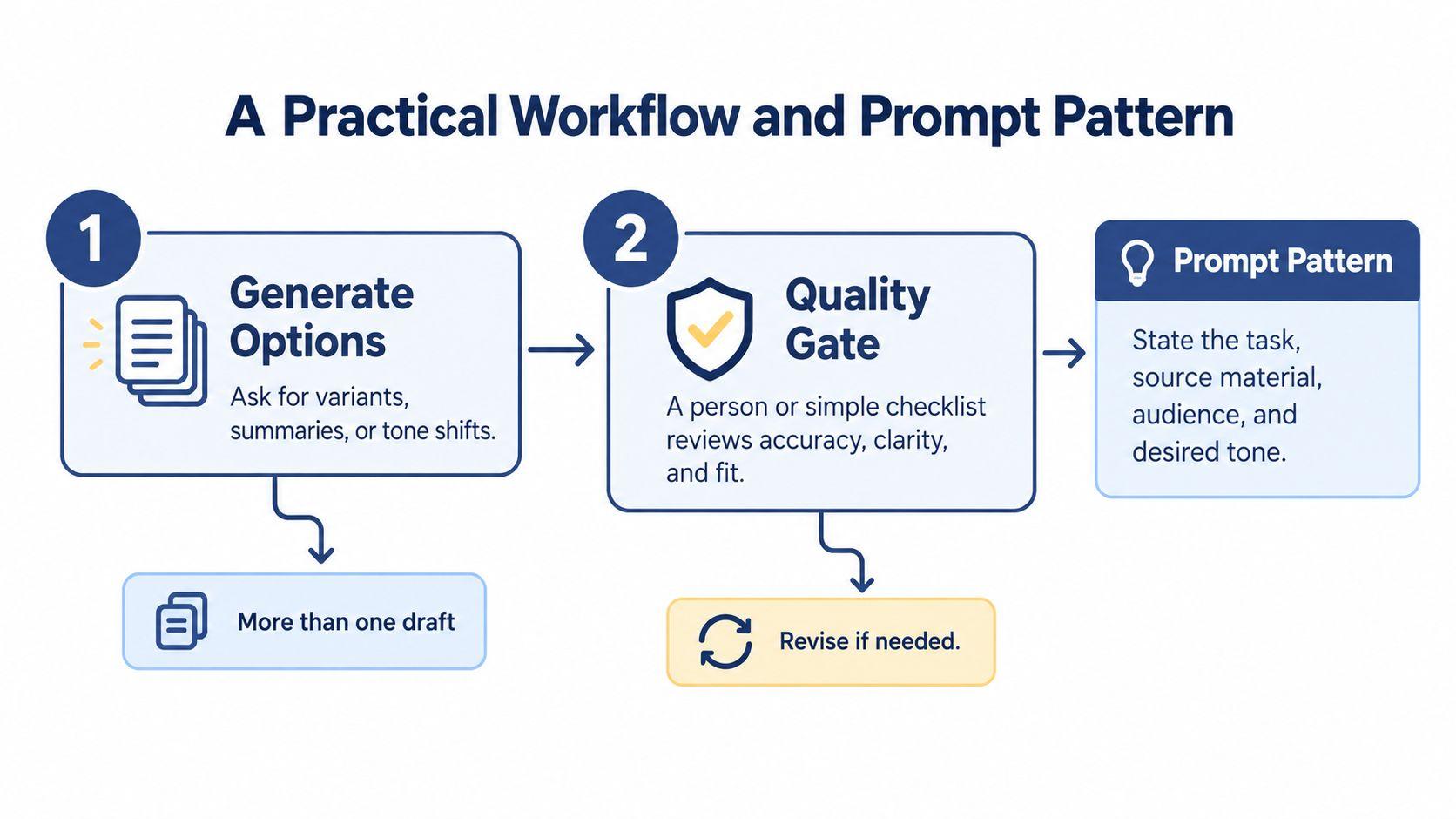
An analysis of AI and human business refusal emails found AI outputs more formulaic and less nuanced than human texts. Human assessors identified authorship with 68.1% accuracy, so a professional surface doesn't hide every stylistic tell. On a rubric of clarity, credibility, and connection, there was no statistically significant quality difference between Gemini-generated and human-written texts, while ChatGPT-generated texts scored lower. Constraints won't erase that gap. They do give the model fewer ways to drift into generic courtesy.
Gather the brief before you prompt
Write these down in your own words first: audience, offer, proof you can show, claims you must not make, reading level, brand words to keep or avoid, and the single action you want.
A prompt you can reuse
Fill the brackets. Don't add a second task in the same ask.
- State the job in one line, such as three email openers, not "write my marketing."
- Paste only the source notes the model is allowed to use.
- Name the reader, the tone, and the action.
- Ask for more than one option so you can choose, not accept the first block.
- Stop. The next move is review, not another prompt that "makes it perfect."
Sample, filled in: "Write three versions of a 60-word email to parents who already booked a Saturday pottery class. Source: class is 90 minutes, $40, includes clay, no experience needed, spots left for May 11 only. Tone: warm and plain, no hype words. Do not mention discounts or skill gains. End each version with one line asking them to reply YES if they are still coming. Label the versions A, B, and C."
The quality gate
Read each option for five things only. Specificity: does it name the actual offer? Audience fit: would this person recognize themselves? Evidence: is every claim in your notes? Differentiation: could a competitor paste their name on it unchanged? Earned emotion: does the feeling come from the situation, or from stock warmth?
If it fails, revise the constraint and ask again, or rewrite the weak line yourself. Stop when a version is ready for review by you, not when it merely sounds smooth. If you're unsure which kinds of help still leave you as the author, the assisted-writing questions page is a plain place to check the boundary before you send anything.
Copywriting Use Cases for Teams and Students
The same two-stage habit looks different depending on who is accountable for the words.
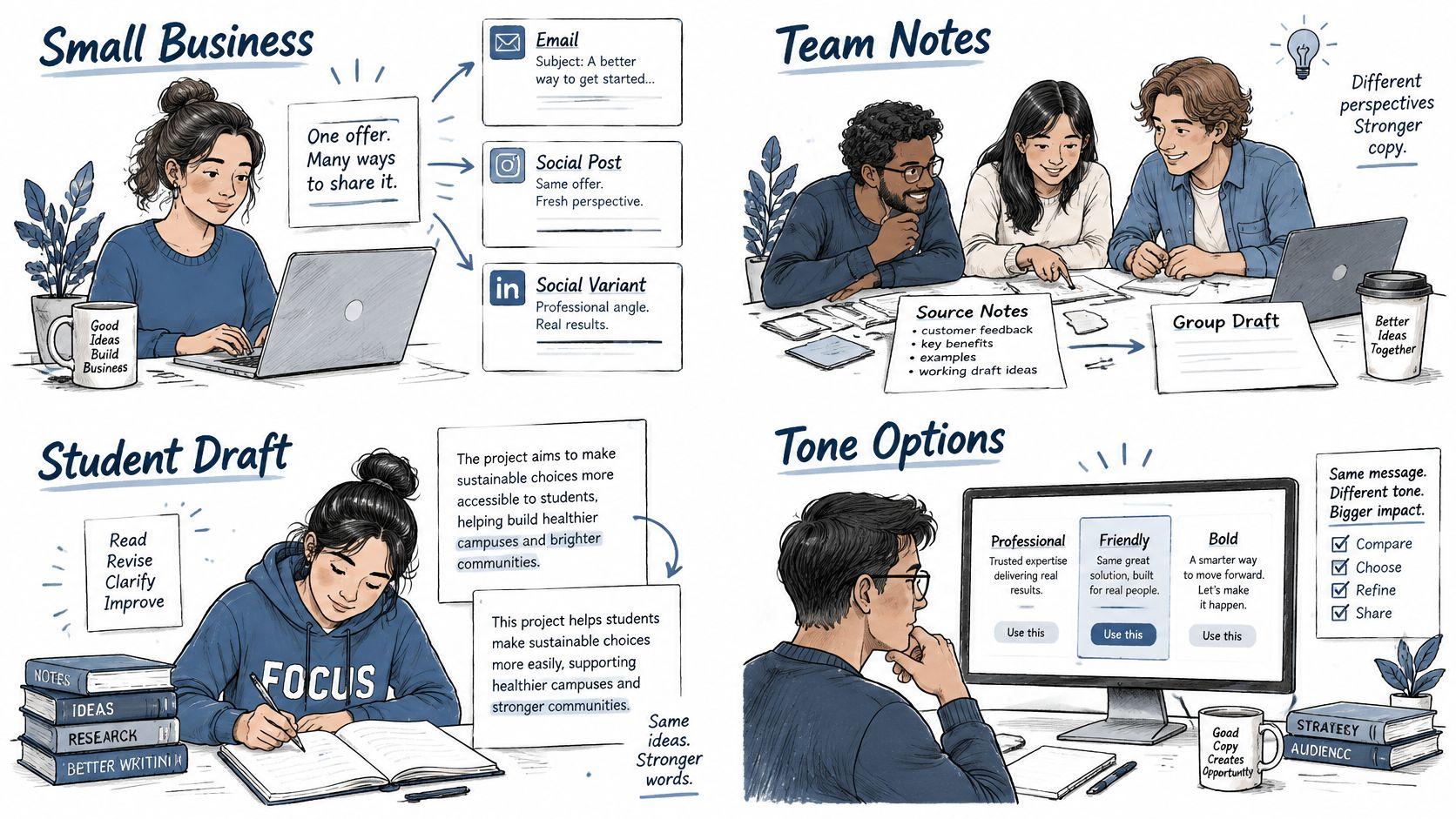
A shop owner with one offer. Maya sells a Saturday class. She pastes the price, the date, and one proof point, then asks for an email and two captions. She keeps the line about "no experience needed" because she wrote it after a nervous first-timer asked. The model may rearrange it. She does not let it add a promise that people "leave as artists."
A team that shares one brief. Two coworkers keep pasting different versions of the return policy into separate chats. They stop. One shared note holds the policy, the banned phrases, and the last approved paragraph. Variants come from that note. Nobody publishes a sentence the note doesn't support. That is assistance. Substituting a fresh model answer for the shared source is how teams drift.
A parent and a school project. A father wants a cleaner opening for a science-fair board his daughter is presenting. He asks for three simpler ways to say a sentence she already wrote. She picks one and changes it again in her own words. He does not ask the model to invent her conclusion. The voice on the board has to survive a question from a judge who is looking at her, not at the chat.
A student and an essay. Brainstorming topics, building an outline, and proofreading a draft you wrote can leave you as the author. Translation or a rewrite of your own paragraph can too, if you can explain every claim afterward. Full generation of the argument cannot. If you can't point to the note that produced a sentence, it isn't yours yet.
Help, labels, and bad referees
Disclosure isn't a slogan. A teacher, a client, or a family member may need to know what was assisted. A private brainstorm often doesn't. Labels change judgment even when the sentences don't. Research on writing and detection found that labeling affects how people judge persuasive AI writing. The same body of work reported that ChatGPT made creative writing feel less effortful and less intellectually demanding, while reducing enjoyment and the perceived value of creativity and writing skills. Easier isn't the same as more yours.
Detectors are a poor referee. In that 2025 test, only about 30.8% of human-written essays were correctly identified as human, which implies a 68.8% false-positive rate. Keep your source notes and your revision history instead. They show what you decided. For teams who also care how drafts get reused on a site, a practical roundup of AI tools for SEO content is worth a look after the authorship rule is clear. If you want one place to try more than one model against the same brief, start from a shared writing workspace rather than a fresh public chat for every teammate.
How to Choose a Privacy-First Writing Tool
The buying choice isn't "which bot writes prettier sentences." It's where the text goes, who else can open the draft, and whether the tool matches your work.
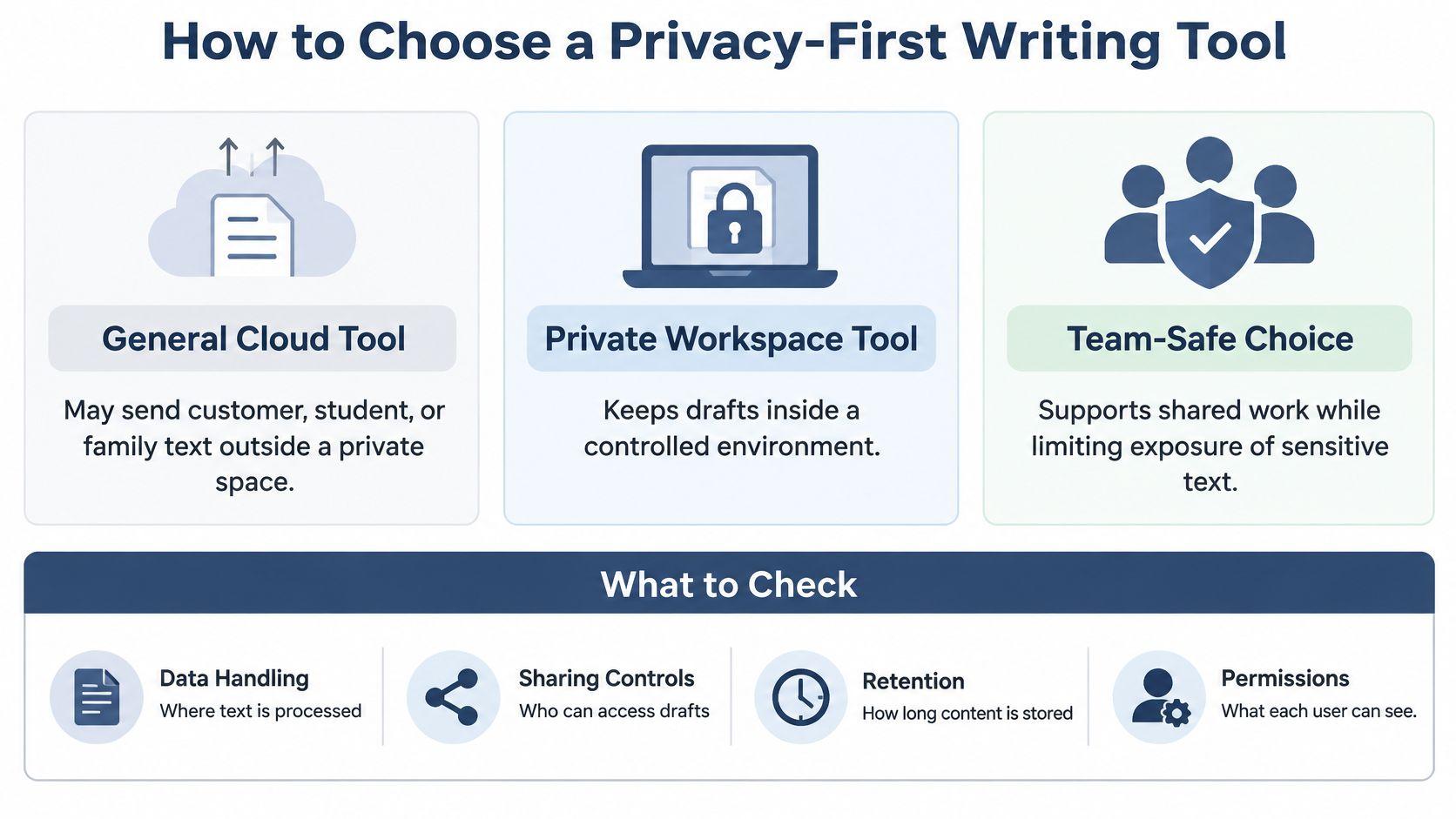
Three checks before you paste
Whose words are these? Customer complaints, student essays, and family details don't belong in a general public chatbot you opened because it was the first tab. A private workspace is the better default when the text isn't yours alone to share.
Do you need more than one model? A small team often wants to compare a plain version and a warmer one without rebuilding the brief in four products. A single place that reaches several strong models saves that copying.
What files show up on a real Tuesday? If the source is a PDF menu, a scanned permission slip, or a product photo, a chat box that only accepts pasted text will push people back to informal workarounds.
A concrete fit, not a trophy
1chat is one option built for that mix. It is a family-friendly, privacy-first alternative to ChatGPT aimed at small businesses and teams. People can chat with leading language models in one place, analyze PDF documents, generate AI images, and ask questions. That covers a shop turning a product sheet into email options, and a household that doesn't want a child's project living in a random thread. It is not a reason to skip the quality gate. Read how drafts are handled before you upload anything you wouldn't pin to a bulletin board.
A generic public chatbot can still be fine for a throwaway headline about a public event. It is a weak habit for client copy or homework when nobody shares a review step. The failure mode is casual. Someone pastes a full customer email "just to make it nicer," and the niceness is now outside your shop.
Before you commit, read the vendor's own policy the way you'd read a lease. ProdSnap's privacy policy is a useful example of the document to open. Look for where text is processed, who on a team can see a draft, how long content is kept, and what each person is allowed to open. Match the tool to the audience and to how sensitive the page is. Pretty output is the last question, not the first.
Measuring Results and Your Next Step
A fair test starts before anyone falls in love with a draft. Pick one live asset. Use the same offer, the same kind of reader, and the same send rule or the same small budget. Choose the metric first. Then write the variants.
Separate the writing score from the business score. Editing time and a quick brand-fit read tell you whether the message is usable. Qualified conversions, what it cost to acquire a buyer, refunds, and a simple "does this still sound like us" check tell you whether it worked. As the ad comparison showed, a fluent version can lose on cost even when another version wins a click. Don't let a nice read override the number you named in advance.
One week, one asset
- Choose a single live piece, such as one email or one homepage line, not the whole site.
- Write the constraint brief in your own notes, including proof and banned claims.
- Generate two or three variants inside a workspace you already trust with that text.
- Run the gate. Specific, true, distinct, and something you would say.
- Publish only the version a person will stand behind. Archive the losers with the metric, so the next test doesn't restart from taste.
For a student or a family, skip the campaign math and write a responsibility rule on a sticky note. What help is allowed (ideas, an outline, a proofread). What must stay in the writer's own words (the claim, the story, the conclusion). What gets disclosed, and to whom. Keep the notes. If a detector, a teacher, or a relative asks what happened, the history answers better than a vibe.
The hybrid habit is small on purpose. You didn't hire a replacement writer. You shortened the blank page, and you kept the signature.
This week, take one real paragraph you still have to send, write the constraints before you open a chat, and publish only the version you can defend without the model in the room. If the text includes a customer, a student, or a child, do that work in a private shared workspace and read its privacy terms before you paste.