A lot of students still get told, “APA doesn't use footnotes.” That advice is too broad, and in APA 7th edition, it's wrong.
APA does use footnotes. It just uses them in a narrow way. If you're searching for an APA footnotes example because your professor mentioned one, you're not breaking the rules by asking. You're trying to follow the current rules correctly.
The confusion usually happens because APA moved standard source citation into parenthetical in-text citations, so many handouts shortened that idea into “no footnotes.” The exact rule is more precise: footnotes still exist, but only for specific situations.
Debunking the Myth APA Does Use Footnotes
The myth is widespread enough that it trips up careful students. A 2025 survey found that 65% of college students still believe footnotes are forbidden in APA, and 4 out of 10 top search results reinforce that mistake by explicitly saying APA does not use footnotes, according to the NCEES APA misconceptions survey.
That's why so many students end up confused when they see an instructor ask for a copyright note, or when Word inserts a footnote automatically and they wonder whether they should delete it.
What the myth gets wrong
The outdated version of the advice confuses two different ideas:
- APA does not use footnotes for regular source citation
- APA does allow footnotes for limited special purposes
Those are not the same thing.
If you're comparing styles and trying to keep them straight, a broader academic writing styles guide can help you see where APA differs from Chicago and MLA. That comparison matters because students often borrow note habits from another style without realizing it.
APA 7 didn't erase footnotes. It restricted them.
What you should remember under deadline pressure
If you only remember one sentence, make it this one: In APA 7, regular citations go in the text, not in footnotes. Footnotes are reserved for content notes and copyright notes.
That small distinction fixes most student mistakes.
The Two Official Uses for Footnotes in APA Style
APA 7th edition limits footnotes to exactly two purposes: content notes and copyright attribution, as stated in the APA 7 footnote rules summary.
Think of these as two very different jobs.
Content footnotes
A content footnote is a short side note. It adds helpful information that would interrupt the main paragraph if you forced it into the sentence.
Good uses include:
- Clarifying a point when the explanation is useful but not central
- Adding a brief limitation that matters but would clutter the flow
- Pointing readers to related material in a compact way
A content footnote is not a place to hide a whole extra argument. It should stay brief and focused on one idea.
Copyright footnotes
A copyright footnote is different. It isn't just a helpful aside. It's a formal acknowledgment used when you reproduce or adapt material that requires permission.
That often applies when you use:
- A figure or table from another source
- A long quotation
- Test items or other protected material
- Adapted visual material
This type of footnote exists to show that you had permission and that you're giving the required credit.
Practical rule: If the note explains your thinking, it's probably a content footnote. If the note acknowledges reused material and permission, it's probably a copyright footnote.
The easiest way to tell them apart
Here's the quick distinction:
| Footnote type | Main purpose | Typical tone |
| Content footnote | Extra explanation | Brief and informative |
| Copyright footnote | Permission and attribution | Formal and specific |
Students often blur these together. That's where errors happen. A content note should not look like a miniature reference entry. A copyright note should not sound casual or incomplete.
How to Format APA Footnotes Correctly
Formatting is where otherwise good papers lose points. If you use a footnote, it has to look like an APA footnote, not just any footnote.
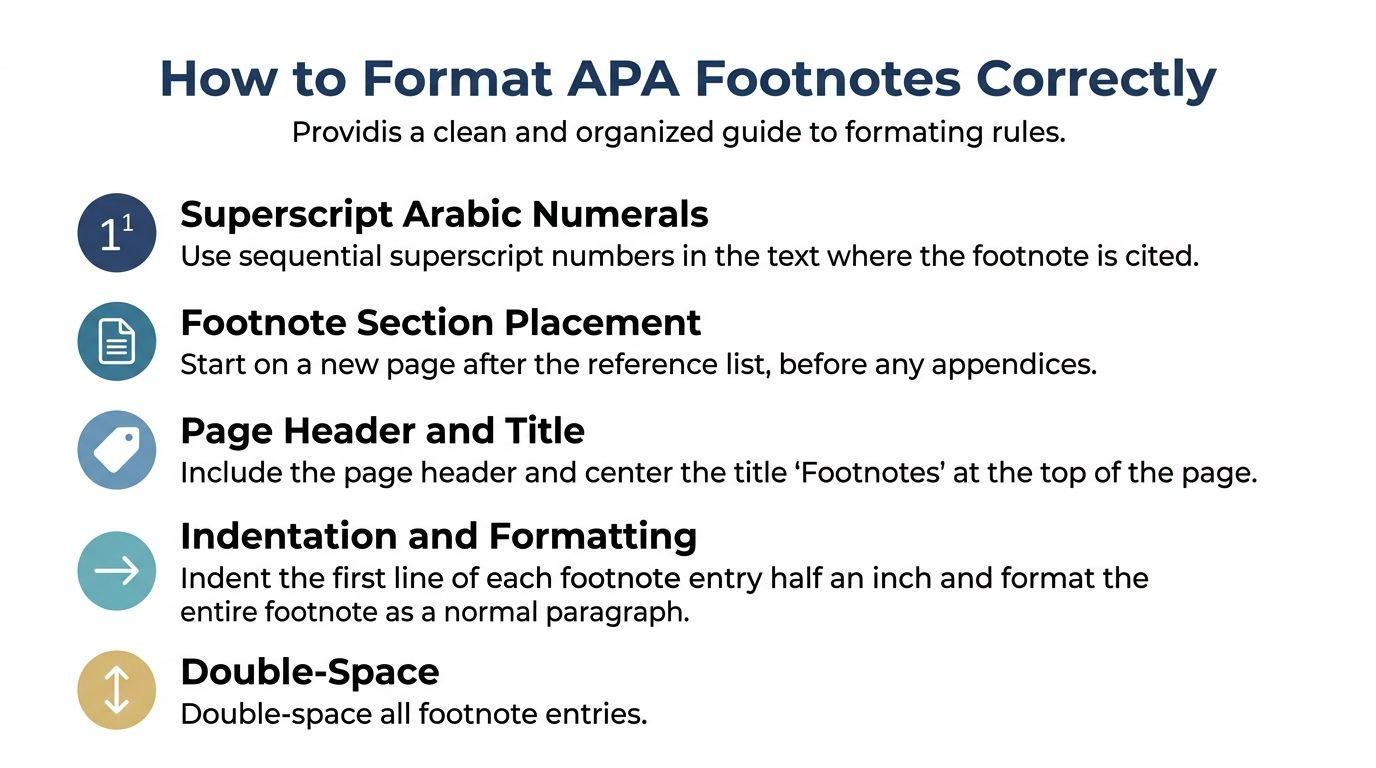
According to the APA footnote formatting syntax guidance, superscript Arabic numerals must appear immediately after the punctuation mark of a sentence or clause, except with a dash, where the callout comes before the dash. If footnotes are placed on a separate page, that page must be titled Footnotes in bold and centered, and each note must be indented ½ inch and double-spaced.
Where the number goes
This is one of the easiest mistakes to fix.
Correct pattern:
- The sentence ends first.^1
Not this:
- The sentence ends^1 first.
The superscript usually comes after the period, comma, or other punctuation. The dash exception is unusual, so if you're rushed, check those cases carefully.
What the footnote page should look like
If your instructor or document setup uses a separate footnotes page, remember these details:
- Title: Use Footnotes in bold, centered
- Spacing: Double-space the entries
- Indentation: Indent each footnote ½ inch
- Numbering: Use consecutive superscript numbers
If your software places notes at the bottom of the page, keep the numbering and wording accurate there too.
When not to use a footnote
Many students use a footnote when they really need one of these instead:
- A regular in-text citation for a source you're discussing
- A revised sentence that says the extra point in the paragraph
- A parenthetical clarification if the detail is very short
If you're still sorting out when APA wants a parenthetical citation versus another formatting move, this overview of APA format guidelines can help you check the broader system.
If the note only gives source credit for an ordinary claim, it probably shouldn't be a footnote in APA.
Annotated APA Footnote Examples Content and Copyright
Students usually understand the rule once they can see both footnote types side by side.
Example of a content footnote
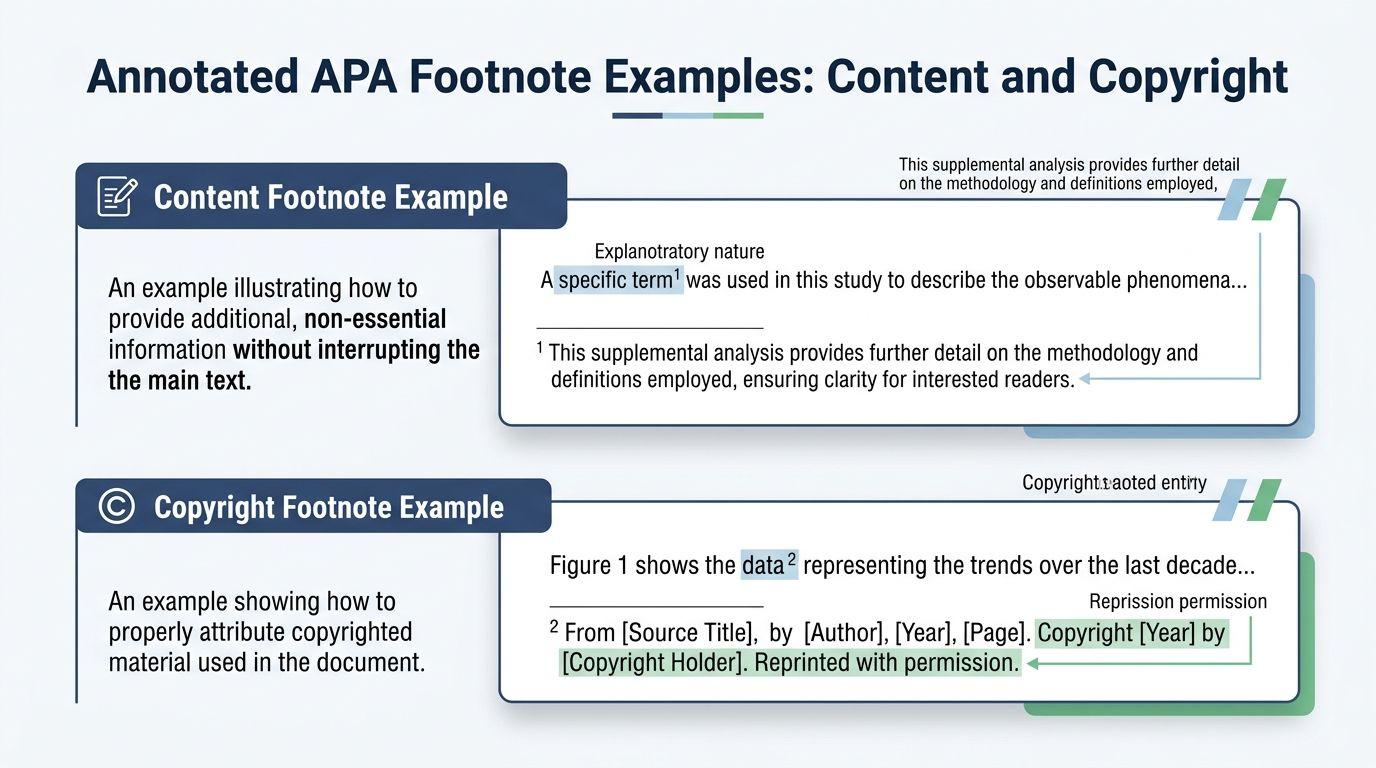
Here's a simple content footnote example in APA style:
In-text sentence:
The pilot program used a narrower definition of student engagement than the one used in most campus reports.^1
Footnote:
^1 This definition counted only discussion participation and submitted reflections, not attendance or online viewing time.
Why this works:
- The main sentence still makes sense without the note
- The note gives extra explanation, not source citation
- The note is short and focused on one point
This is what many students need when they want to add a useful clarification but don't want to overload the paragraph.
Example of a copyright footnote
Now compare that to a copyright footnote.
In-text sentence:
Figure 1 presents the survey layout used in the original publication.^2
Footnote:
^2 From Title of Article, by A. Author and B. Author, year, Title of Journal, Volume, p. XX. Copyright [year] by Name of Copyright Holder. Reprinted with permission.
This pattern follows the required elements described in the APA copyright footnote requirements.
What each part is doing
A copyright footnote has a job that a content note does not. It needs to identify the source and state the permission status clearly.
Use this checklist:
- From or adapted from: Signals whether you copied or modified the material
- Title and authors: Identifies the original work
- Year, journal, volume, page: Supplies bibliographic detail
- Copyright line: Names the copyright holder
- Reprinted with permission / adapted with permission: States permission explicitly
One more detail matters here. Any source cited within a footnote must also appear in your main References list, as noted in the same guidance above.
A copyright footnote should read like formal documentation, not like a casual note to the reader.
The fastest comparison
| Feature | Content footnote | Copyright footnote |
| Purpose | Add explanation | Acknowledge reused material |
| Length | Usually very short | More detailed |
| Tone | Reader-focused | Formal and legal |
| Reference list entry needed | If a source is cited, yes | Yes |
If you were searching for an APA footnotes example because every guide looked vague, this is the distinction you needed.
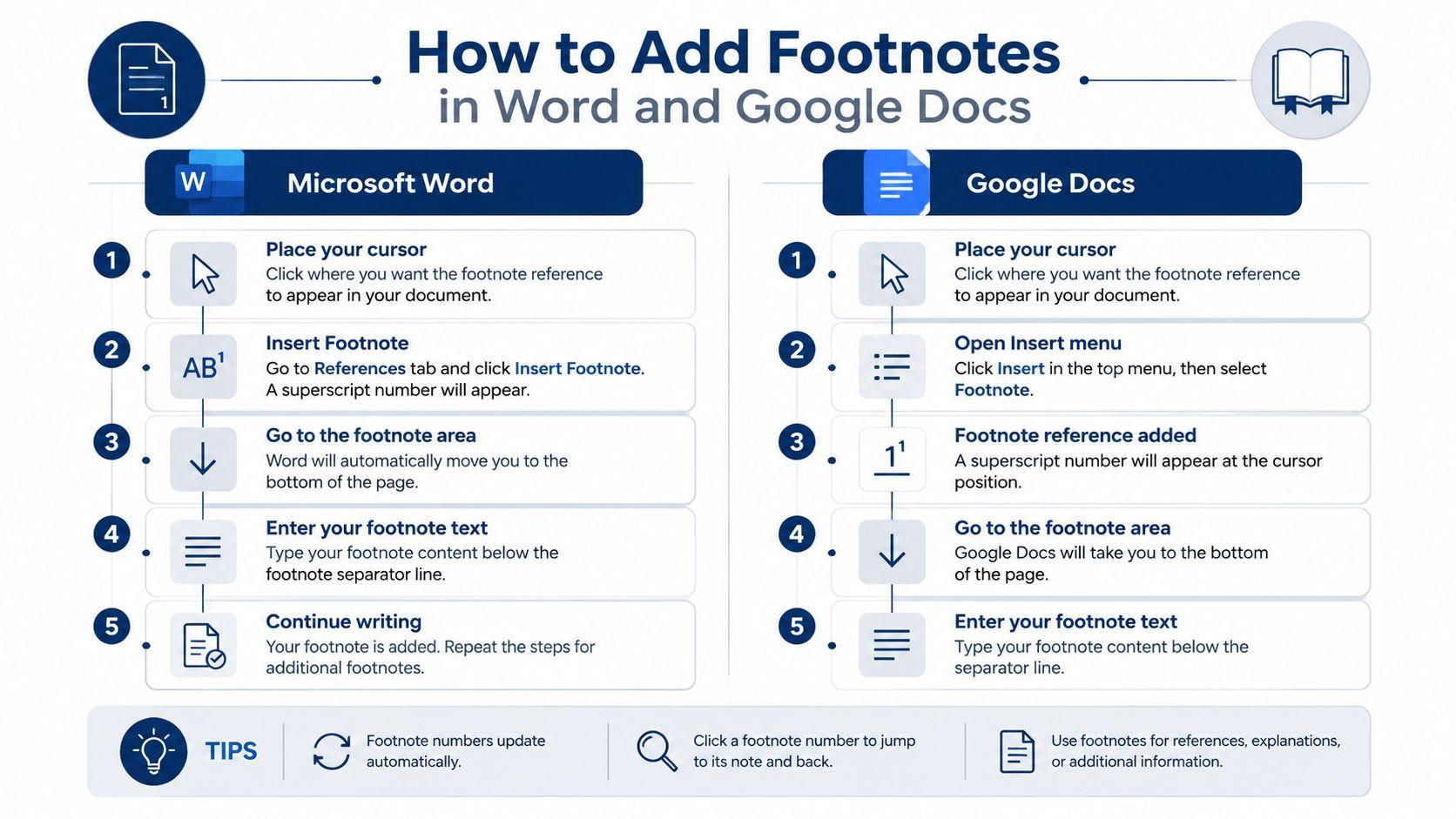
How to Add Footnotes in Word and Google Docs
Once you know the rule, the software part is easy. Both Microsoft Word and Google Docs can insert footnotes automatically.
The shift in APA 7th edition was part of a broader readability goal. Historical APA data says the 7th edition, published in October 2019, was the first major revision to footnote usage since the 5th edition in 1996, and APA estimated that prioritizing in-text citations improves comprehension speeds by 22% for non-native English speakers, according to the APA readability study summary.
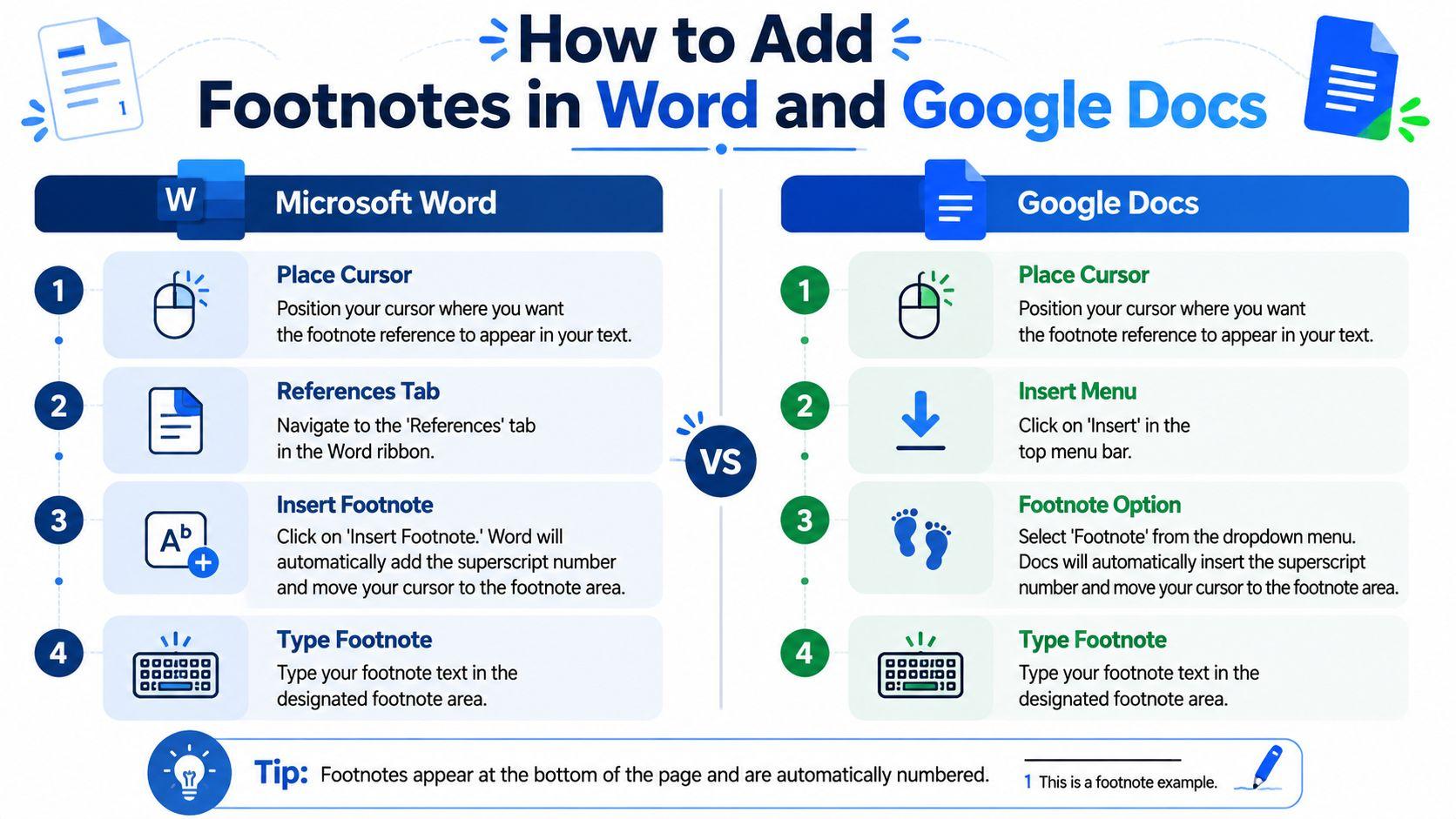
In Microsoft Word
- Put your cursor where the footnote number should appear.
- Open the References tab.
- Click Insert Footnote.
- Word will add the superscript number and move your cursor to the footnote area.
- Type the note text.
- Go back and check that the note matches APA wording and purpose.
In Google Docs
- Put your cursor where the note belongs.
- Click Insert in the top menu.
- Choose Footnote.
- Google Docs will insert the superscript number automatically.
- Type your note at the bottom of the page.
- Review the final formatting before submission.
One small workflow tip
If you draft in Word and later move the file into another format for publishing or sharing, a conversion guide like this Markdown Converters' solution for DOCX can help prevent formatting surprises. If you want more general writing and study support tools, you can also browse the 1chat blog resources.
Common Mistakes to Avoid with APA Footnotes
Most APA footnote problems fall into a small set of repeat mistakes. If you check these before submitting, you'll catch the errors that show up most often.
Mistake one using footnotes for normal citations
This is the biggest one. In APA 7, regular source citation belongs in the text.
Wrong move:
- Adding a footnote just to say where a paraphrase came from
Better move:
- Use the normal author-date citation in the sentence or parentheses
Mistake two writing notes that are too long
A content footnote should not become a mini-essay. If the note carries a whole argument, it probably belongs in the paragraph or in a revised sentence.
Ask yourself:
- Can the reader understand the paper without this note?
- Is the note adding one compact clarification, not a second discussion?
If the answer is no, rewrite the body text instead.
Mistake three mixing content and copyright formats
Students often write a content note that looks like a reference entry, or a copyright note that leaves out the permission statement.
Use this quick check:
- Content note: brief explanation
- Copyright note: full attribution plus permission language
Before you submit, identify the note's purpose in one phrase. “Extra explanation” and “permission acknowledgment” require different wording.
Mistake four misplacing the superscript number
The callout number has to sit in the right place. If you put it before the punctuation in a normal sentence, your paper may look careless even if the note itself is correct.
Check every note marker one by one. This takes less time than fixing instructor comments later.
Mistake five forgetting the reference list entry
If your footnote names a source, that source still needs to appear in the References list. Students sometimes assume the footnote replaces the reference entry. It doesn't.
A final scan before submission
Use this short checklist:
- Correct purpose: Is this really a footnote and not a regular citation?
- Correct type: Is it content or copyright?
- Correct numbering: Are the numerals consecutive?
- Correct placement: Is the superscript in the right spot?
- Correct wording: Does the copyright note include the permission statement?
- Correct reference list match: Did you include the source in References if needed?
If you keep those six checks in mind, you'll avoid most APA footnote errors.
Need help polishing a paper after you've fixed the footnotes? 1chat can help you review drafts, compare wording, and get writing support in one place.