You're staring at an accounting problem that looks simple at first, then turns messy fast. The numbers are there, but the logic feels hidden, and one wrong debit or account label can throw off the whole answer. That's why homework help for accounting works best when it teaches a process, not just a result.
The good news is that accounting problems become much easier once you stop treating them like random questions and start treating them like repeatable patterns. The modern challenge is learning how to use step-by-step support without giving up the learning part, because current AI tutoring content still leaves a gap between getting the answer and building real journal-entry, T-account, and statement skills (EduBrain on accounting homework help). A solid method gives you both, speed and understanding.
Tackling Accounting Homework Without the Stress
Late-night accounting work usually has the same feel. You open the assignment, see terms like “accrual,” “trial balance,” or “adjusting entry,” and your brain jumps straight to, “What's the answer?” That reaction is normal, but it's also where a lot of students get stuck, because accounting rewards the student who can slow down long enough to identify the rule behind the numbers.
The easiest way to reduce stress is to shift from answer-chasing to process-chasing. Instead of asking, “What number goes here?”, ask, “What kind of transaction is this, and what accounting idea controls it?” That small change makes the problem feel less like a puzzle and more like a sequence.
A useful way to think about this is to borrow the same discipline you'd use for harder professional exams. A strong CPA exam study guide helps candidates organize material into manageable parts, and that same habit works for homework too. You're not trying to memorize every possible problem, you're training yourself to recognize patterns and apply the right rule at the right time.
Practical rule: If you can explain what the problem is testing before you calculate anything, you're already ahead.
That mindset also fits the tools students are using now. If you're checking platform features or study support, the 1chat FAQ can help you understand how a privacy-first study tool fits into a learning routine without turning every assignment into a shortcut. The point isn't to avoid effort. It's to make the effort clearer, calmer, and more useful.
First Steps Deconstructing the Problem
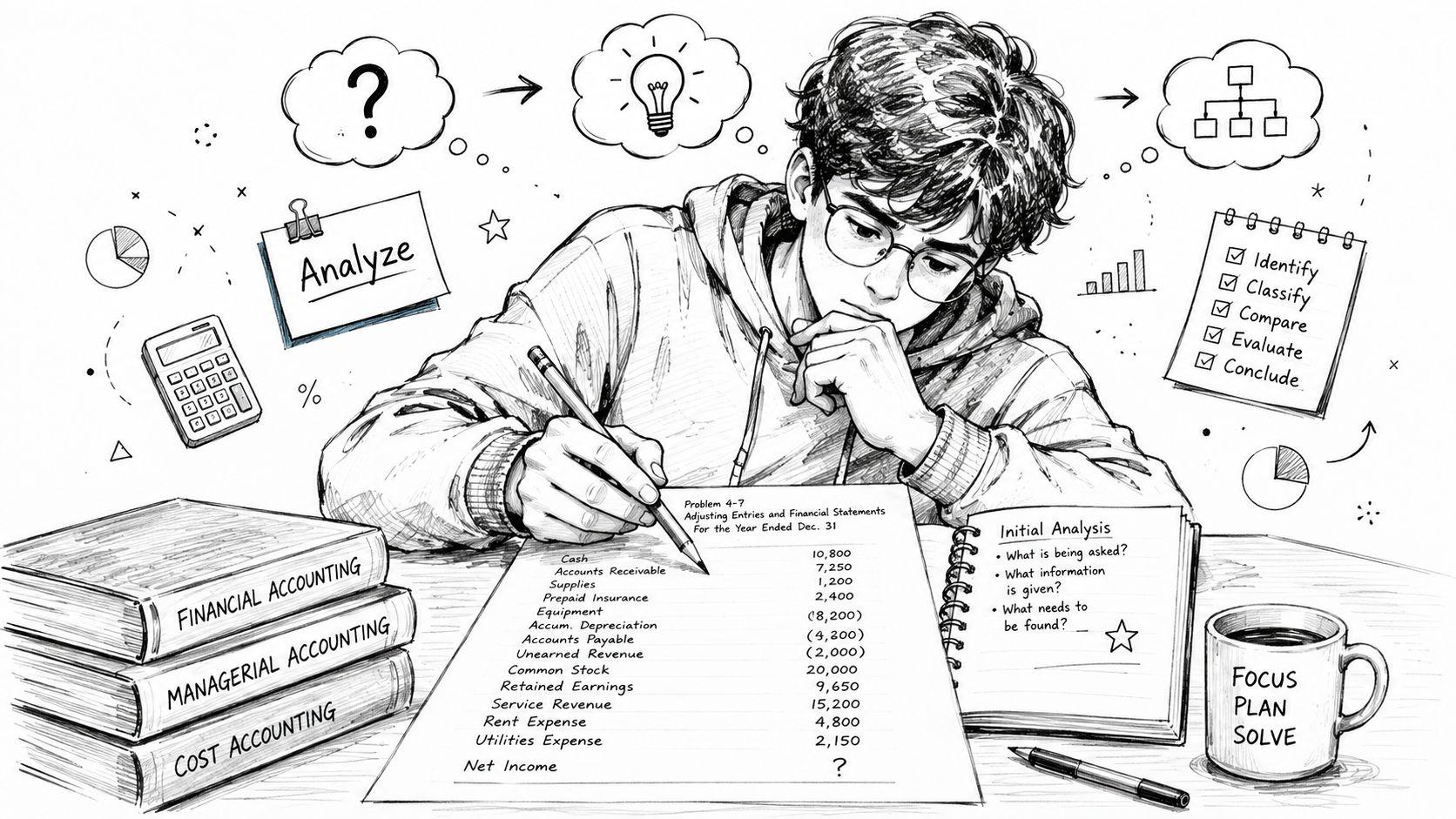
The first mistake many students make is trying to calculate before they classify. In accounting, that usually leads to the wrong journal entry, the wrong statement line, or the wrong treatment of an adjustment. A better workflow starts with diagnosis, because misclassification causes more trouble than arithmetic in many homework problems (EduSolver on accounting).
Identify the problem type
Read the prompt and decide what kind of task it is. Is it asking you to journalize a transaction, post to a ledger, prepare a trial balance, calculate depreciation, or build a statement? The clues are often in the wording. “Record,” “post,” and “adjust” usually point to journal work. “Balance,” “report,” and “statement” usually point to the output stage.
Every accounting task has a different destination. If you start with the wrong destination, the numbers may still look neat, but the logic won't hold. That's why experienced tutors tell students to mark up the question before touching the calculator.
Name the principle before you calculate
Once you know the task type, identify the principle underneath it. Maybe it's the matching principle, revenue recognition, accrual logic, or the basic debit-credit structure. Naming the principle out loud helps you avoid the classic trap of choosing the right math and the wrong rule.
A good workflow follows four stages, identify the problem type and principle, extract the figures, apply the rule, and verify the result (EduSolver on accounting). That order provides significant protection against error. If the prompt mentions prepaid rent, for example, the issue isn't just the amount. It's whether the cost belongs in the current period or a future one.
Start with the rule, not the calculator. That one habit prevents most avoidable homework errors.
The Standard Workflow for Solving Accounting Problems
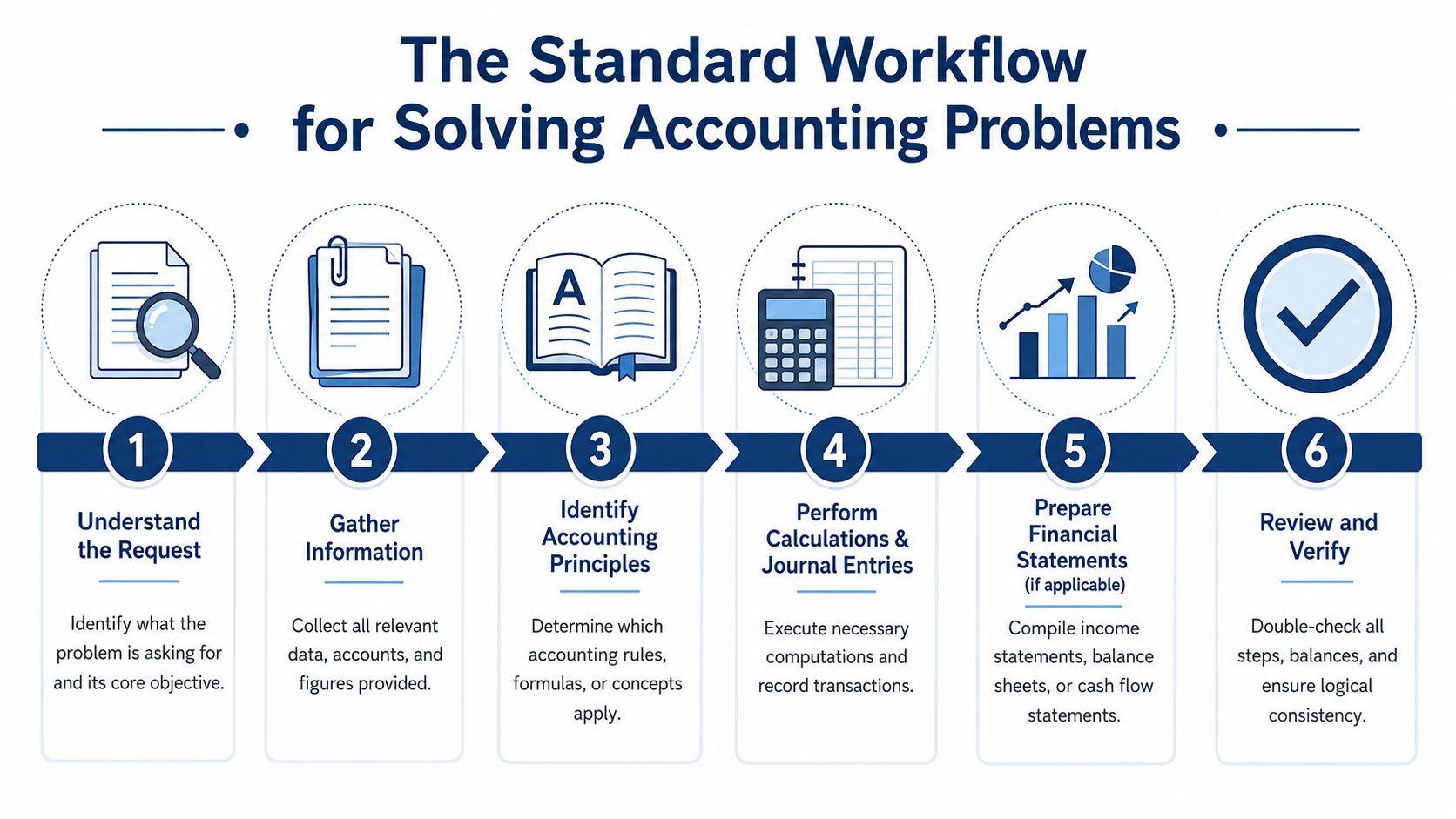
Accounting homework gets much easier when you use the same sequence every time. The canonical path is the accounting cycle, journalize the transaction, post to ledgers or T-accounts, prepare a trial balance, and then verify that the accounting equation still balances (Investopedia on the accounting cycle). That sequence is useful because it gives you a built-in audit trail instead of a guess.
Journal
Start with the transaction itself. Ask what changed, which accounts are affected, and whether each account increased or decreased. Then record the entry with the proper debit and credit structure.
Many students often require more than just a final answer. If you want a reliable reference for the mechanics of recording entries, the accounting entry journal resource is a helpful companion because it keeps the focus on the form and flow of the entry rather than a one-line solution.
Ledger
After the journal entry, move the amounts into the relevant T-accounts. Here, you can visually see how one transaction affects cash, revenue, expenses, liabilities, or equity. Students often skip this step because they think it's extra work, but it's one of the best ways to catch a reversal before it spreads.
Trial Balance
Once the ledger is updated, prepare the trial balance. This is your first major consistency check. If debits and credits do not line up, the error is usually earlier in the process, not in the final statement.
Statements
The final output depends on the assignment. You may need an income statement, balance sheet, or another report. At this stage, the key question is whether every number flows logically from the transaction history. A correct statement should feel like the end of a chain, not a fresh guess.
A Worked Example Putting Theory Into Practice
Laura opens a small web design shop and wants to track her first month cleanly. She invests cash, buys a computer for the business, and finishes a client project that gets paid right away. None of this is complicated by itself, but the accounting becomes clearer when you follow the cycle in order.
Start with the journal entries
First, Laura contributes cash to the business. That means the business has more cash and more owner's equity. Next, she buys a computer for use in the business. That usually means one asset goes up, while another asset goes down if she pays cash. Then she earns service revenue from the first client. Cash increases again, and revenue is recorded because the business completed the work.
That basic flow is exactly why 1chat's blog can be useful for students who want short, guided explanations while they work through practice problems. The point is not to skip steps. It's to use support that helps you trace the logic from transaction to entry.
Post into T-accounts
Once the journal is set, Laura's accounts show the effect more clearly. Cash has moved several times, equipment is now on the books, and revenue has increased equity through earned income. If you draw the T-accounts, the pattern becomes easier to inspect, especially when the assignment asks you to explain why one side increased and the other side changed.
Build the trial balance and statements
After posting, Laura checks whether the account totals still make sense. If the trial balance is off, she knows the issue is in the recording or posting stage. If it balances, she can move to the statements and see the business result in a cleaner format.
That final report is where homework often becomes more understandable. The income statement shows whether Laura earned more than she spent. The balance sheet shows what the business owns and owes at that point in time. When students follow the same flow, the numbers stop feeling disconnected.
Common Homework Mistakes and How to Avoid Them
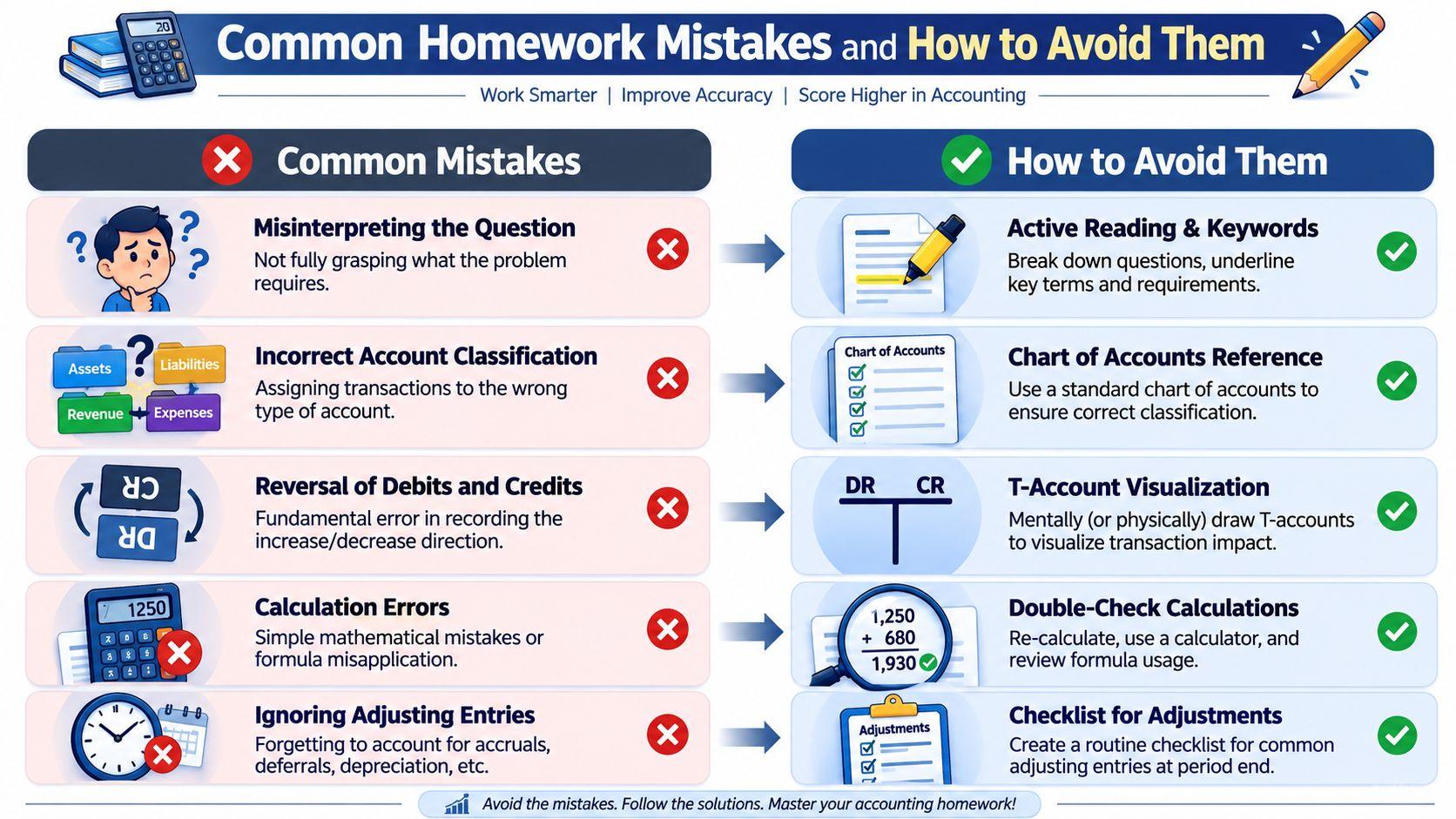
A lot of accounting errors come from a small number of habits. Students rush the reading, classify the account too quickly, or assume that a calculation error is the primary issue when the underlying problem is conceptual. Instant digital support has made it easier to get help quickly, which fits the way students now work on time-sensitive accounting exercises (App Store accounting AI homework solver).
The mistakes that usually cause trouble
The most common breakdown is a debit-credit reversal. Students know something should change, but they flip the direction because they haven't tied the entry back to the account type. Another frequent issue is mixing up assets and expenses, which leads to a wrong placement on the statement and a domino effect later.
Skipping adjusting entries creates a different kind of error. The unadjusted numbers may look fine in isolation, but the final statements won't reflect accruals, deferrals, depreciation, or similar period-end items. A single misclassified account can change the whole trail.
The checks that catch them early
Use a chart of accounts before you post anything. Draw T-accounts if the prompt feels abstract. Recalculate the figures before moving forward. Most important, verify that the accounting equation still balances after each major step.
- Read the wording carefully: Circle verbs like record, adjust, or prepare so you know what the problem wants.
- Match the account type first: Decide whether the item is an asset, liability, equity, revenue, or expense before entering numbers.
- Use visual tracing: Put the transaction into T-accounts so you can see where each amount goes.
- Check the math twice: A correct concept with a weak calculation still gives the wrong answer.
- Keep an adjustment checklist: Run through common period-end items before you submit.
If the equation doesn't balance, the error is usually earlier than the final number.
Using AI Tutors and Resources Responsibly
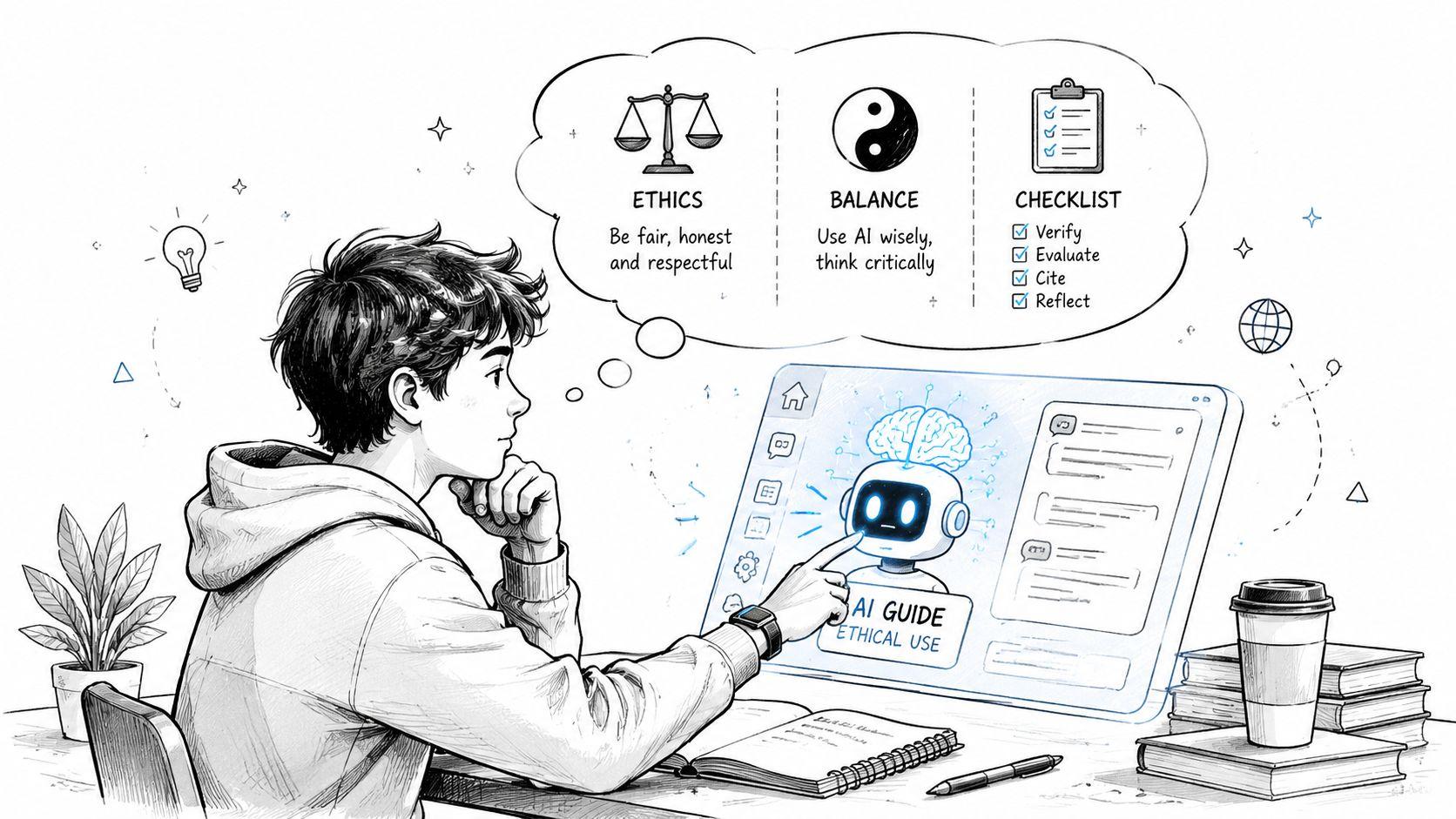
AI tools are now a normal part of homework support, and accounting sits right alongside math, science, economics, and languages in those platforms (Atlas AI homework solver). That matters because the best tools don't just hand over a final answer. They break the problem down so you can see why the entry, classification, or statement makes sense.
Use AI to check, explain, and quiz yourself
A responsible AI workflow is simple. First, try the problem on your own. Then ask the tool to explain the reasoning behind your journal entry, T-account, or adjustment. If you're stuck, ask for a step-by-step breakdown instead of a finished answer. That keeps the tool in the role of tutor, not substitute.
You can also use it to generate practice questions on the same concept. If accrual accounting is confusing, ask for a few fresh examples and work them without looking at the answer first. That's a much better habit than copying a completed solution you don't understand.
Keep learning value at the center
If you're comparing study tools, the AI tools for researchers and students resource is worth a look because it frames AI as a support layer for study, not a replacement for effort. A good platform should help you explain your thinking, not hide it.
The same goes for privacy-first study environments like 1chat. When you use AI, the safest approach is to ask for explanations, practice prompts, and verification help, then write the final homework response yourself. That's how you build confidence without losing the accounting skill underneath.
Use this standard
Ask AI to clarify the rule, then solve the problem yourself.
That approach protects the learning part of the assignment. It also lines up with the way modern accounting support is being packaged, since step-by-step help has become the standard expectation rather than a bonus feature (Atlas AI homework solver).
If you want a steadier way to handle your next assignment, try one problem with the full accounting cycle, then check your reasoning with a privacy-first study tool like 1chat and compare your steps, not just your final answer.