An argumentative essay investigates a question, takes a clear position, and supports it with reasons and evidence a reader can check.
If stating your opinion and adding a quotation were enough, why would a reader still disagree? Often, the missing sentence is the one explaining why that evidence justifies your position. Sometimes, the missing work is taking an objection seriously enough to discover whether your position holds up.
Consider a school debating a later morning bell. You might favor the change, but an argumentative essay asks you to do more than describe tired students. You need to investigate the proposal, establish what the evidence supports, and answer families who worry about buses, sports, and after-school jobs.
What an Argumentative Essay Is
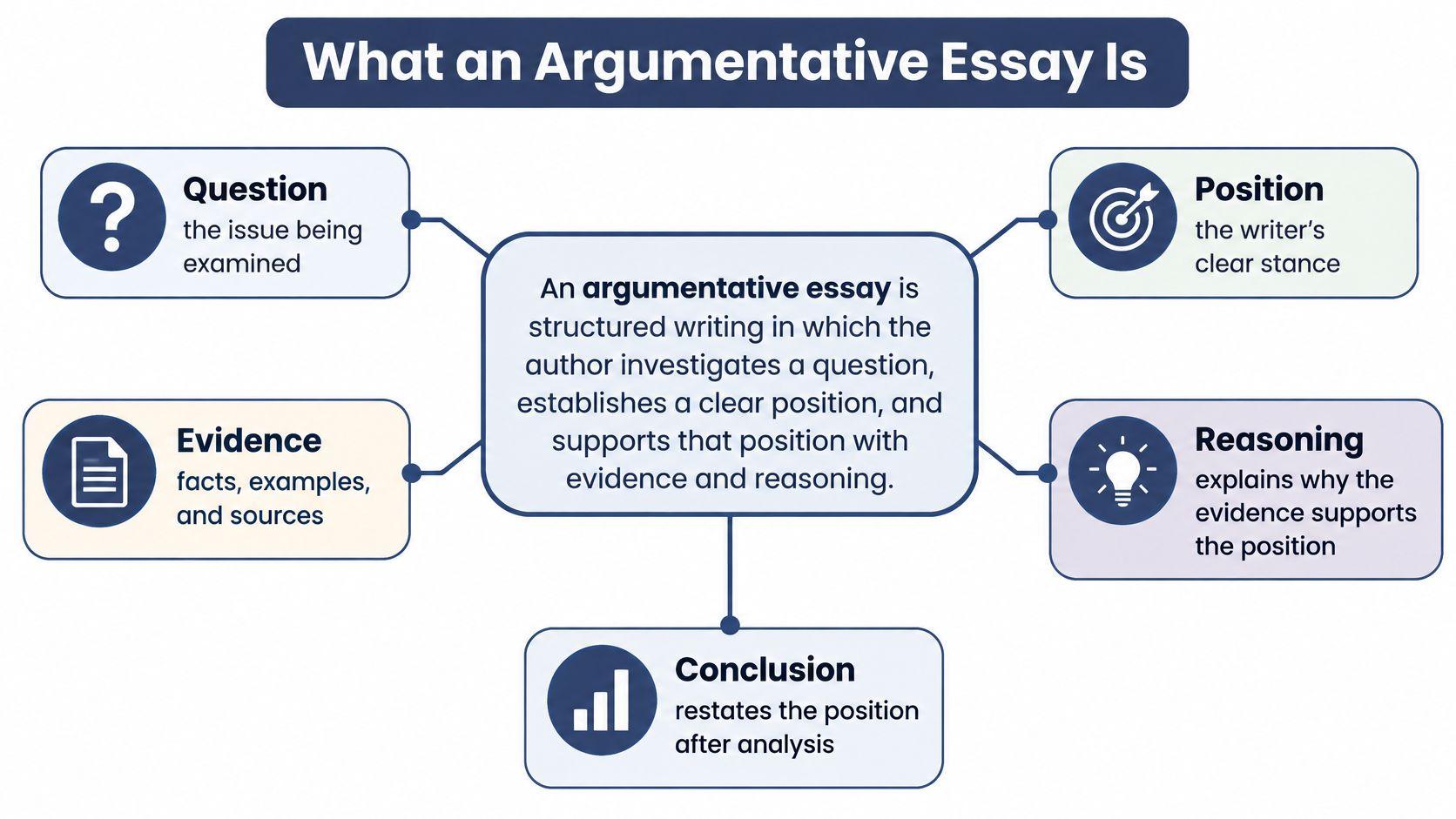
An argumentative essay is structured writing in which an author investigates a question, establishes a clear position, and supports that position with evidence and reasoning. It isn't a diary entry about personal preferences, and it isn't a collection of facts with no conclusion.
Think of a courtroom, with an important limit: you're defending a position, not trying to win at any cost. Your thesis is the claim you agree to defend, your reasons organize the case, and your evidence gives the reader something to examine. The reader may reject your conclusion if your explanation doesn't hold.
Purdue University's argumentative essay guidance identifies the central work as investigating a topic, collecting and evaluating evidence, and presenting a position concisely. It also emphasizes that a clear thesis and sound reasoning matter regardless of how much research an assignment requires.
From a school question to a position
Suppose your question is whether your school should begin classes later. Start by investigating the current schedule, the proposed change, and the concerns of students, families, and staff. Don't decide that every source supporting your preference must be useful.
Then collect and evaluate evidence. A student's description of a difficult morning might illustrate the issue, but it can't establish what happens across an entire school. You'd need evidence suited to the claim you're making.
Finally, state a position you can defend:
- Claim: The school should adopt a later start, provided it can preserve reliable transportation and essential after-school access.
- Reason: The change could improve students' readiness to participate in morning lessons.
- Evidence needed: Credible findings about sleep and classroom alertness, alongside local information about scheduling.
Notice that the reason isn't evidence yet. It tells readers why they might accept the proposal; evidence must establish whether that reason is justified.
The same structure, different kinds of proof
The working model is claim + reasons + evidence. Evidence might be a quotation, documented example, statistic, experimental result, or other verifiable information. Repeating that later starts are better doesn't supply any of those things.
History, science, business, and public policy share this basic structure, but writers must match their proof to the discipline. A science argument may depend on experiments and statistical analysis; a historical argument may depend on primary documents and their context.
For a draft checklist, use the major parts below. They help you distinguish a missing piece of writing from a missing piece of thinking.
The Five Parts of a Working Argument
| Part | What it must do | Reader test |
| Introduction and context | Name the debatable question and why it matters | A stranger can tell what is at stake |
| Thesis | State one arguable position in one or two sentences | A reasonable person could disagree |
| Body reasons and evidence | Sequence reasons, each with evidence, interpretation, and a warrant | Every paragraph ties back to the thesis |
| Counterargument and rebuttal | State a fair opposing view, then answer it | The other side is not a straw man |
| Conclusion | Restate the position and its significance without new evidence | The reader knows what to believe or do |
Establish the issue before defending the answer
Your introduction should give readers enough context to understand the dispute. For the school-start proposal, that means identifying the proposed schedule change and who would be affected. You don't need to summarize every source before stating your position.
The thesis then commits you to an answer. Compare these possible sentences:
- Too vague: School starts too early.
- Arguable: The school should move its morning bell later if it can protect bus access and essential after-school commitments.
The second version identifies a decision and a boundary. A reasonable reader could oppose it because they weigh the costs differently or doubt that the conditions can be met.
Develop your reasons in a sequence the reader can follow. A useful paragraph contains a topic sentence, source-based evidence, interpretation, a warrant, and any necessary qualification. The warrant is the connection between the evidence and your position, not another quotation.
Austin Peay State University's argumentative essay handout emphasizes logical organization, credible support, analysis, and responses to opposing views. Treat those features as connected work: a well-ordered paragraph still fails if its evidence doesn't support its conclusion.
Make the objection part of the proof
A counterargument isn't a ceremonial paragraph beginning with a dismissive reference to what some people think. Choose an objection that could change the decision.
For example, later dismissal could interfere with paid work or family responsibilities. That objection deserves more than the response that learning matters. The opposing reader may agree that learning matters and still need a workable schedule.
Practical rule: Answer the strongest reasonable objection, not the easiest version to defeat.
First, state the concern fairly. Then explain why it matters before answering it with evidence, a feasible adjustment, or a narrower proposal. If you suggest altered practice times, you still need to establish that coaches, facilities, and transport can accommodate them.
Sometimes the honest rebuttal changes your thesis. You might defend a trial rather than permanent adoption, or make approval conditional on an access plan. That's stronger reasoning than pretending you've eliminated every cost.
Finish by bringing your reasons together and explaining the significance of the decision. An argument may change a viewpoint, prompt action, or defend an explanation. Your conclusion should make the intended result clear without introducing a new study.
Use the Reader test column while revising. It asks whether each part works for someone who doesn't already agree with you.
How Claims, Warrants, and Evidence Fit Together
Argumentative writing is a reasoning process, not just an assignment format. A writer must decide what follows from the available information and what doesn't.
The basic terms describe different jobs:
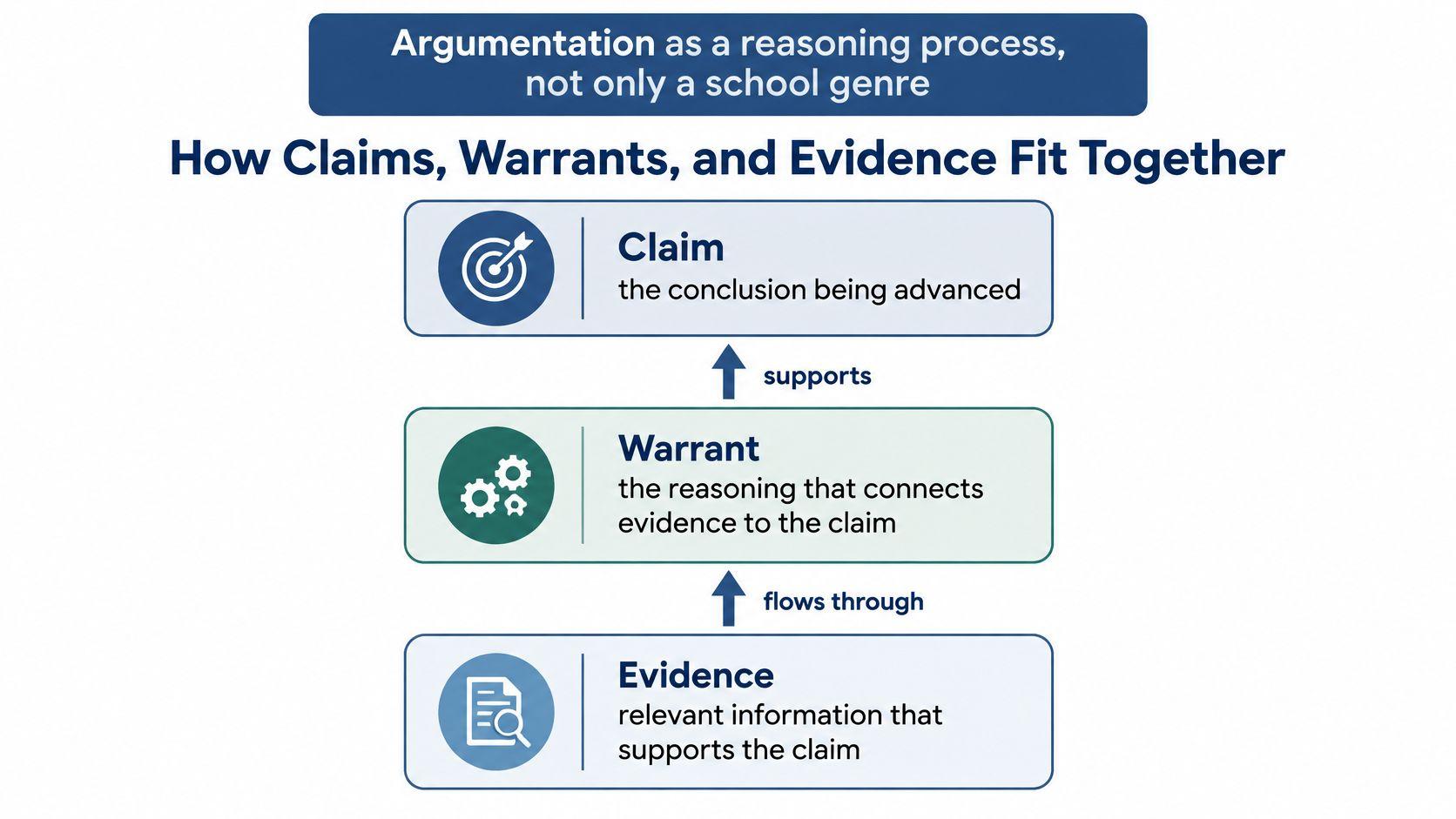
- Claim: The conclusion or position you're advancing.
- Evidence: Relevant information offered in support.
- Warrant: The reasoning explaining why that information justifies the conclusion.
The historical-writing scholarship indexed by ERIC describes evidence-based argumentation and the expectation that students construct interpretations from sources. It also discusses U.S. secondary-school standards requiring valid reasoning and relevant, sufficient evidence, whether the writer aims to change a viewpoint, prompt action, or establish an explanation's accuracy.
Find the missing connection
A sleep statistic wouldn't automatically prove that a later bell improves learning. Even an accurate finding needs a logical connection to the particular decision.
The following sentences are hypothetical reasoning examples, not reported research findings. They show why adding a warrant also requires checking the intermediate claims.
| Version | Sentence | What is missing |
| Bad | Students who sleep longer report better alertness, so the school should start later. | No established link from a later bell to more sleep, or from alertness to attendance or learning |
| Repaired | If a later bell increases sleep and reduces late arrivals, students could gain instructional time because arriving before lessons begin allows them to participate. | The warrant connects attendance to learning opportunities; the claims about sleep and arrivals still need evidence |
The repair doesn't make the conclusion automatically true. It makes the reasoning visible, so a reader can inspect each step.
If you're using numerical evidence, learn to cite statistics correctly with Statlyst's guide. Keep the population, measure, and context attached to the number rather than turning a limited finding into a claim about all students.
Read sources as evidence, not decorations
Before using a source, ask who produced it, what question they investigated, and whether its context matches your claim. A finding about self-reported alertness doesn't necessarily establish improved grades. A schedule change elsewhere doesn't establish that your school can use the same bus arrangements.
History makes the distinction especially clear. Summarizing a textbook page describes what that page says; comparing documents and explaining why they support a particular interpretation constructs an argument.
The sentence after the evidence should do work the evidence cannot do by itself.
That sentence might explain a pattern, identify an alternative explanation, or limit the conclusion. A critical reader should be able to trace your reasoning without accepting your confidence as proof.
One Mini Essay From Thesis to Rebuttal
Suppose a school is considering a first bell at 8:30. The time is a hypothetical proposal, not a research-based recommendation. Because no sleep findings or district attendance figures are established here, the model below keeps those claims conditional instead of inventing proof.
A worked school proposal
In this imagined school, students describe struggling to concentrate during the opening lesson, while families disagree about whether changing the schedule would help. A later bell would also require decisions about bus routes, sports, and dismissal. The school should test an 8:30 start, with permanent adoption conditional on demonstrated benefits and workable transportation.
The strongest reason to consider the change is the possibility of better readiness for morning lessons. Before adopting the policy, school leaders should examine credible sleep research and determine whether its findings apply to their students. Evidence connecting additional sleep with alertness would support investigating the proposal, but it wouldn't by itself prove that moving this school's bell would improve learning.
A further reason to test the proposal is its possible effect on late arrivals. The school should compare attendance records under the existing and trial schedules, while checking whether bus changes or other events could explain any difference. If fewer students miss the beginning of class, they would have more opportunity to receive instructions and join activities, though attendance alone wouldn't demonstrate greater understanding.
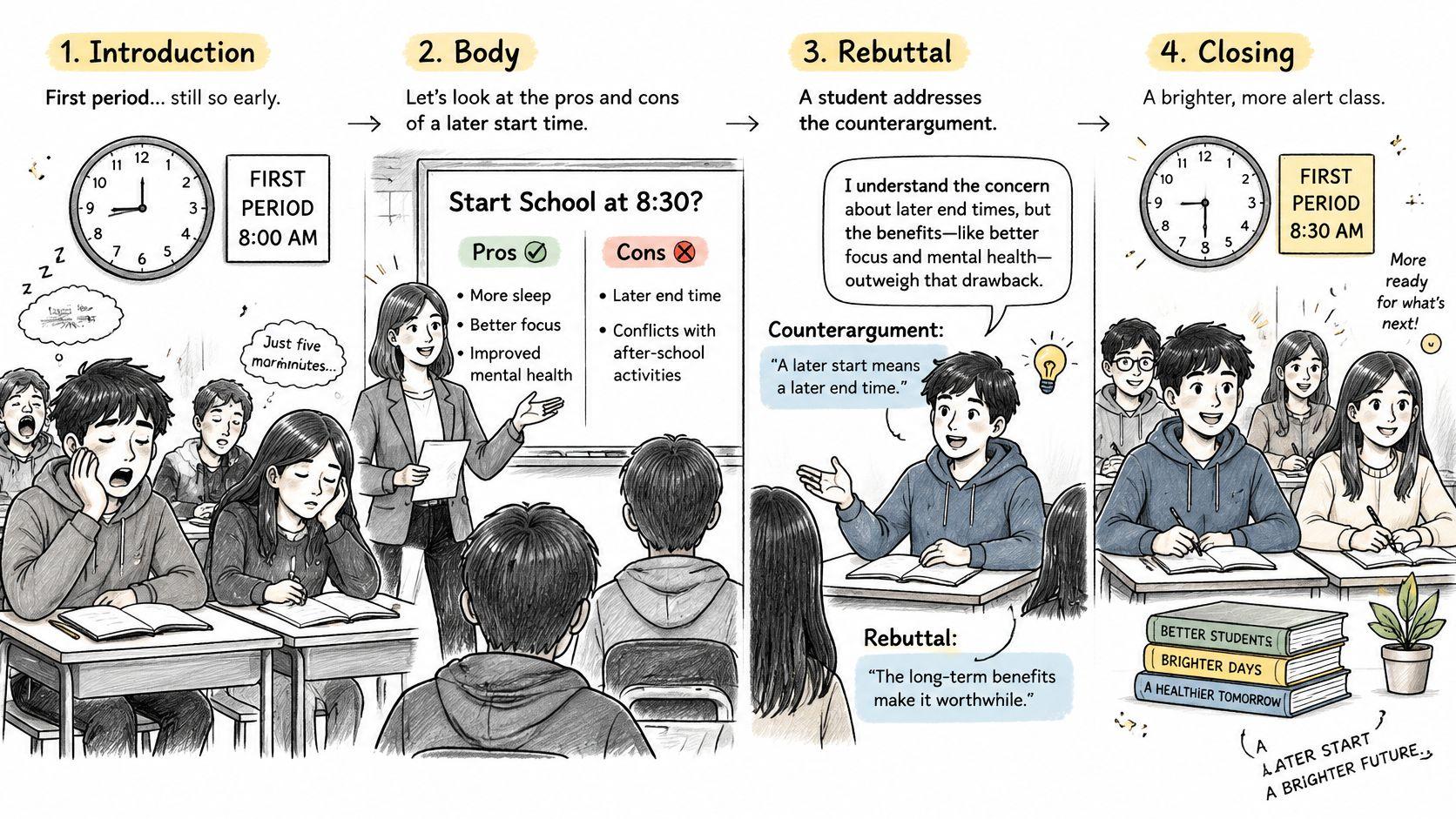
Families could reasonably object that later dismissal would squeeze athletics, paid work, and care for younger siblings. Those obligations aren't trivial inconveniences, and students shouldn't have to abandon them because the school prefers a different schedule. Administrators should investigate staggered practices or adjustments to homeroom, but shouldn't describe either option as a solution until they establish that it can work.
If the school can't protect essential after-school access, that limitation would count against permanent adoption. A trial therefore offers a more defensible position than an unconditional promise that everyone will benefit. It allows the school to evaluate the educational case alongside the burdens families would bear.
The school should test the proposed start and retain it only if the results justify the disruption and the access problems can be addressed. The purpose is to improve students' opportunity to learn, not merely to move the clock. A defensible decision requires both evidence of benefit and an honest account of the costs.
Check what the example has earned
This is a conditional policy argument, not a completed evidence-backed case for later starts. A final research essay would need actual, accurately cited findings where this model identifies questions for investigation.
- Arguable thesis: A reader could reasonably oppose the proposed trial or its conditions.
- Evidence plus interpretation: Each proposed benefit identifies what must be established and what that finding would permit the writer to conclude.
- Real objection: The response treats work, care, and transport as constraints that could change the recommendation.
How Argumentative Writing Differs From Nearby Genres
| Genre | Main aim | Counterargument expected | Enough support |
| Argumentative essay | Defend a position a reader can inspect | Yes, stated fairly and answered | Relevant, sufficient, credible evidence plus a warrant |
| Persuasive essay | Move the reader or prompt action | Often lighter | Evidence mixed with emotional appeal |
| Opinion or personal response | Share a viewpoint | No, unless assigned | The writer's own reasons may be enough |
| Expository report or summary | Explain a topic without taking a side | No, unless assigned | Accurate information, not a defended thesis |
These are useful classroom distinctions, not rigid boundaries. Teachers may use persuasive and argumentative for overlapping assignments, so read the prompt and assessment criteria before deciding how to approach the task.
For the school-start topic, an expository report might explain how bus routes and class schedules fit together. A personal response might describe how you feel during an early lesson. An argumentative essay must defend a decision about the schedule.
Correct the common mix-ups
A strong opinion isn't yet an argument. Writing that the current schedule is unfair expresses a judgment, but readers still need grounds for accepting it. Identify the affected students, explain the relevant disadvantage, and connect that evidence to the change you're proposing.
A quotation isn't analysis. After quoting a student who struggles to arrive on time, explain what that testimony establishes and what it doesn't. It may illustrate a transportation problem without showing how widespread that problem is.
Literary assignments require the same distinction between describing and interpreting. When using a resource such as MasteryMind's A Room With A View analysis, distinguish background explanation from an interpretation you must support with passages from the novel. A plot summary doesn't become an argument just because you add your agreement.
Revision check: Ask whether you've explained the source or used it to justify a conclusion. Those aren't always the same task.
Mocking the opposition isn't rebuttal. Saying that families oppose later starts because they dislike change replaces their actual concern with an easier target. That is a straw man, a distorted version of an opposing position.
A research paper can contain an argument, but research alone doesn't determine the genre. A paper that surveys sources about scheduling may remain a report if the writer never defends an answer to a debatable question.
Let the assignment determine the job
If the prompt asks you to explain a process, don't manufacture a dispute. If it asks you to evaluate a policy, don't stop after presenting both sides.
A useful sorting test is simple: if a reasonable person could disagree and you can show why your reading of the evidence is better, you're in argumentative territory.
Draft the Thesis Before Asking AI for Help
Write a provisional thesis before opening a chat tool. Then ask: Could a reasonable person disagree? A sentence saying that school schedules affect students gives you a topic, not a defensible position.
Make the decision specific enough to investigate. You might support a conditional trial, oppose a change because essential access hasn't been secured, or argue that the school needs better local evidence before voting. Keep the thesis provisional so you can revise it when the evidence requires.
Revise the reasoning before polishing the introduction
Begin with the weakest body paragraph rather than repeatedly rewriting your opening. Underline its main reason, locate the supporting evidence, and identify the sentence connecting that evidence to your thesis. If you can't find that sentence, write it yourself.
Next, add a fair objection and a response that answers it. For the schedule proposal, an objection about students' jobs needs a response about access and timing, not another paragraph praising sleep.
Use a focused revision sequence:
- Repair the unsupported claim: Find a suitable source, qualify the statement, or remove it.
- Test the opposing view: Ask whether someone holding that view would recognize your description.
- Clean the conclusion: Move newly introduced evidence into the body, where you can analyze it.
- Apply the reader tests: Check whether the introduction establishes the stakes and each paragraph contributes to the position.
Don't confuse fluent sentences with completed reasoning. A polished paragraph can still depend on a source that doesn't support its central claim.
Delegate challenges, not judgments
A 2025 study of 30 Indonesian university freshmen reported statistically significant improvements in argument structure and critical-thinking measures under a human-AI collaborative writing strategy, with approval ratings above 85%. Its pre-experimental, one-group design cannot establish that AI alone caused the improvements.
That supports a cautious approach to assistance, not handing over authorship. Use an AI writing tool as a challenger or coach while retaining responsibility for the argument.
| Ask AI to help with | Keep under your control |
| Generate plausible objections | Decide which objection genuinely threatens the thesis |
| Flag sentences that appear unsupported | Verify sources and choose relevant evidence |
| Suggest research questions | Decide what information would answer those questions |
| Comment on paragraph order | Determine the logical sequence of your case |
| Identify a possible reasoning gap | Write and defend the warrant |
A useful request is to ask the tool to identify the weakest connection between a paragraph's evidence and conclusion, without rewriting either. That gives you a problem to solve rather than a ready-made position to submit.
For application writing, Mrs. College Counselor's discussion of college essay authenticity and AI offers a related context for thinking about authorship. Follow your assignment's rules on permitted assistance and disclosure, and don't submit generated judgments as your independent reasoning.
Source-opening rule: If a sentence asserts an external fact, you must be able to open its source and show where the support comes from.
Take your current draft and mark its thesis, strongest evidence, connecting warrant, and fairest objection. Repair whichever you can't identify, then check that every factual claim has support you can inspect. Your finished essay should let a critical reader see how the evidence supports the thesis without taking your word for it.