You're probably dealing with data privacy already, even if you haven't used that label.
A small business owner opens a spreadsheet with customer names, email addresses, and purchase notes. A student signs into a research platform, clicks through articles, and leaves behind a trail of searches. A parent connects a new smart toy or tablet and taps “agree” just to get it working before dinner. In each case, personal information is being collected, stored, shared, or used.
That's where the definition of data privacy starts to matter. Not in a courtroom first, and not in an IT department first. It matters in ordinary moments when people hand over information and expect some control over what happens next.
Why Data Privacy Matters to Everyone
Data privacy affects people at home, at school, and at work because personal information now sits inside almost every routine task.
A bakery owner might collect emails for a weekend specials list. That sounds harmless until the owner wonders: Can I also use that list for partner promotions? Should I keep customer birthdays forever? What happens if a vendor can see the data too? If the business stores customer details in apps or dashboards, it also needs to think about technical exposure. For teams working through those risks, practical guidance on how to remediate leaky APIs and RLS can help connect privacy rules to real product behavior.
A student may think, “I'm only researching a paper.” But search terms, account details, device information, and reading habits can all reveal something personal. A parent setting up a smart speaker for a child faces similar questions. What data does the device collect? Is it storing voice recordings? Who else gets access?
These aren't edge cases. They're normal digital life.
Public concern reflects that reality. One industry compilation reports that 92% of Americans are concerned about their privacy when using the internet, and the EU's GDPR, effective since 2018, can impose penalties of up to 4% of an organization's global annual turnover or €20 million, whichever is higher (OpenStax summary via LibreTexts/06:_Enterprise_Security_Data_Privacy_and_Risk_Management/6.01:_Key_Concepts_in_Data_Privacy_and_Data_Security)).
That combination matters. People care intensely, and regulators can enforce the rules.
For readers who want to see how a company explains handling, rights, and requests in plain policy language, 1chat's privacy policy is a useful real-world example. It shows that privacy isn't just an abstract promise. It has to be spelled out in operational terms.
Privacy becomes real the moment someone asks, “Why do you need this information, and what will you do with it after I give it to you?”
What Data Privacy Really Means
Think of your personal data like mail delivered to your home. Security is the lock on the mailbox. Privacy is the rulebook that says who may open it, which letters they may read, whether they can copy them, and when they must throw them away.
That's why the definition of data privacy is broader than “keeping hackers out.” It's about proper handling.
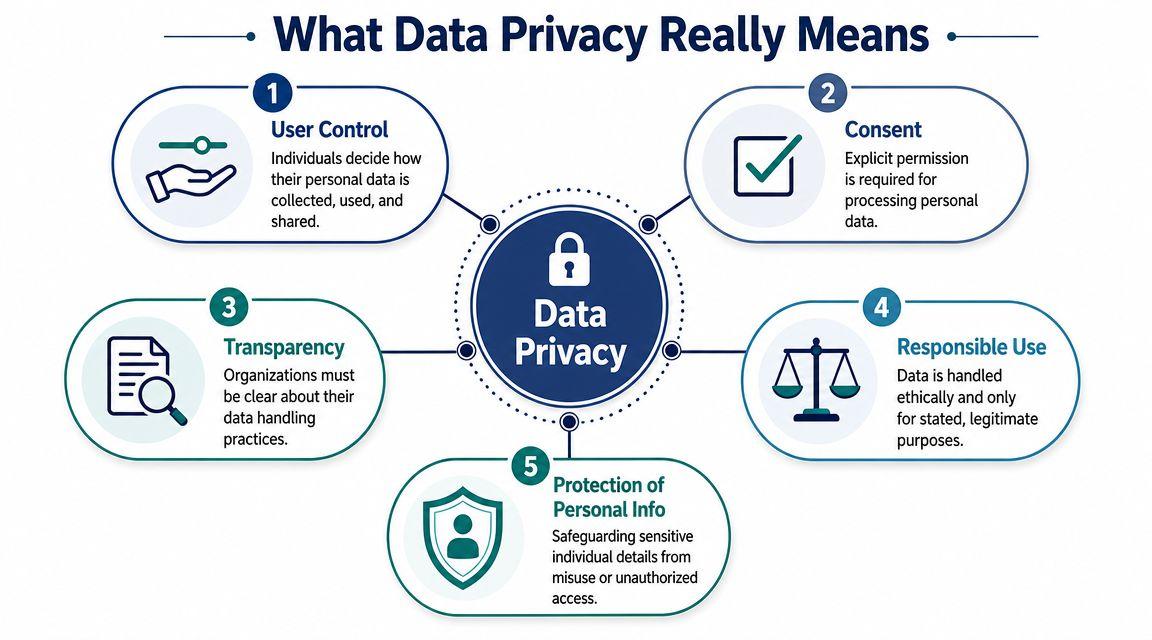
Definition: Data privacy is the set of principles that governs how personal data is collected, used, stored, shared, and deleted.
Three controls that make privacy practical
Experts often reduce privacy to three operational controls: purpose limitation, data minimization, and accountability (Dataversity explanation of data privacy).
Here's what those mean in plain language:
- Purpose limitation means you use data only for the reason you gave when you collected it. If a parent gives a school an emergency contact number, that doesn't automatically mean the number should be used for marketing messages.
- Data minimization means you collect only what you need. If a bookstore wants to send an ebook receipt, it likely needs an email address. It probably doesn't need a customer's birth date.
- Accountability means you can prove you're following the rules. That includes written policies, access controls, records, audits, and retention rules.
Where people often get confused
Many readers hear “privacy” and think “consent banner” or “terms and conditions.” Those are part of the picture, but they aren't the whole picture.
A real privacy program shapes decisions like these:
| Situation | Privacy question |
| App signup | Do we need all these fields? |
| Newsletter form | Did we explain the purpose clearly? |
| Shared spreadsheet | Who inside the business can see it? |
| Old customer records | Why are we still keeping them? |
That's why reading an actual policy can be helpful. For example, WhatPulse's privacy statement shows how an organization can explain collection, use, and retention in a way users can review.
If you can't explain why you collected a piece of data, you probably shouldn't have collected it.
The Core Principles of Data Privacy
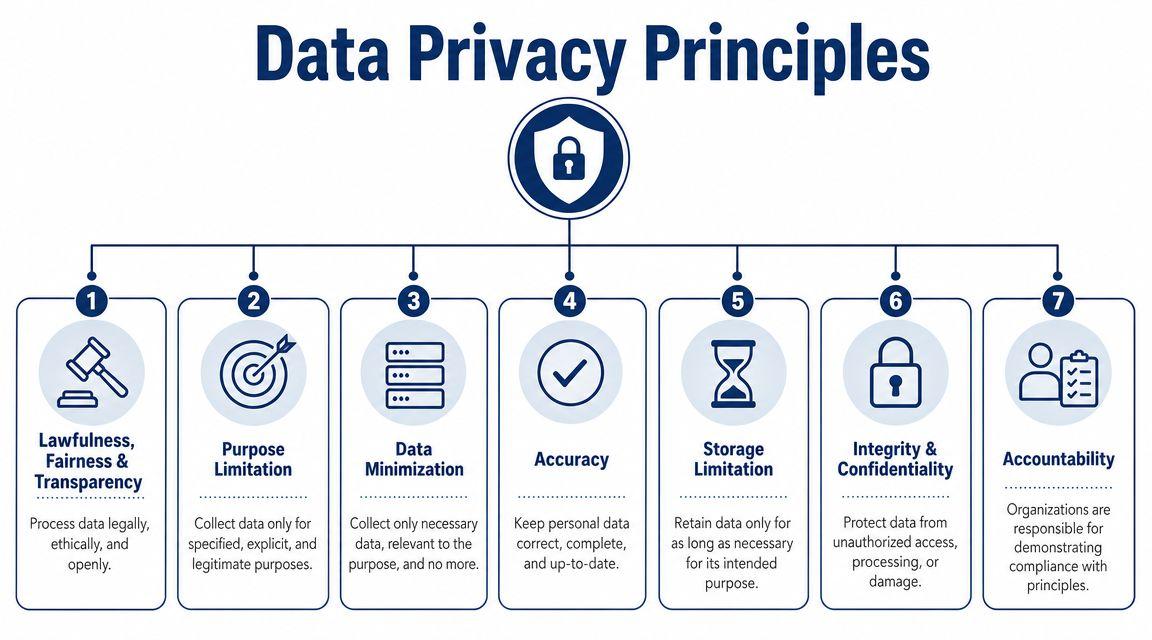
Modern privacy rules didn't appear out of nowhere. A major foundation came from the OECD Privacy Guidelines, first adopted in 1980, which the OECD describes as the first internationally agreed-upon set of privacy principles and a template that has “inspired data protection frameworks around the globe” (OECD privacy and data protection overview).
That history matters because the core logic is still the same today. People should know what happens to their information, organizations should limit what they collect, and individuals should have ways to challenge misuse or errors.
Collection and purpose
Two principles work together at the start of the data lifecycle.
- Collection limitation asks organizations to avoid grabbing data just because it's available.
- Purpose specification requires a clear reason for collection.
If a tutoring business asks students for contact details so it can schedule sessions, that purpose should stay narrow and understandable. The business shouldn't stretch that into unrelated profiling later, exceeding the agreed purpose.
Consent and use
Consent gets a lot of attention, but it's only useful when it's tied to a real purpose and understandable choices.
- Consent should be meaningful, not buried.
- Use limitation means data shouldn't be repurposed beyond what was explained or lawfully allowed.
A simple test helps: would the person who gave the data be surprised by this use? If the answer is yes, the privacy design is probably weak.
Practical rule: The less surprising your data use is to the person involved, the stronger your privacy posture usually is.
Accuracy and individual participation
Privacy also includes the right to challenge mistakes.
If a school platform stores the wrong parent contact, or a retailer attaches the wrong address to a customer profile, the problem isn't just administrative. Incorrect data can cause real harm. That's why privacy frameworks emphasize data quality and individual participation, meaning people should be able to access and correct information about themselves.
Security safeguards and storage limits
Privacy principles don't ignore protection. They require security safeguards, but they also go further by asking how long data should remain in the system.
Keeping records forever creates risk. Old files can be exposed, misread, or reused in ways no one intended. Storage limitation pushes organizations to ask a hard question: when the purpose ends, why is the data still here?
Accountability in real organizations
Accountability is what turns principles into daily practice.
For a small business, that might mean staff access rules and a retention schedule. For a school club, it might mean not sharing student rosters casually. For a product team, it could mean visual planning tools that map where personal data enters, moves, and exits a system. If you like seeing those relationships laid out clearly, these visual data compliance frameworks can make abstract governance ideas easier to grasp.

Data Privacy in Your Daily Life
Privacy feels abstract until you notice how many ordinary activities involve personal data.
For a small business owner
A neighborhood gym wants to start a newsletter. It creates a signup form with name, email, birthday, phone number, and home address because “maybe that will be useful later.”
That's a privacy red flag.
If the goal is sending updates, the gym may need only an email address and perhaps a first name. Asking for more creates extra responsibility. It also increases the chance that staff use the information for unrelated purposes later.
The scope of personal data is broader than many people expect. Under laws like the CCPA in the U.S., personal information can include device IDs, browsing history, location data, biometrics, and inferences drawn to create a profile about a consumer, not just names and street addresses (DLA Piper U.S. data protection summary).
For parents and families
A child gets a new tablet and a smart speaker for homework help and music. The setup process asks for account creation, voice settings, app permissions, contact access, and location access.
Parents often focus on content controls first, which makes sense. But privacy questions deserve equal attention:
- Microphone access should be checked app by app.
- Location sharing should be turned on only when the feature really needs it.
- Profiles and recommendations may rely on usage patterns that reveal family habits.
- Connected devices may collect household-linked information, not just data about one person.
For readers comparing how online services disclose tracking and related practices, 1chat's cookie policy offers a practical example of the kind of information users should look for.
For students
A student researching climate policy logs into a school portal, uses a library database, opens AI writing tools, and saves notes in cloud documents.
Each service may observe something different:
| Tool or service | Possible privacy issue |
| Library database | Search history tied to an account |
| Writing assistant | Essay drafts containing personal details |
| Video platform | Viewing habits and behavioral profiling |
| Shared document app | Broad access permissions |
Students often assume school-related use is automatically private. It isn't always. The safer habit is to treat every platform as a place where data needs boundaries.
A homework tool can still be a data collection tool. Educational purpose doesn't erase privacy risk.
Privacy vs Security What Is the Difference
People mix up privacy and security all the time because the two overlap. They aren't the same thing.
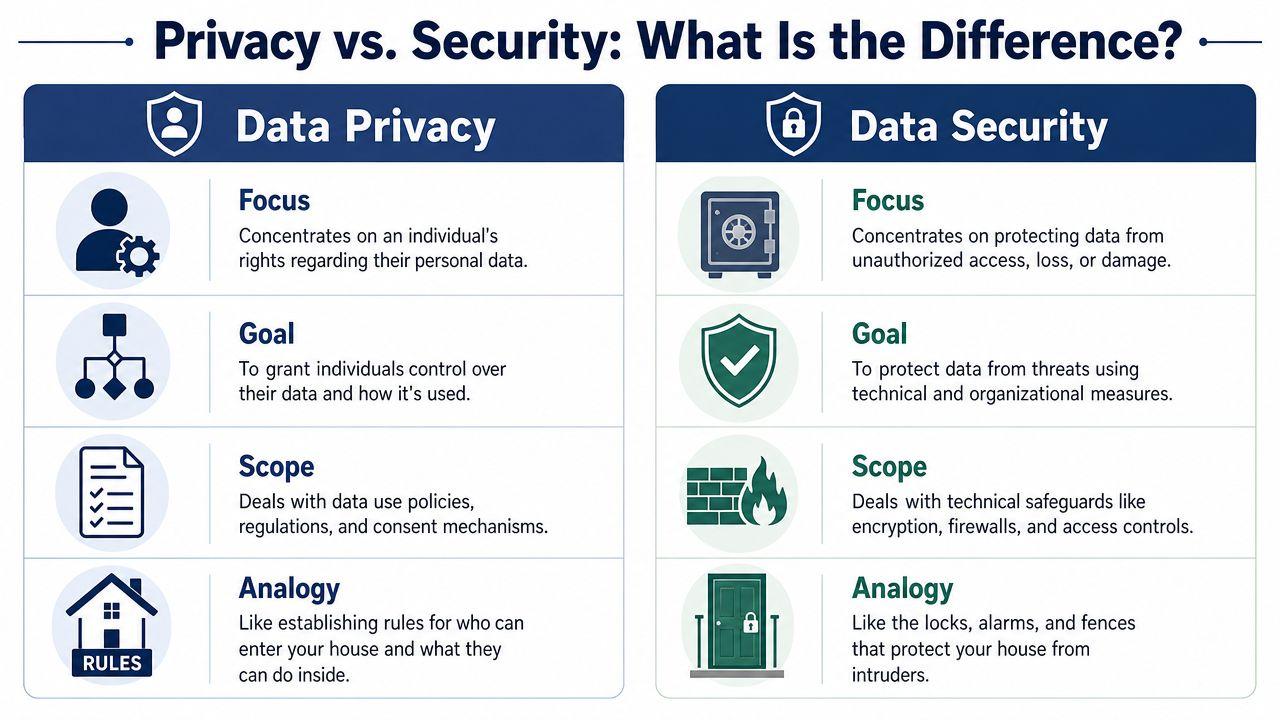
Security is the lock, alarm, and fence around the house. Privacy is the rule about who gets a key, which rooms they may enter, and whether they may photograph what's inside.
The clearest distinction
Data privacy governs authorized use, while data security protects against unauthorized access. An organization can encrypt data and still violate privacy if it shares personal data with third parties without valid notice, consent, or another lawful basis (Proofpoint's explanation of data privacy).
That one idea clears up a lot of confusion.
Side by side
| Question | Privacy | Security |
| Main concern | Should this data be used this way? | Can outsiders or unauthorized users get in? |
| Typical tools | Notices, consent, retention rules, access policies | Encryption, MFA, IAM, DLP |
| Failure example | Using customer data for an unrelated campaign | Exposing files through a compromised account |
Why non-technical readers should care
A family can use strong passwords and still overshare through app permissions. A student can protect a laptop and still paste sensitive personal details into the wrong service. A business can buy excellent cybersecurity software and still fail if staff use data in ways customers didn't agree to.
If you want a plain-language example of service rules that shape acceptable use alongside privacy expectations, 1chat's usage policies show how platform rules and privacy concerns often connect.
Strong security without clear privacy rules is like a locked filing cabinet with no policy for who may open it.
A Practical Checklist for Better Privacy
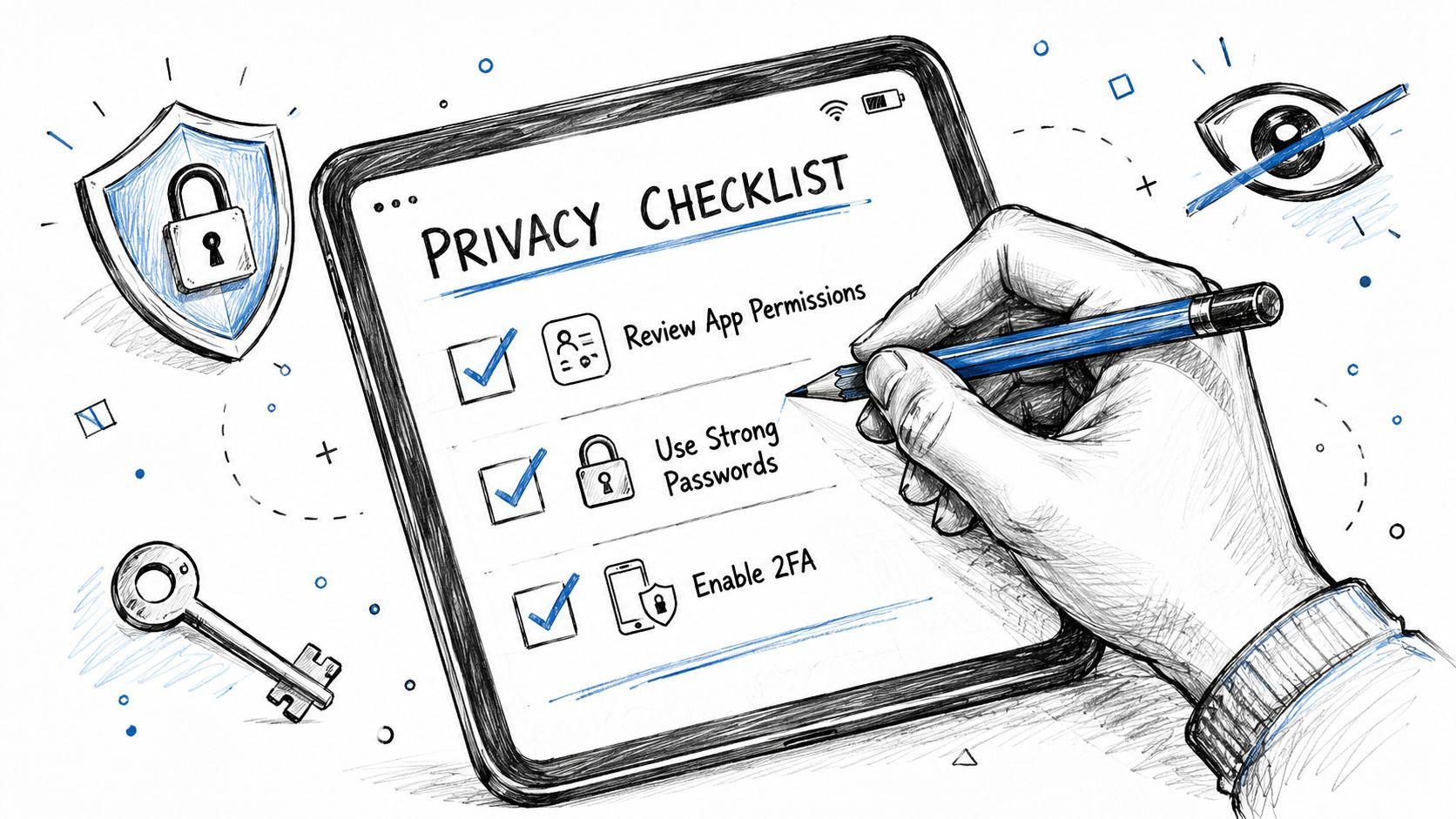
Individuals don't need a legal department to improve privacy. They need a short list and the habit of reviewing it.
Your devices
Start with the hardware you use every day.
- Review app permissions on phones, tablets, and laptops. If a flashlight app wants contacts or location, that deserves a second look.
- Update operating systems and apps so privacy and security settings stay current.
- Check microphone, camera, and location access regularly, especially on children's devices and shared family tablets.
Your accounts
Most privacy problems begin where too much information sits in too many accounts.
- Trim old accounts you no longer use. Dormant accounts still hold data.
- Audit profile fields on shopping, school, and social platforms. Remove optional details when you can.
- Use multi-factor authentication because account takeovers often become privacy incidents.
Your habits
At this point, the definition of data privacy becomes personal.
- Pause before filling forms. Ask what's necessary and what's optional.
- Avoid pasting sensitive details into random tools. Drafts, resumes, homework, customer notes, and family information can all contain personal data.
- Be careful on public or shared devices. Sign out fully, don't save credentials, and clear local files if needed.
Choose tools built with privacy in mind
Privacy isn't only about settings. It's also about product choice.
When you pick software for writing, research, customer communication, or family use, look for plain explanations of what data is collected, how long it's kept, and whether your content is used beyond the service you requested. One example is 1chat, which presents itself as a privacy-first AI option for families, students, and small teams, with tools for chatting with multiple LLMs, working with PDFs, and generating images. The useful habit isn't brand loyalty. It's choosing services that explain data handling clearly before you trust them with personal or business information.
Common Data Privacy Questions Answered
Is private browsing enough to protect my privacy
No. Private or incognito mode usually limits what your browser stores on your own device after the session ends. It doesn't automatically stop websites, apps, networks, schools, employers, or service providers from collecting information about your activity.
A good mental model is this: private browsing helps with local privacy on the device. It doesn't guarantee broad online privacy.
If I have nothing to hide, why should I care
Because privacy isn't about hiding wrongdoing. It's about control, context, and protection against misuse.
Individuals typically close the bathroom door, cover medical information, and avoid handing strangers their diary. That doesn't mean they're doing anything wrong. It means boundaries matter. The same logic applies online.
Privacy protects ordinary life. It gives people room to learn, shop, parent, study, and work without unnecessary exposure.
Can data ever be truly anonymous
Sometimes data can be deidentified, but true anonymity is harder than many people think. If enough details remain, someone may reconnect the dots and link information back to a person or household.
That's why it's safer to ask better questions than “Is this anonymous?” Ask: who has access, what identifiers remain, how long is it kept, and could combining datasets reveal someone again?
Data privacy starts with a simple idea: personal information shouldn't be collected or used without clear rules. Once you understand that, the definition of data privacy stops sounding abstract. It becomes a practical standard for how businesses treat customers, how families choose devices, and how students use digital tools every day.