Central idea is the text's dominant message or unifying concept, the claim that ties together plot, characters, and supporting details into one meaning. If you're staring at a worksheet right now and wondering why “friendship” isn't enough, that confusion is normal.
A student can name the topic of a story in seconds, but the central idea asks for more. It asks what the author wants you to understand about that topic, and that difference is where reading comprehension starts to sharpen.
Understanding Central Idea Through a Real Reading Scenario
A familiar classroom moment usually starts like this. A student finishes a short story, gets asked for the central idea, and answers, “Friendship.” The teacher circles the word, not because it's wrong as a topic, but because it doesn't go far enough.
Friendship is a label. Central idea is the meaning built from what happens in the text. Educational guides describe it as the dominant message or unifying concept that connects the plot, characters, and supporting details, and classroom strategy often starts with a one-sentence summary plus a check of the first and last sentences for clues, as summarized in this overview of central ideas in literature (Helpful Professor's explanation of central ideas).

A simple house analogy
Think of the topic as the address on the mailbox. It tells you where the text lives, but it doesn't tell you how the house is built. The central idea is the foundation, the part holding up every room, wall, and beam.
That image matters because students often stop at the label. They spot a repeated word, decide the passage is “about” that word, and move on. A strong reader asks a harder question, What is the author trying to teach me about this topic?
Practical rule: if your answer could fit dozens of other texts, it's probably a topic, not a central idea.
A passage about friendship might argue that real friendship is tested by conflict, or that loyalty matters more than popularity. Those are not just categories. They're claims, and every important detail in the text should support them. That's why central idea is better treated as the text's core meaning, not its label.
Central Idea vs Theme vs Main Idea vs Topic
These terms get mixed up because they overlap, but they don't do the same job. A student who keeps them separate reads more accurately and writes stronger responses.
A clear side by side comparison
Topic is the broad subject. Main idea is the specific point a paragraph or section makes. Theme is the larger insight or lesson a literary text suggests about life. Central idea is the author's dominant claim that holds the whole text together, and it can apply to both literary and informational writing. That distinction lines up with classroom guidance that treats central idea as something readers verify against evidence, not just spot by repetition (St. Augustine's step-by-step central idea guide).
| Term | Definition | Scope | Text Type | Example |
| Topic | The broad subject matter | Very wide, often one or two words | Any text | friendship |
| Main Idea | The main point of a paragraph or section | Narrower, tied to a specific part | Informational or literary | The paragraph shows that the group's trust grows after a shared problem. |
| Theme | A universal lesson or insight | Broad, interpretive, often across a whole work | Mostly literary | Loyalty is tested during hardship. |
| Central Idea | The unifying claim the text develops | Whole text, supported by repeated details | Literary and informational | True friendship is proven through sacrifice. |
One sentence memory aids
Topic names the subject.
Main idea states the point of a paragraph.
Theme expresses a life lesson.
Central idea gives the author's whole-text claim.
Many students get stuck on tests because they choose a theme when the question asks for a central idea, or they write a topic when the prompt needs a complete claim. That confusion is understandable, since reading guides often use the terms loosely. Some sources note that central idea and main idea are frequently treated as similar, while theme remains more interpretive and more common in literary discussion (Newsela's comparison of theme and main idea).
The safest habit is this. Ask whether your sentence goes beyond naming what the text is about. If it does, and it explains what the author wants you to understand about that subject, you're probably in central idea territory.
A Step-by-Step Method to Identify the Central Idea
Treat the central idea like a testable hypothesis. Don't wait for a magic phrase to jump off the page. Draft a claim, then check whether the text keeps proving it.
The first read
Start with structure. Headings, repeated words, chapter openings, and ending paragraphs all give clues about what the author wants to emphasize. Khan Academy's reading guidance notes that authors often introduce the central idea early and restate it at the end, and it also recommends summarizing each paragraph to track how the idea develops across the passage (Khan Academy's main idea and theme guidance).
Then read for the obvious sense of the text. Don't hunt for the deepest answer first. Get the surface meaning clear, then move into analysis.
The best central idea statements usually survive close reading, not just fast reading.
The verification step
Write one sentence that sounds like a claim, not a subject label. Then test it against every paragraph. If one paragraph pushes against your claim, revise it. If multiple details don't fit, your sentence is too narrow, too broad, or just plain off.
Here's the habit in order:
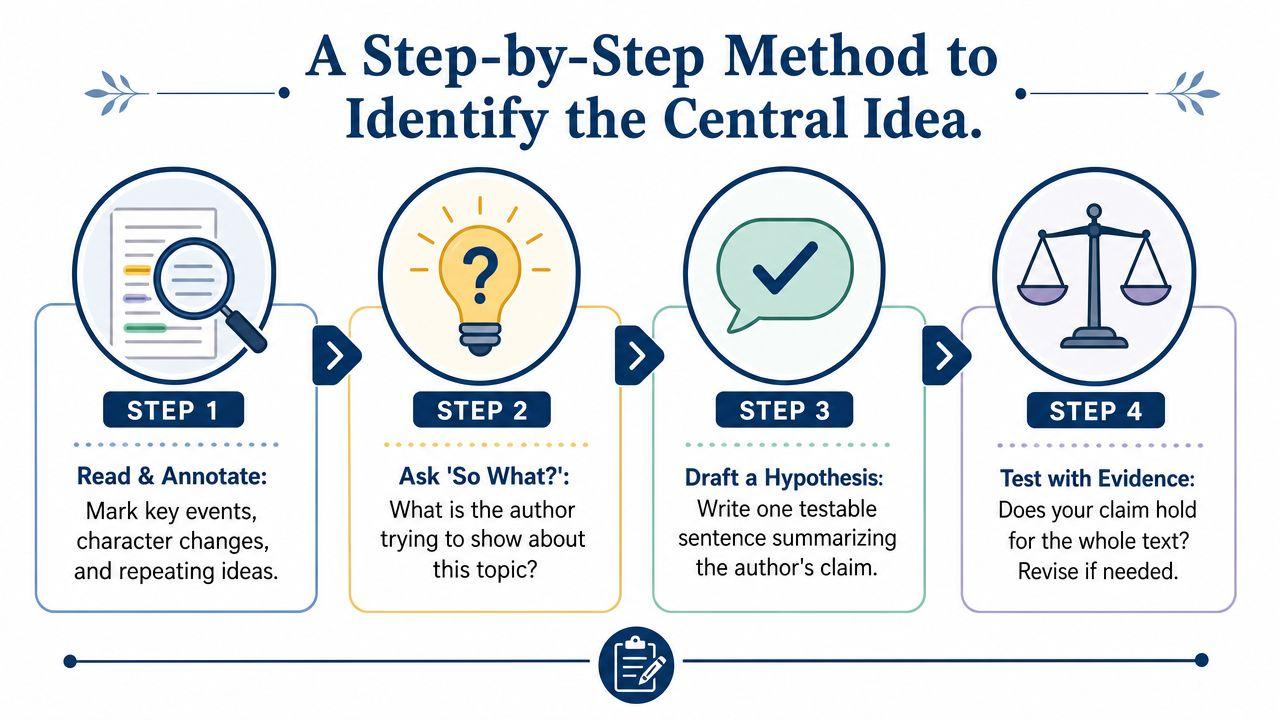
- Read and annotate. Mark repeated events, symbols, character changes, and important details.
- Ask “So what?” Decide what those details seem to show about the topic.
- Draft the hypothesis. Write one sentence that makes a claim about the author's message.
- Test with evidence. Check whether the whole text supports that claim, paragraph by paragraph.
If you want a model of this process, the guide to The Lights That Failed shows how readers can move from surface details to a stronger interpretive claim.
A helpful shortcut is to summarize each paragraph in a few words and see how those summaries fit together. If they all point in one direction, you're getting close. If they point in several directions, the text may be building toward a more layered central idea than your first draft captured.
Central Idea Examples in Well-Known Texts
Concrete examples make the method feel less abstract. The key is not to memorize one perfect sentence for each work, but to watch how topic, evidence, and claim connect.
Fiction, nonfiction, and poetry all work differently
Take a familiar story like The Three Little Pigs. The topic is obviously the pigs and the wolf, but the central idea is not just “pigs build houses.” The repeated contrast between weak materials and strong materials pushes readers toward a claim about planning, effort, and survival. The details matter because they all support the same larger meaning.
Now look at nonfiction. A memoir or historical account often announces its central idea through conflict, consequence, or purpose rather than through a moral lesson. In Red Notice, for example, the pitch in the research brief centers on an American financier, a dangerous mission, and corruption. The topic is a real-life political thriller, but the central idea develops around exposure, risk, and the cost of confronting power.
Poetry usually demands even more care. A poem may not state its central idea directly, but repeated images, rhythm, and shifts in tone can still point to one unifying claim. That's why readers shouldn't treat central idea as a search for a single repeated word. It's a synthesis of the text's strongest evidence.
A quick model for applying the method
1Chat can be useful for practice if you want to generate a passage and ask for feedback on whether your one-sentence claim fits the evidence. Use it as a drafting partner, not a substitute for reading the text yourself.
A good test is simple, if your sentence explains why the details belong together, you're probably closer to the central idea.
A story like Bleak House also shows why strong central ideas often come from patterns, not just plot summary. The pitch in the research brief links law, inheritance, fog, and corruption, so the central idea becomes larger than any one event. That same logic applies when you're reading in class. Ask which details keep showing up, then ask what claim those details keep reinforcing.
The most useful habit is to keep your claim flexible at first. A strong reader doesn't defend the first sentence at all costs. A strong reader revises until the claim matches the text.
Analyzing Central Idea in Complex and Culturally Layered Texts
A text can feel slippery for a good reason. Some works do not hand over a neat, one-sentence takeaway, yet they still have a central idea. In those cases, the central idea works less like a label and more like a hypothesis you test against the evidence in the page.
Why repetition isn't always enough
Many guides tell students to look for repeated words or repeated statements. That method helps with straightforward passages, but it can flatten texts that use symbols, coded references, or a specific community's shared experience. A writer may build meaning through silence, irony, gesture, or context, and the central idea may emerge from those choices instead of from obvious repetition.
Good readers slow down and check the whole pattern. They ask who is speaking, what assumptions the text challenges, and what background knowledge the author expects the reader to bring. They also notice when a work resists a neat moral or a tidy takeaway. Some texts are not built to deliver a single lesson. They ask the reader to hold tension long enough to see what the details are doing together.
Context changes the reading
Texts shaped by culturally specific or marginalized perspectives often require research. The goal is not to replace the text with outside facts. The goal is to read the text more accurately by adding context, such as historical background, cultural references, or the social pressure shaping a character's choices. That kind of support matters in close reading, and it fits well with the kinds of research tools discussed at 1Chat research when students are testing whether a one-sentence claim matches the evidence. The point is careful reading first, then a better claim.
Storyloft helps build characters in a way that shows why character pressure matters, because character choices often reveal what a text is really asking us to understand.
Useful question: what does this text assume I already know, and what does it refuse to say directly?
The same caution applies to the reader's own assumptions. Students often expect every text to behave like a textbook paragraph, with one clear point and repeated support. Many literary works do something else. They build central idea through contradiction, layered symbols, or a character's changing choices.
The practical move is to draft a claim, then test it against the text. If the sentence forces the work into something simpler than the evidence allows, revise it. A careful central idea statement should sharpen the reading, not flatten the work.
Why Central Idea Mastery Matters in the Classroom and Beyond
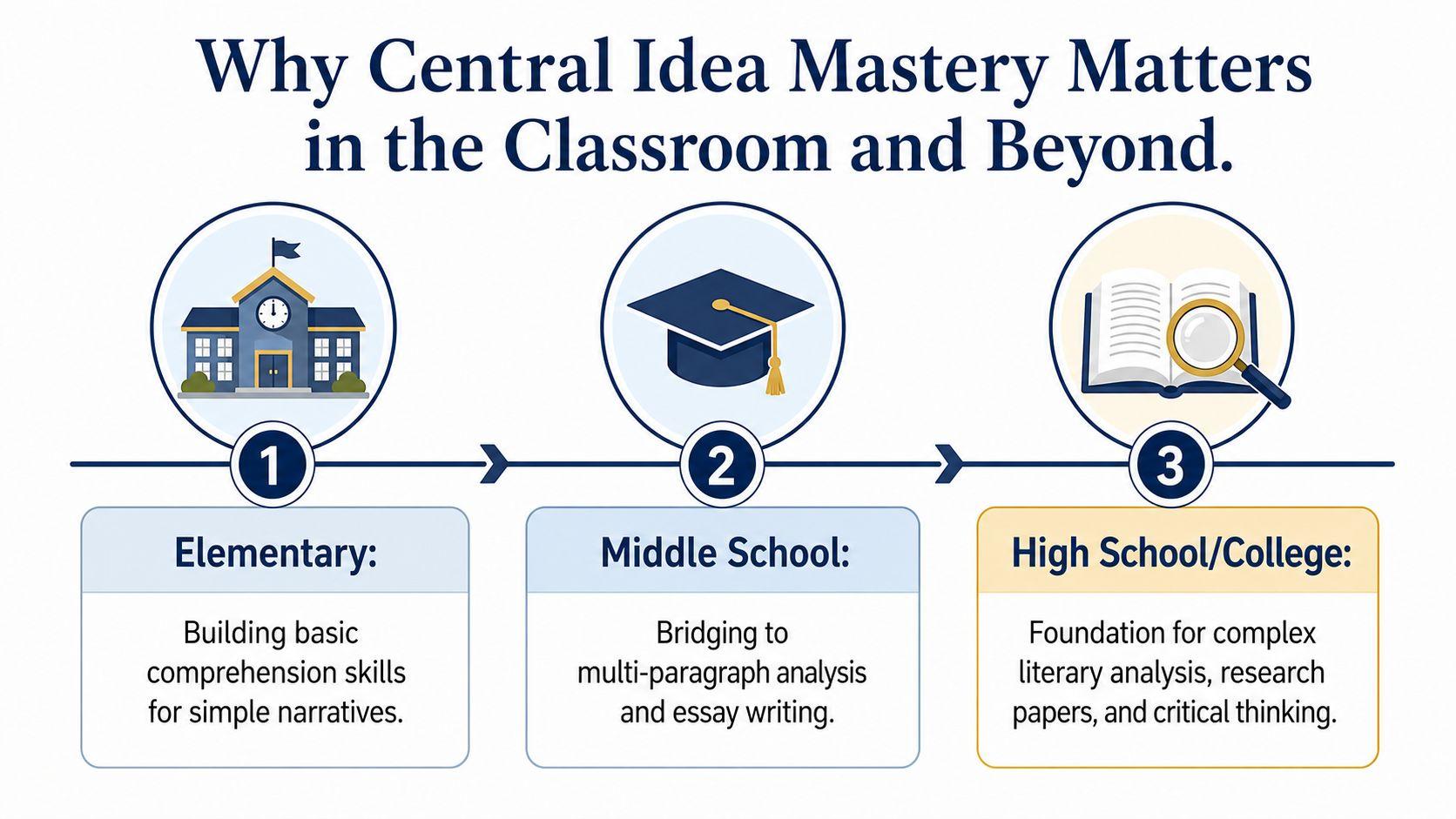
Central idea is one of those skills that looks small but offers significant benefits. Students use it in discussion, reading comprehension, essay writing, and test prep because it trains them to move from details to meaning. Educational resources have increasingly treated it as a bridge between basic understanding and deeper analysis, especially as students move from short passages to longer works and more complex interpretations (Khan Academy's reading guidance).
Why teachers keep returning to it
At the classroom level, central idea helps students organize their thinking. It keeps a response from drifting into plot summary, and it gives writing a clear spine. Once a student can name the author's claim, evidence selection gets easier because the student knows what counts as support.
That's also why central idea shows up so often in reading standards and test-prep materials. The question isn't just whether a student can remember what happened. It's whether the student can explain what the author is doing with those events.
Why it keeps paying off later
In higher grades, the skill grows instead of disappearing. Students move from identifying a point in a short passage to tracking motifs, shifts in character, and authorial purpose across longer works. That progression matters in research papers and literary essays, where a weak central idea usually leads to scattered evidence.
If you're looking for an example of related reading support, Storyloft's discussion of character motivation can help students see how actions and choices reveal deeper claims in a text, especially when they're trying to connect what a character wants to what the author is saying about that want (Storyloft's character motivation guide).
Central idea also strengthens discussion. When students can name a claim and point to evidence, they stop guessing at answers and start arguing from the text. That habit carries into every subject where reading matters.
Practice Questions and a Self-Check Framework
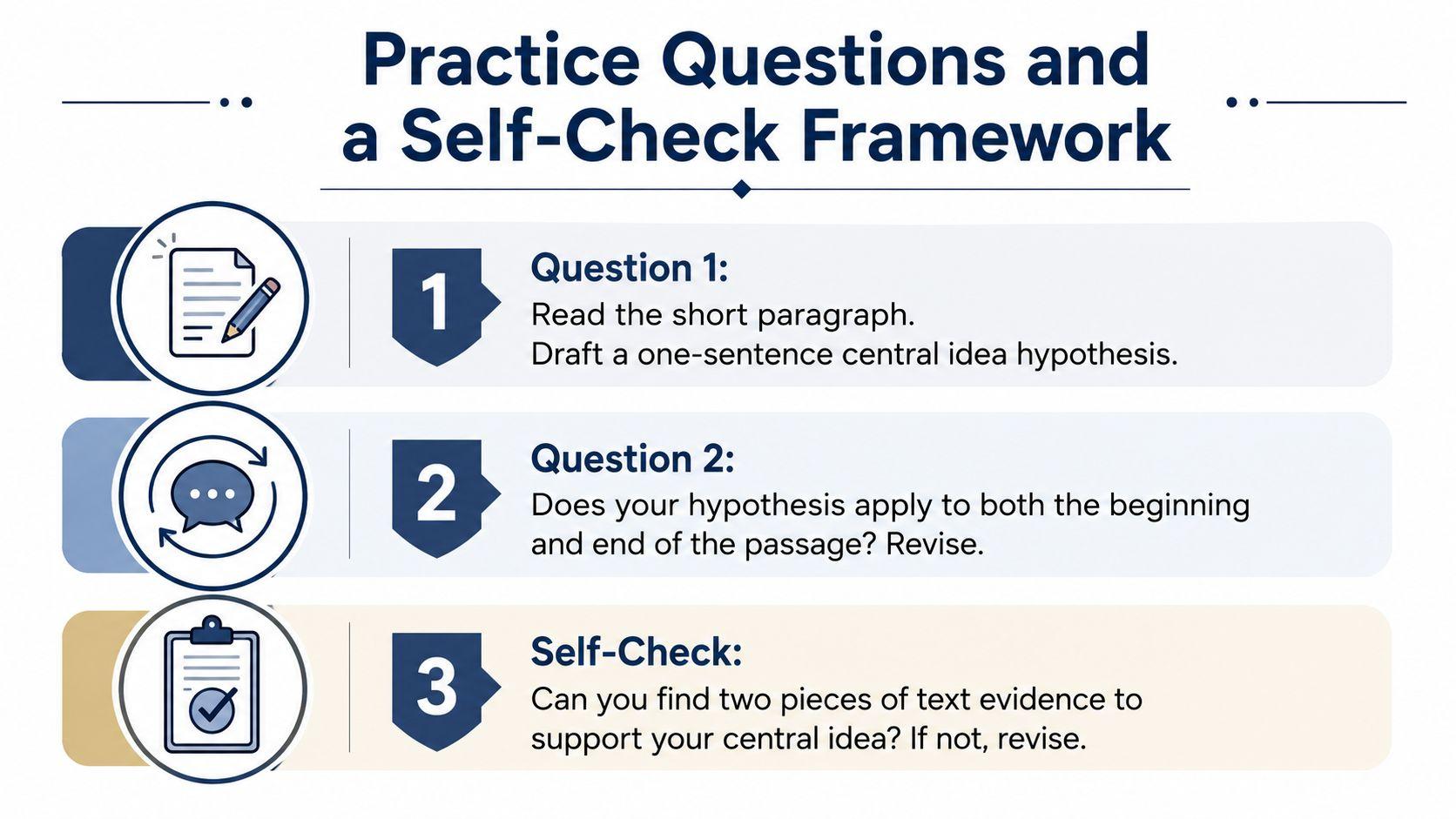
The fastest way to get better is to practice on short passages and force yourself to defend your sentence with evidence. Use these prompts with any story, article, or poem you're reading.
Try these prompts
- Passage 1: A character keeps helping neighbors even after being ignored. What is the author saying about kindness?
- Passage 2: A scientist changes methods after several failed trials. What does the text suggest about persistence?
- Passage 3: A poem repeats images of doors, keys, and locked rooms. What larger idea connects those details?
Use 1Chat's FAQ page if you want a quick way to ask for a passage, then draft your own central idea before checking any response. Its chat-based format can help you generate practice text and compare your sentence to the details you notice (1Chat FAQ).
Self-check before you submit
- Does my sentence go beyond the topic? If it only names the subject, it's too thin.
- Does it fit the whole passage? Check the beginning, middle, and end.
- Can I point to evidence? If you can't find support, revise the claim.
A strong central idea statement should feel like a hypothesis you can defend, not a guess you hope the teacher accepts. When you can say what the author is arguing, not just what the text mentions, you've cracked the code.
If you want to get better at central idea questions, pick one passage from your next assignment, write a one-sentence claim, and test it against the evidence before class. Then compare your draft with the text line by line, because that's where confidence starts to grow.