You're writing an essay about school uniforms when your teacher writes counterclaim in the margin. Down the hall, a paralegal uses the same word in a court filing about an unpaid invoice. The label is identical, but the task is not. In an essay, a counterclaim is the strongest opposing view you acknowledge and answer. In a lawsuit, it's an independent claim filed by a defendant against the opposing party.
What This Article Will Untangle
The confusion is understandable because both meanings involve responding to someone else's claim. Think of the word as describing two versions of the same basic move: the other side puts forward a position, and you answer with a competing position of your own.
For a student, that answer belongs inside an argument. You might argue that school uniforms improve focus, then recognize that uniforms can create a financial burden for families before explaining why your main position still stands. The counterclaim strengthens the essay because you're dealing with a serious objection rather than pretending it doesn't exist.
For a small-business owner or curious reader, the legal meaning is more formal. A defendant who has been sued over payment might assert that the plaintiff breached the contract first. That demand can affect evidence, discovery, settlement discussions, and the relief each side seeks. It isn't just a clever rebuttal in a paragraph.
Practical rule: First identify the setting. If you're writing for a teacher, think argument and evidence. If you're responding to a complaint in court, think pleading, procedure, and requested relief.
The examples ahead keep those paths separate while showing their shared logic. You'll see a clear definition, a payment-dispute example from civil litigation, and student-friendly argumentative paragraphs about uniforms and remote work. You'll also get practical tools for building a counterclaim, refuting one, and translating the term from classroom language into courtroom language.
The point isn't to make legal writing sound like an essay or to turn an essay into a legal document. It's to help you choose the right meaning before you start writing.
What a Counterclaim Actually Means
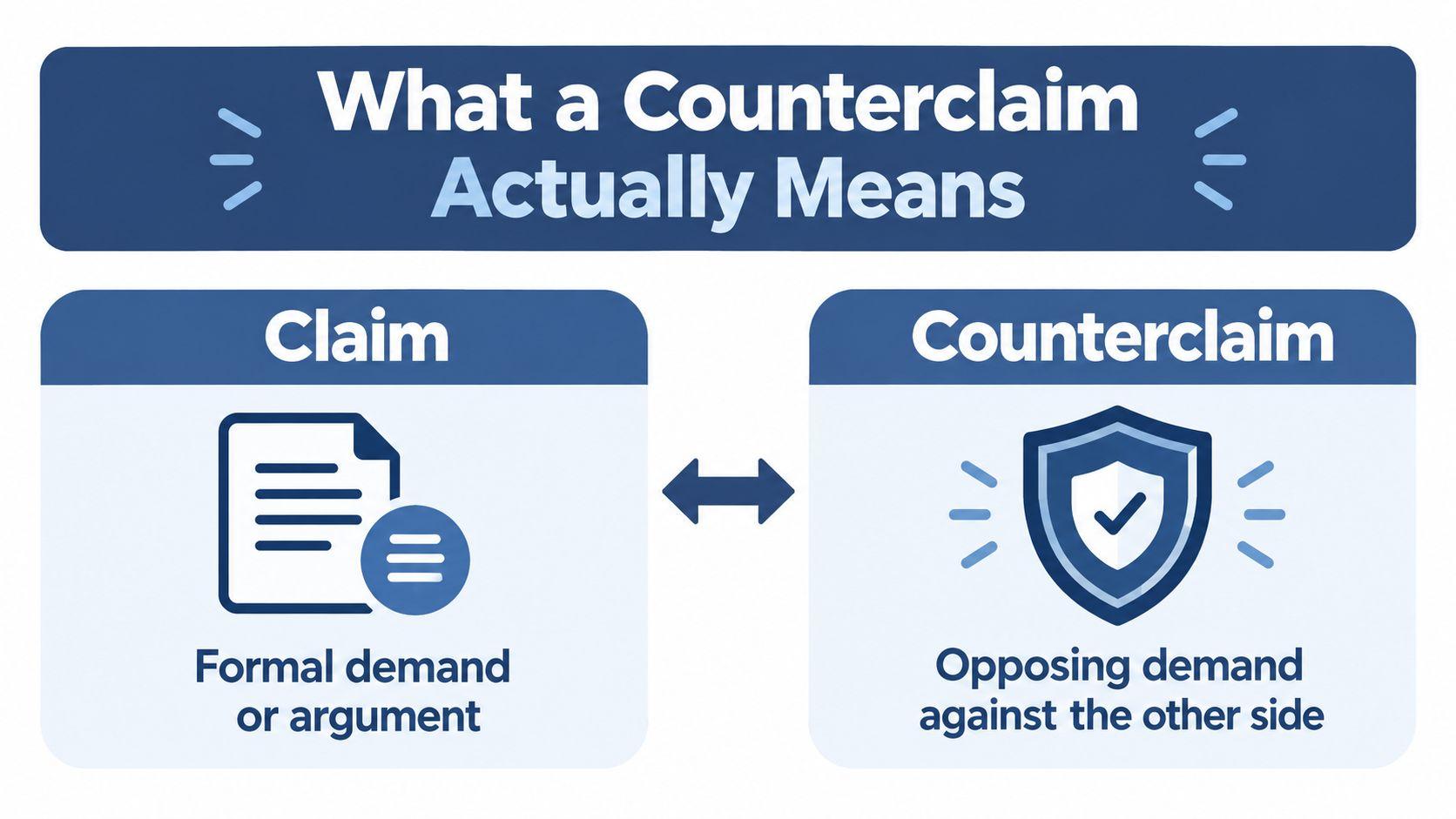
A counterclaim is an opposing demand or argument raised against the other side's claim. In academic writing, the “other side” is the position you're challenging. In civil litigation, it's usually the plaintiff who started the case. Cornell Law School describes a legal counterclaim as an independent claim for relief brought by a defendant against the opposing party, rather than merely a denial of the original allegations (Cornell Law School's definition of counterclaim).
A useful image is a pair of fencing gloves. One person makes the first move with a claim. The other person doesn't merely block it. They may also turn the movement back toward the first person with a competing demand. In an essay, that competing demand is an opposing reason. In court, it can be a request for damages, an injunction, or a setoff.
Four terms beginners often mix up
Rebuttal responds to an argument or piece of evidence. In an essay, you might say that uniforms cost money but that schools can provide assistance. In a lawsuit, a response may challenge the plaintiff's evidence without creating a separate demand for relief.
Counterclaim asserts an opposing claim. In an essay, it might be, “Some families oppose uniforms because the required clothing adds a financial burden.” In court, it might be, “The plaintiff breached the agreement and owes the defendant damages.”
Defense denies liability or offers a legal justification. A defendant who says, “I already paid the invoice,” is presenting a defense to nonpayment. That statement doesn't automatically ask the plaintiff to pay the defendant.
Cross-claim is a claim brought by one party against a co-party in the same lawsuit. It's different from a counterclaim against the opposing side. For example, one defendant may assert that another defendant must contribute to any loss.
The academic version often appears as a paragraph with a claim, concession, and refutation. The legal version appears in a formal pleading and must connect alleged facts to a legally recognized basis for relief. Treating the two as interchangeable can cause a student to write a vague paragraph or cause a business owner to underestimate the requirements of a court filing.
How Counterclaims Work Inside a Lawsuit
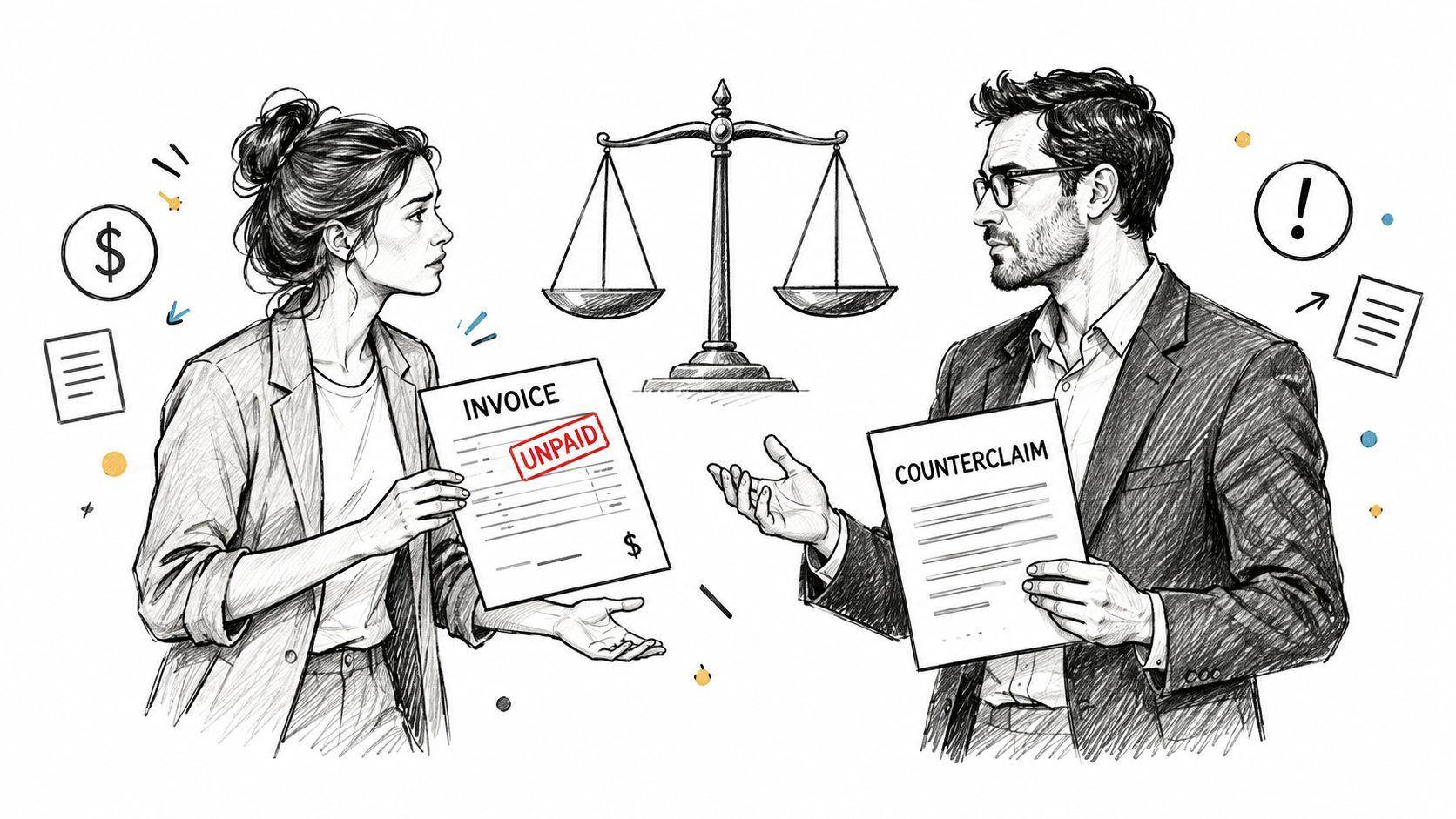
Consider a simple payment dispute. A freelancer says a client failed to pay for completed website work and files a lawsuit seeking the unpaid amount. The client answers that the work was defective, didn't meet the contract's specifications, and caused a business loss. If the client formally seeks relief based on those allegations, the client may assert a counterclaim.
The defendant usually raises the counterclaim in the answer or another permitted pleading. The filing needs to identify the relevant parties and court, state the factual basis, connect those facts to a legal cause of action, and explain the relief requested. The exact procedure depends on the jurisdiction, the court, the contract, and the applicable rules.
The case now has two connected demands
The freelancer's original claim asks the court for relief. The client's counterclaim asks the court to grant relief to the client. The court may address the related claims in the same case, and the outcome can involve payment to one side, payment to the other, a setoff, or dismissal of one or both demands if the evidence or law doesn't support them.
A counterclaim can also expand the practical scope of the dispute. The parties may need to exchange contracts, drafts, messages, invoices, revision requests, and records showing what happened after delivery. Discovery can become broader because each side must investigate not only the original claim but also the new allegations.
The historical framework matters here. The Federal Rules of Civil Procedure adopted in 1938 codified the distinction between compulsory and permissive counterclaims in Rule 13, helping create a nationwide federal framework. The rule also reflects a broader effort to handle related claims together rather than forcing parties into duplicative litigation.
Two traps to avoid
- A counterclaim isn't a motion to dismiss. A motion to dismiss argues that the original case has a legal or procedural defect. A counterclaim asserts that the defendant has a claim for relief.
- A counterclaim doesn't erase the original lawsuit. The defendant still needs to respond to the complaint and follow the court's deadlines. Raising a new claim doesn't excuse an unanswered original claim.
Because pleadings can affect rights and deadlines, a person facing a real lawsuit should review the complaint and applicable rules carefully and consider speaking with a qualified lawyer. A classroom example can teach the structure, but it can't substitute for jurisdiction-specific legal advice.
Example of a Counterclaim in an Argumentative Essay
An argumentative essay counterclaim usually follows a recognizable pattern. The writer states the opposing view accurately, concedes a valid point, and then explains why the main argument remains stronger. Academic argumentation materials describe this as a claim-plus-evidence structure, where the opposing position should be supported with reasons or evidence before the writer responds (an explanation of counterclaims in argument writing).
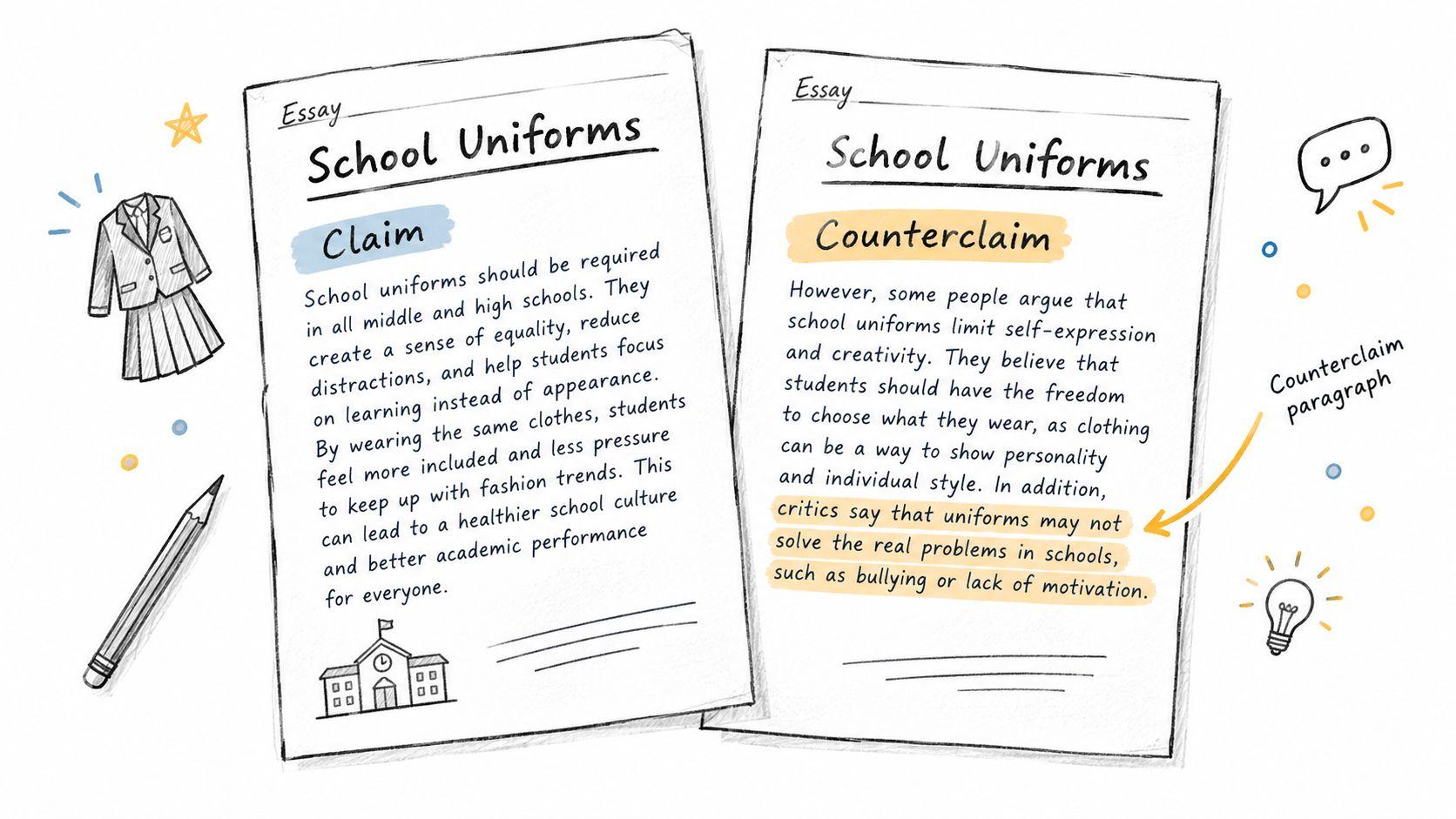
School uniforms
Claim sentence: School uniforms can improve the learning environment by reducing visible competition over clothing and helping students treat school as a focused academic space.
Concession sentence: Some families reasonably object that required uniforms add a cost, especially when students need particular shirts, trousers, skirts, shoes, or seasonal items.
Refutation sentence: However, that concern supports a better uniform policy, not necessarily the removal of uniforms, because schools can use affordable clothing requirements, secondhand exchanges, and assistance for families who need it.
Complete paragraph: School uniforms can improve the learning environment by reducing visible competition over clothing and helping students treat school as a focused academic space. Some families reasonably object that required uniforms add a cost, especially when students need particular shirts, trousers, skirts, shoes, or seasonal items. However, that concern supports a better uniform policy, not necessarily the removal of uniforms, because schools can use affordable clothing requirements, secondhand exchanges, and assistance for families who need it. A strong policy should address the financial objection directly while preserving the argument that a shared dress standard can reduce distractions.
The counterclaim works because it doesn't caricature the opposing side. The writer concedes a genuine problem, then answers it with a specific response. A weak version would say, “Some people disagree, but they're wrong.” That isn't a refutation. It's a dismissal.
Remote work
Claim sentence: Hybrid remote work can help employees protect concentration while still giving teams opportunities to coordinate in person.
Concession sentence: Critics correctly point out that remote schedules can make spontaneous collaboration harder, particularly when colleagues need quick feedback on a shared task.
Refutation sentence: However, a collaboration gap doesn't prove that every task requires daily office attendance, because teams can define shared meeting times, document decisions, and reserve in-person sessions for work that benefits from direct interaction.
Complete paragraph: Hybrid remote work can help employees protect concentration while still giving teams opportunities to coordinate in person. Critics correctly point out that remote schedules can make spontaneous collaboration harder, particularly when colleagues need quick feedback on a shared task. However, a collaboration gap doesn't prove that every task requires daily office attendance, because teams can define shared meeting times, document decisions, and reserve in-person sessions for work that benefits from direct interaction. The strongest conclusion is conditional: hybrid work is more persuasive when the team's communication practices match the work it performs.
Notice the transitions. Phrases such as “some argue,” “however,” “although,” and “the evidence shows” tell the reader what function each sentence serves. You can find further writing and research support through 1chat's writing and AI workspace, but the reasoning still has to come from you.
Use evidence that answers the objection directly. If the concession concerns cost, use cost-related evidence or a practical solution. If it concerns collaboration, use evidence about communication, workflow, or the type of work involved. The refutation should be more than a louder assertion. It should explain why the opposing point is limited, incomplete, or outweighed in the circumstances your thesis addresses.
How to Write and How to Refute a Counterclaim
A reliable counterclaim paragraph can be built in four moves. The order matters because readers need to understand the opposing position before they can judge your response.
Build the opposing side fairly
First, state the opposing view. Name the actual objection, not an exaggerated version. For a uniforms essay, write, “Some families argue that required clothing creates an unfair financial burden.” For a remote-work essay, write, “Some managers argue that distributed schedules weaken quick collaboration.”
Next, acknowledge the strongest point. A concession shows that you understand why a reasonable person might disagree. It doesn't mean you've abandoned your thesis. It means you're separating the objection's valid part from the conclusion you reject.
Then, pivot clearly. Use a transition that signals a change in direction. “However” is useful, but you can also write “Even so,” “That concern matters, but,” or “The stronger conclusion is.”
Finally, refute with reasoning and evidence. Explain what the objection misses. A uniform policy may address cost through assistance and exchanges. A hybrid-work policy may address collaboration through scheduled coordination and shared documentation. The answer should connect directly to the original claim.
A strong refutation doesn't pretend the objection is foolish. It shows why the objection doesn't defeat the thesis.
Sentence and paragraph templates
Use this sentence-level pattern when you need a quick start:
Some may argue that [opposing view]; however, [your response] because [reason or evidence].
A fuller paragraph can follow this structure:
- Opposing view: Some readers argue that [specific objection].
- Concession: This concern is reasonable because [valid point].
- Pivot: However, it doesn't settle the issue because [limitation or distinction].
- Evidence: [Relevant evidence, example, or source] shows that [support for your response].
- Return: Therefore, [reconnect to the thesis].
For uniforms, the final sentence might return to the idea that a carefully designed policy can preserve academic focus while reducing financial hardship. For remote work, it might conclude that schedule design, rather than office presence alone, determines whether collaboration succeeds.
Refute someone else's counterclaim
When another writer raises a counterclaim against your position, don't answer every sentence at once. Use a compact three-part method:
- Find the weak assumption. Ask what the opposing argument assumes without proving. A remote-work critic may assume that spontaneous conversation is the only effective form of collaboration.
- Name counter-evidence. Provide a fact, example, rule, or distinction that tests that assumption. Shared documents, planned meetings, and task-specific office sessions may offer other collaboration methods.
- Close the loop. Explain why the original claim still follows. Don't leave the reader to make the connection.
Readers who want to practice identifying the logic of a countering move can use this LSAT Lab question breakdown. The same habit applies in essay writing: identify what a statement is trying to challenge, then assess whether it defeats the reasoning.
Legal Versus Academic Counterclaims Compared
The quickest way to choose the correct meaning is to compare the setting, the speaker, and the consequence. Both versions answer an existing claim, but they operate at different levels of formality.
| Dimension | Legal Counterclaim | Academic Counterclaim |
| Where it appears | In a civil lawsuit pleading | Inside an argumentative essay or debate |
| Who raises it | A defendant against the opposing party | A writer against an opposing position |
| What triggers it | A plaintiff files an original claim | A thesis faces a reasonable objection |
| What form it takes | Alleged facts, legal basis, and requested relief | Opposing view, concession, rebuttal, and evidence |
| What it requires to succeed | Sufficient facts, applicable law, procedure, and proof | Accurate representation, sound reasoning, and relevant evidence |
| What follows | The court may decide connected claims, set off amounts, or grant or deny relief | The paragraph makes the thesis more credible and complete |
A legal counterclaim can change the direction of the entire case. An academic counterclaim changes the quality of one argument. That difference should guide your language. A student can write, “Some readers argue that uniforms are expensive.” A defendant needs to identify the factual allegations and legal relief supporting the formal claim.
Common mix-ups
- Essay versus pleading: An essay paragraph doesn't need a court caption, jurisdictional basis, or formal demand for damages. A legal filing may require all of those elements.
- Counterclaim versus rebuttal: A rebuttal answers an opposing point. A counterclaim presents the opposing claim itself. Writers often use the terms loosely, but the distinction helps you organize the paragraph.
- Counterclaim versus cross-claim: A counterclaim targets the opposing party. A cross-claim targets a co-party in the same lawsuit.
- Acknowledgment versus surrender: Conceding a valid concern doesn't mean accepting the opposing conclusion.
For more research-oriented writing support, 1chat's research workspace can help you organize questions and source material, but you should still verify evidence and follow your assignment or court's requirements.
Rule of thumb: If the counterclaim asks a judge for relief, it's legal. If it helps a reader test a thesis, it's academic.
Key Takeaways and Ready-to-Use Templates
A student may answer an opposing view in four moves. A defendant may assert a separate claim against the opposing party. The shared word, counterclaim, names different work in a classroom and a courtroom.
- Legal meaning: A defendant brings an independent claim against the opposing party in a civil case. The requested relief may include damages, an injunction, a setoff, or another remedy.
- Academic meaning: A writer presents the strongest opposing view, recognizes a valid concern, and answers it with reasoning and evidence.
- Rebuttal distinction: A rebuttal responds to an argument or objection. It does not automatically create a new claim.
- Evidence standard: An essay needs relevant support for its refutation. A legal counterclaim must meet procedural and legal requirements and establish its factual basis.
- Next step: Students should draft the four academic moves in order. Small-business owners facing litigation should check the applicable filing rules and consult a qualified lawyer before asserting a legal claim.
Copy-ready essay template
Some may argue that [opposing view]. This concern is reasonable because [valid point]. However, [explain the limitation] because [reason or evidence]. Therefore, [return to your thesis].
The pattern works like a bridge: acknowledge the other side, then lead the reader back to the thesis.
Basic legal opening
By way of Counterclaim, Defendant/Counterclaimant asserts against Plaintiff/Counter-Defendant that [state the factual basis, legal cause of action, and relief requested].
This wording is a structural prompt, not a complete pleading. Captions and titles vary by jurisdiction. The facts, cause of action, requested relief, and formatting must match the court's requirements.
Students can draft a fair objection and evidence-based response. Debaters can identify a counterclaim versus a rebuttal. Small-business owners can gather contracts, invoices, messages, and other records before seeking legal advice. For research and writing questions, consult the 1chat FAQ, or use 1chat's research workspace to organize questions and source material.
If an actual dispute is involved, collect relevant documents and contact a qualified lawyer before filing or responding.