You've probably asked some version of this already: How can I write a good song if I don't feel inspired, don't know enough theory, or keep ending up with half-finished ideas?
That's a normal place to be. Most weak songs don't fail because the writer lacks talent. They fail because the writer starts too broad, adds too much too early, or mistakes a first draft for a finished piece.
A good song usually comes from a repeatable process. You find a clear idea. You choose an angle. You build a structure that gives the hook somewhere to land. You write a melody people can sing. Then you revise until the message feels obvious and the awkward parts are gone.
That process isn't less creative than waiting for inspiration. It's more reliable.
Finding Your Song's Core Idea
The blank page causes more bad writing than lack of skill. If you sit down and tell yourself to write “a song about love,” your brain gives you clichés because the prompt is too wide.
A stronger start is to separate topic from angle. Love is a topic. “Wanting someone back after you were the one who left” is an angle. Advice on songwriting often tells writers to “find the angle,” but it often stops before showing how to compare one angle against another. That gap matters because general topics usually create vague songs, while multiple tested perspectives can produce a stronger one, as discussed in this piece on songwriting perspective and angle selection.
Use idea generation that creates raw material
Don't wait for a perfect concept. Generate ugly material on purpose, then sort it.
Three methods work well:
- Object writing: Pick one object in the room. A coffee mug, bus ticket, cracked phone screen. Write sensory details around it for a few minutes. What does it smell like, feel like, remind you of?
- Headline mining: Open a news app, local paper, or community page. Don't steal stories. Pull emotional tensions from them. Regret, distance, obsession, relief, guilt.
- Journal fragments: Write down one sentence you wish you could say to someone, but wouldn't. That sentence often contains the song.
The reason these work is simple. They give you specific language before you start rhyming. Specific language creates believable songs.
Practical rule: Don't start by asking, “What should my song be about?” Start by asking, “What tension am I trying to name?”
Test the angle before you write the song
Here's a fast filter I use.
Take one topic and force yourself to list three possible angles.
Topic: heartbreak
Weak angle: “I'm sad you're gone”
Stronger angle: “I still take the long way home so I don't pass your street”
Another strong angle: “I only miss you when life goes well”
Those last two create imagery, tension, and point of view. They suggest scenes, not slogans.
If you want another practical breakdown of idea development and how to write good songs, that resource does a good job of reinforcing the value of narrowing broad themes into something usable.
A fast decision framework
Before you commit to an idea, ask:
- Can I say the core thought in one sentence?
- Does this idea create a chorus line naturally?
- Do I know what emotional change happens from verse to chorus?
- Can I picture at least one concrete image tied to it?
If you can't answer those, the idea isn't dead. It just isn't focused yet.
A good song rarely starts as a fully formed masterpiece. It starts as a sharp emotional premise.
Building a Strong Song Structure
A song structure is a delivery system. It tells the listener when to lean in, when to expect payoff, and where the main message lives. Without that architecture, even a strong melody can feel like a loop with no destination.
One practical method recommended by songwriting educators is to build around a clear hook plus controlled variation. Start with a concise concept, write a chorus that states the emotional center in plain language, create contrast from verse to chorus, then repeat the hook with one intentional change in the final chorus. The same guidance warns against sameness. If every section carries similar rhythm, density, and contour, attention drops because there's no payoff arc. It also recommends revising until each “cringe or unsettled moment” is resolved, as outlined in this walkthrough on songwriting techniques and structural contrast.
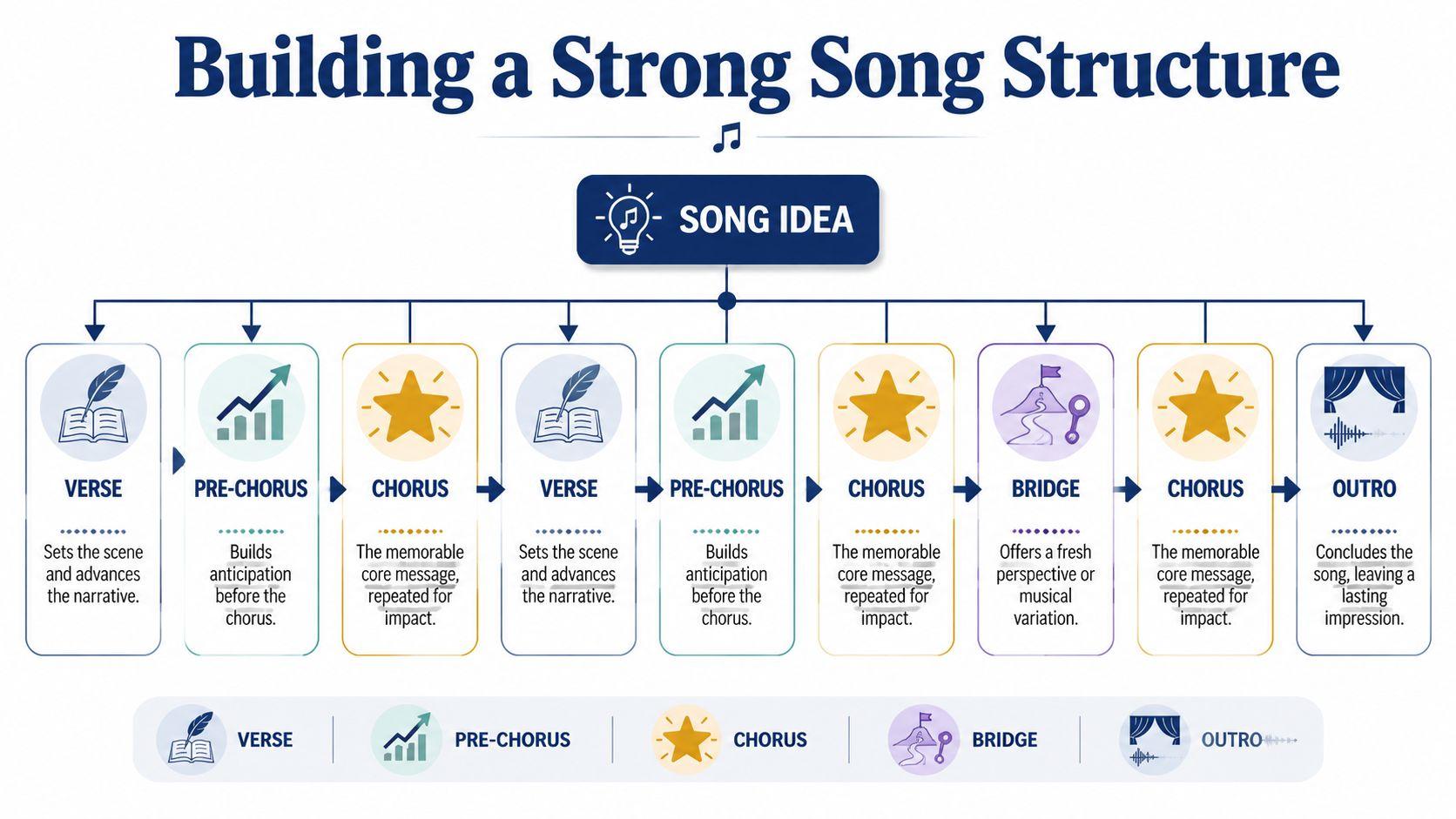
Think of each section as a job, not a decoration
Writers get stuck when they add sections because songs are “supposed to have them.” That's backward. Each section should do work.
| Structure | Pattern | Best For |
| Verse-Chorus | Verse -> Chorus -> Verse -> Chorus | Direct pop, folk, singer-songwriter songs |
| Verse-Pre-Chorus-Chorus | Verse -> Pre-Chorus -> Chorus -> Verse -> Pre-Chorus -> Chorus | Building tension before a bigger hook |
| Verse-Chorus-Bridge | Verse -> Chorus -> Verse -> Chorus -> Bridge -> Chorus | Songs that need a late perspective shift |
| ABAB form | Verse -> Chorus -> Verse -> Chorus | Clean, memorable songs with a clear emotional loop |
Use this as a guide:
- Verse carries detail. It sets scene, time, and emotional context.
- Pre-chorus lifts pressure. It prepares the emotional turn.
- Chorus delivers the point. If the listener remembers one thing, it should be here.
- Bridge changes the frame. New thought, new energy, or a complication.
- Outro leaves the aftertaste. Don't waste it on filler.
Contrast is what makes the chorus hit
If your verse and chorus feel equally loud, equally dense, and equally melodic, the listener doesn't get a sense of arrival. Good structures use contrast on purpose.
That contrast can come from several places:
- Rhythm: A busier verse can make a broader chorus feel open.
- Range: A chorus often feels bigger when the melody lifts or the phrasing stretches.
- Lyric density: Verses can carry detail. Choruses usually need fewer, stronger words.
- Harmony: A chord shift can signal emotional change without needing a complicated arrangement.
The chorus shouldn't just repeat the verse in a louder voice. It should answer it.
A practical template that works
If you're stuck, use this:
- Verse 1 gives the setup.
- Pre-chorus raises the emotional question.
- Chorus states the central hook in plain language.
- Verse 2 adds a new detail or consequence.
- Pre-chorus builds again, but slightly tighter.
- Chorus repeats for recognition.
- Bridge offers a twist, confession, or realization.
- Final chorus returns with one controlled variation.
That last variation matters. Double the hook, change the last line, or alter part of the melody. Small changes often land harder than dramatic rewrites.
If you want extra examples of beginner songwriting techniques, especially around arranging sections in a listener-friendly way, that's a useful companion read.
A strong structure doesn't make the song rigid. It makes the emotion legible.
Crafting Memorable Melodies and Harmonies
Most beginner melodies fail for one reason. They try to impress before they try to connect.
A dependable foundation for writing a good song is to keep the melody simple and singable. Songwriting guidance consistently recommends mostly stepwise motion and clear forms like ABAB, and one practical constraint is to start with only 3 chords, which helps focus the writing and makes the tune easier to remember, according to this set of professional songwriting tips.
Start with fewer choices
If you're staring at a keyboard trying to invent something “beautiful,” reduce the problem.
Pick a simple progression. You can try C - G - Am - F, or make it even narrower and use only three chords. Then do this:
- Loop the progression.
- Hum without words.
- Keep the melody inside a comfortable vocal range.
- Favor neighboring notes over big leaps.
- Stop when one phrase feels easy to remember after one listen.
That last point matters. If you can't remember your own melody ten minutes later, your listener probably won't either.
Shape melody with contour, not complexity
Melody needs direction. Think in shapes.
A rising phrase can create urgency or longing. A falling phrase often feels reflective or resolved. Repeating a note can sound conversational if the rhythm carries it. You don't need advanced theory to hear this. You just need to test whether the line feels natural when sung aloud.
Try this exercise over your chord loop:
- Pass one: sing only on “la”
- Pass two: keep the same shape but change the rhythm
- Pass three: identify the strongest phrase and repeat part of it
That repetition often reveals the hook.
If you regularly sketch ideas digitally, a resource like the 1chat blog can also help you think about lightweight creative workflows and drafting habits, especially if you like organizing rough ideas before full production.
Harmony should support, not compete
A lot of developing writers bury the melody under “interesting” chords. That usually weakens the song.
Use harmony to clarify emotion:
- Stable chords help the vocal stand out.
- One surprising change can make a chorus bloom.
- Repeated progression helps the listener lock into the hook.
A memorable melody usually wins because it feels inevitable, not because it sounds complicated.
If you're asking how can I write a good song, melody is one of the simplest answers. Write the line a friend could hum back after hearing it once. That's a harder discipline than flashy writing, and it works better.
Writing Lyrics That Connect Emotionally
Good lyrics don't just say something meaningful. They sound right when sung. That's where many songs fall apart. The idea may be solid, but the words fight the rhythm, the stress lands on the wrong syllable, or the line reads better on paper than it feels in the mouth.
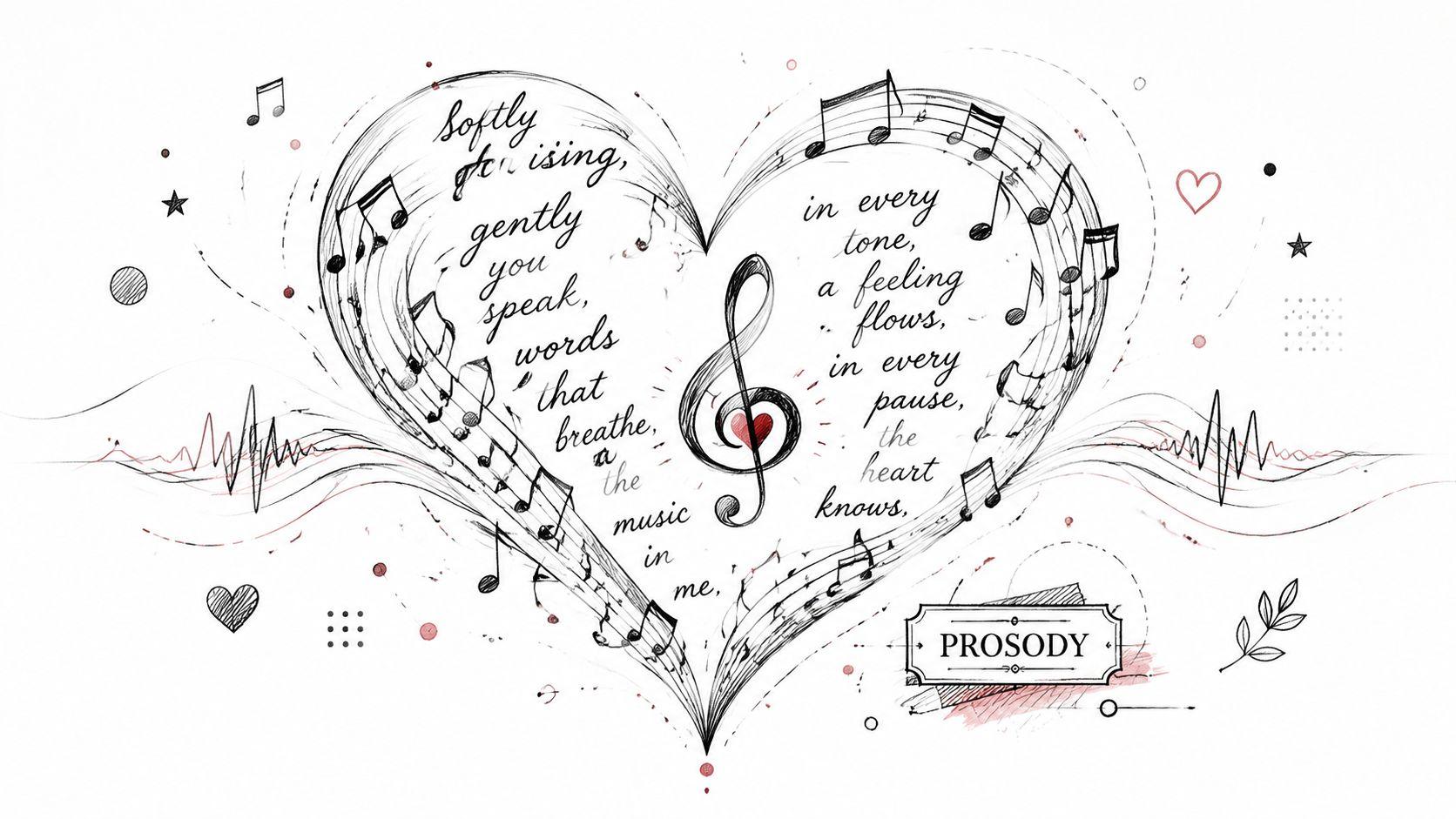
A strong workflow is to write for prosody first. That means matching the natural stress pattern and syllable count of the lyric to the melody's accents, because prosody is the “agreement between music and message.” Songwriters using this approach are also encouraged to demo songs in a stripped-down format, such as voice plus piano, so structural problems are easy to hear, as explained in this analysis of prosody, momentum, and restraint in songwriting.
Start with speech, not rhyme
Say the line out loud before you sing it. If it feels awkward in normal speech, it usually gets worse when melody stretches it.
Here's a simple before-and-after example.
Before:
“I cannot survive this condition tonight”
The meaning is clear, but nobody talks like that in a modern song unless it's a very deliberate stylistic choice.
After:
“I won't get through tonight”
The second line is cleaner, more conversational, and easier to place rhythmically.
Match stress to musical emphasis
If the natural stress of the sentence falls on one word, but your melody emphasizes another, the line sounds off even if the listener can't explain why.
Look at this pair:
- Awkward: “I was never the one you chose”
- Stronger: “You never chose me”
The second version puts the emotional weight on words that can take stronger beats more naturally. It also says more with less.
Write the line. Speak it naturally. Mark the stressed syllables. Then fit the melody to that pattern, not the other way around.
Replace abstract emotion with concrete detail
A lot of weak lyrics report feelings. Better lyrics embody them.
Instead of writing:
- I miss you
- I feel broken
- I'm lonely tonight
Try details that imply those emotions:
- Your side of the bed stays cold
- I still know the code to your door
- I talk to the dog like you're coming back
Concrete details give the listener somewhere to stand. They also help your song avoid the generic language that makes so many drafts blur together.
Cut words that don't earn their spot
Every extra word asks the listener to hold more information. Most songs improve when the lyric gets shorter.
Use this quick filter:
- Keep the title language
- Keep the image that no one else would write
- Cut filler setup if the chorus already explains the idea
- Cut formal phrases that don't match your voice
- Cut lines that exist only to complete a rhyme
A lyric connects when the listener feels that the singer means every word. Prosody helps that happen. So does restraint.
Using AI as Your Creative Songwriting Assistant
Writer's block usually isn't a lack of creativity. It's a traffic jam. You've got fragments, phrases, half-melodies, and a vague emotion, but no clean way to move them forward.
That's where AI can help, if you use it as an assistant and not a ghostwriter.

Use AI for divergence, then choose like a songwriter
The ethical use case is simple. You bring the theme, taste, emotional truth, and final decisions. AI helps you generate options faster.
That's useful for:
- breaking a blank-page freeze
- testing alternate angles for the same title
- finding fresher metaphors
- loosening a clunky line
- generating non-obvious rhyme families
- creating contrast ideas for verse and chorus
What it shouldn't do is define your emotional point of view for you. If the machine writes the whole thing, the result often sounds technically acceptable and emotionally generic.
AI is strongest at producing options. The songwriter's job is still judgment.
Prompts that actually help
If you use 1chat or a similar tool, keep your prompts narrow. Broad prompts produce broad writing.
Try prompts like these:
- Angle exploration: “Give me 10 different song angles for the topic of jealousy. Keep each one specific and emotionally distinct.”
- Hook development: “I want a chorus around the idea ‘I only miss you when life goes quiet.’ Give me 12 alternate hook lines with plain language.”
- Verse contrast: “My chorus says the relationship is over. Suggest verse scenes that imply that without repeating the chorus idea.”
- Metaphor generation: “Give me concrete metaphors for the feeling of waiting for a text that never comes. Avoid clichés.”
- Line repair: “Rewrite this lyric in a more conversational way while keeping the meaning: ‘I cannot endure this silence anymore.’”
- Rhymes with taste: “List near-rhymes and slant-rhymes for ‘home' that would work in an intimate pop or folk lyric.”
These prompts don't ask AI to be the songwriter. They ask it to act like a fast brainstorming partner.
Keep your voice in charge
A simple rule helps. Never paste AI output directly into the final lyric without rewriting it in your own language.
Use the response to ask better questions:
- Which version sounds like me?
- Which line says the same thing everyone says?
- Which metaphor is vivid but still singable?
- Which option gives the chorus more clarity?
If you're comparing tools or want a practical place to start, you can review 1chat pricing and decide whether a multi-model assistant fits your writing process. The value isn't in replacing craft. It's in protecting momentum when momentum disappears.
A blocked writer stops. A working writer finds a prompt, generates alternatives, and keeps moving.
Refining and Polishing Your Finished Song
A first draft proves you have a song. It does not prove you have a good one.
Professional songwriting advice now treats lyrics less as literal storytelling and more as emotion-first communication, with revision at the center of the process. Writers are repeatedly encouraged to record ideas, test melodies, and refine lyrics until the emotional message is clear and concise, because strong songs are built through structured iteration, as described in this guide to revision-driven songwriting.
Use a self-critique checklist
When the draft exists, stop writing for a minute and start diagnosing.
Run through this checklist:
- Can I state the song's message in one sentence?
If not, the lyric may still be wandering. - Does the chorus earn its repetition?
Repetition helps only when the hook is clear enough to deserve it. - Does every verse add new information?
If Verse 2 only rewords Verse 1, cut or rewrite it. - Is there one line I secretly know is weak?
That line needs work. Songwriters usually know where the soft spot is. - Can the song survive without production tricks?
Sing it with one instrument. If the song collapses, the writing isn't finished.
Step away, then demo simply
Distance matters. Leave the song alone for a bit, then come back and listen like an editor.
Record a rough demo with just voice and guitar or piano. This exposes:
- rushed syllables
- awkward melodic jumps
- filler lyrics
- sections that are too long
- hooks that don't land strongly enough
A stripped-back demo is also the best format for feedback. People respond to the actual song instead of getting distracted by sounds and effects.
Ask for the right feedback
Don't ask, “Do you like it?” That question gets polite answers.
Ask sharper questions:
- Where did your attention drop?
- Which line felt generic?
- Did the chorus say enough, or too much?
- What phrase do you remember after one listen?
- Did any lyric feel unnatural in the melody?
If you're also improving the quality of your rough recordings before sharing them, a practical guide to better sound production can help you clean up the presentation without hiding writing flaws.
A useful feedback circle doesn't just praise the song. It identifies where the emotion goes blurry.
Finish the song on purpose
Many writers stay in endless revision because “polishing” feels productive. At some point, revision turns into avoidance.
Finish when these conditions are true:
- the hook is clear
- the melody feels singable
- the lyric sounds natural aloud
- each section has a distinct role
- no obvious line pulls you out of the song
If you want help evaluating drafts, organizing feedback, or building a lightweight AI-supported writing process for creative work, you can reach out through 1chat contact options.
Good songs rarely arrive all at once. They're found by narrowing the idea, choosing the right angle, shaping a structure that pays off, and revising until the message feels inevitable.
If you're still asking how can I write a good song, start smaller than you think. Pick one sharp idea. Write one honest chorus. Keep the melody singable. Fix the awkward line instead of defending it. Use tools, including AI, to generate options, but keep your own taste in charge.
That's the work. It's also the craft.
And it's learnable.