You've read the novel twice. You know who leaves, who lies, and what happens at the end, but your document still contains only a title. The assignment asks for an argument, and everything you write sounds like a book report.
Learning how to write a literary analysis paper starts with a smaller task than explaining the whole book. Choose a passage, notice something specific about its language, and ask why that choice matters. Build a record of those observations before committing to a thesis, especially when the passages don't agree with one another.
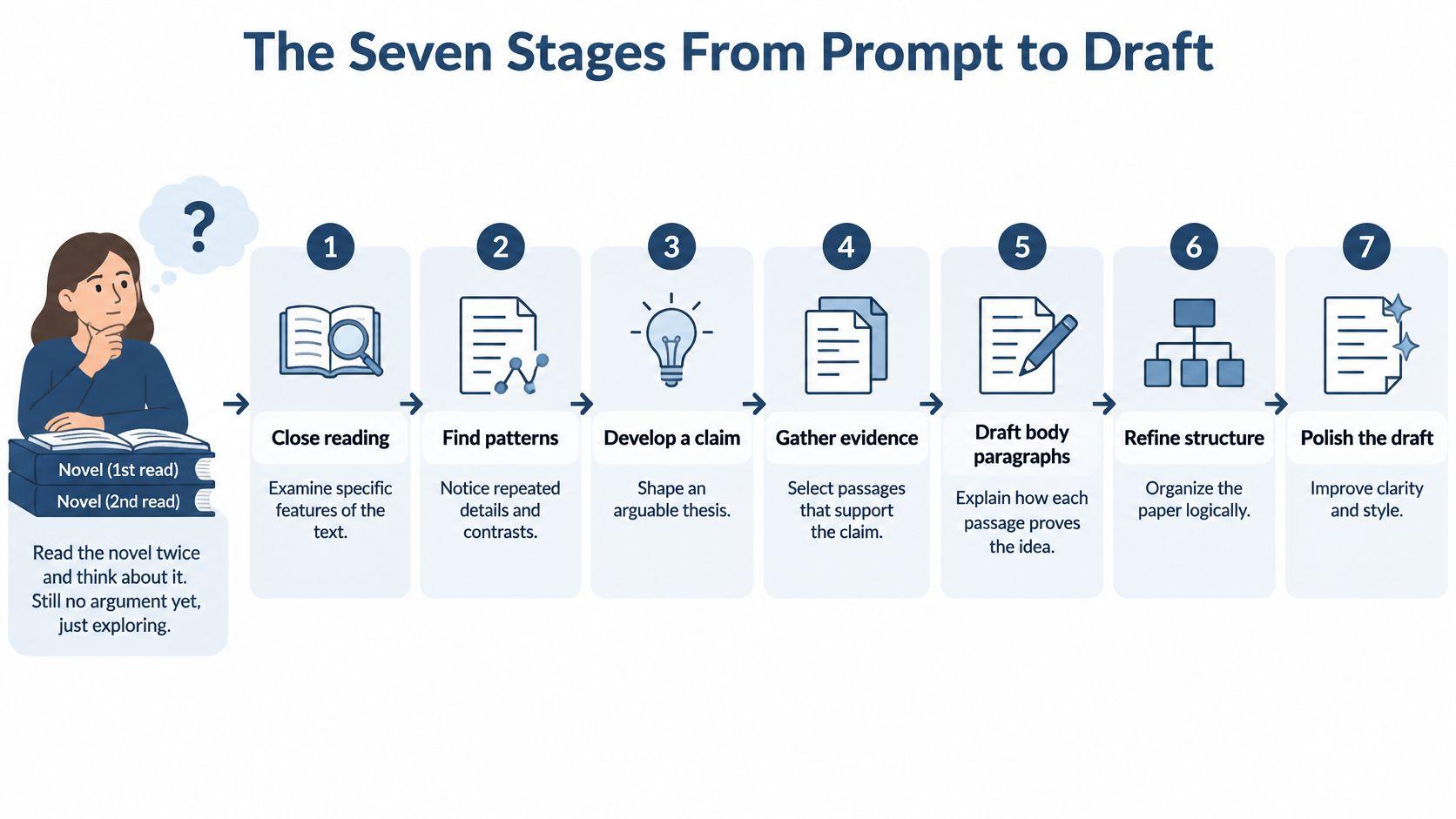
The Seven Stages From Prompt to Draft
Literary analysis examines how a text produces meaning, not just what happens in it. Through close reading, you connect features such as imagery, diction, structure, and point of view to an interpretation. Loyola University's writing guidance supports a process that begins with attentive reading and develops toward claims supported by interpreted evidence.
Treat the process as a sequence you can revisit, rather than a set of doors that lock behind you.
Move From a Question to an Argument
- Turn the prompt into a debatable question. If the assignment concerns setting, ask how a familiar home becomes threatening rather than merely identifying where events happen. Output: a focused question. Self-check: could thoughtful readers offer different answers?
- Close read relevant passages slowly. Select scenes that bear directly on your question and reread them with attention to wording. Output: marked passages with page or line references. Self-check: can you explain what changes when you read beyond the events?
- Annotate formal features. Notice diction, syntax, imagery, figurative language, tone, form, repetition, and contradictions. Output: notes attached to particular words or structural choices. Self-check: have you marked interruptions as well as repetitions?
- Cluster observations into patterns. Gather related details under provisional labels such as domestic unease or withheld speech. Output: groups of connected evidence. Self-check: does each group help answer your question?
- Formulate a working thesis. Explain how a feature shapes meaning and why that meaning matters. Output: an arguable interpretation. Self-check: have you explained how and why, rather than just named a device?
- Build body paragraphs around claims. Arrange your findings so each paragraph advances the argument rather than follows the plot mechanically. Output: a claim-based outline or draft. Self-check: does each topic sentence support the thesis?
- Integrate evidence and interpretation. Select brief quotations and explain their precise effects. Output: paragraphs in which evidence and reasoning work together. Self-check: if you remove the quotation, can you identify exactly which reasoning loses its support?
Starting point: Run the opening stages, from questioning through pattern-finding, on a single chapter or scene before drafting your introduction.
You don't need your final answer before you begin. You need a question specific enough to guide your attention and flexible enough to change when the text surprises you.
Close Reading and Logging Your Evidence
Reading for plot means following actions and consequences. Reading for form means examining how the writer presents those actions: a repeated adjective, an abrupt sentence, a change in narrative distance, or a contradiction in the narrator's account.
Close reading connects those details to larger meaning rather than treating literary devices as labels to collect. That emphasis on the text itself is central to the method described in EBSCO's account of New Criticism.
Record Words, Not Just Events
Slow down over a paragraph that feels important or puzzling. Mark repeated words, shifts in tone, unusually long or short sentences, and moments when a speaker seems to undermine an earlier statement. You don't have to know the technical term immediately, but you do need to describe what you notice accurately.
An evidence log keeps that noticing available when you write. Each entry should preserve the exact wording, the edition and location, the feature you noticed, and an interpretive question.
Sample evidence log entries
These are invented teaching examples, not quotations from a published work. The sample chapter and page reference is fictional; replace every entry with wording and locations from your assigned edition.
| Quotation | Location | Feature noticed | Question it raises |
| The house was quiet, too quiet. | Sample location only, Ch. 3, p. 41 | Repetition of quiet | Why does calm feel like a threat? |
| She folded the letter twice. | Record the page in your assigned edition | Concrete gesture that withholds detail | What might she be refusing to say? |
| Nobody asked me to stay. | Record the ending's page or line reference | Negation and an unnamed group, expressed in active voice | Whose absence shapes the ending? |
Notice that the last sentence isn't passive voice. Nobody is the grammatical subject performing the action of asking, even though the sentence denies that anyone did it. An accurate description of the wording is more useful than an impressive but mistaken label.
Keep Contrary Evidence Visible
A summary-only entry might say that a character receives a letter. That records an event but loses the analytical opportunity: the narration describes her handling of the letter while withholding its contents.
Add a separate column for evidence that challenges your emerging interpretation. If you think silence signals fear, record the passage where silence appears comforting instead of excluding it.
A passage that complicates your idea may help you write a more precise argument than a passage that merely confirms it.
Aim for a selective log you can explain, not a document full of unexplained highlights. The useful entry is the one that helps you recover both the passage and your thinking.
Writing a Thesis Someone Could Dispute
A thesis is an interpretation you must defend, not a topic you intend to discuss. Apply the dispute test: could a thoughtful reader accept your evidence but reasonably question your explanation of it?
Hamilton College's literature-writing guidance connects a strong claim to the literary feature under examination, how that feature supports the interpretation, and the interpretation's broader significance. Those connections keep your argument from stopping at identification.
Compare the Claim, Not Just the Wording
The following are practice statements, not established conclusions about particular texts. Even the more specific versions remain provisional until passages support them.
Weak and strong thesis statements compared
| Weak thesis | What fails | Stronger version |
| The novel uses a lot of water imagery | Names a device with no claim about meaning | Water recurs at moments of concealment, so the novel treats honesty as something that drowns. |
| The story is about a girl starting school | Plot summary with no interpretive question | Her lists of school rules show how she organizes away her fear, and the lists fail her at the end. |
| Macbeth is about guilt and blood | Topic instead of claim | Blood imagery grows more physical as Macbeth grows guilty, so his conscience appears on his own hands. |
The water statement proposes a relationship between imagery and concealment. To defend it, you'd need to establish that relationship across relevant passages, including any scene where water suggests openness instead.
The school statement identifies a structural change: the lists initially appear useful but eventually prove inadequate. Its strength comes from explaining a development rather than attaching a general moral to the plot.
The Macbeth statement offers a direction for investigation, but its progression claim needs testing. If the imagery doesn't become consistently more physical, revise the thesis rather than forcing the passages into that sequence.
Make the Thesis Match the Evidence
Introduce your focused interpretive problem, then place your thesis early enough that readers understand what the paper will demonstrate. You don't need a sweeping opening about humanity or literature.
Use about as a revision signal. Replace it with a more exact verb, such as exposes, contrasts, complicates, or shows, then specify the mechanism and stakes. Changing the verb won't create an argument by itself, but it helps you see where your sentence still needs an interpretation.
Building Body Paragraphs That Analyze Evidence
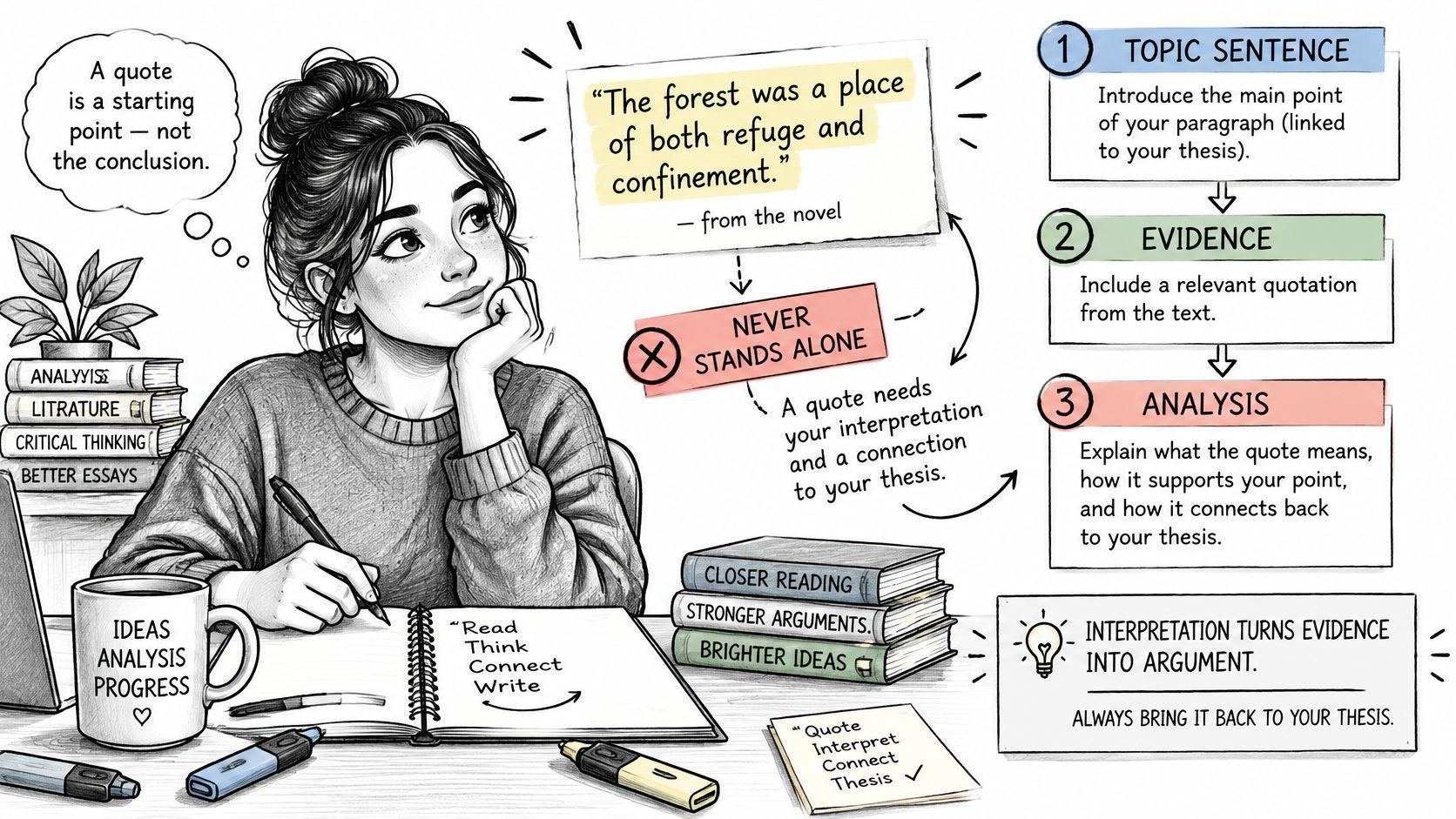
A dropped quotation leaves the reader to supply the reasoning. You might introduce a scene, insert a passage, and then announce that it supports your thesis without explaining how.
Instead, give each paragraph a topic claim, contextualized evidence, close analysis, and an argumentative link. If you need help distinguishing those jobs, AIDictation's guide to the essential components of effective paragraphs offers a useful structural reference.
Follow the Reasoning Through a Model
Suppose your working thesis argues that a narrator interprets domestic calm as a warning. Using the invented house sentence from the evidence log, you could develop this paragraph:
The narrator's correction of an ordinary description turns domestic calm into a source of suspicion. The house is described as quiet, too quiet (insert the actual page reference when working with a real text). The repeated adjective initially preserves the same sensory observation, but too changes its value: silence now exceeds what the narrator considers normal. The comma separates the observation from the anxious reassessment, allowing readers to follow that change in judgment. The house need not contain a visible threat for the narrator to experience it as unsafe.
The topic sentence makes a local claim about correction and suspicion. The evidence then gives the exact wording that requires explanation, rather than a general description of the scene.
The analytical sentences examine the modifier too and the comma. They explain a mechanism: the narrator reclassifies the same silence instead of reporting a new sound. The final sentence connects that finding to the larger argument about perceived danger.
Choose Evidence You Can Actually Explain
Prefer a brief quotation you can examine phrase by phrase. Use a block quotation only when you need the reader to see an extended feature, such as a sustained shift in perspective, and follow the assignment's formatting rules.
Apply the removal test carefully. When deleting the quotation leaves an unsupported claim, identify the exact words that justify it; when deleting it changes nothing, ask whether the quotation is necessary at all.
Avoid ending with a statement that the passage proves your point. Name what the passage lets you conclude.
Use this drafting template:
- Topic claim: [A sentence tied to the thesis.]
- Evidence: [A brief quotation with enough context and a page or line reference.]
- Analysis: [What the exact wording does and how it works.]
- Link: [How this finding advances or qualifies the thesis.]
Handling Ambiguity Translation and Unfamiliar Forms
A passage can support competing readings without making analysis impossible. Suppose a narrator denies wanting an invitation but repeatedly describes watching the door. The denial could indicate independence, while the repeated attention to an entrance could suggest a desire for recognition.
Contradiction can be the finding, not a flaw you need to conceal. James Madison University's literary-analysis guidance emphasizes explaining how textual elements work together and why an interpretation matters, a useful foundation for evaluating competing readings.
Preserve Uncertainty Without Giving Up the Claim
Begin by identifying the tension between the narrator's explicit denial and the repeated action. State your dominant interpretation, perhaps that the narrator wants an invitation but resists admitting it. Then acknowledge the alternative: watching the door might express apprehension rather than longing.
Decide between those readings by examining formal choices. Does the narrator describe arrivals with anticipation or alarm? Does the denial appear before or after a disappointment? Your argument becomes stronger when you explain why the diction or sequencing favors a reading, not when you dismiss alternatives as obviously wrong.
Interpretive discipline: State what the passage supports, what it leaves unresolved, and why that unresolved tension matters.
A suitable thesis might argue that the narrator's performance of independence depends on concealing a desire for recognition. That's more precise than declaring the character either completely independent or dishonest.
Adapt the Evidence to the Medium
The principles of close reading and contextual framing described in Lewis University's literary-analysis guide provide a starting point, but your evidence record should also reflect the text's language and medium.
What changes in analysis by text type
| Text type | What changes in the analysis | What to record as evidence |
| Standard print novel | Focus on diction, point of view, and structure | Edition and page number |
| Translated fiction | Distinguish the author's choices from the translator's wording where possible | Original term, when available, or translator note |
| Graphic narrative | Treat panel layout and image-text gaps as form | Page and panel number |
| Spoken-word poetry | Examine pauses, sound, and performance choices | Performance timestamp, transcript location, or line break |
| Ambiguous passage | Treat contradiction as a possible finding | Both readings and the textual trigger for each |
When analyzing a translation, name the edition and avoid confidently attributing an English sound pattern to the original author without checking. You can still analyze its effect in the translation you're reading.
For graphic narratives, explain what the arrangement of panels makes visible or withholds. For spoken-word poetry, distinguish a printed line break from a performer's pause. Check unfamiliar cultural references before treating an object, color, or gesture as a universal symbol.
Revise Against a Checklist Before You Submit
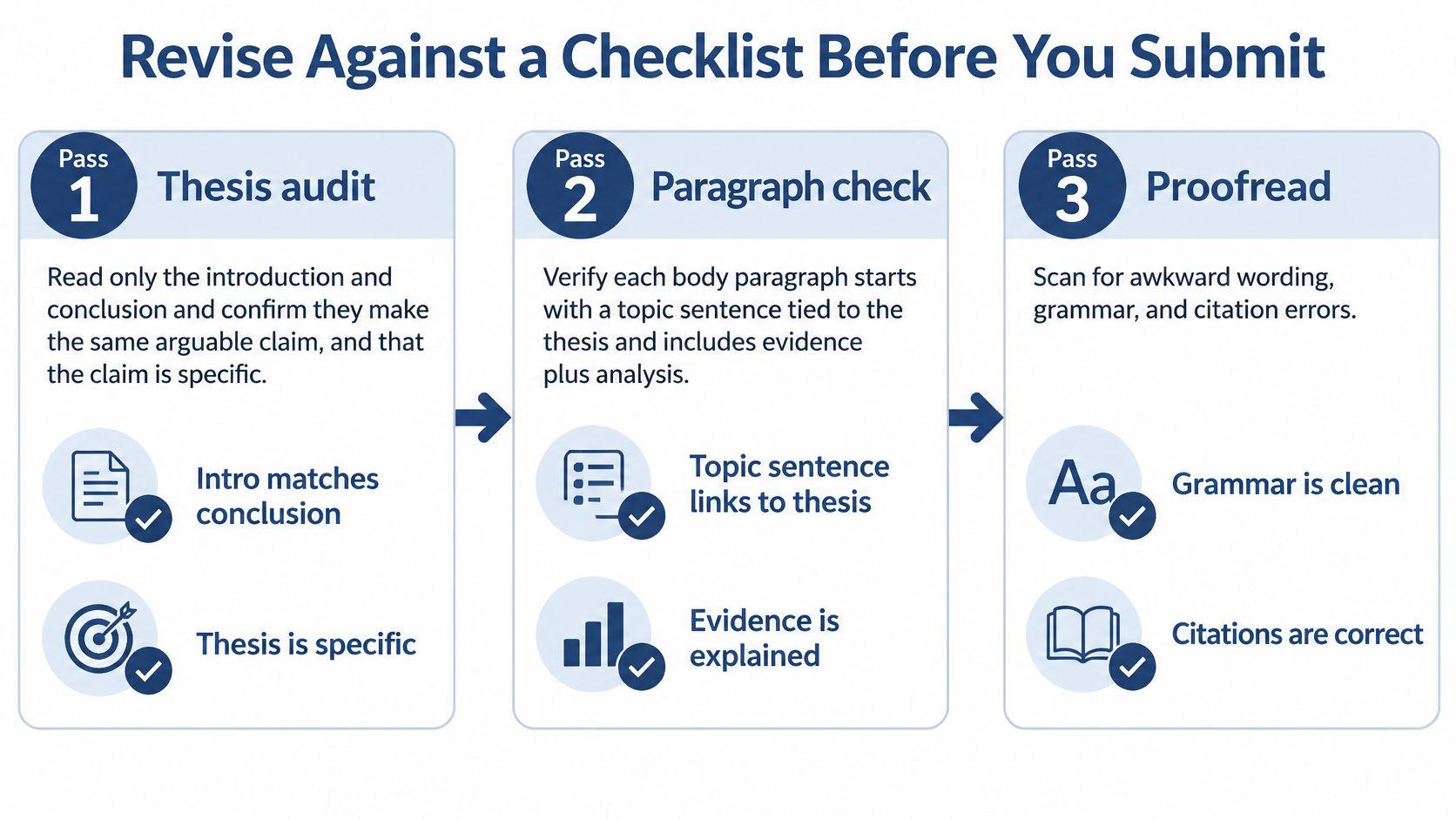
Revision should test the argument before it polishes the sentences. Correct grammar won't resolve a paragraph whose evidence points somewhere different from its claim.
Work in separate passes so you're not trying to judge interpretation, organization, and punctuation simultaneously. If you're preparing for an AP assignment, ClassLecture.ai's guidance on how to revise essays for higher AP scores can supplement your teacher's criteria without replacing them.
Check the Thesis and Evidence
For the thesis audit, read only the introduction and conclusion. Drafting may have changed your interpretation, so make sure the introduction presents the argument you developed. The conclusion should explain what readers can understand differently because of your analysis, rather than repeat the opening.
- Claim alignment: The introduction and conclusion defend the same interpretation.
- Specificity: The thesis identifies a meaningful feature and its effect.
- Significance: The conclusion explains why the finding matters to the work.
For the evidence audit, examine each paragraph's claim beside its supporting passage. Check whether your explanation accounts for inconvenient words as well as convenient ones, and verify every quotation against the assigned text.
- Support: The removal test identifies a real connection between evidence and reasoning.
- Interpretation: Each quotation receives analysis, not just a summary.
- Accuracy: Wording and page or line references match your evidence log.
- Qualification: Contradictory passages receive an explanation rather than disappearing.
Read for Precision and Submit Deliberately
During the sentence-level pass, cut plot summary that readers don't need to follow the argument. Vary repetitive paragraph openings and read aloud to catch awkward wording or claims broader than your evidence permits.
Distinguish the narrator from the author, and prefer a precise claim about the passage over an unsupported claim about what all readers feel.
- Openings: Topic sentences identify distinct argumentative steps.
- Economy: Summary supplies only necessary context.
- Scope: No sentence claims more than the text supports.
- Citations: Formatting follows the assignment's required style.
Open your draft and schedule these revision passes before submission. If your deadline allows, set it aside until the next day, then make a final read with the assigned text beside you. Submit only after you've checked that every major claim has evidence you can explain in your own words.