You're standing at a hotel check-in desk in Shanghai. The staff member is speaking quickly, you catch a few words, then lose the thread. Or maybe you're at a family dinner, trying to talk with a grandparent who speaks Mandarin while you think in English. Or you're on a supplier call, and everyone is polite, but nobody is fully sure the other side understood the last pricing or shipping detail.
That's the moment a Mandarin to English voice translator stops feeling like a gadget and starts feeling like a bridge.
A few years ago, voice translation felt narrow and unreliable. Today, it's part of the mainstream toolset. Google Translate says it instantly translates between English and over 100 other languages, and dedicated live-translation products also advertise 60+ supported languages, which helps explain why Mandarin-English voice translation now shows up across phones, web apps, and meeting tools in everyday use (travel app guidance on Chinese translation tools).
That wide availability matters because Mandarin-English translation isn't a niche edge case. It's a common need for travel, family communication, study, and business. You no longer need special hardware or a dedicated interpreter for basic interactions. In many cases, you can open an app and start talking.
Still, most reviews stop too early. They tell you whether a translator “works,” but they skip the trade-offs that shape real conversations. How fast is it? Does it keep up when two people interrupt each other? Does it protect your audio? Does it fall apart in a noisy restaurant? Is it better for a live call, or only for uploaded recordings?
Those questions matter more than a shiny demo.
If you're comparing tools and trying to understand what you're buying into, it helps to treat voice translation as a practical system, not magic. The right way to evaluate one is to look at speed, accuracy, and privacy together. If one of those breaks, the whole experience gets awkward fast.
If you want broader context on privacy-first AI tools for families and small teams, the 1chat blog is a useful starting point.
Introduction Bridging the Communication Gap
A lot of language barriers aren't dramatic. They're small, repeated moments.
You want to ask a taxi driver if they accept card. You want to explain a food allergy. You want your child to hear a great-grandparent's story without waiting for someone else to interpret every sentence. You want a factory contact to confirm a material change without misunderstanding a technical term.
Why this feels different now
What changed isn't just that software got smarter. It's that voice translation became common enough to be built into tools people already carry.
That lowers the friction. Instead of planning ahead, you can use it on the spot. Open the app. Tap the microphone. Speak. Listen. Read the on-screen text if the audio feels uncertain.
A good translator doesn't just swap words. It helps two people stay in the same conversation.
That last part is what readers often miss. Human conversation has rhythm. If a tool is too slow, too robotic, or too invasive with your data, it doesn't feel like help. It feels like a third person interrupting both sides.
Where people get confused
Many people assume all translators work roughly the same way. They don't.
Some are built for live conversation. Others are better for uploaded audio or video. Some emphasize convenience. Others put more weight on local processing or privacy settings. A few give you text, subtitles, and dubbed audio from the same source file, which is useful for media and training content, but not the same as handling a real-time back-and-forth exchange.
A Mandarin to English voice translator can be excellent in one setting and frustrating in another. That's why the smartest question isn't “Which app is best?” It's “Which tool fits the kind of conversation I need to have?”
How Modern Voice Translators Actually Work
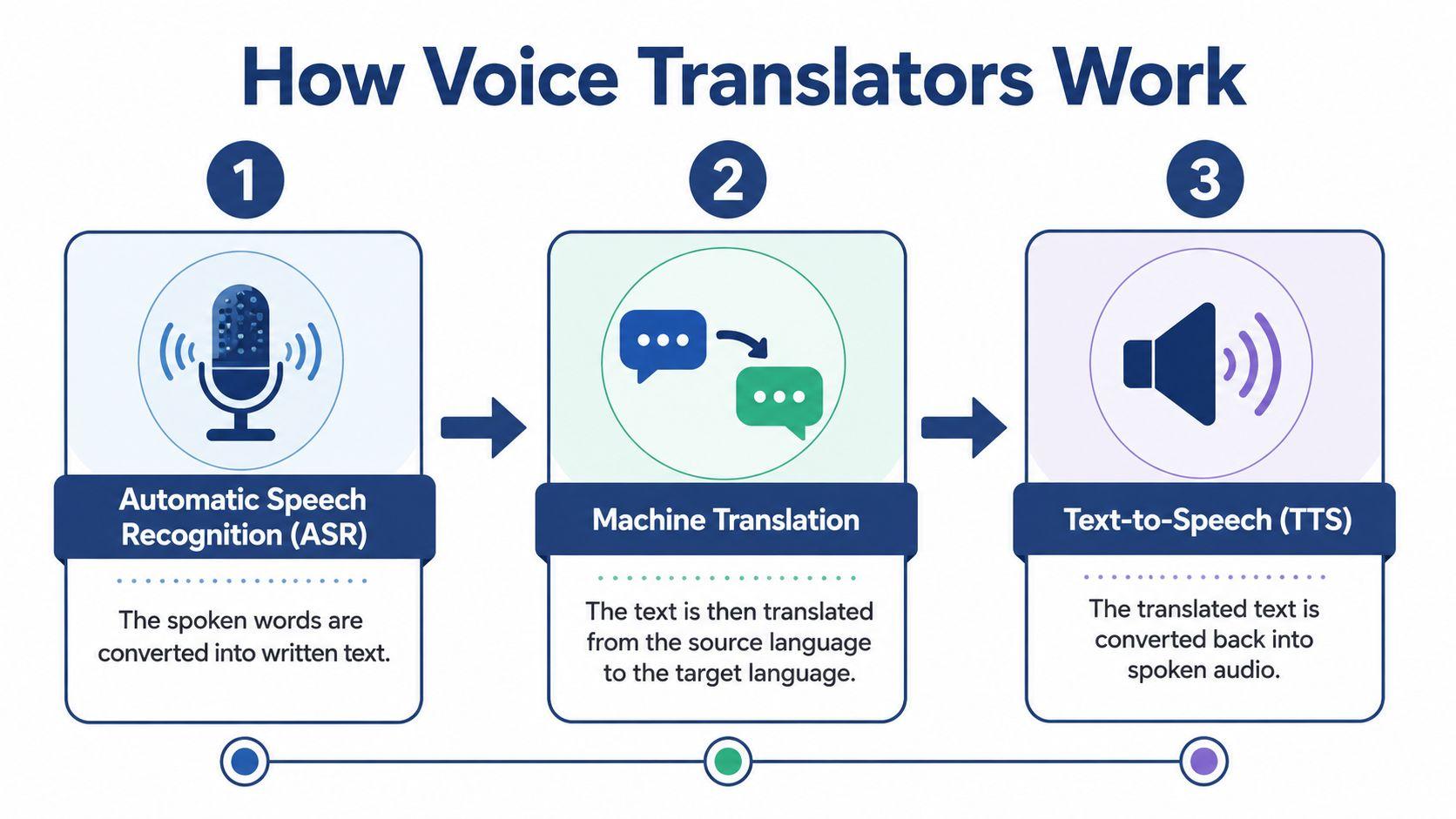
A modern Mandarin to English voice translator usually runs on a three-step pipeline. First, speech recognition turns spoken Mandarin into text. Next, machine translation turns that text into English. Then text-to-speech reads the English output aloud. One real-time product cited in market coverage reports voice and subtitle output in under 0.5 seconds, which shows how fast this pipeline has become for live use (overview of Mandarin voice translator pipelines).
Think of it like a relay team
A simple analogy helps.
Imagine three very fast helpers standing in a row:
- The listener hears the Mandarin and writes down what was said.
- The translator reads that text and rewrites it in English.
- The speaker says the English version out loud.
If any one helper stumbles, the final result gets worse.
The first helper might mishear a place name. The second might choose the wrong meaning for a short phrase. The third might speak clearly, but with timing that feels off. To the user, it all blends together as “the app translated badly,” even though the error may have started at the listening stage.
Why it's not just word replacement
People often expect voice translation to work like a bilingual dictionary. That's not how modern systems behave.
They try to capture meaning, not just swap one word for another. That matters because Mandarin often depends on context, and spoken language includes incomplete sentences, fillers, and implied meaning. A direct word-for-word conversion can sound stiff or wrong in English.
If you want a plain-language primer on the translation layer inside these systems, this piece on understanding AI voice translation gives helpful background on neural machine translation without getting too technical.
What this means in practice
Once you understand the pipeline, a lot of real-world behavior makes more sense:
- If the room is noisy, the speech recognition step may struggle first.
- If a phrase is ambiguous, the translation step may choose the wrong English meaning.
- If the result sounds unnatural, the text-to-speech step may be smooth, but the earlier steps may have already introduced errors.
- If the app feels fast, that usually means the system is processing speech in chunks instead of waiting for a full monologue.
Practical rule: When a translator makes a mistake, don't assume the whole system is broken. First ask which step likely failed.
That mindset helps you troubleshoot better and choose tools with the right strengths.
Key Factors Beyond Basic Translation
When people ask whether a translator is “accurate,” they usually mean three different things at once. Did it hear the words correctly? Did it catch the intended meaning? Did it respond fast enough to keep the conversation natural?
For live Mandarin-English use, latency is one of the biggest practical factors. Some systems report playback in less than 0.5 seconds and stream output without waiting for sentence boundaries. That matters because Mandarin is a tonal language, and when a tool lags too long, the pause feels like an interruption rather than assistance (discussion of real-time Chinese-English latency).
Speed changes the conversation
A delay doesn't just waste time. It changes behavior.
When translation comes quickly, people keep their normal rhythm. They make eye contact. They react. They interrupt a little, laugh, and clarify naturally. When translation is slow, everyone starts speaking in careful blocks. The interaction becomes formal and fragile.
That's why a fast translator often feels “smarter” even before you judge its wording.
Here's a simple explanation:
| Factor | What you notice | Why it matters |
| Low latency | Replies arrive quickly | Conversation keeps its flow |
| Higher latency | Long pauses before output | Speakers talk less naturally |
| Streaming translation | Partial output appears as you talk | Faster turn-taking, but occasional revisions |
| Wait-for-finish translation | More complete output after longer pauses | Can sound steadier, but feels slower |
Accuracy is situational
There isn't one universal accuracy score that tells you whether a tool fits your life.
A translator may do well with short travel requests and struggle with family stories full of references, nicknames, or shared history. It may handle simple supplier updates but stumble on industry-specific vocabulary. It may sound polished in a quiet office and become uncertain in a crowded train station.
The hardest cases usually involve:
- Idioms and indirect phrasing
- Fast speech with overlapping voices
- Regional pronunciation and dialect variation
- Background noise
- Short phrases that need context to translate well
Mandarin adds its own challenge
Mandarin packs a lot of meaning into short spoken units. That makes timing and segmentation important.
If the system streams partial guesses early, it may reduce waiting time. But it also risks changing the English phrasing as more context arrives. That's the core trade-off in live translation. Faster output can mean less stable output.
In a live setting, “accurate enough, right now” often beats “more polished, five seconds later.”
That's especially true in travel, family conversation, and customer support, where keeping the exchange moving matters as much as perfect phrasing.
What to test before you trust a tool
Don't judge a translator from one quiet demo. Try it with your actual use case.
- Test your environment: Use it in a café, on speakerphone, or in a hallway.
- Try your vocabulary: Say names, locations, and terms you commonly use.
- Check repair moves: When it gets something wrong, see how easy it is to repeat or rephrase.
- Watch the text on screen: Audio can sound confident even when the text reveals uncertainty.
A translator for live Mandarin conversation should feel less like a dictation app and more like a quick-thinking interpreter. If it can't keep the tempo, the rest of its features won't matter much.
Offline vs Cloud Translators The Privacy and Connectivity Tradeoff
A voice translator usually makes you choose between two comforts. Privacy and power.
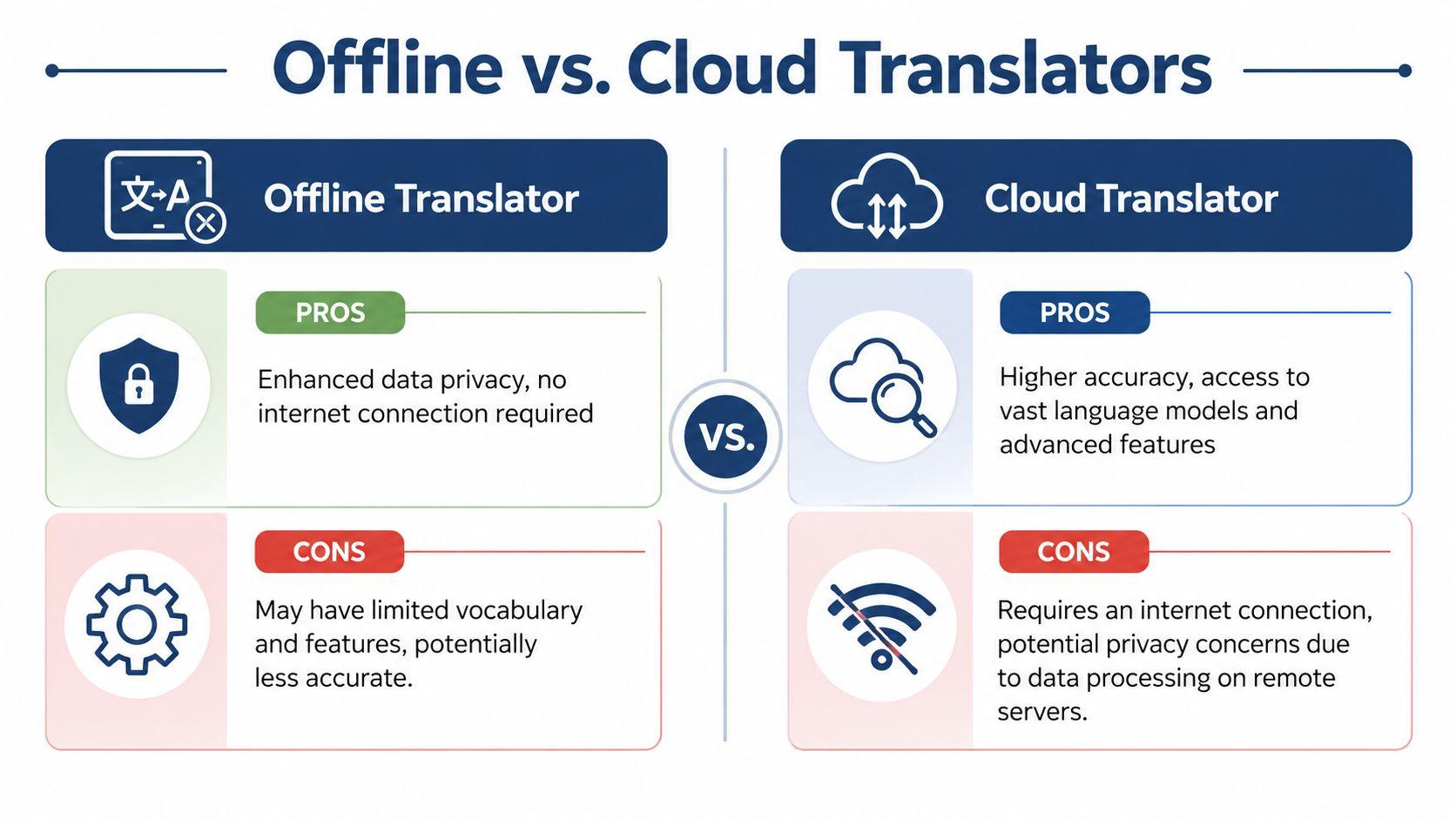
Cloud tools tend to be more feature-rich because they can send audio to stronger remote systems. Offline tools avoid that dependency, but they often make compromises in nuance, flexibility, or convenience. That doesn't make one category universally better. It means you should match the tool to the stakes of the conversation.
A side-by-side view
| Type | Strengths | Limits | Best fit |
| Offline translator | Works without a network, keeps more processing local | May feel simpler, may offer fewer advanced features | Travel, privacy-sensitive family use, weak connectivity |
| Cloud translator | Often supports broader features and smoother cross-device workflows | Needs internet access, sends data outward for processing | Meetings, customer support, richer live experiences |
When offline makes more sense
Offline translation is attractive for obvious reasons. It keeps working when the signal drops. It can be more comfortable for people who don't want spoken conversations processed remotely. And it's often easier to justify when the conversation is personal rather than professional.
That matters on family trips and in day-to-day communication with children or older relatives. If the topic is routine and the stakes are low, many people would rather have a decent local result than a stronger cloud result that raises more privacy questions.
You can also use an offline-capable translator as a backup. That's smart when you're traveling through areas where coverage is inconsistent.
When cloud is worth it
Cloud systems can be the better choice when nuance matters more than independence.
On a business call, for example, you may care about handling fast back-and-forth discussion, support for multiple output formats, and smoother live processing. Some tools also combine voice translation with transcripts, subtitles, or other workflow features. If your conversations need records, review, or follow-up, those extras can matter as much as the translation itself.
Before choosing a cloud tool, it's worth checking the provider's own privacy information from 1chat or the equivalent policy page for any product you're considering.
The right question isn't “offline or cloud?” It's “how much risk, convenience, and translation quality am I willing to trade for this specific conversation?”
That framing usually leads to better decisions than chasing a general “best app” list.
Real World Use Cases for Voice Translation
The value of a Mandarin to English voice translator shows up most clearly in ordinary life. Not in polished demos. In messy moments where two people need to understand each other and don't share a language.
Family conversations that stop feeling filtered
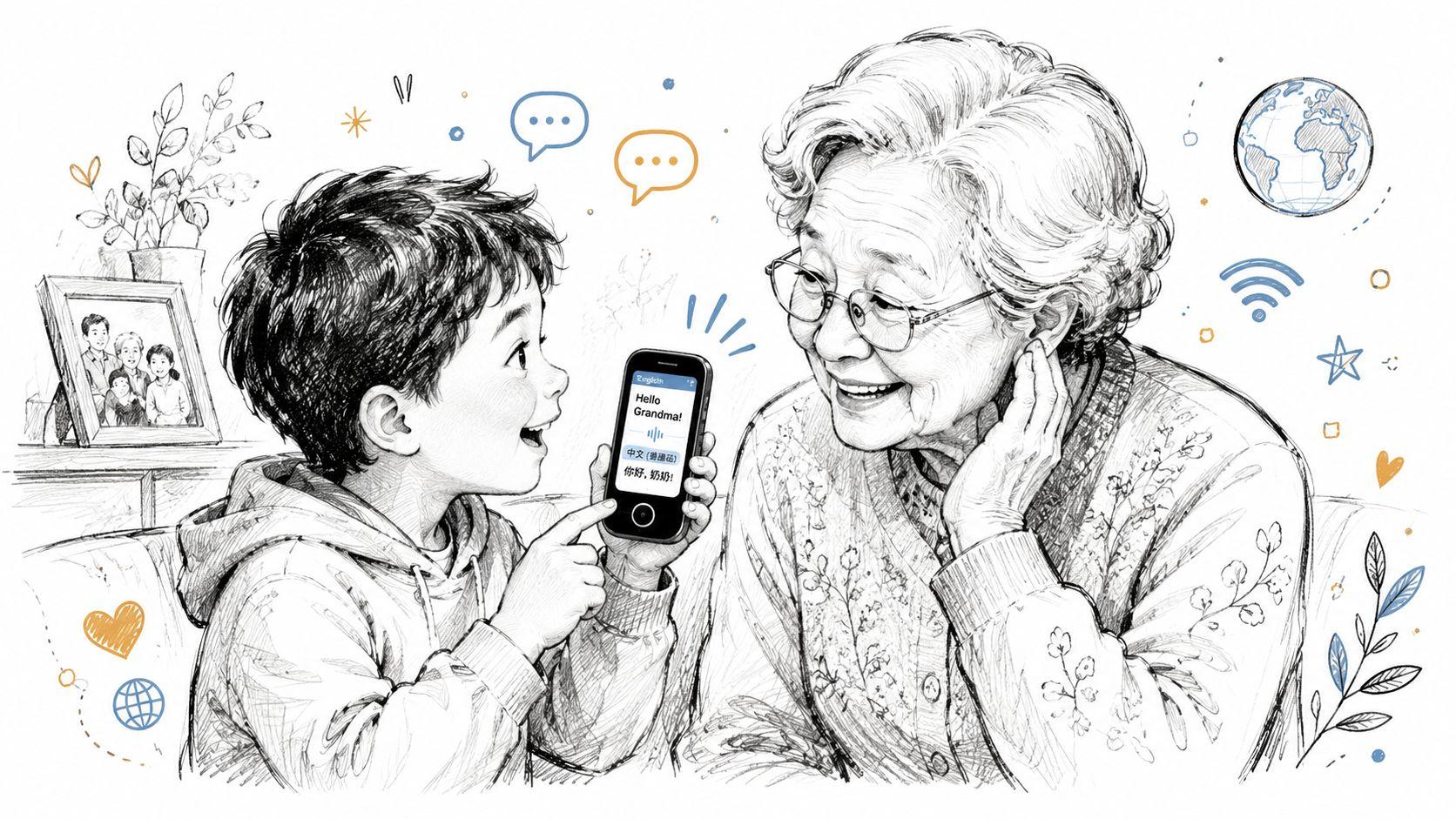
A child wants to tell a Mandarin-speaking grandparent about school. The parent usually acts as interpreter, but that changes the tone. The child speaks to the parent, not directly to the grandparent. The grandparent replies to the middle person. The warmth gets delayed.
With voice translation, even if it isn't perfect, the exchange becomes more direct. The child speaks. The device helps. The grandparent answers. They can still laugh, pause, repeat themselves, and look at each other.
That directness matters more than polished grammar.
Students who use it as a practice tool
A student learning Mandarin can use voice translation as a feedback loop, not just a rescue button.
They speak a phrase in English and compare the translated Mandarin text. Or they listen to spoken Mandarin, read the English output, and notice where their ear missed a word boundary or tone pattern. It's not a substitute for learning. It's a support rail.
This works best when the student treats the tool as a conversation mirror, not an answer machine.
Use translation to check understanding after you try first. That's where the learning happens.
Small businesses that need practical communication
For a small or midsize business, voice translation can reduce friction in supplier calls, onboarding conversations, customer support, and internal coordination across languages. It won't replace a professional interpreter for legal or highly technical negotiations, but it can help teams move routine work forward.
One underappreciated use case is media and training content. Some services support Chinese audio files up to 50 MB, analyze the audio, translate the meaning into English, and create a voice-preserved dub aligned with the original timing. That's useful when a team needs synchronized English versions of Mandarin materials for training or localization (Chinese-to-English audio translation workflow details).
Different tools for different jobs
A family may want a simple phone app with readable text.
A student may prefer a tool that makes repetition easy.
A business team may want a browser-based option that handles live conversation and recorded audio in one place. For example, 1chat is one option in this broader category because it supports AI workflows for teams and families and can fit into communication-heavy tasks beyond plain text chat.
The main lesson is simple. Don't buy a translation tool for what it promises in general. Pick it for the conversations you have.
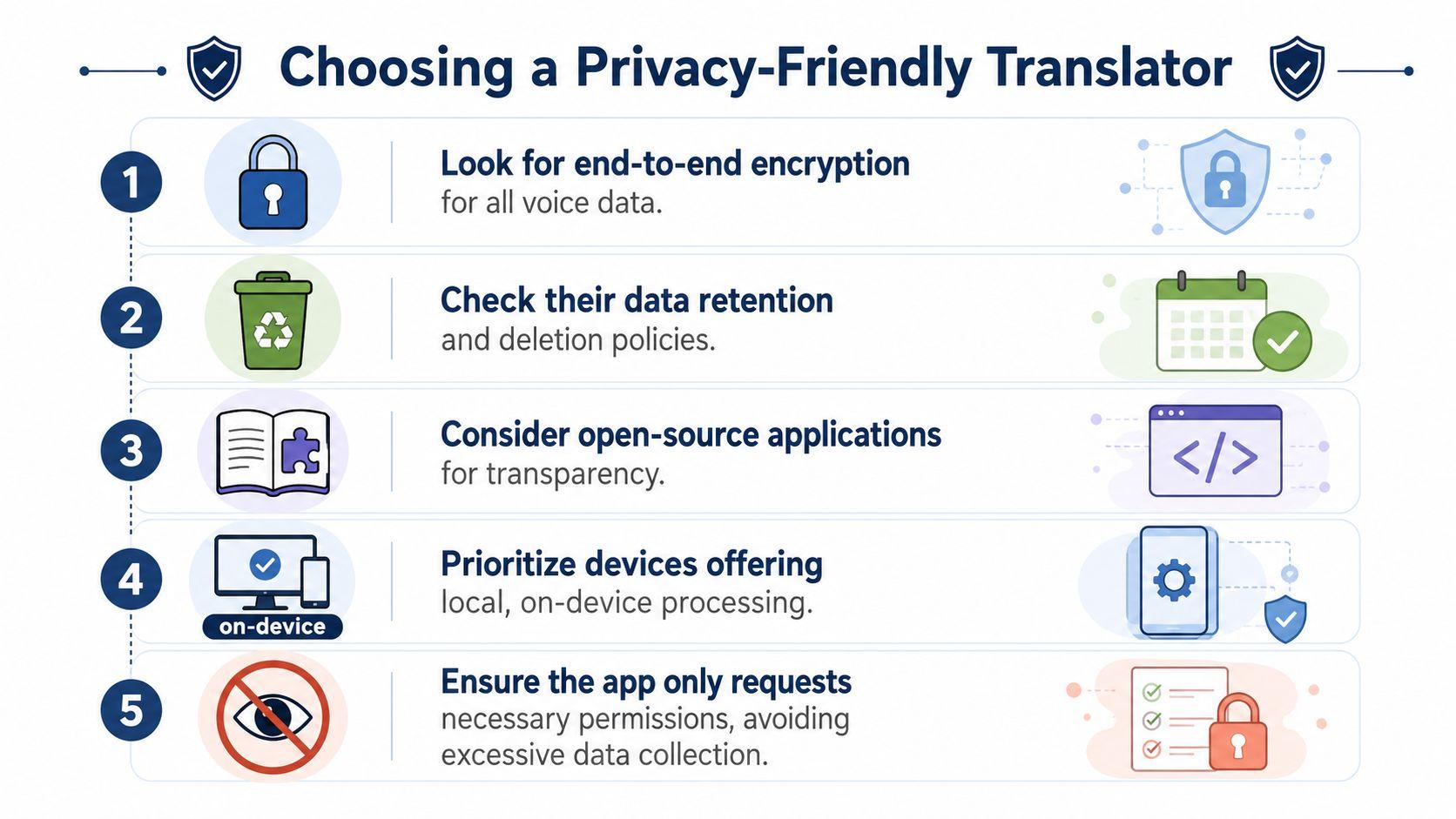
How to Choose a Privacy-Friendly Translator
Privacy isn't a bonus feature for voice translation. It's part of the product.
A translator hears what you say, often in moments that include personal details, family context, work information, or customer data. If a tool handles live Mandarin-English speech well but tells you almost nothing about what happens to your audio, that's not a small omission. It's a serious gap.
Market coverage also points out a broader problem. Many tools focus more on file uploads than live, low-latency conversation, and vendors rarely provide independent performance data for noisy rooms or Mandarin dialect variation. That makes privacy policies and on-device processing more important differentiators when you compare options (market gap analysis for Chinese audio translators).
Questions worth asking before you install
You don't need to be a lawyer to screen a translator. You need a short list of concrete questions.
- Where is audio processed: On your device, on a remote server, or both?
- Is audio stored: If yes, for how long, and can you delete it?
- Is data used for training: Some products improve models using user data unless you opt out.
- What permissions does the app request: Microphone access is obvious. Contact lists and unrelated device access are not.
- Can you review the policy easily: If the policy is vague, scattered, or hard to find, treat that as a warning sign.
What a useful policy looks like
A strong privacy page won't answer every technical question, but it should be direct about collection, retention, and user control.
For comparison, reading a clearly presented document like Voibe's privacy policy can help you see what a more explicit policy structure looks like, even if you ultimately choose another tool.
You can also check a provider's support or policy documentation, such as the 1chat FAQ, to see whether practical privacy questions are answered in plain language.
Red flags people often ignore
Some warning signs are easy to miss because they're framed as convenience.
- Automatic cloud sync with little explanation
- No clear deletion process
- Broad language about “service improvement”
- No mention of on-device options
- Heavy emphasis on features, little detail on data handling
If a translator wants your voice, your contacts, your activity history, and broad permissions, it should explain exactly why.
For families and small businesses, this matters even more. Kids may use the tool. Staff may mention customer names. Routine conversations can still contain sensitive information. A privacy-friendly translator respects that reality instead of assuming convenience always wins.
Tips for Getting Clearer More Natural Translations
Even the best translator needs help from the person using it. Small changes in how you speak can improve the result more than switching apps every week.
Speak for the machine, not just the person
You don't need to sound robotic. You do need to make your speech easier to segment.
- Use short units: One idea per sentence works better than long, nested thoughts.
- Pause briefly between thoughts: That gives the system space to process live speech.
- Avoid slang first: If the first try sounds odd, rephrase in simpler language.
- Say names carefully: Product names, places, and family nicknames often cause errors.
Watch the text as well as the audio
Many users rely only on the spoken output. That's risky.
The on-screen transcript often reveals uncertainty before the audio does. If the text looks wrong, don't push forward and hope the English voice somehow fixed it. Stop and repair the phrase.
A useful habit is to treat voice and text as a pair. Listen for flow. Read for confirmation.
Use repair moves naturally
Good translation users don't just repeat louder. They adapt.
Try these in order:
- Repeat the sentence more clearly
- Shorten it
- Swap in simpler words
- Break one long question into two short ones
This works well for both English and Mandarin speakers. Simpler structure gives the system less room to guess wrong.
When translation sounds strange, your first move should be rephrasing, not arguing with the app.
Match the tool to the moment
If you're in a noisy market, hold the phone closer and keep turns short.
If you're on a family video call, ask one person to speak at a time.
If you're translating training audio or business media, check file limits, output options, and synchronization support before you start the workflow.
A Mandarin to English voice translator works best when you treat it like a helpful interpreter with limits. Speak clearly. Keep context manageable. Verify important details. Do that, and the technology becomes much more useful, whether you're ordering dinner, reconnecting with family, or trying to keep a business conversation moving.
A good translator doesn't need to be perfect to be valuable. It needs to be fast enough for real conversation, accurate enough for the moment, and respectful enough of your data that you feel comfortable using it. That's the essential standard worth applying.