
You're probably here because a simple sentence turned complicated the moment you tried to put it into Hindi.
Maybe it was a message to a grandparent. Maybe it was a school assignment. Maybe it was a client email, and the translated version sounded stiff, childish, or oddly rude. That happens all the time when people try to translate sentences from English to Hindi with a basic app and assume the first output is good enough.
Hindi translation works best when you treat it as meaning transfer, not word replacement. The same English sentence can produce multiple valid Hindi versions depending on who will read it, how respectful you want to sound, and what the sentence is supposed to do. A request, a joke, an apology, and a contract line all need different handling.
Going Beyond Literal Translation
A literal translation can be grammatically close and still feel wrong.
Take a short English line like: “Come here.” In Hindi, the best choice changes with the relationship. You might say “Yahan aao” to a child or close friend, but “Yahan aaiye” to an elder, customer, teacher, or senior colleague. The dictionary meaning is similar. The social meaning is not.
That's why the first question isn't “What does this word mean in Hindi?” It's “What does this sentence need to do?” If you skip that step, your translation may become technically understandable but emotionally off.
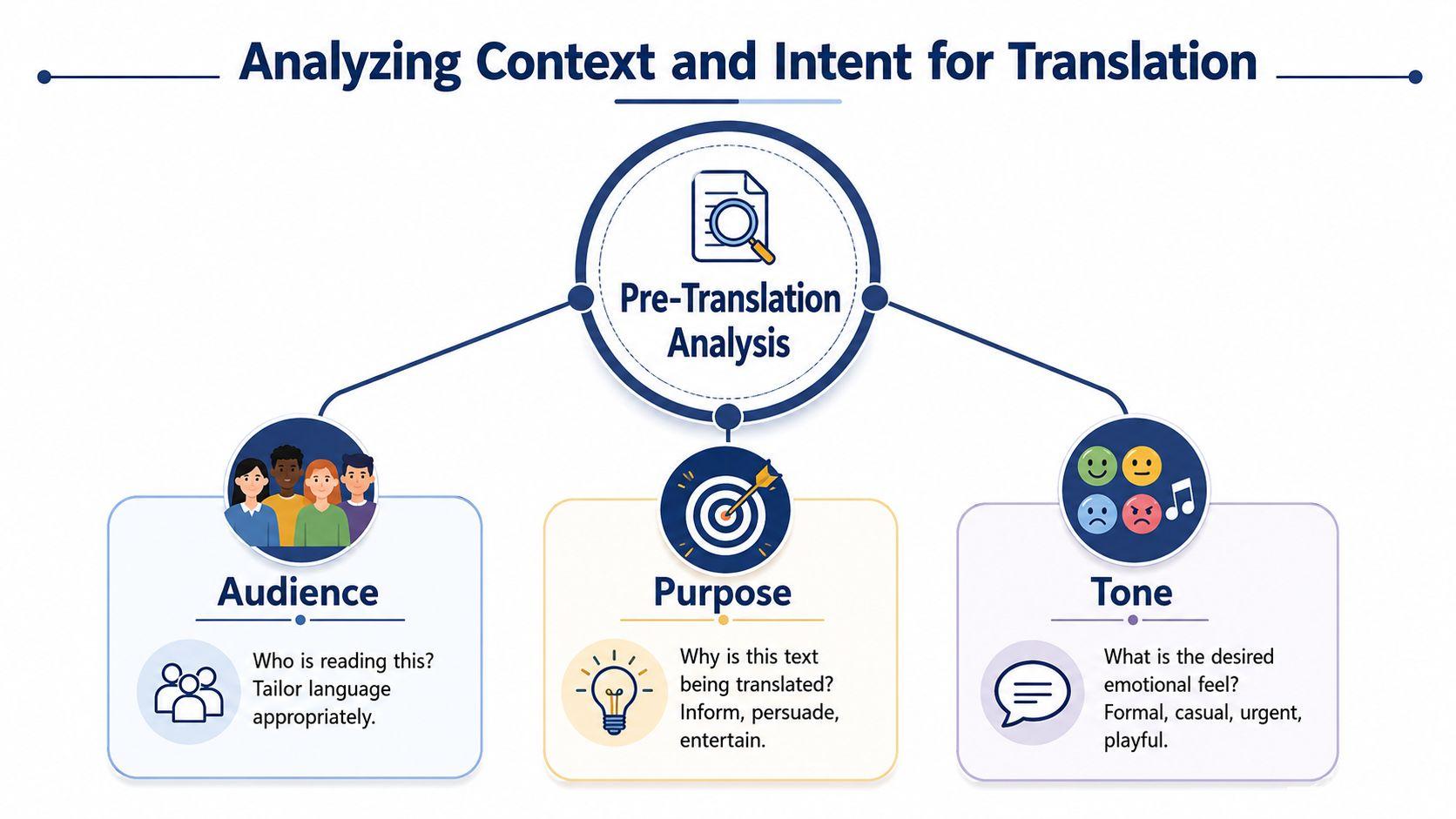
Three things shape a good translation:
- Audience matters: A cousin, a customer, and a professor shouldn't receive the same Hindi phrasing.
- Tone matters: Warm, formal, playful, urgent, and respectful each sound different.
- Purpose matters: A sales email, exam answer, bedtime story, and family message need different wording.
If you've studied language learning before, the best advice often overlaps with solid translation practice. These effective language translation techniques are useful because they push you to think in context, not just vocabulary lists.
Practical rule: If a translation feels correct but sounds unlike something a real Hindi speaker would say, stop and revise.
Translating sentences from English to Hindi often prioritizes speed. Speed helps, but judgment matters more. Good translation is usually a short process: understand the sentence, create a draft, then adjust it so the Hindi sounds natural, respectful, and clear.
First Step Analyze Context and Intent
The strongest translations usually begin before any tool is opened. A few seconds of analysis can prevent awkward Hindi later.
Start with audience
Hindi carries social signals very clearly. English often hides them.
“Please come here” might become one of several Hindi sentences depending on the listener:
| Audience | Better Hindi choice | Why it works |
| Young child | Yahan aao | Direct and informal |
| Friend | Idhar aao | Natural in casual speech |
| Elder relative | Kripya yahan aaiye | Respectful and polite |
| Customer or client | Kripya yahan aaiye | Formal and safe |
| Classroom setting | Yahan aaiye | Respectful without sounding overly stiff |
The confusion often comes from English being socially flatter. Hindi is not. It expects you to signal closeness, respect, and distance more explicitly.
Then define purpose
Now ask what the sentence is trying to achieve.
A sentence can inform, persuade, comfort, invite, warn, or entertain. That purpose changes word choice. “Please review this document” in a team setting may need more formality than “Please check this quickly” in a chat with a classmate.
A good habit is to write a one-line note before translating:
- Who is this for
- What reaction do I want
- How formal should it sound
That tiny note often prevents robotic output.
Write the sentence's job in plain English first. “I need this to sound respectful and clear.” That instruction helps you choose better Hindi than any dictionary alone.
Watch tone and grammar together
Hindi formality isn't just about polite words. It affects verbs, pronouns, and rhythm. English may say “Go,” but Hindi may need “Jao” or “Jaiye” depending on the relationship. This social-context preservation fails in 25% of cases when basic systems miss the nuance, according to the verified technical data provided for this topic.
English and Hindi also differ structurally. If you want more examples on language workflows and writing with AI support, the articles on the 1chat blog are useful for thinking about prompts, revision, and clarity.
Here's a quick before-and-after view:
| English sentence | Literal instinct | Better Hindi choice | What changed |
| I need your help | Mujhe tumhari madad chahiye | Mujhe aapki madad chahiye | Respect level |
| Please sit down | Kripya baitho | Kripya baithiye | Formal verb ending |
| We are happy to work with you | Hum tumhare saath kaam karke khush hain | Hum aapke saath kaam karke prasann hain or a simpler professional alternative | Register and professionalism |
The important shift is mental. Don't ask for a translation first. Ask for the right relationship, tone, and purpose first.
Bridge the Gaps in Grammar and Culture
At this point, machine output often starts to wobble. English and Hindi don't just use different words. They organize meaning differently.
Grammar is not a small detail
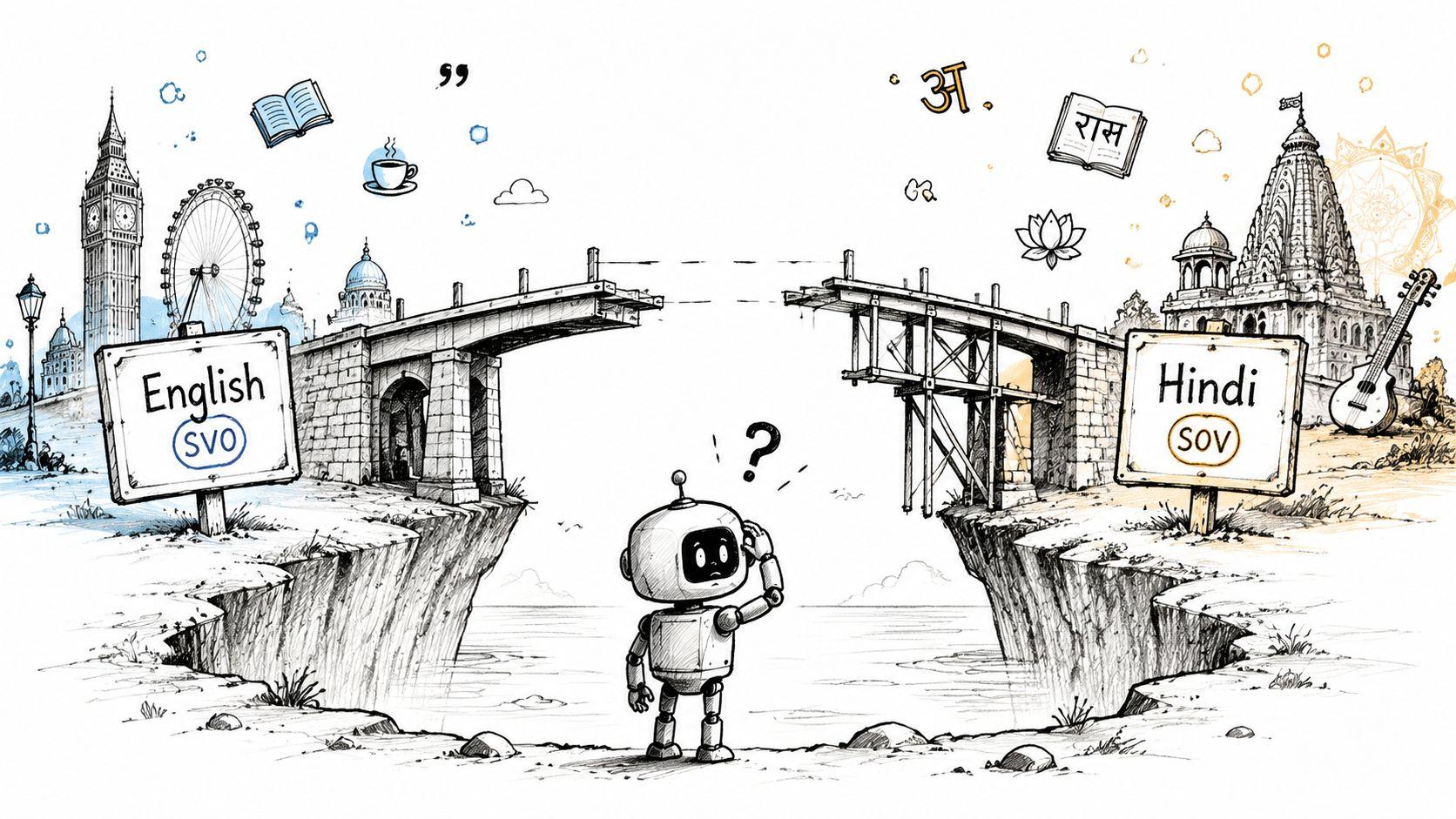
English is a Subject-Verb-Object language, while Hindi is Subject-Object-Verb. That structural mismatch leads to translation errors in 15 to 20% of sentences if not explicitly modeled, and over 68% of idiomatic English sentences are mistranslated into Hindi by automated systems according to the verified data tied to HindiPod101's discussion of untranslatable Hindi words.
A simple example shows the shift:
| English | Word-for-word order | Natural Hindi |
| She reads the book | Vah padhti hai kitaab | Vah kitaab padhti hai |
| I finished the work | Main samapt kiya kaam | Maine kaam samapt kiya |
| They will send the file | Ve bhejenge file | Ve file bhejenge |
Literal order can still be understandable. But “understandable” is not the same as natural.
Idioms need interpretation, not substitution
Idioms are even trickier. If someone writes, “He kicked the bucket,” you cannot translate each word and expect Hindi readers to understand the intended meaning. The same goes for “break the ice,” “spill the beans,” or “stealing my thunder.”
A better workflow is to ask:
- Is this sentence literal or figurative
- What does it mean in plain English
- What would a Hindi speaker say in the same situation
For example:
| English expression | Wrong approach | Better approach |
| It's raining cats and dogs | Literal animal-based Hindi | Translate the idea: it's raining very heavily |
| Break the ice | Literal “barf todna” | Translate the social meaning: start conversation comfortably |
| On the same page | Literal page-based phrasing | Translate the idea of agreement or shared understanding |
When an English phrase paints a picture, first decide whether that picture exists in Hindi culture. If it doesn't, carry over the meaning instead.
A three-step translation process
For most everyday and professional use, this process is reliable:
- Create an initial draft
Use a translator or your own first attempt to get the basic meaning down. - Refine for tone and domain
Ask an advanced AI assistant to adjust formality, explain awkward phrasing, or suggest alternatives for technical language. A useful prompt is: “Rephrase this Hindi translation more formally for a business email.” - Verify with a fluent speaker or careful reviewer
Read for naturalness, respect level, and hidden cultural mismatch.
This process matters because the language pair has traps beyond grammar. Verified data for English-Hindi translation notes approximately 1,200 false cognates and says they cause semantic inversion errors in roughly 18% of unverified machine translations. That means some outputs don't just sound awkward. They can reverse or distort meaning.
Watch for hidden culture signals
Hindi also encodes relationships through honorifics, verb agreement, and social warmth. Commands, invitations, apologies, and requests often need a cultural adjustment, not just a grammatical one.
Common warning signs:
- A sentence sounds too blunt: English brevity can sound rude in Hindi.
- Humor disappears: The words survive, but the emotional point doesn't.
- Professional language becomes casual: This is common in legal, academic, and business translation.
- Family language feels cold: Direct translation often strips affection from Hindi.
If your goal is to translate sentences from English to Hindi well, this is the essential skill. You're not just crossing a language gap. You're crossing a grammar system and a culture at the same time.
A Modern Workflow Using AI Tools Like 1chat
One-shot translation is fine for rough understanding. It's a weak method for final output.
The better approach is a workflow. You use one tool for draft speed, another for refinement, and human judgment for final trust. That's especially important in professional settings, where precision matters more than convenience.
Step one gets the bones right
Start with a quick draft. This can be from a standard translator or your own bilingual attempt. At this stage, don't obsess over perfect style. You're only trying to capture core meaning.
Then stop. Don't send it yet.
A quick draft often misses:
- Formality level
- Technical precision
- Natural Hindi rhythm
- Audience fit
Step two improves the draft
Here, a conversational AI tool becomes useful. Instead of asking for a blind translation, ask for targeted revision.
Useful prompts include:
- “Make this Hindi version more respectful for an elder.”
- “Rewrite this in simpler Hindi for middle school students.”
- “Check whether this sounds natural for a business email.”
- “Give me two Hindi alternatives, one formal and one conversational.”
- “Explain which words in this translation sound too literal.”
That kind of prompting is far more effective than accepting the first generated sentence.
For comparison, translation challenges in other language pairs also show why revision matters. This overview of Brazilian Portuguese English translations is useful because it highlights the same core issue: direct conversion rarely preserves tone, context, and idiomatic meaning.
Step three is not optional
The strongest reason to review is precision loss. Verified data for this topic states that 72% of business and legal English sentences lose precision when translated into Hindi using standard tools, especially in finance, law, and healthcare, as cited in the verified reference tied to QuillBot's English to Hindi translation page.
That means if you're translating a contract clause, a research summary, a patient instruction, or a policy note, a quick machine result is risky.
You can use the 1chat homepage as part of a broader AI-assisted drafting workflow, but the key point is methodological, not tool-specific. Draft fast. Refine carefully. Review before use.
A translation is ready when the reader gets the same meaning, tone, and level of respect that the original intended.
Different users need different checks
Here's a practical checklist by audience.
For families
- Respect words: Check whether you used aap, tum, or tu appropriately.
- Warmth: Make sure affection didn't disappear during translation.
- Clarity for elders: Prefer simple, natural Hindi over awkward literal phrasing.
For students
- Concept accuracy: Translate the idea, not just the sentence shell.
- Academic vocabulary: Keep technical terms consistent.
- Teacher-facing tone: Use formal Hindi when required by assignment style.
For small teams
- Brand voice: A polished English message shouldn't become uneven Hindi.
- Terminology: Keep key business terms precise and stable across documents.
- Cultural fit: Avoid sounding abrupt, especially in requests and follow-ups.
The workflow is simple enough for everyday use. But it's disciplined. That's why it works better than hitting “translate” once and hoping for the best.
Finalizing Your Translation with Quality Checks
A translation isn't done when the wording looks acceptable. It's done when it survives checking.
That final pass matters more than many people think, especially with Hindi, where small changes in pronouns, verb endings, and phrasing can alter respect, tone, or accuracy.
Why review changes everything
Verified data for this topic says that skipping a native speaker validation loop after generation causes a 40% increase in publicly embarrassing or contextually incorrect translations. The same verified data says that adding this final check reduces lexical errors by 35% and helps ensure the message is culturally accurate.
That aligns with what bilingual speakers already know from experience. The last problems are rarely big grammar mistakes. They're subtle issues of tone, awkwardness, and social appropriateness.
If you want a broader professional perspective on review practices, this guide on achieving accurate translations is a helpful companion to a careful editing process.
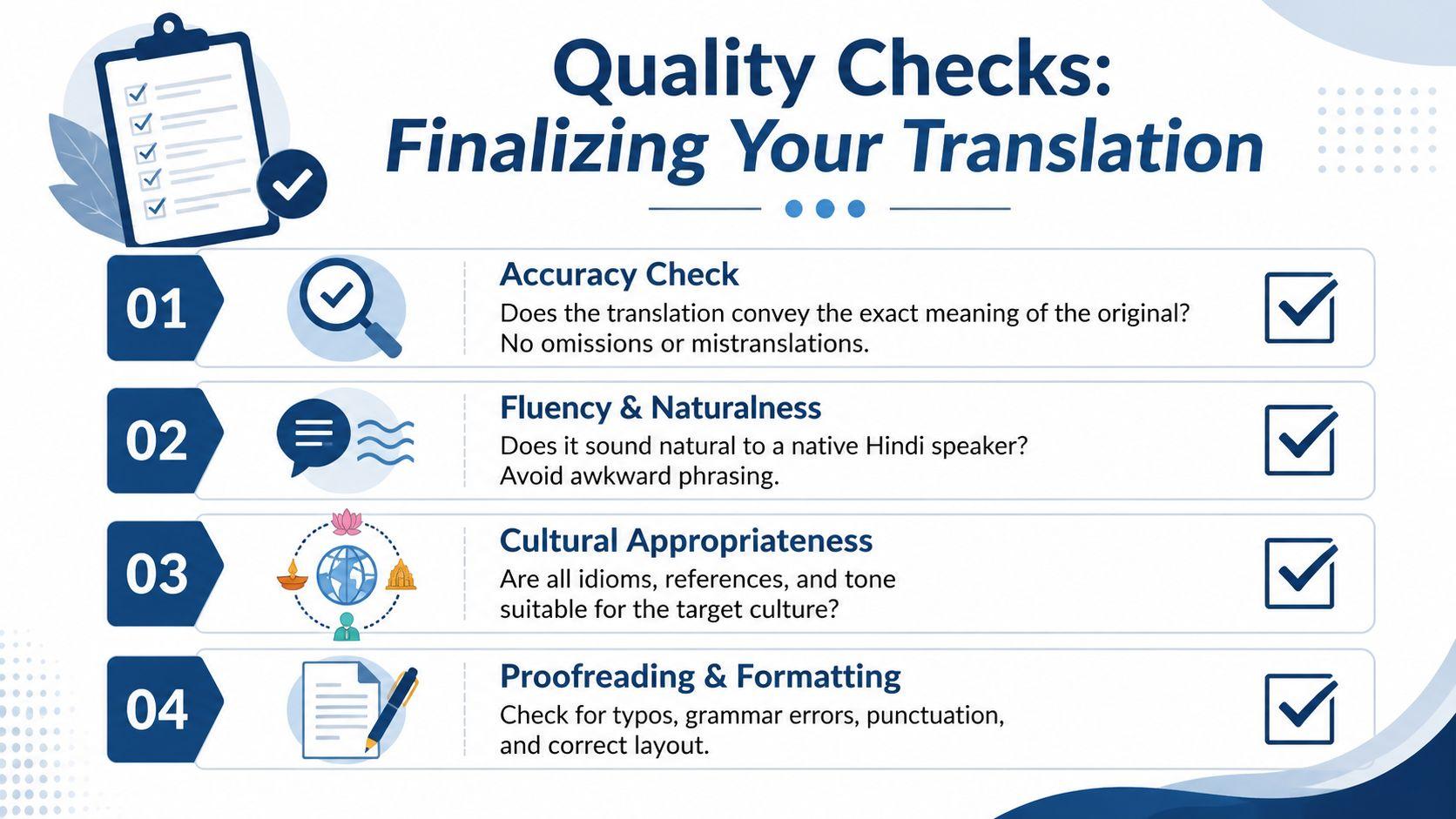
Use a four-part review
Read your Hindi sentence through these lenses:
| Check | What to ask |
| Accuracy check | Does it preserve the exact meaning of the English sentence? |
| Fluency and naturalness | Would a Hindi speaker actually say it this way? |
| Cultural appropriateness | Is the tone respectful, warm, formal, or casual in the right way? |
| Proofreading and formatting | Are spelling, punctuation, names, and layout correct? |
Targeted review by use case
Family messages
Read it aloud. Family Hindi should sound human, not translated.
- Honorifics: Did you choose the right level of respect?
- Emotion: Does the sentence still feel loving, apologetic, or joyful?
- Natural phrasing: Would your relative say it this way in conversation?
Student work
Student translation needs precision and readability.
- Subject meaning: Did the original idea survive?
- Terminology: Are academic or textbook terms appropriate?
- Sentence structure: Is the Hindi clear, or does it mirror English too closely?
Team and business communication
Professional Hindi has to do two jobs at once. It must be exact and polished.
- Consistency: Are the same terms translated the same way throughout?
- Professional tone: Does it sound serious without becoming stiff?
- Risk words: Are legal, financial, or medical terms too vague?
Read the final Hindi as if you never saw the English. If anything feels strange, the translation still needs work.
A short final-pass routine
Use this before sending anything important:
- Compare sentence by sentence with the original.
- Check pronouns and verb forms for respect and audience fit.
- Replace literal idioms with meaning-based Hindi.
- Read the Hindi aloud once.
- Ask a fluent reader if the message matters.
If you're using AI in any review process, it's smart to check what content rules apply before you paste in sensitive material. The 1chat usage policies are a practical example of the kind of policy page worth reading when handling personal, academic, or business text.
When people want to translate sentences from English to Hindi accurately, they usually expect a vocabulary problem. Most of the time, it's a judgment problem. The translation becomes strong when you choose the right level of respect, reshape English structure into natural Hindi, and verify the final message with fresh eyes.
If you want help drafting, refining, and reviewing Hindi translations with AI support, you can try 1chat, a privacy-first option built for families, students, and small teams who need more than a one-click translation.