You open a dashboard, school portal, bank app, or AI chat window and get hit with numbers. A chart says engagement is down. A spending app says this month looks unusual. An AI tool summarizes a report and sounds confident. You know the information matters. You're just not sure what you're supposed to do with it.
That feeling is exactly why data literacy matters.
For a small business owner, it can mean knowing whether a busy week was a profitable one. For a parent, it can mean understanding a child's screen time report instead of reacting to a scary-looking graph. For a student, it can mean spotting when a source uses numbers to persuade rather than inform. In the age of AI, it also means knowing when to trust a summary, when to question it, and when to go back to the original source.
What Data Literacy Actually Means
A lot of people hear the phrase data literacy and assume it belongs to analysts, spreadsheet power users, or people who enjoy statistics. It doesn't.
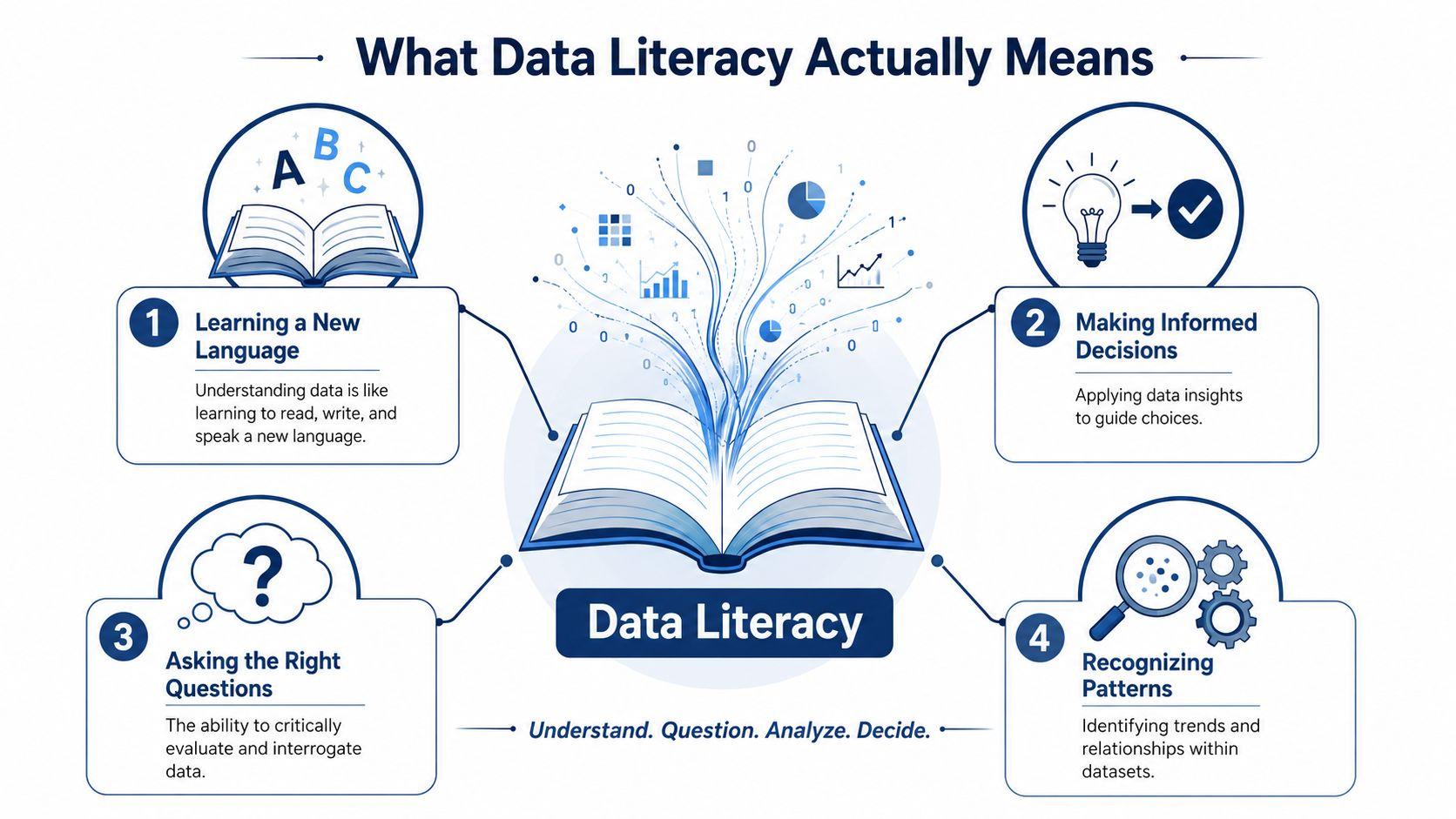
Data literacy is much closer to learning how to read a language than learning advanced math. When you read a sentence, you don't need to be a linguist to understand the message. You need to recognize the words, understand the context, and notice tone and intent. Data works the same way. A chart, table, or dashboard is trying to say something. Data literacy helps you understand what it's saying and whether you should believe it.
It isn't about becoming technical
A clear definition helps: data literacy is the ability to explore, understand, and communicate with data in a meaningful way, with more emphasis on information, critical thinking, and communication than on coding or advanced formulas, as explained by Northwest Missouri State University's overview of data literacy.
That means you can be data literate without knowing SQL, Python, or statistical modeling.
You don't need to build the engine to drive the car well.
If you run a bakery, data literacy might look like noticing that one pastry sells out every Saturday but not on weekdays, then asking why. If you're a student, it might mean noticing that a chart in an article leaves out where the data came from. If you're a parent, it might mean realizing that a spike in family spending came from one annual bill, not a broken budget.
A simple way to think about it
Try this comparison:
| Everyday reading | Data reading |
| Understand the words | Understand the numbers or chart |
| Notice who wrote it | Notice who collected the data |
| Ask what it means | Ask what the pattern means |
| Decide whether to trust it | Decide whether the data is useful and fair |
A lot of confusion starts when people mix up business metrics with technical complexity. A metric can be simple. Orders per day, homework time, monthly grocery spending, attendance, email opens. If you want a plain-English primer on that idea, this DashDB business metrics guide is a useful companion.
What most people get wrong
People often think data literacy means being good with numbers. That's only part of it. The deeper skill is judgment.
- Seeing context: A number alone rarely means much.
- Spotting missing information: A chart can be accurate and still misleading.
- Asking better questions: "Compared to what?" is often more valuable than any formula.
- Explaining the takeaway: If you can't say what the numbers mean in plain language, you probably don't understand them yet.
That's why what is data literacy is really a question about understanding, not technical status. It's the skill that helps you move from "I'm looking at numbers" to "I know what this is telling me."
The Core Skills of Data Fluency
Once the idea feels less intimidating, the next question is practical. What do data-literate people do?
A helpful framework comes from ThoughtSpot. It describes four competencies: reading data, working with data, communicating with data, and reasoning with data, as outlined in ThoughtSpot's explanation of data literacy.
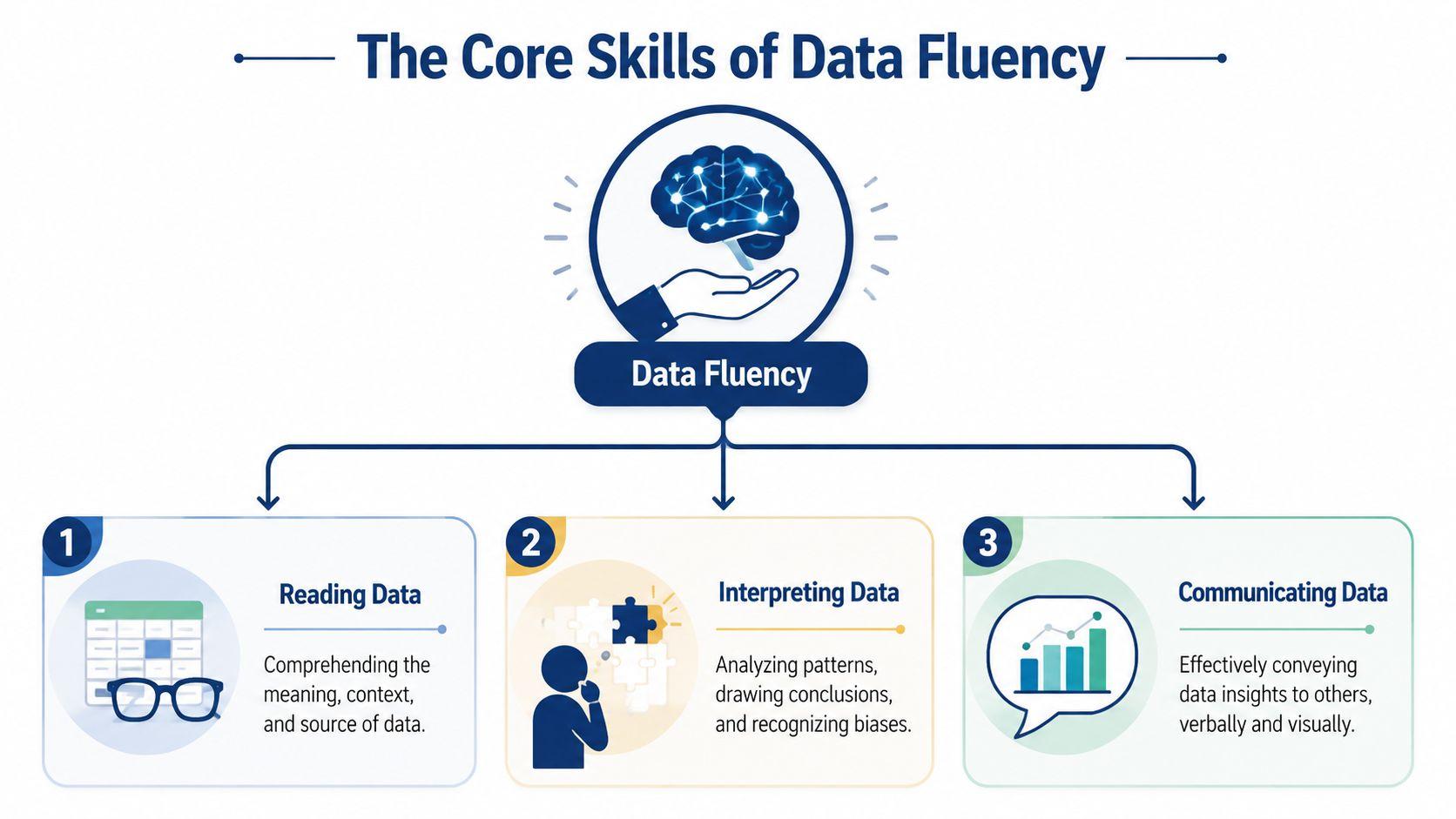
Working definition: Data fluency means you can read what's in front of you, make sense of it, and explain the takeaway clearly enough that someone else can act on it.
Reading data
Reading data is the most basic layer. It's the ability to look at a table, chart, or report and understand what it shows.
That sounds obvious, but it isn't always easy. A line chart might show sales over time. A bar chart might compare classes, products, or months. Reading means noticing the labels, time frame, categories, and units.
A student does this when reading a graph in a science article. A shop owner does it when checking weekly sales by product. A parent does it when reviewing a school attendance summary.
Common mistakes happen here first:
- Ignoring labels: Is the chart showing dollars, percentages, or counts?
- Missing the time window: Is this one day, one month, or a whole year?
- Skipping the source: Who created the numbers and for what reason?
Interpreting data
Interpretation is where thinking starts. It's the step after "what does this chart show?"
A bakery owner sees cupcake sales rise on Fridays. Reading says sales went up. Interpreting asks whether a school event, weather pattern, promotion, or payday might explain it. A student sees a poll result and asks whether the sample was broad enough. A parent sees a jump in screen time and asks whether it happened during a long car ride or exam week.
This is also where bias starts to matter. Data doesn't arrive in a neutral box. Someone chose what to measure, how to group it, and what to leave out.
Communicating data
Many people stop at private understanding. Data literacy goes further. It includes explaining what you've learned in a way that another person can use.
That doesn't mean building fancy dashboards. It means saying something like, "Our after-school snack costs looked high this month because we hosted two team dinners," or, "This article's graph looks dramatic, but it compares a short period and doesn't explain the source."
A good data explanation usually includes three parts:
- What happened
- Why it might have happened
- What action makes sense next
Reasoning with data
Reasoning turns information into decision-making. It's the bridge between noticing and acting.
- A small business owner compares product categories and decides which ones deserve more shelf space.
- A student reviews sources for a paper and rejects the one with weak evidence.
- A parent looks at household spending trends and changes one habit instead of overreacting to one unusual week.
This last skill matters most because numbers don't make decisions. People do. Data fluency helps people do that more carefully.
Why This Skill Is Your New Superpower
People often ask whether data literacy is really necessary if AI can summarize reports, answer questions, and generate charts. The short answer is yes. It may matter more now than before.
AI can speed up access to information. It can't replace your judgment. If anything, faster answers create more opportunities for faster mistakes.
For small business owners
A small business owner rarely struggles because there's no data. The problem is too much data with too little clarity. Sales reports, ad dashboards, review trends, inventory spreadsheets, website analytics, payment summaries. Every tool offers numbers. Not every number deserves equal attention.
Data literacy helps you sort signal from noise.
You might notice that one product sells often but carries low margin, while a slower-selling service produces steadier profit. You might realize an ad campaign brought traffic but not buyers. You might catch that a dip in orders came from a stock issue, not weak demand.
This skill also matters at the organizational level. According to the Qlik Data Literacy Index, organizations in the top third of the index show three to five percent greater enterprise value, which translated to $320 million to $534 million in higher enterprise value based on an average organization size used in that report. That doesn't mean every small business should chase enterprise dashboards. It does show that understanding data isn't a side skill. It's connected to performance.
For students
Students live in a world full of charts, rankings, claims, and AI-generated summaries. A polished answer can still be weak. A graph in a slideshow can still be misleading.
Data literacy gives students a filter. It helps them ask whether a source is relevant, whether a conclusion fits the evidence, and whether a confident claim rests on shaky numbers. That's useful in essays, presentations, science projects, and everyday media consumption.
A smart student isn't the one who accepts the cleanest chart. It's the one who asks what the chart leaves out.
Students who build this habit early also gain a long-term advantage. They learn how to evaluate evidence before repeating it.
For parents and families
Families use data more than they realize. Budgeting apps, school reports, health portals, screen time summaries, shopping histories, grade books. These tools can be helpful, but they can also trigger unnecessary worry.
A parent who is data literate doesn't panic at one sharp spike. They look for pattern, context, and explanation. They ask whether the measure is complete, whether the app defines terms clearly, and whether one unusual event skewed the picture.
That creates calmer decisions. It also models a valuable habit for kids: don't fear numbers, and don't worship them either.
Why AI makes the skill more urgent
AI tools often present information in a polished, conversational way. That can make uncertain or flawed output feel more trustworthy than it is. If you can't assess the result, convenience becomes a risk.
Data literacy gives you a healthy pause. It helps you ask, "Where did this come from?" "What evidence supports it?" and "Should I verify this before acting?" In a world full of dashboards and bots, that's a genuine superpower.
How to Build Your Data Literacy Starting Today
You don't need a course catalog, a statistics textbook, or a new software stack to begin. You need repetition, curiosity, and a small set of habits.
The best starting point is your own life. Familiar numbers are easier to question because you already know the context.
Start with one real example
Pick one thing you already touch each week:
- A utility bill
Look at usage over time. Don't just note whether the total changed. Ask what likely caused the change. - A bank or budgeting app
Check one category, such as groceries or transport. Look for repeating patterns, not one-off surprises. - A school grade portal
Instead of staring at the final average, compare assignment types. Are quizzes, essays, and projects telling the same story? - A simple sales report
If you run a business, compare products, days, or channels. Which numbers help you make one decision today?
Use a short question checklist
When people say they feel "bad at data," they often mean they don't know what questions to ask. Use this checklist until it becomes natural:
- Who created it?
- What exactly is being measured?
- What time period does it cover?
- Compared with what?
- What's missing?
- What decision would this change?
Practical rule: If a chart gives you a feeling before it gives you context, slow down.
Practice saying the takeaway out loud
A strong exercise is to explain one chart to another person in plain language. No jargon. No dramatic claims.
Try this structure:
| Step | Plain-language prompt |
| Observation | What do I see? |
| Meaning | Why might that be happening? |
| Action | What should happen next? |
If you can't explain it clearly, stay with it longer. Clarity often comes from restating, not from adding complexity.
Use everyday tools carefully
Spreadsheets like Google Sheets or Excel are enough for many beginners. So are school portals, commerce dashboards, and budgeting apps. The goal isn't to collect more information. It's to learn how to interpret the information you already have.
You can also build the habit by reading thoughtful explainers and prompts. The articles in the 1chat blog library are a good example of the kind of practical AI and productivity reading that can help you sharpen your questions without drowning in technical language.
Let AI assist, but not decide
AI tools can help you summarize a long report, identify repeated themes in a document, or turn a dense PDF into a shorter overview. That's useful. It lowers the barrier to getting started.
But treat AI as a study partner, not a final judge. Ask it to help you find the key points, then check whether those points are supported by the material. That's where your literacy grows. Not when the tool answers for you, but when it helps you inspect the answer more efficiently.
Navigating Data Privacy and AI Generated Insights
Many guides answer the question "what is data literacy" as if the main challenge is reading a chart. That used to be closer to the truth. Today, a big part of the challenge is deciding what to trust and what you're giving away in the process.
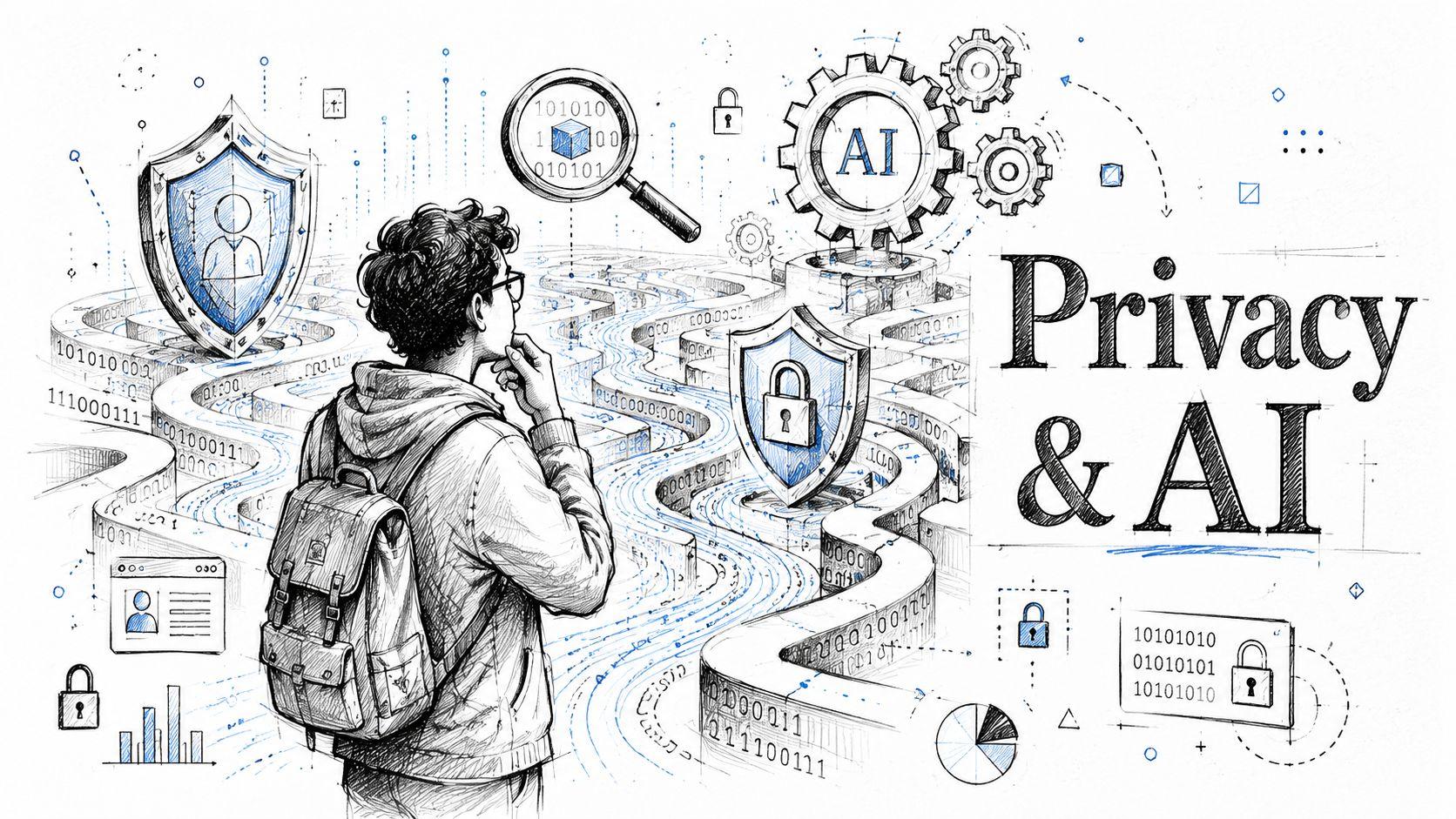
When you upload a document, paste customer notes, or ask an AI tool to analyze schoolwork or business records, you're not only handling information. You're handling privacy, consent, and risk.
AI can sound certain when it shouldn't
Many non-experts can be misled. AI often presents answers in smooth, readable language. That style can hide weak evidence, missing context, or outright mistakes.
The risk isn't theoretical. In 2025, 42% of small business owners reported making at least one critical decision based on AI-generated data that contained hidden biases or errors, while only 12% had received training on validating AI outputs, according to Minitab's discussion of the growing importance of data literacy.
That gap matters because confidence is not the same as correctness.
Privacy is part of literacy
Data literacy now includes asking basic privacy questions before you use any AI system:
- What am I uploading? Customer data, student work, financial records, family details?
- Do I need to include personal details? Often you can remove names or identifiers first.
- Where is this going? If the tool isn't clear, that's a warning sign.
- Do I have permission to share it? This matters for teams, schools, and households.
If you're working with sensitive information, it helps to learn the basics of anonymization before any AI workflow. This guide to best practices for training data is useful because it focuses on reducing exposure before information is reused or analyzed.
A simple trust test for AI output
Use this quick filter before acting on any AI-generated insight:
| Question | Why it matters |
| Can I trace this claim to the original material? | AI summaries can blur source boundaries |
| Does the answer mention limits or uncertainty? | Overconfidence is a red flag |
| Would I make the same decision if I checked manually? | Important choices deserve verification |
Treat AI-generated analysis like an intern's first draft. Helpful, fast, and worth reviewing.
Privacy-first habits matter here too. If you're evaluating tools for personal, family, or business use, reviewing a service's privacy policy details is part of responsible decision-making. That's not legal busywork. It's a literacy skill in the AI era.
From Data Overload to Data Empowered
Data literacy doesn't turn you into a data scientist. It turns you into someone who can pause, question, interpret, and act with more confidence.
That's a major shift. Instead of feeling pushed around by dashboards, reports, school portals, or AI summaries, you start using them on purpose. You notice context. You ask better questions. You stop treating polished output as automatic truth.
For small businesses, that can lead to steadier decisions. For students, it builds stronger judgment. For parents and families, it creates calmer, clearer choices around money, technology, school, and everyday information.
The skill starts small. Read one chart more carefully. Question one summary. Explain one number in plain English. Those repetitions add up.
If you want an AI tool to support that habit, choose one that fits responsible use from the start, including clear usage policies for safer AI use.
Data doesn't have to feel like noise. With the right habits, it becomes signal. And if you want a privacy-first place to practice asking better questions with AI, 1chat can be a useful next step.