Research writing is a structured form of academic communication that presents a research question, explains the method, reports evidence, and interprets findings; its modern model took shape over more than 200 years, with systematic referencing established by approximately 1850. If you're staring at a blank document labeled “research paper,” the hardest part may not be typing. It may be understanding what kind of thinking the assignment requires.
Many first-year students assume a research paper is only a longer essay with more sources. That assumption creates familiar problems: an introduction that announces a broad topic, a series of paragraphs that summarize articles one by one, and a conclusion that repeats the introduction without answering a precise question.
Research writing asks for something more demanding and more useful. You select a question, investigate it through an appropriate method, weigh evidence, and make a conclusion that readers can trace back through your reasoning. This article will give you a working definition, the history behind modern research structure, a practical explanation of IMRAD, a process for moving from question to final draft, and a verified approach to using AI without surrendering authorship.
A Clear Starting Point for First-Time Writers
A student opens a blank document after receiving an assignment called “Write a research paper.” The instructions mention scholarly sources, citations, and analysis, but they don't explain what the finished paper is supposed to do. The student knows how to write a personal essay, perhaps even an opinion piece, but those forms don't provide a reliable map for research.
Research writing is a structured form of academic communication that presents a research question, explains the method used to investigate it, reports evidence, and interprets the findings. That definition matters because each part has a job. The question gives the paper direction. The method explains how the writer gathered or evaluated information. The evidence supports the answer. Interpretation explains what the evidence means.
A personal essay may center on experience and reflection. An opinion piece may persuade through reasoning, examples, and the writer's perspective. A source summary reports what another writer said. Research writing can include personal judgment and explanation, but its central claim must remain accountable to evidence.
Practical rule: If a reader can't tell what question you asked, what evidence you used, and how you moved from evidence to conclusion, the paper probably isn't functioning as research writing yet.
The distinction becomes clearer through an analogy. A summary is like a tour guide describing several buildings one at a time. Research writing is like an architect explaining how those buildings relate to a larger plan, where the structure succeeds, where it fails, and what the evidence supports.
Academic-writing guidance from Yale's framework for the academic paper identifies claims, evidence, analysis, methodology, complications, and new understanding as connected parts of serious academic work. You don't need to use those exact labels in every assignment, but you do need to perform those reasoning functions.
How Research Writing Evolved into a Standardized Form
Research writing wasn't designed as a collection of arbitrary obstacles for students. Its conventions developed because scholars needed a dependable way to communicate with people who weren't present when an investigation took place.
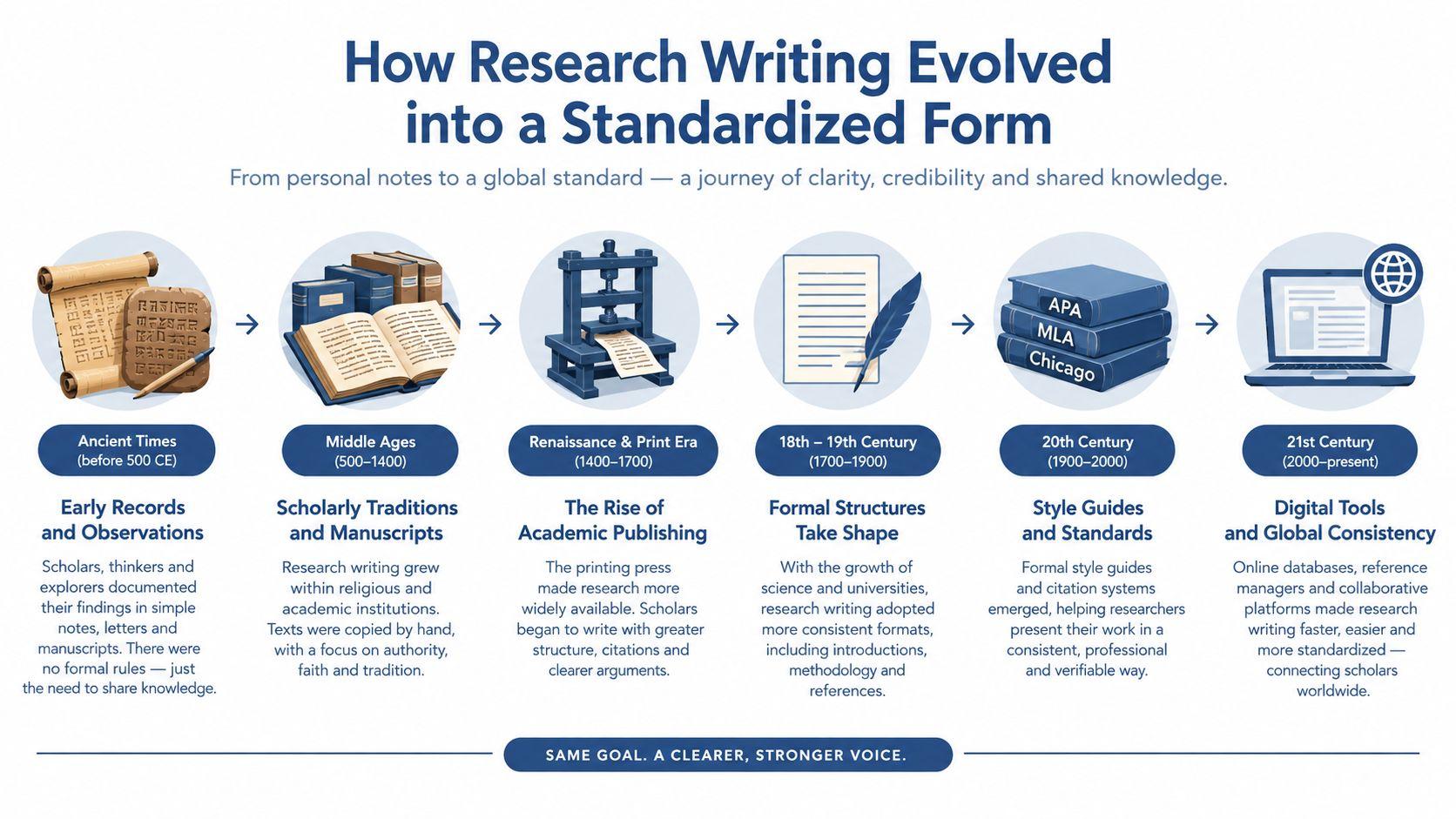
Early scholarly communication included letters and chronological accounts. As scientific journals appeared in the 17th century, researchers gained a public venue for sharing observations and arguments. Yet writers didn't follow one generally accepted paper format for more than 200 years. During the 19th century, papers increasingly organized knowledge around theory, experiment, and discussion, while references to previous work became more systematic.
By approximately 1850, systematic referencing had become part of the modern research-paper model. A citation wasn't merely decoration. It showed readers where an idea came from, helped them inspect the reasoning, and placed a new claim inside an existing conversation. The historical development of research writing is documented in this overview of research communication and reproducibility.
Why documentation became central
Imagine receiving a recipe that says, “I combined several ingredients and the result was excellent.” You couldn't reproduce the dish or diagnose a failure. Research readers face the same problem when a paper hides its procedures, leaves evidence uncited, or jumps from observation to conclusion without explaining the connection.
Modern research writing therefore works like a contract between author and reader. The author promises to identify the problem, describe the investigation, show the evidence, and avoid claiming more than that evidence supports. The reader receives enough information to evaluate the argument rather than trusting the writer's confidence on faith.
This is why citation, transparent methods, and reproducibility matter across research systems, even though disciplines use different terminology and formats. A humanities paper may analyze archival documents differently from a laboratory study, but both should make the path from question to interpretation visible.
The Structure That Makes a Research Paper Work
The most recognizable research-paper structure is IMRAD, meaning Introduction, Methods, Results, and Discussion. Treating IMRAD as four labels to fill in misses its real value. Each section answers a different question in the reader's mind.
The Introduction answers, “What problem is this paper addressing, and why does it matter?” It establishes context, identifies a gap or uncertainty, and presents the research question. A weak introduction offers a broad topic. A strong one narrows that topic into an answerable problem.
The Methods section answers, “How did the writer investigate the problem?” It describes the procedure, materials, data, participants, texts, or analytical approach. Its purpose isn't to burden the reader with technical detail. Its purpose is to make the investigation assessable and, where appropriate, reproducible.
The Results section answers, “What did the investigation find?” It reports observations, patterns, measurements, or textual findings. Writers often weaken this section by interpreting every result immediately. Results should first present what was found clearly, using prose, tables, or figures where appropriate.
The Discussion answers, “What do these findings mean?” It interprets the results, connects them to prior work, addresses limitations, and explains the contribution of the study. A discussion shouldn't just repeat the results. It should show how the findings change or refine our understanding of the question.
| Section | Reasoning Function | Typical Content |
| Introduction | Defines the problem and establishes significance | Context, research question, thesis or hypothesis, relevant background |
| Methods | Makes the investigation understandable and assessable | Materials, procedures, sources, participants, analytical method |
| Results | Presents the evidence produced by the investigation | Findings, patterns, measurements, tables, figures, textual observations |
| Discussion | Interprets evidence and qualifies the conclusion | Meaning, comparison with prior work, limitations, implications |
The structure became increasingly standardized during the 20th century. In a 50-year analysis of articles published from 1935 to 1985, no sampled article used the complete IMRAD pattern in 1935. By 1950, more than 10% of articles in all journals studied used it, adoption exceeded 80% during the 1970s, and by the 1980s it was the only organizational pattern used in the original papers examined. The study also records formal recognition through ANSI Z39.16, first published in 1972 and revised in 1979. These milestones are reported in the history of the IMRAD structure.
Humanities assignments often use variations, including argument-driven essays, close readings, historical analyses, or literature reviews. The labels may change, but the underlying logic stays stable: ask a question, select evidence, analyze it, and explain the conclusion.
The Research Writing Process From Question to Final Draft
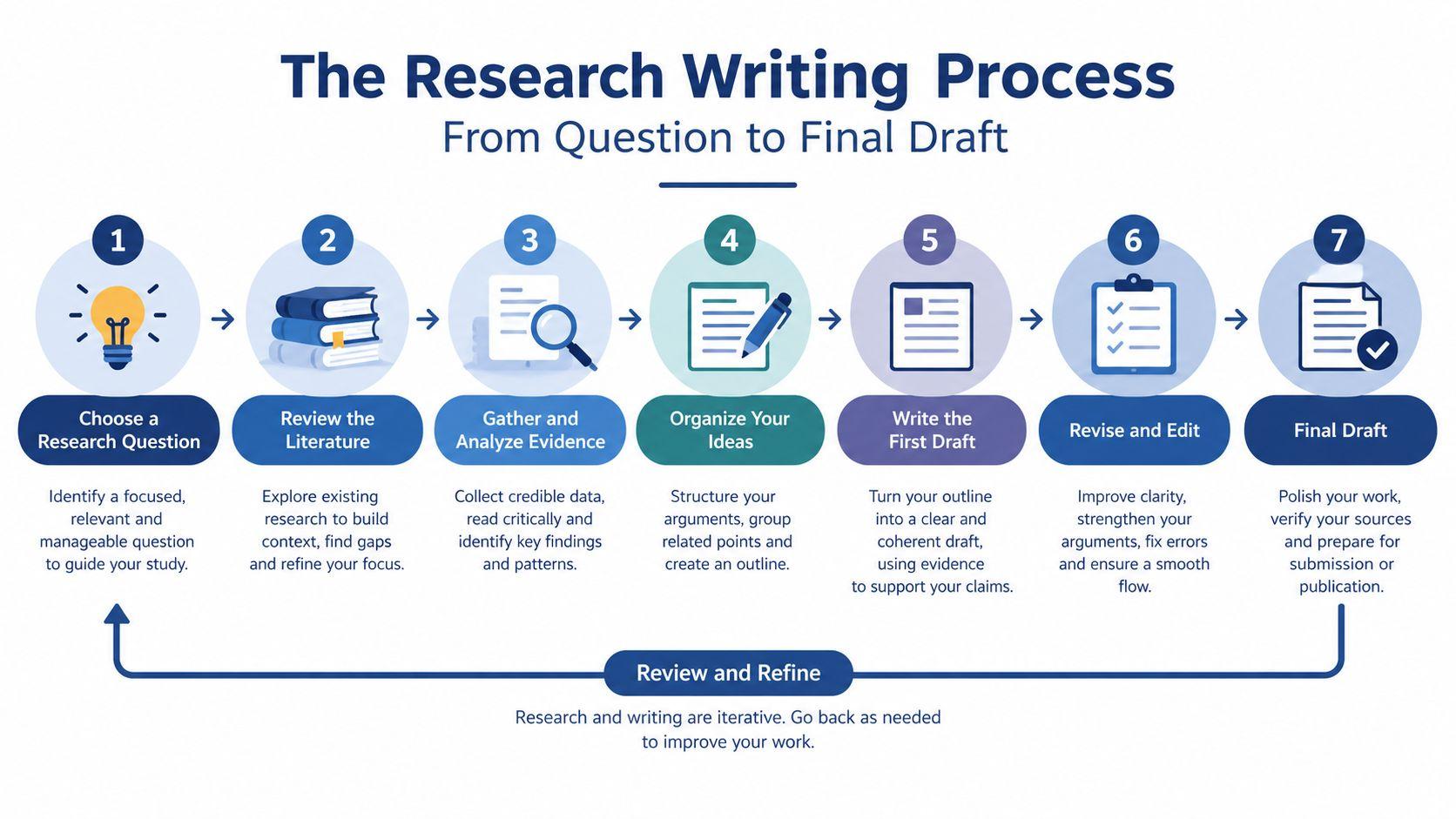
Finished papers hide the uncertainty that produced them. Students see polished paragraphs and assume experienced writers drafted them in order from the first sentence to the last. Most strong papers develop through a less tidy process, with questions narrowed, sources rejected, arguments revised, and paragraphs drafted out of sequence.
Begin with a question you can investigate
Start with a subject that interests you, then turn it into a question with boundaries. “Social media and education” is a subject. “How does classroom use of short-form video affect students' attention during a specific learning activity?” is closer to a research question because it identifies an object of study and a relationship to investigate.
Preliminary research helps you discover what scholars already know, where they disagree, and whether your question is manageable. Don't write your thesis after reading one source. Read enough to identify recurring concepts, competing explanations, evidence gaps, and methodological limits.
A working thesis is allowed to change. At this stage, it functions like a provisional route on a map. It gives your reading and drafting direction while leaving room for evidence to complicate your first idea.
Turn research into an argument
Create an outline that assigns each section a reasoning task. Instead of listing “Source A” and “Source B,” write notes such as “establishes the dominant explanation,” “presents contradictory evidence,” or “shows why the method has a limitation.” That change prevents the outline from becoming a catalogue of readings.
Draft in passes. You might first write the evidence paragraphs, then the analysis, then the introduction once you understand what the paper argues. A rough draft is a thinking instrument, not a performance. Revision is where you test whether each claim has adequate support and whether each paragraph moves the argument forward.
Track citations while you work. Record the source, page or section details, the idea you borrowed, and your own response to it. If a supervisor or instructor gives feedback, treat it as information about how a reader experienced the argument, not as a verdict on your ability.
For a fuller planning model, Thezis writing guide can help you organize the stages of a paper. If you use an AI writing environment such as 1chat's research workspace, keep the same discipline: use it to inspect or organize material, but verify the original sources yourself.
Set milestones around tasks rather than vague intentions. “Find better sources” is difficult to measure. “Locate two competing explanations and write a paragraph comparing their assumptions” gives you a concrete objective and a reason for doing it.
Why Summarizing Sources Is Not the Same as Research Writing
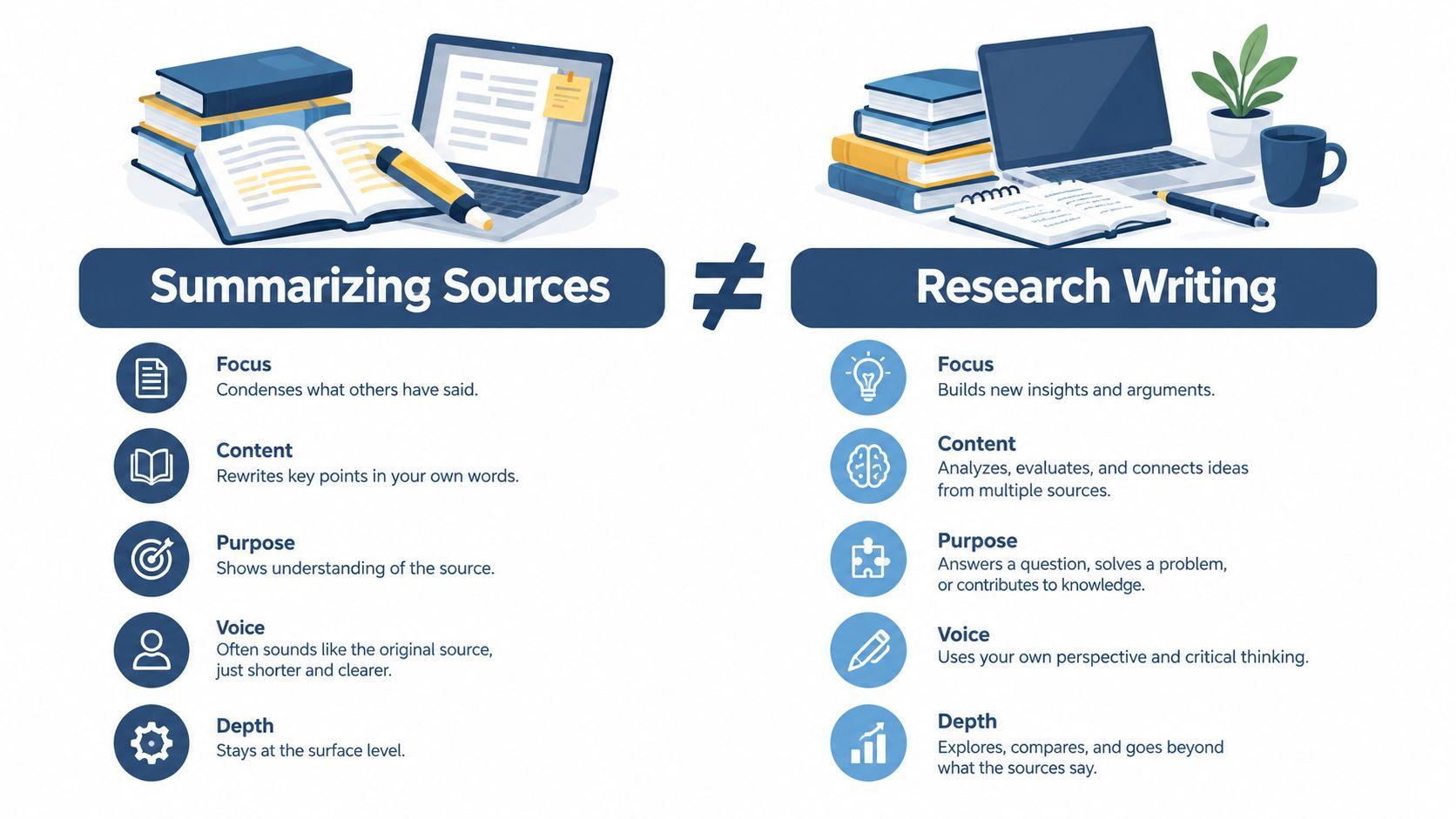
Many students believe a paper becomes analytical when it contains enough paraphrases. It doesn't. Paraphrase changes the wording of a source. Analysis explains the relationship between evidence and your claim.
Consider this summary-style paragraph:
Source A argues that online discussion increases participation. Source B reports that students contribute more when prompts are specific. Source C finds that participation can remain superficial even when students post frequently.
The paragraph may accurately represent all three sources, but the writer hasn't shown how they fit together. The reader still has to perform the central intellectual task.
Now consider a research-writing version:
Taken together, these sources suggest that the value of online discussion depends less on posting frequency than on the design of the prompt. Source A links discussion with participation, while Source B identifies specificity as a condition that encourages contribution. Source C complicates both claims by showing that visible activity can remain shallow. The evidence therefore supports a narrower conclusion: online discussion is most useful when instructors evaluate the quality and direction of participation, not merely its presence.
The second paragraph uses the same source contributions, but it makes a new interpretation. It compares the sources, identifies a condition, acknowledges a complication, and advances a qualified conclusion. That is the moment research writing diverges from source summarizing.
Synthesis is a relationship, not a sequence
A literature dump moves through sources one at a time. “Smith says this. Lee says that. Patel says something else.” A synthesis groups sources by ideas, findings, methods, or disagreements. It asks what the sources collectively reveal that no isolated summary can show.
Try sorting your notes into questions:
- Agreement: Which authors support a similar explanation?
- Conflict: Where do their findings or assumptions differ?
- Conditions: Does a claim hold only in a particular setting?
- Gap: What hasn't the existing evidence explained?
- Contribution: What can your paper clarify, test, compare, or reinterpret?
The shift usually happens in the outline before it happens in the prose. If your outline is organized around authors, your draft will probably summarize. If it's organized around problems and relationships among sources, your draft has a better chance of making an argument.
University of York's guide to evidence distinguishes quoting, paraphrasing, and synthesizing as progressively deeper ways of integrating evidence. The writer's contribution begins when the paper explains why the selected evidence matters and how it supports, limits, or changes the central claim.
Using AI in Research Writing Without Losing Authorship
Generative AI can help with brainstorming, explanations, organization, and language revision. It can also produce fluent sentences that contain unsupported claims, distorted findings, or citations that don't exist. The useful distinction isn't just AI versus no AI. It's verified assistance versus unverified assistance.
A 2025 survey of 1,041 undergraduates found that common AI uses included explaining concepts, summarizing articles, and suggesting research ideas, while 18% reported placing AI-generated text directly into assessed work. Those findings appear in this discussion of research writing and generative AI use. The concern isn't that every use of AI is equivalent. The concern is that a tool can make unsupported reasoning look finished.
Separate assistance by risk
| Risk Level | Acceptable Use | Prohibited Use |
| Lower | Brainstorming research questions, generating counterarguments, checking grammar, suggesting outline options | Treating a generated answer as evidence |
| Moderate | Asking for an explanation of a difficult concept, comparing draft structures, identifying unclear passages | Copying generated analysis without checking its logic or source scope |
| High | Using a tool to organize notes that you've already verified | Submitting generated paragraphs as your own reasoning or trusting unverified citations |
A reliable protocol is simple but essential. Ask AI for questions, possible objections, or organizational options. Locate and read the original sources independently. Trace every factual statement and citation back to a source. Then rewrite the argument in your own reasoning and preserve a record of any material assistance.
Use grammar tools after you understand the claim. If a system changes your wording before you decide what you mean, it may polish confusion instead of solving it. If you need to inspect a draft for unusual formatting or learn about removing hidden Unicode from AI text, treat that as a technical editing task, not as a substitute for source verification or disclosure.
Authorship test: Can you explain why each major claim belongs in the paper, identify the evidence supporting it, and defend the conclusion without asking the tool to answer for you?
Institutions and publishers may set different rules about disclosure, permitted tools, and assessed work. Review the applicable policy before using AI, including the usage policies for 1chat, and disclose material assistance when your institution or publisher requires it.
AI may accelerate searching, outlining, and editing. It can't take responsibility for your evidence. The question, argument, interpretation, and accountability must remain yours.
A Practical Checklist for Your Next Research Paper
A useful checklist doesn't replace judgment. It gives judgment a repeatable place to begin, especially when the document feels too large to control. Use the following as a pre-draft, drafting, and post-draft inspection.
Before drafting
- Narrow the question: Turn a broad subject into a question that names the object, context, or relationship you can investigate.
- Map the conversation: Read across sources to find agreement, disagreement, assumptions, and unresolved problems.
- Choose a defensible position: Write a provisional thesis that answers the question without claiming more than your evidence can support.
- Plan the reasoning: Build an outline around claims and relationships among sources, not a list of authors.
While drafting
- Give every paragraph a job: Decide whether it establishes context, presents evidence, interprets a result, addresses a complication, or advances the thesis.
- Separate evidence from analysis: Tell readers what a source or investigation shows, then explain how that material supports your claim.
- Track provenance: Record citations as you draft so you won't have to reconstruct the source trail later.
- Use structure deliberately: Let the introduction frame the problem, the method explain the investigation, the results present evidence, and the discussion interpret it when the assignment uses IMRAD.
- Protect authorship: Use AI for permitted support, verify every generated claim, and rewrite the reasoning in your own voice.
After drafting
- Test the thesis: Does the conclusion answer the research question, or does it merely repeat the topic?
- Trace major claims: Follow each important assertion back to a source or label it clearly as your own analysis.
- Check scope: Remove conclusions that the evidence doesn't justify.
- Revise for a reader: Cut jargon, clarify transitions, and make the relationship between evidence and interpretation visible.
- Verify documentation: Use a resource such as AIDictation's accuracy guide to support careful documentation practices, then follow your required citation style.
- Read aloud: Awkward sentences and missing logic often become obvious when you hear them rather than merely seeing them.
You can also compare your draft with broader writing and editing resources on 1chat's blog, while keeping your instructor's assignment requirements in control. A checklist can tell you where to look, but it can't decide whether an interpretation is fair or whether a source truly supports your claim. That decision is the writer's responsibility.
Research writing becomes manageable when you stop treating it as an extended summary and start treating it as a traceable argument. Choose a focused question, gather evidence with care, make relationships among sources visible, and revise until a reader can follow every important move. Before submitting your next paper, run this checklist against the draft, verify each citation in the original source, and ask your instructor for feedback on one specific reasoning problem rather than waiting for a general judgment.
Open your next research document by writing the question you want the paper to answer, not the introduction you think it should have. Then build one evidence-backed paragraph around that question today, verify its sources before you draft further, and use the resulting paragraph as the standard for the rest of your paper.