
You're staring at an assignment sheet, a research brief, or a shared team doc, and one line keeps slowing everything down: use secondary sources.
At first, that sounds simple. Then the questions start. Is a documentary a secondary source? What about a memoir? If a journal article includes original charts but also discusses earlier studies, where does it belong? Students run into this in essays. Small teams hit the same problem when they pull together background research for a proposal, training deck, or market overview.
If you've been asking what's a secondary source, the confusion usually isn't about the basic definition. It's about classification in real life. That's where people get stuck, and it's why so many quick explainers feel incomplete. If you want more plain-language research help after this, the 1chat blog library collects practical writing and study topics in the same spirit.
What Is a Secondary Source and Why It Matters
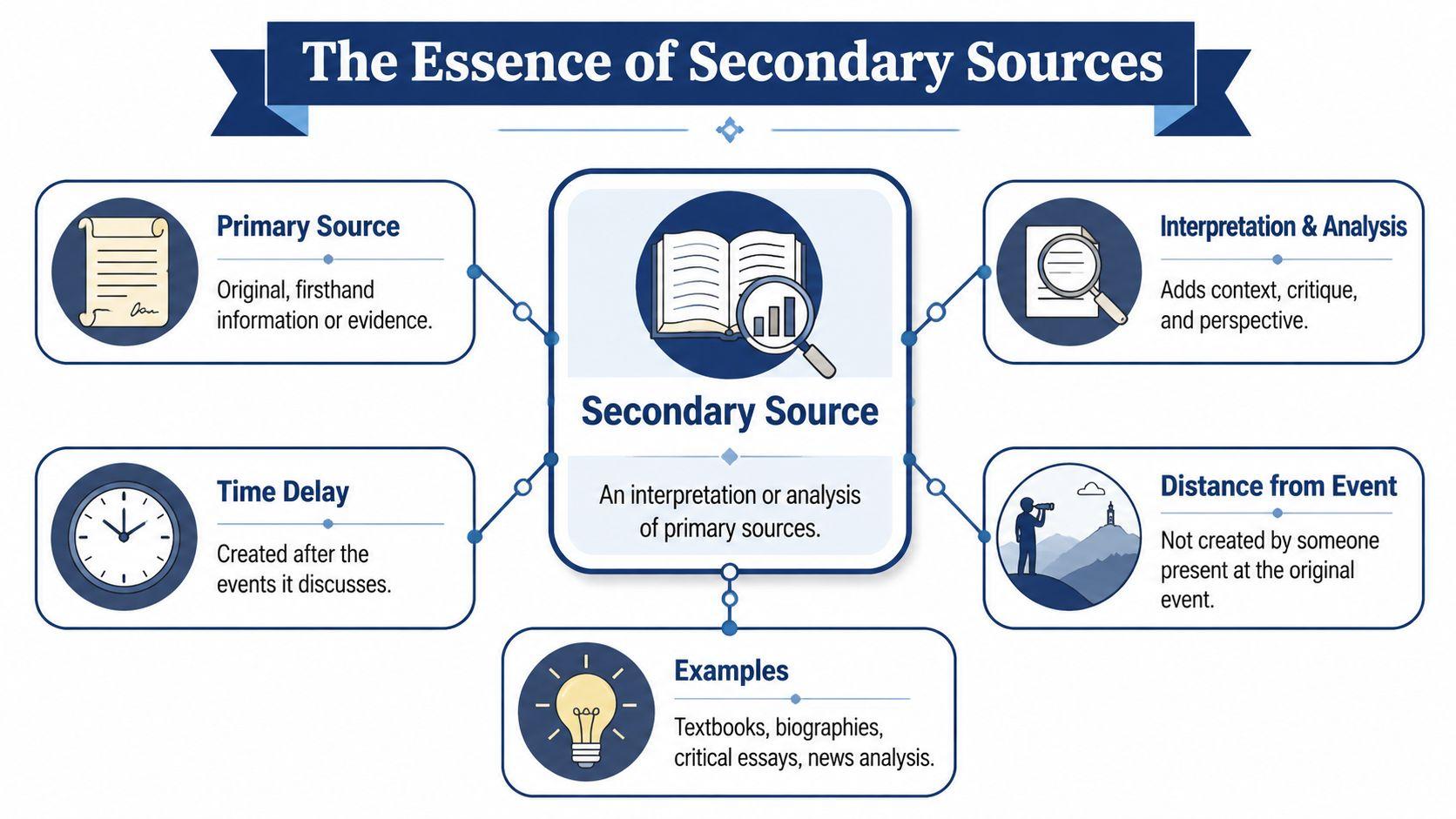
A secondary source is a source that stands one step away from the original evidence. It doesn't give you the raw event, raw document, or raw data first. It gives you someone's interpretation, analysis, synthesis, or summary of that original material.
That sounds abstract until you place it in a real situation.
You're writing a paper on a protest movement. A speech delivered at the rally is a primary source. A historian's book explaining what the speech meant in its political moment is a secondary source. Your instructor asks for both because they do different jobs. One gives you evidence. The other helps you understand it.
Small teams work the same way. If a team is preparing a market brief, the original survey data or interview transcript acts like primary material. A report that explains patterns across those materials acts like a secondary source. One gives direct evidence. The other helps people make sense of it.
Why teachers and managers care
When people ask for source types, they're usually checking whether you know how knowledge gets built.
A strong project rarely comes from raw evidence alone. Seeing context, disagreement, background, and patterns often requires some help. Secondary sources do that work. They help you answer questions like:
- What does this evidence mean
- How do experts interpret it
- What arguments already exist
- Which issues are still debated
The bigger picture
Research often groups sources into three broad families:
- Primary sources give firsthand evidence.
- Secondary sources interpret that evidence.
- Tertiary sources help you locate or quickly review established knowledge.
That distinction isn't just academic housekeeping. It affects how you build an argument, how much weight you give a claim, and when you should dig deeper instead of stopping at somebody else's summary.
Understanding the Core Role of Secondary Sources
The easiest way to understand a secondary source is to stop thinking about format and start thinking about function.
A book is not automatically secondary. An article is not automatically primary. What matters is the source's relationship to the original evidence.
A secondary source is created after the original event or study and analyzes, interprets, synthesizes, or summarizes primary material, rather than presenting firsthand evidence. This distinction is central in research practice because secondary-data work reuses information collected by someone else for a different question or purpose, a point emphasized by the World Bank's DIME Wiki on secondary data sources.
A good analogy is sports.
Think of it like game footage and commentary
If you watch the actual game footage, that's like using a primary source. You're seeing the event itself.
If you watch a commentator break down the game afterward, explain strategy, compare plays, and tell you why a certain moment mattered, that's like using a secondary source. The commentator didn't create the game. They created an interpretation of it.
That's the core role of secondary sources. They help you move from “what happened” to “what it means.”
What secondary sources add
A well-chosen secondary source can give you several things at once:
- Context: It places an event, text, or dataset into a wider story.
- Comparison: It connects one piece of evidence to others.
- Interpretation: It argues for a meaning or significance.
- Synthesis: It combines many pieces of material into a clearer whole.
That's why students often begin with secondary sources even when the final assignment expects some primary evidence too. A secondary source can orient you. It tells you what questions matter, what terms you need, and what debates already exist.
The keyword that matters most
One useful phrase from applied research is the “defining property is reuse”, noted in the same World Bank guidance above. In plain English, that means a secondary source is working with material that already exists. The author didn't gather that original evidence for the purpose now being discussed. They're reusing it to explain something.
Secondary sources are often your research guide. They don't replace the evidence. They help you read it with sharper eyes.
That's why they matter so much. Without them, many readers can collect facts but struggle to understand significance.
Primary Secondary and Tertiary Sources Compared
People often confuse these categories because they treat them like labels attached to objects. It helps more to think of them as jobs.
A source can serve one job in one context and another in a different context. But as a basic reference point, the three types usually work like this:
A simple kitchen analogy
Suppose you're making dinner.
- Primary sources are the ingredients sitting on the counter.
- Secondary sources are the recipe explaining how ingredients work together.
- Tertiary sources are the index or guide that helps you find recipes in the first place.
That isn't perfect, but it's memorable. One gives you raw material. One interprets. One points you toward established information.
Primary vs. Secondary vs. Tertiary Sources
| Attribute | Primary Source | Secondary Source | Tertiary Source |
| Main purpose | Present direct evidence or firsthand material | Analyze, interpret, or summarize earlier material | Compile, organize, or point to broad knowledge |
| Relationship to topic | Close to the original event, text, or data | One step removed from the original evidence | Usually further removed and more reference-oriented |
| What the reader does with it | Examines evidence directly | Understands context, argument, or synthesis | Gets quick background or finds other sources |
| Typical examples | Letters, interviews, speeches, raw data, original records | Biographies, review articles, critical essays, documentaries with interpretation | Encyclopedias, handbooks, indexes, subject guides |
| Best use | Proving what happened or what was said | Understanding meaning and scholarly conversation | Starting research or locating better sources |
| Main risk | You may misread isolated evidence | You may rely too much on someone else's interpretation | You may stop at surface-level information |
Where people mix them up
A textbook often gets called a secondary source in beginner discussions, but in many classrooms it functions more like a tertiary source because it compiles settled knowledge for learners. That's one reason source classification can feel slippery.
A newspaper piece can also shift categories. Straight reporting close to an event might function differently from a later analysis article that reviews causes, effects, and competing interpretations.
For students doing policy or debate work, a specialized guide like Model Diplomat's source analysis for MUN delegates can help sharpen that distinction in practice, especially when you're sorting evidence for position papers.
A quick decision shortcut
Ask what the source is mainly doing:
- Showing you the evidence
- Explaining the evidence
- Organizing known information
That question won't solve every case, but it solves many. If you want a handy place to cross-check common research questions later, the 1chat FAQ library is a useful companion.
If the source's main job is interpretation, you're usually dealing with a secondary source.
Examples of Secondary Sources in Your Field
The meaning of a source doesn't stay fixed across every subject. That's one of the most important points people miss.
According to library guidance from Rider University, the function of a source changes by field. In the sciences, secondary sources are often review articles and meta-analyses that summarize primary research. In the humanities, books, biographies, and scholarly articles that interpret earlier evidence often function as secondary sources, as explained in this guide on primary, secondary, and tertiary sources by discipline.
If you study history or literature
A historian reading letters from a wartime archive is using primary sources. A later book that compares those letters, explains their political setting, and argues about their significance is a secondary source.
The same goes for literature. The novel itself is usually primary for literary analysis. A journal article interpreting themes, symbolism, or historical context is secondary.
Common examples include:
- Biographies that interpret a person's life through records and prior accounts
- Critical essays about a poem, play, or novel
- Documentaries that use older footage while adding narration and argument
- Scholarly books that synthesize archival material
If you study science or health
Science students often ask this in a more specific form: is this article original research, or is it a review?
In many science fields, the classic secondary source is a review article. Instead of presenting one new experiment as the central contribution, it summarizes and interprets results from many earlier studies. A meta-analysis also belongs in this family when it synthesizes prior research.
That makes secondary sources especially helpful when you're trying to get an overview of a topic before focusing on one study.
If you work on a small business team
Business teams use secondary sources all the time, even if they don't call them that.
Suppose your team wants to understand customer behavior in a market. Direct customer interviews, internal support transcripts, or original surveys function like primary material. A market overview written from those materials and earlier reports functions like a secondary source because it interprets and summarizes.
You see this in:
- Industry overviews
- Competitor analysis write-ups
- Trend explainers
- Thought-leadership articles that discuss earlier findings
If your team publishes educational content, it also helps to know when you're writing a synthesis piece rather than presenting firsthand reporting. Writers refining public-facing articles might find Narrareach's guide on leveraging Medium for impact useful because it highlights how interpretation and framing shape reader understanding.
The same item can shift by context
A memoir might be primary in one assignment and secondary in another. If you're studying the author's own perspective, it may count as primary. If you're using it as a later reflection that interprets earlier events, an instructor may treat it differently.
That's why “Is this a secondary source?” usually needs a second question: For which field, and for what purpose?
How to Spot and Evaluate Secondary Sources
The hardest part of this topic isn't the textbook definition. It's the gray area.
Many simple explainers don't help with borderline cases, such as a documentary built from archival footage or a scholarly article that quotes primary material while adding original interpretation. Guidance summarized in the Wikipedia overview of secondary sources and their borderline cases notes that some sources can contain primary-source material and still be secondary overall.
That idea solves a lot of confusion. A source doesn't become primary just because it includes original material somewhere inside it.
Start with four practical questions
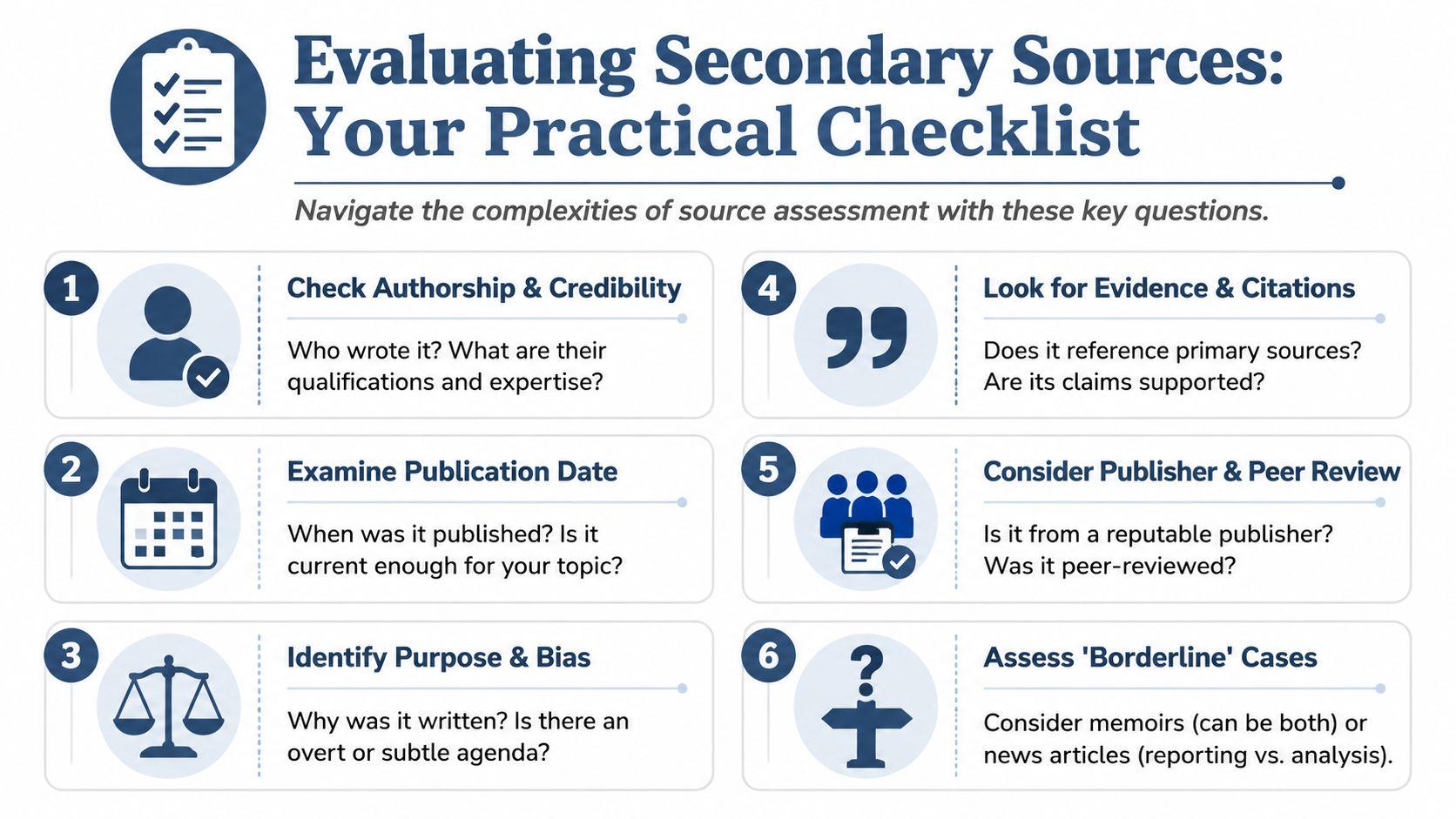
When you pick up a source, ask:
- Who created it
Were they directly involved in the event or study, or are they interpreting material created by others? - When was it created
Was it produced during the event, or later as reflection and analysis? - What is its main purpose
Is it presenting evidence, or making sense of evidence? - How is it built
Does it mainly quote, compare, evaluate, and synthesize existing material?
Those questions work better than trying to memorize a rigid list.
Borderline cases that confuse people
Some source types cause trouble over and over. Here's how to think through them.
- Documentaries: A documentary may include original footage, interviews, or archival documents. If the film's main job is to interpret and organize that material into an argument, it usually functions as a secondary source overall.
- Memoirs and autobiographies: These are tricky. A firsthand account sounds primary, but timing and purpose matter. A memoir written long after the events can carry memory, reflection, and interpretation. In some contexts, instructors may treat it as secondary.
- Scholarly articles with quotes from archives: Don't let the presence of primary material fool you. If the article's main contribution is analysis, it's secondary.
- News pieces: A breaking report may function differently from a later analysis feature. Read the piece's purpose, not just its publication type.
Practical rule: classify the source by its main job, not by one ingredient inside it.
Evaluate quality, not just category
Identifying a secondary source is only step one. You also need to decide whether it's worth trusting.
Use a quick credibility check:
- Author expertise: Does the writer show subject knowledge?
- Evidence use: Does the piece point clearly to supporting material?
- Publisher reputation: Is it published in a setting known for editorial or academic standards?
- Bias and purpose: Is it informing, persuading, selling, or defending a position?
- Fit for your task: Even a solid secondary source may be wrong for your assignment if it's too broad or too opinion-driven.
Teachers building research habits may also like these essential digital age lesson plans, especially for helping students practice source judgment instead of memorizing labels.
A final test for uncertain cases
If you still can't tell, try this sentence starter:
This source is mainly trying to help me understand someone else's evidence.
If that sentence fits, you're probably holding a secondary source.
Using Secondary Sources in Your Work Effectively
Once you know the answer to what's a secondary source, the next step is using one well.
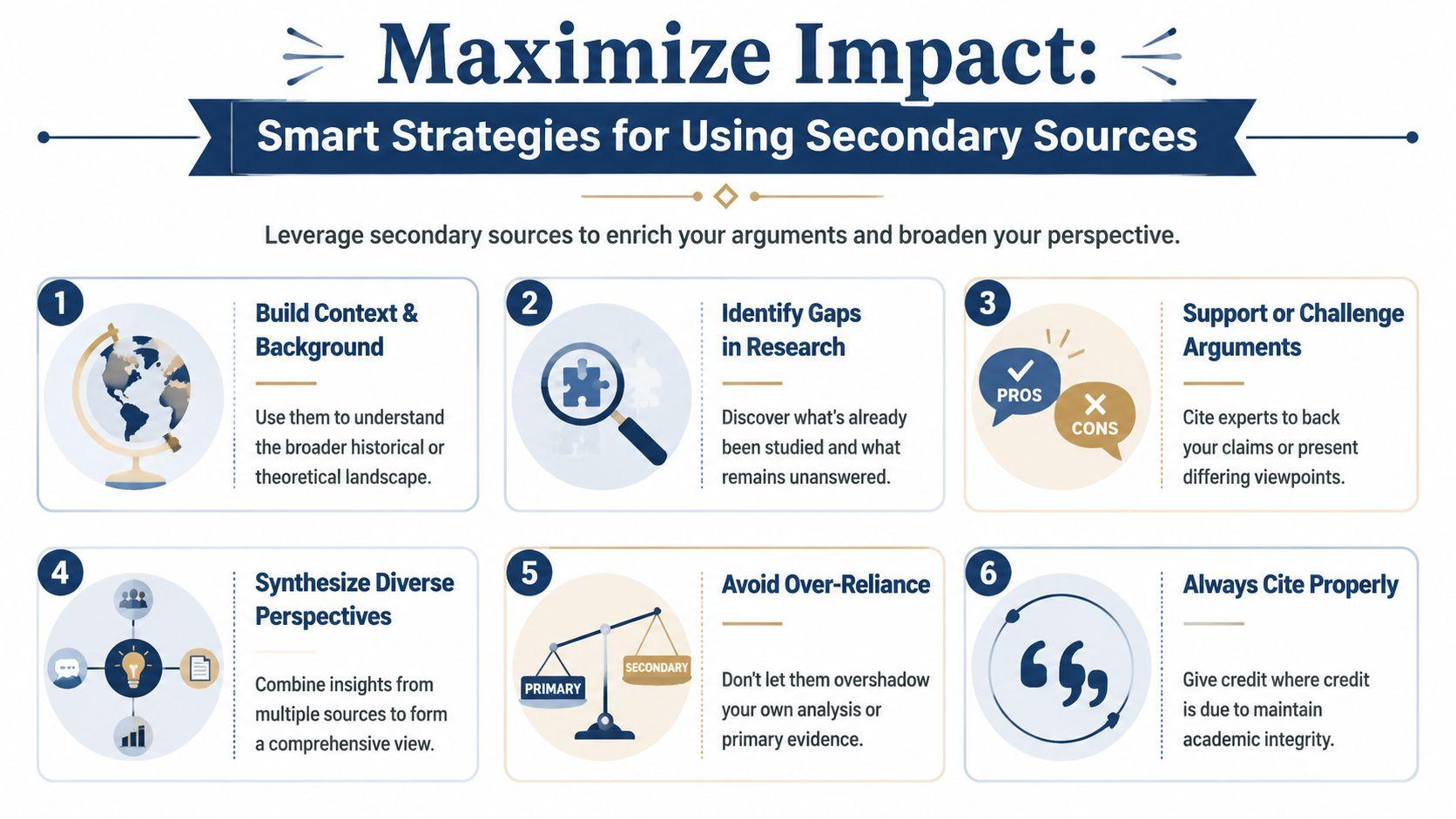
Secondary sources are most helpful when you need to understand a topic before making your own argument. They can introduce background, map the existing conversation, and point you toward useful primary material you might have missed.
When to reach for one first
Use a secondary source when you need:
- Background knowledge before reading raw evidence
- Scholarly context so you can see major debates
- Interpretive models that help explain what you're looking at
- Source trails through footnotes, references, and bibliographies
For students, that often means reading a secondary source early in the research process, then moving into primary evidence once the topic is clearer.
For teams, it often means starting with a reliable synthesis, then checking the underlying material before making a major decision.
How not to overuse them
The biggest mistake is letting secondary sources do all your thinking for you.
If your assignment or report needs evidence, don't stop at somebody else's interpretation of that evidence. Read far enough into the underlying material to understand what the interpreter selected, emphasized, or left out.
Secondary sources are a lens. They help you see. They shouldn't become the only thing you look through.
A simple working method
Try this approach:
- Read one or two good secondary sources for orientation.
- Mark the primary materials they discuss most often.
- Go read those primary materials yourself.
- Use the secondary sources to frame or challenge your interpretation, not replace it.
- Cite carefully so readers can tell whose idea is whose.
That last point matters. Secondary sources are valuable, but you still need to attribute ideas accurately and clearly.
If you keep a research workflow or shared writing system, a resource like the 1chat sitemap for writing and research tools can help you locate related support pages quickly.
A strong essay, report, or presentation usually combines both levels of research. It uses primary sources for evidence and secondary sources for meaning. Once you see that division of labor, source categories stop feeling like arbitrary school rules and start feeling like practical tools.
If you want help summarizing articles, comparing interpretations, or turning messy notes into a clearer draft, you can try 1chat, a privacy-first AI workspace for students, families, and small teams.