November 2022 to October 2024 saw the cost of querying a model with performance equivalent to GPT-3.5 fall from about $20 to $0.07 per million tokens, a drop of more than 280 times in about two years, according to Stanford's 2025 AI Index. The index reports that inference prices fell between 9 and 900 times per year, depending on the task. At those rates, processing 100 million tokens would cost about $2,000 in November 2022 and about $7 in October 2024, before development, hosting, storage, monitoring, and support.
Those falling rates do not capture what a household, student, or small team spends to complete useful work. Model quality, long documents, image generation, and peak capacity can all affect the bill. A realistic cost comparison also needs to account for operational work and chats that fail to resolve the task.
AI Chatbot Cost at a Glance by Pricing Model
The same monthly budget can cover one person's subscription, four household members, or only a fraction of a custom chatbot's operating costs. Compare each option by its billing unit and the work it covers.
| Pricing model | Who it fits | Cost basis | Reference figure |
| Individual plan | One user, with an optional extra seat | Monthly subscription with shared credits | Monthly price; see 1chat's pricing and billing options |
| Family plan | Households of up to 4 members | Monthly subscription covering 4 members | $4.99 per month for each member above 4 |
| Pay-as-you-go API | Developers and variable workloads | Per million tokens processed | About $0.07 per million tokens (GPT-3.5-level, October 2024) |
| Custom-built chatbot | Organizations with system integrations | Development plus monthly operations | $150,000 to $1 million+ to build; $3,000+ per month to run |
| Self-hosted open model | Teams with GPU and engineering staff | GPU hours plus engineering, monitoring, and idle capacity | About $0.0008 per 1,000 output tokens in raw compute |
Individual plan. One main account, optional support for one additional seat, one shared subscription, and shared credits. A student or two-person household using the optional seat pays one subscription price. Multiply that price by 12 to estimate the annual subscription cost, then account for any usage beyond the shared credits.
Family plan. The plan includes four members: the main account plus three others. A fifth member adds $4.99 a month, or $59.88 a year, before usage. A four-person household pays no extra-member fee.
Pay-as-you-go API. The bill varies with tokens processed. At the October 2024 GPT-3.5-level rate, 10 million tokens in a month would cost about $0.70 for tokens alone. That does not include the application around the model.
Custom-built chatbot. Sobot's 2025 pricing review estimates generative-AI chatbot development at $150,000 to $1 million or more, with monthly operating costs starting at $3,000 and potentially exceeding $10,000. Spread a $150,000 build over three years and the build cost alone averages about $4,200 a month, before operations. At the high end of the operating range, a year of running costs exceeds $120,000.
Self-hosted open model. A cloud GPU benchmark reports raw compute costs of about $0.0008 per 1,000 output tokens on H200 infrastructure priced at $6.31 per GPU-hour, according to GPUsmith's cost-per-million-tokens benchmark. The estimate assumes favorable batch sizes and utilization; it excludes idle time, batching overhead, and engineering. A thousand output tokens cost a fraction of a cent at that rate. An underused GPU running for a month creates a separate expense.
Choosing a row: More people, integrations, and custom logic generally mean more costs beyond the model's usage price.
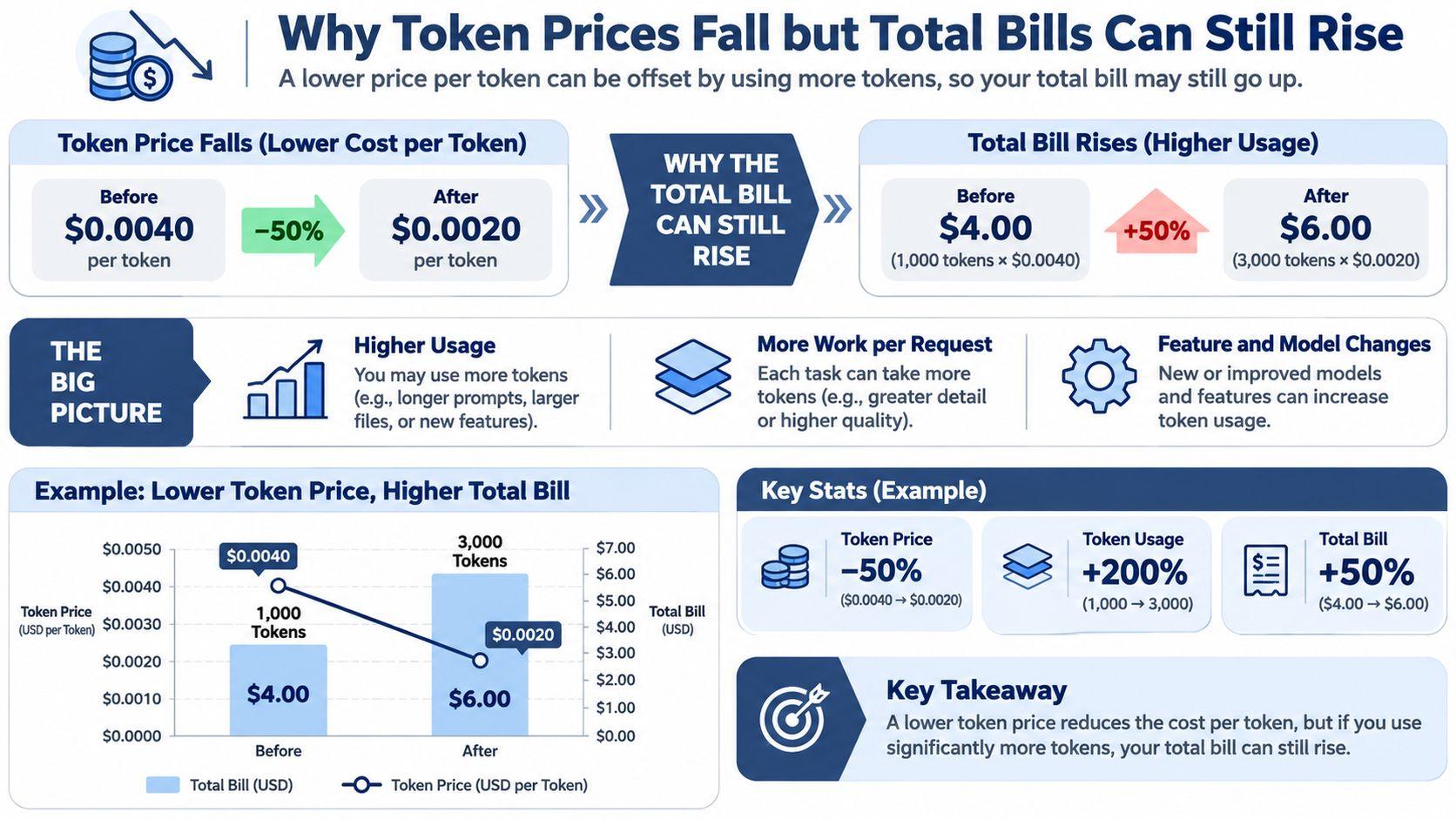
Why Token Prices Fall but Total Bills Can Still Rise
A stamp price is not a mailroom budget. The unit price is the stamp. The total bill is that stamp times every letter, plus the desk, the staff, and the room that sorts them. Token prices fell the way stamp prices would if printing got radically cheaper. Households and companies started sending far more mail, on heavier paper, with more people checking each envelope.
Adoption moved with the price drop. A 2026 paper drawing on Stanford's 2025 AI Index reports that 78% of surveyed organizations said they used AI in 2024, up from 55% in 2023. That is a 23-percentage-point jump while inference was getting cheaper. The same account notes AI hardware costs declining about 30% a year and energy efficiency improving about 40% a year. Cheaper chips and fewer watts per query are why a provider can serve families, students, and small firms that could not have paid early generative-AI rates.
What the token line leaves out
Per-token inference is one line on the invoice. A working service also needs engineering, cybersecurity, privacy controls, content moderation, storage, customer support, model integration, and compliance. None of those shrink just because a benchmark query got cheaper.
For a small business, the comparison that matters is total cost per useful task. Summarizing a contract and drafting a customer reply are tasks. A million tokens is not. A short reply on a smaller model can be almost free. The same month can still swell if staff switch to a larger model, paste full PDFs, generate images, or keep capacity warm for a Monday-morning spike.
Falling unit prices made pay-as-you-go and bundled plans practical. They did not cap the bill.
Subscription Plans, Seats and Family Pricing
Read the seat terms before you pay, then turn the headline fee into a per-person figure.
What each plan actually includes
The Individual plan is one main account, optional support for one additional seat, one shared subscription, and shared credits. Two people who share a login are not two subscriptions. They draw on one pool of credits. If only one of them opens the product in a given month, you still paid for the plan, but you should not pretend two people used it.
The Family plan covers four members, the main account plus three. Each member above four costs $4.99. A five-person household pays the plan price plus $4.99 that month for the fifth member. Invite a sixth and the add-on doubles.
Trial, notice, and the per-person sum
We offer a 14-day free trial, and a user who cancels during the trial is not charged. Treat those two weeks as a free measurement of real homework, PDF, and drafting volume, not as a tour of the interface. If we increase subscription prices, we give at least 30 days' notice, and the increase takes effect at the next renewal so you can cancel first. The plan FAQ is the place to confirm how cancellation and renewal interact before the trial ends.
Seat math is simple and often skipped. Divide the monthly fee by the number of people who use the account that month, not by the number of invitations you sent. A $20 plan used by one person is $20 per active user. The same plan used by four active people is $5 each. Unused seats are the most common leak, because the invoice still shows a tidy monthly price.
- Count active people, not invited people.
- Add paid extras you will turn on, including a fifth family member.
- Ask whether the price would still suit you after a noticed increase at the next renewal.
If the third answer is no, the trial is the time to cancel, before a renewal posts.
Usage-Based Pricing and What Makes Bills Grow
Advertised GPU hourly rates mislead. A 2026 study of 42 systematic vLLM benchmark runs on H100 GPUs found that effective cost per million output tokens varied by 17.5 to 36.3 times on identical hardware when only the offered request rate changed. Across configurations and load levels, costs ranged from $0.21 to $15.25 per million output tokens, as reported in the H100 utilization study.
Low request volume leaves expensive accelerators idle, so each token you do produce carries the empty time. Excessive concurrency raises latency and can force extra replicas. For a small or midsize business, estimate cost from measured tokens per minute at the traffic you expect, not from peak theoretical throughput.
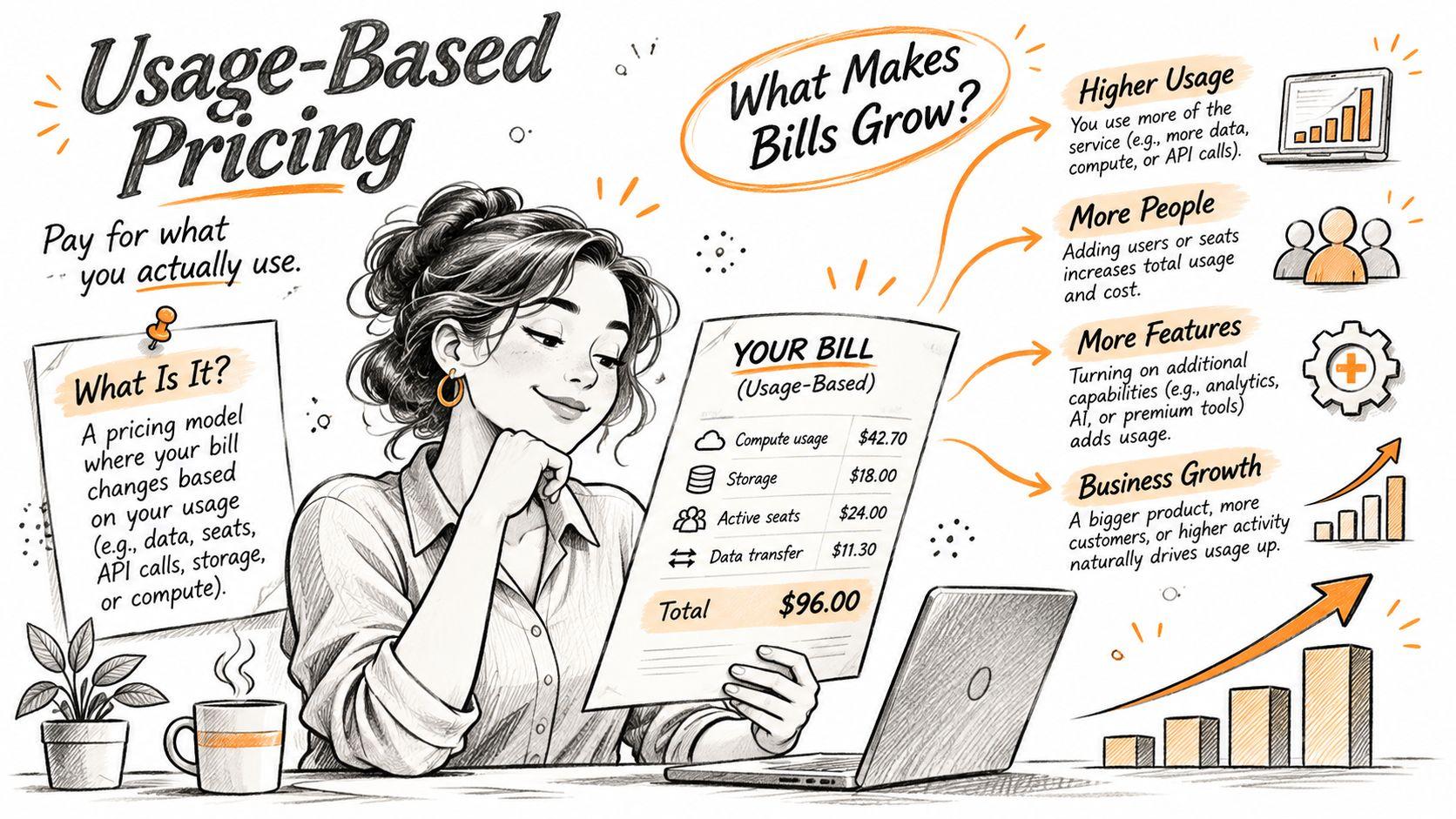
Levers that move a usage bill
| Cost lever | Why it raises the bill | How to keep it in check |
| Image generation | Each image is a separate, resource-heavy task | Batch image requests and set a monthly limit |
| PDF and long-document analysis | Long files consume far more tokens than short prompts | Split documents, ask targeted questions, and summarize first |
| Higher-quality model choice | Larger models cost more per token | Route routine tasks to smaller models and reserve large ones for complex analysis |
| Retries and failed requests | Repeated requests multiply token use | Test prompts before rollout and track the retry rate |
| Peak-demand traffic | Bursts push up latency and capacity needs | Measure tokens per minute at expected traffic, not peak throughput |
We can generate AI images, and you can chat with PDFs. Budget both apart from the base plan. A one-page question is a different job from a 40-page syllabus. Routing everyday drafts to a smaller model, and keeping a larger model for hard analysis, cuts spend only if quality holds and people don't resubmit. A failed answer that gets retried twice has tripled the tokens for one task. Our service credit terms spell out how credits are used and that they are not transferable.
Say a team processes 3 million tokens a day for 30 days. That is 90 million tokens in the month. At the October 2024 GPT-3.5-level rate, token charges alone are about $6.30. Retries, a larger model, or document-heavy prompts multiply the count long before the hourly GPU card looks expensive. Test batch size, prompt length, output length, concurrency, and the latency you will tolerate before you commit.
Hidden Costs of Integration, Oversight and Failed Chats
The cheapest listed plan is not automatically the cheapest way to run a chatbot. After launch, the bill picks up token usage, model selection, governance, human validation, workforce disruption, and model maintenance. RSM's briefing on AI's hidden costs is blunt about those recurring items. A neutral Berkeley analysis, cited in that same briefing, puts the saving at about $0.70 per customer interaction versus human service. The same discussion notes that 53–77% of surveyed users have had a frustrating chatbot interaction.
A low sticker price gets expensive when customers repeat the question, abandon the thread, or get handed to a person. Staff then spend time checking the answer the bot already gave. The $0.70 never arrives on the interactions that bounce.
A break-even you can do on a napkin
Take 2,000 conversations a month and a 15% escalation rate. That is 300 escalations. At six minutes of staff time each, you have 30 staff hours a month before any integration work. If a loaded hour costs $25, oversight alone is $750, which can dwarf a small subscription. Drop the escalation rate to 5% and those hours fall to 10. The subscription did not change. The failure rate did.
A simple informational assistant answers from a fixed set of pages. A multi-system bot tied to a CRM, orders, or support tickets costs more to connect and more to keep current when a policy changes. Teams that want a contained starting point can look at instant AI chat for customer inquiries as one way to handle front-door questions before they wire the bot into every back-office system.
The operational winner is the option with the lowest cost per completed task after escalations, not the lowest price on the comparison grid.
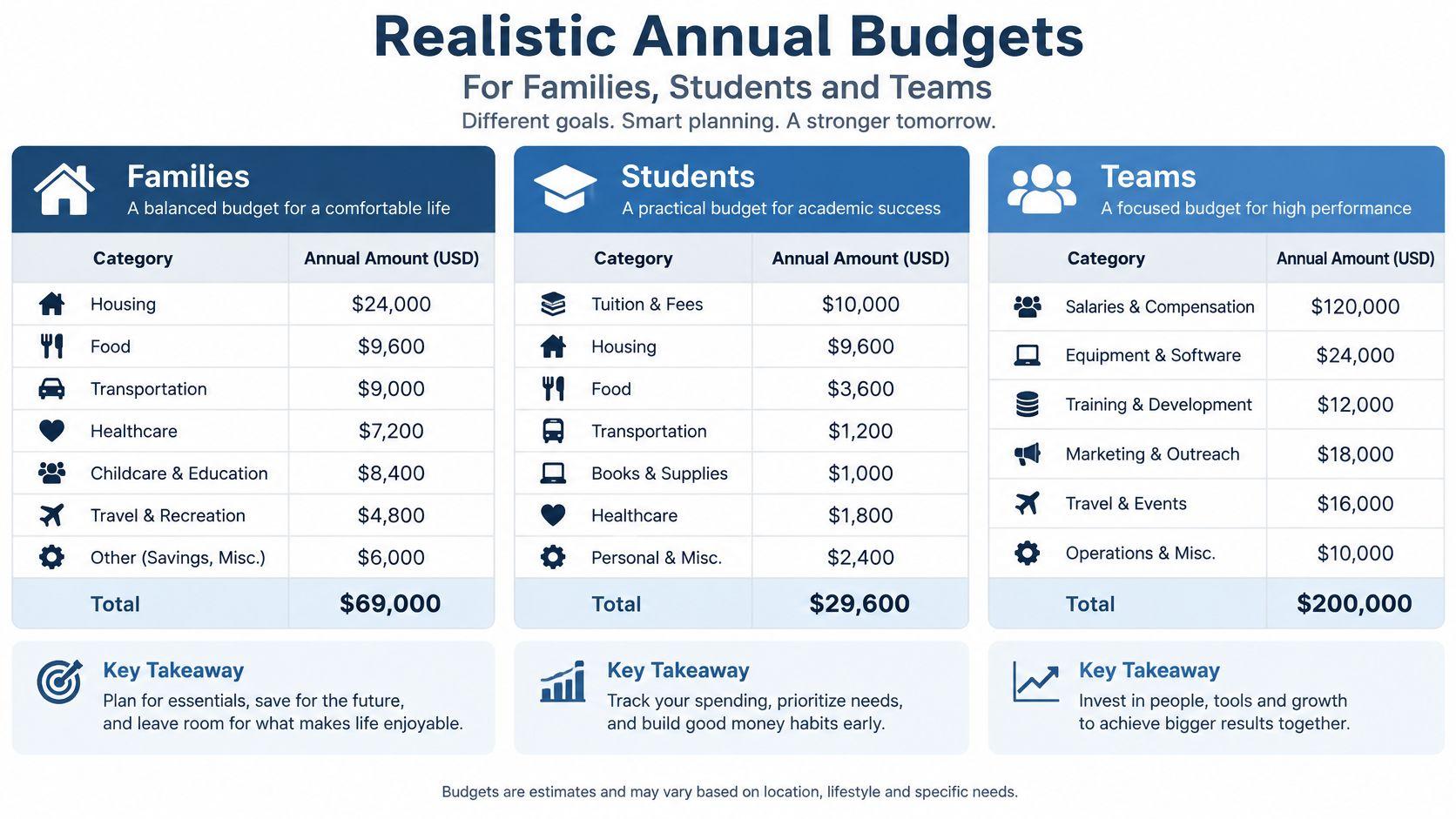
Realistic Annual Budgets for Families, Students and Teams
59% of surveyed executives spent more on AI than expected, and 20% exceeded their targets by more than 30%, according to TechRadar's report on AI spending. A household or team faces the same budgeting problem at a smaller scale: the plan price is only one part of annual spend. Compare cost per active person and useful task, including extra usage and tools that remain in the budget.
| Scenario | Members | Plan | Annual cost formula |
| One college student | 1 | Individual plan | Monthly plan price × 12, plus any extra usage |
| Four-person family | 4 | Family plan | Monthly family plan price × 12 |
| Five-person family | 5 | Family plan | Monthly family plan price × 12, plus $4.99 × 12 for the fifth member |
| Five-person small business | 5 | Individual plan with one optional additional seat, or a team plan if offered | Monthly plan price × 12, minus the cost of duplicate tools cancelled |
Let the Family plan price be P dollars a month. A four-person household pays 12P a year before extra usage. A five-person household pays 12P + $59.88, including the fifth member's $4.99 × 12 fee. A student's annual plan cost is 12 times the monthly Individual plan price, plus any extra usage.
For a small business, subtract only subscriptions it cancels. If it drops writing, PDF, and image tools costing $15, $12, and $10 a month, that removes $444 a year from the net budget. The saving depends on ending those subscriptions, not adding a chatbot.
Divide annual spend by active users. Five seats with two weekly users leave three seats unused, so the cost per active user is higher than the seat price suggests.
Costs that never hit the card
Families also spend time supervising outputs, checking homework accuracy, and managing unsuitable content. Schools and small businesses should include oversight when calculating cost per completed task or saved hour. A shared workspace costs less only if its annual price, extra usage, and supervision time together are below the tools and effort it replaces.
Choose the Plan That Matches Your Real Workflow
Run this in about ten minutes.
- List the tasks. Chat, PDF analysis, image generation, homework help, or team drafting, and how often each happens in a month.
- Count real users. People who will open the account this month, not people who might.
- Add the extras. Additional seats, image and document usage, and any overage.
- Subtract what you would cancel. Separate writing, PDF, or image subscriptions.
- Test during the trial. Confirm the current length and terms on the live pricing page, then run a normal week of work.
A student or a single user with occasional use fits the Individual plan. A household of up to four fits the Family plan. A family of five or more adds the $4.99 member fee. A team with regular integrations or heavy usage should budget add-ons and oversight before it picks a row.
Confirm the current price and payment methods on the live pricing page before you pay. We accept all major credit cards, Apple Pay, Google Pay, Amazon Pay, and Alipay. If you are unsure whether to cancel or request a refund, check the refund terms on that page first. You can also contact us and we will route you to the right support path.
Pull last month's active users, escalations, and the tools you still pay for twice. Put those three numbers next to the plan row that matches your household or team, then start the trial only if the annual per-person figure still looks right after you add oversight time. If it doesn't, cancel before renewal and keep the smaller stack.