The story is open on the kitchen table, covered in three colors of highlighter, and the paragraph on the screen begins: "In this story, the author uses symbolism and foreshadowing to show that things are not always what they seem." The student can retell every plot beat in order. What she can't do is say why the final image turns the whole thing over.
That gap is the job. Noticing a detail is the easy part. Explaining what the detail does, and why that effect supports a claim about the story, is what a literature teacher is marking.
So this guide builds the skill in sequence. You get an element map to carry into the first read, a six-step pass through the story, a routine for the moment you're stuck staring at a quote, a context check that keeps historical background from hijacking the reading, and a failure scan to run before you draft. Then you write one paragraph and revise it.
By the end you should be able to analyze short story fiction at the level of a defensible claim instead of a plot recap. The whole method rests on one property of the form, which is where any honest analysis starts.
Why Short Story Analysis Starts With the Whole Effect
A short story is built to be read in one sitting, and that single fact decides how you analyze it. The entire narrative can sit in your head at once, instead of arriving in chapters you have to reassemble later.
Length estimates vary, but they cluster. Common descriptions call a short story prose fiction meant to be read in one sitting, with typical ranges between about 1,000 and 7,500 words, while a broader scholarly estimate runs from roughly 1,600 to 30,000 words, as the Wikipedia entry on the short story lays out. Those numbers are practical, not pedantic. At 250 words a minute, a 1,000-word story takes about four minutes and a 7,500-word story takes about thirty.
What the tight scale forces writers to do
Nineteenth-century magazines pushed short fiction toward commercially practical lengths, often between 3,000 and 15,000 words. Page space was expensive and reading time was short, so writers learned to make one detail perform several jobs at once.
A single room can set the mood, expose a character's fear, foreshadow the conflict, and carry the theme, all in a paragraph of furniture and lamplight. That's why effective analysis asks not only what happens but why each chosen detail matters inside a narrative with almost no slack. Nothing is in the story by accident, and nothing is there purely as decoration.
Edgar Allan Poe made the classic argument in 1842 that short fiction should be designed for reading in a single sitting and organized around one unified emotional or artistic effect, a framework the Britannica overview of the short story identifies as a major theoretical foundation for the form. That's still the standard your analysis has to meet.
The test for every claim: if your sentence would survive a change of story title, it's a generality, not analysis.
Say a student can retell Shirley Jackson's "The Lottery" from the first line to the last and still freeze when asked what the cheerful chatter in the final paragraph does. She has the events. She doesn't have a claim. The ordinary tone of that ending is the horror of the story, and until she can say so in her own sentence, with the details that prove it, she hasn't analyzed anything yet.
The product, and the mistake to avoid
Three things come out of this method: an element map you carry into the first read, a six-step pass through the story, and one paragraph built on a claim that survives contact with the text.
The mistake to avoid is plot summary dressed as interpretation. Retelling proves you read the story. Explaining why a detail matters proves you understood it, and understanding is what gets marked.
Choose one complete story now, short enough to finish in a single sitting, and write the edition or anthology at the top of your notes. Page numbers shift between editions, so fix yours before you cite a single line. Then read with the ending in view from the first page, because in a form this compressed the last line is usually already waiting in the first.
Six Steps to Analyze a Short Story
Put the element map on the desk before you start reading, not after. The map isn't the analysis. It's the set of questions that keeps you from wandering.
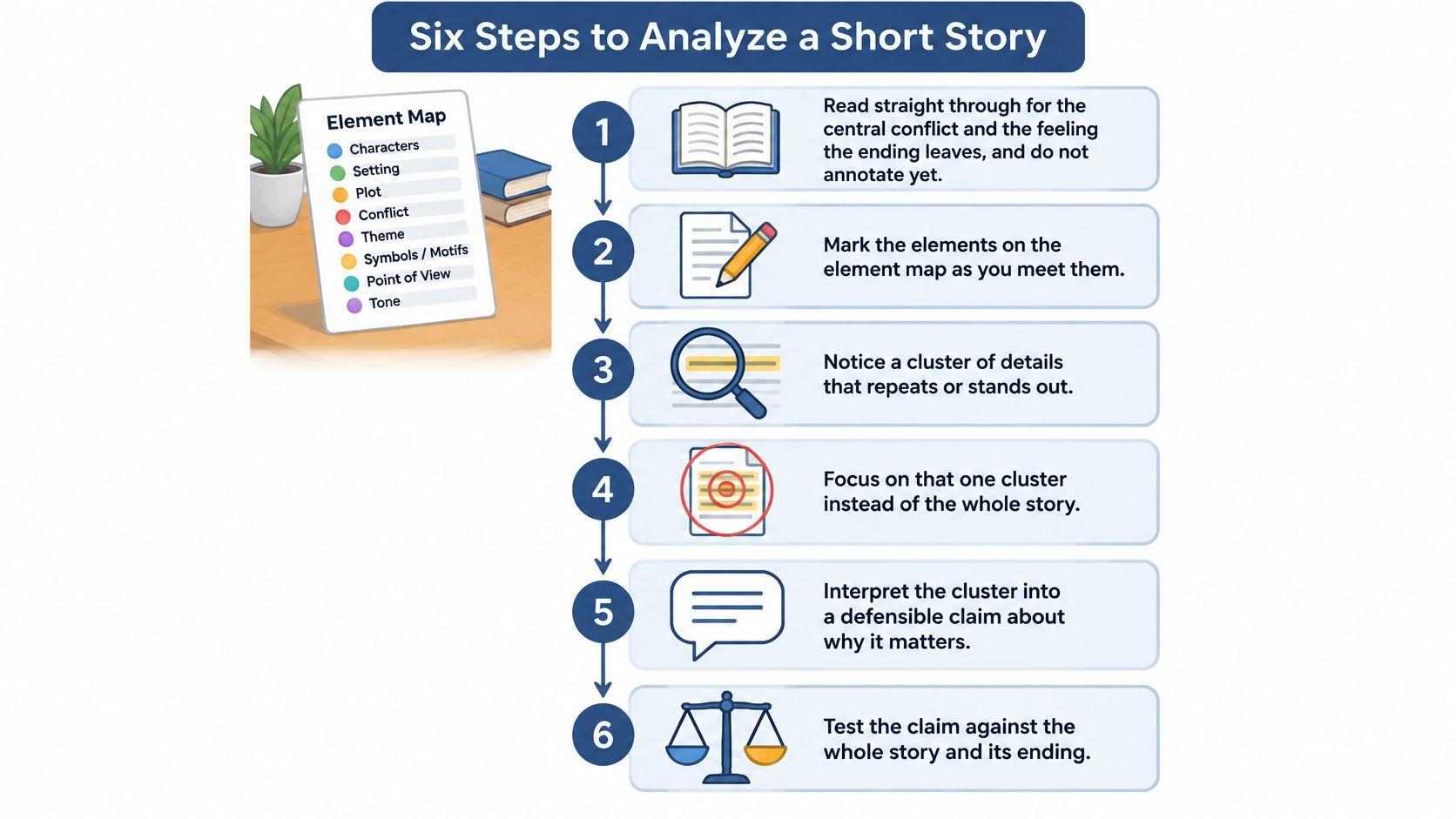
- Read straight through without a pen. Read for the central conflict and for the feeling the ending leaves you with. Resist annotating on this pass. You can't judge which details matter until you know where the story is going.
- Mark the plot spine. Tag exposition, complication, turning point, and resolution. Some stories withhold resolution entirely, and that withholding becomes the thing you analyze.
- Track desire, obstacle, and change. For each major character, write what they want, what blocks them, and whether the ending grants, denies, or transforms the want. Then name who is seeing the events.
- Underline whatever repeats or cuts. Repeated images, odd diction, irony, symbols, and setting details doing more than locating the scene all belong here. Sharpen your pencil for sentences that feel slightly wrong.
- Cluster the marks. Group them by relation, not by device name. A pattern is two or three marks pointing the same direction.
- Write one evidence-claim-warrant line. Quote or pinpoint the feature, state its effect, and say why that effect supports your claim. One line, not a paragraph.
The infographic below shows the same pass as a single continuous flow, from the first unmarked read to the claim you test against the ending.
Steps two through four are where most readers stall, so give each element its own question instead of a vague impression. This is the checklist to keep beside the story.
| Element | What to mark | Question it answers |
| Plot | Exposition, complication, turning point, resolution or withheld ending | What changes, and where does the pressure peak? |
| Character | Desire, obstacle, change or refusal to change | Who wants something, and what does the ending do to that want? |
| Point of view | Narrator position and focalization | Whose eyes limit what the reader is allowed to know? |
| Setting | Place, time, and one detail that does extra work | How does place create mood, pressure, or theme? |
| Literary devices | Repeated image, diction, irony, or symbol | What does the repeat do to the conflict or the ending? |
| Theme | One sentence tying the pattern to the effect | What idea do the details support, and what do they refuse? |
A story of a few thousand words should produce one short pattern, not twenty unrelated notes. When two details contradict the pattern you're building, keep them. They belong in your qualification later, not in the bin. Contradiction is usually the story telling you where its real argument lives.
Writers build these patterns deliberately, and seeing the machinery from the other side sharpens your reading. The guide to how to write a psychological thriller from MEB Books covers withheld information, narrowing options, and pressure that tightens page by page, which is exactly what you're reverse-engineering when you analyze short story fiction well.
Finish this pass with a one-sentence working thesis you're willing to revise. A thesis you'd defend to the death is usually one you haven't tested yet.
How Small Details Become a Defensible Claim
A reader can spot a striking line and still end up with a weak claim: “This shows that the author uses symbolism.” The problem is the missing connection between the detail and what it does in the story. A defensible claim makes that connection visible.
The 2025 AP English Literature Chief Reader Report describes how students may notice details but struggle to explain how those details add up to meaning. It recommends a Notice, Focus, Interpret process: select related evidence, identify the strongest details, then connect them to an analytical question. That habit transfers to any text a reader has to analyze.
Notice, Focus, Interpret gives each stage a distinct job: gather a pattern, choose the evidence that best supports it, then explain the pattern's effect.
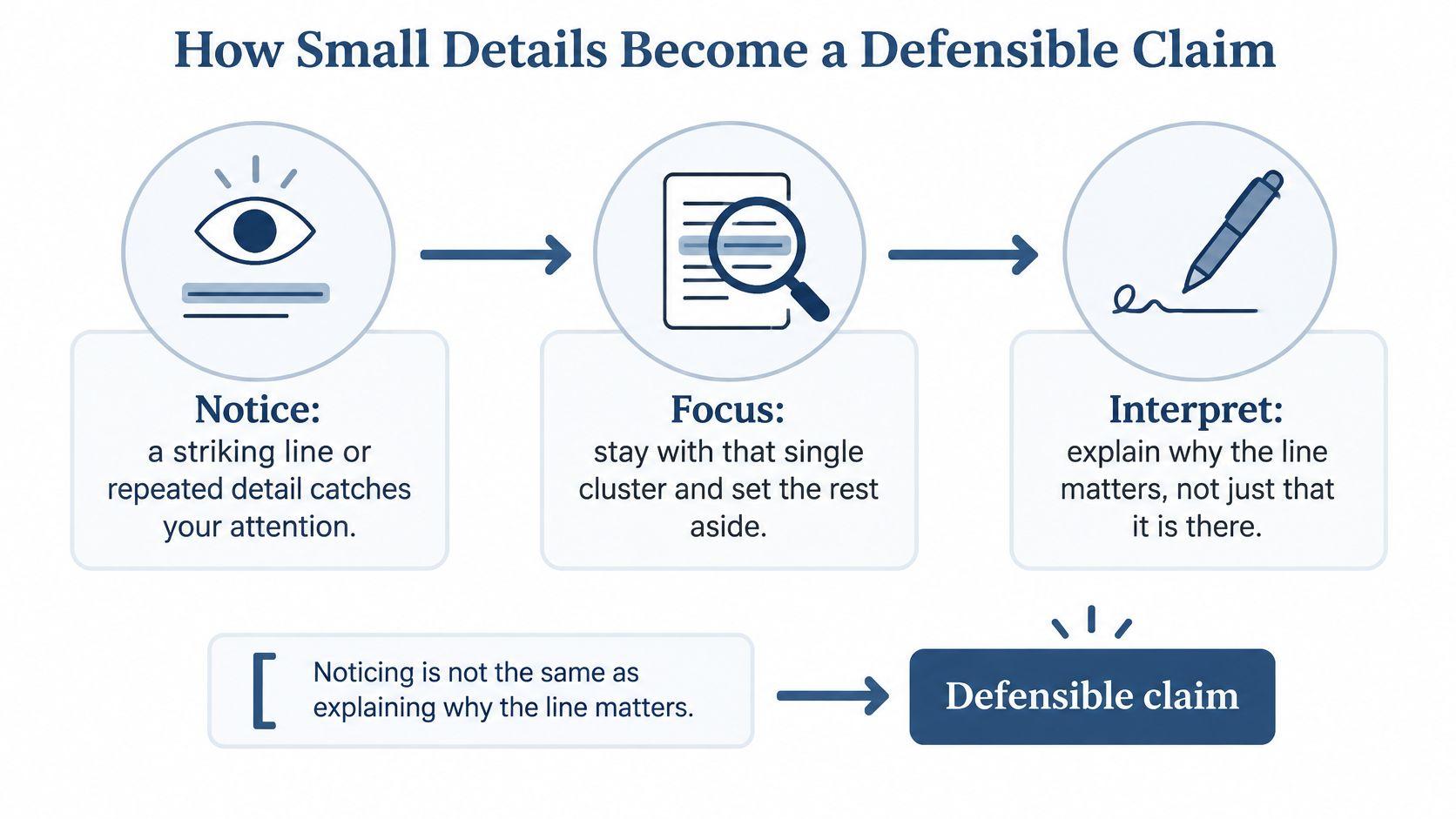
Notice the marks that belong together
Collect related details before deciding what they mean. A repeated color, a clipped sentence, and a door that keeps closing may form a cluster. Group them by what they do together, not just by device type. Ask: What pattern could these marks be building?
Focus by dropping the weakest mark
Choose the details that point most clearly toward the same effect. If two details support a reading and a third does not, set the third aside for now. Focus turns annotations into evidence. If every detail seems equally important, the pattern may still be too broad.
Interpret what the pair does to the conflict or the ending
A device label names what you see; an interpretation explains why it matters. “The author uses imagery” identifies a category. “The cold imagery arrives only after she decides to stay, so the cold belongs to her choice rather than the weather” links a specific detail to a change in the scene. Ask: What does this detail make the reader understand about the conflict?
Consider Kate Chopin's “The Story of an Hour.” A summary says the wife learns her husband has died and feels free. An analytical claim connects the sequence: the open window and the word “free” arrive before grief, so the story measures a marriage against one hour of imagined choice.
“There would be no one to live for during those coming years; she would live for herself.”
Commentary should explain the evidence-claim-warrant chain. The claim might be that the story presents freedom as a private future, not a reaction to news. The warrant is the link between the open window, which puts the outside world in view, and the word “free,” which names what she imagines. Because the window appears first, the order of details supports the interpretation. Ask of each mark: What does it show, what claim does it support, and why does that evidence justify the claim?
Then qualify the reading. A detail that resists the pattern can mark its limits rather than undo it. For example, “The pattern holds except when the sister appears, and the language turns social again” identifies where the claim fits and where it needs care. A qualified claim accounts for the story's complications instead of forcing every detail into one explanation.
An excerpt may end before the conflict resolves. In that case, build the claim from how the selected lines relate to one another, not from an ending the passage does not provide. The evidence still needs to support the interpretation, even when the larger outcome remains unknown.
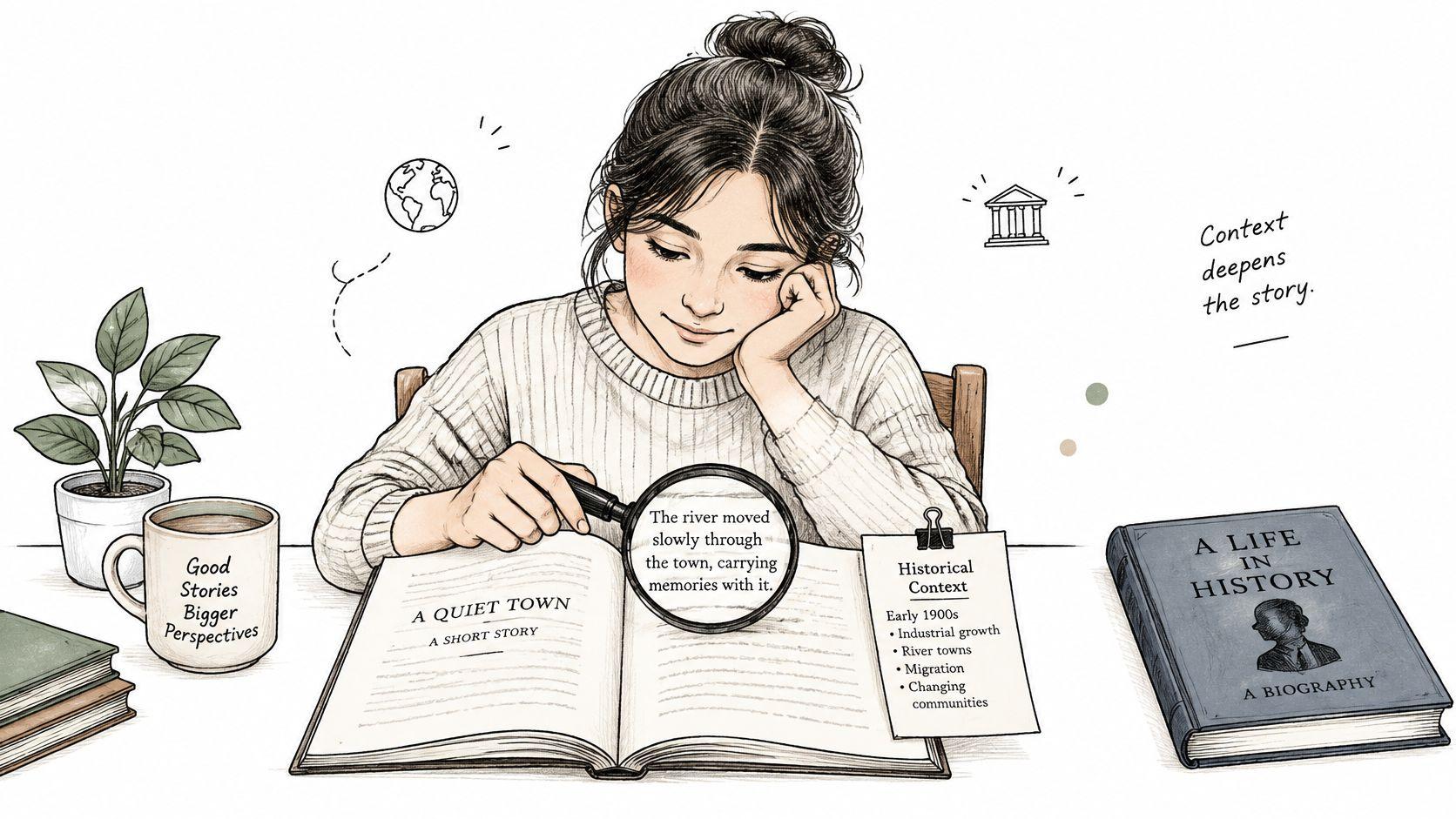
How Context Helps Without Dictating the Theme
Two failure modes sit at opposite ends of the same problem. In one, context is optional decoration you bolt on at the end. In the other, the author's biography swallows the story, and every line becomes evidence for a life rather than a text.
Most readers land in the first camp. A 2025 study of literature students found that 60% did not know what contextual analysis was, while 65% wanted works connected with other fields and every respondent supported introducing contextual analysis into literature classes (the 2025 literature-student survey). The gap isn't a missing definition. It's a missing method.
The four-line context check
Run this test before context enters your paragraph.
- Write the textual claim alone. One sentence about the story's effect that could stand without any outside facts.
- Add one contextual hypothesis. A genre habit, a historical constraint, a power relation the story stages, or a detail about when it was published.
- Test it against the page. The hypothesis is useful only if it explains a detail already in front of you. It distorts the reading if it erases a competing detail you noticed in the first pass.
- Offer two plausible readings. Say what evidence each one privileges and what each one has to explain away.
That fourth step is where most analyses get interesting, because two readings can both be defensible. Consider a story about a village ritual. One reading treats the ritual as social cohesion, the price a community pays to stay coherent. A second treats it as the distribution of violence, with the ending showing who absorbs the cost. Both are arguable from the same details. The weak analysis picks one and pretends the other doesn't exist.
For a culturally sensitive story, three questions do more work than a verdict. Who gets to speak? Who is described from outside? What does the ending grant, and what does it withhold? Answer those before you assign the author a moral, and your reading will be precise instead of preachy.
Keep the textual sentence and the contextual sentence on separate lines in your notes. If the second one can't be deleted without the first one collapsing, you've written biography with a story attached.
Catch Weak Analysis Before the Draft
Run this check between the working thesis and the polished paragraph. It's cheaper to fix a claim than a page.
Start with the disagreement problem. Even trained readers score analytic writing inconsistently. One study of analytic writing found inter-rater correlations of .59 for Theme, .55 for Character, .50 for Plot, .50 for Communication, and .49 for Setting, with Setting falling below that study's acceptable threshold, a result reported in this close reading guide for literature students. If two careful readers can't agree on what a story is about, you need a procedure rather than a hunch.
The procedure is short. Code the story alone, using the element questions, marking exposition, complication, turning point, resolution or a withheld ending, narrator position, focalization, and any time shift. Compare codes only after both passes are finished, so you're not anchored by someone else's reading. Settle each clash with a written definition instead of a vote. Then keep one counterdetail in your notes on purpose.
Frequency is not significance. Three mentions of a color stay a hypothesis until close reading shows what that color does at the turn of the story. Counting gives you a place to look. Only the passage itself tells you what the mark means.
Here are the five habits most likely to sink a note, and the fix for each.
| Failure | What it looks like | Fix |
| Plot summary | Events retold in order with no claim | Stop at the turn and say what meaning changed |
| Device list | Irony or symbol named with no effect | Add what the device does to the reader or the conflict |
| Narrator as author | Every line treated as the writer's belief | Name focalization and what that narrator cannot see |
| Cherry-picked quotes | Only lines that already fit the thesis | Keep one counterdetail and qualify the claim |
| Intention guessing | A moral assigned to the author | Tie the effect to words on the page |
A note is ready only when it quotes a feature, states the effect, and says why that effect supports the thesis. Anything shorter is a bookmark.
Draft One Evidence Paragraph and Revise It
Stop outlining. Write one paragraph, five sentences, in this order.
- Claim. One sentence about the story's single effect. Name what the ending does to the reader or to the character's situation.
- Evidence. Quote the line, or pinpoint the detail precisely enough that a reader can find it in ten seconds.
- Function. Say what that detail does at the turning point, not what it is called.
- Warrant. Explain why that effect supports your claim about the whole story. This is the sentence students skip, and it's the one the mark depends on.
- Limit. Name the counterdetail or the second plausible reading and say what it costs your claim.
Read it aloud and cut every sentence that only retells who did what. Then run a single test: cover the quotation with your thumb. If the paragraph still argues something, the commentary is doing its job. If it collapses into a summary of events, the quotation was carrying all the weight and your commentary was decoration.
If the draft still sounds like a recap, paste your notes, not the whole story, into a privacy-first chat such as 1chat and ask whether each sentence explains an effect or only repeats the plot. Treat the answer as a diagnostic and revise by hand, so the claim, the quotations, and the phrasing stay yours. That workflow suits a homework draft or a family conversation about a story, because the tool organizes feedback while the evidence stays on the page where you can defend it.
The paragraph is done when a classmate can answer two questions from it alone: what does the story's ending do, and which line proves it? If they need the rest of the story to follow you, the paragraph isn't finished. Hand it in, or use it to open the argument about the competing reading.
Open your story to the final page and write one sentence about what that last image leaves the reader holding. Not what happened. What it does. Then run the six-step pass on the two pages before that ending and check whether the pattern you find there earns your sentence. If it doesn't, revise the sentence, not the story. That paragraph, with its claim, evidence, warrant, and limit, is the thing a teacher can mark, a classmate can argue with, and you can defend out loud without your notes in front of you.