You've got a deadline, a folder full of PDFs, and a review draft that still feels like a pile of notes instead of an argument. Maybe you're a student trying to make sense of 40 tabs, or a small team trying to turn scattered articles into something you can cite with confidence. AI for literature review can help, but only when you use it for the parts of the job that are repetitive, structured, and easy to verify. The useful shift is not “let AI write the review,” it's “let AI speed up the tasks that consume time while you keep control of scope, evidence, and interpretation.”
When AI Helps in a Literature Review
A literature review is a chain of work. You search, screen, extract, synthesize, and write. AI helps different parts of that chain in different ways, and the difference matters. The strongest use cases are the steps where scale and consistency matter, while the weaker ones are the parts that depend on interpretation. A 2022 article in AI & Society mapped AI support across the full workflow and showed tools already in use for screening prioritization, trial-quality assessment, and text-mining synthesis methods, while also separating descriptive syntheses from inductive theory work and interpretive reviews AI & Society workflow map.
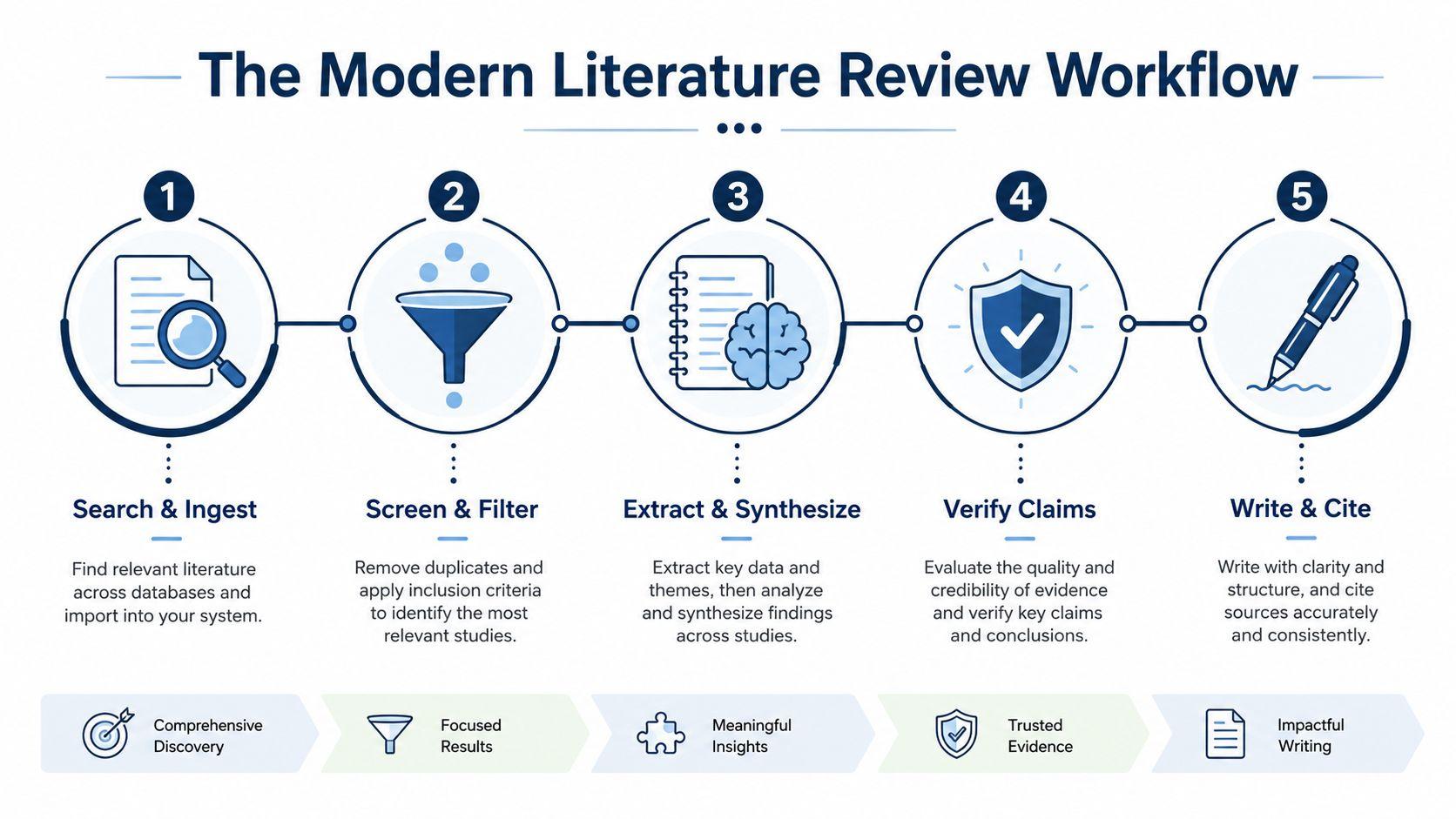
Practical rule: use AI where the task is repetitive and checkable, then keep humans on anything that changes the argument, the method, or the final judgment.
That rule fits a privacy-first, multi-model workspace such as 1chat when you want to upload PDFs, compare models, and keep the work in one place. If you want a broader look at the tool category before you start, the guide on AI literature review tools is a useful companion.
Where the workload changes
The clearest gains show up in screening, extraction, and evidence handling. Reviews of AI-assisted systems report strong results on specific tasks, including exact exclusion-rationale work in health technology assessment cases and high data-extraction performance in a systematic-review assistant JAMIA review of AI-assisted review systems. A human-in-the-loop workflow study also reported strong recall when turning a research question into Boolean search strings, along with time savings in abstract screening and qualitative extraction human-in-the-loop workflow study.
That tells you where AI earns its place. It can widen the search net, sort the pile, and turn messy reading into structured notes. It cannot decide whether your corpus matches your scope, whether a claim is supported by the source you think it is, or whether your review should be exhaustive, illustrative, or interpretive.
What not to outsource
AI is weakest when the review depends on interpretive judgment or a specific method tradition. The earlier AI & Society review rated AI support as very high for descriptive syntheses, moderate for inductive theory development and theory testing, and low or non-existent for traditional interpretive reviews AI & Society workflow map. In practice, the same prompts that help you triage articles for a scoping review can flatten nuance in a narrative review.
Use AI for the mechanics. Keep the logic of inclusion, the meaning of the evidence, and the final shape of the story with the human reviewer. A student may use it to cut down abstract screening fatigue. A small team may use it to speed up extraction while still checking what each source really says.
Pick the Right Review Type Before You Prompt Anything
A weak review often starts with a vague scope. People open an AI chat and ask for “the literature” as if every review follows the same rulebook. It doesn't. A scoping review, a systematic review, and a narrative review ask different questions, tolerate different amounts of ambiguity, and need different search settings.
A one-sentence scope statement changes everything
Before you prompt any model, write one sentence that says what kind of review you're doing, what population or domain matters, what time window or topic boundary applies, and what you need the review to do. That sentence becomes the guardrail for every later prompt. If you can't write it cleanly, AI will only help you produce a cleaner version of a fuzzy project.
“I'm running a scoping review of recent work on AI support for literature screening in health research, and I need broad coverage with transparent inclusion reasons.”
That kind of sentence is specific enough to guide search, screening, and verification. It also stops the model from drifting into adjacent topics that sound relevant but don't belong in your corpus.
Match the workflow to the review type
| Review type | Search tolerance | Best AI tasks | Human-only tasks |
| Scoping review | Broad, can tolerate extra retrieval | Search expansion, fast screening, topic clustering | Final scope decisions, charting the boundaries |
| Systematic review | Narrower, method-driven, prefers reproducibility | Boolean draft generation, abstract screening, extraction support | Inclusion and exclusion decisions, risk-of-bias judgment, protocol adherence |
| Narrative review | Flexible, can prioritize relevance over exhaustiveness | Source summarization, cross-source comparison, gap finding | Argument framing, interpretive synthesis, disciplinary judgment |
The point is not that one review is “better.” The point is that AI should mirror the review standard you've chosen. A systematic review needs tighter control and more explicit verification. A narrative review can use AI for reading efficiency, but it shouldn't inherit the same high-recall search style that a systematic review needs.
The practical payoff is this. Once you know the review type, you know how much recall you need, how much precision you can tolerate, and how hard you should push the model to retrieve edge cases. That choice determines whether AI is acting like a search assistant, a screening assistant, or a drafting assistant.
Build Your Search and Ingest Your Sources
The fastest way to waste time is to ask an AI model for papers before you've shaped the search. Start with a question, not a pile of keywords. Then use AI to draft or refine a Boolean string, test it against a seed paper you already trust, and export the resulting set into a workspace where the PDFs can be analyzed together.
Draft the search, then sanity-check it
A good workflow starts with one known paper, not a blank page. Feed the model your review sentence, ask for a search string with synonyms and controlled terms, and then check whether the seed paper appears under the query you built. If the seed disappears, the query is too narrow. If it drifts into irrelevant subtopics, the query is too loose.
A multi-model workspace helps. One model can help generate search terms, another can help inspect screening logic, and another can support extraction once the PDFs are inside the workspace. In a setup like 1chat, the point is not novelty, it's division of labor. Each model can be used where it performs best, while the uploaded sources keep the discussion grounded.
Get the files ready before you ask for synthesis
File hygiene matters more than many realize. Rename PDFs so you can identify them later, group them by topic or phase, and keep the uploaded set small enough that you can still audit what the model is seeing. If you are dealing with a long review, chunk the upload into batches by subtopic or chronology instead of throwing everything into one prompt.
One useful habit is to keep a note alongside each file set that says why those papers are in the workspace. That simple provenance note saves time later when the model generates an odd comparison or misses a key source. If you want a platform overview focused on this kind of workflow, the internal research page at https://1chat.com/research is the right place to start.
The best use of AI at this stage is first-pass triage. Ask it to identify themes, compare article abstracts, or flag likely duplicates. Don't ask it to write your review from an unverified pile.
Keep uploads structured
A clean ingest process makes later questions more reliable. Group related PDFs together, use one topic per upload batch when possible, and make sure your own notes distinguish between “included because relevant” and “included as background.” That distinction matters when you later ask the model to explain why a paper was selected.
If the workspace supports multiple models, use that intentionally. One model can be better at summarizing a dense methods section, while another might be better at extracting definitions or comparing claims across sources. The value is in letting the source set stay fixed while the analytical lens changes.
Prompt Patterns That Summarize and Synthesize
Generic prompts produce generic summaries. If you want a model to do useful review work, give it a task, a source boundary, and a format constraint. I split the work into four jobs, extraction, comparison, gap finding, and evidence tabulation, because each one needs a different check before it can be trusted.
The prompt library I reach for
A scoped extraction prompt works for one source or a tight set of sources. It keeps the model inside the paper and makes verification easier.
Summarize only the claims relevant to [your question]. List the study's aim, method, main findings, and limits. Do not add outside facts. If the paper does not address the question, say so.
A compare-across-sources prompt is for synthesis across a small, defined corpus.
Compare these sources on [topic]. Group them by agreement, disagreement, and method differences. Quote or paraphrase only from the uploaded files, and flag where the evidence is thin.
A gap-finding prompt helps when you already know the field and need to see what is missing.
Based only on these documents, identify topics that are underdeveloped, methods that are overused, and claims that appear unsupported or repetitive.
A table-of-evidence prompt is the most practical for messy reviews, especially when you need to check whether each claim has a source behind it.
Build a table with columns for author, question, method, sample or corpus, key claim, and verification note. Leave a cell blank if the source does not support it.
Match the prompt to the review type
Different review types need different prompt habits. A scoping review usually benefits from broad extraction and light synthesis, because the point is to map what exists and where the boundaries sit. A systematic review needs tighter source control, explicit inclusion criteria, and prompts that force the model to separate data extraction from interpretation. A narrative review allows more interpretive synthesis, but it still needs a prompt that asks for source-backed themes rather than polished prose.
That difference matters in practice. If I am helping someone with a scoping review, I ask the model to list concepts, methods, and settings, then I verify whether those items really belong in the scope statement. For a systematic review, I ask for extraction rows that mirror the protocol, then I check each row against the PDF or record before any synthesis starts. For a narrative review, I focus on prompts that surface common arguments and tensions, then I verify whether the summary reflects the authors' actual emphasis or just the model's pattern matching.
A realistic example
Suppose your topic is AI support for review screening in health research. Start with a prompt that only extracts screening-related information from each PDF. Then ask for a comparison table across the extracted notes, sorted by task, screening, extraction, or verification. Finally, ask the model to list any claims that need source-level checking before they can be cited.
That sequence works better than one giant prompt because each step narrows the risk of drift. The first prompt keeps the model inside the paper. The second turns notes into patterns. The third forces an audit mindset before anything is written up.
Keep conflicting findings visible
When papers disagree, do not smooth the disagreement away. Ask the model to preserve it.
If the sources conflict, show the conflict in a separate row and note the likely reason, such as different methods, different populations, or different review types.
That instruction matters in mixed corpora. A systematic review article and a narrative review article may be talking past each other even when they use the same keywords. Your prompt should make the difference visible instead of hiding it under a tidy summary.
For more reusable structures like this, the prompt examples in the 1chat blog are worth adapting to your own review process.
Verify Every Citation, Number, and Claim
This is the part most AI tutorials skip. It shouldn't be optional. A review is only defensible if you can show that the sources exist, the numbers are copied correctly, and the argument matches the evidence you collected. AI can speed up review work, but it can also make verification more urgent because the output sounds fluent even when it's wrong.
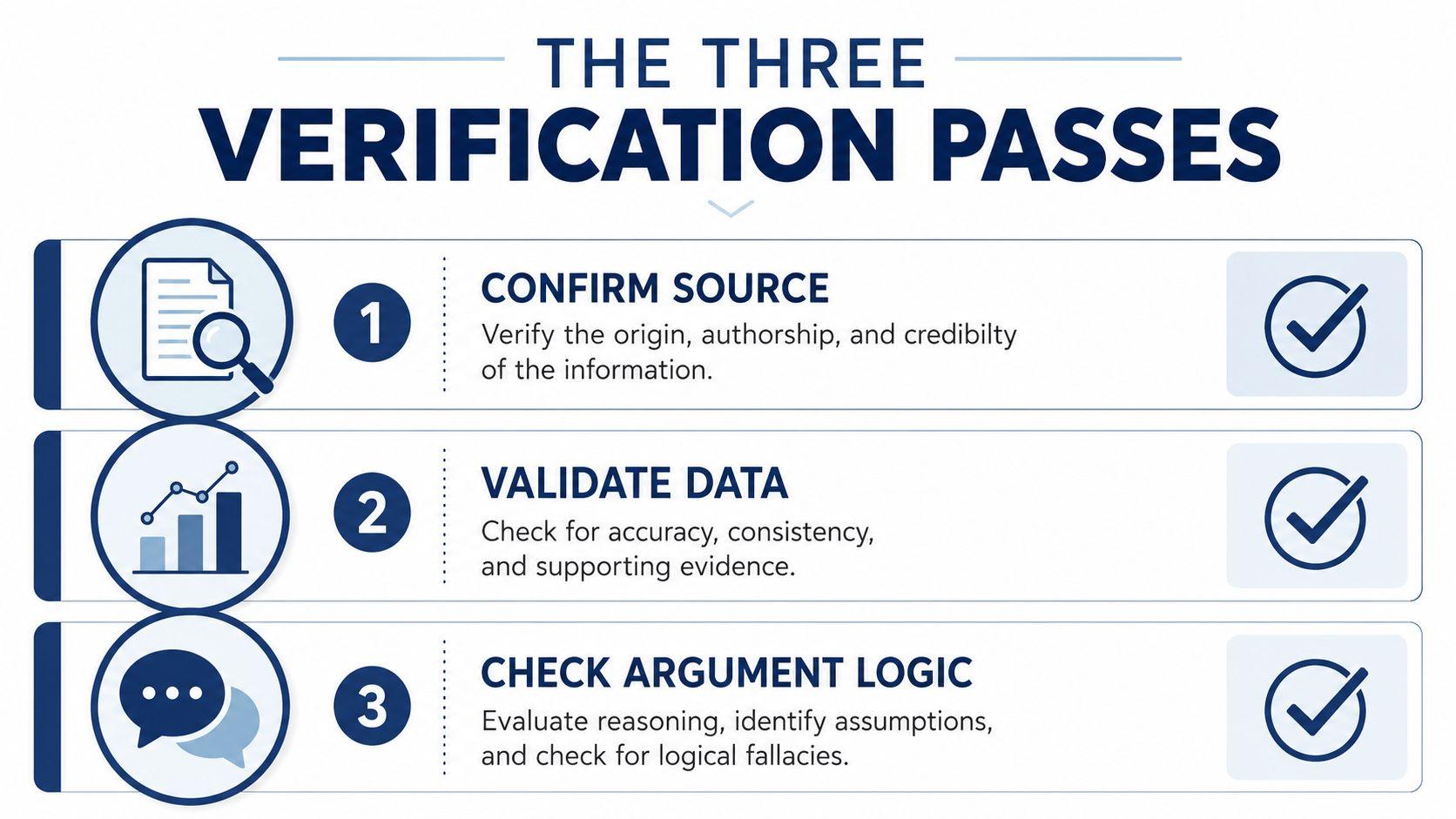
The three passes that catch most problems
First, confirm that every cited paper exists in the source PDF or in the uploaded record. If the model names an article that isn't in your corpus, treat that as a failure until you verify it manually. Second, validate every numeric claim against the table, figure, or abstract in the original source. Third, check whether the argument logic still matches your scope statement, because a paper can be real and still be out of bounds.
If you can't trace a claim back to a page, figure, or table, it doesn't belong in the final draft.
That rule is boring, but it saves you from the most common failure mode, polished summaries with shaky provenance. It also helps when you're deciding whether a result is central or just tangentially mentioned.
A short audit checklist
- Source exists: The citation matches a real paper in your file set or reference manager.
- Claim is grounded: The number or statement appears in the source, not just in the model's paraphrase.
- Scope matches: The source fits the review type and the one-sentence scope statement.
- Inclusion reason is clear: You can explain why the paper stayed in the corpus.
- Missing context is noted: If the model skipped a limitation or qualifier, you've flagged it.
Bias and provenance are part of verification
Verification isn't only about false citations. AI can also skew what it surfaces, especially when language and database coverage are uneven. Practical guidance already warns that summaries should be checked against primary sources and that there's a bias toward English-language publications. That means you should record what databases or file sources you searched, what kinds of papers were easiest to retrieve, and which edge cases may have been missed.
The goal is not perfection. The goal is an audit trail. If someone asks why a source made it into the final corpus, you should be able to answer without guessing. For a concise practical reference on this stage, the FAQ at https://1chat.com/faq is useful when you're setting up a workflow for yourself or a small team.
Adapting the Workflow for Students, Teams, and Families
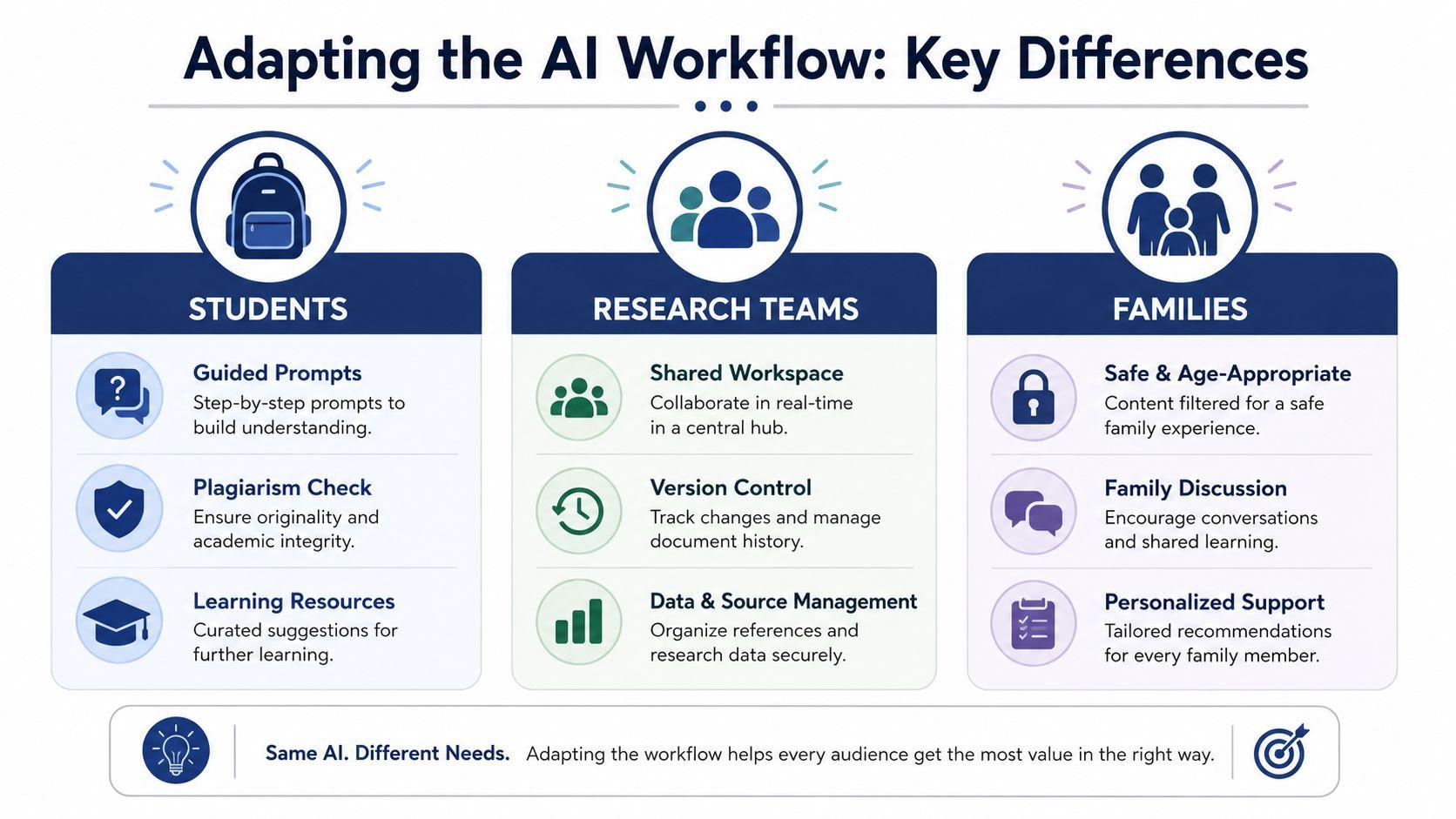
The same review workflow needs different guardrails depending on who is using it. A middle school student, a graduate student, and a small research team all need different amounts of structure, privacy, and oversight. The core sequence stays the same, but the model choice, file handling, and review checks should change.
Students need guidance, not autonomy without limits
For middle and high school students, the best setup is a guided workflow with short prompts and explicit source checks. The model should help with reading, outlining, and rephrasing, but the student still needs to learn how to cite and how to tell a source summary from a personal claim. If a family is using a shared tool, keep the content age-appropriate and make sure the student stays inside the assigned reading set.
A practical model-choice approach is to use the most transparent setup available for summarizing one PDF at a time. That keeps the task manageable and reduces the temptation to paste in a whole project and accept whatever comes back. A plagiarism check still matters, because a fluent summary is not the same thing as original writing.
College students need stronger structure and source discipline
For thesis-level work, the biggest risk is scope drift. A student can start with a narrow topic and end up with a review that mixes methodological papers, commentary, and unrelated background reading. A multi-LLM workspace helps here because one model can help classify sources, while another can help compare them once the included set is stable.
Use annotated PDFs and keep a note about why each file was included. That makes it easier to defend the final corpus if a supervisor asks why one article made it in and another did not. If you're handling sensitive drafts, keep uploads in a private workspace instead of a public chat flow.
Teams and families need collaboration rules
Research teams benefit from shared annotation, version control, and a single place where the source set lives. Without that, two people ask different prompts against different PDFs and the final synthesis becomes impossible to audit. A family using the same tool has a different need, it's more about privacy boundaries, kid-friendly use, and making sure one person's notes don't get mixed into another person's work.
The underlying workflow does not change. Everyone still needs a scope statement, a curated source set, prompt patterns that stay inside the corpus, and the three verification passes from the section above. The difference is how tightly you control access and how much scaffolding each user group needs to stay accurate.
Your Literature Review Checklist and Final Reminders
A usable review workflow is simple to state and hard to execute well. Start with a one-sentence scope statement. Draft the search with AI, then test it against a seed source. Ingest your PDFs into a workspace that can keep the corpus grounded. Use prompt patterns that extract, compare, and tabulate. Run the three verification passes. Then write the review with your own argument still intact.
The central rule is unchanged across scoping reviews, systematic reviews, and narrative reviews. AI is a force multiplier for repetitive review work, not a replacement for methodological judgment. It can help you move faster through screening and extraction, but it can't decide what your review is for, what counts as evidence, or how your synthesis should read.
If your project is broad, messy, and source-heavy, a multi-model workspace makes sense. If your work depends on interpretive nuance or a very specific review standard, keep AI in a narrow support role. And if you can't write down your scope, your inclusion reason, and your verification check in plain language, the project probably isn't ready for automation yet.
If you're starting a review this week, write your one-sentence scope statement first, then test one seed paper against a model-assisted search and one PDF against a verification pass. If the source set is large or shared across people, move it into a private multi-model workspace and keep a simple audit log from the beginning.