Your team has the RFP open in one tab, old proposals in another, pricing notes in Slack, and a deadline that keeps getting closer. Someone is copying boilerplate from last quarter. Someone else is rewriting the executive summary from scratch because the old one sounds wrong for this buyer. By the time you reach compliance review, the team is tired enough to miss things that matter.
That's where AI for proposal writing helps most. Not as a magic button, and not as a replacement for proposal judgment. It works when you use it to remove the repetitive drafting, sorting, summarizing, and proofreading that drain a small team's time.
The mistake I see most often is simple. Teams ask AI to write the whole proposal before they've prepared the source material, clarified the win themes, or defined what the model must not invent. That produces exactly what you'd expect: polished language, weak substance, and generic positioning. A better workflow keeps humans in charge of strategy and evidence, then uses AI to accelerate everything around it.
Why AI Is Now Essential for Winning Proposals
Small teams already know the pressure. You're expected to answer faster, customize more, and maintain consistency across every section without adding headcount. Manual proposal writing breaks down under that load because the work is repetitive and fragmented at the same time.
The market has already shifted. Generative AI adoption among professional proposal teams doubled from 34% to 68% in one year, according to Loopio's 2026 RFP Trends Report as cited by Civio's overview of AI proposal tools. That matters because it signals a change in operating standard, not just tool preference.
What changed for proposal teams
A few years ago, AI in proposal work was mostly experimental. Teams tested it for rough summaries or awkward first drafts, then went back to their old process. That's not the current reality.
Today, a key advantage is speed with control. AI can digest an RFP, pull themes from prior materials, draft repetitive sections, and surface inconsistencies before final review. For a small team, that means more coverage and less time lost to blank-page drafting.
Practical rule: If your competitors use AI to get to a workable first draft sooner, your team can't afford to spend its best hours on copy-paste assembly.
There's also a quality issue hiding inside the speed issue. The teams that respond fastest often get more time for tailoring, stakeholder review, and sharper messaging. AI doesn't win proposals on its own. It creates room for the work that does.
Why this is now a process problem
The question isn't whether to use AI for proposal writing. It's whether your workflow tells AI what to do well. Most failures come from weak setup, not weak models.
That's why proposal managers should think about AI the same way content teams think about editorial systems. The strongest overview I've seen on the broader writing tradeoff is this definitive guide for content creators, because it frames the issue well: AI accelerates production, but humans still determine credibility, tone, and originality.
For teams comparing tools and workflows, it also helps to review current model capabilities in one place instead of building around a single vendor assumption. A practical starting point is 1chat research, especially if your team wants to test how different models handle summarization, extraction, and revision tasks before standardizing a workflow.
Preparing Your AI Co-Pilot for Success
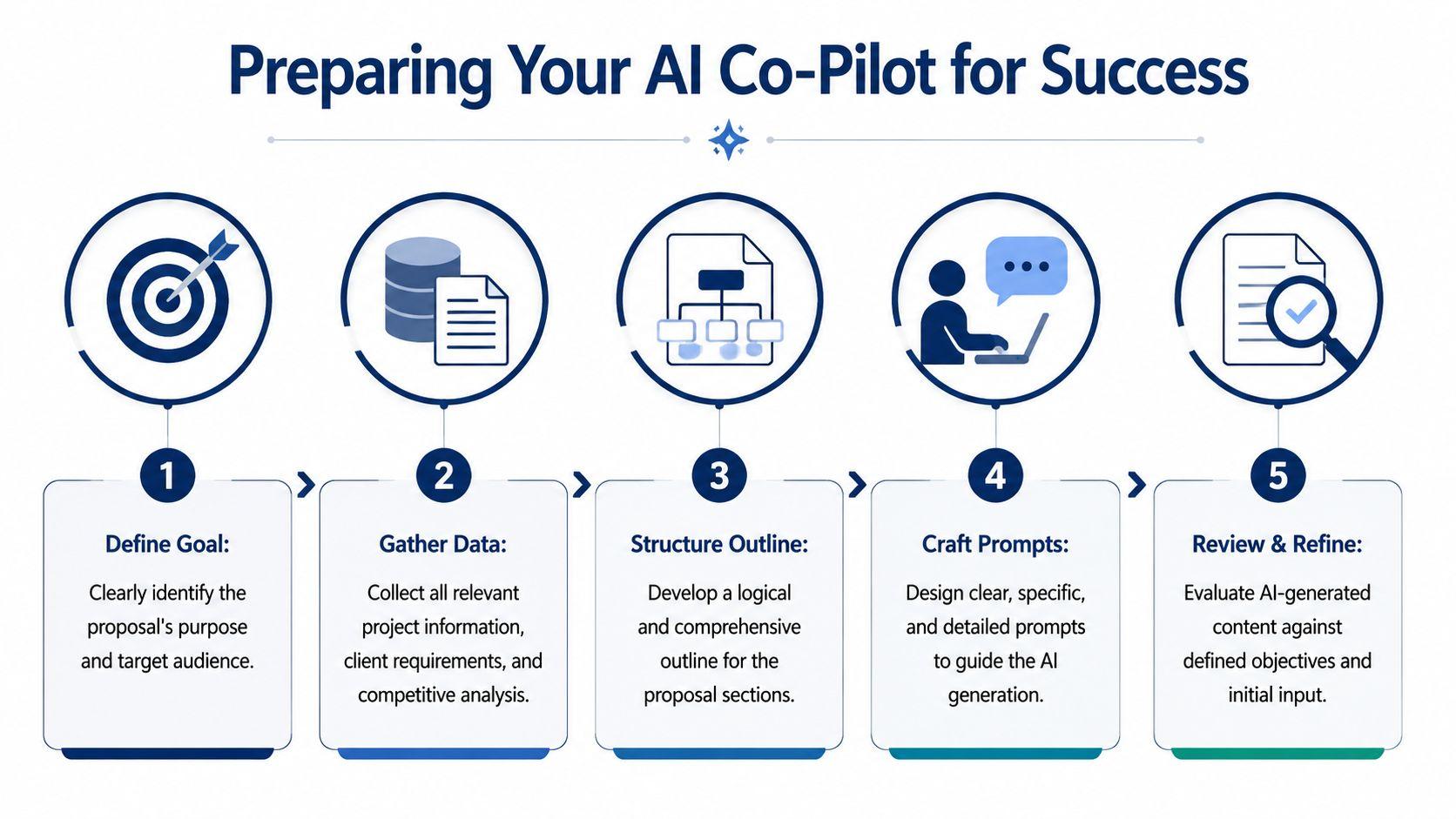
Most proposal problems start before drafting. If you feed AI a messy RFP, incomplete background material, and a vague request like “write a strong response,” you'll get polished confusion back.
Good output starts with controlled input.
Use retrieval before generation
The most effective setup uses two different AI jobs in sequence. A Xait explanation of proposal writing with AI software describes the key distinction well: use discriminative AI first for secure retrieval of approved internal content, then use generative AI for drafting.
That sounds technical, but the workflow is straightforward:
| Step | What happens | Who owns it |
| Retrieve | Pull approved case studies, bios, boilerplate, certifications, and prior answers | Human plus retrieval system |
| Filter | Remove outdated, unapproved, or irrelevant material | Human |
| Draft | Ask the model to write only from the approved source pack | AI |
| Check | Compare draft against RFP requirements and source pack | Human plus AI |
If you skip retrieval and jump straight to drafting, the model fills gaps with guesswork or generic language. That's where compliance errors and bland proposals come from.
Build a source pack before you prompt
For a small team, a source pack can be simple. It doesn't need a giant knowledge system. It needs discipline.
Include these items before any drafting starts:
- RFP summary: Scope, submission rules, page limits, mandatory forms, evaluation criteria, deadlines
- Approved company content: Capability statements, service descriptions, certifications, standard legal language
- Proof points: Named clients if allowed, internal case notes, delivery examples, implementation approach
- Team information: Bios, roles, availability, relevant project experience
- Non-negotiables: Claims AI must not make, wording that must appear, compliance rules that must be preserved
Never ask AI to “fill in the gaps” on credentials, certifications, customer outcomes, or delivery commitments. If the source pack doesn't contain it, the proposal shouldn't contain it.
Prompt for extraction, not prose
Before AI writes a sentence for the client, make it read the RFP like a proposal coordinator would. I use prompts that force structure and force uncertainty to be explicit.
Try this prompt template:
Read the attached RFP and produce a proposal brief in a table with these fields only:
- Client name
- Submission deadline
- Delivery format
- Mandatory sections
- Evaluation criteria
- Required attachments
- Compliance risks
- Questions that need internal clarification
Do not draft proposal language.
Do not infer missing facts.
If a requirement is unclear, label it “unclear in source.”
Then run a second prompt against your internal material:
Review the approved source documents and create a reusable response library for this RFP.
Group content into these categories: qualifications, methodology, team bios, implementation, risk management, security, pricing support, and past performance.
Exclude anything outdated, duplicated, or not directly supported by the source files.
Flag weak evidence and missing proof points separately.
The prep checklist that saves time later
The fastest teams don't skip prep. They make prep repeatable.
Use this short review before drafting:
- Confirm the ask
Translate the RFP into plain language. What is the buyer trying to solve? - Identify the scored items
Separate what is mandatory from what is persuasive. Those aren't always the same. - Match source material to sections
Assign content before writing begins. - List open questions
Missing pricing assumptions, staffing details, delivery constraints, and legal items should never get buried in drafting. - Lock the claims
Decide what the team can prove, what needs approval, and what must stay out.
That prep work looks slower for about half an hour. It saves far more than that when you're not fixing AI-made errors across the entire draft.
Generating the First Draft with Strategic Prompts
Once the source pack is clean, AI becomes useful fast. Small teams then gain time back. You're no longer asking the model to invent a proposal. You're asking it to assemble and shape approved information into a draft your team can improve.
Microsoft reported that AI-powered proposal writing tools cut the time required to produce its first proposal draft by 93%, as cited in this Arphie glossary entry on AI for proposal writing. That result won't happen from generic prompting. It comes from tightly framed drafting tasks.
Start with constrained sections
Don't begin with the hardest part of the proposal. Start with sections where structure matters more than originality.
Good candidates include:
- Company overview
- Relevant experience
- Team bios
- Implementation approach
- Scope narrative
- Executive summary after the core sections exist
This order matters. If you draft the executive summary first, the model usually produces broad claims that sound fine but don't reflect the actual solution.
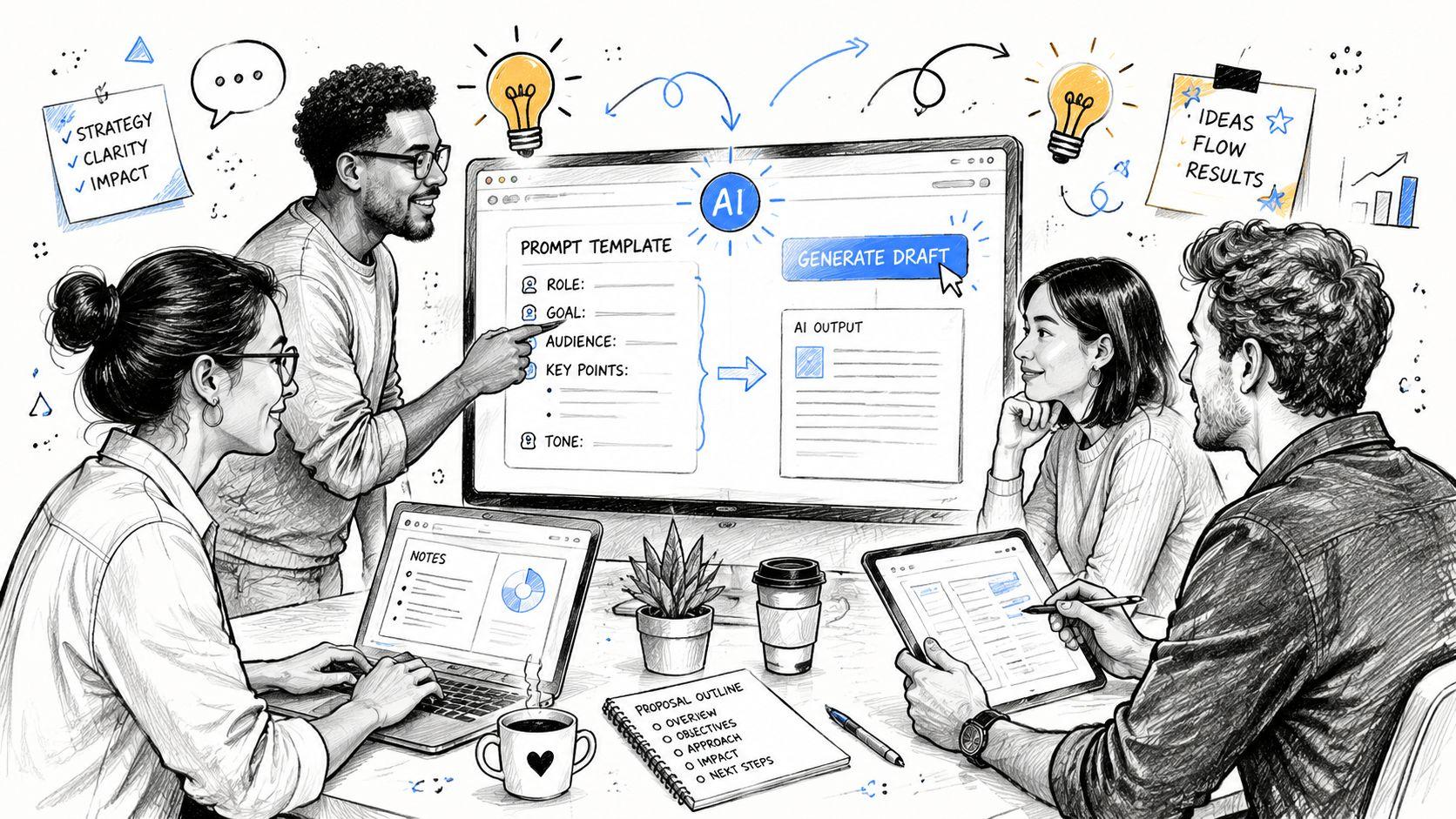
Prompt template for company background
Use a role, source limit, audience, and exclusions.
You are a proposal writer preparing a response to an RFP.
Use only the approved company profile, team bios, and past performance notes provided below.
Draft a company background section for a buyer evaluating reliability, relevant experience, and delivery fit.
Keep the tone professional and specific.
Exclude any claims not present in the source material.
Avoid marketing filler, superlatives, and unsupported statements.
End with a short paragraph explaining why this company is a fit for this specific client need.
That last line matters. Without it, the section reads like website copy.
Prompt template for scope of work
The scope section is where many teams lose control. AI tends to overgeneralize process and understate responsibilities. Give it a structure it must follow.
Draft a scope of work section using only the RFP summary and approved solution notes below.
Organize the response under these headings: discovery, implementation, communication, deliverables, assumptions, and client responsibilities.
For each heading, write concise paragraphs that describe what our team will do, what the client should expect, and any dependencies that affect delivery.
Do not add new deliverables.
Do not create dates, staffing levels, or technical commitments not listed in the source material.
Prompt template for executive summary
The executive summary should sound like a proposal leader wrote it, not a model assembling buzzwords. I get better output by forcing the model to anchor every paragraph to buyer needs.
Write an executive summary for this proposal.
Audience: evaluation committee and business sponsor.
Base the summary only on the RFP brief and approved source pack.
Structure it in four short paragraphs:
- The client problem and why it matters
- Our proposed approach and what makes it practical
- Why our team is credible for this work
- Expected client experience during delivery
Requirements:
- Mention the client's likely priorities in plain language
- Use concrete wording, not generic innovation language
- Do not claim outcomes not supported in the source material
- Avoid repeating section headings or boilerplate
A strong draft prompt does two jobs at once. It tells the model what to write, and it tells the model what it is forbidden to invent.
Ask for a self-audit after each draft
This is one of the easiest ways to catch bad AI output before a human reviewer wastes time on it.
After each major section, run this:
Review the draft against the source material and list:
- unsupported claims
- vague phrases
- repeated ideas
- missing client-specific detail
- sentences that sound generic or promotional
Do not revise yet. Diagnose first.
That extra pass improves quality because it separates generation from critique. It also mirrors a useful principle in understanding generative AI workflows: the best results often come from staged prompting, where drafting and evaluation happen in distinct steps.
If your team wants more examples of prompt-based writing and revision workflows, 1chat's blog is a useful place to compare approaches and adapt them to proposal tasks.
Refining AI Content from Generic to Unforgettable
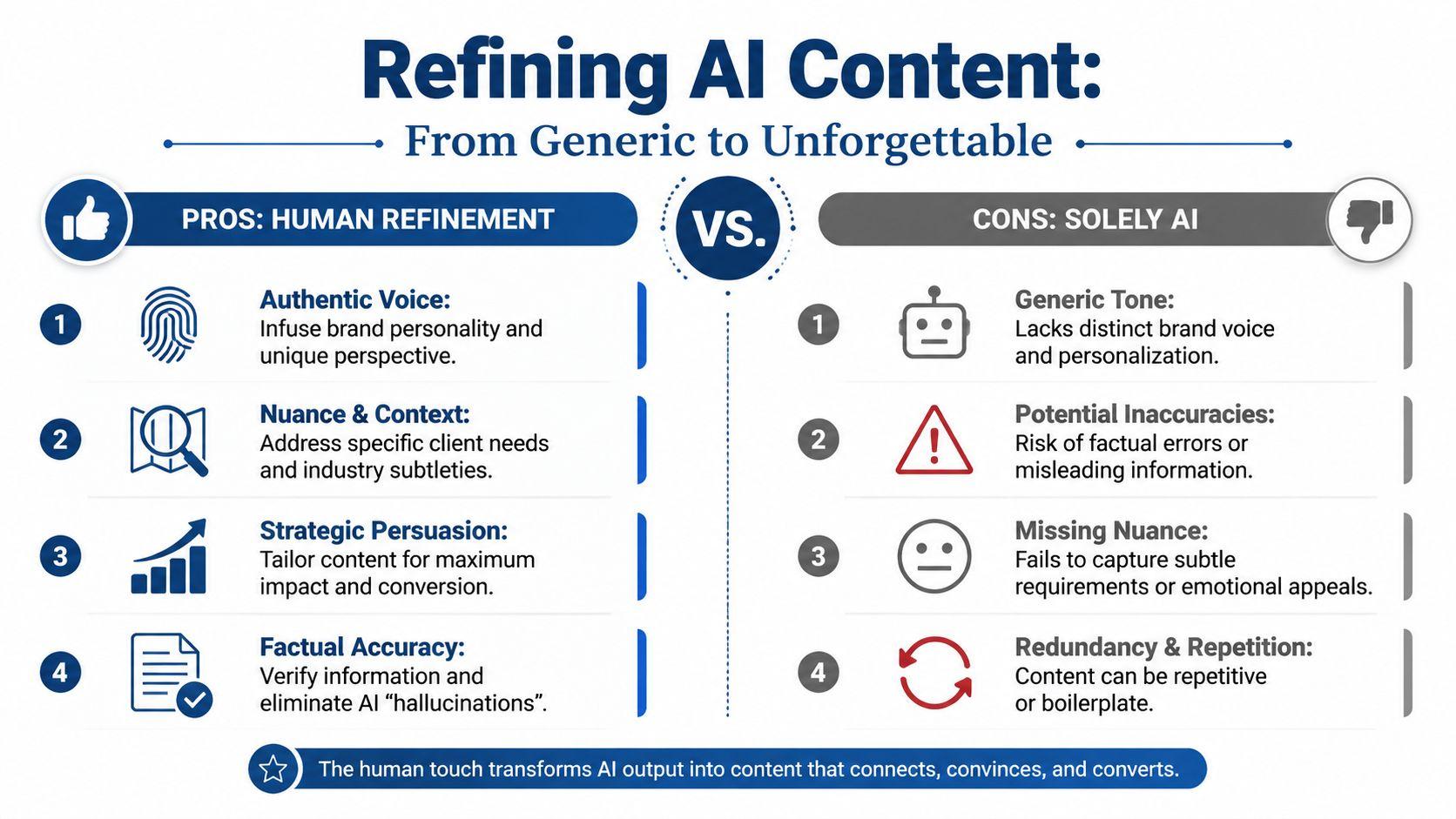
An AI draft isn't a proposal. It's a draft that still needs a point of view.
That distinction matters because AI often writes the kind of proposal no buyer remembers. It covers the basics, sounds professional, and avoids risk. In funding contexts, that pattern can even improve acceptance while reducing originality. A Nature report on AI-assisted grant proposals highlights that trade-off, noting better funding outcomes alongside less original work. The same danger shows up in commercial proposals. Safe language blends in.
What generic AI writing looks like
You can spot it quickly. It uses smooth phrases without buyer tension. It repeats what every competitor would say. It sounds competent and forgettable.
Common warning signs include:
- Abstract value statements: “We deliver customized solutions that drive success.”
- Empty differentiation: “Our team brings innovation and excellence.”
- Weak client connection: The draft mentions the client name but not the client's actual pressures.
- Boilerplate rhythm: Every paragraph has the same tone, length, and pattern.
The fix is not “make it sound more human.” That prompt is too vague. The fix is to inject specificity the model could not invent on its own.
Add the details only your team knows
Human refinement should change the draft in ways the model never could. That usually means adding context from calls, internal delivery history, and proposal strategy discussions.
I revise around these questions:
| Refinement question | Why it matters |
| What does this client care about first? | Sharpens priority and tone |
| What concern will they have about switching vendors or choosing us? | Adds useful reassurance |
| Which proof point is strongest for this exact work? | Replaces generic credibility language |
| What delivery choice reflects our actual operating style? | Makes the approach believable |
Then I use AI again, but narrowly.
Try prompts like these:
Revise this section to reflect a buyer worried about implementation disruption and stakeholder communication.
Keep all facts unchanged.
Increase specificity and reduce generic language.
Rewrite this paragraph using a more grounded tone.
Remove filler and make the language sound like an experienced project lead speaking to a review committee.
Integrate this client-specific note into the draft without overstating certainty.
Show that we understand the issue, but avoid promising results not yet approved.
Editor's note: Human review is where proposals become persuasive. AI can organize language. People supply judgment, restraint, and the details that make a buyer feel understood.
Force evidence into every important claim
A practical rule I use with teams is simple: every claim that matters should point back to proof, process, or experience. If a sentence doesn't do that, it's probably decorative.
Use this editing pass:
- Highlight every promise
Ask whether the proposal explains how the team will deliver it. - Circle every differentiator
If a competitor could say the same thing, rewrite it. - Check for buyer language
Replace internal jargon with the words the client uses in the RFP. - Review the opening lines of each section
These usually carry the most generic phrasing. Tighten them first.
This is also the stage to add your company voice. Not by forcing personality into every line, but by choosing the level of directness, restraint, and specificity that matches how your team operates.
Finalizing Pricing Timelines and Team Review
Pricing and schedule sections tempt teams to overuse AI. That's where mistakes get expensive.
AI can help structure these sections, standardize formatting, and identify gaps. It should not decide what you charge, what margin you accept, or what delivery risk you're willing to carry. Those are management decisions.
Where AI helps in the final pass
AI is useful for turning rough internal notes into cleaner proposal-ready material. If your delivery lead sends a bullet list of phases and dependencies, AI can convert that into a readable timeline narrative. If finance sends assumptions in plain text, AI can organize them into a table for review.
Good final-stage tasks include:
- Formatting a timeline narrative from approved milestones
- Converting pricing assumptions into a cleaner table structure
- Checking consistency between staffing, scope, and deliverables
- Summarizing reviewer comments from emails, docs, or chat threads
- Proofreading for repetition and terminology drift
Researchers using hybrid AI grant workflows achieved a 60% reduction in proposal preparation time and a 22% increase in success rates when the process relied on human-led drafting followed by AI-driven proofreading and consistency checks, according to Proposia's analysis of AI grant workflows. That sequence is the important part. Human judgment first. AI cleanup second.
A practical review sequence
I've had the best results with a review pass that moves from risk to polish, not the other way around.
Use this order:
- Pricing alignment
Check assumptions, exclusions, optional items, and approval status. - Timeline realism
Confirm dependencies, client inputs, review windows, and staffing availability. - Cross-document consistency
Make sure scope, staffing, schedule, and pricing don't contradict each other. - Reviewer synthesis
Paste reviewer comments into AI and ask for grouped issues, not rewrites. - Final language pass
Clean repetition, tighten wording, and fix terminology.
A prompt that works well late in the process:
Review this near-final proposal and identify inconsistencies across scope, timeline, pricing assumptions, team roles, and terminology.
Return the findings in a table with columns for issue, location, risk level, and recommended fix.
Do not rewrite the full proposal.
That keeps AI in reviewer mode, which is far safer than letting it freely regenerate final sections.
Where humans should stay in charge
Never delegate these decisions to AI:
- Discounting strategy
- Commercial tradeoffs
- Delivery commitments
- Legal language changes
- Named resource promises
Those areas require context the model doesn't have, and they carry consequences outside the document itself.
Best Practices for Privacy and Data Security
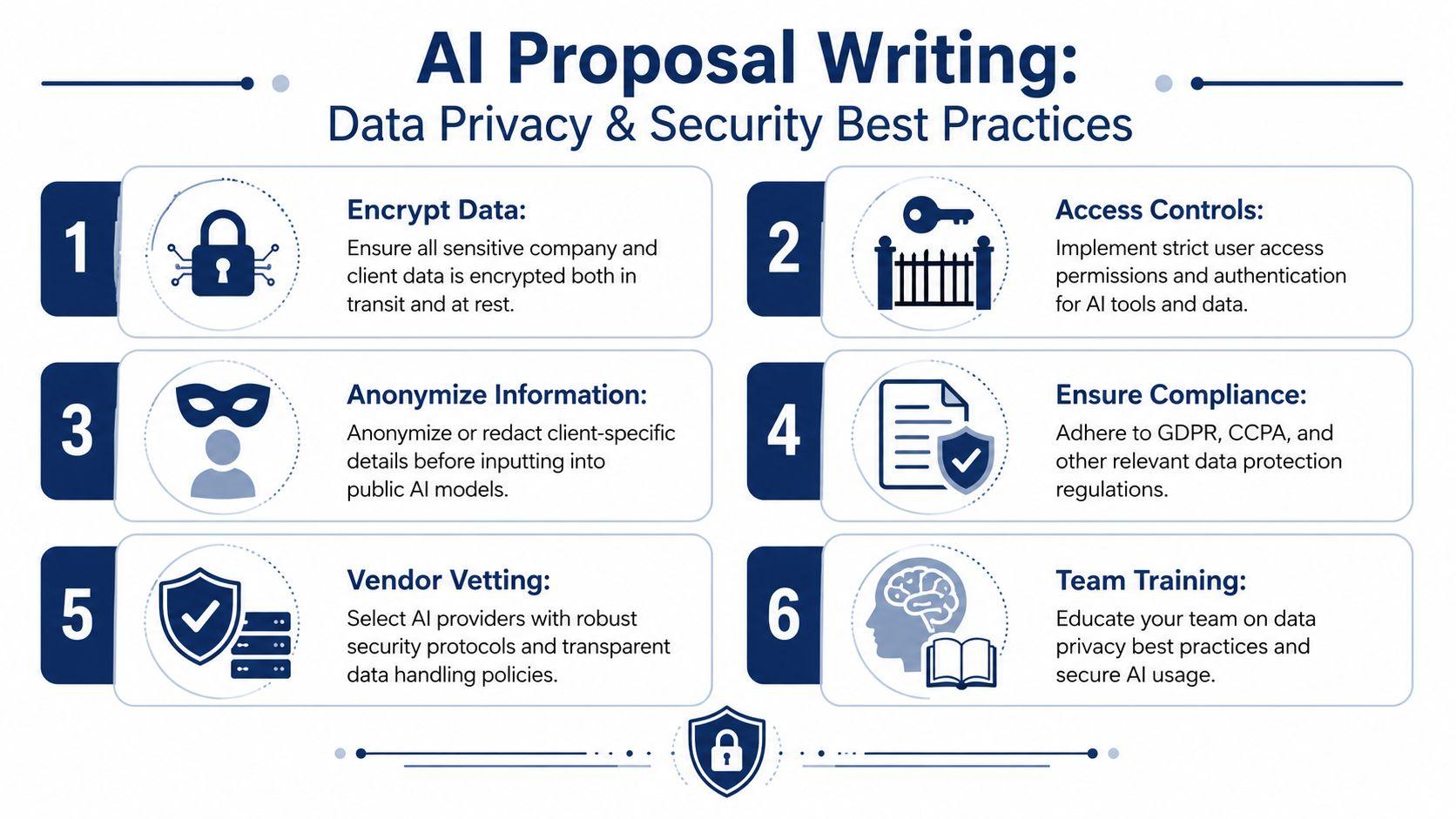
Proposal teams handle sensitive material all the time. Client names, pricing logic, staff resumes, security responses, legal terms, internal delivery notes. If you use AI casually with that content, you create a risk your team might not notice until much later.
That's why privacy isn't a side concern in AI for proposal writing. It's part of the operating model.
What should never go into a public model
Small teams often move fast and paste first. That habit needs to stop when proposal data is involved.
Keep these out of public AI tools unless they've been properly redacted and approved:
- Personally identifiable information
- Unreleased pricing
- Private client documents
- Contract terms under negotiation
- Security architecture details
- Trade secrets and proprietary methods
- Named subcontractor terms not yet approved
If the material would cause a problem when forwarded outside your company, it doesn't belong in an unvetted AI workflow.
The minimum standard for safe use
Your AI process should include a few essential controls:
| Control | Why it matters |
| Redaction before upload | Reduces exposure of client and company data |
| Access limits | Prevents unnecessary internal sharing |
| Approval rules | Stops unreviewed content from reaching the client |
| Vendor review | Confirms how tools handle retention and training |
| Team training | Prevents accidental misuse by well-meaning staff |
For teams evaluating providers, the plain-language expectations in our privacy policy are a good example of what to look for in any vendor documentation: clear statements about data handling, user information, and platform responsibility. You want that level of clarity before proposal content enters the system.
Treat proposal AI the same way you treat client data in any other system. Convenience is not a security policy.
The responsible setup for small teams
A secure workflow usually looks boring, and that's a good sign. Team members know which tool to use, what can be uploaded, what must be redacted, and who approves the final output. The team doesn't guess.
If you're comparing privacy-first options for proposal work, review the platform terms directly before rollout. For example, 1chat's privacy information gives teams a place to check how a tool handles data before using it for business documents. That review should happen before adoption, not after a mistake.
AI can save a proposal team a lot of time. It isn't worth much if the process creates a confidentiality problem.
AI for proposal writing works best when you stop treating it like a writer and start treating it like a disciplined assistant. Let it extract, organize, draft, compare, and proofread. Keep humans responsible for strategy, evidence, pricing, and originality.
For small teams, that hybrid workflow is a significant advantage. You get faster first drafts, cleaner reviews, and more time for the parts of proposal work that influence wins.
If you want a privacy-first place to test that workflow across leading models, compare outputs, and work with proposal documents more securely, take a look at 1chat.