A parent watches a teenager ask an AI chatbot to explain algebra. In a bakery, the owner tests an AI tool for Instagram captions between batches of bread. At a dorm desk, a student pastes lecture notes into a free summarizer before an exam. These decisions happen on kitchen counters, shop floors, and dorm desks, not just in legal departments. The same concerns, including privacy leaks, biased results, and convincing misinformation, now affect people who don't have a compliance team. Practical AI guidelines give families, students, and small teams a simple way to decide what AI may do, what information it may receive, and when a human must check the result.
Why AI Guidelines Suddenly Matter in Everyday Life
AI has become part of ordinary work and learning because it can draft, summarize, translate, brainstorm, and answer questions quickly. That convenience can hide an important distinction: a tool can produce fluent text without understanding whether the text is accurate, appropriate, or safe to share. A polished answer may still contain an invented detail, expose private information, or reflect an unfair assumption.
The risk isn't limited to advanced technical systems. A bakery owner might paste a customer's complaint into a public chatbot to create a courteous reply. A parent might allow a child to upload a school document that contains names or contact information. A student might accept a summary without opening the assigned reading. In each case, the user has made a meaningful decision about data, trust, and responsibility, even if nobody used the word governance.
The everyday decisions hidden inside an AI prompt
A useful guideline begins with four questions:
- What is the task? Is AI helping someone brainstorm, explain, summarize, decide, or act?
- What information is being shared? Does the prompt contain personal, confidential, academic, financial, or customer information?
- Who checks the result? Can a person compare the output with a trusted source before relying on it?
- What happens next? Will the text stay as a draft, or will someone send it, grade it, publish it, or use it to make a decision?
These questions work at home, in a classroom, and in a small business because they focus on behavior rather than technical vocabulary. They also make room for sensible use. A rule that says “never use AI” is difficult to follow when people already depend on it for low-risk tasks, and it may encourage private, unapproved use instead of visible, safer use.
A rulebook people can actually use
The major international frameworks point toward human rights, transparency, safety, accountability, and responsible risk management. Families and small organizations don't need to reproduce those documents. They need to turn their underlying values into actions such as removing names from a prompt, checking a source, labeling AI assistance, or requiring approval before an external message is sent.
This guide defines the language, compares the main frameworks, turns shared principles into practical questions, and addresses two gaps that many beginner resources overlook: autonomous agents and shadow AI. You'll leave with a usable rulebook, not a lecture.
What AI Guidelines Really Are and What They Are Not
AI guidelines are plain-language rules for using artificial intelligence safely, fairly, and transparently. Think of them as house rules, a recipe card, or a school's acceptable-use guidance. They tell people what to do before, during, and after an AI interaction without requiring every reader to interpret a legal contract.
A family guideline might say, “Don't enter a child's full name, address, or private school records into a public tool.” A classroom guideline might say, “Use AI to explain a difficult concept, but write the final response yourself and disclose assistance when the instructor requires it.” A small business rule could require a human to check every customer-facing message before sending it.
Four terms that belong together
These words overlap, but they aren't interchangeable:
- AI guidelines are the practical playbook. They translate values into everyday choices.
- An AI policy is the formal rulebook. An organization usually approves it, publishes it, and connects it to its broader responsibilities.
- AI ethics supplies the principles behind the rules. It asks whether a use respects dignity, fairness, autonomy, and human rights.
- AI governance is the referee and operating system. It assigns owners, records decisions, monitors use, and updates the rules when conditions change.
A one-page family checklist still counts as guidance. A school may add approval procedures and disclosure expectations. A company may map its document to privacy, intellectual property, employment, or sector requirements. The format changes, but the logic remains consistent.
Practical rule: If a person can read the rule, understand the action it requires, and apply it before using AI, the rule is doing useful work.
The 1chat usage policies provide an example of the kind of plain-language material users can consult when deciding what belongs inside an AI tool. A guideline shouldn't promise that a tool is automatically safe for every task. It should help users match the task and data to an appropriate tool, then keep a human responsible for the outcome.
Most beginner articles get this wrong by treating guidelines as a corporate-only artifact. The same framework applies whenever a person asks AI to handle information, create content, influence a decision, or take an action. The difference is scale, not kind.
Comparing the Major AI Frameworks That Shape Guidelines
Three international references appear repeatedly in discussions about responsible AI, but they serve different purposes. The OECD AI Principles were adopted in 2019 as the first intergovernmental standard on AI, updated in 2024, and organized around five values-based principles and five recommendations. In 2024, 47 governments had committed to the principles, according to the OECD overview of its AI Principles.
The UNESCO Recommendation on the Ethics of Artificial Intelligence was adopted by acclamation in November 2021 and applies to all 194 UNESCO member states, as described in UNESCO's account of the recommendation. It places human rights, human dignity, fairness, transparency, environmental sustainability, and human oversight at the center. UNESCO also identifies it as a normative reference for generative AI guidance in education and research.
NIST's AI Risk Management Framework is different in style. It provides a voluntary, technical approach for identifying and managing AI risk across the lifecycle. Its generative AI profile turns that approach into deployment practices such as aligning use with privacy and intellectual property rules, updating policies for generative AI risks, testing models before release, using red-teaming, and monitoring after deployment. The NIST generative AI risk management profile emphasizes defined responsibilities and periodic review.
| Framework | Primary Audience | Core Focus | Enforceability | Best Fit For |
| OECD AI Principles | Governments and policy communities | Human-centered values, transparency, robustness, safety, and accountability | An intergovernmental standard, not a household law | Understanding the diplomatic foundation behind many national approaches |
| UNESCO Recommendation | Governments, educators, institutions, and public-interest leaders | Human rights, dignity, fairness, culture, sustainability, and human oversight | A global recommendation for member states | Education, public policy, and rights-centered guidance |
| NIST AI Risk Management Framework | Technical teams, managers, and organizations | Identifying, measuring, managing, and monitoring risk across the lifecycle | Voluntary guidance | Turning broad principles into operational controls |
What the comparison means for everyday users
The OECD framework is a useful starting point for understanding why transparency and accountability appear in so many guidelines. UNESCO adds a broader social and cultural lens, which matters when AI affects children, education, language, or access to opportunity. NIST helps a team ask operational questions, such as who tests a system, who monitors it, and what happens when its behavior changes.
None of these frameworks dictates the exact wording of a family agreement or a bakery's marketing checklist. They are upstream references. A local rule such as “review every AI-written customer reply” echoes their shared expectation that people should understand, oversee, and remain responsible for AI-assisted decisions.
The Five Shared Principles Behind Modern AI Guidelines
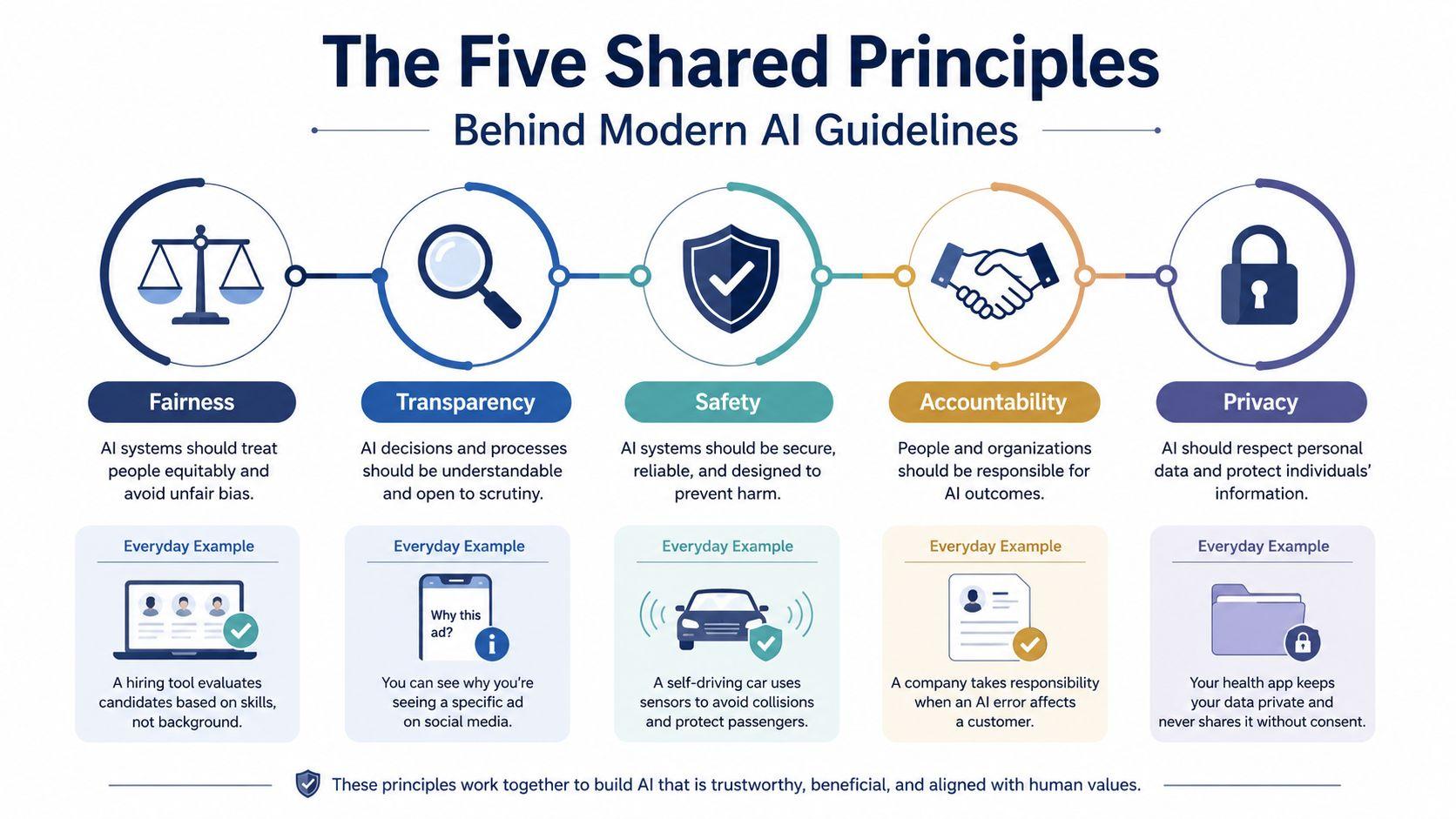
The five principles below form a practical spine for most modern AI guidance. They connect the values emphasized by OECD and UNESCO with the lifecycle risk work described by NIST. You don't need to memorize framework language. Turn each principle into a question that fits the task in front of you.
Fairness
A hiring tool that filters applicants from certain postal areas can reproduce disadvantage, even if nobody intended that outcome. A classroom tool might explain a topic in a way that assumes a particular culture, language background, or learning style. Fairness asks whether the system or workflow treats people appropriately and whether someone checks for harmful patterns.
Ask: Who could be left out, misrepresented, or judged by an irrelevant signal? In a small business, don't let an AI draft become the final basis for rejecting a customer, applicant, or supplier without meaningful human review.
Transparency
A chatbot can invent a refund rule while sounding certain. A student can use AI to reorganize an essay and leave the reader unable to tell what work the student completed. Transparency means explaining when AI was used, what role it played, and what limitations apply.
Ask: Would another person understand how AI influenced this result? Keep source links, label generated drafts where appropriate, and disclose assistance when a school, publisher, client, or employer requires it.
Safety
Safety concerns both the input and the output. A user who uploads confidential records may create a privacy problem before the model writes anything. A user who accepts unverified instructions may create a physical, financial, academic, or reputational problem afterward.
Ask: What could go wrong, and what stops the mistake from reaching a real person or system? Low-risk brainstorming may need a quick check. A medical, legal, financial, employment, or customer-facing use needs stronger review and a clear boundary around what AI cannot decide.
Accountability
AI can't accept responsibility for an email, grade, purchase, or public claim. A person or named role must own the decision, review the result, and know how to correct it.
Ask: Who has the final say, and how could we reconstruct what happened? For a team, that may mean keeping a record of the prompt, source material, reviewer, and final version. For a family, it may mean that a parent reviews a child's use of AI for sensitive tasks.
Privacy
Privacy begins with data minimization. Share the least information needed to complete the task, remove identifying details where possible, and avoid treating a free tool as a private filing cabinet.
Ask: Does this tool need this exact information? A student can request an explanation using a fictional example instead of uploading a real classmate's work. A shop owner can describe a complaint without including the customer's name, order number, or contact details.
These principles are more durable than any single tool rule. A platform can change its interface, model, or settings, but a team can still ask who might be harmed, what data is necessary, who checks the result, and whether the use is visible.
Practical AI Guidelines for Small Businesses, Families, and Students
A useful guideline becomes specific at the moment a person is about to use AI. The following mini-guides turn the five principles into copy-ready starting points. Adjust them to your situation, existing school requirements, and applicable laws.
For small businesses
Start with an approved-tool list. Name which tools staff may use for brainstorming, drafting, summarizing, coding, or customer support. Then create a clear off-limits category for passwords, payment details, private customer records, confidential contracts, and information that the business doesn't have permission to disclose.
Require human review for anything external. The reviewer should check names, dates, prices, promises, tone, factual claims, and whether the output accidentally reveals another customer's information. Marketing copy can receive a lighter review than a contract summary or a message about a complaint, but neither should go directly from model to customer without an owner.
Copy-ready business template
- Approved tools: [name the tools and permitted tasks]
- Off-limits data: [list personal, confidential, regulated, or sensitive information]
- Human review: [name the role that checks external messages and high-impact outputs]
- Disclosure: [state when AI assistance must be mentioned]
- Correction process: [explain how staff report an unsafe or inaccurate result]
For families
Family rules work best when they separate acceptable tasks from private conversations. Homework explanations, vocabulary practice, brainstorming, and question generation may fit the agreement. Health concerns, personal conflicts, identifying details, school records, and private images deserve a stricter boundary and adult involvement.
Parents should agree on reasonable visibility rather than relying on hidden surveillance. A child should know when a parent may review an AI conversation, why that review protects them, and what kinds of questions require a trusted adult instead of a chatbot. The family can also set device and time expectations so AI supports learning without replacing sleep, reading, practice, or conversation.
For families evaluating sensitive or relationship-oriented products, a resource such as browse responsible use of AI girlfriends can support a broader discussion about boundaries, privacy, age appropriateness, and emotional reliance.
Copy-ready family agreement
- Approved tools: [name the tools and shared devices]
- Good uses: [list homework explanations, brainstorming, practice, or creative projects]
- Off-limits data: [list names, addresses, school records, private images, and family disputes]
- Adult check: [identify tasks that require a parent or guardian]
- Learning boundary: [state that the child must understand and review submitted work]
For students
Students should distinguish learning-first use from shortcut use. Asking for a simpler explanation, practice questions, feedback on a draft, or help finding gaps can support learning. Submitting generated work as personal work, inventing citations, or using AI where an instructor forbids it can undermine both learning and academic integrity. APA guidance also emphasizes transparency when authors use generative AI and notes that disclosure and citation expectations depend on the instructor, department, publisher, or assignment.
Copy-ready study checklist
- Approved tools: [name tools allowed by the course or institution]
- Off-limits material: [list private peer work, unpublished research, or restricted course content]
- My learning check: [explain the answer in your own words before submitting]
- Source check: [open and verify every important citation or factual claim]
- Disclosure: [record how AI helped and follow the instructor's required format]
The 1chat privacy information can be included in a tool review when a family, student, or team is comparing how platforms describe data handling. The rulebook should still govern behavior. A privacy-oriented tool doesn't remove the need to minimize data or check outputs.
The Underserved Risks Agentic AI and Shadow AI Expose in Guidelines
Many guidelines were written for a person entering one prompt and receiving one answer. That model no longer covers systems that can plan, use tools, take multiple steps, or delegate work to other systems. It also doesn't cover shadow AI, where employees use personal or unapproved tools because the approved process feels slow, restrictive, or unavailable.
The readiness gap is visible in recent independent reporting. A 2026 forecast found that more than 80% of employees were using unapproved AI tools, while 37% of organizations had AI governance policies according to the cited 2026 business compliance guide. The same source reported that 38% of firms had a formal AI policy and 25% had none, while Stanford's 2026 Responsible AI index identified knowledge gaps at 59%, budget constraints at 48%, and regulatory uncertainty at 41% as implementation obstacles. Each figure needs its own context, but together they point to a practical problem: rules can exist on paper while behavior happens elsewhere.
Why autonomy changes the question
An agent that misreads a calendar may schedule meetings with the wrong people. An agent with procurement access may select an unsuitable supplier. A sales representative may upload a customer list to a free summarizer because the approved tool doesn't support the required workflow. These aren't only content-quality problems. They involve permissions, audit trails, reversibility, and responsibility.
Independent sources also describe agent governance as underdeveloped. The International AI Safety Report 2026 notes that current frameworks don't clearly distinguish recommendation-only systems from autonomous workflows with irreversible external effects. It also reports a survey in which 92% of large-enterprise CISOs lacked full visibility into AI agent identities and 95% doubted they could detect or contain a compromised agent.
| Risk Scenario | Policy Gap Today | Role-Based Response |
| An agent schedules meetings or sends messages | The policy covers chatbot answers but not external actions | Require approval for new recipients, calendar changes, and irreversible messages |
| An employee uses a personal AI account for customer work | The policy bans “unapproved tools” without offering a practical alternative | Provide approved tools, define safe low-risk tasks, and prohibit sensitive data sharing |
| An AI coding assistant changes production files | The policy treats code generation as ordinary drafting | Require review, testing, logging, scoped permissions, and a rollback path |
| An agent delegates work to another agent | No named person owns the downstream action | Assign a human owner across the full delegation chain |
Small teams can supplement general guidance with practical AI coding security, especially when assistants can read repositories or suggest changes. Every current guideline should answer three questions: What may the system do without approval? Which actions require a human checkpoint? Who is accountable when a delegated action causes harm?
Fitting a Privacy-First Tool Like 1chat Into Your AI Guidelines
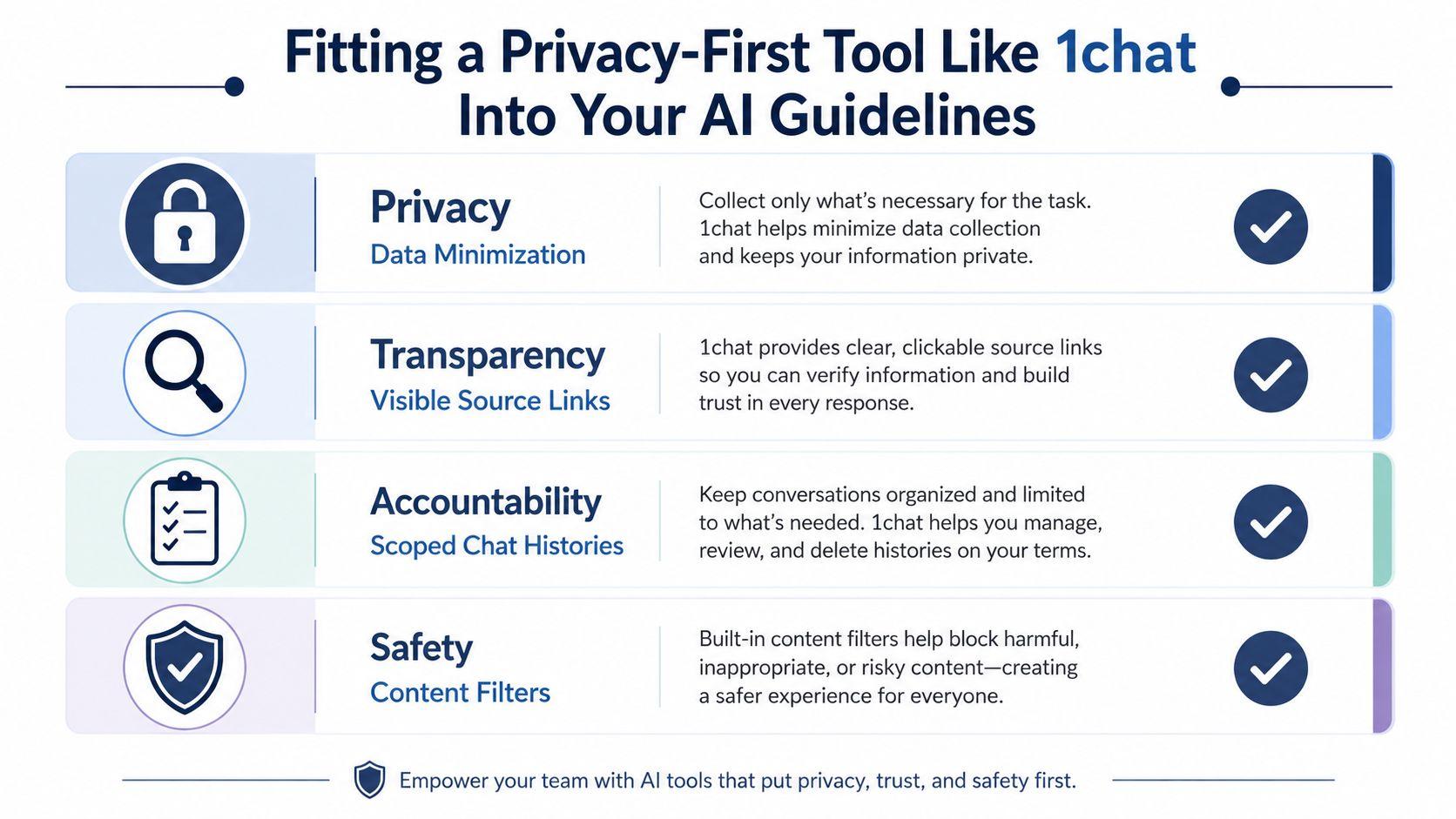
A tool belongs in a rulebook only when its use can be expressed as a clear behavior. 1chat can be treated as one option for family and small-team workflows, with the guideline mapping its stated privacy, transparency, accountability, and safety features to concrete rules.
The mapping is straightforward:
- Privacy: Use data minimization. Share only the content needed for the task.
- Transparency: Use visible source links when researching or checking factual claims.
- Accountability: Keep chat histories scoped to the task and identify the person responsible for the final output.
- Safety: Use content filters and require human review before consequential action.
Those controls don't make every use appropriate. They make the rule easier to apply because the user can connect a principle to a setting or habit.
A small rollout that doesn't overwhelm people
- Audit current use. Ask staff or family members what they already use AI for, including personal accounts. Don't begin with punishment. You need an accurate picture.
- Separate data by sensitivity. Mark tasks as low-risk, private, confidential, or high-impact. Keep the most sensitive material out unless a qualified review confirms the tool and process are suitable.
- Write one-line rules. For example, “Use the privacy-first workspace for drafts containing internal context, remove identifying details, and have a person approve anything sent externally.”
- Run a trial and review the workflow. Check whether people can find the approved tool, understand the restrictions, and complete ordinary tasks without creating workarounds.
A bakery might set a privacy-first tool as the default for drafting general social posts and internal brainstorming, while keeping customer records and sensitive business documents outside the workflow. A family might use it on a shared device for explanations and study prompts, while keeping personal conversations and identifying school information out of the chat.
For teams that want to make guidance easier for AI systems and people to discover, background reading on machine-readable discovery with Agentable can inform how public documentation is organized. It doesn't replace a human-readable rulebook, and it shouldn't be used as a reason to publish private procedures.
A final adoption checklist can stay short:
- Tool choice: name the approved workspace and permitted tasks.
- Data boundary: list what users must remove or never enter.
- Review owner: assign the person who checks important outputs.
- Evidence: retain only the task history needed for accountability.
- Exit plan: define how to stop using the tool if a problem appears.
If you're ready to turn these principles into a working family or team experiment, visit 1chat and compare its available workflow with your approved-tool list, data boundaries, and human review requirements.
Choose one real AI task today, write down its approved tool, forbidden data, and human review step, then share that three-line rule with your family, class, or team. A small rule people understand and follow is more valuable than a long policy nobody uses.