Which entry in your annotated bibliography would survive if your instructor opened the source and read page one? Most students can't answer that, and the reason isn't laziness. They've been taught the task as a citation exercise, a reference entry with a paragraph bolted underneath, when the actual deliverable is a set of verified judgements about what each source says and how far it can be trusted.
APA Style has never been only a visual template. In 1929, psychologists, anthropologists and business managers published a seven-page article in Psychological Bulletin proposing standard procedures for scientific writing, and that guidance grew into the first Publication Manual in 1952 (APA Style). Successive editions followed as scholarly communication changed, and the seventh edition widened APA reporting standards beyond quantitative work to qualitative and mixed-methods research.
Every rule you'll meet below serves that reporting job. A reference entry makes a source identifiable. An annotation makes it comparable and judgeable. The trouble starts when students treat the format as the whole assignment and stop one step short of the judgement, or when they apply APA defaults to a paper whose assignment sheet asked for something different.
That's why this guide is built as a set of checklists rather than a lecture. You'll get the rules in one table, the reference patterns for each source type, the layout steps, three worked entries, a citation-matching check, and a verification pass you can run in the last hour before submission. An APA format annotated bib rewards this kind of line-by-line checking far more than it rewards prose flair.
APA Annotated Bibliography Rules at a Glance
Print the assignment sheet and put it beside this table. The students who lose marks are rarely the ones who ignored APA. They're the ones who applied APA defaults to a paper that asked for something else.
| Element | APA 7 rule | Check against |
| Entry order | Alphabetical by first author surname | Same order as a reference list |
| Spacing | Double spaced throughout | Applies to references and annotations |
| Margins | 1 inch on all sides | Standard APA page setup |
| Font | 12-point Times New Roman or another APA-approved font | Instructor preference |
| Annotation length | Set by the assignment | Common ranges 100-200 or 100-300 words |
| Heading | Annotated Bibliography, centred and bold | Some instructors require References |
| Running head | Not required for most student papers | Only if the instructor asks |
| Page numbers | Top right corner of every page | Confirm with the assignment sheet |
Two documents govern this page, and they don't carry equal authority. APA sets the format: entry order, spacing, margins, font, heading, page numbers. The assignment sets the content: how many sources, how long each annotation runs, and whether the annotation summarises or evaluates. When the two conflict, the instructor's sheet wins, and that isn't a loophole. APA doesn't prescribe one universal annotation length or a required content sequence, so the assignment controls word count, source count, and whether the emphasis falls on summary, methodological critique, authority, relevance or reflection (Purdue OWL).
Where the Assignment Sheet Wins
Four overrides show up constantly. A fixed source count ("annotate eight sources") beats any advice about choosing four good ones. A narrower word range such as 150-200 words beats the wider library range. A descriptive-only brief beats the evaluative annotation you'd write in a research methods course. And a required heading of References beats the Annotated Bibliography default, because the instructor is telling you how the page gets filed in their marking pile.
The font row is quieter than it looks. APA's approved list is short, and a paper set in a decorative sans-serif reads as careless even when every indent is perfect. If your instructor names a font, use it. If they don't, pick one from the APA list and set it once, in the document defaults, so late edits don't reintroduce a second typeface.
Before you draft: read the assignment sheet with a pen, mark every row above it overrides, then apply the remaining defaults. That five-minute pass prevents most of the rewriting students do the night before submission.
How an Annotated Bibliography Differs from a Reference List
A reference list answers one question: which works does this paper cite? A bibliography answers a bigger one: which works exist on this topic, and which deserve my reader's time?
APA draws that line explicitly. A reference list contains works specifically cited or supporting claims in the paper, while a bibliography may include background or further-reading sources and can carry descriptive notes (APA Style). The annotation is that descriptive note turned into a judgement. It sits immediately after a complete reference entry, and it does work the citation alone can't do.
The formatting rules for the entry itself stay the same in both documents. Invert author names, give initials rather than full given names, use the publication year as the date element where appropriate, italicise titles or periodicals according to source category, and include a DOI in its recommended URL form. Alphabetical order, double spacing, the hanging indent and the separate paragraph for the annotation all carry over.
What changes is the paragraph underneath. It has four jobs, and the questions below are the ones I ask students to answer before they type a word of it.
The Questions Every Annotation Answers
- Purpose: what question is the author trying to settle, and what are they arguing?
- Evidence: what data, documents, cases or reasoning supports the claim, and how much of it is there?
- Limits: what does the method miss, what does the author concede, and what would change the conclusion?
- Relevance: how does this source help or complicate the question your paper is asking?
An annotation that answers only the first two is a summary. The assessment is what separates this assignment from a reading log, and you're responsible for every evaluative claim you make. If you can't defend a judgement from the source itself, cut it or soften it.
The one-sentence test: cover the reference entry. If the annotation could sit under any other source on the same topic, you've written a summary and need a sentence on what this particular source contributes.
Choosing which sources deserve an entry comes before any of this, and it's where most weak bibliographies are already lost. These research tips for student writers cover how to narrow a topic and screen candidates before you commit to eight of them.
Reference Entry Patterns for Each Source Type
Three details repeat in every APA reference entry, whatever the source. The author comes first with the surname inverted and initials only. The date follows in parentheses. And when a DOI exists, it closes the entry in URL form. Everything after that is source-specific.
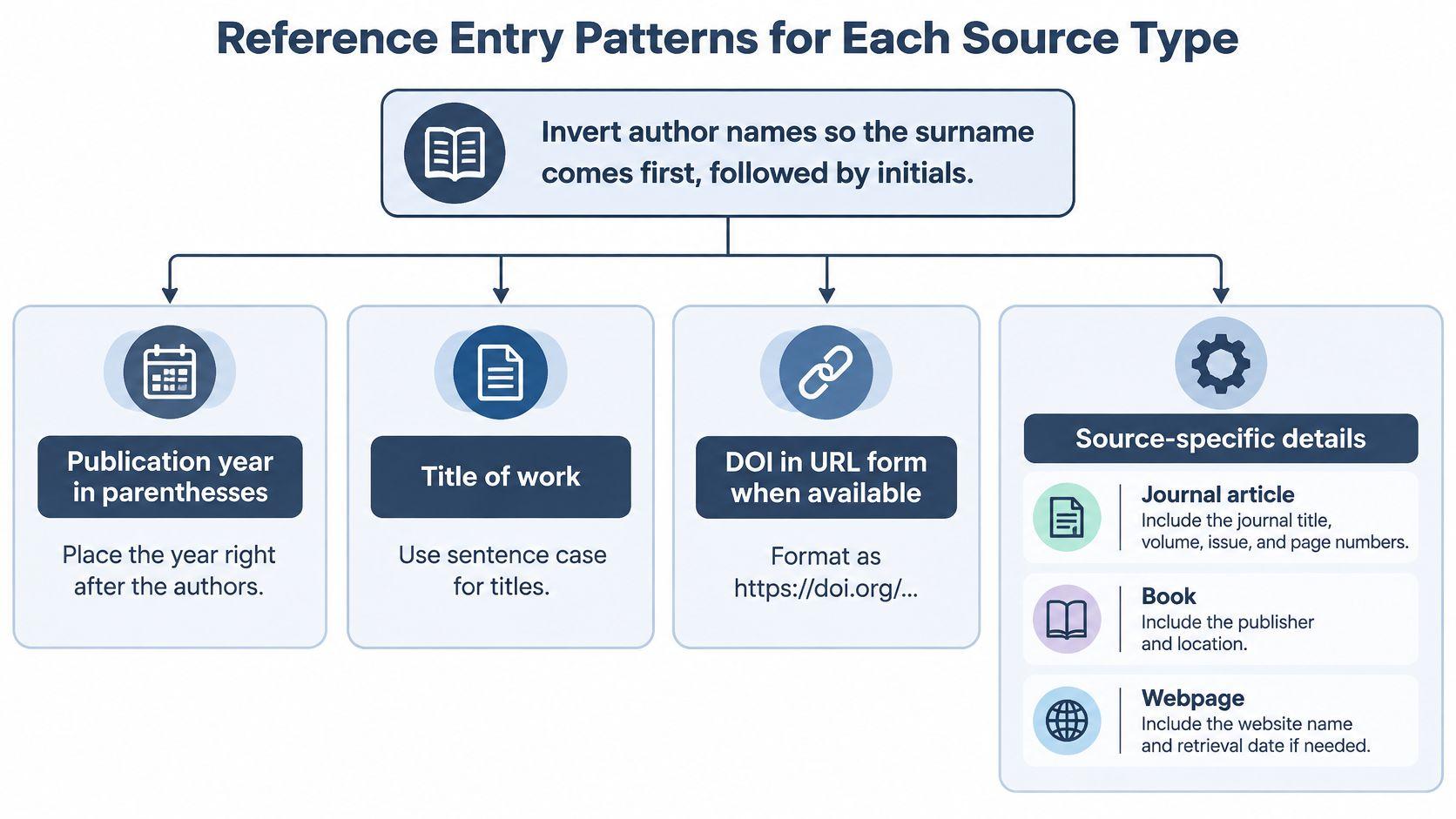
The table below gives the skeleton for each type and names the one element that gets italicised. Italics are where marks disappear, because a journal name in plain text looks almost right on screen and completely wrong to a marker.
| Source type | APA 7 reference pattern | What is italicised |
| Journal article | Author, A. A. (Year). Article title. Journal Name, volume(issue), pages. https://doi.org/xxxx | Journal name and volume |
| Book | Author, A. A. (Year). Book title (edition). Publisher. | Book title |
| Book chapter | Author, A. A. (Year). Chapter title. In E. Editor (Ed.), Book title (pp. xx-xx). Publisher. | Book title |
| Webpage | Author or organisation. (Year, Month Day). Page title. Site name. URL | Page title |
| Agency or organisation report | Organisation. (Year). Report title (Report No.). URL | Report title |
Five Patterns in Practice
One invented example per type, so you can see where the punctuation falls.
- Journal article: Whitfield, S., & Adeyemi, B. (2021). Peer tutoring and maths anxiety in secondary school. British Journal of Educational Psychology, 91(3), 402-419., the issue number sits in parentheses and is not italicised, and only the journal name and volume stay in italics.
- Book: Kowalski, M. (2016). The homework debate (2nd ed.). Ridgeway Press., the edition appears in parentheses only when it isn't the first, and the publisher closes the entry with no location.
- Book chapter: Nkemelu, R. (2021). Oral history as method. In T. Alvarez (Ed.), Approaches to community research (pp. 88-104). Ridgeway Press., the chapter title stays plain, the editor's initials come before the surname, and the page range goes inside the parentheses.
- Webpage with no author: Soil salinity in irrigated fields. (2022, March 14). State Agricultural Extension Service., the title moves into the author position, so it leads the entry and the site name follows the date.
- Agency report: Regional Transport Board. (2021). Rural bus coverage 2015-2020 (Report No. RTB-14)., the report number in parentheses tells a reader which document you used when an agency publishes many.
Copy the punctuation exactly as it appears. Small errors, a missing comma before an ampersand, a period dropped after a DOI, are the most frequent source of lost marks on an otherwise strong bibliography, and they're the cheapest marks to recover.
How to Lay Out Entries and Annotations
Build the page in this order and the layout takes care of itself. Do it in the wrong order, pasting text first and formatting later, and you'll spend an hour chasing indents that won't stay put.
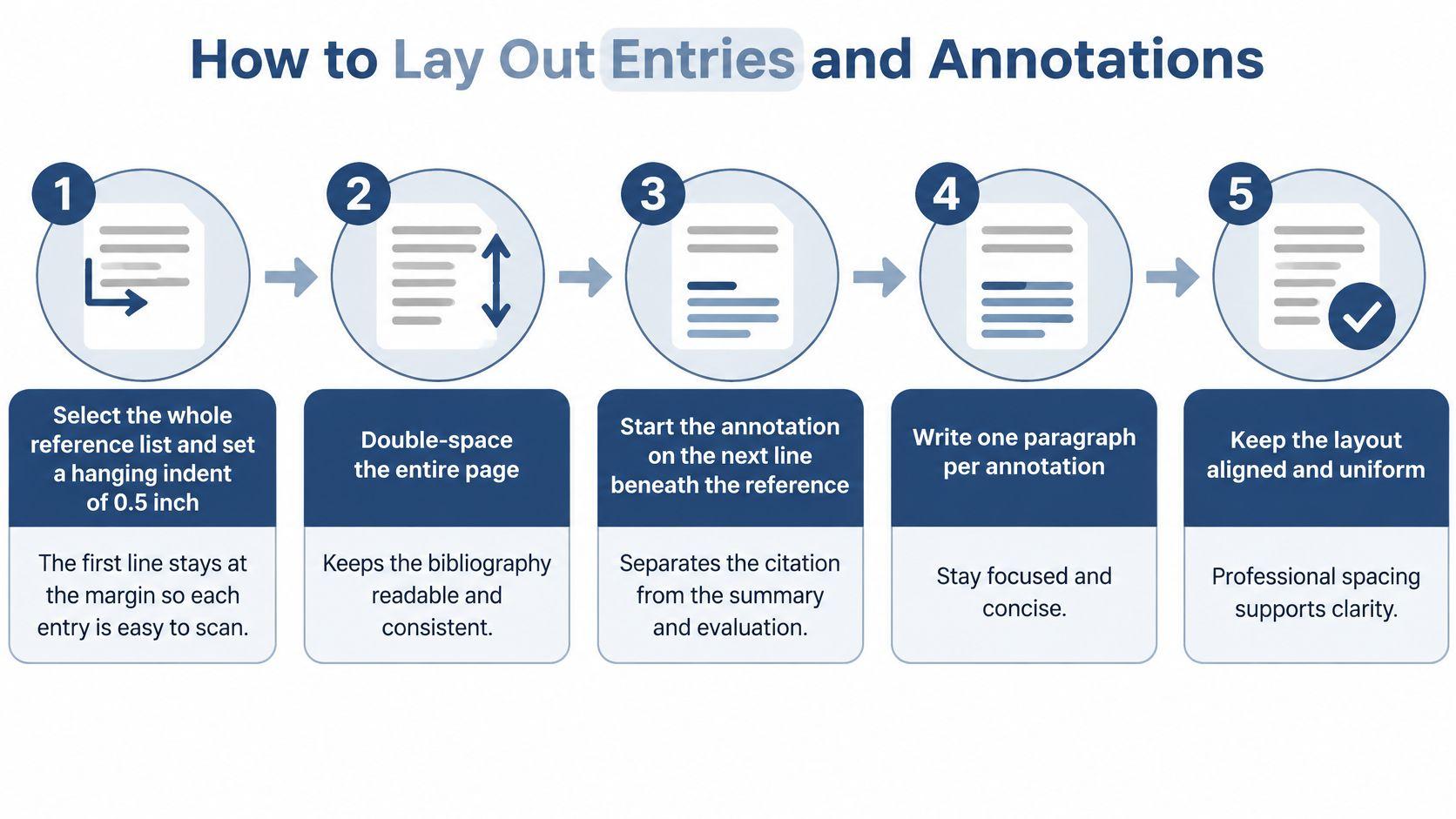
University library guidance based on APA 7 is consistent on the core mechanics here: entries run alphabetically, each annotation starts in a new paragraph below its citation, the annotation is indented 0.5 inches from the left margin to line up with the hanging indent of the reference above it, and the first line of that annotation gets no additional paragraph indent (Quinnipiac library guide).
- Set the hanging indent before you type. Select the whole list, apply a 0.5 inch hanging indent, and watch the first line of each reference stay at the margin while later lines step in. Doing this first stops the layout drifting as entries grow longer.
- Press Enter after the reference's final period. Never continue the annotation on the same line as the citation, even when there's room. The break is what tells a marker where the entry ends and your judgement begins.
- Indent with the paragraph setting, not the Tab key. A 0.5 inch left indent applied through paragraph formatting survives edits, pastes and font changes. Tabs collapse the moment you move text between documents.
- Leave the first annotation paragraph flush, then indent any second paragraph. The opening paragraph of an annotation starts at the block indent with no extra first line. A second paragraph gets an extra 0.5 inch first-line indent so a multi-paragraph annotation still reads as one block.
- Count the words against the assignment's range. The same library guidance puts annotations at roughly 100 to 300 words, with some assignments narrowing to 100 to 200, and it notes that a 200-word annotation leaves enough room for purpose, evidence and limitations without turning into a literature review.
- Scroll the whole list once before saving. Confirm every annotation sits under its own reference, with no stray blank line between entries and no annotation orphaned at the top of a page.
A correct page looks almost boring. Each entry block is visually distinct, every annotation is indented under its reference, the spacing is even from first page to last, and there's nothing to notice except the content.
Reality check: when your instructor's word range is tighter than a library guide's, the instructor's range wins. Generic guidance loses to the sheet you were handed.
Worked Annotated Entries for Three Source Types
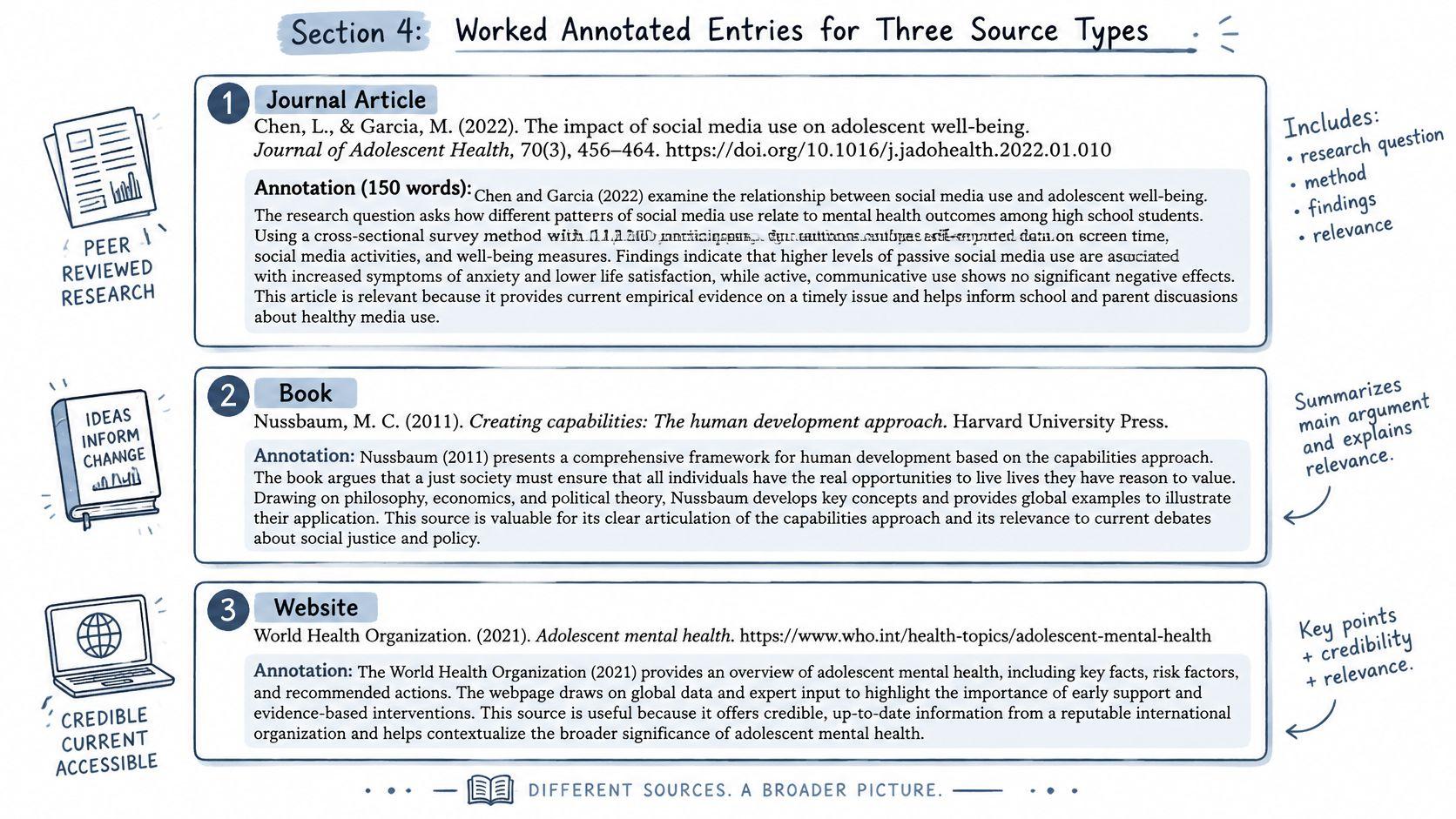
Three finished entries, each invented for illustration, each showing the same three moves: summary of what the source says, evaluation of how good it is, and relevance to the paper. Read the annotations with a pencil and mark which sentence does which job.
A journal article. Reference: Whitfield, S., & Adeyemi, B. (2021). Peer tutoring and maths anxiety in secondary school. British Journal of Educational Psychology, 91(3), 402-419.
This study asks whether a twelve-week peer tutoring programme reduces maths anxiety in Year 9 pupils, and answers it with a quasi-experimental design across four schools. Pupils in the tutoring condition reported lower anxiety than the comparison group, and the difference held after controlling for prior attainment. The authors acknowledge that tutors were trained only by their own teachers, which makes the quality of tutoring hard to separate from the programme itself, and the four schools sit in one city, so generalising beyond that setting needs care. The article matters for section two of my paper because it supplies a school-based measure of anxiety I can compare with the mentoring study discussed later.
That's 130 words and three moves in order. Sentences one and two summarise. Sentence three evaluates, using one limitation the authors concede and one I've added. Sentence four handles relevance. The added limitation is the part markers look for, because it shows you read past the abstract.
A book. Reference: Kowalski, M. (2016). The homework debate (2nd ed.). Ridgeway Press.
The annotation for a book needs a different opening, because books carry no sample and no method section. Identify the author's field, note the publication date, describe the scope, then say whether the argument still holds.
Kowalski, an education historian, traces the homework debate from the nineteenth century to the present and argues that most policy claims rest on assumptions about family time rather than on evidence about learning. The second edition adds two chapters on primary schooling, which is the section relevant to my argument. Because the book predates the shift to remote learning in 2020, its treatment of home study stops short of the conditions my paper examines, and I'll use it for historical framing rather than current claims. It also gives me the vocabulary to distinguish homework volume from homework purpose.
An organisation's webpage. Reference: National Institute for Education Research. (2023, September 5). Homework time and pupil wellbeing.
Web sources need interrogation rather than summary, because anyone can publish one.
This briefing, published by a national research institute and last updated in September 2023, reports average homework time by age group and links long evening sessions to reported wellbeing. It cites its own survey data and names the sample, which raises confidence in the figures. The institute also lobbies for reduced homework in primary schools, so its framing of the evidence aligns with a position it already holds, and I'll present its statistics as findings while treating its recommendations as advocacy. I'll use it in the policy section as an example of how research bodies translate data into recommendations.
Reading the Three Moves
In each entry, the first one to two sentences summarise, the middle sentences evaluate, and the final sentence ties the source to a specific place in the paper. Naming the section isn't decoration. It forces you to decide whether the source is carrying weight or just padding the count.
Rule of thumb: the annotation should let a reader judge the source without opening it. It should never let you skip opening it.
If you're building this bibliography as part of a longer project, you can plan your review with Acres and map each annotation onto the argument it supports, which makes the relevance sentence almost write itself.
Matching Bibliography Entries to In-Text Citations
Every in-text citation needs a matching entry, and every entry should be reachable from the draft. The variations below trip people up because the citation changes while the entry stays long.
| Situation | In-text form | The entry must show |
| One author | (Whitfield, 2021) | Whitfield, S. (2021). Title of article. Journal Name, 91(3), pages. https://doi.org/xxxx |
| Two authors | (Whitfield & Adeyemi, 2021) | Both surnames and initials, joined by an ampersand: Whitfield, S., & Adeyemi, B. (2021). |
| Three or more authors | (Whitfield et al., 2021) | Every author, up to 20, listed in full. "et al." never appears in the entry itself. |
| Group author | First mention: (National Institute for Education Research [NIER], 2023). Afterwards: (NIER, 2023) | The organisation spelled out in full as the author, with no abbreviation in the entry |
| No date | (Lee, n.d.) | Lee, K. (n.d.). Title of work. Publisher. |
| Same author, same year | (Okoro, 2022a, 2022b) | Both entries dated 2022 with a and b suffixes, ordered by title |
The Matching Checklist
Three checks catch nearly everything. First, confirm that every author-date pair in your draft appears in the bibliography. Second, confirm the suffixes line up, so a sentence citing 2022b points at the entry carrying b, not at whichever entry happens to sit first on the page. Third, confirm the alphabetical order runs on the first author's surname, including when that surname belongs to an organisation.
Then deal with the two leftovers, because both get noticed. A source you cited in the paper but never annotated is either an oversight or a sign the bibliography is incomplete. An annotated source that never appears in the paper is defensible only when your assignment invited background reading, and only when the annotation says so.
A habit worth building: tag each annotation with the section of your paper where you'll use it, in brackets after the annotation or in your own notes. When the draft changes, you'll know which entries still earn their place and which are now holding space for nothing.
Common Formatting Mistakes and How to Fix Them
The most frequent error in an APA annotated bibliography isn't in the annotation at all. It's a first name typed out in full, because the writer copied it straight from the title page of the article.
| Mistake | Wrong form | Correct form |
| Full first names | Whitfield, Sarah Ann. (2021). | Whitfield, S. A. (2021). |
| Plain-text journal name | British Journal of Educational Psychology, 91(3), 402-419. | British Journal of Educational Psychology, 91(3), 402-419. |
| Wrong capitalisation from export | The Effects Of Homework On Pupil Wellbeing | The effects of homework on pupil wellbeing |
| Summary without evaluation | This article discusses homework habits. | Add an assessment of evidence, limits and relevance |
| Missing DOI link | No link on an article with a DOI | https://doi.org/ link added |
| Wrong alphabetical order | Zhang before Adams | Adams before Zhang, by first author surname |
Why Database Exports Break
Database exports arrive with predictable damage. Titles come through in title case when APA wants sentence case for article and book titles. Author names arrive inverted in some records and natural order in others, so a list pulled from three databases can contain three different conventions in one page. DOIs may appear as bare numbers without the https://doi.org/ prefix, or vanish entirely because the record was copied from a print-era entry.
None of this is the exporter's fault. It's a reminder that a citation generator formats what it was given, including the wrong capitalisation, and takes no responsibility for whether the article exists.
The evaluation failure is subtler than the mechanical ones. "This article discusses homework habits" is a true sentence that does nothing, and it's the sentence students write when they've read the abstract and run out of patience. Fix it with three clauses: what the evidence is, what it can't support, and where the source sits in your argument.
Next move: scan your draft for the three errors you personally make most often. Fix those first, then read only for content. Trying to catch formatting and argument problems in a single pass means catching neither.
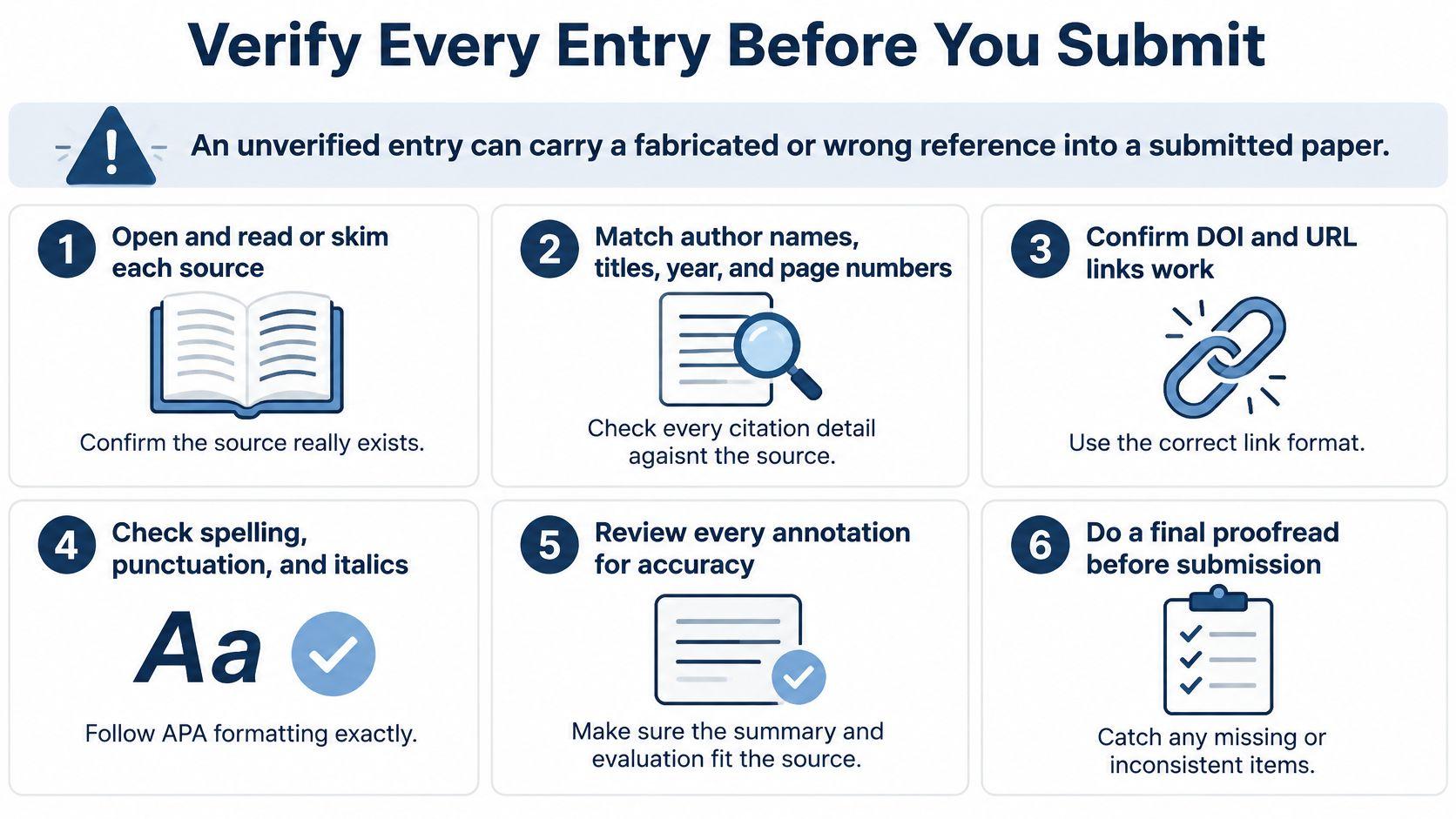
Verify Every Entry Before You Submit
A hanging indent can look perfect while the year belongs to a different edition, or the annotation describes a method the article never used. Treat the finished entry like a packing list before a trip: each fact either matches the source in front of you, or it stays out of the file. Your assignment sheet outranks APA defaults on this pass. If the sheet caps annotation length, requires a critique sentence, or bans AI summaries, follow the sheet even when a generic APA guide is silent.
- Open each source and skim it. Confirm the document exists, that it is the one your reference describes, and that it is the version you read rather than a preprint of the same title.
- Check the details against the publisher record. Author names, year, title, journal or publisher, volume, issue, page range, and DOI are confirmed at the source, not from a citation generator's output.
- Test every link. A DOI that resolves to a different article is worse than no DOI, because it looks verified.
- Compare each annotation's claims with the source's methods and findings. If the annotation says the study was longitudinal and the design was cross-sectional, correct the sentence, not the source.
- Label uncertainty instead of inventing detail. "The abstract does not state the sample size" is an honest, acceptable sentence. A guessed sample size is not.
- Separate three AI tasks that get conflated. Brainstorming search terms, summarising a source you have already read, and submitting AI-written prose are three different decisions with three different risk profiles.
Reading the source is the step students skip, and it is the step that is hard to shortcut. A forty-page paper still has to be the thing you annotate. If you only need the method and the limitations, chat with the PDF and ask what the sample was and what the authors concede. 1chat lets users chat with PDFs, which keeps the question pointed at the document rather than at a summary of a summary.
Policies differ by instructor and by institution. Ask before you draft, disclose the assistance you used, and write every judgement sentence yourself. Source fidelity is the standard: the annotation should not claim a finding, a sample, or a design the PDF does not support. You stay answerable for those sentences even when a tool helped you locate a paragraph.
The Submit-Ready Test
Three conditions, all of which you can check in a single pass. Every entry carries a DOI or URL you have opened yourself. Every annotation can be defended out loud from the source in front of you. Your disclosure statement, if the assignment requires one, matches the assistance you used rather than the assistance that sounds acceptable.
Before you close the document, pick the entry you trust least. Read the reference line by line against the publisher page, then read the annotation against the passage you would quote if asked. If a line fails, rework that entry. The other entries usually need only a punctuation pass. If you would rather question a long PDF than skim it twice, upload it to 1chat, ask what the method section says, and write the annotation in your own words with the evidence in front of you.