Most advice about cheque vs check stops too early. It tells you which spelling belongs to Britain and which belongs to the United States, then treats the topic like a trivia question. That misses the more useful 2026 question, whether you're choosing a spelling for an audience, or deciding whether paper cheques and checks are still relevant enough to worry about at all.
| Topic | Cheque | Check |
| Standard region | British English and most Commonwealth usage | American English |
| Basic meaning | A bank-issued payment instruction | The same basic financial document |
| Other common meanings | Rare outside banking | Many unrelated meanings in U.S. English, including verification, a tick mark, and a chess threat |
| Modern reality | Still used, but paper use has declined | Still used, but paper use has declined |
If you want a fast answer, use the spelling your reader expects, then keep reading if you need the reason behind that choice. For the practical side of modern writing and payment workflows, the spelling question also connects to how often paper items still show up in business life, not just in old style guides. If you need a quick place to bookmark for follow-up questions, the 1chat FAQ is here: 1chat FAQ.
Why This Spelling Question Still Gets Asked
People keep searching cheque vs check because they're usually asking two questions at once. They want the correct spelling for their audience, and they want to know whether this paper payment instrument still belongs in modern writing at all. Those are related, but they're not the same question.
The spelling part is easy enough. The relevance part is trickier, because paper payment habits have changed so much that many readers only encounter the term in banking forms, legacy contracts, or cross-border business writing. That's why this topic still gets attention in style guides, finance explainers, and customer support articles. The wording looks simple, but the context has shifted.
Why the query feels bigger than grammar
In older banking systems, a cheque or check was central to everyday payments. Merriam-Webster notes that the concept reaches back to ancient banking forms and was already in use by at least the 9th century, long before modern spelling differences mattered, and that checks became especially important in the U.S. after the Civil War, when federal laws in the 1860s changed the paper-money system and pushed the need for a national clearing system for paper payments. The same source also notes that U.S. check volume later grew from 8.5 billion in 1952 to more than 85 billion in 1995 (Merriam-Webster on check vs. cheque).
That history explains why the term still feels familiar even as its real-world role shrinks. Writers are not just choosing between two spellings. They're deciding whether they need a banking term, a regional spelling, or a reminder that the payment method itself is fading.
Practical rule: if your reader is in the U.S., use check. If your reader expects British or Commonwealth spelling, use cheque.
The rest of the article keeps both layers in view, because that's the part most quick answers leave out.
What Cheque and Check Actually Mean
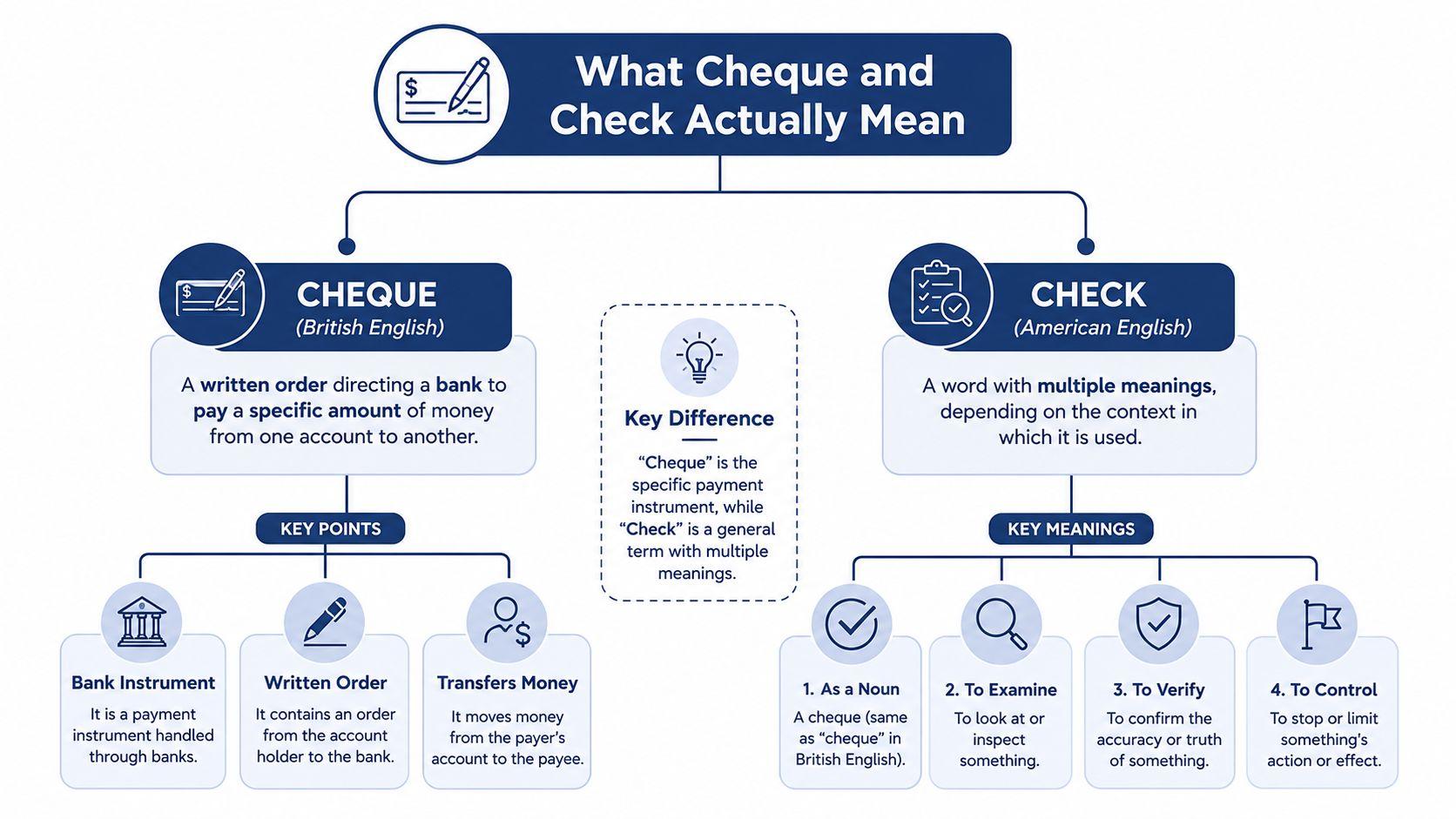
At the core, cheque and check refer to the same thing, a written bank instruction telling a financial institution to pay a specified sum. The difference is regional spelling, not different financial instruments. In British and Commonwealth English, the banking noun is cheque. In American English, the same noun is check.
That simple definition helps, but it's not the full story for English readers. In American English especially, check has many other meanings. It can mean to verify something, to place a tick mark, or to make a move in chess that threatens the king. Cheque does not carry those extra everyday meanings in standard English, so it is much narrower in use.
Why the spelling split happened
The split reflects how English evolved on different sides of the Atlantic. The shared root term survived, but spelling conventions diverged as British and American English standardized differently. In practical writing, that means the choice is usually not about meaning. It's about matching the language system your reader expects.
A few examples make the difference obvious:
- British English: “Please pay the invoice by cheque.”
- American English: “Please pay the invoice by check.”
- American English, unrelated use: “I need to check the address.”
- British or American English, banking noun only: “The cheque/check cleared yesterday.”
The key point is that the noun form is the financial document, while the verb check in American English belongs to a separate meaning family. That's why mixing the two spellings in the wrong context can sound sloppy, even when the sentence is technically understandable.
If you remember nothing else, remember this: cheque is the banking spelling outside the U.S., and check is the banking spelling in the U.S. Everything else grows out of that.
British, American, and Commonwealth Usage Compared
The regional map is broader than a simple Britain-versus-America split. Cheque is standard in the United Kingdom and across much of the Commonwealth, including Australia, New Zealand, India, South Africa, and, in practice, much of Canada's formal English. Check is standard in the United States. Canadian English is where writers often pause, because both forms may appear, but cheque remains the conventional spelling in formal usage.
Pronunciation helps explain why the written forms can feel odd to learners. In speech, the banking noun is pronounced like “chek” in both British and American English. The spelling is what changes, not the sound. That's why many English speakers hear no difference at all, until they see the word on paper.
Choosing the right form by audience
For editorial work, the safest rule is to mirror the reader's region. A UK business brochure should use cheque. A U.S. invoice template should use check. A multinational site may need separate versions for each market, especially if payment pages, FAQs, and legal notices all speak to different customers.
| Region | Standard Spelling | Common Alternative | Pronunciation |
| United Kingdom | Cheque | Check in imported U.S. content | Chek |
| Ireland | Cheque | Check in U.S.-influenced contexts | Chek |
| Australia | Cheque | Check in imported U.S. content | Chek |
| New Zealand | Cheque | Check in imported U.S. content | Chek |
| Canada | Cheque | Check is widely recognized | Chek |
| India | Cheque | Check in U.S. material | Chek |
| South Africa | Cheque | Check in U.S. material | Chek |
| United States | Check | Cheque in British quotations | Check |
Context beats habit. A Canadian author writing for a bank may still choose cheque. A Canadian startup writing for a U.S. app interface may choose check if the product language is localized for American users. The right answer depends on the audience, not on which spelling looks more familiar to the writer.
Useful shortcut: if the surrounding copy already sounds British, keep cheque. If the surrounding copy is American, keep check.
That consistency matters more than trying to force one global spelling into every market. Readers notice mismatch faster than they notice which country a word came from.
Sample Sentences and Tricky Edge Cases
The easiest way to avoid mistakes is to see the word inside a real sentence. In financial writing, the noun form stays stable. In general American English, check can shift into a verb, which is where some confusion starts.
- Payment request: “Please make the payment by cheque.”
- U.S. payment request: “Please make the payment by check.”
- Banking status: “The check cleared this morning.”
- Verification verb: “Please check your account balance.”
- Customer service wording: “We can resend the lost check after the claim is approved.”
Edge cases that trip up writers
Some phrases are fixed by convention, so you shouldn't translate them letter by letter. Checkmate stays checkmate. Rain check stays rain check. In those idioms, the spelling is not a regional banking choice. It belongs to the phrase itself.
A few expressions deserve extra caution:
- Blank check / blank cheque: both forms can appear, but the regional choice should still match your audience.
- Cheque book / checkbook: same logic, different regions.
- Check in / check out: these are verbs or phrasal verbs, not banking nouns, so they usually stay American in modern usage.
- Chequemate: don't write this. It isn't standard English.
If you're editing someone else's copy, the first question is always grammatical role. Is the word a noun referring to a bank payment instrument, or is it a verb meaning verify, inspect, or compare? Once you answer that, the spelling choice becomes much easier.
A clean edit often comes down to this: if money is moving, spell for the market; if verification is happening, check is usually the right English word in American usage.
That distinction saves time in legal copy, customer support text, and any document where a single word can change the tone of the whole page.
Is the Paper Instrument Still Relevant in 2026
The spelling question still matters, but the paper instrument matters less than it once did. In Canada, cheques made up only 2.4% of all non-cash payments in 2021, yet they still represented 30% of total value paid out, with 404 million cheques worth $3.28 trillion and an average value of over $8,000. That pattern, described by the Bank of Canada Museum on cheques, suggests cheques survive mainly where larger-value payments still need a paper trail.
The U.S. picture points the same way. Federal Reserve payments data show that check use fell to 11.2 billion in 2023, down from 11.7 billion in 2022, and the value of those payments slipped from $27.2 trillion to $26.9 trillion (Federal Reserve payments data referenced in the prompt). A separate estimate put annual U.S. check volume at about 9.2 billion in 2024, with average value rising from under $1,000 in 2000 to about $2,600 in 2024. Volume keeps shrinking, while the checks that remain tend to be the larger ones.
Why the decline changes the writing advice
The processing side has changed too. The U.S. Check 21 law, passed in 2003, allowed image-based processing instead of requiring the physical paper item, and by 2021, 52% of consumer and business checks were deposited as images, up from 22% in 2015. The old paper route is no longer the default path, even when the payment instrument still exists.
That change affects how writers should treat the word. If a document is about payments, payroll, tax, accounting, or back-office operations, the noun still carries real meaning. If the copy is consumer-facing, the distinction may matter far less than the topic of the payment itself.
For a business-focused look at how electronic transfers fit beside older payment language, NACHA rules for businesses help explain the modern context around ACH and other non-paper methods.
The larger point is straightforward. In 2026, cheque and check are still correct words, but the paper instrument behind them is no longer a universal everyday object. Writers still need the spelling distinction, yet they also need to know whether the subject is a live payment tool or a historical holdover.
For readers comparing older usage with current business writing, 1chat research is a useful place to review how language shifts as payment habits change.
Practical Guidance for Businesses, Students, and Writers
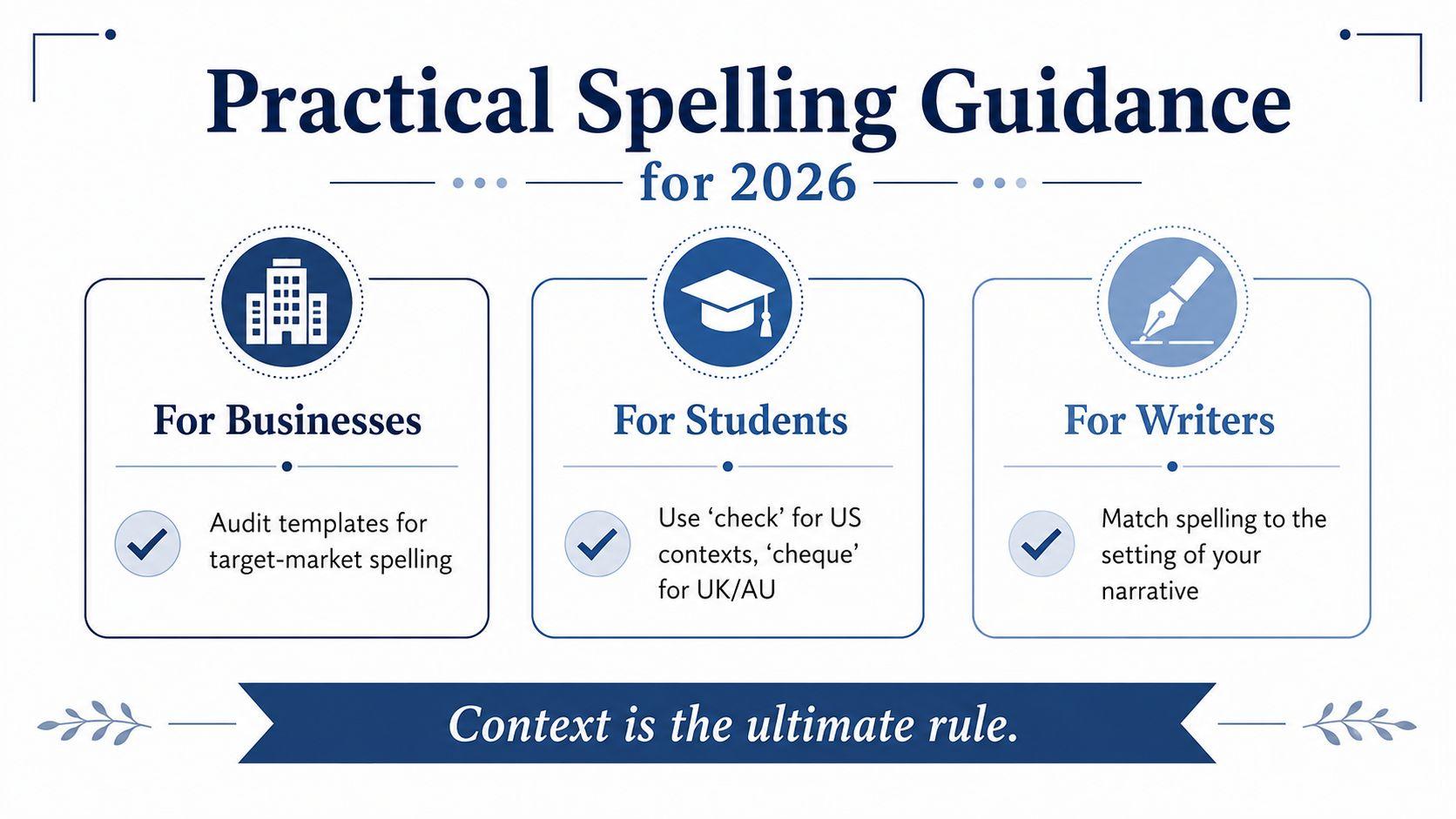
Different readers need different rules. Businesses should match spelling to the market they serve, not the market they happen to be in. A finance team writing customer emails for the U.K. should use cheque consistently, while a U.S. billing workflow should use check. If your templates cross borders, audit every payment form, FAQ, and help article so the noun, the verbs, and the region all line up.
Students need a simpler rule. Follow your institution's house style, and if it doesn't say, choose the regional spelling used in the rest of the essay. If you're explaining the difference in class, keep it direct: cheque is the British and Commonwealth spelling for the banking noun, and check is the American spelling. That's the cleanest exam answer and the easiest one to remember.
Writers and content creators should think about consistency first. Pick one spelling per page, use it in headings and body text, and avoid mixing forms unless you're quoting a source or discussing regional usage. A search article can target both spellings through structure, but the prose itself should still feel deliberate, not accidental.
For copy that touches bookkeeping or account reconciliation, reconciliation tips from Stewart Accounting can be a helpful companion reference when you're aligning payment language with actual ledger work.
The best editorial habit is to treat spelling as a signal of audience, not personal preference. That keeps the copy clean and the intent obvious.
Choosing the Right Spelling for Your Situation
Use cheque for British and most Commonwealth readers, check for American readers, and keep fixed idioms in their usual form. If you are quoting a form, notice, or contract, leave the original spelling untouched even when it differs from the style guide you usually follow.
The better question is not which spelling looks nicer. It is which audience you are writing for, and whether the term still refers to a paper instrument at all. In many settings, the old paper version has faded into the background, so readers meet the word inside banking, legal, or business language rather than across a teller window.
That is why context does more work than preference. A spelling choice should match the reader, the document type, and the payment reality behind the word. If the copy is meant for a global product page, a regional invoice, or a help article, consistency matters more than clinging to one form out of habit.
If you want a quick check before publishing, ask whether the audience still handles paper payments or only needs wording that sounds local and correct. For interface copy, compare the surrounding labels and payment flow with Suby's checkout button tips and with your own product wording, then keep the spelling aligned with the people who will read it. For broader editorial support on regional spelling and customer-facing copy, 1chat's blog is a useful place to review how language choices affect clarity across different contexts.
For teams writing about payments, bookkeeping, or support content, the safest habit is to match spelling to audience and channel, then keep that choice steady across the page. That keeps the copy readable and makes the writer's intent obvious.