You've opened the Common App prompt, stared at the blank page, and decided that every meaningful experience in your life has suddenly become impossible to explain. The cursor keeps blinking while you search for a profound story, an impressive lesson, or the perfect first sentence. That pressure makes college essays feel like a test of inspiration, but strong essays rarely begin with inspiration. They begin with a manageable process.
Good college essay writing help should make your thinking clearer, not replace it. The most reliable workflow has three stages: brainstorming to find the story, drafting to shape it, and revising to make its meaning unmistakable. AI can support each stage, but only if you remain the person making the important decisions.
Why Most Students Get Stuck on College Essays
A student often treats the personal statement as one enormous assignment: choose a perfect topic, write a polished opening, sound insightful, stay within the word limit, and reveal something memorable. That combination creates task activation friction. The blank page feels threatening because the student is trying to solve every problem at once.
A better approach is to separate the work. First, collect memories. Then choose one moment. Then write a rough version. Only after the story exists should you worry about elegance. Advice on overcoming task activation friction is useful here because starting is often a behavioral problem before it becomes a writing problem.
Admissions readers aren't looking for a manufactured life lesson. They want a clear sense of how you notice the world, respond to difficulty, make decisions, and understand your own experiences. A small, specific moment can reveal more than a résumé summary if the reflection is honest and precise.
Practical rule: Don't ask, “What's the most impressive thing I've done?” Ask, “What experience lets a reader understand how I think?”
Stop demanding a perfect first draft
The first draft has one job: get the experience onto the page. It can contain awkward sentences, missing transitions, and reflections you later reject. Trying to make every sentence polished while discovering the story usually produces cautious writing because the inner critic interrupts before the writer has found anything real.
Use a simple starting sequence:
- Set a narrow task. Write down memories connected to one prompt rather than attempting the entire essay.
- Separate discovery from judgment. Generate possibilities before deciding which one sounds impressive.
- Draft privately. Write as if you're explaining the moment to a trusted person, not performing for an admissions committee.
- Review later. Look for meaning after you have enough material to evaluate.
Students also get stuck because they confuse a topic with a story. “I care about medicine” is a topic. A late-night conversation with a relative, a mistake during a volunteer shift, or an unexpected observation that changed your understanding of care could become a story.
For research support, 1chat's research workspace can help you organize questions or investigate background information, but your personal essay shouldn't become a research report. The material admissions officers need most is yours: your memories, choices, reactions, and reflection.
Finding Your Real Story Through Brainstorming
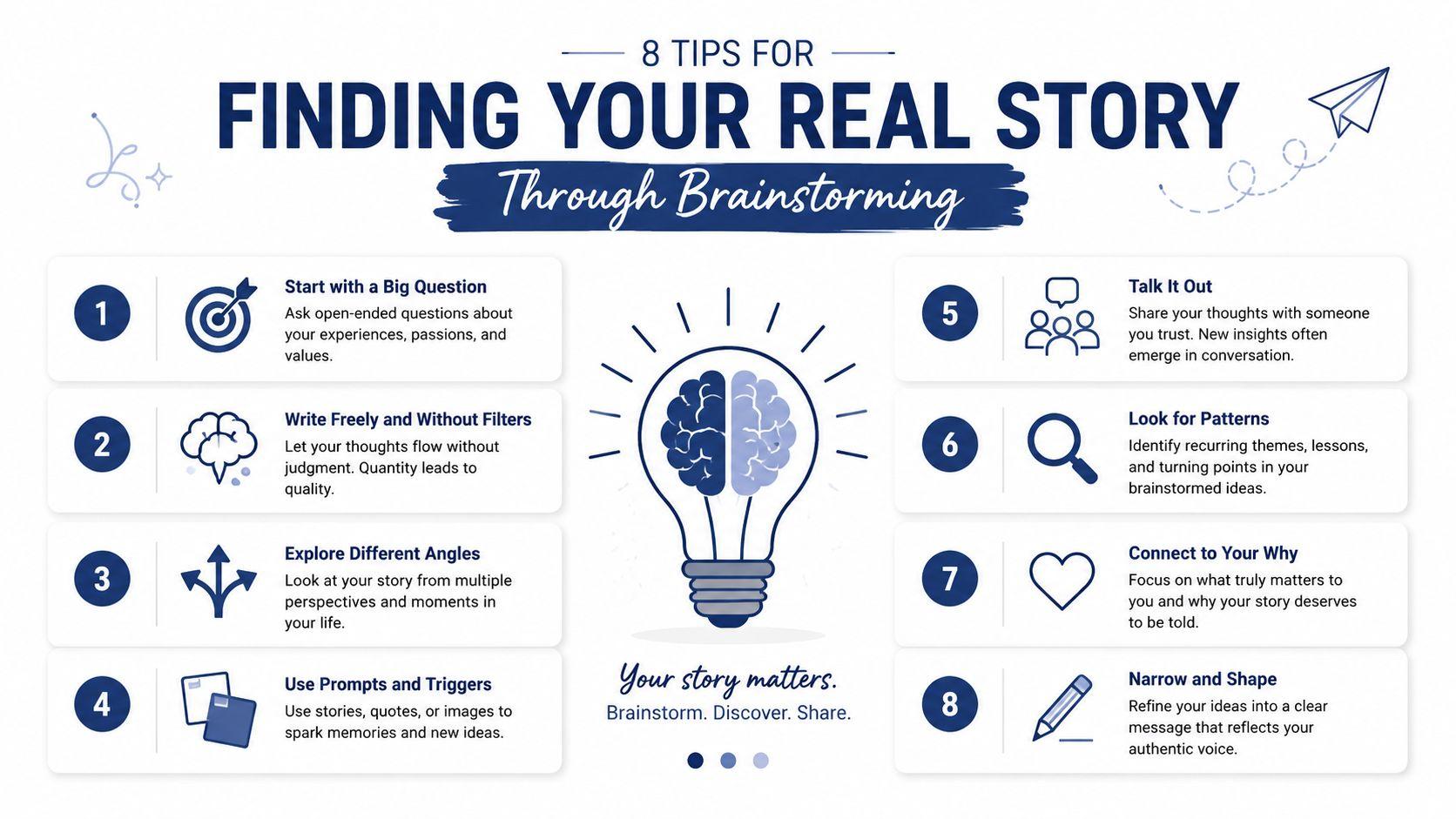
The hardest part of college essay writing help isn't correcting grammar. It's finding an experience that carries your voice and gives you something genuine to examine. Start with evidence from your life rather than broad claims about your personality.
Use objects, timelines, and tension
Try the essence objects exercise. List objects that carry personal meaning: a cracked instrument reed, a bus pass, a recipe card, a worn library book, or a tool you keep repairing. For each object, answer three questions:
- Where did it come from? Describe the setting and the people connected to it.
- Why have you kept noticing it? Identify the memory, conflict, or habit it represents.
- What does it reveal now? Explain how your interpretation has changed.
Next, draw a timeline of moments that altered your direction. Include disappointments, awkward transitions, arguments, discoveries, responsibilities, and ordinary routines. Don't limit the list to awards or dramatic achievements. The useful material often appears in the moment before a decision, when you weren't yet certain what to do.
A values exercise can narrow the list. Complete these sentences without editing yourself:
- “I become stubborn when…”
- “I used to assume…”
- “People misunderstand me when…”
- “I notice details that others often miss, such as…”
- “A rule I questioned was…”
The strongest candidate usually contains tension. You wanted two things at once. You made a reasonable decision that produced an unexpected result. You admired someone and later saw their limitations. You failed publicly, adjusted privately, or discovered that your original interpretation was incomplete.
Let AI widen the search, not author the memory
AI works well as a questioning partner during brainstorming. Give it a short list of your own experiences and ask for possible themes, hidden tensions, or follow-up questions. Tell it to challenge obvious interpretations rather than produce an essay.
Useful prompts include:
- “What values might be present in these experiences?”
- “Which memory has the clearest change in perspective?”
- “What questions would help me make this story more specific?”
- “What assumptions am I making about this event?”
- “Give me several possible angles, but don't write paragraphs.”
You can also speak your ideas aloud and use a voice brainstorming and outlining tutorial to capture details before they disappear. Spoken recollection often produces more natural phrasing than an early attempt to sound polished.
Keep a shortlist of two or three promising moments, then test each one. Can you remember physical details? Is there a decision or change? Does the experience reveal something not already obvious elsewhere in your application? If the answer is no, keep brainstorming. A fresh topic doesn't need to be extraordinary. It needs to be personal, specific, and capable of supporting meaningful reflection.
Drafting With Structure and Authentic Voice
Once you've chosen a story, stop searching for a more impressive one. Draft the experience you have, with enough context for a reader who wasn't there. A personal essay needs movement, not a list of qualities.
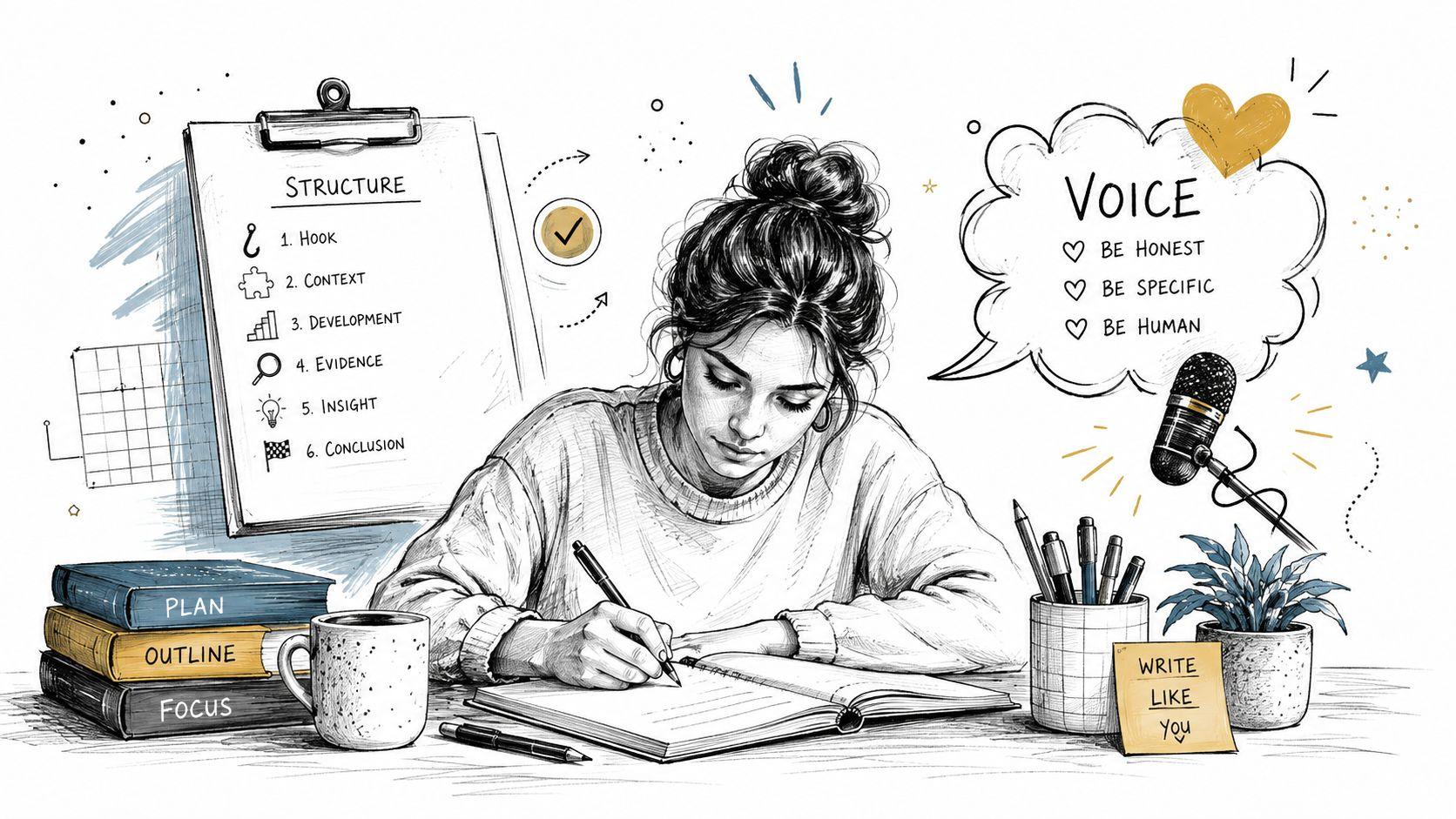
Use this basic structure:
- Opening scene. Begin inside a moment, action, conversation, or observation. Avoid starting with a universal statement about life.
- Narrative movement. Show what happened and what you wanted, feared, misunderstood, or decided.
- Reflection. Explain what you realized, questioned, or now see differently.
- Forward-looking close. End with a present understanding or continuing question, not a generic promise to change the world.
The opening doesn't need to be dramatic. “I had always been passionate about...” usually gives the reader a claim before evidence. A concrete image or action gives the reader something to follow.
Write like yourself on your clearest day
Students often add formal vocabulary because they think college writing must sound academic. It doesn't. Admissions readers can recognize language that feels borrowed, inflated, or disconnected from the student's actual experience.
Choose the sentence you would naturally say, then make it precise. Replace “I faced numerous adversities” with the actual problem. Replace “this experience was transformative” with what you did differently afterward. Specific verbs and concrete details create authority without decoration.
During drafting, don't stop to perfect every paragraph. Mark uncertain areas with a note such as “[explain this]” and continue. A complete rough draft gives you something to revise; a perfect opening followed by nothing gives you no essay.
AI can provide limited feedback without taking over the writing. Ask it to identify confusing transitions, repeated words, vague claims, or places where the reflection arrives too late. Don't ask it to “make this sound impressive,” because that invitation often pushes the language away from you.
You can compare your draft against practical guidance on essay revision and feedback workflows, especially when you need to sort comments into major issues and minor edits. Keep the final wording yours. If a suggested sentence sounds unlike something you would say aloud, reject it.
Voice test: Read the draft to someone who knows you. Any sentence that makes them pause and say, “You don't talk like that,” needs attention.
Revising for Impact and Clarity
Revision isn't proofreading. It's the stage where you decide what the essay means and whether the reader can feel that meaning through the story. Read the draft several times, with a different question each time.
Start with the structure
Read only the first sentence of each paragraph. Those sentences should create a recognizable progression. If the essay jumps from childhood background to a recent achievement and then back to a family story, the reader may lose the thread even if every paragraph is well written.
Ask:
- Does the opening place the reader in a specific situation?
- Does each paragraph change the situation, deepen the conflict, or add reflection?
- Does the middle contain a turning point rather than a summary?
- Does the ending grow from the story instead of adding a detached life lesson?
Cut background that doesn't affect the decision or realization. Students often spend too much space explaining circumstances and too little showing what they noticed. Context matters only when it helps the reader understand your choices.
Replace claims with evidence
Circle abstract words such as “passionate,” “resilient,” “unique,” “challenging,” and “inspiring.” These words aren't automatically wrong, but they require proof. If you call yourself patient, show the repeated action that required patience. If you say you became more open-minded, identify the conversation or observation that changed your response.
A useful revision pass focuses on detail. Add the sound, object, gesture, setting, or exact choice that makes the scene yours. Then remove details that merely decorate the paragraph.
Polish only after the meaning works
At the sentence level, look for verbs that carry action. Replace “made a decision to” with “decided.” Remove introductions that delay the point. Read aloud to catch rhythm problems, accidental repetition, and sentences that look fine on screen but sound unnatural.
AI can act as a second set of eyes during this pass. Ask it to flag unclear passages, identify places where you summarize instead of dramatize, or suggest questions about missing context. Treat every suggestion as an option, not an instruction. You're the editor because you understand the experience and the emotional truth behind it.
The evidence supports process-oriented writing support. A meta-analysis of 71 writing-center outcomes found that 31.2% more writing-center visitors showed better writing performance than nonvisitors, with effect sizes from .39 to .70; among struggling writers, 40.6% more visitors demonstrated improved outcomes (meta-analysis of writing-center outcomes). The lesson is practical: feedback works best when it helps you make better decisions across a process, not when someone hands you a finished essay.
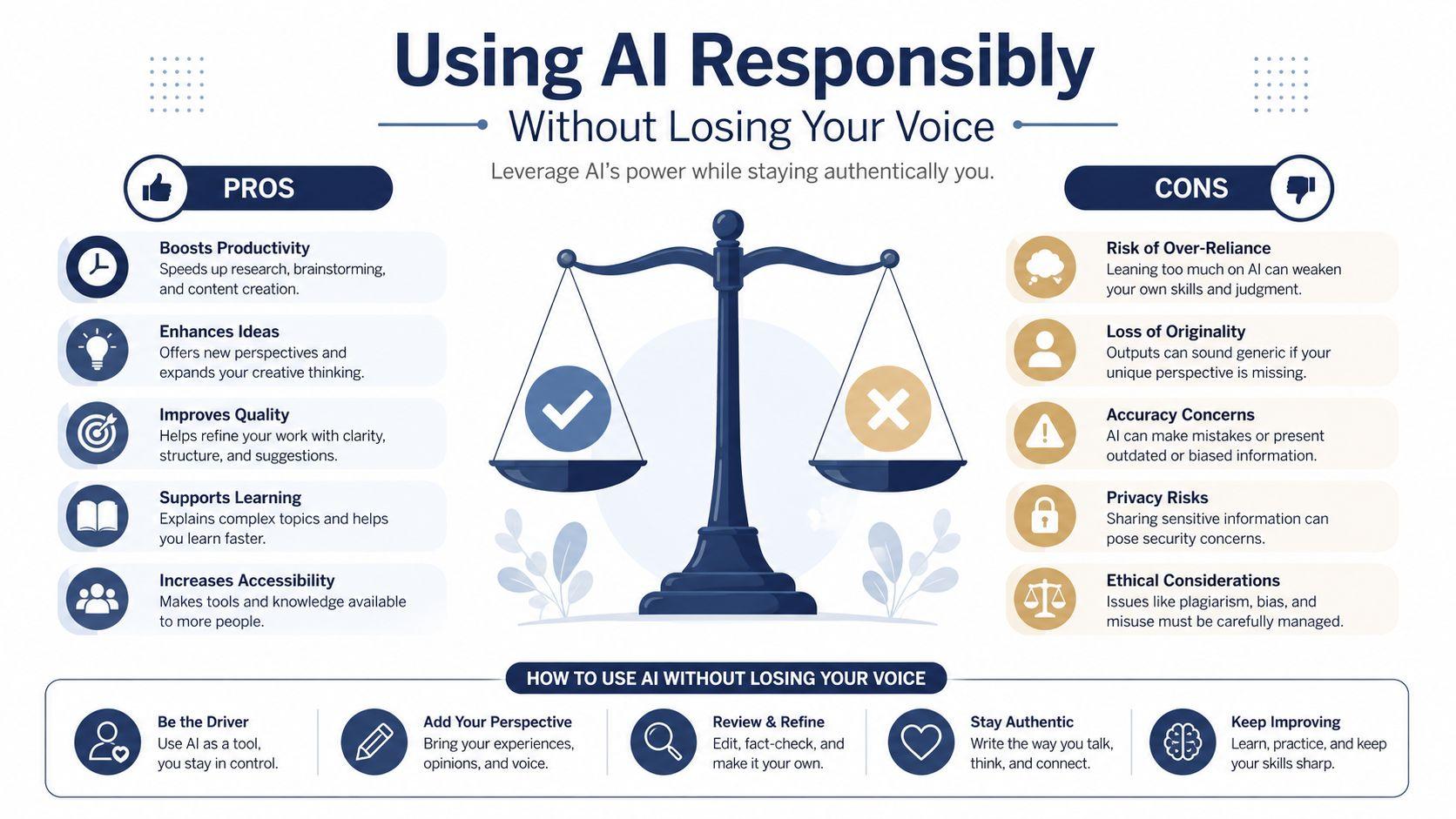
Using AI Responsibly Without Losing Your Voice
The risky assumption is that AI detection is the only problem. It isn't. The deeper risk is submitting an essay that contains polished language but no recognizable person behind it. Admissions readers notice generic reflection, exaggerated vocabulary, smooth but empty transitions, and stories that could belong to anyone.
One-shot prompts are especially dangerous. If you ask an AI system to write an essay from a topic, it has to fill in the emotional logic and details you haven't supplied. The result may be grammatically clean, but it can invent implications, flatten your personality, or produce language you couldn't explain in an interview.
Draw a firm line between support and outsourcing
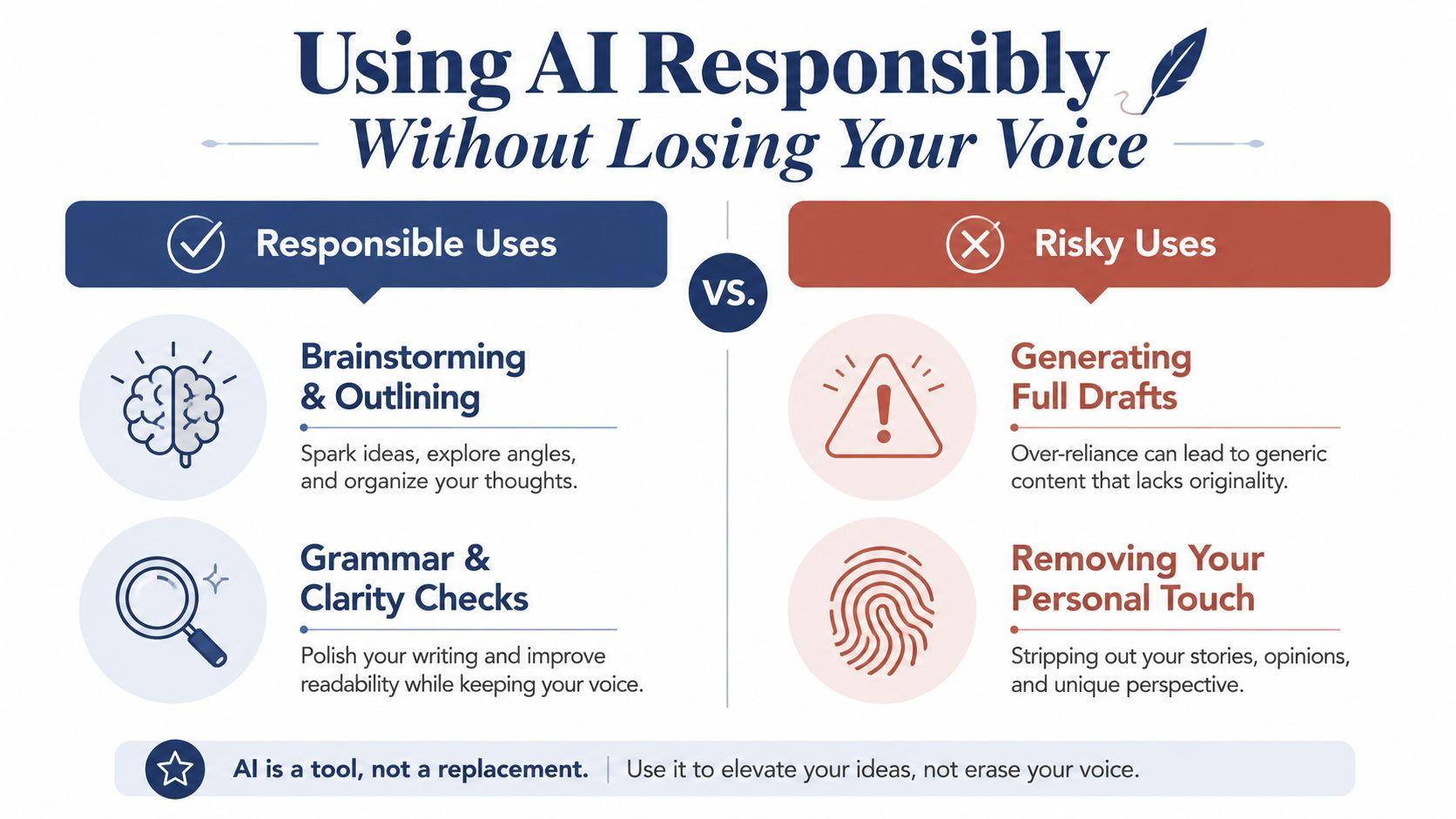
Responsible use keeps the student's thinking at the center:
- Brainstorming: Ask for questions, themes, and alternative angles based on your own notes.
- Outlining: Test whether your chosen moments create a logical sequence.
- Clarity feedback: Request flags for confusing wording, weak transitions, or repetition.
- Revision questions: Ask where the essay makes a claim without showing evidence.
- Proofreading: Check grammar after you've made the substantive decisions.
Risky use removes your authorship:
- Full-draft generation: Don't submit paragraphs created from a broad prompt and minimal personal input.
- Voice replacement: Don't ask a tool to make the essay sound like a different kind of student.
- Fabricated detail: Never accept invented memories, dialogue, achievements, or emotional reactions.
- Policy avoidance: Don't treat “humanizing” as permission to conceal outsourced writing.
For broader guidance on using AI to support personal application materials, StoryCV's advice on AI-assisted resume writing offers a useful parallel: tools can help organize and refine your material, but the underlying facts and decisions must come from you.
Protect the story as well as the submission
Be careful with sensitive information. Personal essays may include family circumstances, health information, immigration experiences, financial hardship, or private details about other people. Use a tool only when you understand how it handles your input, and remove identifying information when it isn't necessary.
A privacy-first alternative such as 1chat's FAQ and product guidance can help you evaluate how an AI writing assistant fits your needs, but no platform can decide whether a particular use complies with a college's rules. Check each institution's current guidance, especially if the application portal or school gives specific instructions about AI assistance.
The current conversation around AI use makes authenticity more important, not less. Student-focused guidance reports that 97% of Gen Z students had used AI tools, including for essays and applications, while an admissions-focused summary reports that about half of applicants use AI to brainstorm and one in five use it to create a first draft (student guidance on AI tools for college essays). Those figures describe reported use, not permission. They make a clear distinction essential: use AI to think more, never to impersonate yourself.
Your Complete Essay Writing Workflow
A dependable workflow turns college essay writing help into a series of decisions rather than a last-minute rescue.
The working sequence
Brainstorm first. Collect objects, memories, conflicts, and moments of changed perspective. Keep the material personal and avoid drafting before you know what the story is about.
Choose one story. Select the experience with the clearest tension and the strongest details. Don't choose a topic merely because it sounds impressive.
Draft without polishing. Establish the scene, show the movement of events, and write the reflection in language you'd use.
Revise in passes. Check structure, then voice, then specificity, then sentence-level clarity. Change one category at a time so you know what each edit accomplishes.
Proofread and verify. Confirm the prompt response, word limit, names, dates, and formatting. Remove anything an AI tool invented or changed without your approval.
A writing-support assessment found that students receiving more than two hours of consultation were more likely to earn satisfactory composition-course grades, with reported advantages varying by incoming GPA, including 54% for students entering below 2.0 and 7% for those entering at 3.5 or above (2022 assessment report). The practical takeaway is simple: sustained attention beats a one-time emergency edit.
Your essay is ready when the story is specific, the reflection is earned, the language sounds like you, and every paragraph serves the prompt. Stop editing when new changes make the essay less natural rather than more precise. Then submit work you can explain, defend, and recognize as your own.
Start today by opening a blank document and writing ten private memories without judging them. Choose one with real tension, draft the scene in your own words, and use AI only to ask sharper questions about clarity, structure, and missing detail. That process will give you safer, stronger college essay writing help than any tool that promises to write your life for you.