Cultivating critical thinking skills in students is about so much more than just acing a test. It’s about handing them a toolkit for life, one that helps them make sense of a complicated and constantly shifting world. At its heart, it’s the ability to look at information with a clear eye and form a solid, well-thought-out judgment.
Why Critical Thinking Is a Student's Secret Weapon
So much of school can feel like a race to memorize facts, dates, and formulas. And while that foundational knowledge is absolutely a building block, its real power is only unleashed when students know what to do with it.
Think of it like getting a giant box of LEGOs. Having all the pieces is great, but the real fun—and the real skill—comes from knowing how to sort, connect, and build them into something new, something that stands on its own.
Critical thinking is that building process. It's the hands-on, methodical work of questioning, analyzing, and weighing information instead of just taking it at face value. For students, this is the leap from just learning what to think to understanding how to think.
From Mental Filing Cabinet to Innovation Lab
Without critical thinking, a student's mind can easily become a passive filing cabinet—a place where facts are stored away, rarely to be seen or used again. But with these skills, that same mind becomes an active, bustling workshop. It’s a space where ideas are tested, arguments are constructed, and new solutions are born. This mental workshop is what sets them up for the future.
Why is this shift so vital? Because the problems they'll encounter in college and their future careers won't come with an answer key. They’ll need people who can:
- Tackle complex problems that have no easy, off-the-shelf solution.
- Judge the reliability of sources, especially in an era overflowing with misinformation.
- Articulate their ideas persuasively and back them up with sound reasoning.
- Roll with the punches by thinking creatively and adapting to new situations.
The trouble is, there's a big gap between what's needed and what's happening in many classrooms. A major study that looked at over 27,000 classroom lessons revealed a startling trend: students spent most of their time on basic thinking tasks. A full 25% of class activity was dedicated to just remembering facts, and another 32% was spent on simply understanding concepts. The higher-level skills, like analysis and evaluation, were only being developed in less than one-sixth of the classrooms observed. Learn more about these classroom observations.
The goal isn’t to turn students into cynics who doubt everything. It's to nurture discerning thinkers who can tell the difference between a strong argument and a weak one, empowering them to make better decisions in every part of their lives.
Ultimately, teaching these skills isn't just about preparing students for the next exam. It’s about preparing them for a lifetime of smart choices, intellectual curiosity, and real-world impact. It's the secret weapon that helps them not only understand the world but also find their unique place in it.
Understanding the Core Critical Thinking Skills
Let’s be honest: "critical thinking" can sound a bit vague and intimidating. But it’s not some mysterious talent you’re either born with or you’re not. It’s actually a set of specific, trainable skills that all work together.
Think of it like learning to play an instrument. You don't just "become a musician." You start by learning the notes, then chords, then timing, and eventually you put it all together to create music. Critical thinking is the same—you master a few distinct mental moves, and before you know it, you’re not just absorbing information, you're engaging with it.
At its heart, that’s the big shift: moving from being a passive receiver of facts to an active participant in your own learning. It’s the difference between simply reading a headline and asking, "Who wrote this? What's their angle? And what are they not telling me?"
This journey from just gathering facts to truly understanding them is built on six core skills.
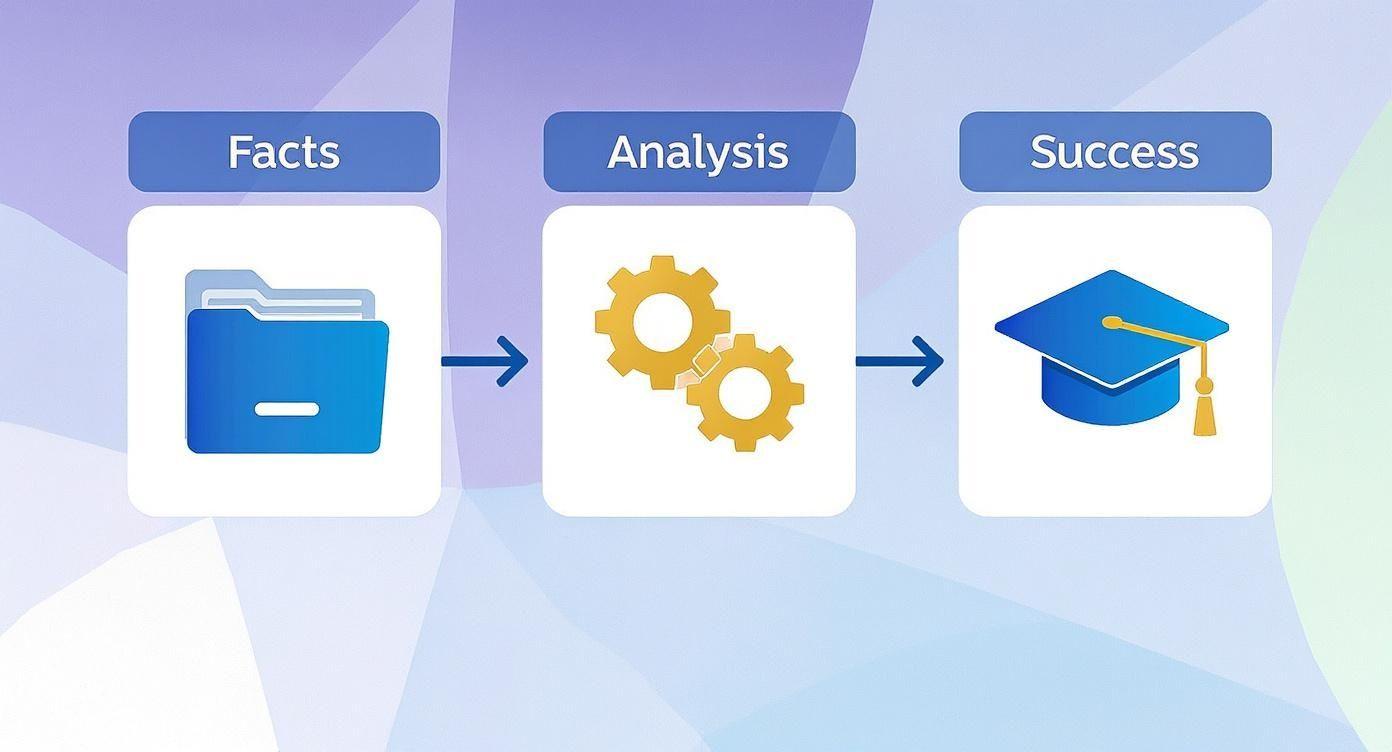
As you can see, success isn't just about memorizing facts. The real magic happens in the middle—the analysis—where those mental "gears" turn raw information into genuine insight. So, let's break down the six skills that power that process.
The Six Core Critical Thinking Skills Explained
To really get a handle on this, it helps to see each skill in action. The table below breaks down the six fundamental components of critical thinking, giving a straightforward definition and a practical classroom example for each one.
| Core Skill | What It Means (Definition) | Classroom Example |
| Analysis | Breaking down information into its core components to understand its structure. | Identifying the thesis statement, supporting arguments, and key evidence in an essay. |
| Interpretation | Determining the meaning and significance of data, statements, or events. | Explaining the symbolism of a character's actions in a novel. |
| Evaluation | Assessing the credibility, relevance, and strength of arguments and sources. | Determining if a website is a reliable source for a research paper by checking its author and bias. |
| Inference | Drawing logical conclusions based on evidence and reasoning. | Concluding the likely outcome of a science experiment based on initial data. |
| Explanation | Clearly articulating your reasoning and the evidence that supports your conclusions. | Writing a lab report that justifies the experiment's conclusion with detailed findings. |
| Self-Regulation | Monitoring and correcting your own thinking processes to avoid bias and errors. | A student recognizing their own bias on a topic and actively seeking out opposing viewpoints. |
These six skills are the building blocks. Now, let’s explore how they fit together, pair by pair.
Breaking It Down: Analysis and Interpretation
First up are analysis and interpretation, two skills that are practically joined at the hip. They're the starting line for any real investigation.
Imagine a student is handed a historical document. Analysis is where they take it apart to see how it's built. It's like a mechanic looking under the hood. They’re not fixing anything yet, just identifying the parts: What’s the main argument? What evidence is used to back it up? What assumptions is the author making?
Interpretation, then, is all about figuring out what it all means. If analysis is identifying the parts, interpretation is understanding their function. The student starts asking bigger questions: "What does this evidence actually imply in its historical context?" or "Why did the author use this specific tone?" This skill is deeply connected to reading comprehension, as both require you to pull meaning from the words on the page. For more on that, our guide on how to improve reading comprehension skills is a great resource.
Making a Judgment: Evaluation and Inference
Once you’ve taken the information apart and figured out what it means, it’s time to decide what you think about it. This is where evaluation and inference come in.
Evaluation is about putting on your judge's robes. You have to weigh the evidence and assess its quality. Is the source credible? Is the logic sound, or are there holes in the argument? This is the skill that separates solid reasoning from clever manipulation and helps students become savvy consumers of information.
Inference, on the other hand, is the art of reading between the lines. It’s about making an educated guess based on the evidence you have. For example, if a scientist’s data shows a strong link between two variables, a student can infer a potential relationship, even if the study doesn't spell it out. It’s about spotting the unsaid, connecting the dots, and drawing a reasonable conclusion.
Critical thinking is not about finding fault. It's about finding depth. It’s the discipline of seeing the parts, understanding the connections, and judging the value of the whole.
Putting It All Together: Explanation and Self-Regulation
The final pair of skills, explanation and self-regulation, are what turn good thinking into a powerful, repeatable habit.
Explanation is simply the ability to communicate your reasoning to others. It doesn’t matter how brilliant your internal analysis is if you can't articulate it. This means clearly stating your conclusion, walking someone through the evidence you used, and showing how you got from point A to point B.
Finally, there's self-regulation—the master skill. This is where you turn that critical thinking lens back on yourself. It's about thinking about your own thinking (a process called metacognition). A self-regulating student constantly checks their own work, asking questions like, "Am I only looking for facts that support what I already believe?" or "Could there be another way to look at this?" This is what separates a good thinker from a great one.
Building a Classroom That Fosters Inquiry
Knowing the core critical thinking skills is one thing, but getting them to stick is another. The real magic happens when students start putting those skills into practice, and that requires a specific kind of classroom environment. We're not talking about a place where a teacher just delivers information, but a space intentionally designed to spark curiosity and encourage genuine intellectual exploration.
This doesn't mean you have to overhaul your entire curriculum. It’s more of a philosophical shift—moving away from a top-down, teacher-knows-best model to one where students are at the center of the inquiry. The goal is to create a culture where questions are celebrated more than easy answers, and "I don't know, but how can we figure it out?" is the go-to response.
This simple change empowers students to take the reins of their own learning. They stop being passive listeners and become active investigators who question, analyze, and build their own understanding from the ground up.
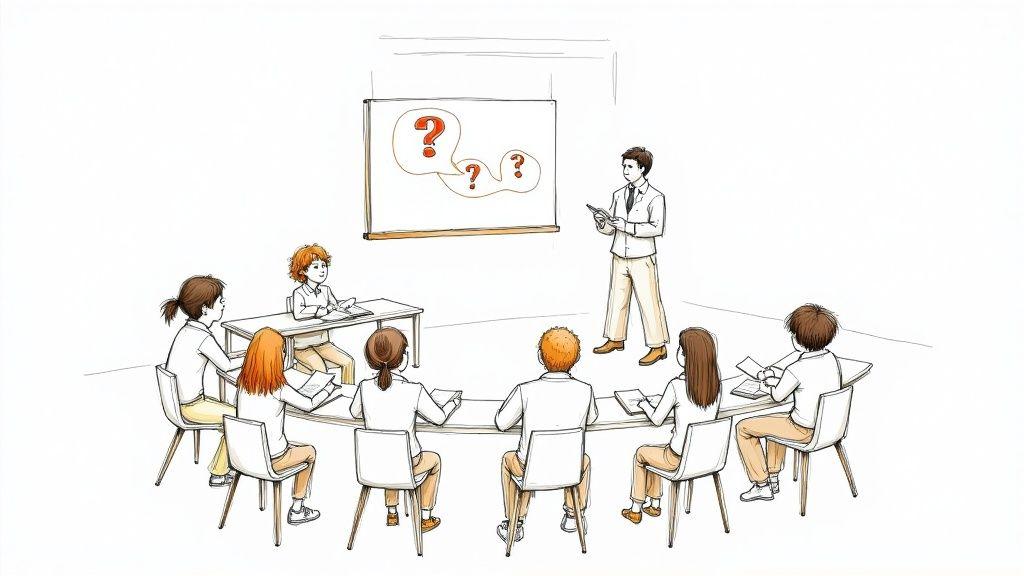
So, how do you make this shift? It comes down to intentional strategies that put inquiry at the heart of every lesson. Let's dig into some of the most effective ways to turn any classroom into a powerhouse of critical thought.
Sparking Curiosity with the Socratic Method
One of the oldest and most powerful tools in an educator's arsenal is the Socratic method. This isn't about lecturing; it's the art of disciplined, thoughtful questioning. The teacher becomes a guide on the side, asking probing questions that push students to examine their own beliefs, dig up hidden assumptions, and follow the logical thread of their own arguments.
Think of it as guided discovery. Instead of just giving them the definition of "justice," you might ask a series of questions:
- Can you give me an example of something you think is just?
- What is it about that action that makes it just? Would it be just in every situation?
- Now, what would an unjust action look like in that same scenario?
- Who gets to decide what's just or unjust in the first place?
This line of questioning forces students to move beyond knee-jerk reactions. It makes them confront inconsistencies in their own logic and build a much deeper, more nuanced understanding of complex ideas. The real power here is that it shows students that learning isn't about memorizing facts—it's a process of exploration.
Solving Real Problems with Project-Based Learning
Another game-changer is Project-Based Learning (PBL). PBL yanks learning out of the abstract world of textbooks and drops it right into the real world. Instead of simply reading a chapter on environmental science, students might be challenged to develop a workable plan to reduce waste in their own school.
This approach naturally builds a whole suite of critical thinking skills. To get the job done, students have to:
- Define the Problem: First, they have to analyze the situation to figure out what the core challenges are. What's the main source of the waste? Who does this affect?
- Research and Gather Information: They'll need to hunt down credible data, evaluate different solutions, and carefully weigh the pros and cons of each one.
- Collaborate and Synthesize: Working in teams, students have to explain their ideas, really listen to other perspectives, and then weave those different viewpoints into a single, strong plan.
- Present and Defend their Solution: Finally, they present their plan and have to be ready to answer tough questions, justifying every choice with solid evidence.
Project-Based Learning turns the classroom into a microcosm of the real world, where knowledge is a tool used to solve authentic problems rather than an end in itself.
This hands-on method makes learning stick because it's meaningful. It shows students how vital critical thinking skills for students are in their actual lives.
Cultivating Multiple Perspectives Through Debate
Nothing sharpens evaluation and explanation skills quite like a good old-fashioned debate. The key is to structure them in a way that goes beyond a simple for-or-against argument. You want students to dive into the messy, nuanced middle of a complex issue. A well-run debate requires them to not only defend their position but also to truly understand and accurately represent the opposing viewpoint.
For example, when debating a historical event, you could assign students specific roles—a politician, a soldier, a civilian—forcing them to argue from a perspective that might be completely at odds with their personal beliefs. It’s an incredible exercise in empathy and intellectual humility, showing them that a strong thinker can find merit in an argument they ultimately disagree with.
Research from sources like the National Institutes of Health confirms that developing these skills is a complex process. Studies show that when teachers explicitly guide students through activities focused on reflection, analysis, and argumentation, the results are powerful. This kind of intentional teaching measurably improves both academic performance and cognitive abilities. By using these strategies, you’re not just teaching content; you’re building a lasting culture of inquiry that students will carry with them for the rest of their lives.
Let's Get Practical: Activities for Every Grade Level
Knowing the theory is one thing, but critical thinking skills are built through practice. Just like a muscle, the brain needs regular workouts to get stronger. The trick is to find activities that don't just challenge students but also genuinely engage them at their own developmental stage.
An activity that gets a high school junior fired up might just overwhelm a sixth-grader. By meeting students where they are, we can build their confidence and slowly introduce more complex ways of thinking. Here’s a toolkit of practical, age-appropriate ideas to make critical thinking a hands-on, and even fun, part of learning.
Engaging Middle School Minds
Middle school is that fascinating time when students start shifting from purely concrete thinking to more abstract ideas. The best activities tap into their budding curiosity and their growing awareness of the world, often by using things they see every day.
A fantastic starting point is simply looking at advertisements. Have students find a few ads they see online, in magazines, or on TV. Then, get a discussion going with a few key questions:
- What is this ad really selling? Is it just a pair of sneakers, or is it selling the feeling of being cool, fast, or popular?
- Who are they trying to reach? How can you tell from the music, the colors, or the people in the ad?
- What tricks are they using to persuade you? Are they using a famous celebrity? Trying to make you laugh or feel a certain emotion?
This simple exercise is a direct lesson in evaluation. It teaches them to look beyond the flashy surface and question the real message and motive behind the information they’re constantly consuming.
Another great one is a game I call "Fact, Opinion, or Educated Guess?" Give them a list of statements and have them sort each one into the right category.
- Fact: "Water is made of hydrogen and oxygen." (Something you can prove.)
- Opinion: "Pizza is the best food." (A personal feeling.)
- Reasoned Judgment: "Our school should have a longer lunch break." (A conclusion that needs evidence to be convincing.)
This activity really sharpens their analysis skills, forcing them to break down a statement and figure out if it's based on objective truth or subjective feeling.
Challenging High School Thinkers
By high school, students are ready for more nuance. They can handle ethical gray areas and dissect sophisticated arguments. Now is the time to push them to see an issue from multiple angles and back up their own views with solid proof.
You can't beat a good, structured debate. Pick a genuinely complex topic—something like, "Should genetic engineering be used to enhance human traits?" or a controversial moment in history. Here's the twist: require students to argue for the side they personally disagree with.
Forcing yourself to argue for an opposing viewpoint is an incredibly powerful exercise. It builds intellectual empathy, pushing students past their own biases to truly understand a different line of reasoning. This strengthens both their explanation and self-regulation skills at the same time.
Another powerful activity is to play historian with conflicting documents. Give them two primary source accounts of the same event that tell different stories—for instance, a letter from a British soldier and a diary entry from an American colonist about the Battle of Lexington.
Then, have them put on their detective hats and ask:
- Where do these stories match up, and where do they clash?
- What biases might each writer have that could color their story?
- Looking at all the evidence, what do you think really happened?
This kind of task requires sharp inference and evaluation. They have to weigh how credible each source is and piece together a coherent story from incomplete, and sometimes contradictory, information.
Honing Skills for College and Beyond
For students heading into college or just starting out, the focus shifts to applying critical thinking within their chosen field. The training wheels come off, and they're expected to create their own original analysis.
Case study analysis is a staple in higher education for good reason. Whether you're in a business, law, or science class, a case study drops you into a messy, real-world problem with no easy answer. Students have to:
- Analyze all the complicated factors at play.
- Evaluate the different ways to solve the problem, weighing the pros and cons of each.
- Explain their final recommendation and justify it with evidence from the case and their own research.
This is a direct rehearsal for the kind of problem-solving they'll do in their careers, moving past theory to demand the use of nearly every critical thinking skill.
Finally, structured peer review is an invaluable tool. Have students critique each other's essays, lab reports, or project proposals using a clear rubric. The feedback shouldn't be about grammar alone, but about the strength of the argument, the quality of the evidence, and the clarity of the writing. This process doesn't just help them improve their own work; it trains them to be more discerning readers and thinkers. It's a masterclass in self-regulation, as they learn to turn that same critical eye back on their own efforts.
Teaching Critical Thinking in the Digital Age
The sheer volume of information students encounter online is staggering. It's a constant flood, and the challenge isn't just about finding facts anymore. It’s about navigating a complex world of viral trends, sophisticated misinformation, and algorithms quietly shaping what they see and believe. This is why digital literacy has become an absolutely essential pillar of modern education.
Today's students can't afford to be passive scrollers; they need to become discerning consumers of media. Giving them the right mental toolkit is crucial for everything from academic integrity to being a responsible citizen. That means teaching them practical, real-world strategies to look at online sources with a healthy dose of skepticism.
Introducing the SIFT Method
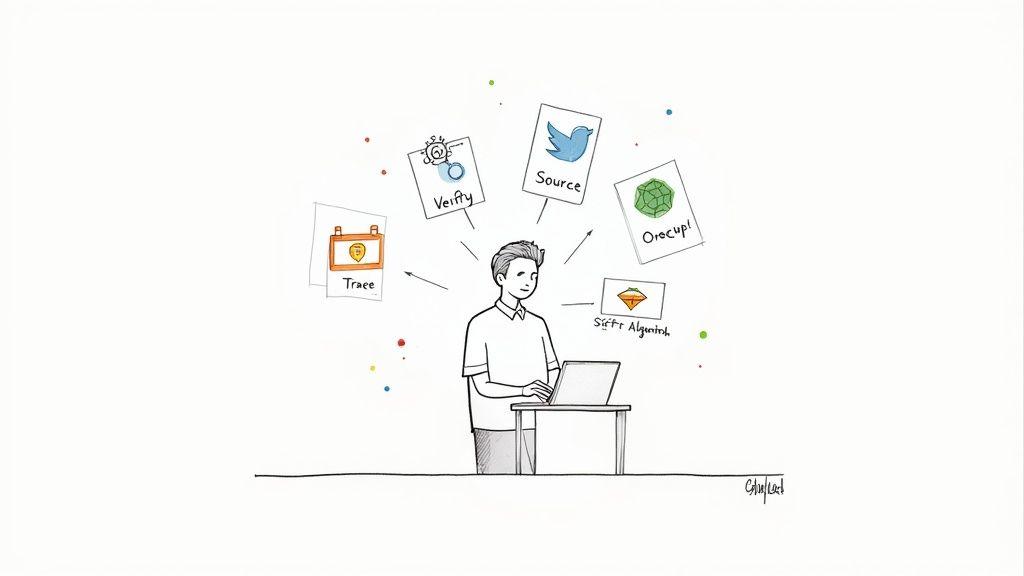
One of the most powerful and practical frameworks out there is the SIFT method. It’s a simple, four-step process that helps students quickly get a read on the credibility of a website, article, or social media post. Instead of getting bogged down in a deep-dive analysis of a single questionable source, SIFT promotes a faster, more effective way to verify information.
Here’s the breakdown:
- Stop: Before you read, share, or have any kind of emotional reaction, just pause. Ask yourself: "Have I heard of this source before? What’s my gut reaction to this headline?" The idea is to hit the brakes on a knee-jerk response.
- Investigate the Source: This goes beyond a quick glance at the "About Us" page. Do a quick search on the author or the publication to see what other, more reliable sources have to say about them. You're trying to figure out their expertise and potential agenda.
- Find Better Coverage: If a claim seems important, take a moment to see if you can find trusted, expert sources talking about the same thing. This is how you get the bigger picture and see if the information is being presented accurately and in context.
- Trace Claims to the Original Context: So much online content twists original sources. Trace quotes, stats, or images back to where they first appeared. A video clip might be real, but is it from the event it claims to be?
This simple framework empowers students to become their own fact-checkers. It fundamentally shifts their mindset from asking "Is this true?" to "Is this a reliable source?"—which is a much more useful question.
Navigating the Algorithmic Echo Chamber
Beyond just spotting outright fakes, students need to grasp how the platforms they use every day actually work. Algorithms on social media and search engines create personalized "echo chambers" or "filter bubbles" designed to show users content they're already likely to agree with. This can cement biases and drastically limit exposure to different viewpoints.
A critical thinker in the digital age understands they aren't just consuming information—an algorithm is actively feeding it to them. The challenge is to consciously break out of that bubble to see a more complete picture.
The lightning speed of today's information cycles makes these skills more important than ever. Students have to learn how to evaluate the accuracy and bias of countless sources in the blink of an eye. Research confirms these skills aren't just picked up along the way; they have to be intentionally taught using frameworks to evaluate source credibility. You can find more insights on building these skills in an educational setting. https://nijournals.org/wp-content/uploads/2025/05/NIJCIAM-61-2025-P16.pdf
While these are big challenges, technology can also be part of the solution. For instance, you can learn more about the best AI for students that, when used responsibly, can aid in research and analysis. By pairing sharp critical thinking with the smart use of modern tools, students can learn to navigate their online world with confidence and skill.
Answering Your Top Questions About Critical Thinking
Even after getting a handle on the core skills and classroom strategies, some very practical questions usually pop up for teachers, parents, and even students themselves. How do you actually measure something as abstract as thinking? Does this stuff really matter outside of English class? And what can we do at home to keep the momentum going?
Let's dig into the nitty-gritty and get you some clear, straightforward answers.
How Can I Tell if Students Are Actually Getting Better at This?
Assessing critical thinking isn't like grading a math test; there's no clean answer key. You're looking at the process of how a student thinks, not just the final product they turn in.
The best approach mixes a few different methods. For formal assignments like essays or projects, a good rubric is your best friend. Instead of just grading for grammar and completion, build in criteria that target the thinking itself. For example, you could evaluate:
- Strength of their evidence: Are they pulling in credible, relevant facts to back up what they're saying?
- Analytical depth: Do they move past the obvious and start digging into the assumptions and complexities of the topic?
- Considering other views: Do they actually acknowledge counterarguments and engage with them thoughtfully, or just ignore them?
But don't underestimate the power of informal observation. Paying attention during a class discussion or group work can give you a live look into a student’s reasoning. Are they asking sharp questions? Are they connecting their ideas to what someone else said? Those moments often reveal more growth than a written test ever could. Of course, you want to be sure their written work is truly their own. A solid, free AI essay checker can be a great tool to ensure academic integrity, helping you confirm that the analysis you're reading is the result of their unique thought process.
What Can I Do at Home to Encourage These Skills?
Parents are huge players in this game. The best part? You don't need a curriculum or a formal lesson plan. You can build these skills right into your daily life.
Get comfortable asking "why" and "how." When your child tells you their opinion on something, just gently probe a little deeper. Instead of letting "that movie was dumb" be the end of the conversation, try asking, "What about it didn't work for you? What do you think the director was trying to do with that one scene?" This simple habit nudges them from making a snap judgment to forming a reasoned one.
Another fantastic (and easy) strategy is to just talk about what’s going on in the world. You can discuss the news or a local event and encourage them to see it from all sides:
- Who is telling this story?
- Who does this event affect the most?
- Is there a totally different way to look at this?
The dinner table can be one of the most powerful classrooms for critical thinking. It’s a space for curiosity, respectful disagreement, and exploring complex ideas without the pressure of a grade.
Conversations like these show kids that being curious is a good thing. It teaches them it's not just okay, but valuable, to question what they hear and explore different points of view.
Isn't This Just an English and History Thing?
Not at all. While critical thinking feels right at home in humanities classes, it’s a universal skill that’s vital in every subject. It just looks a little different depending on where you are.
In a STEM class, for example, critical thinking is the very heart of the scientific method. A biology student isn't just memorizing what the Krebs cycle is; they're analyzing data from an experiment, figuring out if a hypothesis holds water, and drawing conclusions based on the evidence. A math student uses it to figure out the most logical way to attack a complex problem, not just to plug numbers into a formula they’ve been told to use.
The same goes for the arts. A student in a music class isn't just learning to play the notes. They're interpreting the emotion behind a composition, analyzing how a painter uses color to create a mood, or evaluating their own creative choices. Every single subject is a new playground for students to flex and strengthen these analytical muscles. The trick is to make the thinking visible, no matter what classroom you’re in.