To make better decisions, you first have to understand the invisible forces that shape them. We all rely on mental shortcuts, or cognitive biases, to navigate the hundreds of choices we face every day. Becoming aware of these patterns is the first step toward pausing, questioning your gut reactions, and making a more conscious, effective choice.
Recognizing the Hidden Roadblocks to Great Decisions
Every decision you make, from a minor daily choice to a life-altering one, is quietly influenced by these hidden mental patterns. Think of them as your brain's autopilot—incredibly efficient but often prone to error. These cognitive biases can trip up even the most experienced leaders.
The goal isn't to magically eliminate them, because you can't. The real power comes from building the self-awareness to spot them in action. That awareness gives you a crucial moment to pause and decide if your initial instinct is truly the best path forward. This is a fundamental part of developing stronger critical thinking skills for students and professionals alike.
Common Biases That Cloud Your Judgment
So, what do these roadblocks look like in the real world? Two of the most common are confirmation bias and the availability heuristic.
- Confirmation Bias: This is our natural tendency to hunt for information that proves what we already believe, while conveniently ignoring anything that challenges it.
- Availability Heuristic: This happens when we give more weight to information that's fresh in our minds, often because it was recent or emotionally charged.
I almost made a huge hiring mistake because of another classic trap: the halo effect. One candidate was incredibly charismatic, and I was so impressed by their confidence that I was ready to offer them the job. I had let that one shiny trait blind me to the fact that another, quieter candidate was far more competent and had the stronger technical skills we actually needed. Recognizing that bias forced me to step back and re-evaluate them both based on merit, not just personality.
The most dangerous biases are the ones you don't know you have. The act of identifying them is the first and most critical step toward overcoming their influence on your choices.
Turning Awareness into Action
Just knowing about biases isn't enough; you have to put that awareness to work. This is becoming a huge focus in the business world, with a 2026 BCG survey finding that 79% of companies now rank innovation as a top-three priority. You can't innovate if your decisions are stuck in old, biased patterns.
A simple but powerful habit is "decision journaling"—logging your choices and their outcomes. This practice alone has been shown to improve decision accuracy by 25% over five years. It forces you to confront the results of your thinking.
Tools that help you simulate different scenarios, like 1chat, can also be a game-changer. They allow you to weigh your options using real statistics, turning an overwhelming pile of possibilities into clear, actionable paths. You can dig deeper into these innovation trends and their strategic impact by reading the full BCG report.
When you're facing a tough call, it's easy to get stuck in your own head. The best way I've found to cut through the noise is to lean on a structured framework. Think of it less like a rigid set of rules and more like a map that helps you see the terrain clearly.
These frameworks force you to step back from gut feelings and break down a big, intimidating decision into smaller, more manageable pieces. Suddenly, the path forward doesn't seem so daunting.
Move Fast with the OODA Loop
In fast-paced environments where you have to think on your feet, the OODA Loop is a game-changer. It's a concept borrowed from military strategy, designed for making rapid, effective decisions when conditions are constantly changing. The loop consists of four stages: Observe, Orient, Decide, and Act.
- Observe: What’s happening right now? This is all about gathering raw, real-time information from your surroundings.
- Orient: This is the most critical step. You have to make sense of what you've observed, filtering it through your own experience and—importantly—your own biases.
- Decide: Based on your analysis, you develop a hypothesis for the best way forward.
- Act: You execute your decision, turning your plan into action.
I’ve seen small businesses run circles around larger competitors by using this exact cycle. They can react to customer feedback or market shifts in days, not months, because they’re constantly observing, orienting, and acting. Each time through the loop, they get a little smarter and a little faster.
The "Orient" phase is where many of us get tripped up by cognitive shortcuts. This is where awareness of your own biases becomes a superpower.
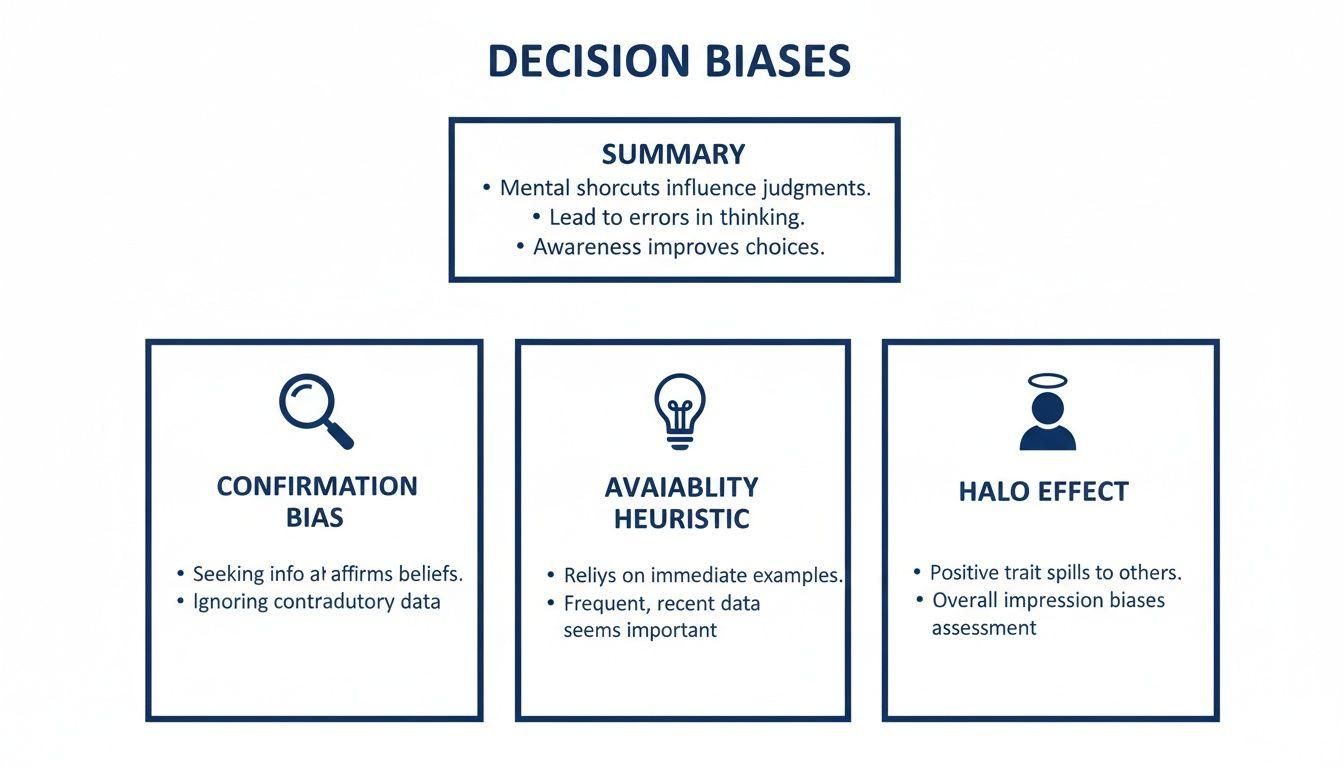
Understanding things like confirmation bias (seeking out information that proves you right) or the availability heuristic (overestimating the importance of recent events) is crucial for staying objective.
Choosing Your Decision Making Framework
Different situations call for different tools. The OODA Loop is perfect for speed, but sometimes you need a more methodical approach to unpack complexity. Here’s a quick guide to a few popular frameworks and when I’ve found them most useful.
| Framework | Best For | Key Benefit |
| OODA Loop | Rapid, iterative decisions in changing environments. | Builds agility and speed by creating a fast feedback cycle. |
| Decision Tree | Choices with multiple paths and uncertain outcomes. | Visually maps out consequences and probabilities, clarifying complex scenarios. |
| Pros/Cons Matrix | Comparing a few distinct options with multiple factors. | Forces you to weigh the importance of different criteria, leading to a more objective choice. |
Ultimately, the best framework is the one that helps you think most clearly about the problem at hand. Don't be afraid to try different ones until you find what works for you and your team.
Visualize Your Options with Trees and Matrices
When you're dealing with a decision that has several branching paths, a Decision Tree is incredibly useful. It's a simple but powerful way to sketch out your choices, the potential outcomes of each, and the risks involved. It transforms a jumble of "what ifs" into a clear, visual map.
Before you start building one, it's vital to ensure the information you're using is solid. You can learn more about what makes a credible source in our guide on the topic.
This kind of structured thinking is what separates high-performing teams from the rest. In fact, more than 65% of organizations with strong analytical capabilities outperform their peers in navigating unexpected market changes. Research also shows that using tools like decision trees can reduce the impact of bias by 28%. When you pair these methods with powerful analytical tools, like those in 1chat, teams have been shown to cut decision-making time by 35%.
For a more straightforward comparison, I often turn to a Weighted Pros and Cons Matrix. It’s a smart upgrade to a simple pro/con list.
Let’s say you’re picking a new project management software. Instead of just listing good vs. bad, you first identify the most important factors—cost, ease of use, integration capabilities, and customer support. Then, you assign a "weight" to each factor (say, 1-10) based on how much it matters to your team. Finally, you score each software option on those factors.
This simple act of weighting often makes the best choice obvious, preventing you from getting distracted by a single flashy feature on an otherwise inferior product. It grounds the decision in what truly matters.
Building Habits for Smarter Long-Term Decisions
Getting better at making big calls isn't about some secret, one-time trick. The real, lasting change comes from the small, consistent habits you bake into your everyday thinking. When you practice these little routines, you're essentially training your brain to see problems with more clarity and foresight. It's the foundation for anyone serious about learning how to improve decision making skills.
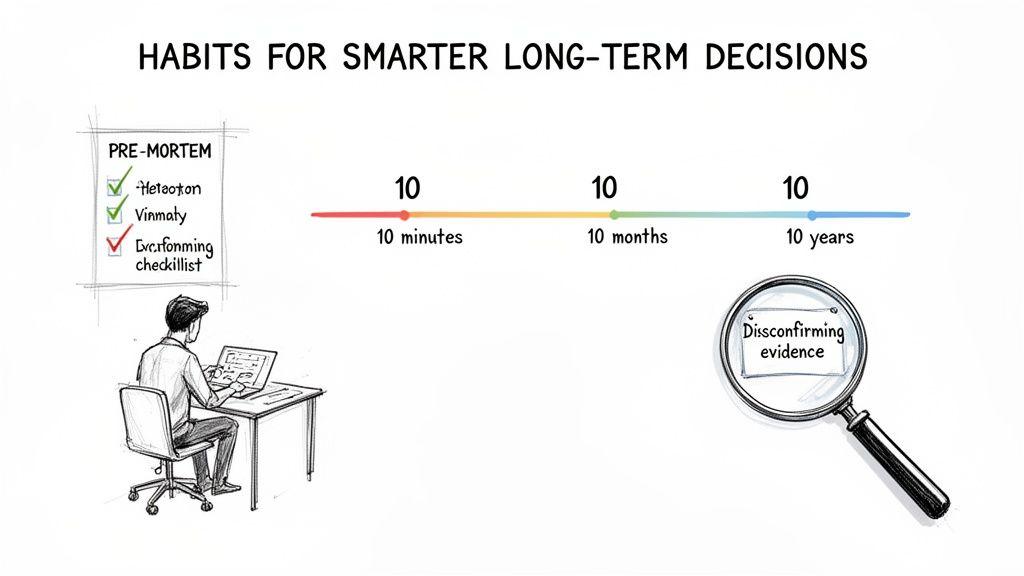
One of the most powerful habits I’ve ever adopted is the pre-mortem. It sounds a bit grim, but it’s an incredibly useful exercise. Before we commit to a new project, my team and I will gather and imagine it’s a year from now and the whole thing has failed spectacularly. From there, we work backward and list all the possible reasons why it went off the rails.
It feels a little strange at first, but it works wonders. This process gives everyone permission to voice the nagging doubts they might otherwise keep to themselves. Just recently, a pre-mortem helped us spot a massive supply chain risk and a potential marketing message that would have completely missed the mark—two issues we’d have walked right into otherwise.
Expand Your Time Horizon With the 10/10/10 Rule
We've all been there—our immediate emotions get the best of us and drive a decision we later regret. A brilliant little mental habit to fight this is the 10/10/10 Rule. It yanks you out of the heat of the moment and forces you to think about the future.
When faced with a choice, just ask yourself three quick questions:
- How will I feel about this in 10 minutes?
- What about in 10 months?
- And in 10 years?
This simple drill shifts your perspective from short-term feelings to long-term consequences. An option that seems fantastic right now might look incredibly foolish in 10 months. This framework exposes that potential conflict before you’re locked in. Think of it as a quick way to stress-test a decision against your future self.
According to a study by organizational psychologist Tasha Eurich, 95% of people believe they’re self-aware, but only 10% to 15% actually are. This is why habits that force you to reflect and challenge your own assumptions are your best defense against that huge blind spot.
Actively Seek Out Why You Might Be Wrong
Another habit that separates good decision-makers from great ones is the discipline to actively search for disconfirming evidence. In other words, you have to stop trying to prove yourself right and start looking for proof that you’re wrong. It’s a direct assault on our natural confirmation bias.
For instance, if you're absolutely sold on a new marketing campaign, make a real, honest effort to find data suggesting it's a bad idea. Go talk to the people who disagree with you and truly listen to what they have to say.
Weaving these habits into your daily and weekly rhythm is what truly moves the needle. It's not about being perfect or finding the magic answer every single time. It's about consistently using a better process to get there.
Using AI and Data to Supercharge Your Choices
It’s a strange paradox: we’re swimming in data but often starving for actual wisdom. Honing your decision-making skills today means learning to find the signal in the noise. The good news? You don't need a data science degree to do it. The right tools can act as your personal analyst, turning overwhelming information into a clear advantage.
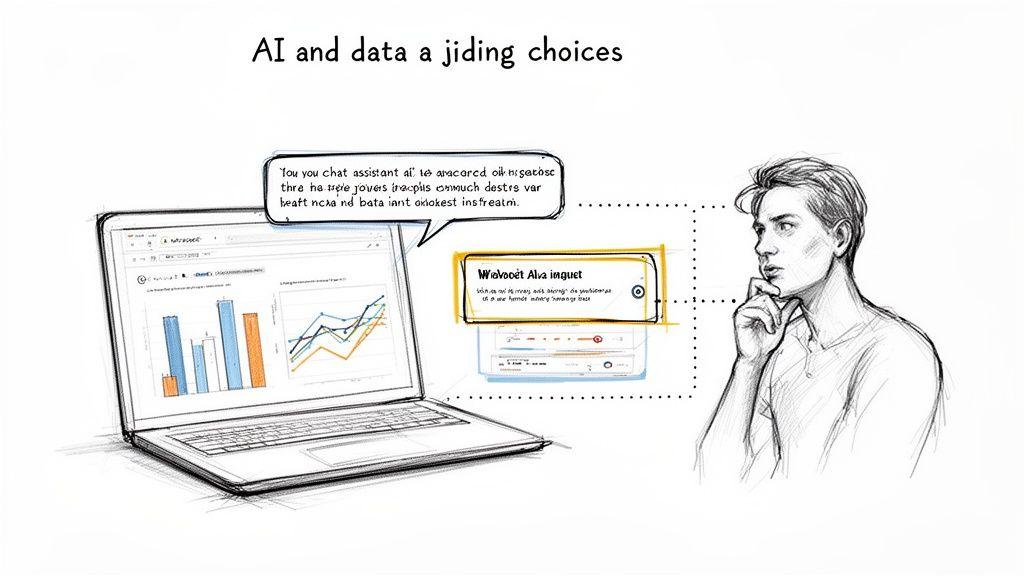
This isn't about outsourcing your judgment to a machine. Think of it more like empowering your judgment with a powerful assistant that never gets tired, sick, or bored.
This approach hits directly at a major roadblock I see leaders face all the time. A recent survey found that 81% of IT decision-makers blame slow implementation and complexity as top challenges. Right behind that, 80% pointed to a lack of high-quality data. On the flip side, companies that have managed to integrate AI for real-time analysis have boosted their decision speeds by up to 40%.
Turn Information Overload into Actionable Insight
Imagine you’ve got a 100-page market research PDF, a spreadsheet packed with thousands of lines of raw customer feedback, and three competitor websites to break down. By hand, that’s a multi-day slog. An AI assistant can tear through that in minutes, giving you back precious time to actually think and strategize.
Here’s how you can put this into practice right away:
- Summarize Dense Documents: Instead of reading a massive report, upload it and ask for a bulleted summary of the key findings, risks, and opportunities.
- Analyze Raw Data: Connect a spreadsheet and just ask questions in plain English. For example, "What were the top three customer complaints this quarter?" or "Which marketing channel gave us the highest conversion rate?"
- Cross-Reference Sources: Task your AI tool with comparing information from multiple documents or websites to spot common themes or contradictions for a research project.
This is where a tool like 1chat really shines. It can digest and analyze complex PDFs or even query multiple large language models at once, cutting through the muck to give you insights that would otherwise take weeks to uncover manually.
The goal of using AI isn't to get a final answer. It's to get better questions and a more complete picture. This lets you focus on the high-level strategic thinking that only a human can provide.
Practical AI Applications for Better Choices
Beyond just crunching numbers, AI can become your sparring partner, helping you explore possibilities and pressure-test ideas before you commit. This is an incredible way to develop and refine your judgment.
For instance, a marketing manager planning a new campaign could use an AI tool to:
- Generate Audience Personas: Create surprisingly detailed profiles of their target customers from a bit of demographic data.
- Brainstorm Creative Angles: Ask for a dozen different headlines and ad copy variations to see what kind of messaging might resonate.
- Simulate a Launch: Tell the AI to act like a skeptical CFO and poke holes in the campaign strategy. This is a great way to find weak spots.
Running these kinds of simulations helps you anticipate roadblocks and bulletproof your plan before it ever sees the light of day. If you want to go deeper on this, our guide on the best AI for data analysis gives a great overview of the top tools out there. When you start using AI this way, you move from just reacting to data to proactively shaping your decisions with it.
Making It Work: How to Adapt Your Decision-Making for Any Situation
A great decision in the boardroom looks very different from one made around the kitchen table. While the core ideas—thinking clearly and weighing your options—always apply, the best tactics are rarely one-size-fits-all. Truly knowing how to improve decision making skills is about learning which tool to pull out of your toolbox for the right situation.
The context of a choice is everything. Who's involved? What's really at stake? How fast do you need to move? The answers to these questions should guide your entire approach. A framework that works for a fast-moving business team will likely fall flat for a big family decision, which requires a totally different blend of logic and heart.
For Business Teams
Getting a team to agree on a path forward, especially when everyone is remote, can feel like herding cats. If you just aim for consensus, you often end up with a watered-down idea that nobody truly loves. It's a widespread problem—a McKinsey survey found that a staggering 72% of executives don't believe their companies make high-quality strategic decisions.
A better way to get both speed and genuine buy-in is a simple technique called dot-voting.
After a good brainstorm, get all the ideas up on a shared document or a virtual whiteboard. Then, give every person on the team a limited number of "dots" (three is a good starting point) to cast their votes for the options they think have the most merit.
- It’s a powerful way to instantly see where the group's energy is.
- It keeps the loudest voices from steering the entire conversation.
- It gives you a data-backed starting point for a much deeper, more focused discussion.
I once saw a team completely stuck debating which of five major features to build next. The conversation was going in circles. We took an hour, put the features in a simple decision matrix, and scored them against criteria like "customer impact," "engineering effort," and "revenue potential." The right path forward became obvious, not because one person "won" the argument, but because the data did the talking.
For Families
Family decisions are often tangled up in emotions. Whether you're figuring out finances or just trying to pick a vacation spot, the real goal is to make sure everyone feels seen and heard. A little structure here can be the difference between a productive conversation and an all-out argument.
Here’s a method I’ve seen work wonders: have each person privately write down two things—their ideal outcome and their biggest worry. Go around the room and let each person share, with the rule that no one can immediately judge or dismiss what's said.
This simple exercise forces everyone to listen and builds empathy. It shifts the goal from "How do I get my way?" to "How can we find a solution that works for us?"
No matter the group, getting buy-in from the people who have to live with the consequences is everything. A technically perfect decision that no one supports is just a failure waiting to happen.
For Students
If you’re a student, you're facing a sea of choices that can feel completely overwhelming. Picking a major, figuring out a career, even just deciding on a research topic can lead to analysis paralysis. The key is to make the decision smaller.
Instead of trying to choose from a hundred different careers, try working backward from just a few potential futures.
Pick three paths that seem even remotely interesting. For each one, spend a week or two acting as if you’ve already committed. Find one person in that field and ask for a 15-minute chat. Read about the day-to-day realities of the job. Figure out the very first concrete step you'd have to take. This process turns a huge, abstract decision into a series of small, manageable experiments that give you clarity through action, not just endless thinking.
Common Questions on Making Better Decisions
As you start putting these ideas into practice, you're bound to have some questions. It’s a natural part of the process. Let's tackle some of the most common ones I hear from people just starting this journey.
How Quickly Will I See Results?
You can get an immediate win with your very next decision. Seriously. Just grabbing a simple tool, like a weighted pros and cons list, forces you to add structure where there was none before, and that alone brings instant clarity.
But real, lasting change? That's built through consistent practice. Think of it like a new fitness routine. You'll start noticing a difference in just a few weeks of consciously using techniques like a "pre-mortem" or the "10/10/10 rule." You'll find yourself reacting less and thinking more deliberately.
While small wins come fast, deeper change is a long game. Practices like decision journaling show measurable boosts in accuracy—around 25%—over several years as you build a personal database of your own decision patterns and outcomes. The key is consistency, not intensity.
Should I Let AI Make Big Decisions for Me?
Absolutely not. The biggest mistake you can make is outsourcing your judgment. Instead, think of AI as the most powerful research assistant you've ever had. Its job is to sharpen your thinking, not replace it.
AI is brilliant at chewing through massive datasets, summarizing dense reports, and highlighting patterns a human might miss. Use it for that—to gather intelligence and explore alternatives.
But the final call has to be yours. It’s your values, your ethics, and your unique understanding of the situation that matter most. AI enhances your ability to decide; it doesn't do the deciding.
What's the Single Most Powerful Habit for Better Decisions?
If I had to recommend only one change, it would be this: deliberately create a pause between the problem and your response. This tiny moment is the decision gap, and it's where you take back control from your gut reactions and all the cognitive biases that come with them.
During that pause, just ask yourself one question: "What am I missing?"
This simple prompt is incredibly effective. It forces you to hunt for disconfirming evidence, consider other perspectives, and switch from a reactive to a strategic mindset. It’s the foundation for every other technique, and you can start doing it today.
How Can I Practice Without Real-World Consequences?
This is a great question. The best way to build any skill is in a low-risk environment. Start by applying decision-making frameworks to everyday choices, like picking your next book with a decision matrix or planning a weekend trip. You build the mental muscle without any real pressure.
Another fantastic method is scenario simulation. You can use an AI tool like 1chat to role-play challenging situations. This is like a sparring partner for your brain.
- Practice a tough negotiation: Ask the AI to be a difficult client who keeps pushing back on your pricing.
- Pressure-test an idea: Have it give you the strongest possible arguments against a business plan you're excited about.
This kind of practice helps you anticipate roadblocks and refine your approach without anything actually being on the line. You can also dig into historical case studies—from business failures to scientific breakthroughs—to map out the decision points and think through what you might have done differently.