When we talk about a credible source, we’re talking about information you can actually trust. It’s not just a random opinion or a flimsy claim; it's accurate, reliable, and backed up by solid evidence and real expertise.
Think of it like building a house. You wouldn't use shoddy materials and hope for the best. You'd want a foundation built on strong, dependable materials. A credible source is that solid foundation for your knowledge.
What Makes a Source Credible and Why It Matters
Imagine you're lost in a huge, unfamiliar city. Who do you ask for directions? Would you trust a random person who seems unsure, or would you look for an official city guide or a police officer? The guide or officer is your credible source—they have the authority and the verified knowledge to get you where you need to go.
In a world where we’re constantly bombarded with information, learning to spot the reliable "city guide" is more than just a good skill—it's essential. This ability helps you make smarter decisions, whether you're a student working on a research paper, a parent looking up health information for your child, or a small business owner trying to understand market trends.
Relying on bad information can have real consequences. It could mean citing a fake statistic in your schoolwork, making a poor health decision based on a myth, or even losing money on a business venture because you followed biased advice.
The Four Pillars of Credibility
When you boil it down, figuring out if a source is credible really comes down to checking four key things. Think of these as a quick mental checklist you can run through whenever you encounter a new piece of information.
To make this easier to remember, here's a quick breakdown of what we call the four pillars of a credible source.
| Pillar | What It Means | Key Question to Ask |
| Authority | The person or organization behind the information has proven expertise on the subject. | Who created this, and what makes them qualified to talk about it? |
| Accuracy | The information is factually correct, free from errors, and can be verified. | Can I confirm these facts with another reliable source? |
| Objectivity | The information is presented in a fair, balanced way, without a strong bias or a hidden agenda. | Is this trying to inform me or persuade me? |
| Currency | The information is recent enough to be relevant for the topic at hand. | When was this published, and is it still relevant today? |
These four pillars work together to hold up the credibility of a source.
You can think of these pillars like the four legs of a table. If you take one away, the whole thing gets wobbly and unstable. A source needs all four to be considered truly reliable and worthy of your trust.
Getting comfortable with these four ideas is the first step toward confidently navigating the massive sea of information out there and building your arguments on solid ground.
A Practical Framework for Evaluating Any Source
It’s one thing to talk about credibility in theory, but it’s another thing entirely to put it into practice. To really get a feel for what makes a source credible, you need a repeatable process—a mental toolkit you can pull out for any article, website, or document you come across. This framework boils the whole evaluation down into six straightforward checks.
Think of yourself as a detective sizing up a piece of evidence. Each of these checks is a different lens you can use to figure out if the information is solid enough to trust. By running through these steps consistently, you’ll start building the kind of critical thinking skills for students and professionals that are essential for separating fact from fiction.
This decision tree gives you a quick visual map for the process.
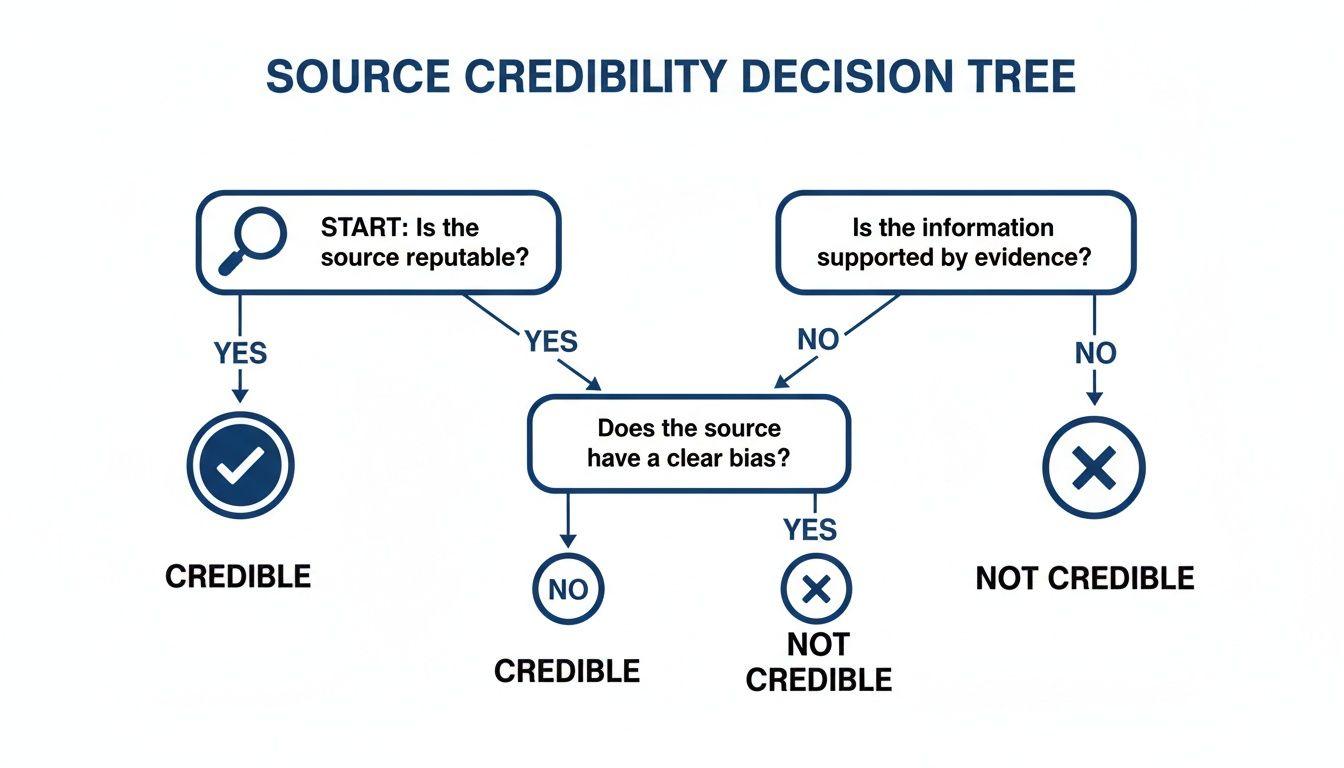
It lays out the core questions to ask, guiding you from an initial gut check to a final verdict on whether a source is trustworthy.
Check 1: Who Is the Author?
Your first move should always be to figure out who is behind the information. An author’s expertise (or lack of it) is one of the biggest clues to a source’s reliability. After all, an anonymous blog post making wild medical claims just doesn’t have the same weight as an article written by a board-certified physician.
Look for a name and credentials. A truly credible source isn't shy about who created the content. Ask yourself:
- Is the author a known expert in this field? A cybersecurity pro writing about data privacy is a lot more convincing than a lifestyle blogger covering the same topic.
- Do they have the right qualifications? Look for degrees, professional certifications, or a long track record of experience related to the subject.
- Is there an "About Us" or author bio page? Reputable authors and organizations want you to know who they are.
This initial check on authorship is your foundation. It's often the quickest way to spot a source that might not be worth your time.
Check 2: What Is the Evidence?
Big claims demand solid proof. A credible source doesn’t just state opinions and expect you to believe them; it backs up its arguments with things you can actually check—verifiable data, research, and citations. Think of it like showing your work on a math problem. It proves how you got to the answer.
As you read, keep an eye out for links to original studies, direct quotes from named experts, or references to official reports. A vague claim like "research shows this diet works" is pretty meaningless without a link to the actual study. Unsupported claims are a massive red flag.
A credible source builds its arguments brick by brick with solid evidence. An unreliable source often builds on a foundation of sand, using vague statements and emotional appeals instead of verifiable facts.
Check 3: Where Is It Published?
The platform matters. A lot. Different types of publications operate under completely different standards. A peer-reviewed academic journal, for instance, has a brutal fact-checking and review process that a personal blog or a social media account simply doesn't.
Take a hard look at the publisher's reputation. Is it a major news organization with a long history of journalistic integrity? A government agency? A university? Or is it a fringe website known for clickbait, sensationalism, or pushing a specific agenda? The container is often just as important as the content inside it.
Check 4: How Recent Is the Information?
Information has a shelf life. In rapidly changing fields like technology, medicine, or law, a source that’s even a couple of years old might be totally useless. An article from 2015 on the "best smartphone" is a historical artifact today, just like a medical guide from 1990 would be dangerously out of date.
Always check the publication or last-updated date. For fast-moving topics, hunt down the most current information you can find. For historical subjects, on the other hand, an older primary source might be exactly what you need. The trick is to match the source's age to the topic's needs.
Check 5: Is There an Obvious Bias?
Look, every source has a perspective. But a credible one tries to be fair and objective. It presents information honestly and will often acknowledge opposing viewpoints. An unreliable source, however, usually wears its bias on its sleeve, using emotionally loaded language or showing you only one side of the story to get you to agree with them.
Ask yourself what the source is trying to accomplish. Is its goal to inform you, or is it trying to sell you a product or push an ideology? Be skeptical of any content that feels more like an advertisement or a political rally than a balanced explanation.
Check 6: Are the Sources Transparent?
Finally, a credible source isn’t afraid to show you where it got its information. That’s what citations, bibliographies, and reference lists are for. They create a paper trail, allowing you to go back to the original information and check it for yourself.
A complete lack of sources is a deal-breaker. If an article makes huge claims but doesn't tell you how it knows them, you have no way to confirm if it’s accurate. Always give more weight to sources that are open and honest about their evidence.
How to Identify Credible Academic Sources
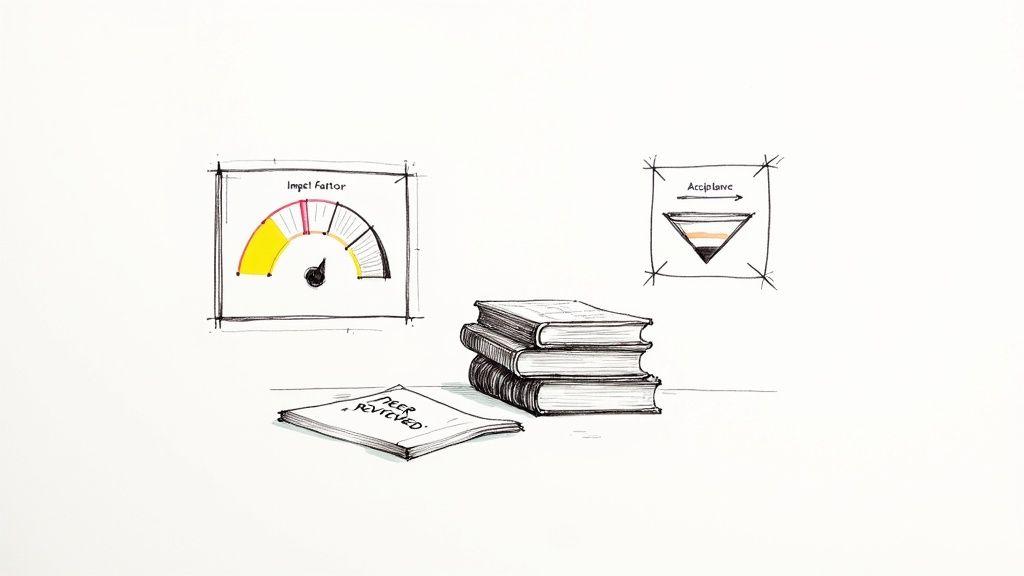
When you need to build an argument on solid ground, academic and scholarly sources are your bedrock. These aren't your average articles. They are deeply researched papers that have been put through a grueling quality-control process called peer review.
Think of it like this: a top chef creates a new, groundbreaking dish. But before it ever appears on the menu, a panel of other master chefs must taste it, critique it, and give it their stamp of approval. They check every ingredient and every step of the process. That's exactly how peer review works for academic research—it ensures that a study is original, methodologically sound, and significant before it gets published.
Unpacking Key Quality Metrics
The academic world has a few key metrics to help researchers sort through the noise and find the most influential work. They might sound a bit technical, but they're really just simple tools for measuring a journal's reputation and reliability.
One of the most well-known is the Journal Impact Factor (IF). First introduced way back in 1960, this number simply shows the average number of times articles from a specific journal were cited in a given year. It’s not perfect, but it’s a quick shorthand for quality, and over 70% of universities and funding bodies around the world still use it.
Another helpful metric is CiteScore, which takes a broader look by counting citations over a four-year window and including all types of documents. These scores give you a quick, at-a-glance idea of a journal's influence in its field.
Look for High Standards
Beyond the numbers, a few other signs can tip you off to a high-quality academic source. Don't worry, the concepts are simple.
- Low Acceptance Rates: Think of a journal with a low acceptance rate (say, under 20%) like an Ivy League university. Its tough admissions process filters out all but the most rigorous and important research.
- Expert Authors: Who wrote the paper? A quick search of the authors' names and affiliations will tell you if they are tied to respected universities or research institutions. This helps confirm their expertise.
- Transparent Methodology: A credible study never hides how it reached its conclusions. The authors will lay out their research methods in detail, allowing other experts to examine their work and even try to replicate it.
Finding and citing these high-caliber sources is a crucial step in academic writing. For students, mastering this skill is fundamental to constructing a compelling argument. If you're building a research paper outline, learning how to structure your arguments around these credible sources is essential.
Once you know what to look for, academic databases transform from overwhelming archives into powerful toolkits. By focusing on peer-reviewed journals with strong impact metrics and transparent research standards, you can build your work on a foundation of the most reliable information available.
Evaluating Websites and Online Information
Trying to find reliable information online can feel like wandering through a massive library where the fact-checked encyclopedias are shelved right next to gossip magazines. There’s no librarian to guide you, so you have to become your own expert fact-checker. Learning to spot the difference between a high-quality source and a flimsy one is the most critical skill for navigating the web.
The first clue often lies right in the website's address.
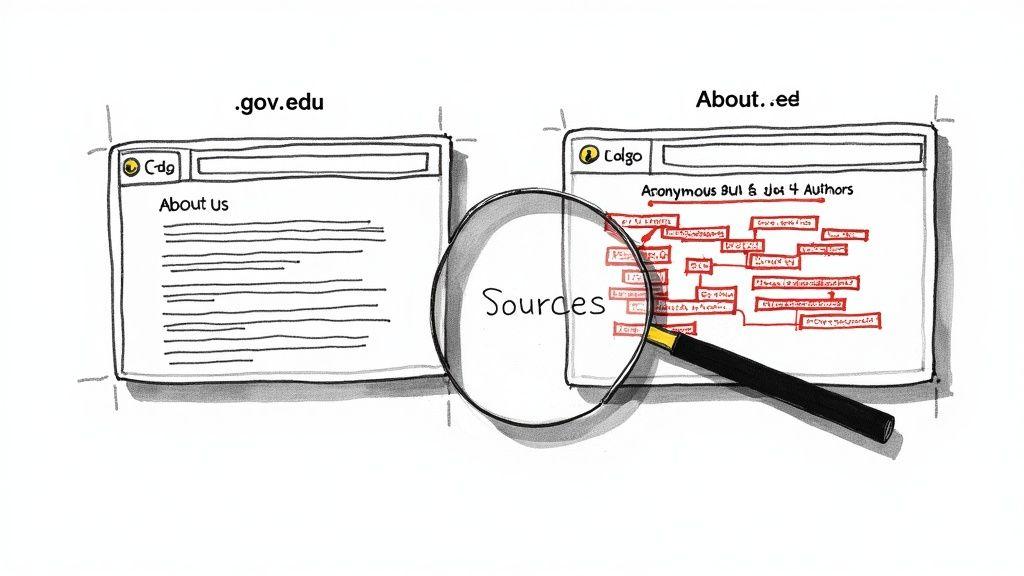
A domain extension—the part at the very end of a web address—gives you a quick hint about a site's general purpose. It's not a perfect system, but it's a great starting point.
- .gov: These sites belong to U.S. government agencies. For official statistics, laws, and public records, they are typically a gold standard of credibility.
- .edu: This extension is for educational institutions. You'll find a lot of solid academic research here, but be aware that you might also stumble upon student projects or opinion pieces that aren't peer-reviewed.
- .org: Traditionally, this was for non-profit organizations. The content quality can be a mixed bag, ranging from impartial research to information with a heavy political or social agenda.
- .com: This is the Wild West of domains—it’s for commercial entities. Many top-tier news outlets and respected companies use it, but so do countless sites built to sell you something, not inform you. Always approach with a critical eye.
Spotting Trustworthy Websites in Seconds
Beyond the URL, you can get a gut check on a site's reliability in just a few seconds. Think of it like this: credible websites want you to know who they are. They are transparent about their mission, their authors, and how they operate. An untrustworthy site, on the other hand, often feels like it's hiding something.
A credible website makes it easy to find its "About Us" page, author bios, and contact information. If you have to dig around to figure out who is behind the content, that’s a major red flag.
Look for a clean, professional design. Is the information well-organized and easy to navigate? Does the site clearly state its purpose? These aren't just aesthetic choices; they signal that an organization has invested time and resources into presenting its information clearly and professionally.
Common Red Flags to Watch For
Just as there are green lights, there are plenty of bright red flags that should make you hit the brakes. If you notice any of these warning signs, it's time to question whether you've found a credible source.
- Too Many Ads: Is the article you're trying to read interrupted by pop-ups, flashy banners, and auto-playing videos? When a site is overloaded with ads, its main goal is probably making money, not delivering objective information.
- Emotionally Charged Headlines: Headlines using sensational words like "SHOCKING" or "SECRET" are designed to get clicks, not to inform. This is classic clickbait, and it’s a huge indicator that the content prioritizes traffic over accuracy.
- No Sources to Be Found: Real experts and journalists show their work. If an article makes bold claims but doesn't link to any original studies, reports, or data to back them up, be very skeptical. It's the digital equivalent of "trust me, bro."
- Sloppy Design and Bad Grammar: A few typos can happen to anyone, but a website littered with spelling mistakes and grammatical errors suggests a lack of professional oversight. If they don't care about their presentation, how much do they care about their facts?
Your Go-To Checklist for Verifying Information
We've covered the theory behind what makes a source trustworthy, but now it's time to get practical. Think of this checklist as your mental shortcut—a quick guide you can pull up whenever you run into a new piece of information and need to make a fast, informed decision.
This isn't about memorizing a textbook. It's about building a simple habit of asking the right questions, the kind that get straight to the heart of credibility. Answering them will give you the confidence to know whether a source is worth your time and trust.
The Essential Five-Minute Source Check
Before you drop a citation into your research paper or share that "interesting" article in a team meeting, pause and run it through this quick filter. Making this a reflex will sharpen your critical thinking and become your best defense against bad information.
- Who Is Behind the Curtain?
Always look for an author’s name and credentials. Can you find an "About Us" page that explains who runs the site? If the creator is anonymous or has zero experience in the field they're writing about, that’s a huge red flag. - Where Is the Proof?
Trustworthy sources don't just make bold claims; they back them up. Look for links to original research, data sets, or direct quotes from identifiable experts. If there's no evidence, there's usually no credibility. - What Is the Real Goal Here?
Think about the source's motivation. Is the goal to genuinely inform you with a balanced view? Or is it trying to sell a product or push an agenda? Be on the lookout for heavily biased, emotional language—it's a dead giveaway. - Is This Information Still Fresh?
Don't forget to check the publication date. In fast-moving fields like technology or medicine, information that is just 2-3 years old can be dangerously out of date. - Are They Showing Their Work?
Good sources are transparent. They should have a bibliography, a reference list, or clear citations showing where they got their information. A source that hides its own sources is one you simply can't trust.
Think of this checklist as your personal fact-checking filter. It quickly separates carefully researched content from unsubstantiated opinion. By asking these questions every time, you ensure that whatever you build—whether it's an argument, a business plan, or a decision—is built on solid ground.
This process also builds great professional habits. For instance, knowing how to properly use the sources you've verified is just as important. To get that part right, check out our guide on how to paraphrase without plagiarizing. Making this checklist a routine ensures your own work will always stand up to scrutiny.
Your Questions Answered: A Guide to Source Credibility
As you start putting these ideas into practice, you're bound to run into some tricky situations. The digital world is full of gray areas where the rules aren't always so clear-cut. This section is designed to tackle the most common questions and challenges that pop up when you're trying to figure out if a source is the real deal.
Think of this as your field guide for those "what do I do when..." moments. The goal here is to give you straightforward advice so you can feel confident in your decisions.
How Can You Spot Hidden Bias in a Source That Seems Neutral?
Uncovering subtle bias is a bit like trying to hear a faint accent—you have to listen carefully for the little giveaways. A source might look perfectly balanced on the surface, but it can gently nudge you toward a certain conclusion through the words it uses, the facts it highlights, and, just as importantly, the facts it leaves out.
One of the most effective tricks is to watch for loaded language. Words like "sensible," "reckless," "unprecedented," or "alarming" are dead giveaways. They’re designed to create an emotional response, not an objective one. Also, pay close attention to which experts are quoted and which are ignored. A genuinely balanced article will almost always present more than one competing viewpoint.
A classic tactic of biased reporting is "cherry-picking" data. This means presenting only the facts that support one side of an argument while conveniently sweeping the rest under the rug. Always ask yourself: what’s missing from this picture?
A great way to bring any hidden slant into focus is to read another article on the same topic from a source with a different perspective. Placing them side-by-side often makes the bias jump right off the page.
Can Wikipedia Ever Be a Credible Source?
Ah, the classic question. The answer isn't a simple yes or no. Wikipedia can be a fantastic starting point for your research. It’s perfect for getting a bird's-eye view of a topic, learning the key terms, or figuring out who the major players are. It helps you get the lay of the land before you dive deeper.
But—and this is a big but—it should never be your final source. Because anyone can edit it, Wikipedia doesn't meet the standards for a primary credible source, especially not for academic papers or critical business decisions. Its true superpower is hidden at the bottom of the page: the footnotes.
- Check the References: The real gold is in the citations list at the end of every article.
- Go to the Original Sources: Follow those links to the peer-reviewed studies, news reports, and official documents the Wikipedia page is built on.
- Cite the Originals: These are the sources you should be using and citing in your own work.
Think of Wikipedia as a helpful librarian who points you to the right books, not as the book you should be quoting from directly.
What Are the First Three Things I Should Check on a New Website?
When you land on a website you’ve never seen before, you can usually get a good sense of its reliability in less than a minute. A quick triage focusing on three key areas will tell you whether it's worth your time.
- The "About Us" Page: This is your first stop. Credible organizations are transparent about who they are, what they do, and who's on their team. If you can't find this page, or if it's frustratingly vague, that's a huge red flag.
- An Author's Name: See if there's a person's name attached to the article. Is there a bio? Does a quick search reveal that they have genuine expertise on the subject? Content with no author is instantly less trustworthy.
- The Publication Date: Find out when the information was posted or last updated. For fast-moving topics like technology or health, this is absolutely critical. An old article might be serving up dangerously outdated advice without any warning.