Let's be honest, planning an assignment often feels like a chore—something you have to get through before you can dive into the real work. But what if I told you that planning isn't just a step? It's the single most important skill that separates a frantic, last-minute scramble from a high-quality, stress-free submission.
When you treat your assignment like a mini-project, you're not just setting yourself up for a better grade. You're building the exact same habits that professionals use to succeed every single day.
Why Planning Your Assignment Is a Skill Worth Mastering
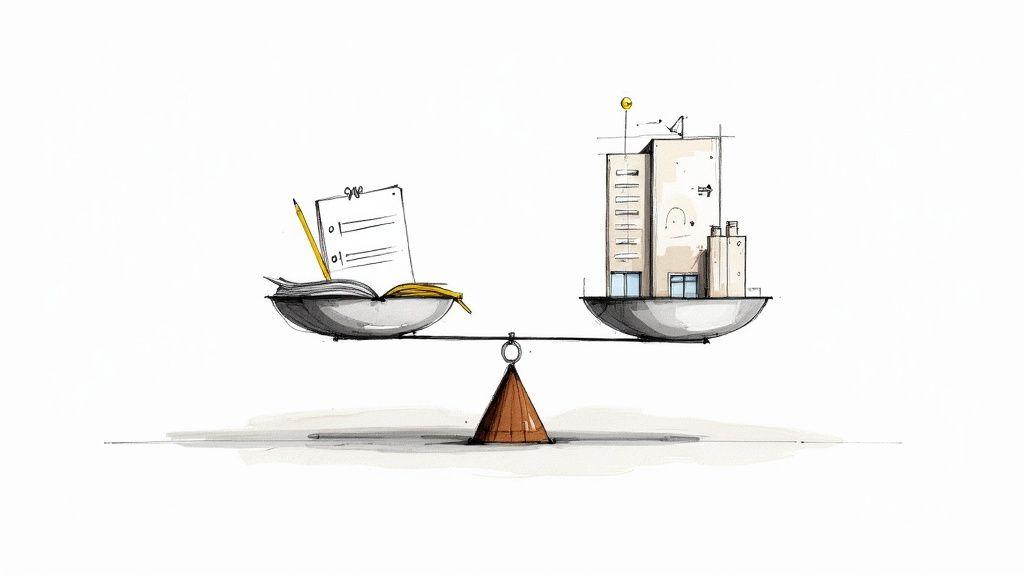
It’s easy to dismiss planning as unnecessary bureaucracy, but that's a huge mistake. The skills you develop while planning a 10-page essay are the very same ones that drive success in the real world, whether you're managing a marketing campaign or launching a new app.
Think about it: you wouldn't build a house without a blueprint, right? A plan prevents costly mistakes, clarifies everyone's role, and keeps the whole project on track. Your assignment is no different. A solid plan is your blueprint for academic success.
The Real-World Connection to Project Management
In the professional world, a lack of planning can be catastrophic. The tech industry, for instance, is littered with stories of projects that failed spectacularly because of poor upfront preparation. It's not a small problem. Research from McKinsey revealed that a jaw-dropping 99.5% of IT projects fail to deliver what they promised on time and within budget.
Even worse, these projects run an average of 75% over budget and finish 46% behind schedule, often because the initial planning was weak. If you're curious, you can discover more project management statistics and see how planning guides successful outcomes.
This is where it all clicks into place. The planning skills you're sharpening right now directly translate into preventing these multi-million dollar failures down the road.
A well-structured plan is the most effective tool for reducing stress and uncertainty. It turns a vague, overwhelming goal into a series of clear, achievable steps, giving you control over the process from start to finish.
Benefits of Adopting a Project Mindset
When you start treating your schoolwork with a project manager's mindset, you unlock some serious advantages. You stop just "doing the work" and start thinking strategically about the entire lifecycle of the assignment.
Here’s what changes:
- Clarity of Purpose: You define exactly what a great final product looks like before you even start, ensuring every bit of effort pushes you toward that goal.
- Efficient Resource Allocation: You figure out what you need—books, research papers, specific software—and get it all together upfront. No more mid-project panic when you can't find a key source.
- Proactive Problem-Solving: A good plan forces you to think ahead. You can anticipate roadblocks, like a tricky research question or a busy week, and build in a buffer or a backup plan.
Mastering this skill now doesn't just mean better grades. It means you're preparing to be a competent, reliable, and successful professional, no matter which career path you choose.
How to Actually Understand Your Assignment Brief
The starting point for any A+ assignment isn't a brilliant idea—it's a deep, almost obsessive, understanding of the brief. Before you even think about planning your work, you need to become an expert on what’s being asked of you. It's so easy to just skim the instructions, but that's a classic mistake.
You see a topic you like, get excited, and dive straight into the research. The problem is, this often leads to a final paper that completely misses key requirements or answers a question you wanted to be asked, not the one that was actually on the page. Think of the brief as a puzzle. Your first job is to figure out what all the pieces are before you start trying to put them together.
Deconstructing the Prompt
First things first, get out a highlighter (digital or physical) and pinpoint the action words. I'm talking about the verbs that tell you what to do: "analyze," "compare," "evaluate," or "describe." These aren't just suggestions; they are direct commands that dictate the entire structure of your assignment. If it says "compare," you need a balanced argument looking at similarities and differences. If it says "evaluate," you’re expected to make a judgment call based on evidence and clear criteria.
Next, find the limiting keywords. These are the guardrails for your project. If the prompt asks you to discuss the economic impact of renewable energy in Northern Europe since 2010, that's your sandbox. No matter how fascinating your insights are about solar power in Australia, they're irrelevant here. Sticking within these boundaries is crucial.
A well-deconstructed brief is your best defense against going off-topic. It turns a vague, intimidating prompt into a clear, actionable checklist, making sure every part of your plan is laser-focused on hitting the marking criteria from the very beginning.
Uncovering Hidden Requirements
The main question is just the tip of the iceberg. You’ll often find critical details buried in the fine print. I'm talking about formatting rules, required citation styles (is it APA or MLA?), word count limits, and submission guidelines. Ignoring these is like throwing away free marks—don't do it.
A really simple but effective trick is to create a quick checklist as you read. This forces you to methodically pull out every single instruction and make sure nothing gets missed.
Here’s a quick-reference checklist you can use to make sure you've fully understood every component of your assignment before you start planning.
Assignment Brief Analysis Checklist
| Component | What to Look For | Example Action |
| Core Question | The main task you need to complete. | Pinpoint the central verb and topic, like "Analyze the causes of the Industrial Revolution." |
| Key Concepts | Important terms or theories you must include. | Make a list of specific terms like "capitalism" or "urbanization" that you absolutely have to define and discuss. |
| Scope & Limits | Any constraints on time, geography, or focus. | Note down any date ranges ("1760-1840") or geographical areas ("in Britain") that define your focus. |
| Formatting | Specific rules for layout, font, and citations. | Confirm the required style, for instance: "APA 7th edition, double-spaced, 12pt Times New Roman." |
| Marking Criteria | How your grade will be calculated. | Look for the breakdown of marks. For example, "Introduction 10%, Analysis 60%, Conclusion 10%." |
Going through this process removes all the guesswork. Once you have this level of clarity, you can move forward with confidence, knowing your plan is built on a solid foundation that directly meets every single expectation. You’re no longer hoping for a good grade; you're creating a clear path to get one.
Creating Your Personal Assignment Action Plan
Alright, you've dissected the assignment brief and know exactly what you need to deliver. You've got your destination in sight. Now, it's time to draw the map. This is where you translate that understanding into a concrete plan that will guide you every step of the way.
Think of it this way: a good action plan isn't about boxing yourself into a rigid, stressful schedule. It's about breaking down a huge, intimidating project into a series of smaller, much more manageable tasks. This simple act takes the "fear factor" out of a big assignment, turning a mountain into a series of small, conquerable hills.
From Big Project to Small Milestones
First things first, let's identify your major milestones. These are the big-ticket items—the key stages you'll move through to get this assignment done. For most academic work, the path is pretty well-trodden.
- Research and Discovery: This is your information-gathering phase. You're hunting down sources, collecting data, and finding the evidence to back up your arguments.
- Outlining and Structuring: Here, you organize all that research into a logical flow. This is your blueprint.
- First Draft Creation: The goal here is just to get it all down on paper. Don't aim for perfection; just write.
- Editing and Revision: Now you go back and sharpen your arguments, clarify your points, and make sure your analysis is solid. This is where good work becomes great.
- Final Proofreading: The last pass. You're hunting for typos, grammatical errors, and formatting mistakes before you hit "submit."
This visual shows how to tackle those crucial first steps of planning.
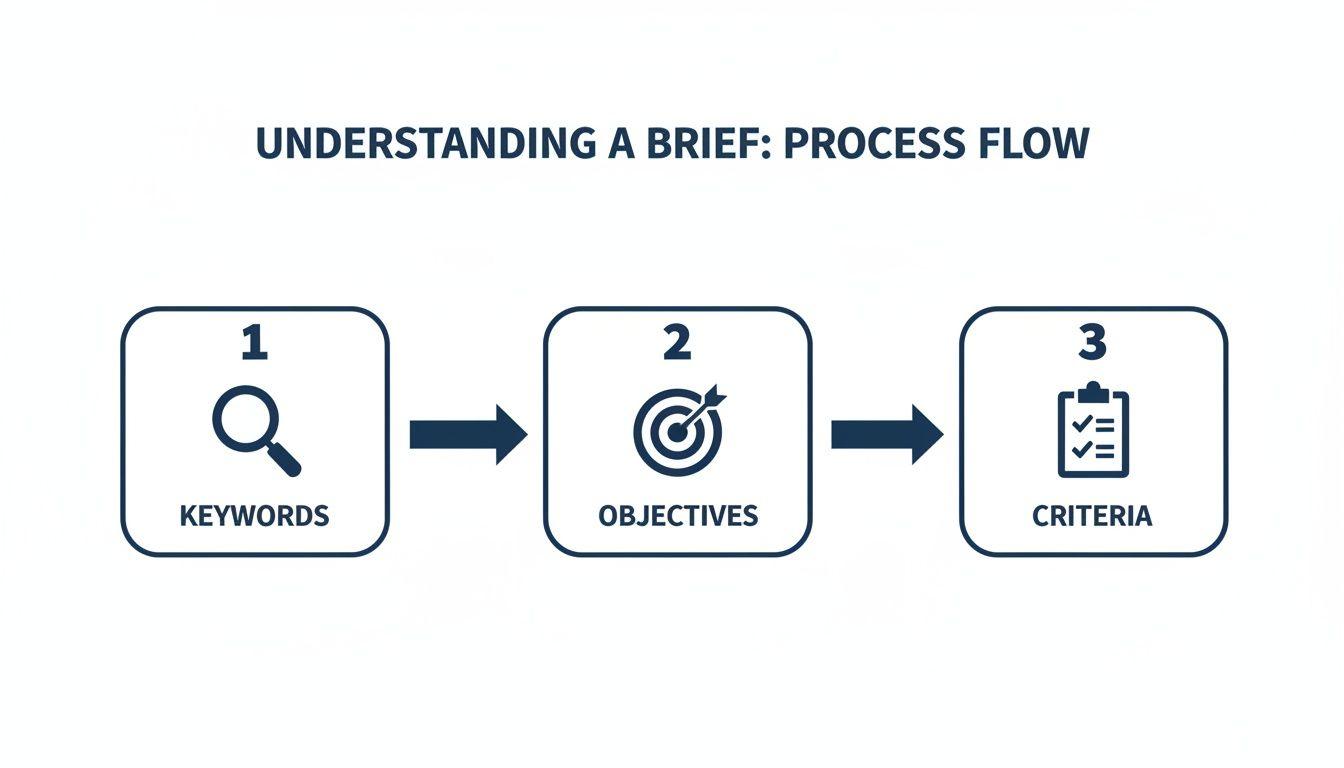
As you can see, a solid plan starts with nailing down keywords and objectives before you even think about the finer details. By breaking the work into milestones, you can assign chunks of time to each one, which keeps any single part from feeling overwhelming.
Choosing Your Planning Method
How you actually map this out is entirely up to you. There is no one "best" way to plan an assignment; the right method is whichever one you’ll actually stick with.
For a straightforward essay, a simple to-do list in a notebook or a notes app might be all you need. Just list out your milestones and the smaller tasks for each, then get the satisfaction of checking them off. But for more complex projects, especially if you're working in a group, something more visual like a Gantt chart could be a lifesaver. It helps you see the whole timeline, understand how tasks overlap, and keep everyone on the same page.
Here's a pro tip I swear by: build buffer time into your schedule. Always, always add an extra day or two before your final deadline. This little cushion turns a potential crisis—like a key source being unavailable or a sudden head cold—into a minor speed bump.
Putting Your Plan on a Timeline
Once you’ve picked your tool, it's time to put dates on things. The easiest way to do this is to work backward from the final due date. Let's say you have four weeks. Your schedule might look something like this:
| Milestone | Deadline | Allocated Time |
| Research & Discovery | End of Week 1 | 7 days |
| Outlining & Structuring | End of Week 2 | 7 days |
| First Draft Creation | Middle of Week 3 | 4 days |
| Editing & Revision | End of Week 3 | 3 days |
| Buffer Time | Start of Week 4 | 2 days |
| Final Proofreading | Middle of Week 4 | 2 days |
| Final Submission | End of Week 4 | - |
This gives you a solid framework without being so rigid it causes stress. If you want to see how this looks in a more detailed format, check out a sample research plan to see how all the pieces come together. Ultimately, a well-thought-out action plan is your best defense against stress and the dreaded all-nighter, making sure you have enough time to do your best work.
Smarter Research and Resource Management
The backbone of any strong assignment is the quality of its evidence. Let's be honest, we've all fallen down the rabbit hole of endless search results. A well-planned research phase is what pulls you out of that chaos and helps you build a compelling argument. The goal isn’t just to find stuff; it’s to find the right stuff, and to do it without wasting hours.
This really starts with prioritizing credible sources from the get-go. I’m talking about academic journals, peer-reviewed studies, and reports from established organizations. These materials have already been through a gauntlet of fact-checking and expert review, which instantly adds authority to your work. Your university's online library is the best place to start—it's a goldmine of high-quality databases.
Building Your Resource Library
Once you start finding great sources, you need a way to keep them straight. If you don't have a system, you'll quickly end up with a desktop full of random PDFs and a dozen browser tabs, with no idea where you found that one perfect quote. A simple digital folder system can be a lifesaver.
Try creating a main folder for your assignment, then break it down with subfolders:
- Primary Sources: Raw data, original documents, firsthand accounts.
- Secondary Sources: Expert analysis, articles, and books that interpret the primary stuff.
- Potential Sources: Things that look interesting but you haven't had a chance to fully vet yet.
When you save a file, get into the habit of using a consistent naming format like “Author-Year-Topic.pdf” (for instance, “Smith-2022-RenewableEnergy.pdf”). It seems small, but this one trick will make finding what you need later on so much easier. Of course, knowing what counts as trustworthy evidence is a critical skill. For a deeper look, check out our guide on what is a credible source.
Choosing Your Management Tools
For bigger projects, you might want to level up from a simple folder system and use a dedicated tool for managing research and citations. This is a part of planning that so many people ignore until they're facing a deadline.
A word of advice: Don't wait until you're building the bibliography to think about citation management. Weaving it into your research process from the very beginning will save you from a world of last-minute pain and help you avoid accidental plagiarism.
Here are a couple of popular options that can really help:
| Tool | Best For | Key Feature |
| Zotero | Academic Research | Its browser extension is fantastic for grabbing citation info from websites and databases automatically. |
| Notion | Integrated Note-Taking | Lets you build flexible databases where you can link your sources directly to your notes and outlines. |
Whether you go with a powerful tool or a basic folder structure, the core idea is the same. An organized resource library helps you connect the dots between different ideas and build a much more coherent argument. This transforms your research from a frantic, messy search into a focused, strategic part of your plan.
Using AI Tools to Enhance Your Planning Process
Let's be honest, knowing how to use artificial intelligence the right way is a modern academic superpower. It’s not about letting a robot do the work for you. It's about having a smart assistant on hand to help you get past those all-too-common hurdles, like a stubborn case of writer's block or feeling buried under a mountain of information.
Think of it this way: when you're staring at a blank page, AI can be an incredible brainstorming partner. You can drop your assignment prompt into the chat and ask for potential angles, counterarguments, or unique perspectives you hadn't considered. This isn't cheating; it's just a new way to kickstart your own creative process, much like you’d bounce ideas off a classmate.
This skill is more than just academic. The professional world is crying out for skilled planners. Forecasts show a staggering need for 25 million new project management professionals by 2030, a talent gap that's directly linked to project failures rooted in poor planning. You can read the full analysis of these project management trends to see just how critical these skills are. Getting good at this now gives you a serious advantage later.
Streamlining Your Workflow
Once you’ve settled on a general direction, AI can help you map out a preliminary structure. For instance, you could ask a tool like 1chat to draft a sample outline based on your main arguments. This gives you a solid skeleton to work with, which you can then flesh out with your own research and analysis. It’s a great way to see how your paper will flow before you sink hours into writing.
Here are a few practical things you can try:
- Summarizing Research: Got a dense, 20-page academic journal article to get through? Ask an AI to summarize the key findings for you. It can save a ton of time.
- Refining Your Thesis: If your main argument feels a bit shaky, you can ask for suggestions on how to make it more specific or debatable.
- Checking Grammar and Tone: Even before you write a full draft, you can test out key sentences to make sure they sound academic and hit the right professional tone.
Here’s the golden rule: always treat AI output as a starting point, never the final product. Your unique voice, critical analysis, and original insights are what make the work yours.
Privacy and Ethical Use
When you’re planning an assignment with AI, it's incredibly important to use a platform that respects your privacy. Some tools are built with data security as a priority, ensuring your drafts and research notes stay confidential. As a general rule, never paste sensitive personal information or unpublished data into a public AI model.
The whole point is to make the planning process faster and more efficient. That way, you can save your brainpower for the deep thinking and critical analysis that actually earn you top marks. To see what's out there, have a look at our guide on the best AI tools for students, which breaks down a range of helpful and secure platforms.
Got Questions About Assignment Planning? I've Got Answers.
Even the most meticulously crafted plan can hit a few bumps. Let's tackle some of the most common questions and worries that pop up when you're trying to get organized. Think of this as your go-to FAQ for when you get stuck and need a practical way forward, fast.
How Much Time Should I Actually Spend on Planning?
This is a great question. As a rule of thumb, I always recommend dedicating about 15-20% of your total assignment time purely to the planning stage. I know, that sounds like a huge chunk of time that could be spent writing, but trust me, it’s an investment that pays off big time.
Let's say you have an assignment that you figure will take around 20 hours from start to finish. That means you should block out a solid three to four hours just for digging into the brief, mapping out a timeline, and structuring your outline. This initial effort seriously cuts down on the confusion and last-minute rewrites later, ultimately saving you a ton of time and stress.
What’s the Best Tool for Making an Assignment Timeline?
The honest answer? The best tool is the one you'll actually use. There’s no magic app. The most sophisticated project management software in the world is useless if you set it up once and then never look at it again.
- For straightforward assignments: Don't overcomplicate it. A physical planner, a wall calendar, or a simple app like Google Tasks is often perfect. There's a real, tangible satisfaction in physically ticking something off a list.
- For complex or group projects: This is where visual tools like Trello or Asana really shine. Even a well-organized Google Sheet can work wonders for tracking all the moving parts and seeing who's responsible for what at a glance.
The goal isn’t to find the fanciest tool; it's to find a system that works for you. A simple plan that you stick with will always beat a complex one you abandon.
What if I Fall Behind on My Plan?
First off, don't panic. It happens to literally everyone. The moment you realize you're behind schedule, the key is to react calmly and strategically.
Take a breath and just pause. Look at your plan and identify the absolute most critical tasks that are left—the things you must do to meet the core requirements. Are there any "nice-to-have" elements you can simplify or even cut completely? If you're really in a bind, the best thing you can do is communicate with your instructor early. They can’t help if they don’t know there’s an issue, and they can often offer solid advice or, if the situation warrants it, an extension.
How Do I Plan a Group Assignment Without It Turning Into Chaos?
Ah, the dreaded group project. The secret to success isn't luck; it's a foundation of crystal-clear communication and shared accountability. Chaos almost always stems from fuzzy roles and a lack of clarity on who owns what.
Your very first step should be a dedicated kickoff meeting. Before anyone writes a single word, you need to explicitly agree on roles, responsibilities, and firm deadlines for each person's part.
From there, use a shared space like a Google Doc or a Trello board for your master plan so progress is transparent to everyone. Finally, establish a simple, consistent communication rhythm—a dedicated group chat for quick questions and a mandatory five-minute check-in once a week can prevent small issues from snowballing into major crises.