Think of a good sample research plan as your project’s GPS, not just another box to check. It's the strategic blueprint that turns a vague idea into a concrete, executable project, keeping your investigation focused, credible, and on track by clearly laying out your objectives, methods, and timeline.
What a Research Plan Actually Does for You
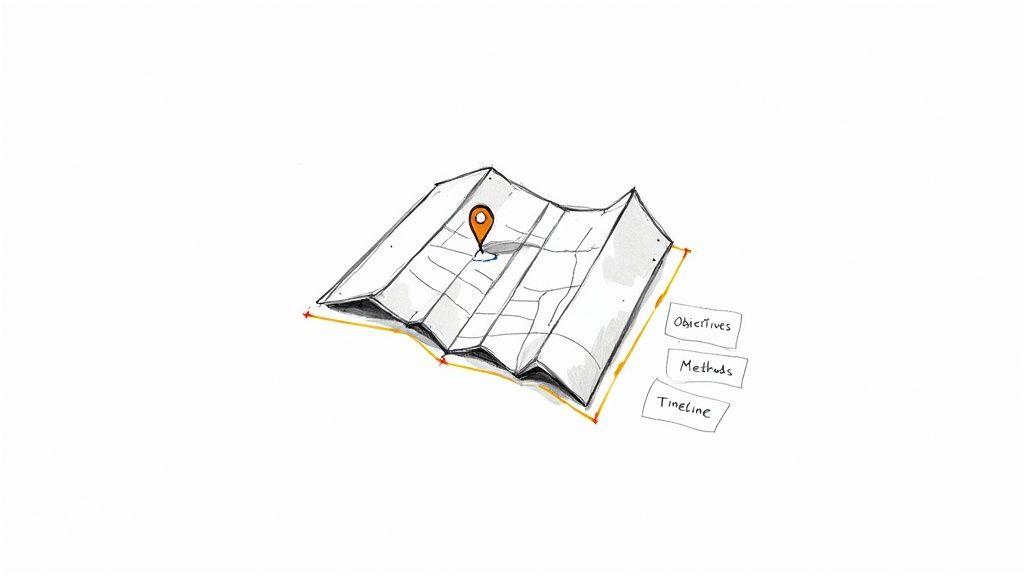
It’s easy to dismiss a research plan as a formality, but its real value is in how it guides and protects your work from beginning to end. It’s your most important communication tool, whether you're trying to convince a professor, a grant committee, or your own team that your project is well-thought-out and worth pursuing.
Preventing Scope Creep
One of its most critical jobs is to prevent scope creep—that all-too-common problem where a project balloons beyond its original goals. A solid plan draws firm boundaries around your work. It keeps you from getting sidetracked by interesting but irrelevant tangents, ensuring you stay focused on answering your core research questions without wasting time.
Securing Stakeholder Buy-In
A detailed research plan is an instant credibility builder. It proves to stakeholders that you’ve done your homework and considered every angle, from your methodology to potential roadblocks. That kind of foresight makes them far more likely to invest their time, money, or approval in what you’re doing.
A research plan is your project's first and most important deliverable. It’s the proof of concept that signals you have a viable, well-structured idea ready for execution, rather than just a fleeting thought.
Here's a quick look at the essential building blocks every effective research plan needs, no matter the context.
The Core Components of Any Strong Research Plan
| Component | Its Purpose |
| Objectives | Clearly states what you aim to discover or prove. What's the central question? |
| Methodology | Explains how you will conduct your research—the specific tools and techniques. |
| Timeline | Lays out a realistic schedule with key milestones to keep the project on track. |
| Resources | Details the budget, tools, and people needed to complete the work successfully. |
| Outcomes | Defines what success looks like and how you'll measure your findings. |
Each of these elements works together to create a compelling case for your project.
The need for this kind of structured, data-driven thinking has exploded. The global market research industry, for instance, shot up from $71.5 billion in 2016 to $140 billion recently—a massive 95.8% jump. That tells you just how much companies are investing in the formal insights that a well-executed research plan can deliver.
For students, who are often balancing multiple demanding projects, the planning stage is everything. Using some of the best AI for students can be a huge help for structuring initial thoughts or organizing a literature review, making the entire process of creating a research plan feel much less daunting.
Breaking Down the Key Components of a Research Plan
A truly solid research plan doesn't just happen. It evolves from a big, messy idea into a series of sharp, well-defined building blocks. Each piece has a job to do, guiding your work while also convincing stakeholders, professors, or investors that your project is worth their time and resources.
Let's walk through these critical pieces. I'll give you some practical advice you can put to work right away. Think of it like a story: you need a compelling hook (the problem), a clear plot (the questions), and a defined setting (the scope).
The Problem Statement and Research Questions
First up is your problem statement. This is the "so what?" of your entire project. In a tight paragraph, you need to frame the issue you're tackling, highlight why it’s important, and point out what we don't know yet. It’s not just a topic; it’s your argument for why this research needs to exist.
A vague statement like, "I want to study social media's effect on teenagers," just won't cut it. It’s a start, but it has no teeth.
Now, let's give it some power: "While extensive research documents the rise in anxiety among teenagers, few studies have isolated the specific impact of algorithm-driven content on short-form video platforms. This project will address this gap by investigating the correlation between daily TikTok use and self-reported anxiety levels in adolescents aged 14-17." See the difference? It’s specific, it identifies a gap, and it tells the reader exactly what you're setting out to do.
Once you’ve nailed that down, your research questions practically write themselves. These are the specific, answerable queries that will drive your investigation. They need to be sharp, focused, and tied directly back to your problem statement.
Good research questions often fall into a few categories:
- Descriptive: The "what" or "how much" questions. (e.g., "What is the average daily screen time for teenagers on TikTok?")
- Comparative: These look at differences between groups. (e.g., "How do anxiety scores differ between high-usage and low-usage TikTok users?")
- Relational: Here, you explore connections between variables. (e.g., "What is the relationship between hours spent on TikTok and feelings of social comparison?")
A well-crafted problem statement sets the stage, but razor-sharp research questions are what guide the action. If the problem statement is the destination, the questions are the turn-by-turn directions to get there.
Defining Your Scope and Methodology
With your "why" and "what" sorted, it's time for the "how." This is where scope and methodology come in.
Your scope sets the boundaries. It's the fence you build around your project to keep it from sprawling into an unmanageable mess. Scope forces you to make clear choices about who or what you’ll study, the timeframe, and any geographical limits. Honestly, being explicit about what is out of scope is just as important as defining what is. Will you focus on a single demographic? One company? A particular decade? Get specific.
Next up is your methodology—the operational core of your entire plan. This section lays out the exact techniques you'll use to gather and analyze your data. The real key here isn't just listing your methods, but justifying them. Why is a survey a better fit for this project than a series of interviews? What’s your rationale for choosing a quantitative approach over a qualitative one?
Your methodology section should clearly detail:
- Research Design: Is this going to be an experiment, a correlational study, or something purely descriptive?
- Data Collection: How are you getting the goods? Will it be through surveys, interviews, observation, or digging through existing documents and datasets?
- Data Analysis: Once you have the data, what will you do with it? What statistical tests or thematic analysis techniques will you apply to find meaning in your results?
For example, imagine a business team trying to figure out why customers are leaving. They might opt for a mixed-methods approach. They could start with a quantitative analysis of user data to pinpoint when people cancel their subscriptions. But numbers only tell part of the story. So, they’d follow up with qualitative interviews to understand the why—the frustrations, the missing features, the competitor offers. That combination gives you a much richer narrative than either method could alone.
Building out this justification is a lot like crafting a detailed argument, much like you would for a formal paper. In fact, looking over a great essay outline example can be surprisingly helpful for learning how to structure your methodological reasoning with logic and clarity.
Annotated Sample Research Plan Examples
Moving from theory to a tangible document can be the toughest part of getting a research project off the ground. To help you bridge that gap, let's break down three distinct, fully annotated examples. I’ve found that generic templates often fall flat because the context—whether you're a student, an academic, or a business professional—completely changes the plan's focus, language, and structure.
Each sample is built for a specific, real-world scenario. I won't just show you what to write; I’ll add commentary explaining the "why" behind each section. This side-by-side look will highlight the subtle but crucial differences you need to get right.
The Student Project: Clear, Concise, and Doable
For a student, clarity and feasibility are everything. The whole point is to show you understand the research process and can actually finish the project within a tight semester-long deadline. That means the scope needs to be narrow and the methodology straightforward.
Let's imagine a marketing student with a final project on local consumer behavior.
- The Problem: "Local coffee shops in the downtown area face increasing competition from national chains. This research aims to identify the key factors that influence a consumer's decision to choose a local coffee shop over a major brand like Starbucks."
- The Questions:
- What are the primary drivers (e.g., price, ambiance, quality, community support) for customers choosing local coffee shops?
- How does customer loyalty differ between local shops and national chains in this specific geographic area?
- The Method: A mixed-methods approach is perfect here. It could start with a quantitative survey sent to 100 local coffee shop patrons to get a broad overview. Then, follow up with qualitative one-on-one interviews with 5-7 shop owners to add that crucial depth and expert context.
- Timeline & Resources: The plan would map out a clear 10-week schedule, from the initial literature review to the final presentation. Resources would be minimal and realistic: access to university library databases and a free survey tool.
The beauty of this plan is its simplicity and manageability. It proves the student can execute a focused study without a big budget or tons of resources, which is exactly what a professor wants to see.
The Academic Plan: Rigor and Contribution
Academic research, like for a dissertation or a peer-reviewed article, is a different beast entirely. It demands far more rigor and needs to be deeply grounded in existing theory. Here, the focus shifts to contributing brand-new knowledge to a field. The literature review isn't just background reading; it's the very foundation the entire study is built on.
Consider a Ph.D. candidate in sociology studying how remote work affects community engagement.
- The Problem: "While plenty of research has explored the productivity effects of remote work, its impact on civic engagement and local social capital remains underexplored. This study will investigate whether the shift to remote work has led to a measurable decline in community participation among formerly office-based professionals."
- Justifying the Method: This plan would dedicate significant space to justifying the choice of a longitudinal study. It would explain exactly why tracking the same group of people over two years is essential for establishing causality. It would also detail the specific statistical models for data analysis, like regression analysis, to prove methodological sophistication.
- Ethical Considerations: This section has to be rock-solid. It would outline detailed protocols for informed consent, data anonymization to protect participant privacy, and secure data storage plans approved by an Institutional Review Board (IRB).
An academic research plan is really a conversation with a scholarly community. Its primary job is to demonstrate that your work not only fills a specific knowledge gap but also does so using methods that the field will recognize as valid and credible.
The Business Plan: Actionable Insights and ROI
For a business, research is all about one thing: actionable insights that drive smart decisions. The language is direct, the timeline is aggressive, and the budget is a central, non-negotiable component. The entire plan is geared toward a clear return on investment (ROI).
The U.S. market research industry is a $36.4 billion powerhouse for a reason—it helps businesses make smarter choices. This massive market, made up of over 45,000 firms, shows just how vital adaptable research plans are. You can get a sense of the market research industry on ibisworld.com.
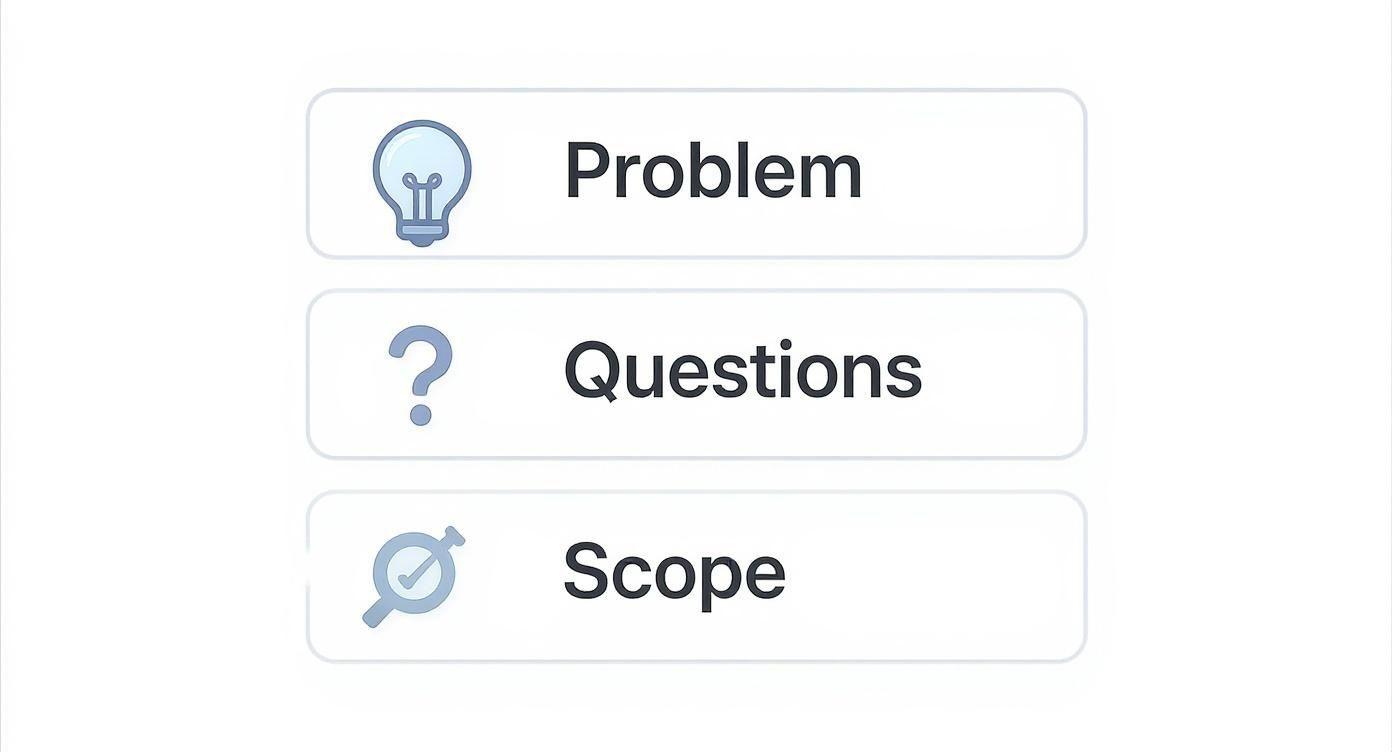
As this shows, everything starts with a clear problem. That initial definition directly informs the questions you ask and the boundaries you set for your work.
For instance, a software startup trying to understand why customers are leaving might draft a plan like this:
- Business Objective: "Reduce monthly customer churn by 15% within the next six months."
- Success Metrics: The plan would define success with concrete KPIs: a measurable drop in cancellation rates, a spike in user engagement metrics, and a higher Net Promoter Score (NPS).
- Budget & Resources: This part is non-negotiable. It would list every cost, from survey software subscriptions and incentives for interview participants ($50 gift cards) to the hours required from the product and marketing teams. The total cost is then weighed against the projected revenue saved from keeping those customers.
Ultimately, the best research plan is one that's meticulously adapted to its audience and its goal. You can even use AI tools to generate initial drafts and structure your findings, which is a huge help when compiling the final report. For more on that, check out our guide on leveraging AI for report writing to speed up your workflow.
How to Plan Your Timeline and Resources
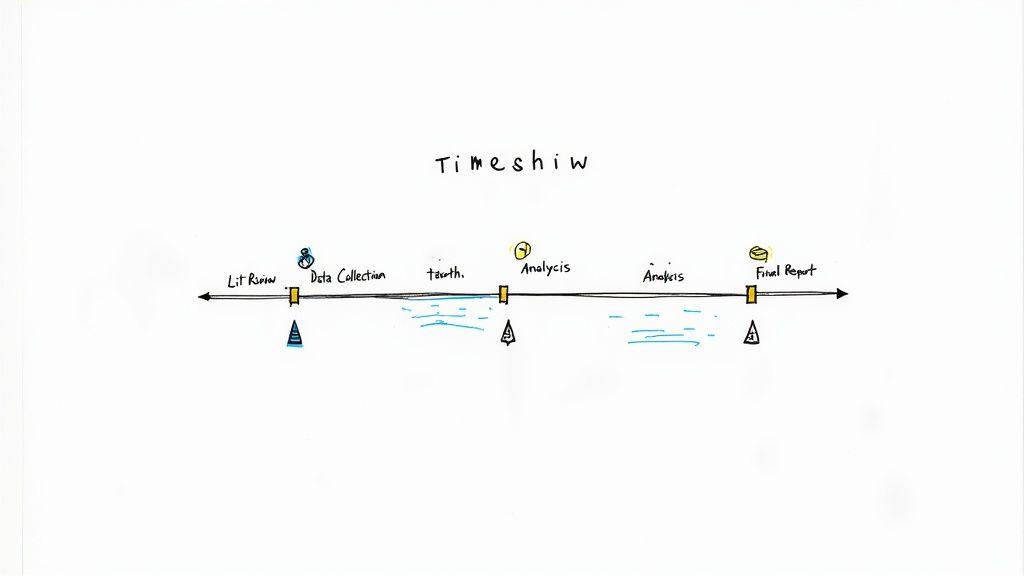
A brilliant research idea is one thing, but a brilliant idea with a practical plan is what actually gets done. This is where your timeline and resource plan come in. They’re the bridge from abstract goals to concrete, achievable actions. Without this operational blueprint, even the most promising projects tend to fizzle out, becoming frustrating and directionless.
The point isn't just to list dates and slap some numbers down. It's about thinking through the entire lifecycle of your project from start to finish. This foresight helps you spot potential roadblocks, justify your needs to stakeholders, and keep the momentum going from the first literature review to the final report. A solid timeline becomes the heartbeat of your project, keeping everything moving forward at a steady, manageable pace.
Building a Realistic Project Timeline
One of the most common pitfalls I see is a wildly optimistic timeline. It's easy to underestimate how long things actually take. The trick is to avoid this by breaking your entire project down into distinct phases, and then breaking those phases down into smaller, individual tasks. Getting granular makes your estimates far more accurate.
For example, a typical academic project might break down like this:
- Phase 1: The Foundation (Weeks 1-4). This is all about groundwork: nailing down your research questions, burying yourself in a literature review, and getting any necessary ethical approvals squared away.
- Phase 2: Data Collection (Weeks 5-10). Now you're in the field. This means creating your survey or interview guide, recruiting participants (which always takes longer than you think), and actually gathering the data.
- Phase 3: Analysis & Writing (Weeks 11-14). With the data in hand, you'll start digging in to find key patterns and insights. This is also when you'll begin drafting the core sections of your paper or report.
- Phase 4: Finalization (Weeks 15-16). The home stretch. Time for editing, proofreading, formatting citations, and prepping your final submission or presentation.
I’m a big fan of using a visual tool like a Gantt chart here. It lets you map everything out, set dependencies (where Task B can’t start until Task A is done), and track your progress against the plan. Having that visual makes it so much easier to see where you are and what’s coming up next.
A timeline is more than a schedule; it's a diagnostic tool. If you're constantly falling behind, it’s a clear signal that your scope might be too ambitious or your initial estimates were off. It lets you adjust before the project goes completely off the rails.
Identifying and Budgeting for Your Resources
Once the "when" is mapped out, you need to figure out the "what." What will it actually take to get this job done? This means identifying every single resource you'll need and creating a budget that reflects reality. Your resource plan should cover everything from people to software to petty cash for participant coffee.
Start by brainstorming every potential cost. For a small business doing market research, that list might look something like this:
| Category | Specific Item | Estimated Cost | Justification |
| Software | Premium survey tool subscription | $120 (3 months) | We need advanced logic and data export features. |
| Personnel | Research assistant hours | $600 (30 hrs @ $20/hr) | To help with data entry and scheduling participants. |
| Incentives | Participant gift cards | $500 (20 interviews @ $25) | Critical for getting people to show up and participate. |
| Contingency | Miscellaneous unexpected costs | $200 (15% of total) | A buffer for things like extra software or travel. |
And don't forget about non-monetary resources! These are just as crucial. This could be access to a specific database, borrowing equipment from another department, or getting an hour of a subject-matter expert's time. In any sample research plan, clearly defining both your timeline and your resources shows you've thought things through and dramatically boosts your project’s chances of success.
Measuring Success and Maintaining Ethical Standards
So, how do you know if all this research actually paid off? A truly solid research plan doesn't just list out what you're going to do; it defines what a "win" looks like and makes sure you're doing everything by the book, ethically speaking. These aren't just boxes to check at the end—they are fundamental to whether anyone will trust or care about your findings.
Defining success means setting up clear, measurable yardsticks that connect directly to your core research questions. And it’s not always about hitting some magic number in a spreadsheet. Sometimes, success is purely qualitative, like uncovering three recurring themes from a dozen interviews that finally explain a baffling customer behavior.
Defining Your Success Metrics
The trick here is to be specific and relevant. A goal like "understand the market" is way too fuzzy. You need to aim for concrete results that prove your research delivered something genuinely useful.
Here are a few examples of what strong success metrics look like in the real world:
- For Quantitative Research: "Our goal is a 25% response rate on the customer feedback survey. Success means we find a statistically significant correlation (p < 0.05) between how often someone uses a feature and whether they stick around as a customer."
- For Qualitative Research: "We need to walk away from these interviews with at least five distinct user pain points, backed up by direct quotes, that the product team can immediately use to make design changes."
- For Business Projects: "The research will be considered a success if our competitive analysis directly shapes the Q3 marketing strategy, with a sign-off from the head of marketing."
Success isn't just about finding the 'right' answer. It's about generating clear, defensible insights that are directly useful to your project's goals, whether that's passing a class, publishing a paper, or launching a product.
Upholding Unbreakable Ethical Standards
Just as crucial as your results is how you arrive at them. Ethical considerations need to be baked into your plan from the very beginning. This isn't just about being a good person; it protects your participants, your reputation, and the integrity of your entire project.
Think of your ethics section as a practical checklist, not a deep philosophical debate. It just needs to cover the non-negotiables.
- Informed Consent: Your participants need to know exactly what they’re signing up for—the purpose, what they'll have to do, and that they can walk away at any time without penalty. You have to get their explicit consent, written or verbal, before anything starts.
- Data Privacy and Anonymity: Be crystal clear about how you’ll protect people’s identities. This means spelling out your process for anonymizing survey data, using pseudonyms in interview transcripts, and scrubbing any personally identifiable information from your datasets.
- Data Storage: Where is this sensitive information going to live? You need to specify if it's on an encrypted hard drive or a secure university server and state your plan for destroying the data once the project is officially wrapped up.
By tackling these things head-on in your research plan, you’re building a project that’s not just effective but also responsible.
Answering Your Top Questions About Research Plans
I get asked a lot of the same questions when people are first tackling a research plan. Let's walk through some of the most common ones.
How Long Should My Research Plan Be, Anyway?
This is probably the number one question, and the honest answer is: it depends. There’s no magic number here. For an undergraduate class, a solid plan might just be 2-3 pages. But if you're drafting a PhD proposal, you could easily be looking at something over 15 pages. In a small business setting, I've found that a focused plan of around 10 pages usually hits the sweet spot.
The real goal isn't the page count. It's about being thorough enough that someone else can pick it up and completely understand what you’re doing, how you’re doing it, and why it makes sense. Clarity and completeness trump length every single time.
What's the Single Biggest Mistake I Can Make?
Hands down, the most common mistake is biting off more than you can chew. People get ambitious and try to solve a massive problem with research questions that are way too vague. It's a classic trap that leads to a muddled, unfocused study and, almost always, weak results. You end up chasing too many threads and proving nothing.
A truly effective sample research plan is built on precision.
The biggest pitfall I see is a lack of focus. A great research plan is defined by a tightly controlled scope and laser-focused questions. Every single decision you make from that point on should serve those specific questions.
Having that discipline from the start saves you from wasting time and energy on things that don’t actually move your core project forward.
Can I Change the Plan Once I've Started?
Of course! In fact, you probably will. Think of your research plan as a living document, not a rigid contract. Research is messy and unpredictable by nature. You’re going to stumble upon unexpected findings or hit roadblocks that force you to adjust your approach.
The important thing is to be intentional about any changes. If your early data points to a fascinating new direction, or if a method you chose just isn't working, it's smart to pivot. Just make sure you update your plan and explain why you're making the change to your professor, team, or stakeholders. Your plan is meant to be your guide, not a cage.