
Let’s be honest: the hardest part of writing an essay is just getting started. That blank page can feel incredibly intimidating. But what if you had a roadmap before you even wrote the first sentence? That's exactly what a good essay outline is—a strategic blueprint that takes a jumble of ideas and turns them into a structured, persuasive paper.
It's a simple step, but it makes the entire writing process less stressful and way more effective.
Why a Great Essay Starts with an Outline
A lot of students just dive in, hoping inspiration will strike as they go. But I've seen it time and again: the best writers know that success starts with a solid plan. Think of an outline as your GPS. It ensures every paragraph has a clear purpose and directly supports your main argument. It's the difference between wandering aimlessly and taking a direct route to a powerful conclusion.
Taking a few minutes to plan forces you to organize your thoughts logically before you get bogged down in sentence structure. It's a game-changer.
Suddenly, you can:
- Strengthen Your Argument: Spot weak points or gaps in your logic early on, when they're easy to fix.
- Improve Cohesion: Make sure your ideas flow smoothly from one point to the next, creating a seamless reading experience.
- Save a Ton of Time: Forget about massive, soul-crushing rewrites. A good outline nearly eliminates the need for major structural edits later.
The Proven Impact of Planning
This isn't just a "nice-to-have" tip; it’s a proven strategy. Educational research consistently shows that structured writing improves student performance by a whopping 20-30% on standardized assessments. In fact, students who regularly use outlines tend to score about 15 points higher on the SAT Writing section than those who don't.
I tell my students to think of their outline as more than a to-do list. It’s a diagnostic tool. It tests the strength of your ideas and the logic of your argument before you invest hours into writing the full draft.
Ultimately, outlining is an exercise in foresight. It builds a solid foundation, freeing you up to focus on crafting compelling sentences instead of worrying about where the essay is going. This not only boosts your grade but also builds stronger critical thinking skills for students that are valuable long after you've left the classroom. It's the single most effective way to turn a daunting assignment into a manageable, and maybe even enjoyable, task.
How to Build a Classic Five-Paragraph Essay Outline
The five-paragraph essay is a staple for a reason. It’s a clean, logical structure that forces you to build a coherent argument from start to finish. Once you nail this format, you can write clear, persuasive essays on pretty much anything.
Let's walk through building one from scratch instead of just looking at a blank template. We'll use a common but important topic: The Impact of Social Media on Teen Mental Health. This is a great subject for showing how to plug specific, compelling details into a classic framework.
Start with a Powerful Thesis Statement
Every single sentence in your essay should ultimately support your thesis. A thesis isn't just your topic; it's the specific, debatable claim you're going to prove.
For our example, a weak thesis would be something like, "Social media affects teenagers." It’s true, but it’s vague and doesn't take a stand.
Here’s a much stronger one:
While social media can foster connection, its pervasive nature contributes significantly to heightened anxiety and lower self-esteem among teenagers due to constant social comparison and curated realities.
See what that does? It sets the entire stage for the essay. This thesis accomplishes three key things:
- It acknowledges the other side: "While social media can foster connection..."
- It makes a clear claim: "...contributes significantly to heightened anxiety and lower self-esteem..."
- It previews the main points: "...due to constant social comparison and curated realities."
Just from that one sentence, we have a roadmap for our entire paper.
Flesh Out Your Body Paragraphs
Now, let's map out the three body paragraphs. Each one needs to unpack a different piece of your thesis. Think of them as mini-arguments that all serve the main one, complete with their own main idea, supporting evidence, and a bit of analysis.
Body Paragraph 1: The Social Comparison Trap
My first point will dig into how these platforms are literally designed to make us compare ourselves to others, which is a major source of anxiety. The outline for this part might look something like this:
- Topic Sentence: Platforms like Instagram and TikTok create an endless feedback loop where teens are constantly measuring their own lives against the polished, often unrealistic, highlight reels of their peers.
- Supporting Evidence 1: I'd find a specific study linking time spent on these visual-heavy platforms to a rise in social anxiety.
- Supporting Evidence 2: A real-world example works well here—like the immense pressure to post the perfect vacation photos or a flawless social life, even if it’s totally staged.
- Analysis: This is where I'd connect the dots, explaining how this constant one-upmanship leads directly to feelings of inadequacy and the all-too-common fear of missing out (FOMO).
Body Paragraph 2: Curated Realities and Self-Esteem
Next, I'll focus on how the curated, filtered nature of social media content messes with self-esteem. The structure stays the same, just with a new focus.
- Topic Sentence: The prevalence of digitally altered images and influencer-driven trends on social media establishes unattainable beauty and lifestyle standards that directly damage teenage self-esteem.
- Supporting Evidence 1: I'd look for stats on the rise of body dysmorphia and how it correlates with the age of photo filters.
- Supporting Evidence 2: I could point to a specific trend that promoted an unhealthy or unrealistic body type or lifestyle as a concrete example.
- Analysis: Here, the job is to explain that being bombarded with this "perfection" makes teens feel like their own normal, unfiltered lives are somehow falling short.
Body Paragraph 3: The Counterintuitive Loneliness
My thesis acknowledged the "connection" argument, so a smart third paragraph can tackle that head-on and actually use it to strengthen my main point.
- Topic Sentence: Although social media is marketed as a tool for connection, its overuse can paradoxically lead to greater social isolation by replacing deep, real-world relationships with shallow online interactions.
- Supporting Evidence 1: There's plenty of research showing a link between heavy social media use and feelings of loneliness. I'd cite one here.
- Supporting Evidence 2: I could describe how texting and commenting lack the non-verbal cues and emotional depth of a face-to-face conversation.
- Analysis: The final step is to argue that these superficial connections don't fulfill our core need for belonging, which can actually intensify feelings of loneliness.
Adapting Your Outline for Different Essay Types
Once you get the hang of the classic five-paragraph structure, you'll quickly realize that not every assignment fits into that neat little box. Academic writing will push you to do more—to argue a point, compare complex ideas, or analyze deep research—and your outlines need to evolve right along with those demands. The core principles of having an introduction, body, and conclusion don't change, but the internal architecture of your plan definitely will.
Thinking of your outline as a rigid template is a common mistake. Instead, see it as a flexible blueprint. This ability to adapt your plan to the specific task at hand is what really separates good writers from great ones.
This diagram shows the fundamental components that form the foundation for any essay structure, no matter how complex it gets.
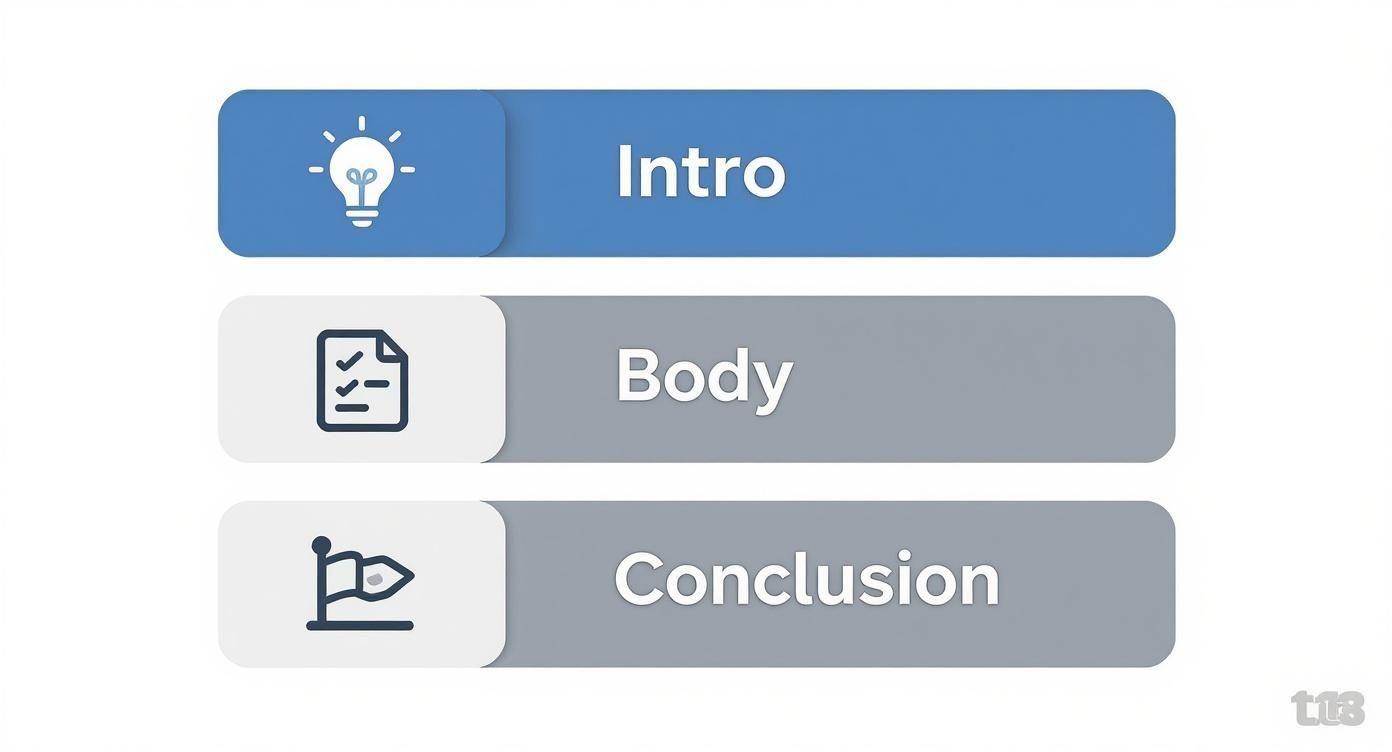
It’s a simple visual, but it powerfully reinforces how the introduction (the idea), the body (the evidence), and the conclusion (the final takeaway) must work in harmony to create a convincing piece of writing.
Crafting an Argumentative Essay Outline
When you're writing an argumentative essay, your main goal is persuasion. It’s not just about listing your points; you have to actively engage with and dismantle the other side of the argument. This means your outline absolutely must include a dedicated section for counterarguments and your rebuttal.
Here’s a practical essay outline example for an argumentative paper asking: Should the federal minimum wage be raised to $15 per hour?
- Introduction
- Hook: Grab the reader with a shocking statistic about income inequality or the rising cost of living in the U.S.
- Background: Briefly touch on the ongoing debate around the federal minimum wage.
- Thesis Statement: A higher federal minimum wage is crucial for reducing poverty and boosting the economy, even when considering potential impacts on employment.
- Body Paragraph 1 (Pro-Argument): A $15 wage is a direct tool to lift working families out of poverty.
- Evidence: Pull data from economic studies showing the real-world impact on low-income households.
- Example: Point to a specific city or state that has already raised its wage and seen positive outcomes.
- Body Paragraph 2 (Pro-Argument): More money in workers' pockets means more consumer spending, which fuels the economy.
- Evidence: Explain the economic concept that low-wage workers tend to spend any extra income immediately.
- Analysis: Draw a clear line from that spending to the benefits for local businesses.
- Body Paragraph 3 (Counterargument & Rebuttal): Tackle the common claim that a higher wage kills jobs.
- Acknowledge the opposition: "Opponents often argue that businesses, particularly small ones, will be forced to cut jobs to cover higher labor costs."
- Dismantle it with evidence: "However, multiple studies, including analyses by the Congressional Budget Office, show a minimal impact on overall employment. Furthermore, higher wages often reduce employee turnover, saving businesses significant money on hiring and training."
- Conclusion
- Restate Thesis: Reiterate in new words that the measurable benefits of a $15 minimum wage outweigh the speculative downsides.
- Summarize Key Points: Briefly remind the reader of the main arguments—poverty reduction, economic stimulus, and the counterargument you disproved.
- Concluding Thought: End with a strong, memorable statement about economic fairness and the value of labor.
Structuring a Compare and Contrast Essay Outline
With compare and contrast essays, your organization is everything. A weak outline can lead to a paper that feels like a jumbled mess of similarities and differences. The two most common strategies are the Block Method and the Point-by-Point Method.
While the Block Method (discussing all of Subject A, then all of Subject B) can work, the Point-by-Point method is almost always more effective for complex topics because it weaves the comparison throughout the essay, making your analysis clearer.
Let's break down an outline comparing remote work vs. in-office work using the more sophisticated Point-by-Point method:
- Introduction: Set the stage by talking about the modern workplace debate. State a clear thesis, like, "While in-office work fosters spontaneous collaboration, remote work offers superior flexibility and productivity, making it a more effective model for many industries."
- Body Paragraph 1 (Point of Comparison: Productivity)
- Remote Work: Discuss studies showing increased focus and output away from office chatter.
- In-Office Work: Acknowledge the benefit of quick, in-person feedback but also the constant interruptions.
- Body Paragraph 2 (Point of Comparison: Collaboration)
- Body Paragraph 3 (Point of Comparison: Work-Life Balance)
- Remote Work: Emphasize the gains in flexibility, personal autonomy, and the elimination of the daily commute.
- In-Office Work: Discuss the clear boundary between work and home life but also the rigidity of a 9-to-5 schedule.
- Conclusion: Briefly summarize your main points of comparison and restate your thesis, offering a final judgment on which model you believe is more advantageous overall and why.
The table below shows how the structure and goals of your outline need to shift depending on what type of essay you're writing.
Outline Structures for Different Essay Types
| Essay Type | Key Outline Sections | Primary Goal |
| Argumentative | Introduction with a clear stance, pro-arguments with evidence, counterargument and rebuttal section, conclusion. | To persuade the reader to accept a specific point of view. |
| Compare-Contrast | Introduction with a thesis, body paragraphs organized by points of comparison (or by subject), conclusion with a final judgment. | To analyze the similarities and differences between two subjects to reveal a deeper insight. |
| Research Paper | Introduction with a research question, literature review, methodology, findings/analysis, discussion, and conclusion. | To present and interpret original research or a deep analysis of existing research on a specific topic. |
As you can see, the fundamental building blocks are there, but the "rooms" you build inside your outline serve very different purposes.
Taking the time to build a solid, tailored outline does more than just organize your thoughts—it measurably improves your writing quality and cuts down on the time it takes to finish.
This isn't just anecdotal advice. A 2021 controlled experiment found that students who used detailed outlines finished their essays 25% faster on average. Even better, their final drafts had a 30% reduction in structural errors, and their grades improved by an average of 18%. If you're interested in the data behind such findings, you can explore the underlying principles of statistics on Britannica. The evidence is clear: starting with a solid plan works.
Turning Your Outline into a Polished Draft
So you've got your outline. That's your blueprint, your road map. But now comes the real challenge: turning those bullet points and brief notes into a piece of writing that actually flows. This is where a lot of people hit a wall, but don't overthink it. Your outline isn’t a cage; it’s a guide to keep you on track.
The easiest way to start is to see each main point in your outline as the topic sentence for a new paragraph. From there, your job is to build on that single idea, pulling in the supporting details you've already gathered. The trick is not just to drop in facts, but to connect them into a story that explains why they matter and how they support your main thesis. This is how you breathe life into the skeleton you’ve built.
Expanding Your Points into Paragraphs
Try tackling your outline one section at a time. Think of it as writing a series of mini-essays. Find your first main point—something like, "Social comparison on Instagram leads to anxiety"—and dedicate all your energy to just that one paragraph. Flesh it out with your research, your examples, and your own analysis.
This keeps the overwhelming feeling of a five-page paper at bay. You're not writing a massive essay; you're just writing one solid paragraph. Then another. This approach makes the whole process feel much more achievable and helps you build a logical argument, piece by piece. If you ever get stuck trying to flesh out a point, an AI paragraph writer can be a handy assistant for brainstorming a few sentences to get you unstuck.
A common mistake I see is students treating their outline like a simple to-do list. It’s more of a compass. It points you in the right direction, but you're the one who has to navigate the terrain and express the ideas in your own voice.
Weaving Seamless Transitions
What separates a decent essay from a great one? The flow. A great essay glides from one idea to the next, pulling the reader along without any awkward jumps. Those connections between your paragraphs are your transitions, and they’re more than just filler. They are the logical glue holding your argument together.
Building strong transitions doesn't have to be complicated. Here are a few things I always recommend:
- Use transition words: Simple phrases like "Furthermore," "In contrast," or "Consequently" do a lot of heavy lifting. They immediately signal to your reader how the new idea relates to the previous one.
- Repeat a key word or phrase: You can create a powerful link by picking up a key term from the end of one paragraph and using it near the beginning of the next.
- Ask a question: Try ending a paragraph with a question that your next paragraph immediately answers. It’s a great way to pull your reader forward.
For instance, if you just finished a paragraph on social comparison, you could start the next one with something like: "But it isn't just the constant comparison. The curated nature of these platforms poses an entirely different threat to self-esteem." That simple sentence connects the old idea to the new one and makes the entire essay feel more sophisticated and cohesive.
Common Mistakes to Avoid When Outlining
Creating an essay outline might seem simple enough, but a few common missteps can easily trip you up before you even start writing. I've seen it time and time again—students fall into one of two traps.
First, they make an outline that’s way too vague, which offers almost no real direction. On the flip side, some create an outline that’s so incredibly detailed it feels like a cage, killing any chance for creativity once the real writing begins.
The sweet spot is somewhere in the middle. A great outline does more than list your topics; it reveals the logical threads connecting your ideas. A solid essay outline example won't just show you what to say, but will map out exactly why each point reinforces your main argument.
Getting Lost in the Details
One of the biggest mistakes I see is creating an outline so granular it basically becomes a full-blown manuscript in bullet points. People can spend hours detailing every single source and plotting out every sentence, only to realize there’s no room left for discovery or natural flow in the actual draft.
This often leads to a stiff, robotic essay and a serious case of burnout.
Just remember, your outline is the scaffold, not the entire building. If you find yourself spending more time on intricate numbering systems than on the flow of your argument, it's a sign to step back. The whole point is to achieve clarity and direction, not to perfect the essay before you’ve even written it.
Your outline’s job is to make writing faster and more focused. If it becomes a source of procrastination or feels more complex than the essay itself, you're likely overcomplicating it.
This isn’t just my opinion; it’s a widely recognized principle. Look at the Purdue OWL, a resource trusted by over 2 million users every year. They consistently emphasize that a clear outline is the key to managing complex topics. In fact, their traffic data for writing process guides shows a steady 10% annual increase, highlighting how universal the need for structured planning really is. For more on this, you can check out the principles behind writing informative essays on their site.
Forgetting the Central Argument
This one is probably the most damaging mistake of all: crafting an outline where your points don't actually support your thesis. It’s surprisingly easy to get sidetracked by interesting facts or related ideas. But if a point doesn’t directly serve your central claim, it’s just dead weight that weakens your entire essay.
Think of it this way: every main point in your outline should be a pillar holding up your thesis. If a pillar is wobbly or out of place, the whole structure suffers.
To stay on track, constantly gut-check your outline with these questions:
- Does this point directly prove my thesis? If the answer isn't a clear "yes," cut it.
- How does this section logically follow the one before it? Your ideas need to flow seamlessly from one to the next.
- Is this the strongest evidence I have? Don’t just settle for the first piece of information you find.
Keeping your thesis front and center ensures your outline builds a powerful, cohesive argument instead of just being a random collection of thoughts. This kind of strategic thinking is one of the secrets to learning how to write essays faster without sacrificing quality.
Frequently Asked Questions About Essay Outlines
Even with a great template in hand, you’re bound to have questions. It's one thing to look at a polished essay outline example on a screen, but it's a completely different ballgame when you're trying to wrestle your own jumbled thoughts into that same clean structure. Let's dig into some of the most common snags I see students run into.
How Detailed Does My Outline Really Need to Be?
This is probably the number one question I get. The honest answer? It depends entirely on the project. For a straightforward five-paragraph essay, a simple outline with just your thesis and main topic sentences will probably do the trick. It’s enough to keep you on track without getting bogged down.
But if you’re tackling a ten-page research paper, that minimalist approach will leave you lost in the woods. For bigger projects, you need a much more detailed map. Think sub-points for each main idea, notes on which sources or data points you'll use, and maybe even a few key quotes you plan to include.
The sweet spot is finding the right balance. Your outline is your guide, not a cage. It should give you structure and direction, but still leave room for discovery as you write.
What if My Ideas Change While I’m Writing?
This will happen. In fact, it should happen! If your ideas aren’t evolving as you write, you might not be thinking deeply enough about your topic.
Your outline is a living document, not a contract you signed in blood. When you stumble upon a more powerful argument or a piece of evidence that completely reframes your perspective, don’t ignore it. Go back and adjust the plan.
An outline is meant to serve your writing, not the other way around. If a new direction makes your essay stronger, embrace it. A quick tweak to your outline will keep the rest of your paper aligned with your new, better argument.
I see this all the time. A student starts an argumentative essay, finds a counterargument that's too compelling to ignore, and smartly decides to build a whole rebuttal section around it. That's not a sign your outline failed—it's a sign your critical thinking succeeded.
Can an Outline Be Too Rigid?
Oh, absolutely. It’s a classic trap. You create an outline so meticulously detailed that it strangles any creativity out of the writing process. When every single sentence is pre-planned, writing becomes a robotic task of just filling in the blanks, and your essay loses its voice.
How do you know if your outline is too restrictive? Here are a few red flags:
- There's no room for discovery. You find yourself shutting down interesting new thoughts or connections simply because they weren't in the original plan.
- Writing feels like a chore. Instead of feeling supported by your outline, you feel trapped by it. Your motivation plummets.
- The prose feels stiff. Forcing yourself to stick to a rigid script often leads to clunky transitions and unnatural-sounding arguments.
A better way is to focus your outline on the skeleton of your essay: your thesis statement, the topic sentence for each body paragraph, and the key evidence you'll use to back up each point. This gives you a rock-solid foundation but leaves you the freedom to craft your sentences and build your arguments in a way that feels natural and authentic.