In a world saturated with information, the ability to read and truly understand is a fundamental skill. It serves as the bedrock for all learning, critical thinking, and academic success. However, many students, from elementary school through college, find it challenging to move beyond simple decoding to achieve deep, meaningful comprehension. When the words on the page don't stick, frustration can build and learning can stall.
This guide is designed to bridge that gap. We've assembled a detailed list of 10 powerful, evidence-based reading comprehension strategies for students. This resource is built for parents, teachers, and learners alike, offering practical steps, real-world examples, and grade-level adaptations to turn reading from a passive activity into an active, engaging process.
The goal is to provide a clear and actionable toolkit for anyone looking to improve their reading skills. Inside, you'll find structured methods that help organize information, foster critical questioning, and build a stronger vocabulary. Whether you are working through a dense textbook, analyzing a research paper, or exploring a classic novel, these strategies will help you unlock a new level of understanding. By mastering these techniques, students can build confidence and develop reading habits that will support them throughout their academic and professional lives.
1. SQ3R Method (Survey, Question, Read, Recite, Review)
The SQ3R method is a classic, five-step reading comprehension strategy that turns passive reading into an active, structured process. Developed by educational psychologist Francis P. Robinson in 1946, it guides students to engage with a text before, during, and after reading to significantly improve understanding and retention. This approach is one of the most effective reading comprehension strategies for students working with dense material like textbooks, research papers, or lengthy business reports.
How It Works: The Five Steps
SQ3R provides a clear roadmap for tackling any text:
- Survey: Get a general overview before you read. Skim headings, subheadings, the introduction, conclusion, and any charts or bolded terms. The goal is to create a mental framework for the information.
- Question: Turn headings and key points into questions. For example, a heading like "The Impact of Climate Change on Coastal Regions" could become "What are the primary effects of climate change on coastal areas?" This primes your brain to look for specific answers.
- Read: Actively read the material one section at a time, specifically looking for answers to the questions you just formulated.
- Recite: After each section, look away from the text and summarize the key points and answers in your own words. This step is critical for moving information from short-term to long-term memory.
- Review: Once you've finished the entire text, review your notes and mentally run through the main ideas and answers. This solidifies your understanding and organizes the information.
Tips for Implementation
- Go Analog: Keep a dedicated notebook for the "Question" and "Recite" phases. Writing by hand can often improve memory recall.
- Time Your Review: For best results, conduct your first review session within 24 hours of reading the material.
- Integrate AI Tools: Use a tool like 1chat to accelerate the process. For instance, after surveying a long PDF, you can ask it to generate potential study questions based on the document's structure to kickstart your "Question" phase. College students can use it to survey research paper abstracts and identify core arguments quickly.
Key Insight: The power of SQ3R lies in its structure. By intentionally questioning the text and reciting information, you force your brain to process the material actively rather than just passively scanning words.
This method transforms reading from a one-way reception of information into a dynamic dialogue with the text. Its systematic nature builds discipline and is a foundational skill for anyone looking to master complex subjects. For a deeper dive into similar techniques, explore these active learning strategies for students.
2. Annotation and Highlighting Strategy
Annotation and highlighting are active reading techniques where students physically engage with a text by marking up important information. This process involves highlighting key concepts, writing notes in the margins, and underlining critical passages. By interacting directly with the material, students transform reading from a passive activity into an analytical dialogue, which significantly boosts comprehension and retention. This method is one of the most direct reading comprehension strategies for students to create a personalized study guide as they read.
How It Works: A Hands-On Approach
The core idea is to make the text your own by adding layers of meaning through your own marks and notes. This creates a record of your thinking process as you read.
- Initial Skim: Quickly read a section to get the general idea before picking up your pen or highlighter.
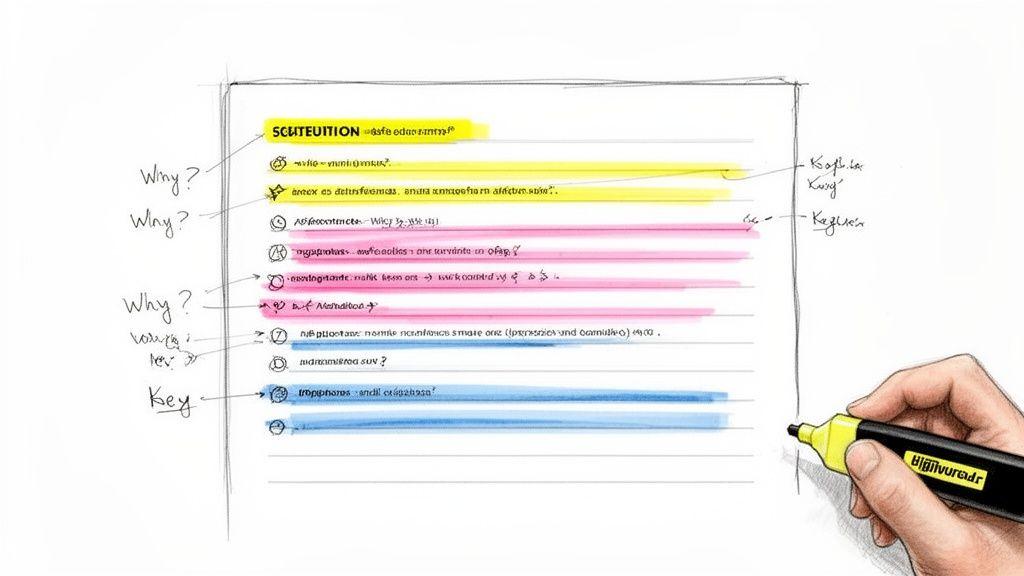
- Mark Strategically: Go back through the text and highlight main ideas, key terms, or surprising facts. Use a pen or pencil to underline supporting details and make notes.
- Write in the Margins: Don't just highlight. Write questions, summarize complex sentences, define new vocabulary, or make connections to other ideas in the margins.
- Create a System: Develop a simple color-code or symbol system. For example, yellow for main ideas, blue for supporting evidence, and a star next to potential test questions.
- Synthesize and Review: After finishing a chapter, review only your annotations and highlights to quickly recall the most important information.
Tips for Implementation
- Less Is More: Aim to highlight no more than 10-15% of the text. Over-highlighting defeats the purpose by making nothing stand out.
- Use a Color Key: Assign different colors for specific types of information like definitions, examples, and key arguments to organize your thoughts visually.
- Question Everything: Use the margins to write questions that arise as you read. This deepens your critical engagement with the author's points.
- Combine with AI: After annotating a PDF, upload it to a tool like 1chat. Ask the AI to summarize your highlighted sections or verify if your identified key points align with the document's core thesis. College students can use this to double-check their analysis of dense research papers.
Key Insight: Annotation is not just about identifying important information; it's about recording your intellectual interaction with the text. Your marginalia-questions, reactions, and connections-are what truly build deep comprehension.
This strategy forces you to slow down and think critically about what you are reading, making it far more effective than simply letting your eyes scan the page. It's a foundational skill for building a deeper understanding of any subject.
3. Summarization and Paraphrasing
Summarization and paraphrasing are fundamental skills that force students to identify and reframe the core ideas of a text. This strategy moves beyond simple recall, requiring a deeper level of processing to condense information accurately. Paraphrasing focuses on rephrasing smaller chunks like sentences or paragraphs, while summarizing condenses the main arguments of an entire section or document. This makes it one of the most practical reading comprehension strategies for students to master for academic writing and research.
How It Works: The Core Process
This strategy involves two distinct but related actions:
- Paraphrase: Read a specific sentence or short paragraph. Then, restate its meaning completely in your own words and sentence structure. The goal is to retain the original meaning without copying the original phrasing.
- Summarize: Identify the main idea and key supporting points of a longer passage or entire text. Condense these elements into a brief overview, omitting minor details and examples.
The process is iterative. Students often start by paraphrasing key sections to ensure they understand them, then use those paraphrased notes to build a concise summary of the entire work.
Tips for Implementation
- Main Ideas First: Before writing a summary, jot down the main idea and 2-3 essential supporting details. This creates a clear outline.
- Write Blind: After reading a section, look away from the source text and write your summary or paraphrase from memory. This prevents accidental copying.
- Leverage AI for Comparison: Use a tool like 1chat to generate an alternative summary of the same text. College students can compare their version with the AI’s to see if they missed any critical points or misinterpreted an argument.
- Check for Accuracy: For high school research papers, students can have 1chat verify the accuracy of their paraphrased findings or check for unintended plagiarism. To learn more, explore these best practices on how to paraphrase without plagiarizing.
Key Insight: The act of translating an author's ideas into your own words is a powerful comprehension check. If you can't explain it simply, you may not have fully understood it yet.
This strategy builds critical thinking and is essential for avoiding plagiarism in academic and professional writing. By regularly practicing both skills, students learn to distill complex information into clear, manageable concepts.
4. Questioning Strategy (Self-Questioning and Inquiry-Based Reading)
The Questioning Strategy transforms students from passive recipients of information into active investigators. Instead of just reading words on a page, students learn to ask questions before, during, and after reading to monitor their understanding and connect with the material on a deeper level. This metacognitive approach, advanced by researchers like Taffy Raphael, is one of the most powerful reading comprehension strategies for students as it builds curiosity and analytical habits.
How It Works: The Three Questioning Phases
Effective questioning is a continuous cycle that supports comprehension at every stage:
- Before Reading: Students generate questions based on the title, headings, or prior knowledge. This sets a purpose for reading and activates relevant background information. For example, before reading an article on renewable energy, a student might ask, "What are the main types of renewable energy discussed?"
- During Reading: Students pause periodically to ask clarifying questions ("What does this term mean?") or inferential questions ("Why did the character make that choice?"). This process helps them monitor their understanding and identify points of confusion in real time.
- After Reading: The questioning shifts to evaluation and synthesis. Students can ask, "What was the author's main argument?" or "How does this information connect to what we learned last week?" This solidifies learning and encourages critical reflection.
Tips for Implementation
- Use Bloom's Taxonomy: Guide students to create questions at different levels, from basic recall ("Who...?") to higher-order evaluation ("Do you agree with...?").
- Pause and Ponder: Encourage students to stop after each paragraph or section to ask themselves if they understood the main idea before moving on.
- Generate Question Banks: Use 1chat to generate a list of potential questions based on a document. This can help students see examples of good questions and inspire their own inquiries, especially when tackling a new or complex topic.
- Create a "Parking Lot": Keep a running list of questions that aren't answered by the text. This encourages further research and intellectual curiosity.
Key Insight: Questioning turns reading into an active dialogue. By constantly interrogating the text, students take ownership of their learning and train their minds to look for meaning, not just words.
This strategy is fundamental for building the analytical habits needed for academic success. It directly supports the development of higher-order thinking, an area you can explore further in these critical thinking skills for students.
5. Chunking and Segmentation
Chunking and segmentation is a strategy rooted in cognitive psychology that involves breaking down large or complex texts into smaller, more manageable pieces. Instead of attempting to read a dense document in one sitting, students process it in sections, ensuring full comprehension of one part before moving to the next. This method directly addresses the limits of working memory, preventing cognitive overload and making intimidating texts feel approachable. It is one of the most practical reading comprehension strategies for students facing long textbook chapters or detailed business reports.
How It Works: A Step-by-Step Approach
Chunking turns a marathon reading session into a series of short, focused sprints:
- Identify the Chunks: Before reading, scan the text to find natural breaking points. These are often headings, subheadings, or even significant paragraph breaks.
- Read One Chunk: Focus your attention on reading only the first identified section. Your goal is to fully understand this single piece of information.
- Pause and Summarize: After finishing the chunk, stop and summarize its main points in your own words. Ask yourself, "What was the single most important idea in this section?"
- Connect and Proceed: Briefly consider how this chunk might connect to the previous one, then move on to the next section, repeating the process.
- Synthesize: After working through all the chunks, review your summaries to build a cohesive understanding of the entire text.
Tips for Implementation
- Use Document Structure: Let the author do the work for you. Use existing headings and subheadings as your pre-defined chunks.
- Set a Timer: For texts without clear sections, read for a set period (e.g., 10-15 minutes) and then pause to summarize what you just read.
- Leverage AI for Focus: When analyzing lengthy PDFs, business teams can upload one section at a time to a tool like 1chat. This allows them to get a focused analysis of each part before combining the insights. College students can do the same with research papers to avoid getting lost in the details.
- Create a Visual Map: Draw a simple flowchart or mind map as you go, with each chunk represented by a box. This helps visualize how the ideas connect.
Key Insight: Chunking reduces the mental strain of processing large volumes of information at once. By mastering smaller segments individually, you build a strong and accurate understanding of the whole picture, piece by piece.
This approach is highly effective for any learner who feels overwhelmed by the sheer length or complexity of a text. It fosters discipline and ensures that comprehension is built on a solid foundation rather than a shaky overview.
6. Concept Mapping and Graphic Organizers
Concept mapping is a visual strategy that helps students illustrate the relationships between ideas, events, or characters in a text. By creating diagrams like mind maps or flowcharts, learners organize information hierarchically, making complex material more digestible. This technique, rooted in the work of Joseph Novak, is one of the most powerful reading comprehension strategies for students who are visual learners, as it transforms abstract concepts into concrete, interconnected structures.
How It Works: The Visual Approach
Graphic organizers provide a framework for thinking, helping students see the bigger picture and the details simultaneously.
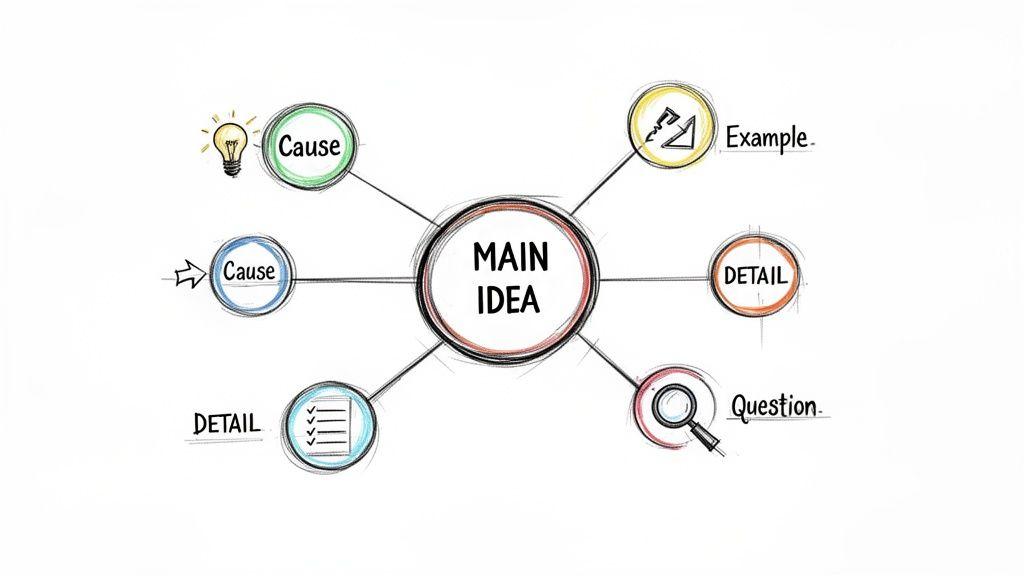
- Identify the Core Concept: Start by identifying the main idea or central theme of the text. This becomes the central node of your map.
- Branch Out with Key Topics: From the core concept, draw branches to major sub-topics or supporting ideas. These could be characters, plot points, or key arguments.
- Add Supporting Details: Create smaller branches from each sub-topic to include specific details, evidence, or examples from the reading.
- Label the Connections: Use linking words or short phrases on the lines connecting the bubbles to define the relationship (e.g., "causes," "leads to," "is a type of"). This step is crucial for clarifying how ideas relate.
Tips for Implementation
- Start Simple: Begin with a main idea in the center and work outward. Don't worry about making it perfect on the first try.
- Use Color-Coding: Assign different colors to different types of information (e.g., green for causes, red for effects) to make the map easier to read at a glance.
- Verify with AI: Use a tool like 1chat to check the accuracy of the relationships you've mapped. For example, a student can ask, "Based on this article, is the connection I made between 'industrial pollution' and 'acid rain' correct?"
- Go Digital: For collaborative projects or easy editing, use digital tools like Coggle or MindMeister to create and share your concept maps with peers for feedback.
Key Insight: Concept mapping forces students to actively process information by asking not just "what are the key ideas?" but "how do these key ideas fit together?" This deepens understanding far more than simple rereading.
This method moves beyond memorization, encouraging students to analyze, synthesize, and evaluate information. It's an excellent tool for preparing for essays, studying for exams, or simply making sense of a dense chapter in a science textbook.
7. Predicting and Making Connections Strategy
The Predicting and Making Connections strategy transforms reading from a passive activity into an interactive investigation. Popularized by researchers like David Pearson, Keene, and Zimmerman, this approach encourages students to act like detectives, using clues from the text to form hypotheses (predictions) and then linking new information to what they already know. This is one of the most powerful reading comprehension strategies for students because it builds anticipation and personal relevance, making the content stick.
How It Works: The Three-Connection Framework
This strategy involves a continuous cycle of predicting, reading, and connecting:
- Predict: Before reading, students examine the title, cover art, headings, or introduction to make educated guesses about the content. What might happen next? What information will this chapter present?
- Read and Revise: As students read, they actively look for evidence that either confirms or contradicts their predictions. They should pause periodically to adjust their initial hypotheses based on new information.
- Connect: During and after reading, students make three types of connections to deepen their understanding:
- Text-to-Self: Relating the content to personal experiences, memories, or feelings.
- Text-to-Text: Linking the current reading to other books, articles, or media they have consumed.
- Text-to-World: Connecting the material to real-world events, societal issues, or historical context.
Tips for Implementation
- Create a Prediction Journal: Have students write down their predictions before reading and then note what actually happened. This creates a clear record for reflection.
- Pause and Ponder: Encourage readers to stop every few paragraphs or at the end of a chapter to explicitly ask, "Does this match my prediction?" and "What does this remind me of?"
- Use AI for Verification: A high school student can predict the main arguments of a historical essay, then use 1chat to analyze the text and verify if their predictions were accurate. College researchers can predict study findings before reading a dense research paper and use the tool to quickly find supporting evidence or counterarguments.
Key Insight: Making connections anchors new, abstract information to existing, concrete knowledge. When a student links a story's theme to their own life (Text-to-Self), it becomes more than just words on a page; it becomes memorable and meaningful.
This strategy fosters a curious and engaged mindset, teaching students to constantly question and relate to the material. By actively anticipating content and weaving it into their own understanding of the world, readers develop a much deeper and more personal grasp of the text.
8. Context Clues and Vocabulary Strategy
The Context Clues and Vocabulary Strategy teaches students to become word detectives, inferring the meaning of unknown words by analyzing the surrounding text. Instead of immediately reaching for a dictionary, this method encourages readers to use clues embedded within sentences and paragraphs to make an educated guess. This approach not only improves reading fluency but also deepens vocabulary acquisition, making it one of the most practical reading comprehension strategies for students of all ages, especially English language learners.
How It Works: The Four Types of Clues
This strategy hinges on recognizing different types of contextual information:
- Definition/Explanation: The word's meaning is directly explained in the sentence. (e.g., "The arboretum, a garden devoted to trees, was his favorite place.")
- Example: The text provides examples that clarify the word. Signal words like "such as," "for instance," or "including" are common. (e.g., "He enjoyed studying celestial bodies, such as the sun, moon, and stars.")
- Contrast/Antonym: The word is defined by its opposite. Look for words like "unlike," "but," "in contrast," or "however." (e.g., "The teacher was affable, unlike the grumpy principal.")
- Inference/General Context: The word's meaning is hinted at by the overall sense of the sentence or passage. This requires putting pieces of information together.
Tips for Implementation
- Highlight and Hypothesize: When you encounter an unknown word, circle or highlight it. Read the sentences before and after it, then make an initial guess about its meaning.
- Look for Signal Words: Actively search for words that point to definitions ("is," "means," "refers to"), examples ("like," "for example"), or contrasts ("but," "on the other hand").
- Verify with AI: After making your guess, use a tool like 1chat to confirm the definition. You can ask it, "Based on the sentence '...', what does 'word' mean?" This provides immediate feedback and strengthens learning.
- Create Vocabulary Cards: Make flashcards that include the new word, its definition, and the original sentence you found it in. This preserves the context.
Key Insight: Using context clues builds independence and critical thinking. It trains the brain to solve problems actively while reading, rather than passively stopping at every unfamiliar word, which disrupts comprehension and flow.
This method transforms vocabulary building from a rote memorization task into an engaging and logical process. It's an essential skill for tackling complex academic texts and understanding discipline-specific terminology without constant interruptions.
9. Reciprocal Teaching Strategy
The Reciprocal Teaching Strategy is a powerful, collaborative approach that transforms students into teachers. Developed by Annemarie Palincsar and David Brown in 1984, this method involves a structured dialogue where students lead a discussion about a shared text. It is one of the most effective group-based reading comprehension strategies for students because it builds both individual accountability and collective understanding through peer interaction.
How It Works: The Four Key Roles
Students work in small groups and take turns being the "teacher," guiding their peers through four distinct comprehension processes:
- Summarizing: The student leader articulates the main ideas and most important information from the section of text just read. This step confirms the group's basic understanding.
- Questioning: The leader generates questions about the text to encourage deeper thought. These questions can address unclear parts, confusing concepts, or connections to other ideas.
- Clarifying: The group works together to resolve confusing words, phrases, or concepts. This could involve re-reading a sentence, using context clues, or asking for help.
- Predicting: Based on the information discussed, the student leader makes an educated guess about what will happen next in the text. This sets a purpose for continued reading.
Tips for Implementation
- Model First: Begin by modeling all four roles yourself as the teacher so students understand the expectations for each step.
- Gradual Release: Slowly transfer responsibility to student leaders, providing support and feedback as they practice leading their groups.
- Rotate Roles: Ensure every student has the opportunity to lead and practice each of the four strategies, building confidence and competence across the board.
- Use a Virtual Partner: For individual practice or distance learning, students can use 1chat as a virtual discussion partner. They can ask it to model questions, help clarify a difficult passage, or check their summary for accuracy.
Key Insight: Reciprocal teaching works by making covert cognitive processes (like questioning and clarifying) overt and collaborative. When students must articulate their thought processes to peers, they deepen their own comprehension and learn new strategies from others.
This method moves beyond simple Q&A sessions, creating an active, student-led environment where thinking is visible and comprehension is constructed together. It’s particularly effective for analyzing complex literary texts, dense research articles, or detailed business documents.
10. Metacognitive Monitoring and Fix-Up Strategies
Metacognitive monitoring is the practice of "thinking about your own thinking." It teaches students to be active, self-aware readers who constantly check if they understand what they're reading. When confusion arises, they deploy specific "fix-up" strategies to repair the breakdown in comprehension. Popularized through the work of educational psychologists like David Pressley, this approach is one of the most powerful reading comprehension strategies for students because it builds independent, resilient learners.
How It Works: The Monitor and Repair Cycle
This strategy operates on a simple but effective two-part cycle:
- Monitor: Students learn to recognize the internal signals of confusion. This might feel like their mind wandering, encountering an unknown word, or realizing the text no longer makes sense. The goal is to catch this moment of breakdown as it happens.
- Repair (Fix-Up): Once a student identifies a comprehension gap, they choose a "fix-up" tool from their toolkit to resolve it. This is not about guessing; it's about applying a specific, pre-learned tactic to get back on track.
Tips for Implementation
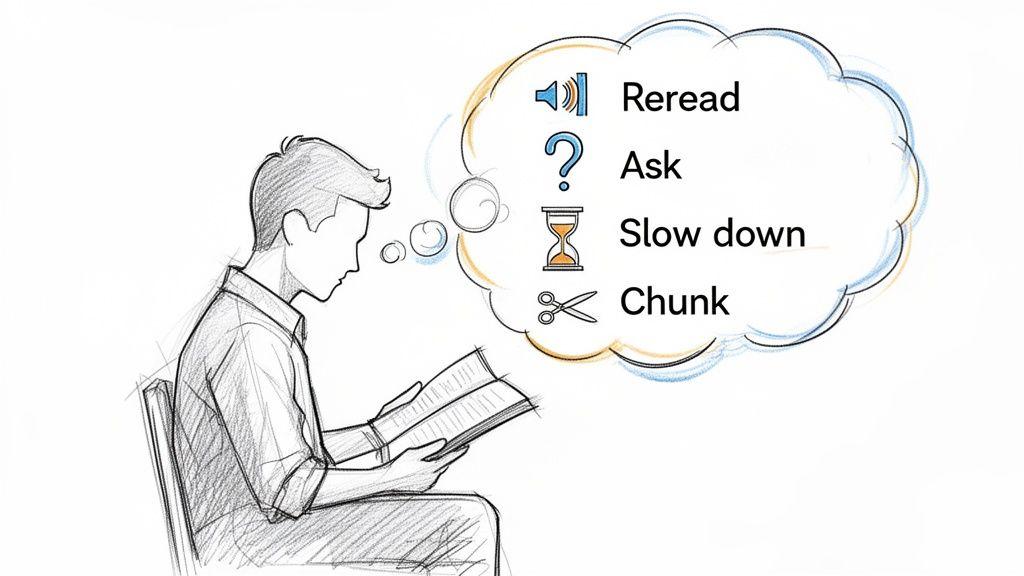
- Build a Fix-Up Toolkit: Explicitly teach and practice 5-7 strategies. Options include: re-reading the confusing sentence, slowing down the reading pace, looking up a key term, asking a clarifying question, or summarizing the last paragraph.
- Think Aloud: Model the process by reading a text aloud and verbalizing your internal monologue. For example, say, "Wait, I don't understand what that word means. I'm going to re-read the sentence to look for context clues."
- Use AI for Support: When students get stuck, tools like 1chat can act as a targeted intervention. High schoolers can ask it, "Can you explain this paragraph about cellular respiration in simpler terms?" This provides instant support without giving away the answer, helping them repair understanding and move forward.
- Create Visual Reminders: Post a chart in the classroom or study area with "Comprehension Check" questions ("Does this make sense?") and a list of fix-up strategies.
Key Insight: This strategy shifts the responsibility for understanding from the teacher to the student. By equipping learners with a toolkit to diagnose and solve their own comprehension problems, you empower them to tackle complex texts independently.
Ultimately, metacognitive monitoring helps students understand that confusion is a natural part of learning, not a sign of failure. It provides them with the concrete tools needed to overcome those hurdles, a critical skill for academic success and lifelong learning.
Reading Comprehension: 10-Strategy Comparison
| Strategy | Complexity (🔄) | Resources & Tools (💡) | Key Advantages (⭐) | Expected Outcomes (📊) | Ideal Use Cases |
| SQ3R Method (Survey, Question, Read, Recite, Review) | 🔄 Moderate — five-step routine | 💡 Medium — time, notes, AI (e.g., 1chat) | ⭐ Strong retention & critical thinking | 📊 Improved long-term memory and research readiness | College/high-school research; deep document analysis |
| Annotation and Highlighting Strategy | 🔄 Low — simple marking practice | 💡 Low — highlighters, marginal notes, scanned PDFs | ⭐ Quick visual reference; supports review | 📊 Faster review and clearer main/supporting idea distinction | Visual learners; exam prep; document-heavy tasks |
| Summarization and Paraphrasing | 🔄 Medium — requires judgment and writing | 💡 Medium — writing practice, AI verification tools | ⭐ Deepens understanding; improves writing skills | 📊 Concise study materials and gap identification | Essay writing; research synthesis; plagiarism-safe paraphrasing |
| Questioning Strategy (Self-Questioning) | 🔄 Medium — needs question-level training | 💡 Low–Medium — prompts, Bloom's taxonomy, AI question banks | ⭐ Enhances metacognition and critical analysis | 📊 Better comprehension monitoring and deeper insights | Critical thinkers; collaborative study; research preparation |
| Chunking and Segmentation | 🔄 Low — divide-and-conquer approach | 💡 Low — headings, outlines, AI chunk analysis | ⭐ Reduces cognitive load; creates checkpoints | 📊 Improved focus and systematic long-document processing | Long reports; busy professionals; attention-challenged students |
| Concept Mapping & Graphic Organizers | 🔄 Medium — planning and spatial layout | 💡 Medium — paper/digital mapping tools, AI validation | ⭐ Clarifies relationships; aids memory recall | 📊 Visual study guides and stronger relational understanding | Complex topics; visual learners; collaborative projects |
| Predicting & Making Connections | 🔄 Low — pre/post reflection routine | 💡 Low — prompts, journals, AI cross-document search | ⭐ Activates prior knowledge; raises engagement | 📊 Stronger inference skills and motivated reading | Literature discussions; research prediction; classroom dialogue |
| Context Clues & Vocabulary Strategy | 🔄 Low — word-level inference practice | 💡 Low — texts, dictionaries/AI for verification | ⭐ Builds vocabulary and reading fluency | 📊 Faster comprehension of unknown words; improved fluency | Language learners; vocabulary development; ESL support |
| Reciprocal Teaching Strategy | 🔄 High — structured group roles and scaffolding | 💡 High — teacher training, time, discussion guides, AI partner | ⭐ Powerful collaborative comprehension gains | 📊 Improved peer-led understanding; effective for struggling readers | Literature circles; group study; distance learning |
| Metacognitive Monitoring & Fix-Up Strategies | 🔄 Medium — requires metacognitive training | 💡 Medium — checklists, strategy toolkit, AI check-ins | ⭐ Builds independence and self-regulation | 📊 Better self-repair, confidence, and lifelong learning skills | Independent learners; struggling readers; professional development |
From Strategy to Skill: Making Reading Comprehension Second Nature
The journey from decoding words to truly understanding ideas is a personal one for every student. The ten powerful reading comprehension strategies for students detailed in this article are not rigid rules to be memorized, but rather a collection of flexible, adaptable tools. Think of them as a reader's toolkit. Just as a carpenter selects the right tool for a specific task, a skilled reader learns to choose and combine strategies to construct meaning from any text they encounter.
This exploration has shown that active engagement is the common thread weaving through all effective comprehension methods. From the structured five-step process of the SQ3R Method to the creative, visual organization of Concept Mapping, each strategy pulls the reader out of a passive role. It asks them to become an active participant: a questioner, a predictor, a summarizer, and a critical thinker. By internalizing these approaches, students move beyond simply extracting information and begin to interact with it, evaluate it, and connect it to their own world.
The Power of Integration and Adaptation
The true mastery of these skills emerges not from using each strategy in isolation, but from blending them into a seamless, intuitive process. The most proficient readers rarely think, "Now I will use the chunking strategy." Instead, they naturally break down a difficult paragraph while simultaneously annotating key terms and asking themselves questions about the author's intent.
Consider these practical combinations for different learning scenarios:
- For Dense Textbooks: A student might begin with the SQ3R Method to get a broad overview. During the "Read" phase, they can apply Chunking to break down long chapters and use Annotation to highlight core concepts and define unfamiliar vocabulary using Context Clues.
- For Complex Fiction: A reader could use the Predicting and Making Connections strategy to stay engaged with the plot and characters. They might pause periodically to practice Summarization, ensuring they are following the narrative's progression and character development.
- For Group Study: The Reciprocal Teaching model provides an excellent framework for collaborative learning. Within this structure, students can collectively build a Concept Map on a whiteboard to visualize relationships between ideas or practice their questioning and clarifying skills.
The goal is to foster a state of Metacognitive Monitoring, where students are constantly, and almost subconsciously, checking their own understanding. When confusion arises, they have a ready set of "fix-up" strategies to deploy, turning a moment of difficulty into an opportunity for deeper learning.
Your Actionable Next Steps
Building these cognitive habits requires deliberate practice and thoughtful support from both educators and families. The key is not to overwhelm but to introduce and reinforce these methods over time.
- Start Small: Introduce one or two new strategies at a time. Focus on a technique like Annotation or Self-Questioning until the student feels comfortable before adding another to their repertoire.
- Model the Process: Educators and parents should "think aloud" while reading. Show students how you make predictions, how you use context clues to figure out a word, or how you summarize a section in your own words. This demystifies the internal process of skilled reading.
- Encourage Reflection: After a reading session, ask reflective questions. "Which strategy helped you the most with that chapter? Why?" or "Was there a point where you felt confused? What did you do to understand it better?" This builds the crucial metacognitive muscle.
Ultimately, strengthening reading comprehension is about more than achieving higher test scores or completing homework assignments. It's about empowering students with the fundamental ability to learn independently, to think critically about the world around them, and to engage with the vast wealth of human knowledge and stories. By consistently practicing these reading comprehension strategies for students, we are not just teaching a school subject; we are nurturing confident, curious, and capable lifelong learners.