At its core, research is really just about asking a good question and then going on a structured hunt for the answer. It’s not some exclusive activity locked away in a university lab. Anytime you've compared customer reviews before buying a new gadget or dug up historical facts for a presentation, you were doing real-world research.
Unpacking What Research Really Means

Think of research as a planned expedition into the unknown. It’s a systematic way to discover brand-new information or find clever new ways to use what we already know. It doesn't matter if you're a student building an argument for an essay, a business owner trying to understand your customers, or just a family figuring out the best vacation spot—you're all using research to get from a place of uncertainty to one of clarity.
But this journey isn't a random walk. It follows a reliable path. You start with a question, gather relevant information, make sense of what you’ve collected, and finally, come to a conclusion. This methodical process is what separates genuine research from aimlessly surfing the web or just asking a friend for their opinion.
The Engine of Innovation
This organized search for knowledge is what fuels progress everywhere. You can see just how much we value it by looking at the money poured into research and development (R&D). Back in 2000, global R&D spending was around $1 trillion. It has since exploded to a staggering $2.87 trillion—nearly tripling in real terms. You can dig deeper into these numbers and other global innovation trends from WIPO to see how this investment is changing our world.
That massive figure tells a simple story: research pays off. It’s the driving force behind new technologies, life-saving medicines, smarter business strategies, and a richer understanding of the world around us.
Core Components of Any Research Project
Every research project, big or small, rests on a few key pillars. Once you get these, the whole process feels a lot less intimidating and much more manageable.
At its heart, good research is about curiosity meeting structure. It transforms a simple "I wonder..." into a methodical quest for a verifiable answer, providing a reliable foundation for decisions and discoveries.
To give you a clearer picture, here’s a quick summary table to help you understand the fundamental building blocks of any research endeavor.
The Core Components of Research at a Glance
| Component | Simple Description | Example |
| Question | The specific problem or uncertainty you want to resolve. | "What marketing channel drives the most sales for our new product?" |
| Method | The plan or set of steps you will follow to find an answer. | Conducting customer surveys and analyzing website traffic data. |
| Data | The information you collect using your chosen method. | 500 survey responses and three months of Google Analytics reports. |
| Analysis | The process of interpreting the data to identify patterns or insights. | Finding that 60% of sales came from social media ads. |
| Conclusion | The final answer to your initial question, based on your analysis. | "Social media advertising is currently our most effective channel." |
Seeing it laid out like this shows that any research project, no matter how complex it seems, is just a combination of these five straightforward parts. Master them, and you can tackle any question.
Basic vs. Applied Research: What's the Difference?
Once you get a feel for what research is, you'll start to see it's not a one-size-fits-all activity. It generally splits into two main paths, and the key difference is the why behind the work. It’s not a matter of one being superior; they simply have different starting points and end goals. The two big players here are basic research and applied research.
Imagine a chef in a culinary lab. One day, she might be fascinated by the fundamental science of how salt crystals react with different types of acids. She isn't trying to perfect a recipe—she’s just driven by a deep curiosity to figure out how these ingredients work together at a chemical level. That’s basic research in a nutshell: a search for knowledge for its own sake.
The very next day, that same chef could be tasked with developing a new salad dressing that won't separate on supermarket shelves. Now, she'll pull from her deep understanding of salt, acids, and emulsions to tackle a specific, commercial problem. This is applied research—it's all about finding a practical solution to a real-world challenge.
Basic Research: Laying the Groundwork
You'll sometimes hear basic research called "pure" or "fundamental" research, and that gets right to the heart of it. The goal is to push the boundaries of human knowledge, not to create a product. It's driven by foundational "why" and "how" questions.
A few examples might be:
- A biologist figuring out the precise function of a protein within a cell.
- An astronomer mapping distant galaxies to better understand the Big Bang.
- A sociologist observing how unspoken social rules form in online forums.
These projects might not have an immediate, marketable outcome. But they fill the library of knowledge that all future inventions and solutions draw from. A seemingly obscure discovery in basic research today could easily become the foundation for a life-changing technology a decade from now.
Applied Research: Solving Problems Now
Applied research is where theory meets reality. It takes the knowledge uncovered by basic research and puts it directly to work on a specific, immediate problem. The entire process is designed to address a pressing need for a company, a community, or society at large.
Think about a business owner. They're constantly using applied research to:
- Figure out which new feature their customers are actually willing to pay for.
- Discover a more cost-effective way to get their products from the warehouse to the customer's door.
- Test two different ad campaigns to see which one brings in more sales.
This is research with a clear mission. It's built to deliver concrete answers you can act on right away.
The relationship between basic and applied research is a true partnership. Basic research provides the fuel—the raw knowledge—and applied research builds the engine that turns that fuel into a solution. One can't get very far without the other.
This powerful cycle is what drives progress. You can even see how much countries value it by looking at what percentage of their economic output they invest in research and development (R&D). Globally, that number is hitting an all-time high of around 2% of GDP, with innovation leaders like Israel pushing that figure past 5%. You can dig into the data yourself and see how different countries invest in R&D via the OECD.
These massive investments show a global consensus: both curiosity-driven exploration and targeted problem-solving are essential for moving forward, whether that means creating life-saving vaccines or designing the next smartphone.
Choosing Your Research Tools: Qualitative vs. Quantitative
Once you’ve nailed down your research question, it’s time to pick the right tools to find the answer. This is a pivotal moment in any project. Your decision usually boils down to two main approaches: qualitative and quantitative research.
Think of them as two different types of detective work. One looks for hard evidence, the other for motive. Neither is better than the other; they just answer different kinds of questions. Understanding which one to use—or when to use both—is the secret to uncovering real insights.
Let's use a simple analogy. Imagine you're trying to figure out why a new coffee shop is so popular.
You could start by counting things. How many customers come in each day? What’s the average amount they spend? How many of them buy a latte versus a drip coffee? This is quantitative research. It’s all about numbers, data, and measurable facts. It tells you what is happening.
But numbers don't tell the full story, do they? To get the real picture, you’d need to sit down and talk to people. You’d ask them what they love about the atmosphere, why they prefer this shop's coffee, or what feeling they get when they walk in. This is qualitative research. It uncovers the context, the feelings, and the all-important "why."
Understanding Quantitative Research
Quantitative research is your go-to method when you need to deal in facts and figures. It’s objective, logical, and focused on data that can be counted and statistically analyzed. The goal here is to measure things and test a hypothesis.
Common quantitative methods include:
- Surveys and Questionnaires: Using multiple-choice, yes/no, or rating scale questions to gather data from a large group.
- Experiments: Controlling variables in a structured environment to see what happens.
- Analyzing Existing Data: Pulling numbers from sales reports, website analytics, or public datasets.
This approach is perfect for answering questions like "how many," "how much," or "how often." For instance, a software company might run a survey and find that 75% of users prefer a new feature. That's a hard, actionable number.
Exploring Qualitative Research
On the flip side, qualitative research is all about exploration. It dives deep to understand people's experiences, opinions, and motivations. You’re not counting things; you're gathering stories and perspectives. The data you collect is often in the form of words, not numbers.
Popular qualitative methods are:
- In-depth Interviews: Having one-on-one conversations with open-ended questions that let people share their stories.
- Focus Groups: Bringing a small group together to discuss a topic and see how they interact and build on each other's ideas.
- Observation: Simply watching how people behave in a natural setting, like a customer in a store.
This method gives you the human story behind the data. That software company now knows 75% of users like the new feature, but qualitative interviews could reveal why: maybe the new design feels more intuitive or it saves them a crucial ten minutes every day.
A simple way to think about it: Quantitative data gives you the "what"—the cold, hard facts. Qualitative data gives you the "so what"—the rich context that makes the facts meaningful.
Often, the most powerful insights come from using both together. You can start with qualitative interviews to form a hypothesis, then use a quantitative survey to see if your findings hold up on a larger scale.
Qualitative vs. Quantitative Research: A Head-to-Head Comparison
Choosing the right method can feel tricky, but it really just depends on what you’re trying to find out. This table breaks down the core differences to help you decide which path is right for your project.
| Characteristic | Qualitative Research (The 'Why') | Quantitative Research (The 'How Much') |
| Purpose | To explore ideas, understand experiences, and find meanings. | To measure, test hypotheses, and confirm theories. |
| Sample Size | Typically small, focusing on depth over breadth. | Usually large, aiming for statistical significance. |
| Data Collection | Interviews, focus groups, observations, and open-ended questions. | Surveys, experiments, and structured data analysis. |
| Data Analysis | Interpretation of themes, patterns, and narratives. | Mathematical and statistical analysis of numerical data. |
| Questions Asked | "Why?" "How?" "What are your experiences?" | "How many?" "How often?" "What is the correlation?" |
In the end, it all circles back to your original question. If you need to prove something with hard numbers, go quantitative. If you need to explore an idea and understand the human experience behind it, qualitative is your best bet.
Your Step-by-Step Research Journey
Starting a research project can feel a bit like setting out on a grand adventure. Without a map, it’s easy to feel lost. The good news is that nearly every successful research project, from a simple school assignment to a complex market analysis, follows a reliable six-step path that keeps you on track.
Think of it like planning a cross-country road trip. You wouldn't just jump in the car and start driving without a destination. Research is the same—it’s a journey with a clear beginning, middle, and end, where each step builds logically on the last.
Step 1: Define Your Destination
The first and most important step is to figure out exactly what you want to know. A vague idea like "I want to research social media" is a road to nowhere. A strong research question, on the other hand, is specific and focused. It acts as the North Star for your entire project.
For example, instead of that broad topic, you could ask, "How does daily social media use impact the sleep quality of teenagers aged 14-18?" Now that's a question. It's clear, it's measurable, and it gives your project a defined destination.
Step 2: Read the Travel Guides (Literature Review)
Before you hit the road, it's smart to see what other travelers have learned. This stage is called a literature review, where you dive into existing studies, articles, and data related to your question. It helps you understand what's already known, spot gaps in the current knowledge, and avoid accidentally reinventing the wheel.
This step is a massive time-saver. You might discover that someone has already answered part of your question, which means you can build on their work instead of starting from square one. It also sharpens your own approach.
Step 3: Plan Your Route (Methodology)
With your destination set and your "travel guides" read, it’s time to map out your route. This is where you decide on your research methodology. Are you going to take a quantitative approach and send a survey to 500 students? Or will you go qualitative, conducting deep, one-on-one interviews with a smaller group?
Your chosen method is your game plan for gathering the information you need. It’s a critical decision that ensures the data you collect is both relevant and reliable for answering your question.
This simple diagram shows how your question, method, and data all connect to create a solid foundation.
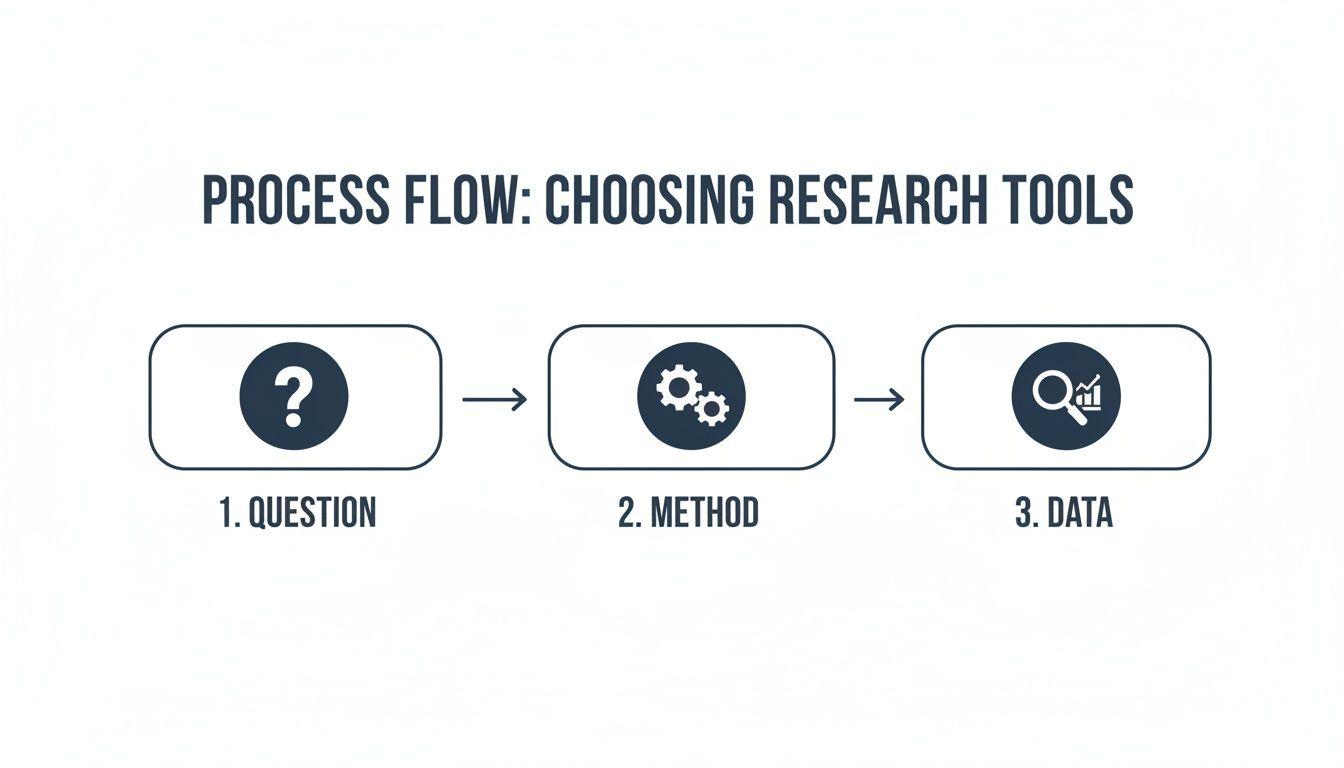
This flow—from a sharp question to the right method to targeted data—is the backbone of any effective research plan.
Step 4: Gather Your Supplies (Data Collection)
Now it’s time to actually get out there and do the work. This step is all about data collection. Whether you're sending surveys, conducting interviews, running experiments, or digging through historical archives, this is when you actively gather the raw information for your project.
Staying organized here is everything. Keep meticulous records and document your process carefully, because the quality of your raw data will directly determine how strong your final conclusions are.
Step 5: Make Sense of Your Trip (Analysis)
Once you’ve collected everything, you have a pile of raw material. The next step, data analysis, is where you organize, interpret, and start making sense of it all. If you collected quantitative data, this is where you'll run statistical analyses to find patterns and correlations.
If you gathered qualitative data, you’ll be looking for themes and narratives in your interview transcripts or observations. This is often the "aha!" moment of research, where real insights begin to emerge and the answer to your original question starts to take shape.
Step 6: Share Your Photos (Reporting)
The final step is to share what you’ve learned. This is where you present your conclusions, backed by the evidence you've gathered and analyzed. Your findings can take many forms—a formal report, an academic paper, a business presentation, or even a blog post.
The goal of research isn't just to find an answer for yourself. It's to contribute that new understanding to a broader conversation, allowing others to build on what you've learned.
A structured process like this takes the mystery out of even the most complex questions. If you're ready to build a solid framework for your next project, take a look at our guide on creating a sample research plan.
How AI Can Give Your Research a Serious Boost
The fundamental steps of good research haven't really changed, but the tools we use are getting unbelievably better. Artificial intelligence isn't here to replace the human brain; it’s more like a highly skilled assistant who can handle the most tedious parts of the job, and it’s available 24/7.
Think of platforms like 1chat as a way to do the heavy lifting. This frees you up to spend your time on what really matters: critical thinking, making connections, and uncovering genuine insights. In today's world, understanding how to work with AI is a core part of research itself. It’s all about getting from question to conclusion faster and more effectively.
This is especially true in the business world, which is a massive driver of global research. Businesses are now the top funders of research and development, with global spending recently hitting USD 2.48 trillion. Just look at the US, where the IT and communications sector made up 28% of all business R&D. With so much invested in discovery, tools that boost efficiency are worth their weight in gold. For a deeper dive, you can check out the global R&D funding and comparisons from the NSF.
AI as a Research Partner for Students
If you're a student drowning in reading lists and facing tight deadlines, AI can feel like a lifeline. The literature review, a step that used to involve days of sifting through dense academic papers, can now be done in a fraction of the time.
- Summarize Dense PDFs: Instead of battling through a 40-page study just to see if it’s useful, you can upload the PDF and ask an AI for a quick summary of its findings, methods, and main arguments. It’s a fast way to vet your sources.
- Brainstorm and Outline: Feeling stuck? Ask an AI to brainstorm research questions on a topic or generate a logical outline for your paper. This gives you a solid framework to start building on.
- Refine Your Drafts: AI can also act as an on-demand writing tutor, suggesting clearer phrasing, pointing out weak arguments, and checking for consistency in your drafts.
Boosting Business Insights with AI
In business, the speed at which you can gather and understand information is a real competitive edge. AI allows teams to analyze market data, financial reports, and competitor announcements far more quickly than any manual process.
An AI assistant doesn't just find data; it helps you find the meaning within the data. It's the bridge between a mountain of information and a clear, actionable insight.
Imagine a marketing team uploading a dozen press releases from competitors and asking, "What are the top three strategic themes our rivals mentioned this quarter?" An AI can synthesize that information in seconds, spotting trends that might have taken a human analyst hours to uncover. We actually have a whole guide on using artificial intelligence for report writing if you want to explore more practical tips.
A Secure Research Tool for Families
Research isn't just for academics and professionals. Families are constantly looking up information, whether it's for a school project or digging into a new family hobby. For parents, having a privacy-first AI tool offers a safe space for that curiosity to flourish.
A student can ask for help understanding a complex science topic without getting lost in the random, and sometimes inappropriate, results of an open search engine. Because 1chat is built with privacy at its core, families can ask questions freely, knowing their conversations aren’t being used for ad tracking. It's a reliable partner for everyday learning.
Avoiding Common Pitfalls and Upholding Research Ethics
Finding answers is only half the battle. Truly great research is defined by the quality and integrity of the journey you take to get there. It's surprisingly easy to fall into common mental traps that can twist your results, even when your intentions are good. A solid process means staying aware of these pitfalls and committing to a strong ethical foundation.
The biggest trap is probably confirmation bias. It's that natural human impulse to seek out, favor, and recall information that confirms what we already think is true. If you go into a project already "knowing" the answer, you'll subconsciously start filtering out any evidence that suggests you might be wrong.
The only way to fight this is to actively hunt for opposing viewpoints and question your own assumptions. A good researcher isn't trying to prove themselves right; they're trying to find the right answer, even if it's uncomfortable or unexpected.
The Bedrock Principles of Research Ethics
Beyond sidestepping your own biases, every researcher has a duty to follow a clear set of ethical standards. These aren't just abstract ideas—they're practical rules that ensure your work is honest, respectful, and responsible. Think of them as the pillars holding up the credibility of your entire project.
Three core principles are absolutely essential:
- Honesty and Transparency: This is all about being upfront and truthful about your methods and what you found. Never, ever make up data or cherry-pick results to fit a narrative. If your study has weaknesses or limitations (and they all do), you need to acknowledge them.
- Respect for Intellectual Property: It's simple: give credit where it's due. This is the heart of avoiding plagiarism. Citing your sources correctly not only honors the work of others but also lets your audience follow your trail of evidence back to its origin.
- Protection of Participants: If your research involves people, your number one job is to protect their well-being. This means getting their informed consent, protecting their privacy by keeping personal data confidential, and making sure they aren't put at risk by participating.
Upholding research ethics is non-negotiable. It’s the system of trust that allows us to build upon each other’s work and move knowledge forward. A single dishonest study can damage the credibility of an entire field.
For businesses, this means handling customer data with care and being honest in marketing claims. For students, it's about the critical importance of academic integrity and proper citation. A huge part of this is learning to spot and use trustworthy information, and our guide on what is a credible source is a great place to start.
At the end of the day, following these principles ensures your research adds real, reliable value—whether you're in a classroom, a boardroom, or a lab.
Common Research Questions, Answered
Even with a solid plan, a few questions always come up. Here are some of the most common ones we hear, with straightforward answers to help you stay on track.
How Do I Pick the Right Research Method?
Let your main question lead the way. What you’re trying to discover should always dictate the tools you use to find it.
Are you after hard numbers and measurable trends? Something like, "What percentage of our users click this button?" That calls for a quantitative method, like a survey sent to a large group. You'll get concrete data you can analyze statistically.
But if you need to understand the why behind the numbers—why do they click that button, what are they thinking?—you'll want to go with a qualitative method like one-on-one interviews. The richest insights often come from using both, giving you the full story.
What’s the Difference Between Primary and Secondary Research?
This one is all about who gathered the information first. Think of it like cooking: are you making a sauce from scratch or using one from a jar?
- Primary Research: This is you, in the kitchen, chopping the tomatoes. You're collecting brand-new information directly from the source through your own surveys, experiments, or focus groups to answer your specific question.
- Secondary Research: Here, you're using a sauce someone else already made. You're digging into existing data that others have published, like academic studies, government census data, or market reports.
Smart research almost always starts with secondary sources to get a lay of the land. Then, you can use primary research to fill in the specific gaps nobody else has addressed.
Can AI Tools Like 1chat Just Do My Research for Me?
Not quite. It’s better to think of an AI tool like 1chat as a brilliant, lightning-fast research assistant, not as a substitute for your own brain. It can’t "do" the research for you, but it can make the whole process a lot less painful.
An AI assistant is there to handle the grunt work—summarizing dense articles, brainstorming angles, finding initial sources—freeing you up to focus on what really matters: asking sharp questions, judging the quality of information, and building your own conclusions. You're still the one in charge.
It's a powerful partner, but the critical thinking, the analysis, and the final "so what?"—that all has to come from you.
How Can I Be Sure My Sources Are Credible?
This is non-negotiable. The credibility of your sources is the foundation of your entire project. If it's weak, everything you build on top of it will be shaky.
For academic projects, stick to peer-reviewed journals, university press books, and established scholarly sources. For business or general topics, lean on government agency data (like the Bureau of Labor Statistics), reports from major industry analysts, and articles from well-known news outlets with strong fact-checking standards.
Be wary of anonymous blogs, websites with a clear agenda, or data that's more than a few years old. A solid rule of thumb is to cross-reference any critical piece of information with at least two other trusted sources. If multiple reliable outlets are reporting the same thing, you can feel much more confident in your findings.