Before you even write the first sentence, you need a game plan. A well-structured argumentative essay follows a clear, logical path: it starts with a powerful introduction and thesis, builds its case with evidence-backed body paragraphs, thoughtfully addresses opposing views, and wraps it all up with a memorable conclusion.
Think of the classic five-paragraph model as your blueprint. It's the perfect framework for constructing a persuasive argument that holds up under scrutiny.
The Blueprint for a Winning Argumentative Essay
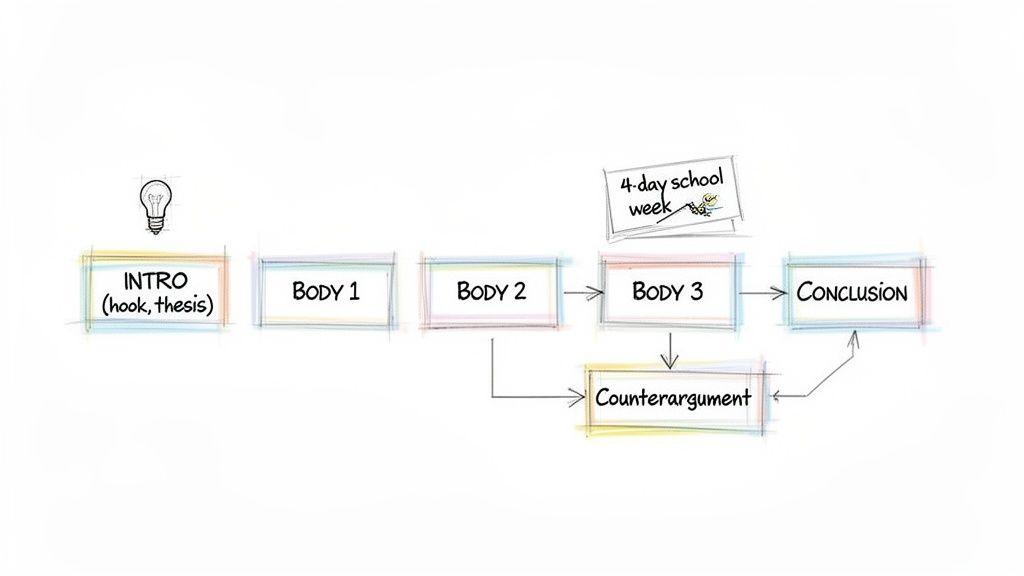
Understanding this architecture is the first step. I always tell my students to picture their essay like a house. It needs a solid foundation (the intro), strong support beams (the body), and a solid roof (the conclusion) to stand tall. Each part has a specific job, but they all work together to create something strong and convincing.
The five-paragraph structure is the most common for a reason—it works. While you’ll write much longer papers in college, the fundamental logic you learn here will carry you through.
The Essential Components
Let's walk through how this structure works using a common high school debate topic: Should schools adopt a four-day week?
- Introduction (Paragraph 1): Your job here is to hook the reader and state your claim. You'll introduce the debate around the four-day school week and end with a sharp, debatable thesis. Something like: "Implementing a four-day school week would significantly boost student well-being and academic performance, outweighing the logistical hurdles for families."
- Body Paragraphs (Paragraphs 2-3): These are the pillars holding up your argument. Each paragraph should tackle a single, distinct point that proves your thesis. For example, one paragraph could focus on how a shorter week reduces student burnout, citing attendance data. The next could present test score improvements from districts that have already made the switch.
- Counterargument & Rebuttal (Paragraph 4): This is where you show your intellectual honesty. Acknowledge a legitimate concern from the other side, like the childcare challenges it creates for working parents. Then, you dismantle it. You could argue that the long-term academic benefits justify exploring community-based solutions for that fifth day.
- Conclusion (Paragraph 5): Time to bring it home. You'll summarize your key points without just repeating them and restate your thesis with fresh language. This is your final opportunity to drive your point home and leave the reader thinking.
To help you visualize how these pieces fit together, here's a quick summary of what each part does and how much space it should generally take up.
| Essay Section | Primary Purpose | Recommended Word Count |
| Introduction | Hook the reader, provide context, and state the thesis. | 10% |
| Body Paragraphs | Present claims, evidence, and analysis to support the thesis. | 60% (20% each) |
| Counterargument & Rebuttal | Acknowledge and refute an opposing viewpoint. | 15% |
| Conclusion | Summarize the argument and provide a final thought. | 15% |
This table provides a solid guideline, but remember to adapt it to your specific assignment's requirements.
A strong structure isn't just about organizing ideas; it's a proven strategy for making them more convincing. When your reader can easily follow your train of thought, they are far more likely to be persuaded by it.
Why Structure Is Your Secret Weapon
Following this blueprint isn't just about checking boxes for your teacher. It fundamentally strengthens your argument. In fact, research on student writing shows a direct link between essay structure and overall quality.
One analysis found that effectively weaving in evidence from credible sources can boost the justification for your claims by as much as 35%. A well-placed counterargument can strengthen your position by another 28%. These aren't small numbers! A methodical approach truly pays off.
Once you get the hang of this framework, you'll have a reliable roadmap for any topic you're assigned. To see how these principles look on paper, check out our helpful collection of essay outline examples. Mastering this structure is the key to turning scattered ideas into a focused, powerful argument.
Crafting a Compelling Introduction and Thesis
Think of your introduction as the first handshake. It's your one chance to grab your reader's attention and set the stage for the argument you’re about to make. A weak opening can lose your audience before they even get to your core points. It’s like the first thirty seconds of a movie trailer—it has to be compelling enough to make someone want to see the whole film.
Your first job is to create a "hook," a sentence or two that pulls the reader right in. This doesn't mean you need to be overly dramatic, just interesting. A surprising statistic, a well-placed question, or a short, relevant story can all work wonders.
The Art of the Hook
The best hooks are directly tied to your topic and guide the reader smoothly toward your main argument. You want to provide just enough context to get them oriented without giving away the entire game upfront.
Here are a few different ways you can hook your reader:
- A Surprising Fact: "The United States spends roughly $80 billion on fast food every single year, a figure that has more than doubled since the 1970s." This immediately shows the scale and importance of your topic.
- A Thought-Provoking Question: "If technology is meant to connect us, why do studies consistently show a rise in loneliness among teenagers?" This invites the reader to ponder the question and makes them curious to hear your take.
- A Relevant Anecdote: Start with a common scenario. "Most college students know the late-night stress of cramming for an exam, but few realize this ritual is one of the least effective ways to actually learn."
The goal is simple: create intrigue. Once you have their attention, you can lead them to the single most important sentence in your entire essay—the thesis statement.
Developing a Strong Thesis Statement
Your thesis isn't just a topic; it's the core argument of your paper, distilled into one clear, assertive sentence. It's the promise you make to your reader about what you're going to prove and how you're going to prove it. A fuzzy thesis almost always leads to a muddled, unconvincing essay.
A solid thesis statement has to be:
- Arguable: It must be a claim someone could reasonably disagree with. "Pollution is bad for the environment" isn't an argument; it's a fact. A better, arguable thesis would be: "A federal carbon tax is the most effective strategy for combating industrial pollution."
- Specific: It needs to be narrow enough to be fully explored in your essay. "Social media has a negative effect on society" is way too broad. A more specific version is: "The algorithmic feeds on platforms like TikTok and Instagram contribute to decreased attention spans in adolescents."
- A Roadmap: It should give the reader a preview of your essay's structure. Your main points, which will become your body paragraphs, should be hinted at.
Your thesis statement is the backbone of your essay. Every claim, piece of evidence, and analysis you include later on must directly support this central idea.
For instance, a high school student arguing for school uniforms might land on this thesis:
- "School uniforms should be mandatory in all public schools because they reduce peer pressure over clothing, minimize classroom distractions, and foster a stronger sense of school identity."
This is a great thesis. It takes a clear stance (pro-uniforms) and lays out the three key points the essay will cover: peer pressure, distractions, and school identity. Getting this one sentence right is so crucial that it's worth taking the time to learn how to write a great thesis statement before moving forward.
A college-level thesis on a more complex topic, like energy policy, would still follow the same fundamental principles:
- "While a full transition to renewable energy is critical, a federal policy that prioritizes nuclear power over solar and wind offers a more reliable and scalable path to achieving carbon neutrality by 2050."
This thesis is more nuanced. It acknowledges a counter-position ("transitioning is essential") before stating its own specific, comparative argument. Mastering this one sentence is a massive step toward structuring a powerful and effective argumentative essay.
Building Your Case with Evidence-Driven Body Paragraphs
The body paragraphs are where the real work of your essay happens. Think of your thesis as a promise you made to the reader in the introduction; now it’s time to deliver on it. Each body paragraph is a mini-argument, a single, focused point that proves one piece of your overall thesis.
I like to tell my students to think of themselves as a lawyer in a courtroom. You can't just tell the jury your client is innocent. You have to present clear, distinct pieces of evidence—a witness testimony here, a forensic report there—and crucially, explain exactly how each piece proves your case. Your body paragraphs function the same way.
The Power of the CEW Framework
One of the most effective tools for building a rock-solid paragraph is the Claim, Evidence, Warrant (CEW) model. It’s a simple but incredibly powerful framework that forces you to build logical, well-supported arguments. Instead of just trying to fill the page, CEW gives you a clear recipe for every paragraph.
Here’s a quick breakdown:
- Claim: This is your topic sentence. It’s a specific, arguable statement that supports a small piece of your main thesis.
- Evidence: This is your proof. It's the "for example" part—a statistic, a direct quote, a factual example, or data from a credible source.
- Warrant: This is the most important part, and it’s the one most people forget. The warrant is your explanation. It’s the "so what?" that connects the evidence back to your claim, telling the reader why this proof matters.
Without a strong warrant, you’re just dropping facts onto the page and hoping your reader connects the dots. A good writer never leaves that to chance. The warrant does the heavy lifting, making your logic undeniable.
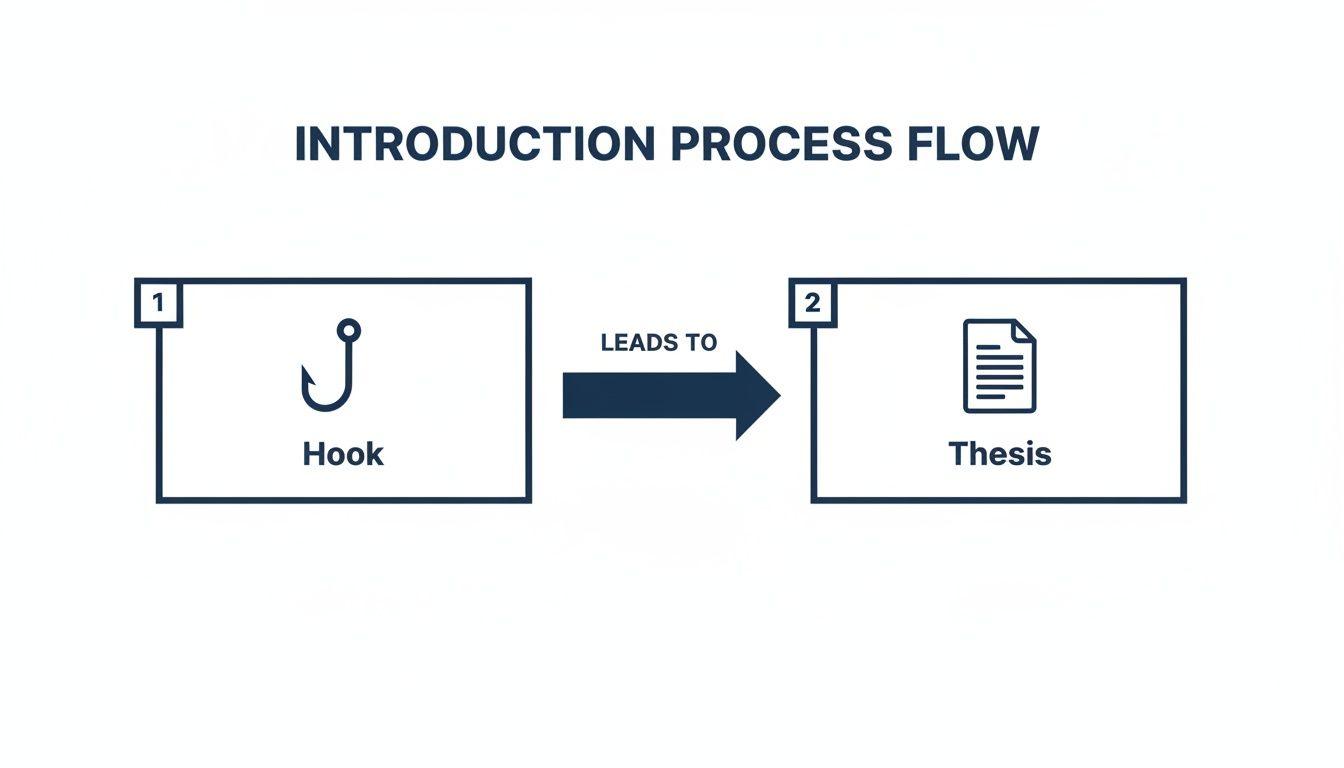
As you can see, the thesis statement is the central hub from which all your paragraph claims will extend.
From Claim to Persuasion: A Practical Example
The CEW model provides a logical blueprint for constructing each body paragraph. Below is a practical example showing how these three components work together to build a convincing point.
| Claim vs Evidence vs Warrant Example | ||
| Component | Definition | Example (Topic: Plastic Bag Fees) |
| Claim | The paragraph's main point; a mini-thesis. | Implementing a small fee for plastic bags in grocery stores effectively encourages consumers to adopt reusable alternatives. |
| Evidence | The specific data or facts that support the claim. | After San Jose, California, introduced a 10-cent fee, there was an 89% reduction in plastic bag use in the city’s storm drain system. |
| Warrant | The explanation connecting the evidence to the claim. | This dramatic decrease shows that even a minor financial incentive is powerful enough to change consumer behavior on a massive scale, directly linking the fee to a significant reduction in plastic waste. |
This table illustrates how a paragraph moves from a general assertion to specific proof, and finally to a clear explanation of that proof's significance.
Finding and Integrating Strong Evidence
An argument is only as strong as the proof you bring to the table. Vague statements like "many people believe" or "it's commonly known that" are credibility killers. Your claims need to be anchored in concrete, verifiable facts.
When you're hunting for evidence, keep an eye out for:
- Relevant Statistics: Numbers are powerful, but make sure they come from unbiased sources like government agencies, academic studies, or reputable research organizations.
- Expert Opinions: Quoting a recognized authority in the field can add serious weight to your argument.
- Real-World Examples: A specific case study or historical event can make your point feel much more tangible and relatable to your reader.
Just finding good evidence isn't enough; you have to weave it into your writing smoothly. Avoid "quote dropping." Instead, introduce your evidence with some context. Phrases like, "According to a study from..." or "As historian Jane Doe notes..." help create a seamless flow.
Putting It All Together
Let's walk through building a paragraph from scratch using the CEW model. Imagine our thesis is: “Companies should embrace a fully remote work model because it increases employee productivity and reduces operational costs.”
Here's how we could build a body paragraph for the productivity claim.
Claim:
A fully remote work model significantly enhances employee productivity by allowing for a more focused and flexible work environment.
Evidence:
For example, a 2021 study involving 16,000 workers over nine months found that remote employees were 13% more productive than their in-office counterparts.
Warrant:
This productivity boost makes sense when you consider the reduction in typical office distractions—like casual interruptions and background noise—and the ability for employees to work during their peak focus hours. By eliminating the daily commute, remote work gives employees more control over their time, which translates directly into higher-quality output and better efficiency.
See how that works? Each sentence has a clear job, and the logic flows from the initial claim to the supporting data and the final explanation. Research actually backs this up: the quality of an essay is strongly tied to how tightly claims and their supporting data are linked. One study found that when related claims are made within one or two sentences of each other, essay scores can improve by as much as 18%.
Don't Just Argue—Anticipate: The Power of the Counterargument
A truly convincing argument doesn't live in a vacuum. The strongest essays don't just push their own agenda; they anticipate the pushback and dismantle it before the reader even has a chance to fully form the objection.
Addressing a counterargument isn't a weakness. It’s a power move. It tells your reader you've done your homework and considered the topic from every angle, which makes your own position that much stronger and more credible.
Ignoring what the other side thinks is like a defense attorney only presenting their case and hoping the jury ignores the prosecutor. You have to meet the challenge head-on. This move shows you’re intellectually honest and builds a huge amount of trust with your audience.
Find Their Best Shot and Present It Fairly
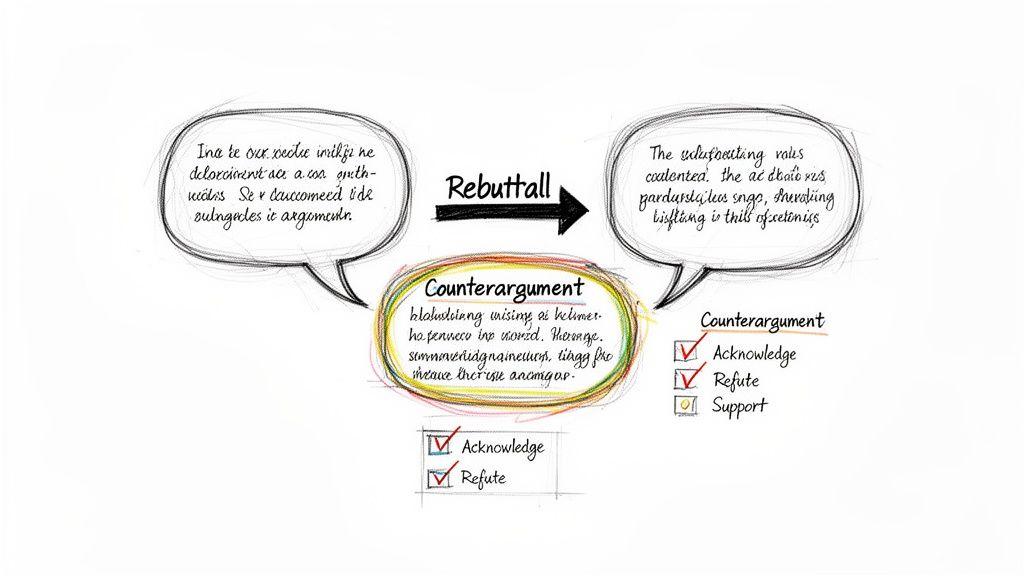
First things first, you need to pinpoint a legitimate, compelling point from the opposing side. Your goal is to take on one of their strongest arguments, not some flimsy, easy-to-dismiss idea.
Why? Because attacking a weak point—a tactic known as a "straw man" argument—actually makes you look bad. It seems like you're ducking a real fight.
Once you’ve found a solid counterpoint, you have to present it with a straight face. You’re not trying to misrepresent it; you’re showing the reader you genuinely understand the other perspective. Your tone should be neutral and objective.
For instance, say you're arguing that your city needs to invest heavily in public transit. A solid counterargument might sound like this:
"Of course, some taxpayers might argue that a major investment in public transportation is financially irresponsible. They worry it could divert crucial funds from other essential services, like road maintenance and public safety."
See how that works? It acknowledges a totally valid concern without surrendering any ground. Now, you've perfectly set the stage to show why, despite this concern, your argument still wins.
Master the Art of the Rebuttal
After you’ve fairly presented the counterargument, it’s time to pivot and take it apart. This is your rebuttal. Your job is to prove why the opposing viewpoint is flawed, incomplete, or simply not as important as the points you’ve already made.
A great rebuttal doesn't just stamp its feet and say, "They're wrong." It uses logic and evidence to show how and why they're wrong.
Here are a few proven strategies for your rebuttal:
- Poke Holes in Their Logic: Point out any flawed assumptions or logical fallacies in their argument.
- Acknowledge and Outweigh: Concede that their point has some truth to it, but then explain why your points carry more weight or have a bigger impact.
- Bring in New Evidence: Introduce a killer statistic or piece of evidence that directly undermines their claim.
Let's go back to the public transit example. A powerful rebuttal could sound like this:
"While the concern over the initial investment is understandable, this view completely overlooks the long-term economic benefits. In fact, studies from cities like Portland and Denver show that every $1 invested in public transit can generate up to $4 in local economic activity. This creates jobs and cuts down on traffic congestion costs, ultimately providing a return that far outweighs the initial price tag."
Boom. The rebuttal takes the financial concern and flips it on its head using hard data, turning a potential weakness into another compelling reason to support your argument.
Make Your Transitions Seamless
The flow from the counterargument to the rebuttal is crucial. If it feels clunky or awkward, you risk confusing your reader and killing your momentum. Think of it like a dance move—it needs to be smooth.
Using clear transitional phrases acts like a signpost for your reader, letting them know you're about to change direction.
Here are a few phrases that can help you nail the transition:
| To Introduce a Counterargument | To Pivot to Your Rebuttal |
| Some might argue that... | However, this perspective fails to consider... |
| Of course, opponents may point out... | While that may be true, it overlooks the fact that... |
| It is understandable why some believe... | Nevertheless, the evidence clearly shows that... |
| A common concern is that... | This argument is outweighed by the reality that... |
Mastering this two-step process is a hallmark of sophisticated writing. It shows you aren't just shouting your opinion into the void but are actually engaging in a real, thoughtful conversation.
Writing a Conclusion That Leaves an Impact
Your conclusion is the last thing your reader sees, so it’s your final chance to make your argument stick. A limp ending can undermine all the effort you poured into the rest of the essay. The goal isn't just to stop writing; it's to seal the deal and leave your reader with a sense of closure, completely convinced of your point.
Think of it like a lawyer's closing argument. You've laid out all the evidence. Now, you need to connect all the dots one last time and leave no doubt in the jury's mind. Simply rehashing your points won't cut it. You need to synthesize them, showing how they all work together to prove your thesis.
Restate Your Thesis with Finesse
Start by bringing it all back to your main point—your thesis. But please, don't just copy and paste it from the introduction.
Rephrasing your argument in fresh language shows a deeper command of your topic. It signals that you've come full circle in your thinking, not just mechanically repeated a sentence.
For instance, if your original thesis was:
"Implementing a four-day school week would significantly boost student well-being and academic performance."
In your conclusion, you could rephrase it like this:
"Ultimately, the evidence confirms that a condensed school week is a powerful tool for improving both how students learn and how they feel."
See the difference? It has the same core idea but with a more confident, conclusive tone.
Synthesize, Don't Just Summarize
After you’ve restated your thesis, you’ll want to briefly revisit your main points. The magic word here is synthesis, not summary.
Don't just give me a laundry list of your topic sentences. Show how your claims are interconnected, how they build on each other to create a single, cohesive, and powerful argument. This is your chance to show the reader the logical journey you've taken them on.
It's interesting to note that how we do this can be culturally influenced. A study on argumentative essays found that 86% of essays from Tswana learners were structured anti-climactically, with arguments presented in descending order of importance. This is a common pattern in high-context cultures, which really underscores how important it is to know your audience. You can learn more about these fascinating cultural patterns in argumentative writing on aclanthology.org.
Leave a Lasting Impression
Your final sentences are your mic-drop moment. This is where you zoom out and give your reader something to chew on. You need to answer that lingering "So what?" question for the last time.
Here are a few solid strategies to close out your essay with a bang:
- Propose a Solution or Call to Action: If you’ve been writing about a problem, offer a concrete next step. Urge the reader to do something. This works great for persuasive topics.
- Connect to a Broader Context: Show how your argument plugs into a bigger picture—a social issue, a historical moment, or a future possibility. This gives your work more weight.
- End with a Provocative Question: A really sharp, thought-provoking question can keep your reader engaged with your topic long after they’ve put your essay down.
What to Avoid in Your Conclusion The biggest pitfall is introducing brand-new evidence or a completely new argument in your last paragraph. Resist the urge! The conclusion is for tying things up, not opening a new can of worms. Stick to the ideas you've already carefully developed and proven.
Your Top Questions About Structuring an Argumentative Essay
Once you get the hang of the basic building blocks of an argumentative essay, a lot of smaller, more specific questions tend to pop up. That's totally normal. Think of this section as a quick-reference guide where I'll tackle the most common questions students ask about structure.
How Long Should an Argumentative Essay Be?
The classic model everyone learns in high school is the five-paragraph essay, which usually works out to be between 600 and 1,000 words. It’s a great starting point because it teaches you to build a tight, logical argument with an intro, three supporting points, and a conclusion.
But in reality, there's no magic number. The "right" length is whatever your assignment calls for. When you get to the college level, it's not uncommon for these papers to stretch to ten pages or even more.
My Advice: Always, always default to your instructor's guidelines. If they don't give you a word count, the five-paragraph structure is a safe bet. It proves you can build a complete argument from start to finish.
Do I Really Need Three Body Paragraphs?
Nope! The "rule of three" is more of a helpful guideline than a hard-and-fast rule. The real driver behind your paragraph count should be the number of distinct, important points you need to make to prove your thesis.
Think of it this way:
- Complex Arguments: If your thesis is layered or you have several key pieces of evidence to analyze, you’ll naturally need more than three body paragraphs to do it justice.
- Simpler Arguments: Sometimes, a more focused claim is better served by two incredibly strong, well-developed paragraphs than by three that feel a bit thin.
The goal here is always quality over quantity. Each paragraph needs to function as a solid mini-argument, complete with its own claim, evidence, and warrant. Don't add a paragraph just to hit a number; add it because you have another crucial point to make.
Where Does the Counterargument Go?
You’ve got a couple of strategic options here, and the best choice really depends on the natural flow of your argument.
- Before the Conclusion (The Classic Spot): The most common approach is to place the counterargument and your rebuttal right before the conclusion. This lets you wrap up your main points, skillfully acknowledge the other side, and then use your rebuttal to pivot powerfully into your final thoughts. It’s a strong way to end.
- Right After the Introduction: Some writers prefer to tackle the main objection right away. This can be a savvy move because it gets the biggest "but what about..." question out of the way early. Your reader can then focus on your evidence without that nagging doubt in the back of their mind.
Honestly, the "before the conclusion" method is usually the safest and most effective, especially if you're still getting comfortable with this form of writing.
What if I Can't Find Evidence for My Claim?
This is a classic problem, and it’s actually a really important moment in the writing process. If you’re hitting a wall finding credible sources, it’s a red flag for one of two issues.
First, your claim might be too broad or fuzzy. A statement like "Social media is bad" is almost impossible to prove with evidence. But if you narrow it down to something like, "The algorithmic nature of social media feeds contributes to political polarization," you suddenly have a specific, researchable topic.
Second—and this is the tough one—your claim might just be wrong. It’s hard to admit, but intellectual honesty is at the heart of good writing. An argument has to stand on the facts. If all the credible evidence you find points the other way, it's time to re-evaluate your thesis.
Remember, the point isn’t just to “win.” It’s to arrive at a well-reasoned conclusion based on proof. Changing your mind in the face of strong evidence isn’t failure; it’s the mark of a thoughtful writer.
Can My Introduction Be More Than One Paragraph?
For longer, more complex essays? Absolutely. While the single-paragraph intro is the go-to for a standard five-paragraph essay, advanced academic papers often need a bit more runway.
In those longer papers, your introduction might need a few paragraphs to:
- Provide Deep Background: If your topic is niche or has a lot of important history, you need space to bring your reader up to speed.
- Define Key Terms: Sometimes an entire argument rests on a specific definition that you need to establish upfront.
- Review Existing Literature: At the college level, you’re often expected to briefly summarize what other experts have already said on the topic before you introduce your own take.
For most high school and early college essays, a single, sharp paragraph gets the job done perfectly. Just make sure it hooks the reader, gives a little context, and clearly states your thesis. Anything more should have a very specific purpose.