Learning how to write a good conclusion is really about mastering the art of the final impression. It boils down to three key things: restating your main point in a new way, pulling all your arguments together, and leaving your reader with one final, memorable thought that shows them why your topic truly matters.
Why Your Conclusion Is Your Most Powerful Paragraph
So many writers treat the conclusion like an afterthought—just a quick summary tacked on at the end. That’s a huge missed opportunity. Your introduction’s job is to get someone to start reading, but your conclusion? Its job is to make them think, feel, and remember what you said.
This is your last chance to drive your point home and really cement your credibility.
Think of it like the final scene in a movie. It’s that moment where all the different threads come together to deliver a powerful, satisfying resolution. A weak ending can sour an otherwise great film, and the exact same thing happens in writing. Your conclusion is where you finally answer the "So what?" question that's been quietly sitting in the back of your reader's mind.
The Psychology of Firsts and Lasts
The power of a great conclusion is backed by a solid psychological principle known as the serial-position effect. This is just a fancy way of saying our brains are wired to remember the first (primacy) and last (recency) things we hear or read far better than anything in the middle. Your intro grabs their attention, sure, but your conclusion is what sticks with them.
The research on this is pretty clear. Some studies suggest that around 80% of readers remember the conclusion most vividly, which gives it an outsized impact on how they feel about your entire piece. This makes it an incredibly important tool, whether you’re finishing a college essay or closing out a business proposal.
It’s Synthesis, Not Just a Summary
Here’s where many people go wrong: they think a conclusion is just a summary. While it does need to recap your points, its real job is to synthesize them.
- A summary just repeats: "This paper discussed the causes, effects, and solutions for deforestation." It's flat.
- Synthesis connects the dots for new insight: "By looking at the interconnected causes and devastating effects of deforestation, it’s clear that sustainable forestry isn't just an environmental choice but an economic and ecological necessity for our future." See the difference?
An effective conclusion always rephrases the thesis with fresh language, weaving together all the key evidence into one final, cohesive argument. In fact, data from academic writing centers shows that the best conclusions dedicate about 40-45% of their space to this synthesis, making it the real heart of the paragraph. For a deeper look at getting that core argument right from the start, check out our guide on how to write a thesis statement.
The conclusion is your final opportunity to connect with your reader. It's where you transition from simply presenting information to explaining why that information matters in the grand scheme of things.
Ultimately, learning how to write a conclusion is about understanding its strategic role. It's not just a box to check; it’s your most valuable piece of real estate for leaving a lasting impact and making sure your message resonates long after someone has finished reading.
The Three Core Elements of an Effective Conclusion
Alright, so we've established why a conclusion is so important. Now, let's get into the nuts and bolts of how to actually write one that sticks the landing. A powerful conclusion isn't just a quick summary; it's a carefully crafted ending with three distinct jobs to do. Once you get the hang of these, you'll have a reliable framework for ending any piece of writing with real impact.
Think of it as a three-part harmony: you remind your reader of the main theme, show how the different pieces of your argument fit together, and then leave them with something memorable to think about.
H3: Restate Your Thesis in a New Light
First things first, you need to bring your main point—your thesis—back into focus. But this is crucial: you can't just copy and paste it from your introduction. That feels lazy. The goal is to rephrase your thesis using more confident, conclusive language, reflecting the journey you've taken the reader on.
This isn't just about avoiding repetition; it's about showing growth. For example, let's say your paper started with the thesis, "Social media negatively impacts teenage mental health." After presenting all your evidence, your restated thesis in the conclusion might sound more like this: "The evidence makes it clear that constant exposure to curated perfection on social media platforms cultivates an environment where adolescent anxiety and depression can flourish." See the difference? The second version is richer and carries the weight of your entire argument.
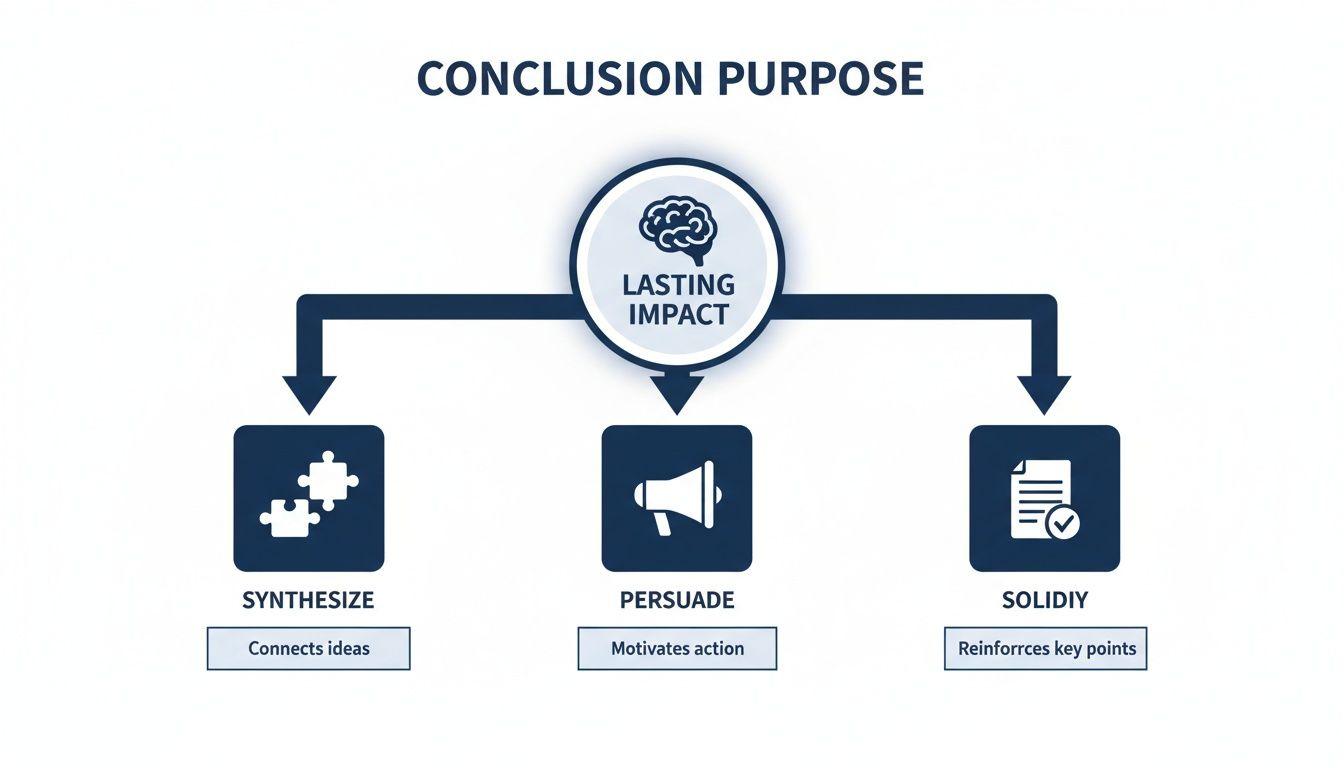
As this image shows, a great conclusion is all about creating that lasting impact. It pulls everything together to solidify your point in the reader's mind.
H3: Synthesize, Don't Just Summarize
Next up, you need to connect the dots. This is where you briefly weave your main supporting points together, showing how they collectively prove your thesis. You're not just making a list—"First I said this, then I said that." Instead, you're revealing the bigger picture you've been painting all along.
This step shows your reader that your arguments were strategic, not just a random collection of ideas. A good synthesis might sound something like: "By linking the addictive nature of algorithmic feeds with the developmental vulnerabilities of the teenage brain, a clear pattern of systemic risk emerges."
A smooth transition is key here. You want to signal that you're wrapping up without being clunky. Choosing the right words can make all the difference. For some great ideas, check out our guide on good transition words for a conclusion.
H3: Answer the "So What?" Question
This is the final, most important part. It's your mic-drop moment. Here, you have to answer the reader's unspoken question: "So what?" Why should they care about any of this? You need to explain the broader implications of your argument, pushing beyond the boundaries of your paper or report.
This is what elevates a good conclusion to a great one. It gives your reader a lasting takeaway. This final thought can come in a few different flavors:
- A Call to Action: "It's therefore imperative for parents and educators to collaborate on creating healthier social media guidelines for young people."
- A Look to the Future: "If these trends continue unchecked, we risk raising a generation defined more by digital anxiety than by real-world connection."
- A Provocative Insight: "Perhaps the true cost of our hyper-connected world is a profound, and ironic, sense of personal isolation."
It's this last part that so many writers struggle with. In fact, studies of student writing show that a staggering 60-70% have trouble crafting an effective conclusion. That’s why many writing centers now teach structured frameworks like this one, which have been shown to improve writing quality by an average of 25-30%. It’s not about being formulaic; it’s about having a reliable strategy to end strong.
Here’s a quick breakdown of these three essential components.
Three Core Elements of an Effective Conclusion
| Component | Purpose | What to Include |
| Rephrased Thesis | To remind the reader of your central argument. | Your main point, stated in a new, more conclusive way. Avoid direct repetition. |
| Synthesis of Main Points | To show how your arguments connect and support the thesis. | A brief summary that links your key ideas together, revealing the "big picture." |
| Concluding Statement | To answer the "So what?" question and leave a lasting impression. | The broader implications, a call to action, a future prediction, or a powerful final thought. |
Mastering these three elements gives you a clear roadmap. Instead of just trailing off, you’ll be able to build a conclusion that feels intentional, powerful, and truly final.
Seeing Strong Conclusions in Action
Theory is one thing, but seeing how a great conclusion works in the real world is another. It’s where the abstract rules suddenly click into place. The core framework—revisiting your thesis, weaving your points together, and delivering a final "so what?"—isn't a rigid formula. Think of it more like a flexible blueprint you can adapt to any writing project.
Let's look at how this plays out in a few different scenarios, from a persuasive academic essay to a bottom-line business report. Each example shows how those essential ingredients combine to create an ending that fits the specific context and goal.
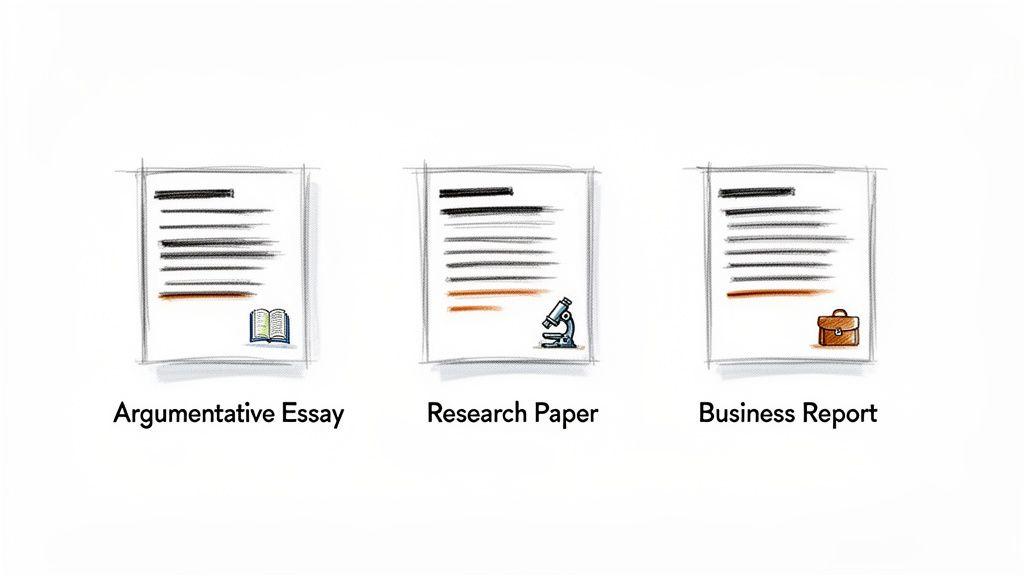
Example 1: The Argumentative Essay
With an argumentative essay, your conclusion needs to land with confidence. The goal here is to leave your reader completely convinced that your position is the right one. This is your final chance to drive your point home and seal the deal.
Topic: The environmental impact of fast fashion. Thesis (from intro): The fast fashion industry's business model is inherently unsustainable and causes significant environmental damage.
Conclusion Paragraph Example:
Ultimately, the "buy-and-toss" culture championed by fast fashion is fundamentally incompatible with environmental stewardship. The evidence is undeniable. From staggering water consumption for cotton to the microplastic pollution shed by synthetic fabrics and the mountains of textile waste choking landfills, the industry’s ecological footprint is immense. These aren't just separate problems; they are symptoms of a system that values fleeting trends over the planet's health. The most meaningful change, therefore, lies not just in corporate promises but in a collective consumer shift toward conscious consumption. As long as we treat our clothes as disposable, we are actively accepting the permanent environmental damage that comes with them.
Here’s a quick breakdown of why this works:
- Restated Thesis: "Ultimately, the 'buy-and-toss' culture... is fundamentally incompatible with environmental stewardship." It echoes the original thesis but with more definitive, powerful language.
- Synthesis of Points: It masterfully pulls together the key arguments—water use, microplastics, landfill waste—to show they form a single, overwhelming case.
- The "So What?": The last two sentences make it personal. They shift the focus to the reader's role, challenging their habits and leaving them with a powerful, thought-provoking final idea.
Example 2: The Research Paper
Conclusions in research papers are a different beast. They are more formal, objective, and focused on contribution rather than persuasion. The main job is to summarize your findings, explain their importance within the wider academic field, and point the way for future researchers.
Topic: The effect of remote work on employee productivity and well-being. Thesis (from intro): This study investigates whether the shift to remote work has had a net positive or negative impact on employee productivity and mental well-being.
Conclusion Paragraph Example:
In summary, our findings indicate that while remote work is associated with a 13% increase in self-reported productivity, it also correlates with a notable rise in feelings of professional isolation. The synthesis of performance data and survey responses suggests a complex trade-off: employees gain autonomy but risk losing the collaborative and social benefits of a physical office. This research, therefore, underscores the critical need for organizations to implement structured virtual team-building and communication protocols to mitigate these downsides. Future studies should aim to explore the long-term effects of hybrid models, which may offer a more sustainable balance between employee independence and organizational cohesion.
Let's dissect this one:
- Restated Thesis/Findings: The first sentence gets straight to the point, summarizing the core result of the study.
- Synthesis of Points: It connects the two key data points (productivity up, isolation up) to create a more nuanced picture of what’s really happening.
- The "So What?": This conclusion answers the "so what" in two ways. First, it offers a practical recommendation for companies. Second, it points to the next logical step for researchers, suggesting a specific path for future studies.
Example 3: The Business Report
In business, you need to be direct and actionable. A report's conclusion should immediately summarize the most important takeaways and provide clear, data-backed recommendations. No fluff. The reader needs to finish knowing exactly what you found and what they should do next.
Topic: Q3 Social Media Marketing Performance Analysis. Goal (from intro): To analyze the performance of our Q3 social media campaigns and provide recommendations for Q4.
Conclusion Paragraph Example:
The Q3 data confirms that while our overall social media reach grew by 15%, engagement rates dropped by a concerning 22%, primarily on Instagram. This divergence shows our content strategy is successfully capturing new eyeballs but failing to foster meaningful interaction, which ultimately hurts our return on investment. Based on these findings, we recommend reallocating 30% of the Q4 content budget from broad awareness campaigns to targeted, interactive video content. Making this strategic pivot will help us convert our expanded audience into a more loyal and active community.
Breaking down this business-focused conclusion:
- Restated Findings: The opening sentence is all business, presenting the key metrics (15% reach vs. 22% engagement drop) without any preamble.
- Synthesis/Implication: It immediately explains why this data matters—audience growth is meaningless if it doesn't lead to a positive ROI.
- The "So What?" / Call to Action: The conclusion gives a specific, measurable recommendation: reallocate 30% of the budget to a different content type. It ends by stating the clear business benefit of taking this action.
7 Common Conclusion Mistakes and How to Fix Them
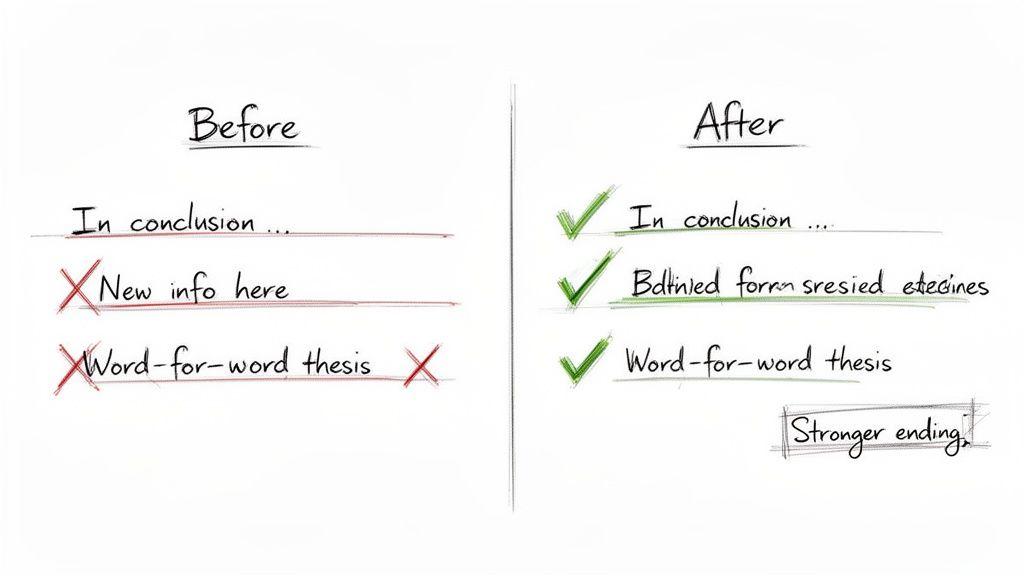
Knowing how to write a good conclusion is one thing, but knowing what not to do is just as critical. The final paragraph is where even seasoned writers can stumble, accidentally undermining all the hard work that came before it.
These mistakes often pop up when you're just trying to get the piece finished. But with a bit of awareness, you can easily sidestep these common traps and make your endings far more powerful. Let's break down the frequent offenders.
1. Dropping in New Information
This is the golden rule of conclusions: do not introduce new evidence, arguments, or ideas. Your conclusion is for tying everything together, not for unraveling a new thread. Tossing in a fresh point at the last minute just confuses your reader and makes your work feel incomplete.
It creates a "wait, what about that?" moment, leaving them wondering why this shiny new idea wasn't important enough to be discussed in the body of your text.
- What it looks like: "In conclusion, reducing plastic waste is essential for ocean health... Additionally, the economic impact of plastic pollution on the fishing industry is another area that needs to be considered."
- The fix: "In conclusion, reducing plastic waste is an essential step toward safeguarding ocean health. Failing to act now means passing on a legacy of pollution, a consequence with both devastating ecological and economic costs."
See the difference? The second version frames the economic angle as a direct consequence of the main argument, rather than a brand-new topic.
2. Leaning on Cliché Phrases
We all learned to start our final paragraph with phrases like "In conclusion," "To summarize," or "In closing." While they aren't technically wrong, in professional and academic writing, they often come across as clunky and uninspired. Your reader knows it's the end—it's the last paragraph!
These phrases are like training wheels; they signal a lack of confidence. A strong conclusion should flow naturally from the rest of your text without needing a signpost.
A truly effective conclusion doesn't need to announce its arrival. The shift in tone and the synthesis of ideas should make its purpose clear, allowing your final thoughts to stand on their own strength.
Instead of relying on a generic opener, try launching directly into your restated thesis. It's more direct, more confident, and ultimately more impactful.
3. Apologizing for Your Viewpoint
Never, ever undermine your own argument. Phrases like, "This is just my opinion," or "I'm not an expert, but..." instantly drain the authority from your writing. You've just spent an entire document building a case with evidence and logic. The conclusion is where you stand behind it.
This habit often stems from a desire to sound humble, but it translates as uncertainty to the reader. Let your evidence do the talking.
- Don't say: "While I may not have all the answers, it seems that implementing a four-day work week could be a good idea for employee morale."
- Do say: "The evidence strongly suggests that implementing a four-day work week is a strategic move to boost employee morale and productivity."
4. Repeating Your Thesis Word-for-Word
Yes, you need to restate your thesis, but that doesn't mean copying and pasting it from your introduction. Doing so feels lazy and misses a huge opportunity to show how your perspective has deepened.
Think of it this way: your introduction's thesis is the promise, while your conclusion's restated thesis is the fulfillment. It should reflect the journey the reader has taken through your arguments and evidence, using stronger, more nuanced language.
Conclusion Mistake Troubleshooting Guide
Even with the best intentions, it's easy to slip into old habits. This quick guide can help you spot and fix common errors as you review your work.
| Common Mistake | Why It's a Problem | How to Fix It |
| Introducing New Ideas | Confuses the reader and makes the piece feel unfinished. | Ensure all points are fully developed in the body paragraphs. |
| Using Cliché Starters | Sounds redundant and can weaken your tone. | Transition smoothly by starting with your rephrased thesis. |
| Being Overly Apologetic | Undermines the authority of your argument. | State your conclusions with confidence, supported by your evidence. |
| Repeating the Thesis Verbatim | Feels lazy and misses the opportunity for synthesis. | Rephrase your thesis using stronger, more conclusive language. |
By keeping these points in mind during your editing process, you can ensure your conclusion provides a satisfying, authoritative end to your writing.
How Long Should Your Conclusion Be
Figuring out the perfect length for your conclusion often feels like a guessing game. If it's too short, you leave your reader hanging. Too long, and you risk them tuning out right before the finish line. Luckily, there's a simple, practical guideline that helps you find that sweet spot.
The trick is to think in terms of proportion. Your conclusion’s length shouldn’t be arbitrary; it should directly reflect the overall length of your entire piece. This approach makes sure your final thoughts carry the right amount of weight without overshadowing all the hard work you put into the body.
Following the 10 Percent Guideline
In both academic and professional writing, a solid rule of thumb is that your conclusion should make up about 10% of your total word count. The same goes for your introduction. So, for a 1,000-word essay, you’d be aiming for a conclusion that’s roughly 100 words long. This gives you a clear target from the start.
Using this proportional method ensures your final statement feels complete and well-developed, preventing you from either rushing the ending or letting it drag on.
Here’s a quick breakdown for common lengths:
- 1,000-word essay: Your conclusion should be around 100 words.
- 1,500-word paper: Aim for a 150-word conclusion.
- 3,000-word report: Your conclusion will likely be about 300 words.
This isn't just a casual suggestion; it's a structural principle rooted in effective writing. Academic standards, like those outlined by institutions like UNE, often reinforce this, noting that for a 1,500-word essay, a 150-word introduction and conclusion are ideal. This ensures these critical sections get the space they deserve.
Beyond Word Counts: A Focus on Substance
While percentages are a fantastic starting point, they are just guidelines—not strict rules. The real measure of a good conclusion is whether it does its job: restating your main idea, tying your key points together, and leaving the reader with something memorable.
The perfect conclusion is long enough to cover its essential duties but short enough to maintain its impact. It’s about being concise and powerful, not just hitting a specific word count.
Think about the context. For a short blog post or an email, your conclusion might just be a couple of strong, punchy sentences. But for a dissertation or a dense research report, you'll naturally need a few paragraphs to properly wrap up the complex arguments you've presented.
Use the word count target to help structure your writing, not to box you in. For a deeper dive into how word counts shape your writing, check out our guide on how many words should be in a paragraph. In the end, what matters most is that your final words are meaningful and impactful—the right length will usually follow.
Your Top Questions About Writing Conclusions, Answered
Even the most seasoned writers have questions when it's time to stick the landing. It’s one thing to have a plan, but it’s another to execute it perfectly. The final paragraph is all about nuance, and getting it right can be the difference between an ending that fizzles out and one that echoes in the reader's mind.
Let's dig into some of the most common questions that pop up when writers are trying to craft that perfect final statement.
Can a Conclusion Ask a Question?
Yes, and it can be incredibly effective when done right. Ending with a rhetorical question is a classic move to get your reader thinking long after they've put your piece down. A sharp, well-aimed question can reframe your entire argument, push the reader to think more deeply, or challenge them to see the real-world consequences of what you've discussed.
The trick is to make sure the question feels earned. It should be a natural extension of your argument, not something tacked on for effect. Your goal is to spark contemplation, not ask for a simple yes or no.
For example, after an article about the environmental impact of fast fashion, you might end with: Knowing the true cost of a $5 shirt, what are we willing to change to weave a more sustainable future? That question pushes the reader to connect your points to their own choices.
What Are Good Transition Words for a Conclusion?
While it’s a good idea to steer clear of the stale "In conclusion," there are plenty of other ways to signal you're wrapping up. The best one really depends on your tone and the complexity of your argument. You want a transition that feels smooth, not like you’re pulling a ripcord.
Here are a few alternatives to get you started:
- For formal and academic writing: "Ultimately," "In the final analysis," or "Therefore, it is clear that..." work well.
- For a more conversational tone: Try something like "What this all comes down to is..." or "So, where does that leave us?"
- When you’re showing a direct result: "As a result," "Consequently," or "Given this evidence..." are all strong choices.
The best phrase is one that creates a logical bridge from your main points to your final insight.
A great conclusion doesn't just start with a transition word; it transitions in tone. The language often becomes more definitive, the perspective widens, and the focus shifts from laying out the evidence to revealing its ultimate meaning.
How Is a Conclusion Different From a Summary?
This is a big one, and it's where many writers stumble. A summary just rehashes your main points. Think of it as a checklist: "I discussed A, B, and C." It's a purely mechanical recap.
A conclusion, on the other hand, synthesizes those points to create new meaning. It's the answer to the "So what?" question. It explains why A, B, and C matter when you put them all together. It’s the difference between listing the trees and showing the reader the whole forest.
Here’s a practical example:
- A Summary: "The quarterly report showed that our operational costs went up while customer engagement went down."
- A Conclusion: "The dangerous combination of rising operational costs and falling customer engagement signals an urgent need to pivot our strategy. If we continue on this path, the business model is simply not sustainable."
See the difference? The conclusion doesn't just list the facts; it interprets them to deliver a final, meaningful judgment.
Can a Conclusion Be Two Paragraphs Long?
For most writing—essays, articles, and reports under about 5,000 words—a single, focused paragraph is your best bet. It keeps your final thoughts tight and impactful, ensuring you don’t lose your reader's attention right at the finish line. The one-paragraph conclusion is standard practice for a reason: it works.
But there are exceptions. In very long and complex documents, like a doctoral dissertation or a massive research paper, a two-paragraph conclusion can be justified. In those rare cases, the structure usually breaks down like this:
- The first paragraph synthesizes the core findings and arguments from the entire work.
- The second paragraph then looks outward, discussing the broader implications, suggesting avenues for future research, or making a final, sweeping call to action.
Only go this route if the sheer scale and complexity of your work truly demand it. For everything else, a single, powerful paragraph is the way to go.