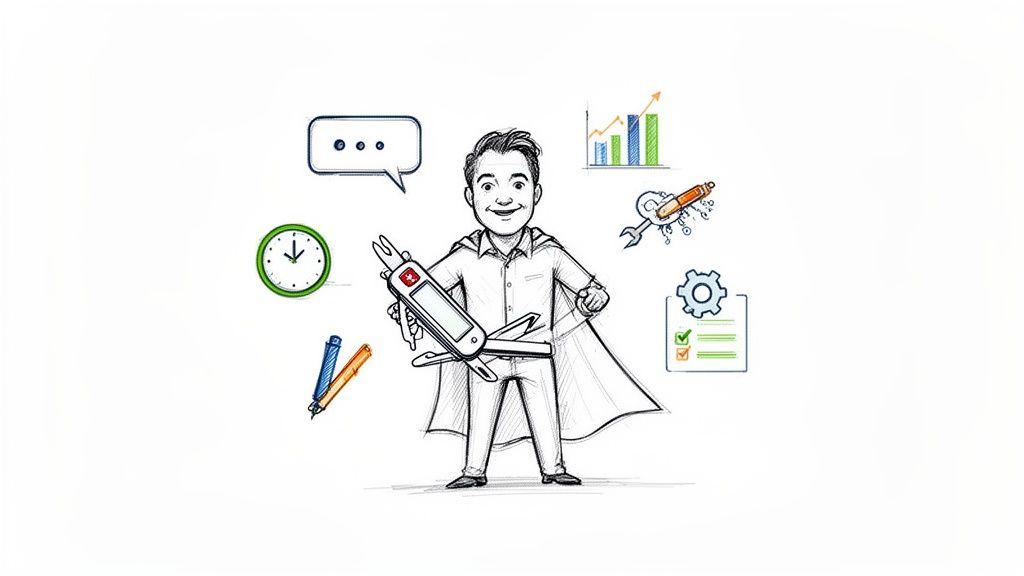
Picture having a team member who works 24/7, masters everything from marketing to operations, and never asks for a single coffee break. This isn't science fiction anymore—it's what an AI assistant for small business brings to the table. Think of it less as a piece of complicated software and more like your company's very own digital Swiss Army knife.
Your New Superpower: Unlocking Business Growth with AI
For a long time, artificial intelligence felt out of reach—something only tech giants with huge budgets could afford. That’s all changed. Today, an AI assistant is a practical, accessible tool that understands and acts on simple, conversational commands, built specifically with the small business owner in mind.
This isn't about replacing people. It's about empowering them. Every entrepreneur grapples with the same core challenges: not enough time, tight budgets, and a small team stretched thin. You’re often the CEO, head of marketing, and lead customer service rep all rolled into one. An AI assistant tackles this head-on by automating the tedious, repetitive tasks that eat up your day.
The Swiss Army Knife Analogy
Your business is a machine with a lot of moving parts. An AI assistant is the ultimate multi-tool, with a different attachment for every job you need to get done.
- The Content Creator: It can whip up drafts for blog posts, social media captions, and email newsletters in minutes.
- The Data Analyst: It can digest long reports, spot key trends in your spreadsheets, and make sense of customer feedback.
- The Customer Service Rep: It helps you write thoughtful replies to common inquiries and can build a complete knowledge base from your existing documents.
- The Brainstorming Partner: Stuck for ideas? It can generate fresh marketing angles, potential product names, or new business strategies on demand.
The real power here is that a true AI assistant isn't just one of these things—it's all of them, integrated into a single platform. This versatility is what makes it so valuable, letting you handle dozens of different needs without paying for and juggling a ton of separate apps.
An AI assistant is a productivity engine. It handles the "work before the work"—the research, drafting, and data organization—so you and your team can focus on the final, strategic decisions that drive growth.
More Than Just a Chatbot
It's crucial to understand the difference between a professional AI assistant and the free, public chatbots you’ve probably used online. While those tools are great for quick, simple questions, a business-grade assistant is in a completely different league. It’s designed for team collaboration, can securely analyze your private company files, and provides the serious data privacy needed to protect your sensitive information.
This guide will walk you through exactly how to choose and deploy the right AI assistant for your business. We’ll look at how it helps you get your time back, cut down on operational costs, and unlock your team’s creative potential. My goal is to cut through the hype and give you a practical playbook for using this superpower to not just keep up, but to innovate and win.
How an AI Assistant Changes the Game for Your Daily Work

Bringing an AI assistant for small business into your daily routine is more than just adding another app—it’s about changing the entire rhythm of your workday. The real magic isn't just about doing things faster. It’s about fundamentally shifting where you and your team spend your most precious resource: time.
Think of it as a clear "before and after" picture. Before, your day was probably a scramble of administrative busywork—wading through emails, cobbling together social media updates, and manually wrestling with data. After, those time-sinks are handled for you, freeing you to focus on strategy, building client relationships, and doing the creative work that actually moves the needle. This all boils down to three key wins.
Reclaim Dozens of Hours Every Single Month
The first thing you’ll notice is how an AI assistant claws back time from all that repetitive, low-impact work. Small business owners are always fighting the clock. An AI acts as a force multiplier, automating the little tasks that quietly eat up hours of your day.
A lot of this is what I call "the work before the work"—all the prep and research you have to do before you can even get started on a project. That’s where an AI can really shine.
- Meeting Preparation: Instead of manually digging through old email threads, an AI can give you a clean summary of key points and action items in seconds. You walk into the meeting ready to go.
- Report Analysis: Got a dense sales report or a spreadsheet full of customer feedback? An AI can instantly pull out the important trends, highlights, and red flags you need to see.
- Initial Drafting: Staring at a blank page is a real momentum-killer. An AI assistant can whip up a solid first draft for a blog post, marketing email, or project proposal that you can then shape and perfect.
This isn’t about replacing your thinking. It’s about delegating the grunt work so you can save your brainpower for high-level strategy and adding that final, human touch.
It's no surprise that 40% of small businesses are already using generative AI, according to a recent study. They're not just playing around; they're actively redirecting those saved hours into things that generate revenue, like sales and product development.
Cut Down on Operational and Software Costs
For a small business, every dollar has a job. An AI assistant can actually take on the roles of several different specialized tools, which can lead to some serious savings. You might be paying for a separate copywriting tool, a social media scheduler, and maybe even a basic design app.
A good, integrated AI assistant can handle content creation, brainstorm marketing ideas, and even help you mock up visuals—all from one platform. That means fewer subscriptions to manage and a much simpler workflow.
It can also help you delay or even skip certain hires. Maybe you need help with market research or drafting ad copy, but you don't have the budget for a full-time marketing assistant. An AI can step in and deliver professional-grade work for a tiny fraction of what a new salary would cost. Suddenly, high-level capabilities are within reach without the high-level price tag.
Unleash Your Team’s Creative Potential
This might be the most overlooked benefit of all: an AI assistant can be an incredible creative partner. When your team isn't bogged down by administrative drag, they have more mental space to innovate and think bigger. The AI becomes a brainstorming buddy that never gets tired.
Let's say your team is launching a new product. You could use an AI assistant to:
- Generate dozens of potential product names and taglines tailored to your target audience.
- Draft multiple versions of marketing campaigns for different channels, from a professional LinkedIn post to a friendly email newsletter.
- Outline a script for a promotional video or create a storyboard to get your visual ads started.
By handling the initial creative lift, the AI lets your team jump right into refining the best ideas. This not only makes the whole process faster but also leads to more interesting and polished work. It effectively turns everyone on your team into a more powerful strategist, creator, and problem-solver.
2. Key AI Use Cases for Every Small Business
An AI assistant isn't some futuristic concept; it's a practical tool you can put to work right now. The real magic happens when you apply it to the specific, day-to-day challenges your business faces. So, let's move past the theory and look at real-world examples of how an AI assistant for a small business can become a vital part of your team.
Think of it like hiring a new team member with multiple specialties. Your new digital colleague can jump in wherever you need them—marketing, customer service, operations—all from one single, intelligent platform.
Supercharge Your Marketing Efforts
For a small team, keeping up with the constant demand for marketing content can feel like a never-ending battle. This is where an AI assistant offers immediate relief, acting as both a content creator and a strategic partner.
Imagine this: it's the first of the month, and your social media calendar is a blank slate. Instead of spending an entire day brainstorming and writing, you give your AI assistant a simple instruction.
Prompt: "Generate a 30-day social media content calendar for my eco-friendly coffee shop. Focus on our new loyalty program, customer testimonials, and behind-the-scenes content. Create engaging captions for Instagram, Facebook, and LinkedIn for each day."
In minutes, you have a full plan. The AI drafts captions with the perfect tone for each platform, suggests relevant hashtags, and even brainstorms image ideas. What used to take a week of stress and creative block is now done in under an hour, leaving you to simply review and refine. The result? Consistent, high-quality marketing that grows your brand while you focus on serving coffee.
And it goes far beyond social media:
- SEO-Optimized Blog Posts: Get well-structured first drafts on topics your customers actually care about, complete with the right keywords and catchy headlines.
- Email Campaigns: Whip up personalized email sequences for new subscribers, special promotions, or campaigns to win back old customers, saving you hours of copywriting.
- Sentiment Analysis: Give the AI a spreadsheet of customer reviews, and it can instantly tell you what people love (and what they don't), summarizing the key themes so you know exactly where to improve.
Elevate Your Customer Service
Great customer service builds loyalty, but it's also incredibly time-consuming. An AI assistant helps you deliver faster, more consistent, and more thoughtful support without overwhelming your team.
We’ve all been there: your inbox is flooded with the same five questions every single day. Answering them one by one is repetitive and pulls you away from the customers who need real help. Instead, you can use an AI to build a library of perfect responses. If you want a deeper dive, you can learn more about how to automate customer service in our dedicated guide.
The AI can draft clear, empathetic email templates for every common question, from "Where is my order?" to "What's your return policy?" This ensures every customer gets a five-star response, no matter who on your team is handling it. You can even have the AI analyze your past support chats to identify the most common questions and build a powerful FAQ page from the results.
Streamline Your Daily Operations
Efficient operations are the backbone of any successful business. This is often the unglamorous work—data entry, summarizing reports, and other admin tasks—but it’s absolutely essential. An AI assistant can automate much of this "work before the work," cleaning up your processes and giving you clearer insights.
Picture this: your main supplier sends over a dense, 40-page quarterly report packed with charts and industry jargon. It would take you hours to read and digest it properly. Instead, you upload the document and ask your AI:
"Summarize this report into five key bullet points. What are the main takeaways for my business, and what are the top three risks I should be aware of?"
In less than a minute, you have the critical information you need to make smart decisions. This is a game-changer for any small business owner who feels buried in data they don't have time to analyze. It can also be used to extract information from invoices or forms and neatly organize it into a spreadsheet, cutting down on manual errors and saving countless hours.
Practical AI Assistant Tasks by Business Function
To make this even more concrete, here's a quick look at how an AI assistant's tasks can be broken down across the different parts of your business.
| Business Function | Example AI Task | Primary Benefit |
| Marketing | Draft a 1,000-word blog post on a new product launch, optimized for SEO. | Content Velocity. Produce high-quality content faster to attract more organic traffic. |
| Sales | Create a personalized follow-up email sequence for leads from a recent trade show. | Improved Nurturing. Engage leads consistently and personally, increasing conversion rates. |
| Customer Support | Generate instant, empathetic replies to common questions like "Where is my order?" | Faster Resolutions. Free up the team to focus on complex issues while delighting customers. |
| Operations | Summarize a 20-page vendor contract into five key obligations and dates. | Time Savings. Quickly grasp critical information from dense documents without hours of reading. |
| HR/Admin | Draft a job description for a new role based on three similar examples. | Process Efficiency. Standardize and accelerate internal administrative tasks, reducing manual effort. |
As you can see, the applications aren't just for one department—a good AI assistant becomes a force multiplier across your entire operation, taking on the repetitive tasks so your team can focus on what they do best.
Choosing the Right AI Assistant for Your Team
Picking the right AI assistant for your business is a big decision, but it doesn't have to be overwhelming. The market is crowded with options, but the truth is, most aren't built for the real needs of a collaborative team. The first step is to look beyond the popular consumer-grade chatbots and find a tool that actually delivers business value.
Your focus should be on features that help your team work together, keep your company data safe, and give you the room you need to grow. This isn't about chasing the latest shiny object; it’s about finding a reliable, secure partner for your day-to-day work. A true business-grade assistant is designed from the ground up with these priorities in mind.
The Non-Negotiables for Team-Based AI
When you're evaluating an AI assistant for a small business, some features are absolutely essential. They’re the foundation everything else is built on.
- Multi-User Access and Collaboration: The tool has to let your whole team work in it together, plain and simple. That means individual logins, shared project spaces, and the ability to collaborate without tripping over each other. A tool built for one person just won’t cut it.
- Business Document Analysis: Your business runs on documents—PDFs, spreadsheets, client contracts, you name it. A capable AI assistant needs to securely read and make sense of these files. It should be able to give you a quick summary, pull out key data points, or answer questions based on your own company’s information.
- Uncompromising Data Privacy: This is the big one. You need a rock-solid guarantee that your confidential business data, customer lists, and internal plans aren't being fed into a public AI model for training.
Your business data is one of your most valuable assets. A privacy-first AI assistant acts like a secure vault, ensuring your proprietary information is used only for your benefit and never exposed to the public domain.
Focusing on these three pillars will help you cut through the noise and zero in on platforms actually built for professional use.
The decision tree below can help you visualize how an AI assistant can impact different growth areas in your business, whether you're focused on marketing, customer support, or making your operations more efficient.
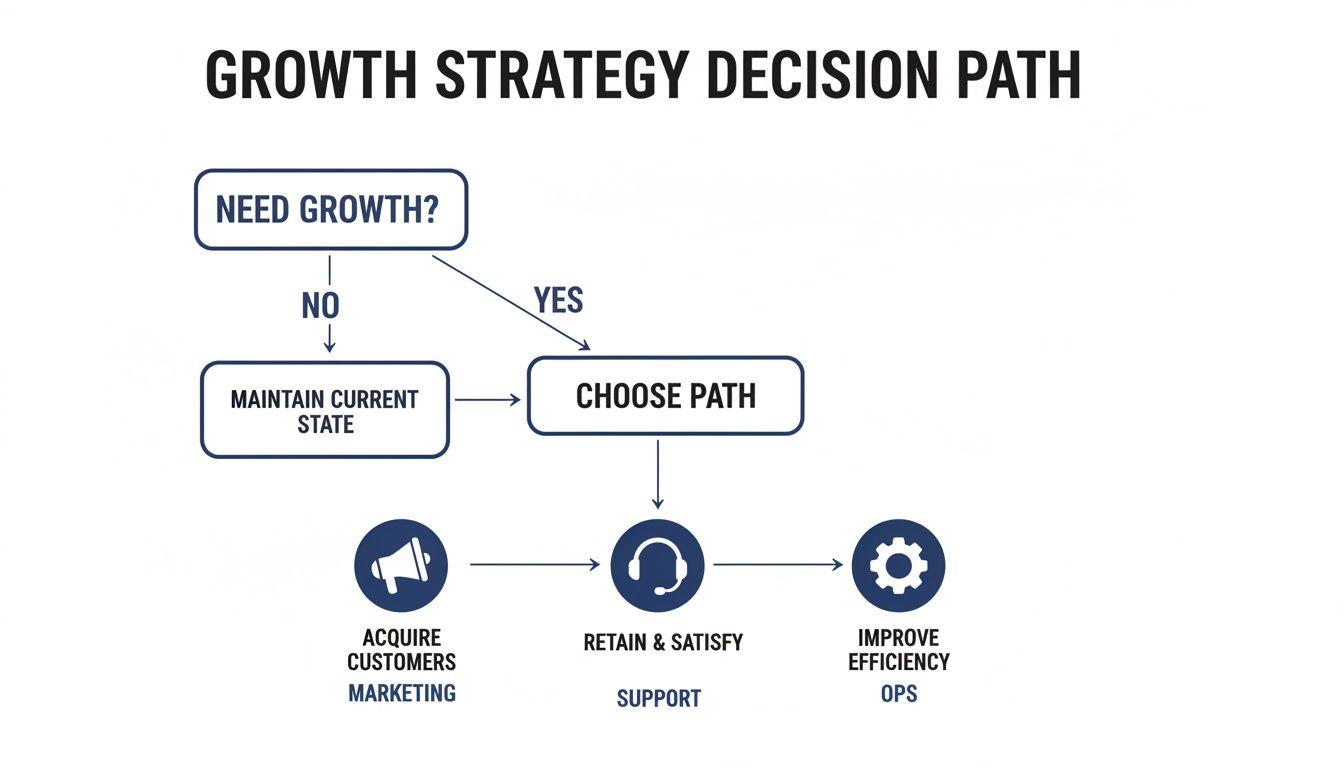
This simple framework shows that no matter what your top priority is right now, a versatile AI assistant can help you get there.
Why a Privacy-First Approach Is Crucial
Using a generic, free AI tool for business is like having a meeting about your company’s secret sauce in a crowded coffee shop. You have no idea who’s listening or what they’ll do with that information. A "privacy-first" AI platform, on the other hand, contractually guarantees that your data stays yours, and only yours.
This means your conversations, the documents you upload, and the content you generate are all kept in a secure, isolated bubble. This is absolutely non-negotiable when you’re dealing with sensitive information like:
- Customer Lists and Contact Information
- Financial Reports and Projections
- Proprietary Product Designs or Formulas
- Internal HR Documents and Employee Data
Choosing a provider that’s transparent about how they handle your data isn't just good practice—it's essential for protecting your business from serious risk.
The Power of Multiple AI Models in One Place
In the world of AI, there's no single "best" model. The different Large Language Models (LLMs)—the engines that power these AI assistants—all have their own unique strengths. Some are brilliant at creative writing, others are wizards at data analysis, and still others excel at coding or logical reasoning.
Sticking with a single LLM is like trying to build a house with only a hammer. It’s a great tool, but it’s not the right one for every single job.
An advanced AI assistant for small business solves this problem by bringing multiple top-tier LLMs together under one roof. This gives you a massive strategic advantage.
- Flexibility for Every Task: You can pick the best model for the job at hand. Need a catchy marketing slogan? Fire up a model known for its creative flair. Need to dissect a dense financial report? Switch to one with superior analytical chops.
- Higher-Quality Results: By matching the right tool to the right problem, you get far more accurate, relevant, and useful results on the first try. That means less time spent editing and re-doing work.
- Future-Proofing Your Workflow: The AI field is moving at lightning speed. A platform that integrates multiple models can easily add the next big thing as soon as it’s available. You’ll always have access to the best tech without having to switch tools or change how you work.
This multi-model approach means you’re never locked into one provider's ecosystem. You can always use the sharpest tool in the shed. If you're weighing your options, our guide on the best AI chatbot for business dives deeper into these comparisons. Ultimately, this ensures you’re always equipped to handle whatever challenges your business throws at you.
How to Bring an AI Assistant Into Your Business (Without the Headache)
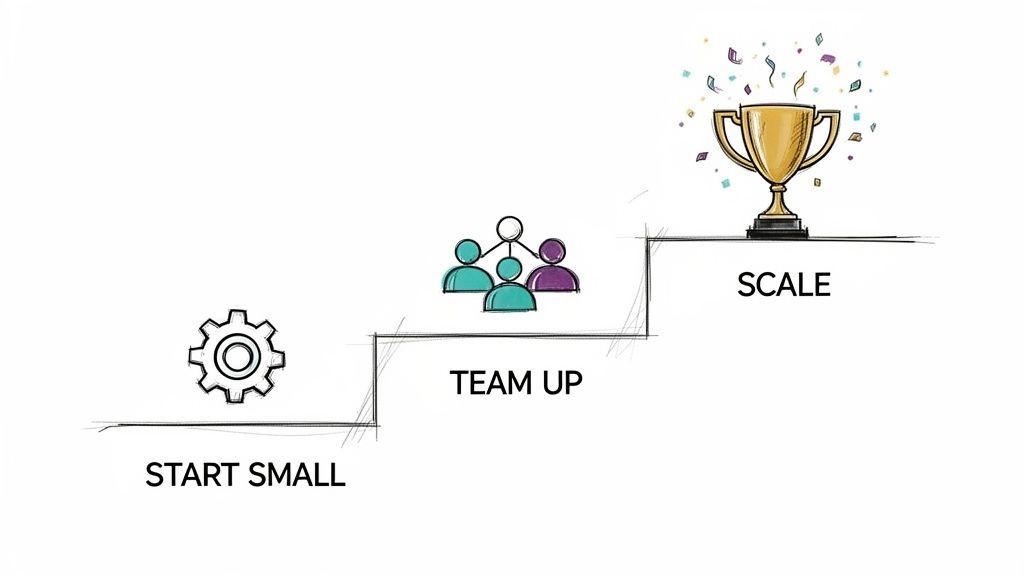
Adopting a new tool can feel like a massive undertaking, but bringing an AI assistant for small business on board doesn't have to disrupt your entire workflow. The trick is to think like a gardener, not a construction crew. You don't bulldoze everything at once; you plant one seed, care for it, and watch it grow.
This gradual, low-risk approach builds momentum and helps the tool become a deeply embedded asset—not just another subscription you forget about. Follow a simple roadmap, and you can make the transition smooth, effective, and maybe even a little exciting for your team.
Start Small With a High-Impact Task
The biggest mistake I see small businesses make is trying to boil the ocean. They get dazzled by all the possibilities and try to sprinkle AI into a dozen different departments at once. This almost always leads to confusion, burnout, and a tool that no one uses.
A much smarter strategy is to find one specific, nagging problem and solve it first. Look for a task that will give you a big return for a small amount of effort. This is your "quick win"—a clear, undeniable demonstration of value that gets everyone on board.
Not sure where to start? Here are a few great ideas:
- Social Media Content: If your team constantly struggles to come up with new posts, use the AI assistant to generate a week’s worth of social media captions.
- Meeting Summaries: Feed the notes from your last team huddle into the AI and ask it to pull out the key decisions and action items. Instant clarity.
- Email Templates: Identify the top three questions you get from customers and have the AI draft perfect, empathetic replies you can use over and over.
By focusing on one small victory, you prove the concept without creating friction. You're building a foundation of success that you can expand on later.
The most effective AI rollouts focus on what experts call "the work before the work"—all the prep, research, and drafting that eats up time before you can even get to the real project. Automating this stuff is a gold mine for productivity.
Involve Your Team From Day One
Bringing in new technology is a team sport. If you just hand down a new tool from on high without any context or training, you’ll be met with either resistance or total indifference. For an AI assistant to be a real success, you have to bring your people into the process from the very beginning.
Start by explaining the "why." Frame the AI assistant not as a replacement, but as a helper—a tool specifically chosen to eliminate their most frustrating tasks. Ask them directly: "What's the most repetitive, mind-numbing part of your day?" Their answers give you a perfect implementation roadmap.
Once you’ve picked your first project, find one or two enthusiastic team members to be your "AI champions." These early adopters can help test the tool, discover tricks and best practices, and then teach their colleagues. This kind of peer-to-peer learning is always more effective than a stuffy, formal training session. For a deeper dive, our guide on how to implement AI in business offers more strategies for this collaborative approach.
Set Clear Guidelines and Celebrate the Wins
To use an AI assistant effectively and safely, your team needs a few simple ground rules. This isn't about creating a dense, 20-page policy document nobody will read. It’s about establishing a few clear principles for success.
Your guidelines should touch on three main areas:
- Brand Voice: Make sure everyone knows how to prompt the AI to match your company's unique tone. Create a shared list of adjectives that describe your brand (e.g., "friendly but professional," "witty and informal").
- Fact-Checking: This is non-negotiable. Reinforce that AI-generated content is always a first draft. All stats, facts, and important claims must be verified by a human before going public.
- Data Privacy: Remind your team to never input sensitive customer data or personal information into the assistant unless you are using a certified, privacy-first platform designed for that purpose.
Finally, don't forget to celebrate your successes! When the AI assistant helps the team save ten hours on a project or contributes to landing a new client, share that win with everyone. This reinforces the tool's value and encourages people to get creative and find new ways to use it.
Got Questions About AI Assistants? We've Got Answers.
Jumping into new technology always stirs up a few questions. When it comes to an AI assistant for a small business, most owners I talk to have the same things on their minds: cost, security, and whether it's actually practical for their team. Let's tackle those head-on.
Is an AI Assistant Going to Break My Budget?
Honestly, probably not. While the big, corporate-level AI systems can have eye-watering price tags, many of the best tools today are built specifically for small businesses with affordable subscription plans.
The real question is about return on investment. Think about it: if an AI saves you 10 hours of work a week or means you don't have to hire a freelance copywriter, it often pays for itself in the first month. Look for tools with team-based pricing—it's usually the best value and helps you avoid those per-seat costs that sneak up on you.
How Can I Trust an AI with My Company's Private Data?
This is the big one, and you’re right to be cautious. The only AI assistant you should even consider is a "privacy-first" one. That means finding a provider who is crystal clear about their data policies and guarantees your business information will never be used to train their public models.
Think of it this way: your business data is your secret sauce. A privacy-first platform is like a locked-down digital vault for your customer lists, financial info, and strategic plans. It ensures they stay yours, and only yours. Always read the fine print.
Things like secure logins, team permissions, and end-to-end encryption aren't just nice-to-haves; they're absolute musts.
Does My Team Need a Ton of Technical Training to Use This?
Not at all. The best AI assistants are designed to be incredibly user-friendly. If your team can handle a Google search or post on social media, they’ve got the basic skills down.
The real learning isn't about complex software; it’s about getting good at writing clear instructions, or "prompts," to get the AI to give you exactly what you need. Most great platforms offer tutorials and examples to get everyone up and running in no time.
How Is This Any Different From a Free AI Chatbot?
Free public chatbots are fantastic for quick, one-off questions. But an AI assistant for small business is a completely different beast—it's a professional-grade tool built for teamwork, security, and real business tasks.
It comes with critical features you just won't find in the free versions:
- Team Accounts so everyone can work together seamlessly.
- Secure Document Analysis that lets you work with your own private files.
- Access to Multiple Specialized AI Models to get higher quality, more accurate results.
- Serious Data Security to keep your business information safe.
It's like the difference between using a public computer at the library and having a secure, fully-equipped workstation for your company.