Knowing how to properly reference an appendix is a simple but powerful skill. The basic rule is to mention each appendix by its label (e.g., Appendix A) somewhere in the main body of your text. This in-text citation acts as a signpost, pointing your reader toward supplemental material like raw data, interview transcripts, or questionnaires without breaking the flow of your core argument.
Why Properly Referencing Appendices Matters
Think of appendices not as a document's junk drawer, but as a vital tool for building trust and clarity with your reader. When you get this right, you instantly elevate the professionalism of your work, whether it's a university paper, a research study, or a business report. It’s all about keeping your main narrative clean and focused while still providing all the necessary backup for those who want to dig into the details.
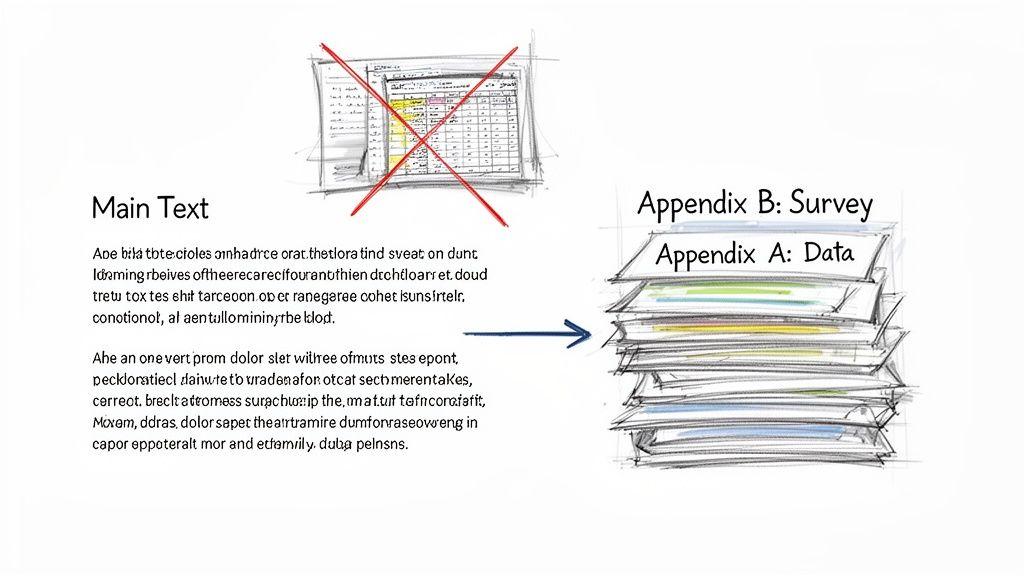
For example, imagine you're writing a business proposal that discusses market growth. If you dropped pages of dense financial tables right in the middle of your argument, you’d lose your reader instantly. Instead, a simple, elegant reference like, "Our quarterly growth consistently outpaced projections (see Appendix C for the detailed financials)," keeps the story moving while proving your point with easily accessible data.
This strategic separation achieves two crucial goals:
- It keeps your main points readable. Your core message doesn't get bogged down in granular detail.
- It makes your work more credible. You're showing your work and being transparent by providing all the supporting information. If you want to learn more, check out our guide on what makes a credible source.
Before we dive into the specific style guide rules, here's a quick overview of the universal principles for referencing appendices.
Quick Guide to Referencing Appendices
| Core Principle | What to Do | What to Avoid |
| Connection | Mention every single appendix at least once in the main text. | Leaving an appendix "orphaned" without a reference in the body. |
| Clarity | Use a clear label (e.g., "Appendix A," "Appendix 1"). | Vague references like "see the end of the document." |
| Context | Refer to the appendix at the most relevant point in your discussion. | Mentioning an appendix randomly, far from the related content. |
| Consistency | Use the same naming and formatting style for all appendix references. | Calling it "Appendix A" in one place and "Table A1" in another. |
This table covers the fundamentals, but mastering the nuances will make your documents even stronger.
The Foundation of Good Referencing
The central rule is simple and absolute: if you include an appendix, you must cite it at least once in your main text. An appendix that isn't referenced is functionally invisible to your reader and serves no real purpose. It’s the equivalent of adding a footnote to your bibliography without a corresponding number in the text—it just doesn't connect. This link is what makes the appendix a legitimate, valuable part of your document.
The rise of data-driven reporting has made appendices more crucial than ever. They act as a bridge between a concise summary and the complex data that backs it up, satisfying both executive-level readers and detail-oriented analysts.
This isn't just a matter of preference; it's becoming standard practice. In fact, an analysis of academic papers shows that over 60 percent of those published in major journals between 2015 and 2025 included at least one appendix for supplementary data. This trend highlights just how essential appendices have become for upholding transparency and rigor in modern writing.
Getting Your Appendices Set Up Right
Before you can even think about referencing an appendix, you have to build it correctly. A clean, well-organized appendix section does more than just make referencing easier—it tells your reader that you’re a professional who cares about the details. It's like framing a house; get the foundation right, and everything else falls into place.
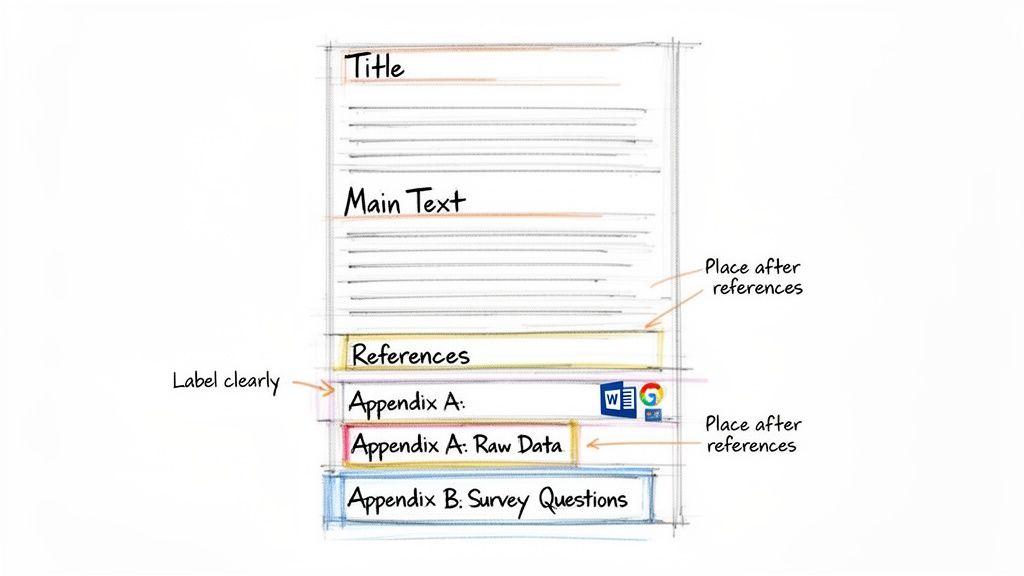
There's one golden rule for appendix placement: it always goes at the very end. Your appendices should come after everything else—after the reference list, bibliography, or works cited page. This keeps your supplementary material from breaking the flow of your main argument but ensures it's there for anyone who wants to dig deeper.
For clarity, always start each new appendix on a fresh page.
Nailing the Labels and Titles
Clear, consistent labeling is the secret to a useful appendix. The system you use is pretty straightforward and depends on how many appendices you have.
- Just one appendix? Easy. Just title the page "Appendix."
- More than one? Use letters. Label them Appendix A, Appendix B, Appendix C, and so on. Make sure they appear in the same order you mention them in your main text.
Right below that label, give each appendix a descriptive title. The title should be centered and in title case, telling the reader exactly what they're about to see.
Here's a quick example of how it should look:
Appendix A Full Interview Transcripts with Project Stakeholders
This simple combination of a reference letter (Appendix A) and a descriptive title is what allows your reader to quickly find what they need. It’s a small detail that makes a huge difference in readability and is a cornerstone of smart document organization. You can learn more by exploring some best practices for document management that will definitely save you a headache later.
Keeping Different Content Separate
Here’s a non-negotiable rule: every unique piece of information gets its own appendix. You wouldn't toss your raw survey data into the same section as your interview transcripts. That just creates a confusing mess. Keep things separate to maintain a clean, logical structure.
Think about a typical research project. You might organize the supplementary materials like this:
- Appendix A: Survey Questionnaire
- Appendix B: Raw Quantitative Data Tables
- Appendix C: Consent Forms and Participant Instructions
Structuring it this way lets you point your reader to the exact information they need, right when they need it. You can write, "The full survey instrument is detailed in Appendix A," and later, "For the complete raw dataset, see Appendix B." It's a clean, direct, and incredibly effective way to handle your supporting documents.
Mastering In-Text Appendix Citations
Once you've got your appendices labeled and looking sharp, the next step is weaving references to them throughout your main text. This is more of an art than a science. The goal is to make these references feel like helpful signposts, not jarring interruptions that break the reader's flow.
A rookie mistake I see all the time is just dropping in a vague phrase like "see appendix." We can do better. A smooth, integrated reference adds a layer of professionalism and makes your arguments feel much more solid.
From Clunky to Clear Phrasing
Let’s look at how to transform those generic references into something more polished and genuinely useful. It's all about being specific and providing context.
- Instead of: "The data is in the appendix."
- Try: "Initial user feedback revealed a strong preference for a simplified interface (see Appendix A for the full survey results)."
- Instead of: "Refer to Appendix B for the charts."
- Try: "Market penetration grew by 15% in the third quarter, a trend clearly visualized in the sales data charts (Appendix B, Figure 1)."
See the difference? This approach doesn't just point to the appendix; it tells the reader why they should bother looking. It’s especially critical when you need to guide them to a specific chart or table within a larger appendix. If you're looking to refine your writing even further, our guide on how to paraphrase without plagiarizing has some great tips.
The Golden Rule: Every single appendix must be cited at least once in your main text. If it’s not mentioned, it doesn’t belong there. An unreferenced appendix is just clutter, but a well-referenced one is a powerful tool for building credibility.
Referencing Specific Elements Within an Appendix
Sometimes you need to get granular and point to a specific table or figure nestled inside a larger appendix. This is where your detailed labeling really pays off. If you’ve numbered your items properly (like Table A1 or Figure B2), your in-text citation becomes a laser-focused guide for your reader.
Think about a business report. Precision is everything. For example, a staggering 75% of Fortune 500 annual reports from 2020-2025 used appendices for their detailed financial breakdowns. Referencing them correctly turns what could be an overwhelming data dump into clear, supportive evidence. This is easily done with a quick parenthetical note like "(see Appendix D, Figure 2 for quarterly sales data)," a best practice supported by over 90% of major style guides. You can find more on these corporate writing trends on Scribbr.com.
The Justification for Inclusion
Ultimately, every in-text citation acts as the justification for that appendix's very existence. It preemptively answers the reader’s silent question: “Why is this extra stuff here?”
By directly linking your core arguments to the supplementary material, you’re showing your work and being transparent. This builds trust, whether your audience is a professor, a client, or your own team. Each reference reinforces that your conclusions aren't just pulled out of thin air—they're backed by evidence that's organized and ready for inspection.
Navigating Different Citation Style Rules
Anyone who has spent time in academic or professional writing knows that style guides are the law of the land. When it comes to appendices, these guides don't all sing from the same hymn sheet. Getting the nuances right between APA, MLA, and Chicago isn't just about being fussy—it's about presenting a polished, professional document.
A single formatting mistake, like placing an appendix in the wrong spot, can be a dead giveaway that you haven't done your homework. Each style guide has its own specific rules for how to label, place, and refer to your supplementary materials. It’s a small detail, but it matters.
APA Style Guidelines
The American Psychological Association (APA) style is the go-to for most social sciences, education, and business fields. Its rules are all about clarity and consistency.
- Placement: This is a big one. In APA, appendices always come after your reference list. No exceptions.
- Labeling: If you only have one, just call it "Appendix." If you have more than one, label them sequentially: "Appendix A," "Appendix B," and so on. Make sure the label is bold and centered at the top of the page.
- Title: Right below the label, add a descriptive title, also centered and in title case. For example: Full Survey Questionnaire.
- In-Text Reference: When you mention it in your paper, a simple parenthetical reference does the trick, like this: (see Appendix A).
MLA Style Guidelines
If you're writing in the humanities, you’re likely working with the Modern Language Association (MLA) style. The core principles are similar to APA, but there's one key difference you can't afford to miss.
- Placement: An appendix in an MLA paper must come before the Works Cited page. This is the complete opposite of APA, and it's a common point of confusion.
- Labeling: The labeling convention is pretty much the same. A single one is "Appendix," while multiple appendices get lettered "Appendix A," "Appendix B," etc.
- Title: You'll want to add a clear, descriptive title here as well.
- In-Text Reference: Just like APA, a straightforward parenthetical reference works perfectly: (see Appendix B for interview notes).
No matter which style guide you follow, the golden rule is connection. Your in-text citation is the bridge that links your main argument to your supplementary material. An appendix that isn't mentioned in the text is just floating in space—it has no purpose.
This guide breaks down the simple but crucial steps for making sure your appendices are properly integrated.
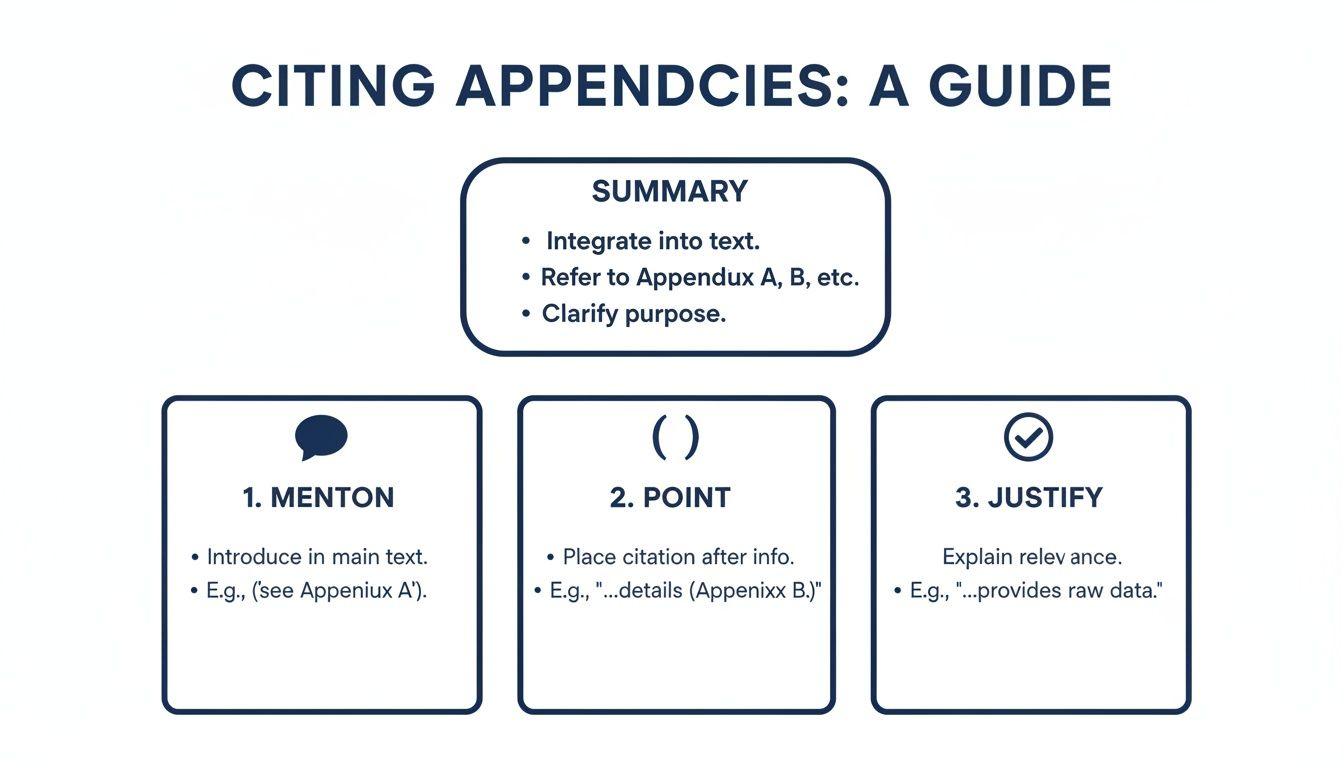
As you can see, it really boils down to three things: mention it, label it correctly, and make sure the information actually belongs there.
Chicago Style Guidelines
Used widely in history, the fine arts, and some other humanities fields, the Chicago Manual of Style tends to offer a bit more flexibility. That doesn't mean it's a free-for-all, though.
- Placement: Chicago gives you a choice. You can place your appendices either before or after the bibliography. The most important thing is to pick one and stick with it.
- Labeling: Here again, you have options. You can use either letters (Appendix A) or numbers (Appendix 1).
- Title: As with the other styles, a clear and descriptive title is a must.
- In-Text Reference: The goal here is a smooth, natural-sounding reference within your sentence. For instance, you might write, "A detailed breakdown of the manuscript changes is provided in Appendix 2."
To help you keep these distinctions straight, here’s a quick side-by-side look at the major rules.
Appendix Formatting Rules APA vs MLA vs Chicago
This table cuts right to the chase, comparing the key formatting and placement rules for the three most common citation styles. It’s a handy reference to have when you're finalizing your document.
| Guideline | APA (7th Edition) | MLA (9th Edition) | Chicago (17th Edition) |
| Placement | After the reference list | Before the Works Cited page | Either before or after the bibliography |
| Labeling | Appendix A, Appendix B | Appendix A, Appendix B | Appendix A or Appendix 1 |
| Page Start | Each appendix on a new page | Can be continuous or on a new page | Typically starts on a new page |
At the end of the day, the best advice I can give is to always double-check your instructions. Whether it's a course syllabus or a publisher's submission guidelines, those specific requirements will always trump the general rules. Getting it right shows you pay attention to detail—a critical skill in any field.
Common Appendix Mistakes and How to Fix Them
Knowing the rules for creating an appendix is a great start, but what really separates a professional document from an amateur one is avoiding the common pitfalls. I've seen these same simple mistakes trip people up time and time again. They're small, but they can make your work look sloppy and confuse your reader.
Let's walk through the most frequent slip-ups and, more importantly, how to sidestep them completely.
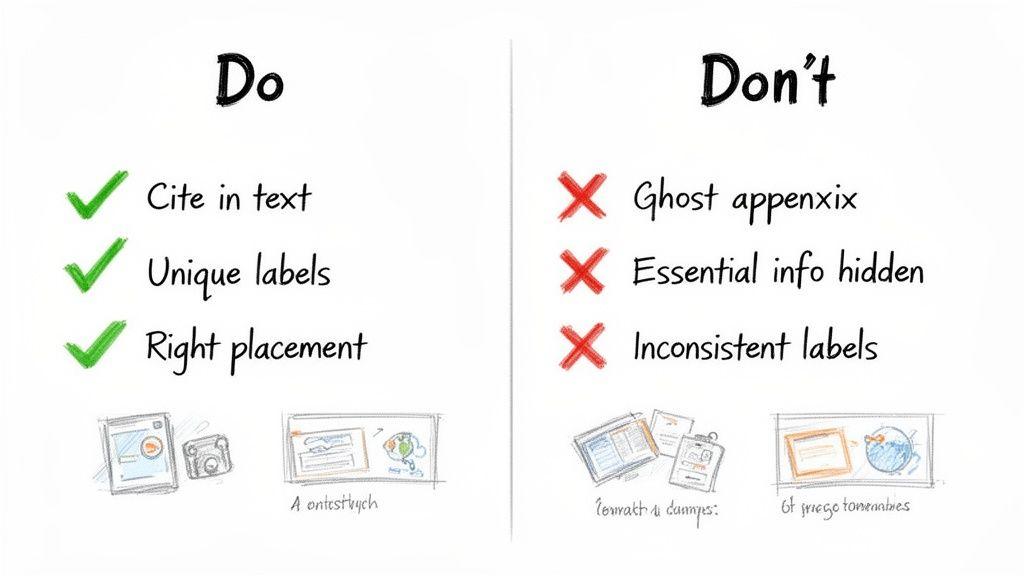
The Ghost Appendix
This is easily the most common mistake I see. A "ghost appendix" is a beautifully prepared section, tucked away at the end of the document, that is never once mentioned in the main body. If you don't point your reader to it, they have no reason to know it's even there.
- The Mistake: You’ve compiled a detailed budget breakdown in "Appendix C" but never actually refer to it in your financial summary.
- The Fix: Simply add a clear, direct reference where it matters most. For example: "Our financial projections remain conservative (see Appendix C for the detailed budget)."
Just like that, you've turned a ghost into a genuinely useful resource for your reader.
Hiding Critical Information in the Back
Another major blunder is treating an appendix like a storage unit for information that’s absolutely essential for understanding your core argument. Your reader shouldn't have to flip to the back of the report just to follow your logic.
Think of it this way: your main document must be able to stand on its own. An appendix is for supplementary material—it adds depth and context but isn't required reading. It’s bonus content, not a missing chapter.
The impact of getting this right is huge. A landmark 2007 study in PLOS ONE discovered that biomedical papers sharing detailed data in properly referenced appendices earned 69% more citations over five years. This isn't an isolated trend; tracking of over 50,000 papers has shown similar boosts. Well-integrated supplemental information makes your work stronger. You can read more about these findings on appendix use and citations.
Messy Labeling and Inconsistent Titles
Nothing screams "unprofessional" quite like inconsistent labeling. If you call it "Appendix A" in one paragraph, "Figure A" in the next, and "the appendix with the charts" somewhere else, you’re just creating confusion.
- The Mistake: A vague reference like, "See the charts in the appendix for more detail." Which charts? Which appendix?
- The Fix: Always be precise and use the official label you've assigned. Something like, "(see Appendix B, Figure 2)" leaves no room for doubt.
This kind of precision helps your reader navigate your work with confidence and signals that you’ve paid close attention to every detail. By sidestepping these common mistakes, you ensure your appendices genuinely add value to your document.
A Few Common Questions About Appendices
Even when you've got the basics down, a few tricky questions always seem to pop up right when you're trying to finalize your document. Getting these details right is the last hurdle to making sure your appendices are perfect. Think of this as your go-to guide for those last-minute "what if" moments.
Let's dive into some of the most common questions I hear and get you some clear, practical answers so you can finish up with confidence.
What Kind of Information Actually Belongs in an Appendix?
This is the big one. An appendix is the perfect place for all the supporting material that’s relevant to your work but would bog down the main text if you included it there. It's for the "bonus features"—the content that adds depth for a curious reader but isn't essential to follow your main argument.
So, what should you move to an appendix?
- Raw data from your experiments or long, detailed statistical tables.
- Complete transcripts of interviews or focus groups.
- The actual surveys, questionnaires, or consent forms you used.
- Technical drawings, detailed equipment specs, or complex mathematical proofs.
Here's the rule of thumb I always use: if the information is helpful but not critical for understanding your main point, it’s a great candidate for an appendix. Your core paper should read smoothly and make sense on its own.
Your appendix should always support your main text, not contain essential parts of it. If someone has to read the appendix to understand your conclusion, that information needs to be moved into the body of your paper.
Keeping this separation makes your primary document clean, focused, and persuasive, while still giving your readers access to all the background information.
How Do I Number Tables and Figures in an Appendix?
This is much simpler than it sounds. Any tables or figures you place in an appendix need their own numbering system, separate from the ones in your main text. This prevents a whole lot of confusion.
The logic is tied directly to the appendix label. For example, in Appendix A, your first table would be Table A1, your first figure would be Figure A1, the next table would be Table A2, and so on.
When you start a new appendix, say Appendix B, the numbering resets. The first table there becomes Table B1, the first figure is Figure B1, and the pattern continues.
Getting this right is a game-changer for clarity. It lets you refer to a very specific piece of information in your text, like, "For a complete breakdown of participant responses, see Table C3 in Appendix C." Your reader knows exactly where to look.
Is It Okay to Have More Than One Appendix?
Yes, absolutely! For bigger projects like a thesis, a dissertation, or a major business report, using multiple appendices is often the best way to stay organized. In fact, I'd strongly recommend it.
The goal is to group similar types of information together. Each distinct category of material gets its own appendix.
For instance, you could organize your supplemental materials like this:
- Appendix A: The full survey questionnaire.
- Appendix B: All the raw data tables.
- Appendix C: Scanned copies of the participant consent forms.
Breaking it up this way makes your document incredibly professional and easy to navigate. Readers can jump straight to the exact information they need without digging through pages of unrelated content.