If you want to write essays fast, you need a modern game plan. It's not about magic; it's about a smart workflow that splits the work into three clear phases: Strategic Planning, Accelerated Drafting, and Efficient Polishing. Think of it as building a solid foundation first, then raising the walls quickly, and finally, adding the finishing touches. This approach turns an overwhelming assignment into a series of manageable steps.
Why Speed Is the New Standard in Academic Writing

We've all been there: staring at a blinking cursor with a deadline breathing down our neck. With academic and professional life getting more demanding, figuring out how to write an essay quickly isn't just a nice-to-have skill—it's a survival tactic. The old-school method of spending weeks on slow research and agonizing over every sentence just doesn't work anymore.
The time crunch is real. The average college student now spends around 15 hours per week on homework alone. When you factor in classes, a part-time job, and maybe even an internship, there’s not much time left for painstakingly crafting essays. You can dig into more student habit trends to see just how packed schedules have become. This is exactly why essays, which are still a huge part of most courses, force students to find faster, more effective ways to get them done.
The 3-Phase Framework for Rapid Essay Writing
At the heart of this guide is a simple, repeatable system. It's a tech-friendly workflow that helps you plan intelligently and then use powerful, privacy-first AI tools to dramatically cut down your writing time.
This table gives you a quick overview of the framework we'll be breaking down.
| Phase | Objective | Key Techniques |
| 1. Strategic Planning | Build a strong, research-backed outline before writing a single sentence. | Rapid research, mind mapping, thesis development, and structured outlining. |
| 2. Accelerated Drafting | Get the first draft done quickly without getting bogged down by perfectionism. | Timed writing sprints (Pomodoro), "zero-drafting," and focusing on flow. |
| 3. Efficient Polishing | Edit and proofread systematically to ensure quality and clarity. | Multi-pass editing (big picture, sentence level, final proofread), AI assistance. |
This isn't about cutting corners; it's about working smarter. This framework gives you a clear path forward before we get into the nitty-gritty of each technique.
The biggest killer of momentum is trying to be perfect from the start. Focus on getting words on the page first—brilliance can wait for the editing phase.
We're going to show you how to build a rock-solid foundation with quick research, draft the entire essay using timed methods that keep you focused, and polish your work with a sharp, multi-pass editing checklist. We'll even explore how to safely use AI assistants to brainstorm ideas, structure your arguments, and tighten up your writing, turning that dreaded all-nighter into a calm, controlled process.
Building Your Foundation with Rapid Outlining
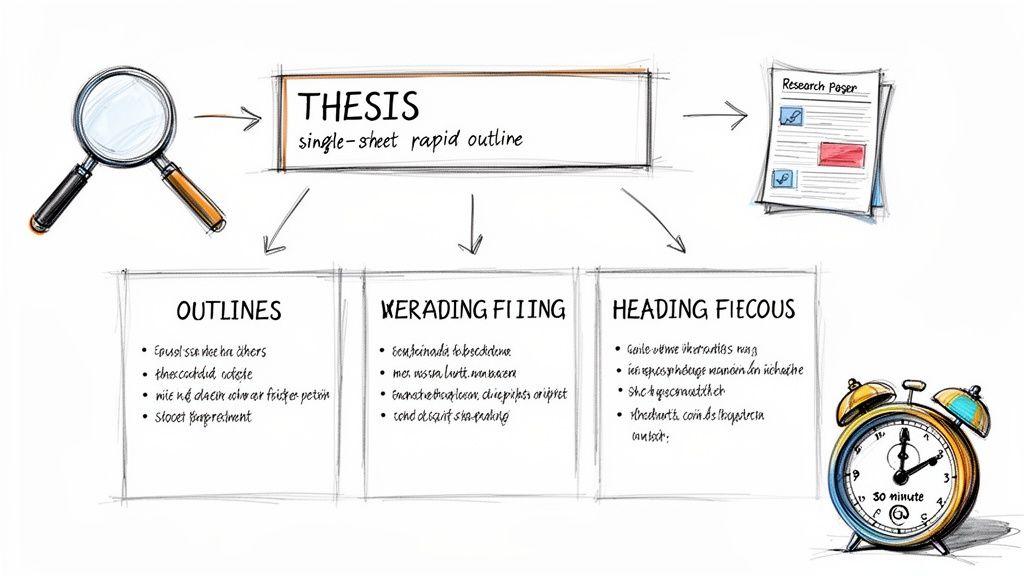
Let's be honest, the biggest time-suck when writing an essay isn't the actual writing. It's staring at a blank page with no plan. When you try to figure out your arguments as you go, you end up with a tangled mess that requires painful, time-consuming rewrites. A solid outline is your single best weapon against this.
The good news? This whole planning phase shouldn't take you hours. The goal is to get a working blueprint hammered out in under 30 minutes. Forget getting lost in library databases for half the day. What we're after is a strategic, focused burst of work that gives you a clear path forward.
Nail Down Your Thesis and Find Quick Evidence
First things first: you need a core argument. Before you can build an outline, you have to know what you're building around. That's your thesis statement—one clear sentence that declares your position. This sentence is your North Star. Every single paragraph from here on out will point back to it.
With your thesis in hand, you need a few solid points to back it up. Head to academic search engines like Google Scholar or JSTOR and use targeted keywords. Don't read entire articles. Just scan the abstracts and conclusions for arguments that support (or even challenge) your thesis.
For example, if you're writing a history paper on why the Roman Empire collapsed, your keywords might look something like this:
- "Roman Empire economic decline"
- "Barbarian invasions impact Rome"
- "Roman political instability causes"
This laser-focused approach helps you grab evidence without falling down a research rabbit hole.
Let AI Help You Structure Your Thoughts
This is where you can really put the foot on the gas. AI assistants are brilliant at taking your core idea and structuring it into a logical outline. You provide the topic and thesis, and the AI builds the skeleton for you.
There's a reason the AI writing assistant market was valued at $1.7 billion in 2023 and is growing fast. These tools can lead to 70% faster content creation by handling the grunt work of organizing ideas. For a student on a deadline, a simple prompt can produce a working framework in seconds, leaving you to do the important part: filling it in with your research and critical analysis.
The real purpose of an outline is to free up your brain. It lets you stop thinking about structure so you can focus entirely on your ideas. By separating the two, you do both better.
Let’s stick with our Roman Empire example. Here’s a prompt you could feed a privacy-first AI like 1chat:
“Generate a 5-paragraph essay outline for the topic: 'The fall of the Roman Empire was caused by a combination of internal decay and external pressures.' I need a thesis statement, three body paragraphs with supporting points, and a conclusion.”
The AI will likely spit back a clean, structured plan:
- Introduction: A hook, some brief background, and your thesis.
- Body Paragraph 1: A focus on internal problems, like economic decay (inflation, over-taxation).
- Body Paragraph 2: Another internal focus, this time on political instability (civil wars, weak leaders).
- Body Paragraph 3: A shift to external pressures, like the barbarian invasions.
- Conclusion: A quick summary of your points and a restatement of the thesis.
This AI-generated structure is now your roadmap. You can tweak it, plug in your own sources, and make sure it perfectly fits your argument. For more detailed guides, we have a whole post with essay outline examples you can adapt.
With this foundation set, you're not facing a blank page anymore. You have a clear path from start to finish.
Drafting at Speed with Timed Writing Techniques

You’ve got a rock-solid outline. Now, it’s all about momentum. The goal here is to get all those structured ideas out of your head and onto the page, transforming your plan into a full-fledged first draft.
This is where so many students get stuck. They try to write and edit at the same time, agonizing over every word choice. That approach kills your flow and easily doubles your writing time.
If you really want to learn how to write essays quickly, you have to give yourself permission to write a messy, imperfect draft first. Mute your inner critic and just focus on getting the ideas down.
Embrace the Power of Timed Sprints
One of my favorite methods for this is the Pomodoro Technique. It’s a simple but incredibly effective time management strategy that breaks your work into focused, timed sprints. It's a fantastic way to build momentum and avoid the burnout that comes from staring at a blank page for hours.
Here’s how you can use it for your essay:
- Set a timer for 25 minutes. This is your sprint.
- Pick one section of your outline to tackle. Maybe it's the intro or the first body paragraph.
- Write without stopping. Don't pause to fix a typo or look up a better word. Just write until the timer dings.
- Take a 5-minute break. Seriously, get up. Stretch, grab a drink, and step away from the screen.
- Repeat the cycle. After about four sprints, give yourself a longer break—maybe 15-30 minutes.
This turns a massive project into a series of small, manageable challenges. You’ll be genuinely surprised at how much you can get done in just a few focused bursts. If you're struggling with that first section, our guide on writing good introductions for essays can help get you started.
The core principle of rapid drafting is this: separate the creative act of writing from the analytical act of editing. Trying to do both at once is like trying to drive a car with one foot on the gas and the other on the brake.
Using Your Outline as a Scaffold
Think of your outline as the structural frame of a house. You don't have to build it from scratch—you just need to fill in the walls.
Instead of staring at a blank paragraph, go back to your outline. Your topic sentences and supporting points are already there. Your job is now to simply expand on them, connecting the dots and turning bullet points into complete sentences. It feels more like a "fill-in-the-blanks" exercise than pure creation. This removes the pressure of coming up with new ideas on the fly and lets you focus completely on getting the words out.
If you do hit a wall and can't find the right words, a quick prompt to a privacy-first AI assistant can be a lifesaver. For example, you could ask:
“Expand on this point: 'Roman political instability was driven by frequent civil wars and a rapid succession of weak emperors.' Write a 3-4 sentence paragraph that explains this idea.”
This gives you a working draft of the paragraph, which you can then immediately tweak to fit your voice. It’s a great way to push through a minor case of writer’s block without letting it derail your entire session.
Polishing Your Draft with an Efficient Editing System
Getting that first draft done is a huge relief, but it's only half the battle. Now comes the part where you turn that raw material into a polished, persuasive essay without getting lost in an endless cycle of tweaks. The secret isn't to just reread your draft over and over; it’s to come at it with a systematic, multi-pass approach that’s both fast and shockingly effective.
Think of it like a quality control process on an assembly line. Each pass has a specific job to do, which keeps you from trying to fix everything at once. This structured method helps you catch way more errors and make much stronger revisions in a fraction of the time.
The First Pass: Big-Picture Review
On your first read-through, I want you to completely ignore grammar and spelling. Seriously. Right now, you’re just looking at the essay's skeleton. Read your draft from start to finish, asking yourself these high-level questions:
- Clarity: Is my thesis statement crystal clear? Does it stay consistent from the intro to the conclusion?
- Structure: Does every single paragraph actually support my main argument? Is there anything in here that feels off-topic or random?
- Flow: Do the paragraphs transition smoothly from one to the next? Does my argument build in a logical, coherent way?
This is the stage where you make the big moves. You might shift entire paragraphs around, completely rewrite your introduction for better clarity, or cut a whole section that doesn't really serve your core point. Don’t get bogged down in the small stuff yet—your only goal here is to make sure the essay is structurally sound.
The Second Pass: Sentence-Level Refinements
Once the structure is locked in, it’s time to zoom in on the sentence level. This is where you focus on making your writing more concise, powerful, and engaging. A non-negotiable step here is to read your essay aloud. It feels a bit weird at first, but it forces you to notice awkward phrasing, clunky sentences, and repetitive patterns that your eyes would otherwise just skim over.
The fastest way to improve an essay is to remove unnecessary words. Your goal is to make every word earn its place on the page.
Look for chances to beef up your language. Can you swap out a weak verb for a stronger one? Can you slash filler words like "really," "very," or "just"? A privacy-first AI assistant can be a great sparring partner here. For instance, you could highlight a clumsy sentence and try a prompt like this:
Prompt Example: "Rephrase this sentence to be more academic and concise: 'The data basically shows that the economy had a lot of problems because of several different factors that were happening at the same time.'"
The AI might suggest something like: "The data indicates the economy faced significant challenges due to multiple concurrent factors." It's a quick way to tighten up your prose without losing your original meaning.
The Final Pass: Meticulous Proofreading
Your last pass is the final, eagle-eyed hunt for technical errors. This is where you put on your proofreader hat and check for:
- Spelling mistakes
- Grammar errors (subject-verb agreement, comma splices)
- Punctuation and capitalization issues
- Correct formatting for citations
This is another area where technology gives you a massive speed boost. The market for writing assistance is exploding; projections show that by 2025, the essay service market will approach $2.5 billion. A huge driver of this growth is tools that make editing easier. Modern error-checking software can catch up to 95% of common issues almost instantly, saving you from painstaking manual work. If you're curious about the numbers behind this trend, you can read the full market research here.
To help structure this final, crucial stage, here’s a quick checklist you can run through.
A Quick and Effective Editing Checklist
This table breaks down the editing process into focused passes, making it manageable and thorough. Instead of trying to catch everything at once, you can zero in on specific areas, using AI as a helpful assistant to speed things up.
| Editing Pass | Focus Area | AI-Assisted Task Example |
| Pass 1: Macro Edits | Structure, Thesis, Flow | "Review this outline. Is there a more logical flow for these arguments?" |
| Pass 2: Micro Edits | Word Choice, Tone, Clarity | "Find all instances of passive voice in this text and suggest active voice alternatives." |
| Pass 3: Proofreading | Grammar, Spelling, Punctuation | "Proofread this text for any grammatical errors, spelling mistakes, or punctuation issues." |
For that final layer of confidence, running your text through a dedicated free AI essay checker can be a great move to spot any lingering errors you might have missed. By breaking your editing into these three distinct passes, you create a reliable system that guarantees a high-quality final product without wasting a single minute.
A Real-World Rapid Essay Writing Workflow
Alright, let's walk through how this all comes together in a real-world scenario. Forget theory for a moment. Imagine you have a hard deadline looming—just a few hours to write a solid essay on "The Impact of Social Media on Small Business Marketing."
The pressure's on. Instead of staring at a blank page, you can jump straight into a reliable process that breaks the whole thing down into small, achievable wins.
Part 1: Lightning-Fast Planning
First things first, you need a strong thesis. A quick search on Google Scholar or your university's database for "social media ROI small business" will give you plenty of material. From that, you can quickly land on a solid argument.
Let's go with this: Social media gives small businesses a powerful, low-cost marketing channel, but its true impact hinges on smart content strategy and real audience engagement.
Perfect. Now you have your North Star. With the thesis locked in, you can use an AI tool to build a skeleton.
AI Prompt Example: "Create a 5-paragraph essay outline for this thesis: Social media gives small businesses a powerful, low-cost marketing channel, but its true impact hinges on smart content strategy and real audience engagement. Give me three distinct body paragraphs, each with a few supporting points."
Within seconds, you have a clear roadmap: an intro, three body paragraphs (one on cost-effectiveness, one on content, and one on engagement), and a conclusion. Your entire planning phase is done in less than 20 minutes.
Part 2: The Drafting Sprint
Time to write. Set a timer for 25 minutes—a classic Pomodoro sprint. Your only mission is to get the introduction and the first body paragraph written.
Don't worry about perfect grammar or beautiful sentences. Just get the ideas from your outline onto the page. You can write freely, elaborating on how platforms like Instagram and Facebook offer cheap advertising compared to traditional methods. Just type.
Part 3: The Polishing Passes
Once the rough draft is down, you switch gears to editing. I always recommend a three-pass system to stay focused and efficient.
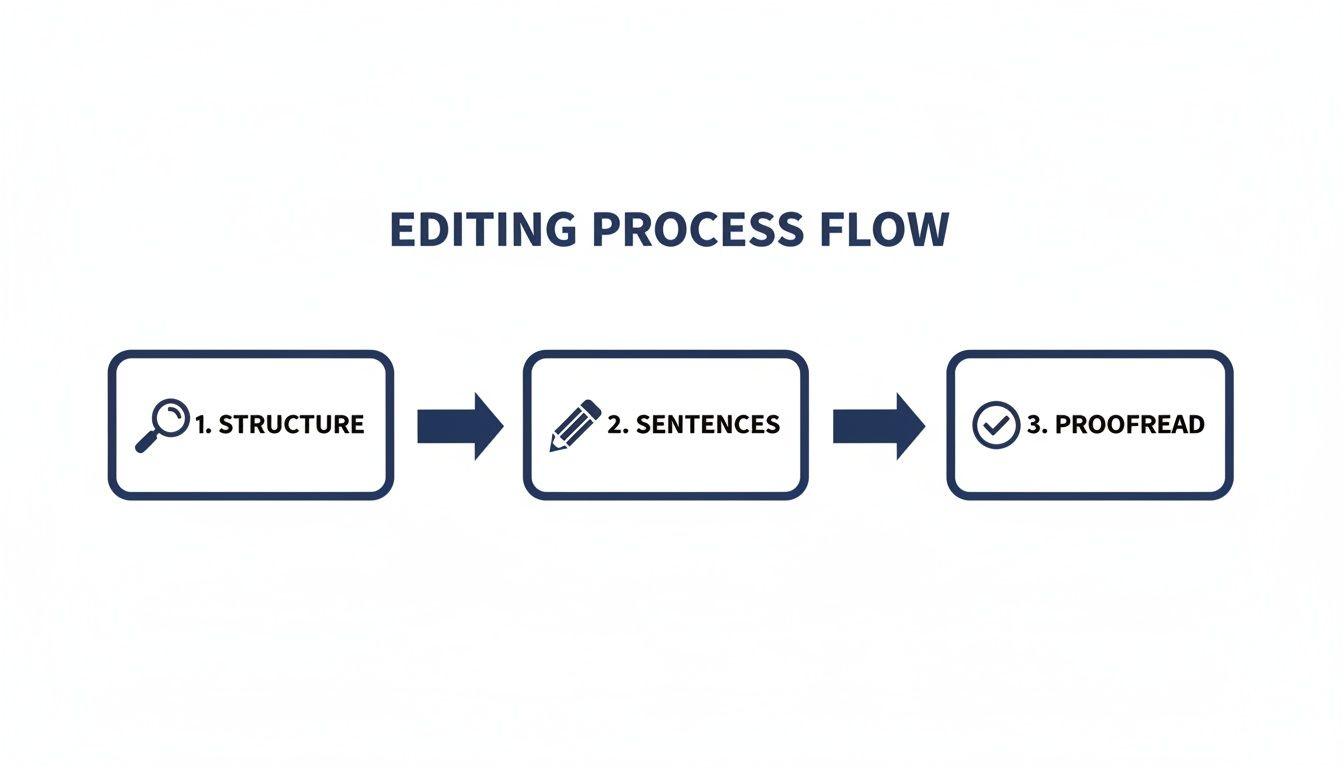
This structured approach prevents you from getting bogged down in tiny comma errors when your argument is still falling apart.
First, you do a quick structural review. Do your paragraphs actually support your thesis? Is the flow logical? Next, read the whole thing out loud. This is the single best trick for catching awkward phrasing and clunky sentences.
Finally, run a grammar and spelling check using a tool like Grammarly. This multi-pass method turns a messy "brain dump" draft into a clean, polished essay without wasting hours.
Got Questions About Writing Essays Fast?
Jumping into a faster, tech-assisted writing workflow is smart, but it's natural to have a few questions. Let's clear up some of the most common concerns so you can write quickly, ethically, and with confidence.
Is Using AI to Write Essays Cheating?
It all comes down to how you use the tool. Think of a good AI writing assistant like a calculator in math class. It’s there to help you handle the tedious calculations and organize complex data, not to solve the core problem for you.
Using AI to brainstorm ideas, get the gist of a dense research paper, or build a solid outline? That’s just being efficient. It’s a modern way to speed up the grunt work. Where you cross the line into academic dishonesty is when you ask it to generate the entire essay and pass it off as your own. At that point, the AI isn't your assistant anymore; it's your ghostwriter.
The real goal here is to augment your own intelligence, not replace it. Let AI do the heavy lifting with structure and organization so you can pour your energy into the critical thinking, analysis, and unique insights that only a human—you—can provide.
When in doubt, always give your institution's academic integrity policy a quick read to see where they stand.
How Do I Make Sure It Still Sounds Like Me?
This is a big one. An essay that sounds like a robot wrote it is a dead giveaway, and it completely lacks the personal touch that earns top marks. The secret is to keep AI focused on structure and polish, not on creating your core ideas.
You should always be the one writing the main arguments, crafting the topic sentences, and weaving in your own analysis during the drafting stage. Get your own thoughts down on the page first. Then, you can bring in an AI tool to help refine what you’ve already created.
For instance, you could feed it a paragraph you’ve written and try prompts like:
- "Can you rephrase these sentences to sound more academic? Don't change my original meaning."
- "Give me three stronger verbs I could use in this paragraph."
- "Check this section for flow and clarity. What could I improve?"
This way, the final essay is still 100% yours—it's just a more articulate and polished version of your own work.
What’s the Absolute Best Tip for Writing Faster?
If you take only one thing away from this guide, let it be this: always, always create a detailed outline before you write a single word of your essay. Seriously. It is the single biggest time-saver you can possibly implement.
A good outline is your roadmap. It forces you to organize your thoughts, line up your arguments logically, and figure out where your evidence goes before you get bogged down in wording the perfect sentence. Spending a solid 30 minutes on a plan can easily save you hours of painful rewriting and staring at a blinking cursor later on.