Your essay title is more than just a label; it’s your first handshake with the reader. It sets the tone, promises value, and can significantly influence a grader's or professor's perception before they even read your opening sentence. A powerful title is the key to standing out, making your work memorable, and framing your argument effectively.
This guide moves beyond generic advice to provide a comprehensive toolkit of strategies and examples. You'll find a massive collection of good essay titles categorized by essay type, subject, and grade level, ready to be adapted for your specific needs. We will also explore the critical techniques for crafting your own original and compelling titles, ensuring they not only accurately reflect your work but also capture attention and spark genuine curiosity.
We’ll break down the art of title creation into actionable steps, from transforming a bland topic into a brilliant headline to understanding the subtle conventions across different academic disciplines. Whether you are a high school student tackling a literary analysis, a college student working on a research paper, or a professional refining a report, this listicle will equip you with the practical skills needed to turn a simple heading into a powerful tool for success.
1. The Art of Crafting Compelling Essay Titles: A Guide for Students and Professionals
Treating title creation as a distinct art form is the first step toward crafting truly good essay titles. This approach moves beyond simply labeling your work and focuses on creating a powerful first impression that captures attention and accurately frames your content. It involves understanding the psychology of what makes a reader curious while clearly signaling the essay's core argument and value.
This method is crucial for anyone, from high school students to business professionals, who needs their writing to stand out. A well-crafted title can increase reader engagement significantly because it promises a worthwhile experience, making it an essential skill for achieving academic success or professional impact.
How to Implement This Approach
- Academic Titles: Use a descriptive title followed by a colon and a more specific subtitle. For example, "Digital Echoes: The Lasting Impact of Social Media on Adolescent Identity."
- Professional Content: In a business context, focus on outcomes or questions. For instance, a report might be titled, "Streamlining Operations: A Cost-Benefit Analysis of AI Integration."
- Creative Essays: For more narrative or persuasive essays, an evocative or provocative title can be effective. Consider something like, "The Silence of the Stacks: What We Lose When Libraries Close."
Actionable Tips for Success
To master this art, focus on precision and creativity. Use AI assistants to brainstorm dozens of variations quickly, helping you see your topic from new angles. Before finalizing, ensure your title aligns perfectly with your thesis statement, a process made easier if you've prepared a strong plan using an essay outline example. Always prioritize clarity over cleverness; a good title must be an honest representation of the content to follow.
2. Why Good Essay Titles Matter: Impact on Academic Success and Professional Credibility
Understanding the direct correlation between your title's quality and your work's reception is crucial. Good essay titles are not just decorative; they are strategic tools that can significantly influence academic grades and professional reputation. A compelling title grabs a grader’s or reader’s attention, setting a positive expectation before they even read the first sentence, which can subconsciously impact their perception of the entire piece.
This principle is vital for students aiming for higher marks and professionals seeking to establish authority. Research and content marketing data show that strong titles directly correlate with higher engagement, more citations in academia, and better performance metrics in business. A well-chosen title frames your argument effectively, making your work appear more credible and impactful from the outset.
How to Implement This Approach
- Academic Impact: Analyze citation rates of influential papers in your field. Notice how many use a clear, descriptive title combined with a specific subtitle. For example, a poorly titled paper might be "Climate Study," while a strong one is "The Sixth Extinction: An Unnatural History."
- Professional Credibility: In content marketing, A/B testing reveals how a title like "5 Ways to Boost Q4 Sales" will outperform a generic one like "Sales Strategies." The same logic applies to reports, proposals, and LinkedIn articles.
- Creative Writing: A powerful title can be the difference between a story being read or ignored. A title like "Fahrenheit 451" is infinitely more intriguing than "A Story About Banned Books."
Actionable Tips for Success
To leverage this impact, use AI tools to generate and analyze multiple title options for their potential engagement. Use 1chat's multi-LLM capabilities to find peer-reviewed studies on title effectiveness or analyze successful essays in your discipline. Before finalizing, gather feedback on your proposed titles; a title that seems brilliant to you might be confusing to others. Always ensure your chosen title is an honest and compelling gateway to your content.
3. From Boring to Brilliant: Transforming Generic Essay Titles into Engaging Attention-Grabbers
Transforming a generic title into an engaging one involves applying specific rhetorical and stylistic techniques to elevate it from a simple label to a powerful hook. This approach focuses on using wordplay, asking provocative questions, and leveraging modern headline conventions to spark immediate curiosity. It's about turning a descriptive but dull title into one that is memorable, shareable, and impossible to ignore.
This method is essential for writers in the digital age, where attention is a scarce resource. Whether for a student essay, a blog post, or a professional report, a brilliant title ensures your work gets noticed amidst a sea of content. It promises value and intrigue, compelling the audience to read further and making it one of the most effective strategies for crafting good essay titles.
How to Implement This Approach
- Rhetorical Questions: Reframe a statement as a question. Instead of "The Effects of Climate Change on Coastal Cities," try "Are We Building Our Future on Sinking Ground? A Look at Coastal Cities and Climate Change."
- Intriguing Statements: Use a bold or counterintuitive claim. A title like "Why Failure is the Secret Ingredient to Success" is far more engaging than "The Role of Failure in Learning."
- Wordplay and Alliteration: Employ literary devices for memorability. For instance, "Fossil Fuels to Future Frontiers: The Fraught Path to Renewable Energy" uses alliteration to create a rhythmic, impactful title.
Actionable Tips for Success
To master this transformation, start by generating at least 20 title variations. This brainstorming process helps you move beyond the obvious first ideas. Test your top choices with peers or use an AI assistant to get real-time feedback on their potential impact and clarity. For students looking to enhance this process, exploring various AI writing tools for students can provide powerful assistance in generating and refining compelling titles that truly stand out.
4. Essay Title Conventions Across Disciplines: What Works in STEM, Humanities, and Business Writing
Understanding that title conventions differ across academic and professional fields is key to crafting good essay titles that resonate with a specific audience. A title that excels in a humanities journal would likely be ineffective for a scientific paper or a business report. Each discipline has its own unspoken rules and expectations for how information should be framed.
This discipline-specific approach ensures your title immediately signals credibility and relevance to experts in that field. STEM (Science, Technology, Engineering, and Mathematics) values precision and objectivity, humanities prioritizes interpretive and theoretical framing, and business writing focuses on tangible outcomes and actionable insights. Aligning your title with these conventions shows you understand the discourse of your chosen field.
How to Implement This Approach
- STEM Titles: Emphasize methodology and findings with precise, descriptive language. For example, "The Effects of Curcumin on Beta-Amyloid Plaque Formation: A Quantitative Analysis in a Murine Model."
- Humanities Titles: Use creative or conceptual main titles followed by a more descriptive subtitle. An example is, "Fragmented Narratives: Deconstructing Postmodern Identity in the Works of Don DeLillo."
- Business Titles: Focus on the value proposition, results, or a direct question to the reader. A strong title could be, "Driving Growth: How AI-Driven Solutions Reduced Operational Costs by 40% in Q3."
Actionable Tips for Success
To apply this effectively, analyze titles from top journals or publications in your specific discipline. Use AI tools to generate title variations that fit the stylistic conventions of STEM, humanities, or business, asking it to adopt the appropriate tone. Before finalizing, get feedback on whether your title aligns with your field's expectations. This ensures your work is not just well-written but also perfectly positioned for your target audience.
5. The Psychology of Reader Attention: How Title Structure Influences Comprehension and Engagement
Understanding the cognitive science behind how readers process information is a powerful strategy for creating good essay titles. This approach leverages psychological principles like information hierarchy, pattern recognition, and emotional triggers to craft titles that are not just descriptive but neurologically engaging. It’s about structuring your title to work with the brain's natural tendencies, making it more memorable and persuasive.
This method is highly effective because it is evidence-based, drawing from research on how the human mind prioritizes and absorbs information. A title designed with these principles in mind can significantly boost comprehension and a reader's motivation to continue, making it an essential tool for academic and professional writers who want their work to make a genuine impact.
How to Implement This Approach
- Information Hierarchy: Place the most critical keywords at the beginning of the title. For instance, in a psychology paper, "Cognitive Dissonance in Digital Spaces: How Online Forums Amplify Belief Perseverance" immediately signals the core topic.
- Pattern Recognition: Use familiar structures, like a question or a "How to" format, that the brain can process quickly. An example would be, "Can Renewable Energy Sustain Economic Growth? A Comparative Analysis."
- Emotional Triggers: Incorporate words that evoke curiosity or a specific emotion. A title like "The Forgotten Promise: Re-evaluating the Impact of Post-War Foreign Aid" uses emotional language to draw the reader in.
Actionable Tips for Success
To apply this technique, analyze your titles through a cognitive science lens. Use AI tools to generate variations that specifically target psychological triggers like curiosity or urgency. Test different emotional language and get feedback on its potential impact. This scientific approach ensures your title does more than just announce a topic; it actively engages the reader's attention from the very first glance, setting the stage for a compelling introduction. For more tips on captivating your audience from the start, explore these examples of good intros for essays.
6. Common Title Mistakes: How to Avoid Ineffective Headlines and Improve Your Essay Quality
Understanding what makes a title ineffective is as crucial as knowing what makes one great. Focusing on common mistakes allows you to sidestep pitfalls that weaken your essay's first impression, such as vagueness, excessive length, or unnecessary jargon. This approach is a diagnostic tool, helping you refine your ideas into a sharp, engaging, and accurate headline that truly reflects your work's quality.
This method is essential for writers at all levels because even a brilliant essay can be overlooked if its title fails to communicate its value. By actively avoiding these errors, you ensure your title serves as an effective gateway to your content, inviting readers in rather than confusing them or turning them away, thereby helping you create good essay titles that capture attention.
How to Implement This Approach
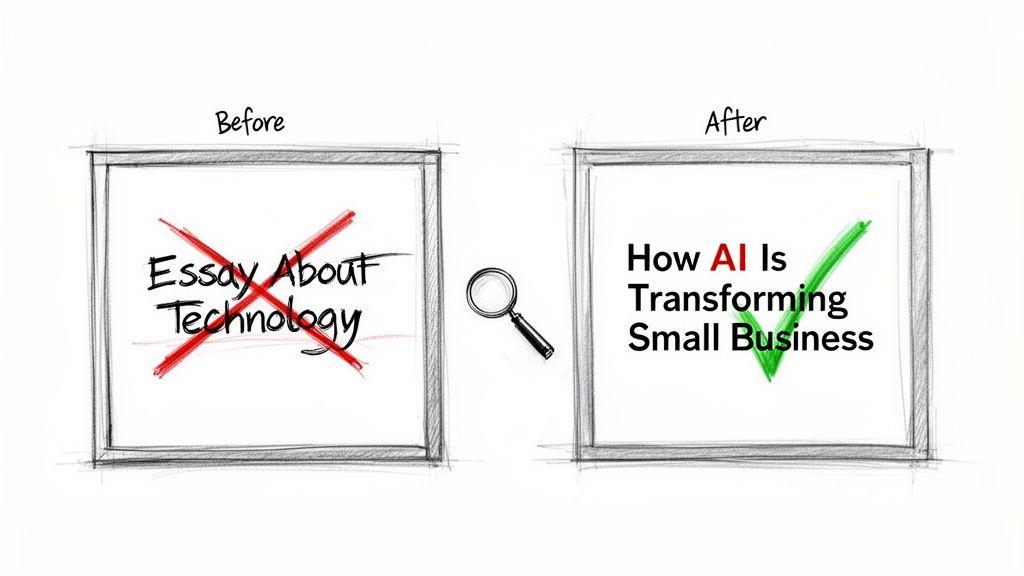
- Vague to Specific: Transform a generic title into a precise one. For example, change "Essay About Technology" to "How AI Is Transforming Small Business Operations."
- Long to Concise: Shorten overly long titles for clarity. A title exceeding 15 words can often be optimized with a main title and a subtitle for better readability.
- Jargon to Accessible: Replace technical jargon with clearer language when writing for a general audience. This makes your work more approachable without sacrificing intellectual depth.
Actionable Tips for Success
Use AI tools like 1chat as a safeguard against common errors. Paste your draft title and ask for specific feedback on vagueness, length, or clarity. You can also have it check for grammatical mistakes or suggest before-and-after improvements from different perspectives. This process ensures your final title is polished, professional, and free of costly mistakes that could undermine your essay.
7. SEO and Discoverability: Optimizing Essay Titles for Search Engines and Digital Platforms
In the digital age, a great title does more than just attract readers; it helps them find your work in the first place. Optimizing your title for search engines (SEO) involves strategically including keywords that your target audience is searching for. This technical approach ensures your essay or article is visible on platforms like Google, academic databases, and even social media, connecting your content with those who need it most.
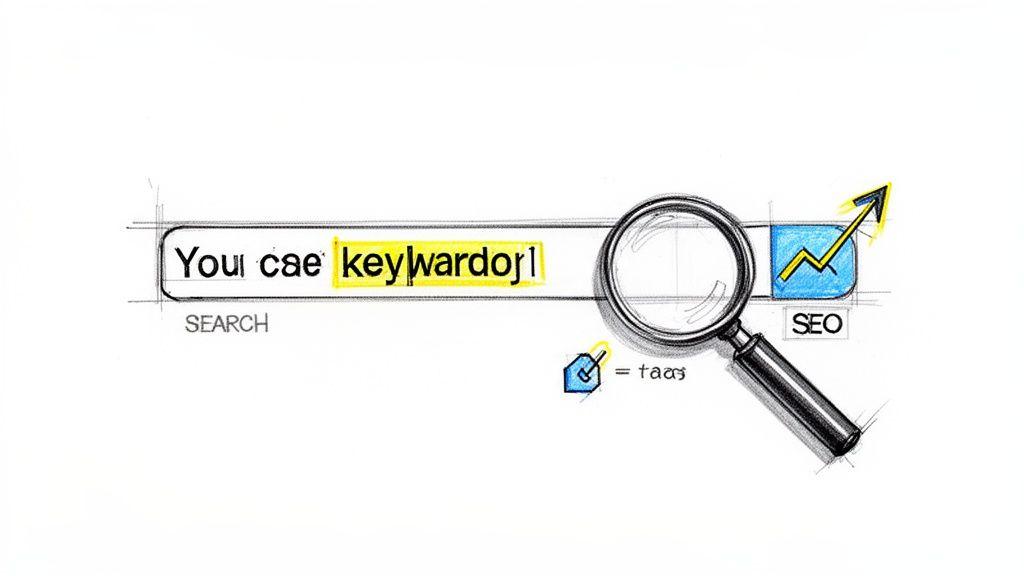
This method is crucial for students publishing online, professionals building a personal brand, and businesses engaged in content marketing. A well-optimized title can dramatically increase traffic and impact by making your work discoverable. It transforms a piece of writing from a passive document into an active asset that continuously attracts an audience.
How to Implement This Approach
- Academic Articles: Instead of "An Analysis of Renewable Energy Policies," try an optimized version like "Renewable Energy Policy Analysis: A 2024 Review of Solar and Wind Incentives."
- Business Blog Posts: A generic title like "Improving Teamwork" becomes more discoverable as "10 Actionable Strategies for Improving Team Collaboration in Remote Workplaces."
- Student Portfolios: For a project, shift from "My Final Project" to "UX Case Study: Designing a Mobile App for Sustainable Grocery Shopping."
Actionable Tips for Success
To effectively craft good essay titles for discoverability, begin with keyword research. Use an AI assistant to identify high-value search terms related to your topic and generate title variations that integrate them naturally. Analyze top-ranking competitor titles to understand what works in your niche. Remember to place your primary keyword near the beginning of the title for maximum impact, ensuring it reads clearly and promises value to the searcher.
8. Cultural Sensitivity and Inclusivity in Essay Titles: Creating Headers That Respect Diverse Audiences
Crafting culturally sensitive and inclusive titles is no longer optional; it is an essential practice for modern writing. This approach involves consciously choosing language that respects diverse audiences, avoids stereotypes, and acknowledges different cultural contexts. It ensures your title serves as a welcoming entry point for every reader, reflecting a commitment to thoughtful and responsible communication.
This method is critical in academic, professional, and personal writing, as an insensitive title can alienate readers before they even engage with your work. Good essay titles built on this principle demonstrate awareness and respect, enhancing the credibility of your arguments and creating a positive first impression that aligns with inclusive values.
How to Implement This Approach
- Gender and Identity: Opt for inclusive language that avoids assumptions. Instead of "Man's Impact on the Environment," choose "Humanity's Impact on the Environment" or "The Human Impact on Global Ecosystems."
- Marginalized Groups: Use respectful, up-to-date terminology. For example, use person-first language like "An Analysis of Educational Barriers for Students with Disabilities" unless identity-first language is preferred by the community being discussed.
- Global Audiences: Consider how a title translates across cultures. A title using a specific regional idiom might be confusing or inappropriate for international readers. Aim for clarity and universality.
Actionable Tips for Success
To ensure your titles are inclusive, use AI tools to research current cultural sensitivity guidelines related to your topic. You can ask an AI assistant to review a potential title for unintentionally biased or insensitive language. Before finalizing, get feedback on whether your title uses inclusive terminology. Continuously update your understanding of these evolving standards to ensure your writing remains respectful and effective.
9. Measuring Title Effectiveness: Analytics, Feedback, and Continuous Improvement Strategies
Transforming title creation from a guessing game into a science involves systematically measuring its effectiveness. This data-driven approach uses analytics, reader feedback, and iterative testing to determine which titles perform best. Instead of relying on intuition alone, you can use concrete metrics to understand what captures attention, drives engagement, and accurately represents your work.
This method is invaluable for professionals in content marketing, academics tracking citation impact, and students publishing work online. By analyzing what works, you can develop a repeatable formula for crafting good essay titles that consistently achieve your goals, whether it's higher readership, better grades, or increased professional influence.
How to Implement This Approach
- Bloggers and Marketers: Track click-through rates (CTR) and on-page time in your analytics dashboard. A high CTR with low on-page time may indicate a misleading title, while a strong combination suggests success.
- Academics and Researchers: Monitor citation counts and download numbers for your published papers. Compare how different title structures correlate with higher engagement within your academic community over time.
- Students: Solicit direct feedback from peers or instructors. Ask questions like, "What do you expect this essay to be about based on the title?" to gauge clarity and interest before final submission.
Actionable Tips for Success
Use AI tools like 1chat to analyze performance data and identify trends in your most successful titles. You can generate multiple title variations for a single piece and use A/B testing in an email newsletter or social media post to see which one performs better. Gather qualitative feedback from readers and use 1chat to synthesize it into actionable insights, helping you continuously refine your title creation strategy based on real-world results.
10. Creating Titles That Tell Stories: Narrative Techniques for Making Essays More Engaging and Memorable
Incorporating narrative techniques transforms a title from a simple label into an engaging hook. This approach frames your essay's core message as a story, complete with a progression, a subject, and even a hint of conflict or resolution. By doing so, you create an immediate sense of intrigue that makes the reader want to discover the full story within your writing.
This method is highly effective for making even complex or data-heavy topics more accessible and memorable. A title that tells a story promises a journey, not just a dry presentation of facts. This makes it an excellent strategy for persuasive essays, case studies, and creative nonfiction, where connecting with the reader on an emotional level is key to making a lasting impact.
How to Implement This Approach
- Professional Case Studies: Frame the title around a transformation. For example, "From Struggling Startup to Industry Leader: How AI Transformed Our Business."
- Data-Driven Reports: Use a title that suggests a journey of discovery. Consider something like, "A Journey Through Data: Discovering the Patterns That Changed Everything."
- Persuasive Essays: Introduce a character or protagonist to create a focal point. An example would be, "The Unexpected Hero: Why Small Teams Outperform Large Organizations."
Actionable Tips for Success
To craft strong, narrative-driven titles, focus on verbs that imply action and progression. Study the titles of popular TED Talks or science articles, as they often use storytelling to distill complex ideas. Use AI tools to brainstorm titles that balance narrative flair with clarity; for instance, you can ask 1chat to generate variations that tell a story while still conveying your essay's main argument. Always ensure the "story" in your title accurately reflects the narrative arc of your essay.
10-Point Comparison: Effective Essay Title Strategies
| Title | Complexity 🔄 | Resources ⚡ | Expected outcomes ⭐📊 | Ideal use cases | Key advantages 💡 |
| The Art of Crafting Compelling Essay Titles: A Guide for Students and Professionals | Moderate — audience analysis required 🔄 | Low–Medium — examples, time, AI help ⚡ | Higher engagement & discoverability; clearer first impressions ⭐📊 | Students & professionals drafting essays or marketing copy | Teaches transferable titling skills; improves SEO and clarity 💡 |
| Why Good Essay Titles Matter: Impact on Academic Success and Professional Credibility | Moderate — needs empirical framing 🔄 | Medium — research and analytics ⚡ | Quantifiable effect on grading, credibility, engagement ⭐📊 | Researchers, students, professionals measuring impact | Evidence-backed case for investing in title quality 💡 |
| From Boring to Brilliant: Transforming Generic Essay Titles into Engaging Attention-Grabbers | Low–Moderate — technique-based steps 🔄 | Low — heuristics, AI brainstorming ⚡ | Immediate lift in reader interest and shareability ⭐📊 | Students, content creators seeking creative boosts | Actionable, easy-to-apply rhetorical techniques 💡 |
| Essay Title Conventions Across Disciplines: What Works in STEM, Humanities, and Business Writing | High — discipline-specific rules and nuance 🔄 | Medium–High — field examples, venue guidelines ⚡ | Higher acceptance/publication and audience fit ⭐📊 | Academics and professionals across disciplines | Field-tailored guidance that increases acceptance rates 💡 |
| The Psychology of Reader Attention: How Title Structure Influences Comprehension and Engagement | High — needs cognitive understanding 🔄 | High — literature review, experiments ⚡ | Scientifically optimized comprehension and engagement ⭐📊 | Marketers, UX writers, researchers, serious writers | Science-based rationale for title choices and predictability 💡 |
| Common Title Mistakes: How to Avoid Ineffective Headlines and Improve Your Essay Quality | Low — checklist and simple fixes 🔄 | Low — checklist, AI feedback ⚡ | Fewer errors; faster revisions; clearer titles ⭐📊 | Students, novice writers, teams standardizing copy | Prevents common pitfalls; quick, practical corrections 💡 |
| SEO and Discoverability: Optimizing Essay Titles for Search Engines and Digital Platforms | Moderate–High — technical plus creative balance 🔄 | Medium–High — keyword tools, analytics ⚡ | Increased organic reach and qualified traffic ⭐📊 | Small businesses, digital publishers, students aiming for reach | Measurable SEO improvements and platform-specific tactics 💡 |
| Cultural Sensitivity and Inclusivity in Essay Titles: Creating Headers That Respect Diverse Audiences | Moderate — requires contextual judgment 🔄 | Medium — research, feedback loops ⚡ | Broader audience reach; reduced risk of offense ⭐📊 | Organizations, educators, global content creators | Builds inclusive reputation; avoids backlash and harm 💡 |
| Measuring Title Effectiveness: Analytics, Feedback, and Continuous Improvement Strategies | High — experimental design and analysis 🔄 | High — analytics tools, time, sample size ⚡ | Data-driven optimization; iterative performance gains ⭐📊 | Marketers, content teams, data-driven students | Objective validation of title choices; continuous improvement framework 💡 |
| Creating Titles That Tell Stories: Narrative Techniques for Making Essays More Engaging and Memorable | Moderate — creative skill and balance 🔄 | Low–Medium — time, examples, creative input ⚡ | Greater memorability and emotional engagement ⭐📊 | Creative writers, marketers, storytellers in academia | Emotional connection and differentiation while retaining info 💡 |
Your Next Great Title Starts Here
We've journeyed through the strategic art and science behind crafting exceptional essay titles. Moving beyond a simple label, a powerful title acts as the first handshake with your reader, setting the tone, managing expectations, and creating an immediate hook. You now have a comprehensive toolkit filled with actionable strategies, from understanding the psychological triggers that capture attention to mastering the specific title conventions required by different academic disciplines. The goal is no longer just to label your work but to strategically position it for maximum impact.
Remember, the difference between a passed-over paper and a praised one often begins with those first few words. By avoiding common mistakes like vagueness or over-sensationalism and instead focusing on clarity, creativity, and relevance, you elevate your writing from the very start.
Key Takeaways and Your Path Forward
As you approach your next writing task, keep these core principles at the forefront of your process. Think of title creation not as an afterthought but as an integral part of your writing workflow.
- Synthesize and Summarize: A great title often distills the core argument or thesis of your entire essay into a concise, powerful statement. It should reflect the main takeaway you want your reader to remember.
- Balance Clarity and Creativity: Your title must be understandable, but it shouldn't be boring. The most effective titles, as we've explored, often combine a clear, descriptive element with a creative or provocative hook, like the popular "Colon-and-Subtitle" structure.
- Know Your Audience and Discipline: A title for a STEM research paper has different requirements than one for a personal narrative or a business proposal. Always tailor your approach to meet the expectations of your specific field and intended readers.
Actionable Next Step: For your very next essay, challenge yourself to brainstorm at least five different titles before choosing one. Experiment with the techniques discussed in this article: try a question-based title, a narrative-driven one, and a direct, declarative statement. This simple exercise will strengthen your title-crafting muscles and lead to better, more thoughtful results.
The Lasting Value of a Strong Title
Mastering the skill of writing good essay titles is an investment that pays dividends far beyond a single grade. In the professional world, it translates directly to writing compelling email subject lines, engaging report headlines, and persuasive project proposals. In our digital age, where content is everywhere, the ability to capture attention quickly and effectively is a crucial and highly valuable skill. A strong title ensures your hard work gets the visibility and consideration it deserves.
You are now equipped not just with lists of examples, but with the foundational knowledge to innovate and create original, compelling titles for any piece of writing. Use these strategies, practice consistently, and watch as the quality and impact of your work transform, starting from the very top. Your next great title is waiting to be written.