Before you write a single line of code or book a single meeting, you need a project proposal. This document is where you lay out the project's entire game plan: its purpose, scope, deliverables, timeline, and budget. The goal is to build a rock-solid case that shows stakeholders exactly why your project is the right move and deserves their backing.
Why a Great Project Proposal Is Your Most Important Tool
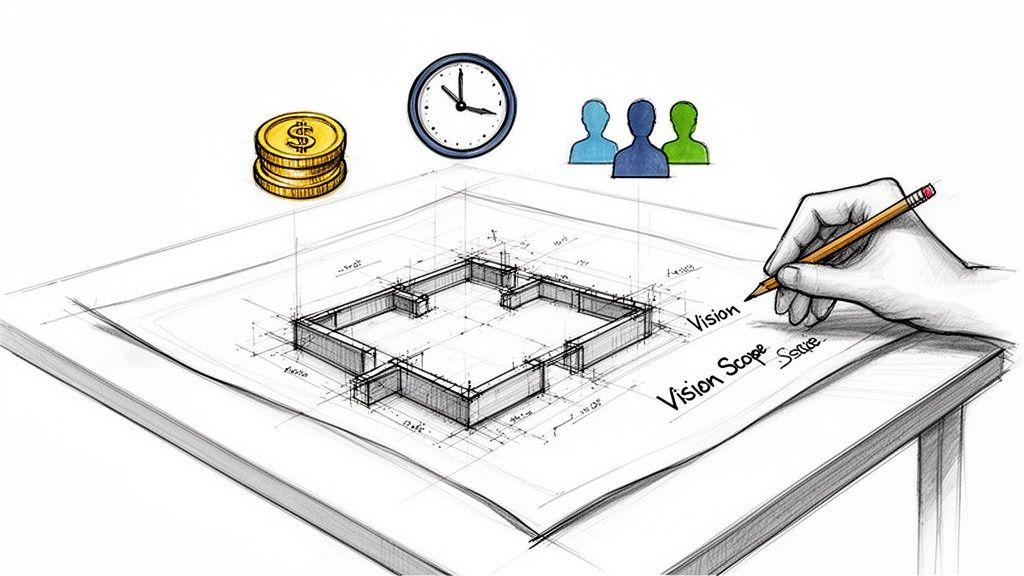
Here's a hard truth: many projects are doomed from the start. The culprit is often a weak proposal that leads to confusion, mismatched expectations, or just a flat-out "no" from decision-makers. A well-written project proposal isn't just bureaucratic busywork; it's the foundation your entire project is built on.
Think of it as the blueprint for a building. A detailed blueprint prevents costly structural mistakes down the line, and a great proposal wards off common project-killers like scope creep and budget overruns. It’s your first—and best—opportunity to share a clear vision and get everyone pulling in the same direction.
Setting the Stage for Success
The process of writing a proposal forces you to wrestle with every critical detail, turning a vague idea into a concrete, actionable plan. This document plays several key roles that have a direct line to your project's success:
- Securing Buy-in: It explains why the project is necessary and convinces leaders to allocate the time, money, and people to make it happen.
- Aligning Stakeholders: It acts as the single source of truth for what gets delivered, when, and how, making sure everyone shares the same understanding from the get-go.
- Defining Boundaries: It clearly fences in the project's scope, deliverables, and schedule, which is your best defense against an endless stream of new requests.
- Demonstrating Foresight: It flags potential risks and lays out a plan to handle them, proving to stakeholders that you’re prepared for what’s ahead.
A strong proposal is more than a request; it's a declaration of competence. It shows you've done your homework and are ready to lead the project to a successful conclusion.
The Real Cost of a Poor Proposal
The stakes are incredibly high. A staggering statistic reveals that only 35% of projects worldwide are actually completed successfully on time and on budget. This number alone should tell you how vital a good proposal is.
Companies that treat project management seriously see a 28% better success rate than those that don't—and it all begins with that first proposal. You can dig into more of these numbers and what they mean in this breakdown of project management trends and statistics.
At the end of the day, learning how to write a compelling project proposal is about more than just getting the green light. It's about earning trust, building confidence, and setting your project up to succeed from day one. It's how you turn great ideas into real, tangible results.
The Core Components of a Persuasive Proposal
A winning proposal isn't just a list of tasks and costs. It's a story. It has to grab a stakeholder, walk them through a problem, and convince them that you hold the perfect solution. Each piece of the proposal is a chapter in that story, building a logical and compelling case for why your project deserves the green light.
Let's break down the essential building blocks you need to nail.
The Executive Summary: The Hook
Think of the executive summary as the movie trailer for your project. It’s your one shot to grab their attention and make them want to read the rest. It has to be sharp, concise, and packed with just enough information to be compelling.
This is where you briefly outline the problem, hint at your brilliant solution, and flash the ultimate benefit. A killer summary shows you respect the stakeholder's time by putting the most critical information right at the top. For a deeper dive, check out our guide on how to write executive summaries that get results.
The Problem Statement: Why This Project Matters
Before you can sell your solution, everyone has to agree on the problem. The problem statement is where you build the "why" behind your entire project. Don't just state an issue; you need to illustrate its real-world impact with cold, hard evidence.
Use data to make your case undeniable. Instead of saying, "Our customer service is slow," hit them with the facts: "Our average customer response time has spiked by 45% in the last quarter, directly causing a 15% drop in our customer satisfaction scores." See the difference? A vague complaint just became an urgent business crisis that needs a solution, now.
This is where you show you’ve done your homework. Project-based work contributes over $20 trillion to the global economy, yet a study from the Project Management Institute shows that only 77% of top-performing companies treat project management as a strategic must-have. Tying your specific problem to these bigger trends proves you understand the landscape.
Goals and Objectives: Defining Success
Okay, you've established the problem. Now, what does winning look like? This section is all about translating your big vision into concrete, measurable outcomes. It's crucial to know the difference between goals and objectives.
- Goals are the broad, ambitious outcomes. Think: "Improve the user onboarding experience."
- Objectives are the specific, measurable steps to get there. Think: "Reduce user drop-off during onboarding by 25% within three months."
Leaning on the SMART framework (Specific, Measurable, Attainable, Relevant, Time-bound) is always a good move. It strips away any ambiguity and gives stakeholders clear benchmarks they can use to track your progress and, ultimately, judge your success.
Scope and Deliverables: What You Will (and Won't) Do
This section is your best friend for preventing future headaches. The scope sets the clear boundaries of your project. It's a definitive list of all the work you'll perform to hit your objectives.
Just as important is defining what's out of scope. Stating upfront what you won't be doing is your primary defense against scope creep—that slow, painful process of new requirements getting tacked on, threatening to blow up your timeline and budget.
The deliverables are the tangible things you'll hand over. These could be:
- A newly launched software feature
- A comprehensive market research report
- A redesigned website homepage
- A series of employee training workshops
Listing them out makes sure everyone is on the exact same page about what they're getting.
Here's a quick cheat sheet to keep these key sections straight.
Key Sections of a Project Proposal at a Glance
| Section | Purpose | Pro Tip |
| Executive Summary | To provide a high-level overview and grab the reader's attention immediately. | Write it last. You'll have a much clearer picture of the project's core message. |
| Problem Statement | To define the "why" behind the project, creating a sense of urgency. | Use hard data and real-world examples to quantify the problem's impact. |
| Goals & Objectives | To outline what success looks like in broad and specific, measurable terms. | Use the SMART framework to ensure your objectives are clear and trackable. |
| Scope & Deliverables | To define the project boundaries and list the tangible outputs. | Be ruthless about defining what's out of scope to prevent scope creep. |
| Timeline | To set realistic expectations with key phases and progress points. | Break it into phases with milestones. It makes the project feel manageable. |
| Budget | To provide a transparent breakdown of all costs and justify the investment. | Always include a 10-15% contingency line. It shows you're a realist. |
| Risk Assessment | To identify potential roadblocks and show you have a plan to handle them. | Frame this as a sign of strength and foresight, not a list of weaknesses. |
The Timeline: Setting Realistic Expectations
A good timeline proves you've actually thought through how this project will get done. Don't just throw out a single end date. Break the project down into distinct phases with key milestones—these are the major checkpoints that prove the project is moving forward as planned.
A phased schedule builds confidence. For example:
- Phase 1: Discovery & Planning (Weeks 1-2)
- Phase 2: Design & Prototyping (Weeks 3-5) — Milestone: Prototype approval
- Phase 3: Development & Testing (Weeks 6-10) — Milestone: Beta launch
- Phase 4: Deployment & Review (Weeks 11-12)
This approach makes a huge project feel manageable and gives stakeholders regular opportunities to see progress, which is exactly what you want.
The Budget: Connecting Costs to Value
Your budget should never be just a list of numbers. It's a story about value. Every single dollar needs to be transparently justified and tied directly to a deliverable or objective. Break your costs down into clear, understandable categories.
| Cost Category | Description | Estimated Cost |
| Personnel | Hours for project manager, developers, designer | $15,000 |
| Software | Licenses for PM and design tools like Asana or Figma | $1,200 |
| Marketing | Costs for promotional materials and ad spend | $2,500 |
| Contingency | A buffer for unexpected issues (10-15% of total) | $1,870 |
| Total | $20,570 |
Including a contingency fund is a pro move. It tells stakeholders that you’re not just an optimist; you’re a realist who plans for the unexpected. That simple line item builds an incredible amount of trust.
Risk Assessment: Demonstrating Foresight
Every project has risks. Pretending they don't exist is naive. Acknowledging them head-on doesn't show weakness—it shows professional maturity and foresight. This section is where you identify potential roadblocks and, more importantly, outline your plan to handle them.
Identifying risks upfront is the mark of an experienced project manager. It proves you're not just planning for the best-case scenario. You’re prepared to navigate the inevitable challenges, reassuring stakeholders that their investment is in very capable hands.
A simple risk matrix works wonders here. Identify a potential issue (e.g., a key developer leaves mid-project), assess its likelihood and impact, and then state your mitigation plan (e.g., maintain thorough documentation, cross-train team members). This proactive thinking turns potential chaos into a manageable hiccup.
A Practical Guide to Crafting Your Proposal
Alright, you've got the essential building blocks down. Now it's time to move from theory to action and start writing. This is where your research, ideas, and strategic thinking come together to form a persuasive document.
Keep in mind, a great project proposal is more than just filling in sections. It’s about telling a story that connects with your audience and convinces them your plan is the right one. Let's walk through how to do that, from understanding who you're talking to all the way to polishing your final draft.
Start with Audience Research
Before you type a single word, you have to know who you're writing for. This is non-negotiable. A proposal aimed at a creative director will flop if you send it to the chief financial officer, and vice versa. They care about completely different things, speak a different language, and define "success" in their own terms.
Don't guess. Dig in and figure out your audience’s pain points, goals, and even their communication style.
- For internal stakeholders: Get your hands on past company reports, internal memos, and strategic plans. What are the big company-wide objectives right now? How does your project help move that needle?
- For external clients or investors: Scour their website, read their press releases, and check out their LinkedIn profiles. Pay attention to the words they use to talk about their own wins and challenges. What do they value?
Knowing this lets you frame your entire proposal in a way that speaks directly to them. You can mirror their language and tie your project's outcomes to the metrics they already obsess over.
Gather and Integrate Credible Data
Your problem statement and proposed solution are only as strong as the evidence you bring to the table. Vague claims like "this will improve efficiency" are easy to ignore. Hard numbers are much harder to argue with.
Back up your claims with credible sources. This could mean:
- Internal Analytics: Pull your own company’s data on customer behavior, operational costs, or team performance.
- Industry Reports: Cite stats from respected market research firms to show you’ve done your homework on the broader landscape.
- Academic Studies: For more technical or research-heavy projects, referencing peer-reviewed studies adds a serious layer of authority. A well-structured sample research plan can give you a great model for presenting this kind of data.
When you use data, weave it into your story. Don't just drop a list of stats. Explain what they mean. For instance, "Industry benchmarks show our competitors have a 25% lower customer acquisition cost. Our proposed marketing automation project is designed to close that specific gap."
At its core, every proposal should follow a simple, powerful logic: you identify a problem, present a solution, and detail the impact.
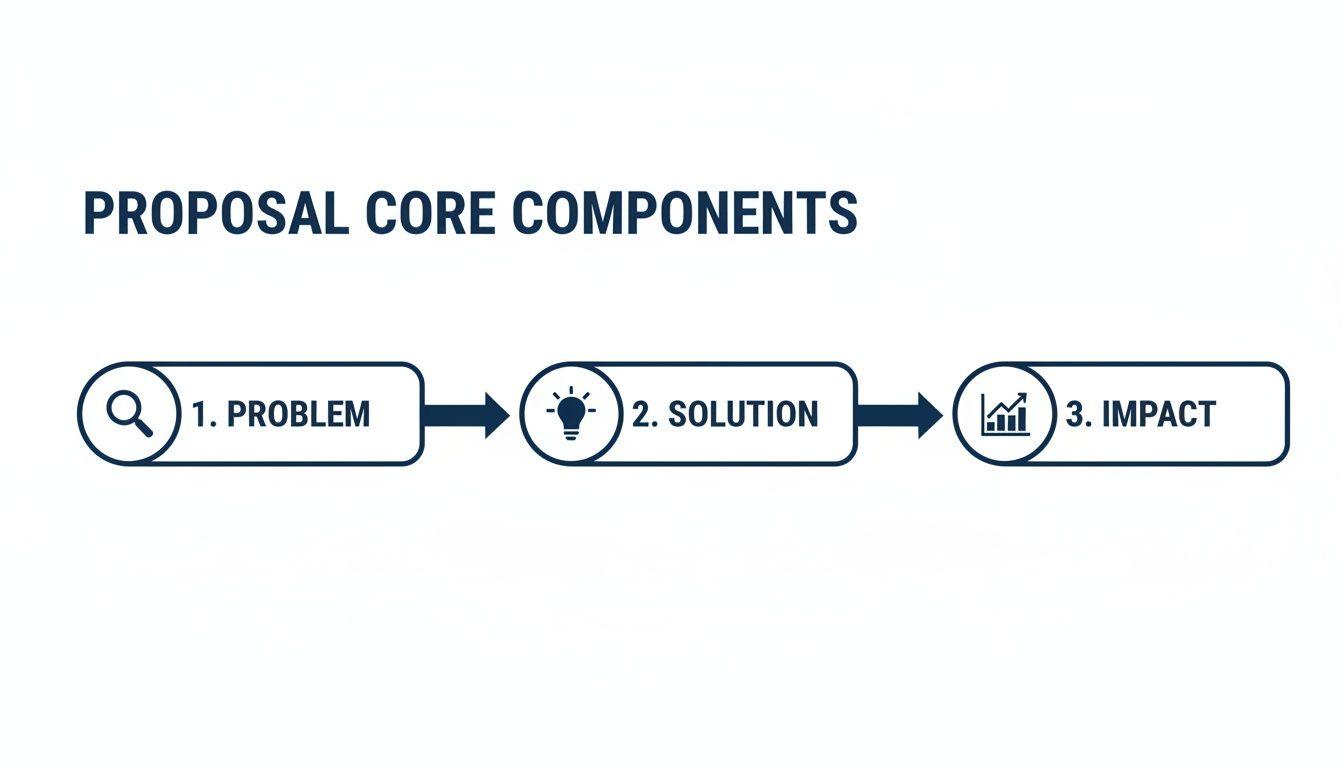
This visual really drives home how a proposal's strength lies in that logical flow. It makes it easy for stakeholders to follow your thinking from the initial need to the final resolution.
Structure a Transparent and Persuasive Budget
Let’s be honest: the budget section is where most proposals get picked apart. The biggest mistake I see is people presenting a single lump-sum figure with no explanation. That just makes people suspicious and invites them to start slashing numbers.
Instead, build trust by being transparent. Break down your costs into clear, logical categories.
| Cost Category | Description & Justification | Estimated Cost |
| Personnel | Hours for Project Manager (80 hrs), Lead Developer (120 hrs), and UX Designer (60 hrs). | $18,500 |
| Software & Tools | Annual licenses for project management software and prototyping tools. | $2,100 |
| External Services | Contract with a third-party quality assurance testing firm. | $4,500 |
| Contingency (15%) | A buffer for unforeseen technical challenges or scope adjustments. | $3,765 |
| Total | Projected Total Investment | $28,865 |
Pro Tip: Always include a contingency line item of 10-15%. This doesn't make you look uncertain—it shows you’re a realist with foresight. It tells stakeholders you understand that projects rarely go exactly as planned and that you’re prepared for it.
When you connect every dollar to a specific project activity, you're not just asking for money. You're showing them exactly how their investment will turn into tangible results.
Use AI as Your Co-Pilot, Not Your Author
AI tools can be a fantastic help when writing a proposal, but they should never be in the driver's seat. Your strategic insight, your understanding of the audience, and your unique voice are what will sell this project. AI is just there to help you execute that vision faster and better.
Think of AI as a co-pilot that can help you:
- Brainstorm Initial Drafts: Perfect for getting past that "blank page" paralysis. Ask it for an outline or a rough draft of a section.
- Refine Your Tone: Make sure your writing strikes the right chord—confident, professional, and suited for your audience.
- Check for Errors: Use it as a super-powered proofreader to catch grammar mistakes, typos, and awkward phrasing.
When you use a tool like 1chat, remember: garbage in, garbage out. Vague prompts will give you generic, useless text. The more specific and context-rich your prompts are, the better your results will be.
Here are a few examples of effective prompts you can adapt:
- For Brainstorming: "Act as a senior project manager. Brainstorm 5 potential risks for a software project to launch a new mobile app for a small retail business. For each risk, suggest one practical mitigation strategy."
- For Refining Tone: "Review this paragraph from my executive summary. Rewrite it to sound more confident and concise for an executive board. [Paste your paragraph here]."
- For Summarizing: "Summarize the key benefits of this project into three impactful bullet points for a CFO. The benefits are improved customer retention, reduced operational overhead, and increased market share."
By using AI thoughtfully, you can speed up the whole process and end up with a more polished proposal that still sounds like you. It’s all about working smarter, not outsourcing your critical thinking.
How to Tailor Your Proposal for Any Audience
A project proposal is never a one-size-fits-all document. I’ve seen countless great ideas get rejected simply because they weren’t framed correctly for the person reading them. A pitch that gets your internal engineering team excited with technical specs will likely put external investors to sleep—they just want to see the bottom line.
The real secret to getting that "yes" is learning to adapt. You have to stop thinking about what your project is and start focusing on what your project does for them. Before you write a single word, put yourself in their shoes. What are their biggest headaches? What does success look like in their world?
Pitching to External Investors and Clients
When you're talking to people outside your company, their first and last question is almost always about value and return on investment. Investors, VCs, and potential clients are all looking at your proposal through a financial lens. They need a rock-solid business case.
To win them over, you have to lead with the money.
- Talk ROI First: Don't bury the lead. Start with the projected revenue, the potential cost savings, or the market share you're going to grab. Numbers speak loudest here.
- Show the Market is Ready: Prove you've done your homework. Back up your claims with credible data that shows how big the opportunity is and why the problem needs solving now. If you need a refresher, this guide on how to conduct market research for small business is a great place to start.
- Define Your Unique Edge: What makes your solution the only real choice? Be crystal clear about your competitive advantage.
For an investor, your project is just a vehicle for growth. Your proposal's job is to hand them the keys and a map showing a direct route to profitability. Skip the nitty-gritty operational details and zoom in on the strategic financial wins.
Presenting to Internal Teams and Leadership
When you’re writing for your own team or management, the conversation changes. The focus shifts from market disruption to internal efficiency and strategic alignment. Your colleagues want to know how this project makes the company stronger, smarter, or faster.
Your proposal has to clearly show how your project fits into the company’s bigger picture.
- Connect to Company Goals: Explicitly link your project's outcomes to the company's current strategic priorities or OKRs (Objectives and Key Results). Don't make them connect the dots for you.
- Highlight Resource Wins: Explain how your project will make better use of people's time, improve a clunky workflow, or cut down on operational headaches.
- Show the Team-Wide Benefits: Point out how your work will help other departments. Does it make life easier for sales? Does it provide better data for marketing? Fostering collaboration is always a winning argument.
Crafting Academic or Research Proposals
For students and academics, you're playing a completely different game. Here, the currency isn't profit or efficiency; it's intellectual contribution and sound methodology. You need to convince a review board that your research is not only possible but also genuinely important to your field.
This means your proposal will be more formal, with a laser focus on the details.
| Your Audience | Their Main Concern | What to Emphasize |
| Investors | "Will this make money?" | Financial projections, market size, and a clear path to 3x ROI. |
| Internal Teams | "How does this help us?" | Efficiency gains, like reducing manual work by 40%, and alignment with company goals. |
| Academics | "Is this sound research?" | Methodological rigor, a solid literature review, and its contribution to the field. |
At the end of the day, tailoring your proposal is about empathy. When you truly understand what your audience cares about, you can frame your project as an unmissable opportunity they can't afford to pass up.
Common Proposal Mistakes and How to Avoid Them
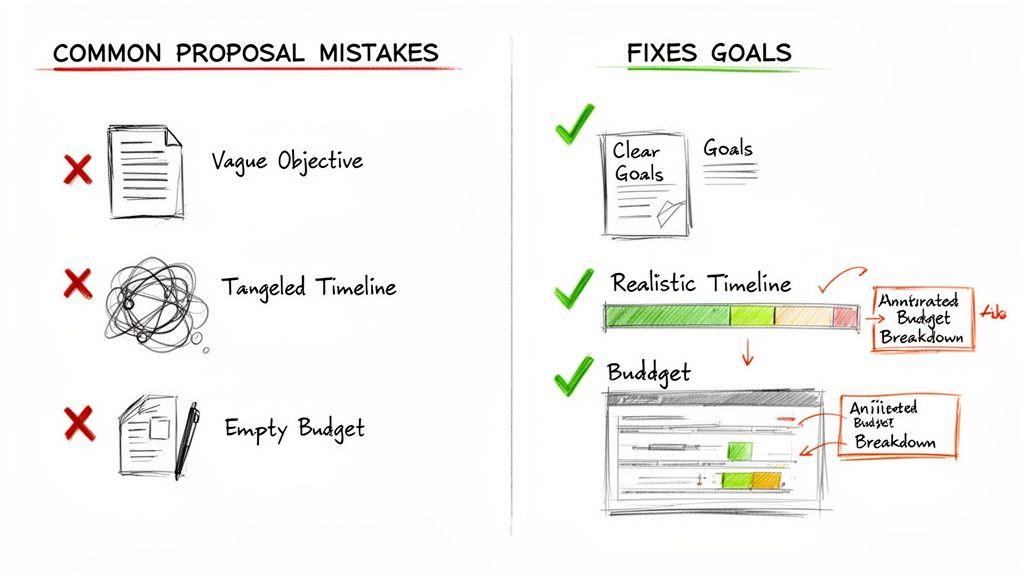
Even the most brilliant project idea can get a swift "no" because of a few common, unforced errors. After reviewing countless proposals over the years, I’ve seen the same tripwires sink otherwise promising projects time and again. Learning to spot and sidestep these mistakes is just as crucial as knowing what to include in the first place.
The gap between approval and rejection often lies in small details that make you look unprepared, unfocused, or disconnected from the stakeholder’s actual needs. Let’s walk through the most frequent offenders and how you can steer clear of them, ensuring your hard work gets the green light it deserves.
Vague Objectives and Fuzzy Outcomes
This is the big one. The single most common mistake I see is a failure to define what success actually looks like. An objective like "improve team collaboration" sounds nice, but it's impossible to measure and means completely different things to different people. This ambiguity creates doubt and leaves stakeholders wondering what they’re really paying for.
Instead, every single objective must be specific and measurable. Your job is to turn the vague into something concrete.
- Before: "Increase our social media presence."
- After: "Grow our organic Instagram engagement rate by 15% and follower count by 2,500 in Q3 by launching a targeted content series."
See the difference? This simple shift provides a clear target, shows you've thought strategically, and gives decision-makers a tangible benchmark to evaluate your project's success. It answers their "so what?" question before they even have a chance to ask it.
The Unrealistic Timeline or Budget
Overly optimistic timelines and underdeveloped budgets are massive red flags. Proposing a plan that promises the world in two weeks on a shoestring budget doesn’t make you look efficient—it makes you look naive. Stakeholders with any real-world experience can spot an unrealistic plan a mile away, and it instantly shatters your credibility.
To get this right, build your timeline and budget from the ground up. Break the entire project into small, manageable tasks, then estimate the time and cost for each one. And please, don't forget to add a contingency buffer of 10-15% to both your timeline and budget. This isn't a sign of weakness; it shows you’re a realist who understands that unexpected issues are just part of getting things done.
A well-justified budget and a realistic timeline are signs of professional maturity. They prove you’ve done more than just dream up an idea; you've thought through the practical realities of making it happen.
Forgetting the "Why" Behind the "What"
So many proposals get lost in the weeds. They meticulously detail every task and deliverable—the "what"—while completely forgetting to sell the "why." They fail to connect the project's day-to-day activities to a larger, more meaningful business outcome. This is a fatal flaw because stakeholders don't fund activities; they fund results.
Think of your proposal as a persuasive argument, not just a glorified to-do list. You need to constantly tie every section back to the core problem you're solving for them.
- Don't just say: "We will build a new CRM dashboard."
- Instead, say: "By building a new CRM dashboard, we will reduce lead response time by 30%, which is projected to increase sales conversions by 5%."
This approach keeps the reader focused on value and impact, which is what truly matters. The data backs this up: the average proposal win rate hovers around 45%, but top-performing teams who focus on value achieve rates over 75%. You can explore more about how efficiency drives success in these in-depth proposal statistics.
Your Project Proposal Questions Answered
After mapping out the structure and strategy of a winning proposal, you're bound to have some practical questions. Let's tackle the most common ones that come up. Think of this as the final Q&A session before you hit "send," giving you the last bits of confidence you need.
These are the nagging "what if" scenarios and tricky distinctions that can trip people up. We'll clear the air so you can move forward.
How Long Should My Project Proposal Be?
I wish there were a magic number, but there isn't. The right length is whatever it takes to make your case clearly and convincingly, and that depends entirely on the project's scale and your audience.
An internal proposal for a minor website update? That could be a crisp 3-5 pages. A complex grant application for a multi-year research study? That might easily run over 20 pages.
The real goal here is to be thorough but not wordy. Your focus should be on persuasive communication, not hitting a specific page count.
My Advice: Be ruthless in your editing. If a sentence doesn't add critical information or strengthen your argument, cut it. Your readers' time is valuable, and a concise, powerful document will always be more effective than a long, rambling one.
What Is the Difference Between a Project Proposal and a Business Plan?
This is a common point of confusion, but the distinction is critical. They serve entirely different functions.
A project proposal is a tactical document. It's laser-focused on getting a single, specific initiative approved and funded. It has a defined start date, a clear end date, and a singular goal.
On the other hand, a business plan is a strategic roadmap for an entire organization. It outlines the company's long-term vision, its position in the market, its operational model, and its financial projections.
Here’s a simple way to think about it:
- Project Proposal: The detailed recipe for a single, specific dish.
- Business Plan: The entire cookbook for the whole restaurant.
One is about executing a project; the other is about running a business. Knowing which one you need is the first step to getting the right kind of "yes."
Can I Use an AI Tool to Write My Entire Proposal?
Absolutely not. Let me be clear: AI tools are fantastic assistants, but they can't be the author. A powerful proposal is built on your unique insights, your strategic thinking, and your deep understanding of the problem you're trying to solve. That’s a human touch AI just can't replicate.
You should use privacy-first AI tools like 1chat to make your process faster and smarter, not to replace your brain.
Here’s how I use them:
- Brainstorming: Get a list of potential risks I might not have considered.
- Drafting: Turn my detailed bullet-point outline for a section into a rough first draft.
- Refining: Polish the tone, check for clarity, and make sure the language is persuasive.
- Proofreading: Act as a final set of eyes to catch typos or awkward phrasing I've missed.
This way, you save a ton of time and improve the quality, but the final proposal is still authentically yours.
What Should I Do If My Project Proposal Is Rejected?
First off, don't take it personally. Rejection is part of the process, and it’s always a learning opportunity.
The most important thing you can do is ask for feedback. Don't be defensive. Politely reach out to the decision-makers and ask if they can share their specific reasons for the "no."
Was the budget too high? Were the goals not aligned with current priorities? Did the timeline seem unrealistic? Getting this direct feedback is gold. It gives you a clear roadmap for what to fix. Once you understand the concerns, you can revise your proposal and come back with something even stronger next time.