Think of an executive summary as the ultimate "cheat sheet" for your entire report. Your main job is to boil down all the critical information—the problem, your proposed solution, the core findings, and what you recommend—into a short, powerful overview. The whole point is to give a busy reader everything they need to make a decision without having to read the full document. It needs to be persuasive, crystal clear, and respectful of their time.
What an Executive Summary Actually Does
Picture this: you’re trying to get a project funded, land a new client, or push for a big change in how things are done. The person you need to convince is probably swamped, juggling a dozen other priorities. They simply don't have the bandwidth to wade through a 40-page report just to find your main point.
This is exactly where the executive summary shines. It’s not just an introduction or a dry abstract; it's a strategic tool designed to be efficient and influential.
Its mission is to act as a miniature version of your entire document. A well-written summary lets a decision-maker grasp the full picture in minutes, understand your conclusions, and see the value in what you're suggesting. If they read nothing else, they should still walk away with your core message locked in.
The Power of a First Impression
Your executive summary is the gateway to your report. It's often the first—and sometimes the only—part that gets read, so it sets the tone for everything else. If the summary is confusing or poorly written, your reader will assume the full report is just as disorganized, and they might just toss it aside.
A great executive summary doesn't just inform; it persuades. Its job is to build enough interest and confidence to get your reader to say "yes" or, at the very least, dive into the full document with a positive outlook.
This idea isn't limited to one field. It’s a universal principle.
- For entrepreneurs, it's the hook that gets an investor to ask for a full business plan.
- For managers, it's the justification for that new software or an expanded team.
- For students, it’s how they prove they’ve synthesized their research and truly understand the topic.
No matter who you're writing for, the function is the same: deliver the most important information upfront in a clear, compelling package. Learning how to write a killer executive summary is a non-negotiable skill. And if you're looking for an edge, you can explore how an AI report writer can help streamline the process for even the most complex documents.
Executive Summary at a Glance
To really nail it, you need to understand the core traits of a great executive summary. The table below breaks down what makes them work, giving you a quick-reference guide for your own writing.
| Characteristic | Description | Why It's Important |
| Concise | Usually 5-10% of the full document's length. | Respects the reader's schedule and forces you to focus only on what's absolutely critical. |
| Standalone | Makes perfect sense without needing to read the rest of the report. | Decision-makers often rely on this section alone to make their initial judgment. |
| Persuasive | Presents a strong argument and clear, actionable recommendations. | Its main purpose is to influence the reader and guide them toward a specific action or decision. |
| Comprehensive | Hits all the major points: the problem, your analysis, the solution, and its impact. | Provides a complete, high-level overview, ensuring no crucial pieces of the puzzle are missing. |
Think of these characteristics as your checklist. If your summary ticks all these boxes, you're on the right track to making a real impact.
The Core Components of a Persuasive Summary
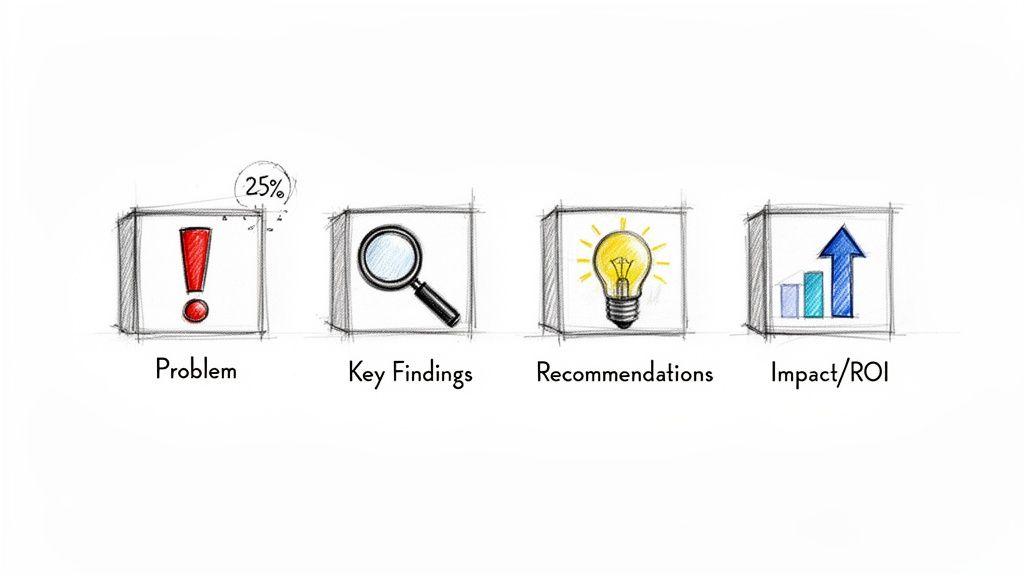
Every truly effective executive summary is built on a handful of key pillars. Don't think of these as just a checklist. Instead, see them as the building blocks of a persuasive argument that can turn a simple overview into a powerful case for action.
Your goal is to take the reader on a quick, logical journey. You'll start with a problem they already care about and end with a solution they can’t wait to support. Getting these core elements right is what separates a mediocre summary from a great one.
Define the Problem or Opportunity
First things first: you have to ground your summary in reality. Start by clearly and concisely stating the problem at hand or the opportunity you've uncovered. Vague statements just won't fly here. You need to be specific and, whenever possible, put a number on the pain point.
For instance, "Our team communication is inefficient" is weak. Compare that to: "Fragmented communication tools are tanking our team productivity by 25%." That immediately gets your reader’s attention and tells them exactly why this matters.
This section is the "why" behind your entire document. A well-defined problem creates a sense of urgency and perfectly sets the stage for the solution you're about to introduce.
Present Your Key Findings and Analysis
Okay, you've laid out the problem. Now you need to show you’ve done the legwork. This is where you bring in the most important data and insights from your research. Your goal isn't to rehash every single detail from the full report, but to cherry-pick the evidence that directly supports your conclusion.
This is your chance to build some serious credibility. Use hard numbers and specific findings to show you have a deep understanding of the situation. Solid, well-researched data is your best friend here. Citing relevant market trends, for example, can add a ton of weight to your proposal.
An effective summary doesn't just list facts—it interprets them. You need to connect the dots for your reader, showing them exactly how your analysis leads to the recommendations you’re making.
Leading with data establishes authority from the get-go. A company like 1chat.com might point out that the global AI tools market is projected to hit $196 billion by 2025, while also noting that 65% of small businesses are worried about privacy. Adding financial projections, like an anticipated 150% user growth from new team plans, makes the pitch feel concrete and ready for investors. Breaking this down into bullet points can even boost readability by as much as 30%, ensuring your key points really land. If you want to see more on this, Coursera's executive summary guidelines show how data-driven points build a much stronger case.
Craft Compelling Recommendations
With the problem defined and the evidence on the table, it's time to talk solutions. Your recommendations need to be crystal clear, direct, and actionable. Don't be ambiguous. Tell your reader precisely what you think needs to happen next.
This is probably the most critical part of your summary. It’s the "what" that follows your "why"—it’s your call to action.
Here's how to make your recommendations pop:
- Get Specific: Don't say, "Improve marketing." Instead, propose, "Launch a targeted digital ad campaign on LinkedIn to reach B2B clients."
- Sound Decisive: Use confident language. "We recommend implementing the new CRM" is much stronger than "It might be a good idea to consider a new CRM."
- Stay Realistic: Make sure your suggestions are actually achievable given the company's time, budget, and resources.
This directness shows you have a clear vision and a practical plan to make it happen.
Quantify the Potential Impact and ROI
Finally, bring it all home by showing them what's in it for them. Quantify the benefits of your recommendations. What’s the expected outcome? This is where you translate your brilliant solution into tangible results, usually focusing on the return on investment (ROI).
For example, tie your impact directly back to the problem you started with. If the issue was a 25% loss in productivity, your impact statement could be: "Implementing a unified communication platform will reclaim an estimated 10 hours per employee each month, boosting output and saving $150,000 annually."
This last piece reinforces the value of your entire proposal. It gives decision-makers the financial justification they need to say "yes." It’s the final proof that your idea isn't just good—it's smart for business.
How to Structure Your Summary for Maximum Impact
Think of your executive summary's structure as its backbone. If it’s weak, the whole thing falls apart, no matter how brilliant your individual points are. A solid, logical flow is what guides your reader from the problem straight to your solution, making your argument feel both natural and completely convincing.
You're not just listing facts here; you're telling a very short, powerful story. And that story needs to lead to a specific conclusion—the one you want your reader to reach.
Nail the Opening Hook
The first sentence is everything. It's the most valuable piece of real estate in your entire summary, so you have to make it count. Ditch the generic intros like "This report will discuss..." and get right to the heart of the matter.
A truly effective opening sentence does two things at once: it states the core problem and hints at the solution. This immediately frames the entire conversation and gives the reader a compelling reason to keep going.
For instance, a project proposal might kick off with something like this: "Our current inventory system is causing an 18% annual stock loss, but switching to an automated platform will eliminate that waste within six months." Boom. In one sentence, you've delivered the problem, the solution, and a timeline. Your reader is hooked.
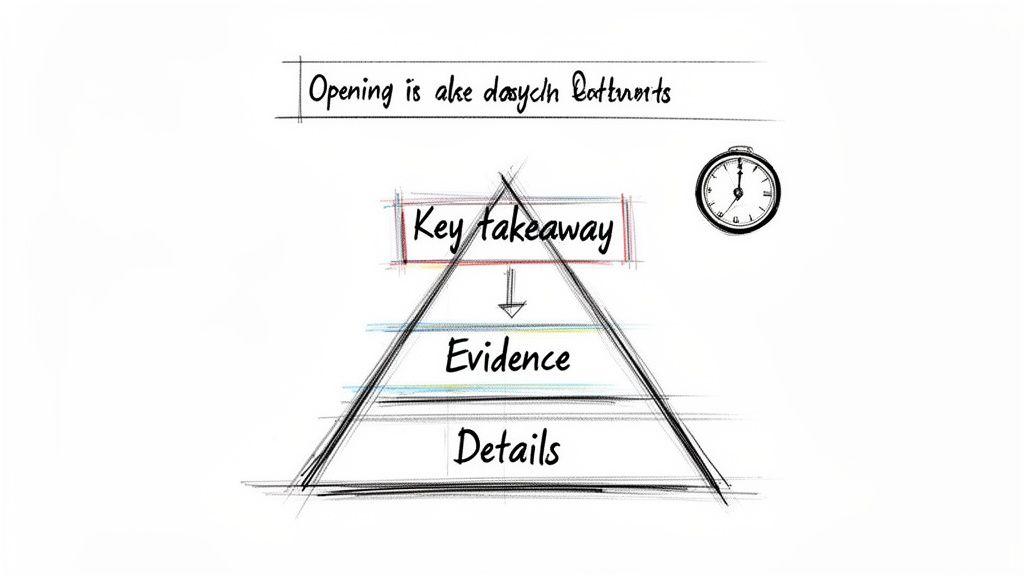
Use the Inverted Pyramid Method
There’s a reason journalists have sworn by the inverted pyramid for decades: it just works. The whole idea is to put your most critical information—the main takeaway or your big recommendation—right at the very top. From there, you gradually add the supporting details.
This approach is all about respecting your reader's time. If they only have 30 seconds to spare, they should still walk away with your core message just from reading the first paragraph.
Here’s how you can put it into practice:
- The Point (Top): Start with your final conclusion or recommendation. What’s the single most important thing they need to know?
- The Evidence (Middle): Next, bring in the key findings and data that back up your conclusion. This is where you provide the proof.
- The Details (Bottom): Finally, add any necessary background or secondary info that adds color but isn't absolutely essential to understanding the main point.
By front-loading the value like this, you make it incredibly easy for busy executives to get the gist and decide if they need to dive deeper.
The real magic of an executive summary is that it should stand on its own while making the reader curious for more. It has to be a complete, self-sufficient picture that doesn't force them to hunt for context.
Tailor the Flow for Different Documents
Let's be clear: there's no single "perfect" structure. The narrative arc for a business plan summary is totally different from one for a project proposal. You have to adapt the flow to match the document's purpose.
- Business Plan Summary: The story here usually goes: problem, our solution, the market opportunity, financial projections, and the team. It’s a complete pitch for a viable business.
- Project Proposal Summary: This is much more focused. The flow is typically: problem, our proposed solution, what we need (resources), the timeline, and the expected ROI. The goal is to get a specific initiative green-lit.
While the core components are often similar, their order and emphasis shift. A business plan needs to highlight market size and competitive advantage early on, whereas a project proposal should immediately focus on the internal impact and return.
The debate over length is a classic one. Some argue for a strict one-page limit, pointing out that this format has sped up board approvals by 35% in some companies. On the other hand, experts like Guy Kawasaki have noted that summaries that are too brief often get rejected by investors—as high as a 70% rejection rate in some cases—because they lack substance. You can get more perspective on how to write an executive summary for different projects to find what works for you.
Ultimately, your structure should serve the story you're telling. Give just enough detail to be persuasive without overwhelming your reader.
Mastering a Clear and Authoritative Tone
How you say something in an executive summary is just as important as what you say. The right tone can turn a dry collection of facts into a compelling, persuasive argument. To get decision-makers on board, your writing needs to be clear, confident, and authoritative—it's non-negotiable.
This means you have to cut through the noise. Ditch any vague language, corporate jargon, or passive phrases that water down your message. You want to sound decisive and in control, confidently guiding your reader toward the conclusion you want them to reach.
Choose Active Voice for Impact
Want to know the single most effective way to sound authoritative? Use the active voice. It’s direct, it's energetic, and it makes it perfectly clear who is doing what. The passive voice, on the other hand, often comes across as wishy-washy or evasive, making your points feel less certain.
Just look at the difference. "A 15% increase in market share is projected" sounds like a detached observation. But "We project a 15% increase in market share" is a statement of confidence. It shows ownership. It shows conviction.
Stick to the active voice, and your writing will feel much more dynamic. It creates a sense of forward momentum and signals that you’re not just floating an idea—you're recommending a specific course of action.
Eliminate Jargon and Weak Language
Your audience is busy. The last thing you want is to make them wade through a sea of buzzwords or overly technical terms just to understand your point. While industry-specific language has its place in the full report, your executive summary needs to be accessible to everyone, including stakeholders who aren't experts in the nitty-gritty details.
Swap out jargon for simple, direct language. Instead of saying you’ll "leverage synergies," just say you’ll "combine the marketing and sales teams to cut costs." It's clearer, more credible, and gets right to the point.
The ultimate goal is clarity. An executive summary cluttered with jargon and hesitant phrases creates confusion, not confidence. Every word should serve the purpose of making your core message easier to understand and accept.
This commitment to clarity also influences length. There's a long-standing business guideline that an executive summary should be about 5-10% of the full document's length, and for good reason. A recent analysis found that documents with concise summaries saw 87% higher stakeholder engagement. Even better, summaries kept between 250-400 words were shown to boost decision-making speed by 40%. If you want to dig deeper, it’s worth seeing how project management experts approach executive summaries.
Writing Dos and Don'ts for Executive Summaries
To help you get this right, here’s a quick look at how to transform weak, passive phrases into strong, active statements. Keep this table handy when you're editing your draft.
| Don't (Passive & Vague) | Do (Active & Specific) |
| It is believed that a new strategy is needed. | We recommend implementing a new strategy. |
| The market could potentially be entered by our company. | Our company will enter the market. |
| Mistakes were made in the budget allocation. | We misallocated $50,000 in the budget. |
| It has been decided that the project will be started. | The leadership team will start the project on Monday. |
| Positive results are expected to be seen. | We expect to see a 20% increase in Q4 revenue. |
See the difference? The "Do" column is direct, takes responsibility, and uses specific data. That’s the kind of writing that builds trust and gets things done. By mastering this style, you ensure your executive summary doesn't just inform—it persuades.
2. Adapting Your Summary for Different Audiences
Let’s be honest: a one-size-fits-all executive summary is a recipe for failure. The document you draft for a venture capitalist should look completely different from the one you hand to your internal leadership team. The real magic happens when you know exactly who you're talking to and, more importantly, what they actually care about.
This means you’ve got to shift your focus, tweak your tone, and shine a spotlight on the details that will make your reader nod along. Think of it like a real conversation—you wouldn't use the same pitch on a potential investor that you would with a colleague you trust. Your summary needs that same level of awareness.
Writing for Venture Capitalists and Investors
When you're trying to catch an investor's eye, they're laser-focused on one thing: return on investment (ROI). These people see hundreds of proposals, so they need to spot a clear path to profitability, and they need to see it fast. Your summary has to scream financial opportunity from the very first sentence.
Forget the jargon about internal workflows or niche product features. Lead with the big, bold numbers that define the market and your unique place within it.
- Market Size: "The global market for AI-powered productivity tools is on track to hit $196 billion by 2025."
- Unique Value Proposition: "Our platform fills a critical gap for SMBs by offering enterprise-level security at a price point 40% lower than the current leaders."
- Financial Projections: "We're projecting a 150% user growth rate in the first 24 months, which translates to a 3x return for our seed-round investors."
Your language needs to be confident and centered on growth, scalability, and financial wins. Every single sentence should answer their silent question: "Why should I put my money here?"
Addressing Internal Leadership
When you're writing for your own company's leaders, the conversation changes. The focus shifts from pure ROI to operational efficiency, resource management, and how your idea fits into the company's bigger picture. Your boss or department head needs to understand how this proposal makes the organization stronger, leaner, or more competitive.
They're less concerned with the total market size and far more interested in the practical details of implementation. Your summary should get straight to the point:
- Efficiency Gains: "By implementing this new CRM, we can automate manual data entry and give each employee back an estimated 10 hours per month."
- Resource Needs: "To get this done, we’ll need a $25,000 budget and two developers for a six-week sprint."
- Strategic Alignment: "This project directly supports our Q3 goal of improving customer retention by 15%."
The tone is less of a sales pitch and more of a solid business case. You're showing that you get the company's internal pain points and have a well-thought-out solution ready to go.
No matter who you're writing for, clarity is king. A great summary cuts through the noise and presents its case with direct, confident language. That’s how you build trust and get the green light.
Framing Findings for Academic Audiences
For students and researchers writing for a professor or academic committee, the priorities shift again. Here, it’s not about profit or productivity—it’s about intellectual contribution and solid methodology. Your summary has to prove you’ve done rigorous work and understand where it fits in the academic landscape.
Your professor isn’t just looking for data; they want to see that you can synthesize it and explain its importance.
- Thesis Statement: Start with a sharp, clear thesis that states the core argument of your paper.
- Methodology: Briefly touch on your research methods, like "a qualitative analysis of 50 case studies."
- Key Findings: State your most important discovery, for example, "Our research reveals a previously undocumented correlation between social media usage and adolescent anxiety levels."
- Academic Contribution: Explain how your work builds on, challenges, or refines what’s already known in your field.
This approach shows you’ve not only mastered the material but can also communicate your findings like a professional. Speaking of which, it's always a good idea to brush up on how to write professional emails to make sure all your academic communications are polished.
Common Pitfalls to Avoid and a Quick Pre-Flight Checklist
You've done the hard work, synthesized pages of information, and drafted a solid executive summary. But even the best summaries can be tripped up by a few common, easy-to-fix mistakes. I've seen it happen time and again—a great report gets sidelined because the summary misses the mark.
One of the biggest blunders is burying the lead. You have to remember your audience is strapped for time. If they can't find your core recommendation in the first few sentences, they might not look for it at all. Another classic mistake is getting lost in the weeds with jargon and technical speak. This instantly alienates anyone not directly involved in the project, which is often exactly who you need to persuade.
Think about who you're writing for. An investor, a department head, and an academic review board are all looking for different things.
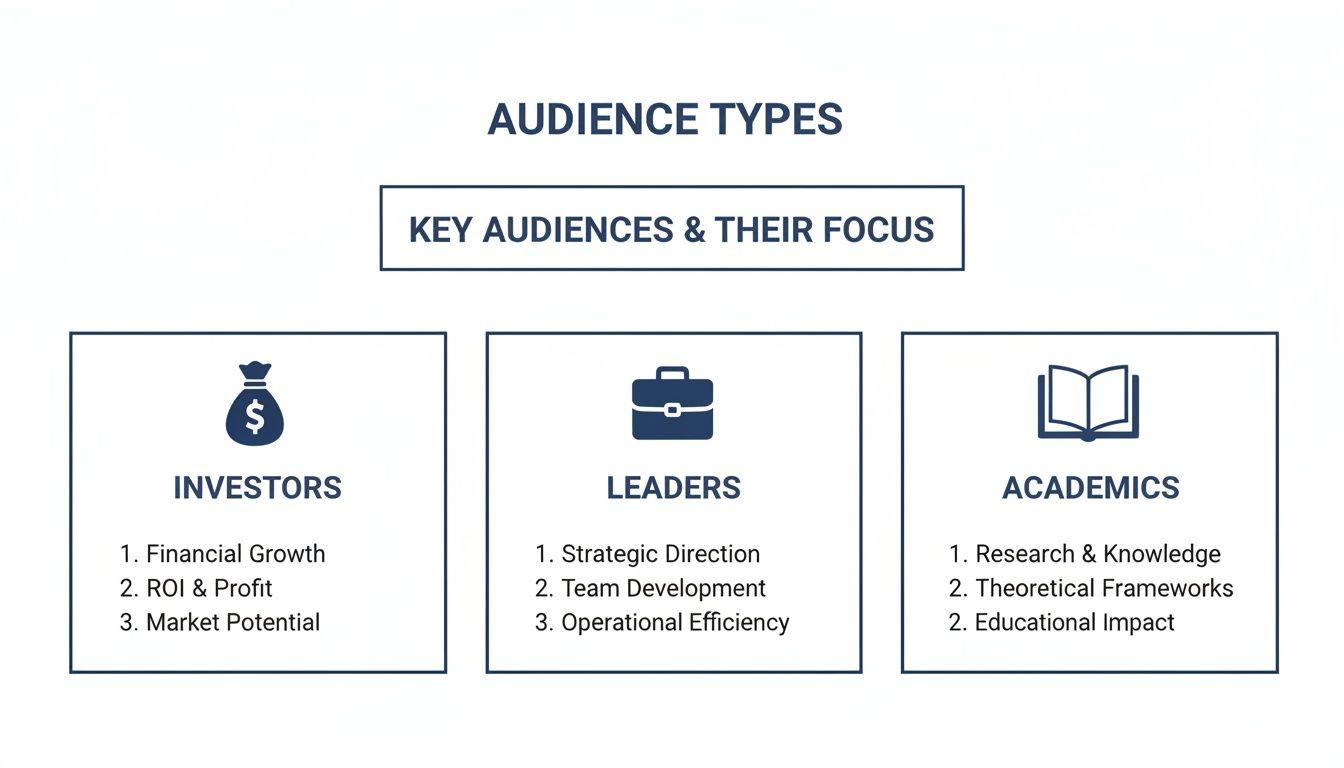
Knowing what your reader values most—whether it's the bottom line, operational improvements, or research validity—is crucial for avoiding generic statements and hitting the right notes.
Your Final Polish Checklist
Before you hit "send," take a few minutes to run through this final checklist. Think of it as your last line of defense to ensure your summary is as sharp and persuasive as possible. This small step can make a huge difference.
- Clarity and Conciseness: Is your main point front and center, right in the first paragraph? Have you ruthlessly cut out any buzzwords or jargon?
- Completeness: Does it cover the essentials: the problem, your proposed solution, the most important findings, and a clear call to action?
- Standalone Value: If someone read only this summary and nothing else, would they grasp the entire situation and your recommendation?
- Audience Focus: Have you tuned the language and tone for your specific reader? Are you speaking their language?
- Data and Impact: Are key claims backed by specific numbers? Have you quantified the potential ROI or impact? If your report has a lot of supporting data, our guide on how to reference an appendix can be a big help here.
- Call to Action: Is it crystal clear what you need from the reader next?
- Proofreading: One last pass for typos, grammar slip-ups, or wonky formatting. Don't skip this.
A great executive summary doesn't just present information; it drives action. This final check ensures your document is polished, professional, and positioned to achieve its goal.
Got Questions? Let's Get Them Answered.
Even with a solid plan, a few practical questions always seem to pop up when you sit down to write. It happens to everyone. Let's tackle some of the most common sticking points I see, so you can get past the hurdles and finalize your document.
I'm Staring at a Blank Page. How Do I Even Start?
We've all been there. Writer's block is a real beast, especially with a high-stakes document like this. The trick is to stop trying to write the perfect opening sentence. It's paralyzing.
Instead, just open a document and brain-dump everything in a messy bulleted list. Don't worry about grammar, flow, or sounding smart.
- What's the one big problem we’re solving here?
- What’s our solution in a nutshell?
- What are the three most compelling numbers or facts that prove our point?
Get the raw ingredients on the page first. You can shape them into a polished, persuasive summary later. The goal right now is just to get the ball rolling.
Can I Put Charts or Graphs in the Summary?
My advice is almost always no. It's tempting, I know, but the executive summary needs to be clean, scannable, and focused on the narrative. A chart, even a simple one, can break that flow and make the page feel cluttered. Think of it this way: your summary should stand on its own as pure text.
Now, there are rare exceptions. If a single, incredibly simple visual (like a line graph showing explosive user growth) tells the most critical part of your story instantly, you might consider it. But the rule of thumb is this: if it saves you a ton of words and drives home the main point without any confusion, it’s a possibility. Otherwise, leave all the visuals for the main report where they belong.
Your summary’s primary job is to deliver a powerful, standalone narrative. A well-chosen statistic is often far more impactful in this condensed format than a crowded chart.
Is This Thing Too Long? Or Too Short?
Ah, the classic length debate. People often throw around the 5-10% rule (of the main document's length), but honestly, that’s just a loose guideline. The real test is whether your summary does its job.
Ask yourself these two questions:
- Is it too short? If a reader finishes and still has major questions ("So what's the ask?" or "What's the potential ROI?"), you've left out something critical. You need to add more substance.
- Is it too long? If you've started including minor details, secondary evidence, or background info, you’ve gone too far. The summary should be a quick read—if it takes more than a few minutes to get through, it's time to make some cuts.
Try reading it out loud. A great executive summary should sound like a crisp, confident pitch. If you start to ramble or get lost in the weeds, you know it's time to trim the fat. The magic is in being comprehensive and brief.