The first rule of thumb for referencing an appendix is simple: you need to call it out directly in your main text. A quick parenthetical note like (see Appendix A) is all it takes. This tells your reader exactly where to find the supplementary material you've placed at the end of your document, right after the reference list.
Why Your Appendix Reference Is More Than an Afterthought
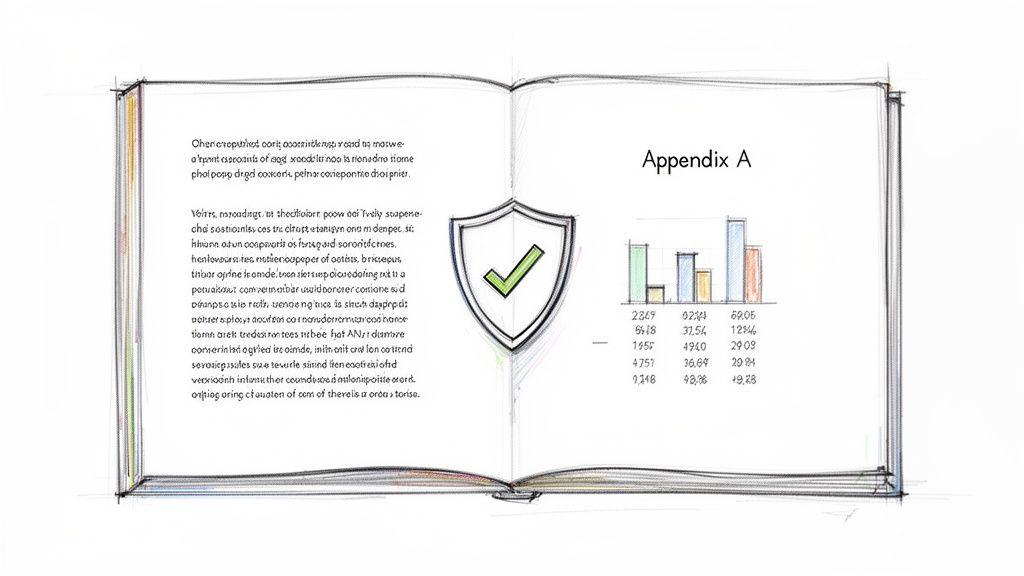
Let’s be honest. Appendices often feel like the last thing you slap onto a paper right before the deadline. But treating them as an afterthought is a huge mistake. A poorly referenced appendix can actually hurt your paper's credibility and leave your reader completely lost.
Think of your appendix reference as a bridge. It connects your main argument to the detailed evidence—the raw data, the full interview transcripts, the complex charts—that proves you've done your homework. If that bridge is missing or broken, your reader can't make the connection, and the impact of your evidence is lost.
The Foundation of Credibility
When you get appendix referencing right, you're building a much stronger, more transparent document. It’s a small detail that makes a big difference.
Clear references allow you to:
- Strengthen your arguments with bulky but important materials, like raw data sets or full survey questionnaires.
- Keep your main text clean and focused by moving non-essential (but still valuable) information to the back.
- Show your work and give others the tools to replicate your findings or evaluate your methodology in full.
This isn't just about good formatting. A misreference doesn't just confuse; it can slash your credibility. In fact, studies show papers with clear appendix links often see 15-20% higher citation rates simply because they're easier to verify and build upon.
This level of detail is more important than ever. Worldwide scientific and engineering publications grew by a massive 19% in just a few years, from 2,712,000 in 2019 to 3,225,981 articles in 2022. You can explore the data on global scientific output to see the trend for yourself.
In a crowded field, properly citing all your sources and supplementary materials is what makes your work stand out. If you're looking for more guidance, check out our guide on what makes a credible source. When you master how to reference an appendix, you turn a simple supplement into a powerful tool that elevates your entire project.
Building and Formatting Your Appendix for Clarity
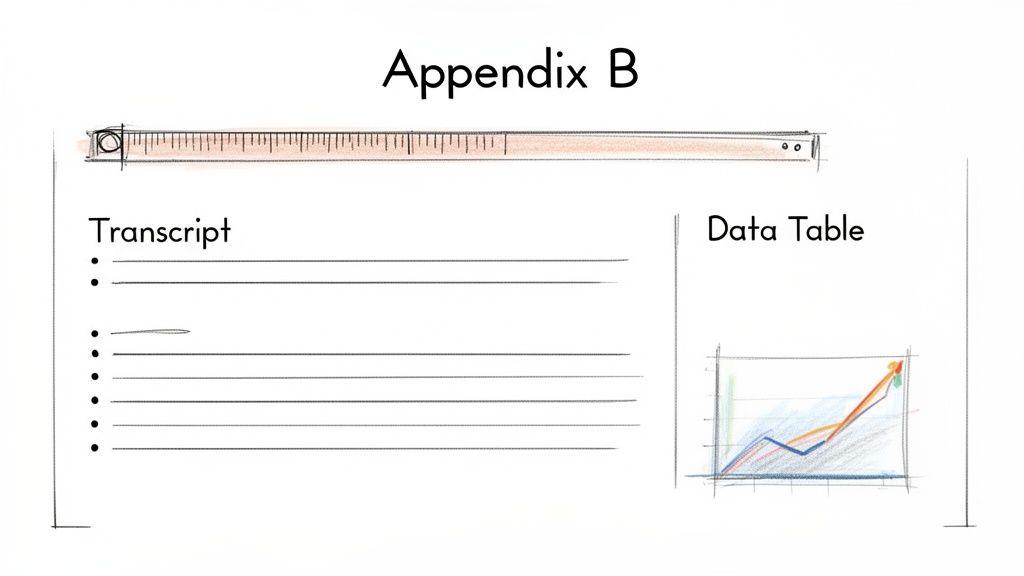
Before you can even think about referencing an appendix, you have to build it right. A great appendix is intuitive, logical, and easy for your reader to navigate. It’s not just a digital junk drawer for leftover files but a curated collection of materials that add genuine depth to your main work.
The guiding principle is pretty straightforward: if the information is critical to understanding your core argument, it needs to stay in the main text. If it's helpful evidence that would otherwise interrupt the flow, the appendix is its perfect home. Getting this distinction right is the first real step in learning how to reference an appendix properly.
Think about it this way: a business report on quarterly performance would feature summary charts and key takeaways right in the main body. But the massive, row-by-row spreadsheet that generated those charts? That belongs in an appendix.
Essential Formatting Rules
When it comes to formatting, consistency is everything. While specific citation styles have their own quirks, a few universal rules will keep your document looking professional and easy to follow.
- Start Fresh: Always begin each appendix on a new page. This creates a clean break from the main text or the preceding appendix.
- Label Logically: Have just one? Simply title it "Appendix". If you have several, label them alphabetically: Appendix A, Appendix B, etc. Stick to one format—never mix "Appendix 1" with "Appendix B."
- Give It a Clear Title: Every appendix needs a descriptive title. Instead of something vague like "Data," be specific: "Appendix A: Raw Survey Responses from Q3 Customer Feedback Initiative."
A well-formatted appendix acts as a silent guide for your reader. The goal is to make finding information intuitive, so clear labeling isn't just a suggestion—it's essential for usability. Think of it as creating a roadmap to your supporting evidence.
What Belongs in an Appendix
Deciding what to include is just as crucial as formatting it correctly. The right content strengthens your work; the wrong content just adds noise. If you're struggling with the overall structure of your document, our guide on how to write a research paper outline can provide some excellent guidance.
Here are some classic examples of material that thrive in an appendix:
- Raw Data Sets: Those comprehensive tables of figures or survey results that you've already summarized in your main text.
- Interview Transcripts: The full, verbatim transcripts from interviews you conducted.
- Survey Questionnaires: A copy of the complete survey or questionnaire you used in your research.
- Complex Mathematical Proofs: Detailed derivations that are too technical or dense for the main body of the paper.
- Technical Specifications: In-depth descriptions of the equipment, software, or instruments used in an experiment.
When you organize these supplementary materials thoughtfully, you create a document that feels both complete and uncluttered. Nailing this foundational step makes referencing your appendix later on a much smoother process.
Weaving Your Appendix into Your Main Text
So, you've created a polished, informative appendix. That's great, but it's not doing any good just sitting at the back of your document. The next step is to seamlessly connect it to your main text, guiding your reader from a point you're making to the detailed evidence that supports it.
Referencing an appendix is all about subtlety and clarity. You want to give your reader a clear signpost without disrupting the flow of your writing. The best way to do this is with a short, simple parenthetical note right where it’s most relevant. Think of it as a helpful aside: "By the way, if you want to see the raw numbers on this, they're right here."
The Art of the Signpost
An effective in-text reference—a signpost—is direct and specific. You want to avoid vague instructions like "see the appendix." Instead, be precise. Tell your reader exactly what they'll find if they flip to the back.
Here are a few common ways I see this done well:
- Pointing to a dataset: "Our initial survey revealed a 15% jump in customer satisfaction last quarter (see Appendix A for the complete survey results)."
- Explaining a complex process: "We followed a multi-step quality assurance protocol, which is outlined in full in the process document (Appendix B)."
- Citing a visual: "The projected growth across different regions is shown in the chart (see Figure C1 in Appendix C)."
See the difference? Each example is crystal clear. It doesn't just point to an appendix; it tells the reader exactly what to expect. This small detail elevates the professionalism of your work and makes it much easier for your audience to follow along.
A well-placed in-text reference should be almost invisible. It shouldn't interrupt the reader's train of thought but must offer an immediate, clear path for anyone who wants to explore your evidence more closely.
Adapting to Your Audience
The phrasing you choose for your reference can change depending on the context. A formal dissertation will sound a bit different from a quarterly business report, but the core principle—clarity—is universal.
For an Academic Paper: "The complete transcripts from the interviews, which formed the basis of our thematic analysis, are available in Appendix A."
For a Business Report: "You can find a detailed breakdown of the Q4 marketing budget, including all line-item expenditures, in Appendix B."
In both scenarios, the reference feels like a natural part of the sentence. Here’s a simple rule of thumb I always follow: if you create an appendix, you must mention it at least once in your main text. If you don't refer to it, your reader will never know it's there, and it becomes dead weight. This simple act of signposting transforms your appendix from a forgotten add-on into an essential part of your argument.
Getting Your Citations Right: A Guide to APA, MLA, and Chicago Styles
Every academic field has its own set of rules, and referencing an appendix is no different. Whether you're using APA, MLA, or Chicago, knowing the specific guidelines is essential for a polished, professional paper. Each style has its own take on labeling, placement, and in-text citations that can easily trip you up if you’re not careful.
Getting these details right isn't just about following rules for the sake of it. Proper citation is about academic transparency and credibility. It shows you've done your homework. Simple habits, like giving your appendices clear titles (e.g., 'Appendix C: Raw Interview Transcripts') and pointing to them smoothly in your text, are the hallmarks of a sharp writer.
In both academia and business, this kind of precision is expected. Interestingly, some data suggests that using modern tools for tedious formatting tasks can cut down the time spent by up to 40%. As research becomes more global, you'll see these citation trends evolve, a point echoed in reports on international collaboration from organizations like the National Science Foundation.
Essentially, referencing an appendix boils down to a simple, three-part process: refer to it in your main text, label it correctly, and make sure it guides your reader to the extra information.
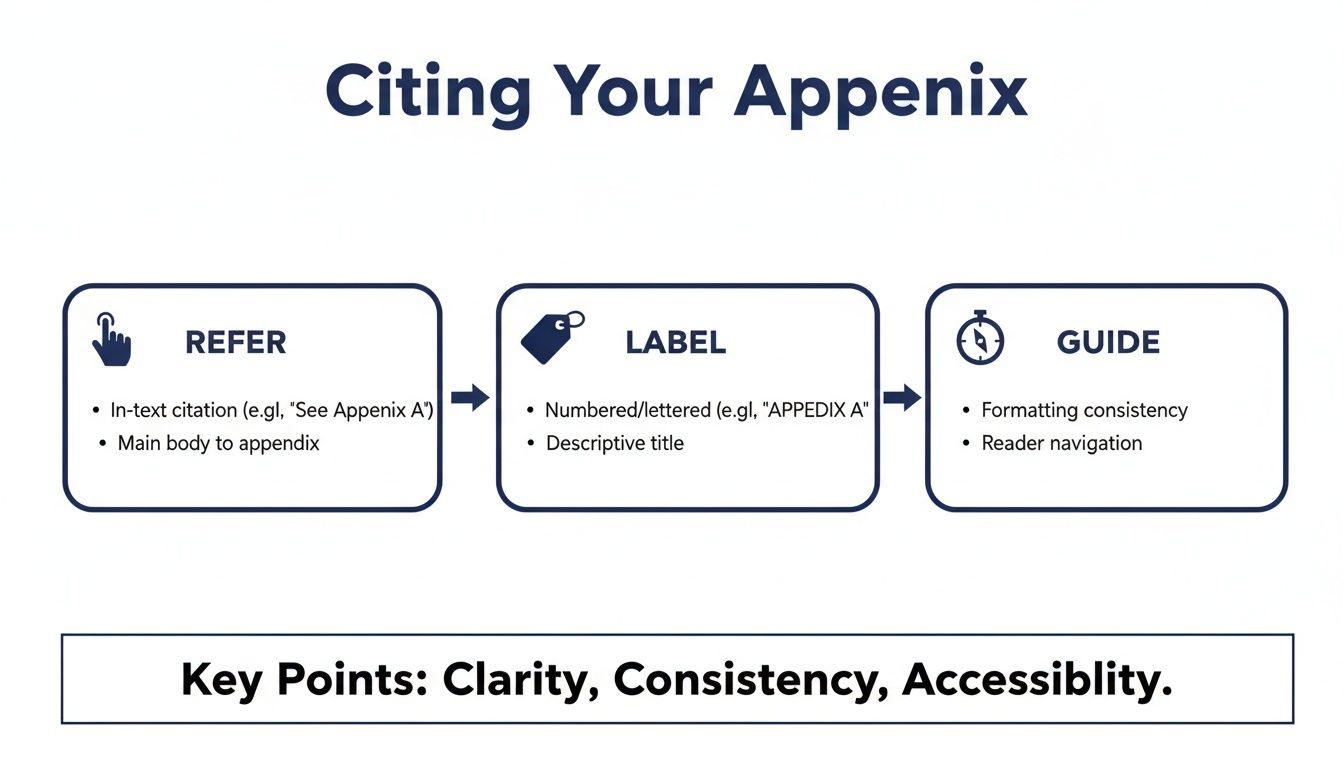
This visual is a great reminder that the goal is clarity. You want to make it effortless for your reader to find the supplementary material you’ve provided.
APA 7th Edition Guidelines
If you're writing in the social sciences, education, or business, you're almost certainly using the American Psychological Association (APA) style. Its rules for appendices are refreshingly straightforward and designed to keep things clean and logical.
Here’s the breakdown for APA 7:
- Placement: The appendix section is one of the very last things in your paper, coming after your reference list.
- Labeling: Have just one? Label it "Appendix." If you have more than one, label them with capital letters: "Appendix A," "Appendix B," and so on. Critically, each new appendix must start on a fresh page.
- In-Text Citation: When you mention it in your main text, simply refer to its label in parentheses. For example:
(see Appendix A).
MLA 9th Edition Guidelines
The Modern Language Association (MLA) style is the go-to for the humanities, but it has one key difference that often catches people by surprise. Pay close attention to this one—it’s a common mistake.
Key requirements for MLA 9:
- Placement: Your appendix goes before your Works Cited list. I'll say it again: before. This is the opposite of APA and Chicago, so always double-check your paper's structure.
- Labeling: Just like APA, use "Appendix" for a single one or "Appendix A," "Appendix B," for multiple. It's also good practice to give each one a descriptive title.
- In-Text Citation: The reference is similar, using a parenthetical note like
(see Appendix A).
When in doubt, just remember the biggest distinction: MLA puts the appendix before the final citations. APA and Chicago put it after. Getting this one detail right makes a huge difference.
Chicago 17th Edition Guidelines
The Chicago Manual of Style, common in history and the arts, gives you a bit more flexibility but generally lines up with APA when it comes to placement. The main thing Chicago emphasizes is clear, logical organization.
Here are the pointers for Chicago 17:
- Placement: Appendices belong after the bibliography or reference list.
- Labeling: You have a choice here. You can use letters (Appendix A) or numbers (Appendix 1). The most important thing is consistency—pick one system and stick with it.
- In-Text Citation: Referencing is direct and clear. You can weave it into a sentence or just pop it in parentheses, like this:
(see Appendix 1 for the full dataset).
To help you keep all this straight, I've put together a quick comparison table that highlights the main differences at a glance.
Appendix Referencing Rules by Citation Style
This table provides a quick side-by-side look at the core rules for formatting, placement, and in-text citations in APA, MLA, and Chicago styles.
| Feature | APA (7th Edition) | MLA (9th Edition) | Chicago (17th Edition) |
| Placement | After the reference list | Before the Works Cited list | After the bibliography/notes |
| Labeling (Multiple) | Labels use letters: Appendix A, Appendix B | Labels use letters: Appendix A, Appendix B | Labels can use letters or numbers: Appendix A or Appendix 1 |
| In-Text Reference | Parenthetical reference to the label: (see Appendix A) | Parenthetical reference to the label: (see Appendix B) | Parenthetical reference to the label: (see Appendix 1) |
Hopefully, seeing the rules laid out like this makes the subtle but important distinctions crystal clear. Keep this guide handy, and you'll be referencing your appendices like a pro.
Common Appendix Mistakes and How to Fix Them
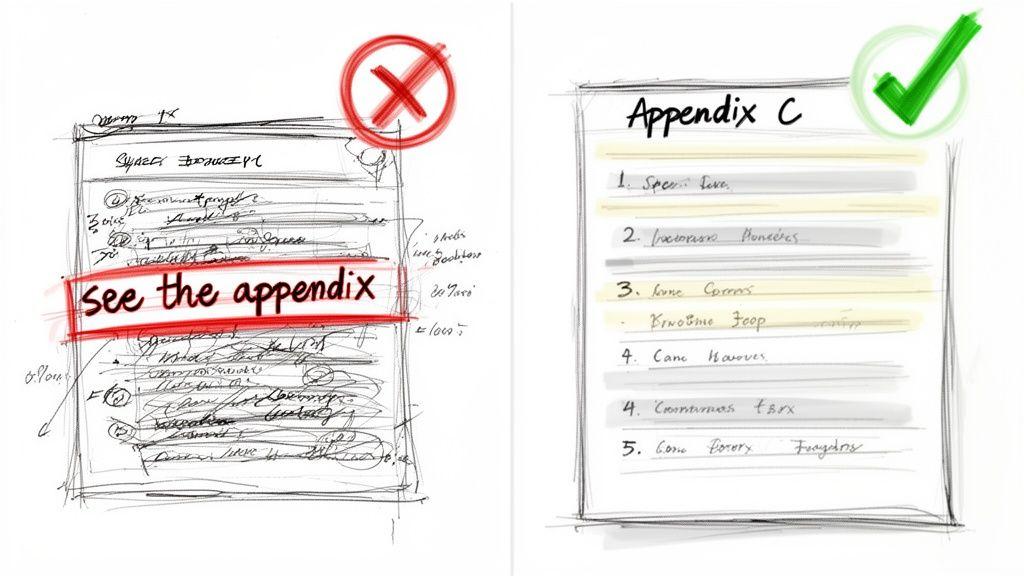
Even after years of writing reports and papers, it’s easy to stumble over the little details with appendices. These small slip-ups might not seem like a big deal, but they can confuse your reader and make your work feel less polished.
The good news? Once you know what to look for, these common mistakes are incredibly easy to catch and correct. Getting your appendix references right is mostly about unlearning a few bad habits.
Mistake 1: The Vague Reference
This one is probably the most common pitfall I see. A writer will make a great point, backed by solid data, and then just vaguely wave toward the back of the document.
- What it looks like: "Our analysis showed significant growth in the third quarter (see the appendix)."
This kind of reference sends your reader on a scavenger hunt. Which appendix? What am I looking for? It breaks their focus and frankly, it's frustrating.
- The simple fix: Be specific. Always. "Our analysis showed significant growth of 12.4% in the third quarter (see Appendix B for the complete sales data)."
See the difference? The reader knows exactly where to go (Appendix B) and what they'll find (the sales data). It’s a small change that makes a huge impact on clarity and professionalism.
Think of your in-text reference as a signpost, not a suggestion. It needs to point to a specific destination and tell the traveler what's there.
Mistake 2: Inconsistent Labeling
This happens all the time, especially when a document is written over several weeks and appendices get added piecemeal. One minute you're using letters, the next you're using numbers.
- What it looks like: The body of your paper references "Appendix A," "Appendix 2," and "Appendix C."
This jumble of styles looks messy and unprofessional. It signals a lack of attention to detail that can make readers question the rest of your work.
- The simple fix: Just pick one system and stick with it. Decide if you're using letters (Appendix A, Appendix B) or numbers (Appendix 1, Appendix 2) and apply it everywhere. A quick "find and replace" search can clean this up in minutes.
Mistake 3: Burying Essential Information
This is the most critical error to avoid. An appendix is for supplementary material, not for information that’s vital to understanding your central argument.
If you find yourself constantly saying "see appendix" to explain a core concept, that's a major red flag. Your primary analysis and the evidence needed to follow it must live in the main body of your text. For tips on integrating your key points smoothly, it’s worth reviewing our guide on how to paraphrase without plagiarizing.
Remember, an appendix should support your argument—it should never contain it.
Common Appendix Questions, Answered
Let's be honest, sometimes you just need a quick, direct answer. When you're in the final stages of a project, the last thing you want is to get stuck on a formatting detail. I've compiled some of the most common questions I hear about appendices to give you clear, straightforward solutions.
Can I Put Tables and Figures in an Appendix?
Yes, you absolutely can—and you often should. The appendix is the perfect home for supplementary data, like complex tables or detailed figures, that would bog down the main body of your work. Think of it as a place for evidence that supports your points without derailing your narrative.
The key is to label them correctly. If you have a chart in Appendix A, you'd label it Figure A1. The first table in that same appendix would be Table A1, the second Table A2, and so on. Then, in your main text, you just point your reader to it: (see Figure A1 for a full visual breakdown).
How Do I Handle Multiple Appendices?
When you have more than one appendix, simple organization is your best friend. Just label them sequentially with capital letters: Appendix A, Appendix B, Appendix C, etc.
The most important thing is to be crystal clear in your in-text references. Don't just say "see the appendices." That sends your reader on a frustrating hunt. Instead, be direct and specific.
- "The complete set of raw survey data is available in Appendix A."
- "...while the detailed interview transcripts can be found in Appendix B."
This kind of precision makes a huge difference in how professional and easy-to-follow your document feels.
Expert Tip: Being precise when you have multiple appendices isn't just a suggestion; it's a sign of a well-organized author. A vague reference can frustrate your reader, but a specific one shows you respect their time and have structured your work with care.
Does the Appendix Go Before or After the Reference List?
This is a classic question, and getting it wrong is a small but very noticeable mistake. The answer depends entirely on the citation style you're using. There's no single rule, so you have to know which one applies to you.
Here’s the breakdown for the major styles:
- APA & Chicago: In these styles, the appendices come after your reference list or bibliography. It’s one of the final sections of your document.
- MLA: MLA flips the script. Here, the appendix goes before the Works Cited page.
Always, always double-check the specific style guide you've been asked to follow. It's a tiny detail that signals you know what you're doing.
Should I List the Appendix in My Table of Contents?
I highly recommend it. For longer documents like a thesis, dissertation, or a major business report, including the appendices in your table of contents is a professional touch that greatly improves navigation. It tells your reader exactly what supplementary materials you've provided and where to find them instantly.
Don’t just list "Appendix A." Give it a meaningful, descriptive title. For example: Appendix A: Raw Data from Q2 Customer Feedback Survey
This simple step gives the reader a clear roadmap and highlights the value of the extra information you've included.