When you paraphrase, you’re not just swapping out a few words. You need to fully digest the original idea, step away from it, and then explain it entirely in your own voice. Think of it like teaching a concept to a friend—you wouldn't just read a textbook definition aloud; you'd break it down and rephrase it in a way that makes sense to them. And crucially, you'd still mention where you learned it.
The Critical Difference Between Paraphrasing and Plagiarism
Many people fall into the trap of thinking that changing a handful of words in a sentence is good enough to avoid plagiarism. This is a huge mistake. That technique, sometimes called "patchwork paraphrasing," is a serious academic and professional foul.
Real, ethical paraphrasing is about engaging with the material on a deeper level. It forces you to actually process the information and then re-articulate it through your own unique perspective and writing style. Plagiarism, on the other hand, is just intellectual theft. It’s taking someone else's ideas, sentence structure, or exact wording without giving them credit. This applies to everything from lifting an entire paragraph to just borrowing a clever phrase without a citation.
To make this crystal clear, let's look at a quick side-by-side comparison.
Paraphrasing vs Plagiarizing at a Glance
| Attribute | Ethical Paraphrasing | Plagiarism |
| Foundation | Your own understanding of the source material | The original author's exact words or structure |
| Wording | Completely new and original vocabulary | Words are only slightly changed or swapped for synonyms |
| Sentence Structure | Fundamentally different from the original source | Mirrors the original sentence patterns and flow |
| Attribution | Always includes a clear citation to the original author | No citation is provided, or it's improperly cited |
| Intent | To integrate a source's idea to support your own argument | To pass off someone else's work as your own |
Ultimately, the goal is to use sources to build your own arguments, not to have them make your arguments for you.
It's All About Transformation and Credit
The line between the two really comes down to transformation and attribution. A good paraphrase completely reworks the structure and vocabulary of the original text. Plagiarism, however, just rearranges the deck chairs—it sticks too closely to the source. Most importantly, ethical paraphrasing is always transparent, giving full credit where it’s due with a proper citation.
The rise of AI in writing has made this distinction more important than ever. It's fascinating, actually—recent data shows that detected plagiarism rates fell by 51% between January 2023 and January 2024. During that same period, the amount of AI-generated content found in student work jumped by 76%.
This suggests a shift: people are using AI tools to rephrase things, but they're often wading into a murky gray area. If you're not careful, using AI to rewrite text can still result in plagiarism or other academic integrity violations. You can dig into more of these plagiarism statistics to see how the academic landscape is changing.
The point isn't just to beat a plagiarism checker. It's about showing that you genuinely understand the topic and can add your own voice to the conversation, using sources as a springboard for your own original ideas.
Most modern writing platforms have built-in plagiarism checkers that scan your work against billions of online sources. They’re an essential safety net.
These tools flag any passages that are too similar to existing content and give you an originality score. It’s a crucial final step to take before you submit any piece of writing, whether it’s for school or for work.
A Practical Method for Effective Paraphrasing
Knowing what to avoid is a good start, but what you really need is a repeatable, ethical process for paraphrasing. Simply being told to "use your own words" is vague and unhelpful. So, let's walk through a solid method for transforming source material into something new and original that genuinely supports your own work.
The first step—and honestly, the most important one—is to really understand the source. Read the passage a few times. Then, turn away and try to explain its core message out loud to yourself. If you can do that without peeking, you've successfully moved the idea from the author's words into your own head.
Once you’ve got a firm grip on the concept, physically hide the original text. Seriously, close the book or tab. Now, write down the idea from memory. This simple action forces you to rely on your own vocabulary and sentence patterns right from the get-go, breaking the linguistic spell of the original author.
Deconstructing and Rebuilding Sentences
With the core idea captured, the real work of rewriting begins. This isn't about just swapping out a few words with synonyms or shuffling clauses around—that's a classic mistake that leads straight to what's often called "patchwork plagiarism."
Instead, you need to fundamentally change the sentence structure. Try these techniques:
- Combine or Split Sentences: Take two short, simple sentences from the source and merge them into a more complex one. Or, do the opposite: break down a long, winding sentence into two punchier, clearer ones.
- Change the Voice: Is the original in the active voice ("The researchers discovered...")? Try flipping it to the passive voice ("It was discovered by the researchers..."). This can completely change the rhythm and focus.
- Reorder the Concepts: If the original text lists points A, B, and C, see if you can explain them in a different order, like C, A, and B. Just make sure you don't twist the original meaning.
This simple flow—understand, rewrite, and then cite—is the backbone of ethical paraphrasing.
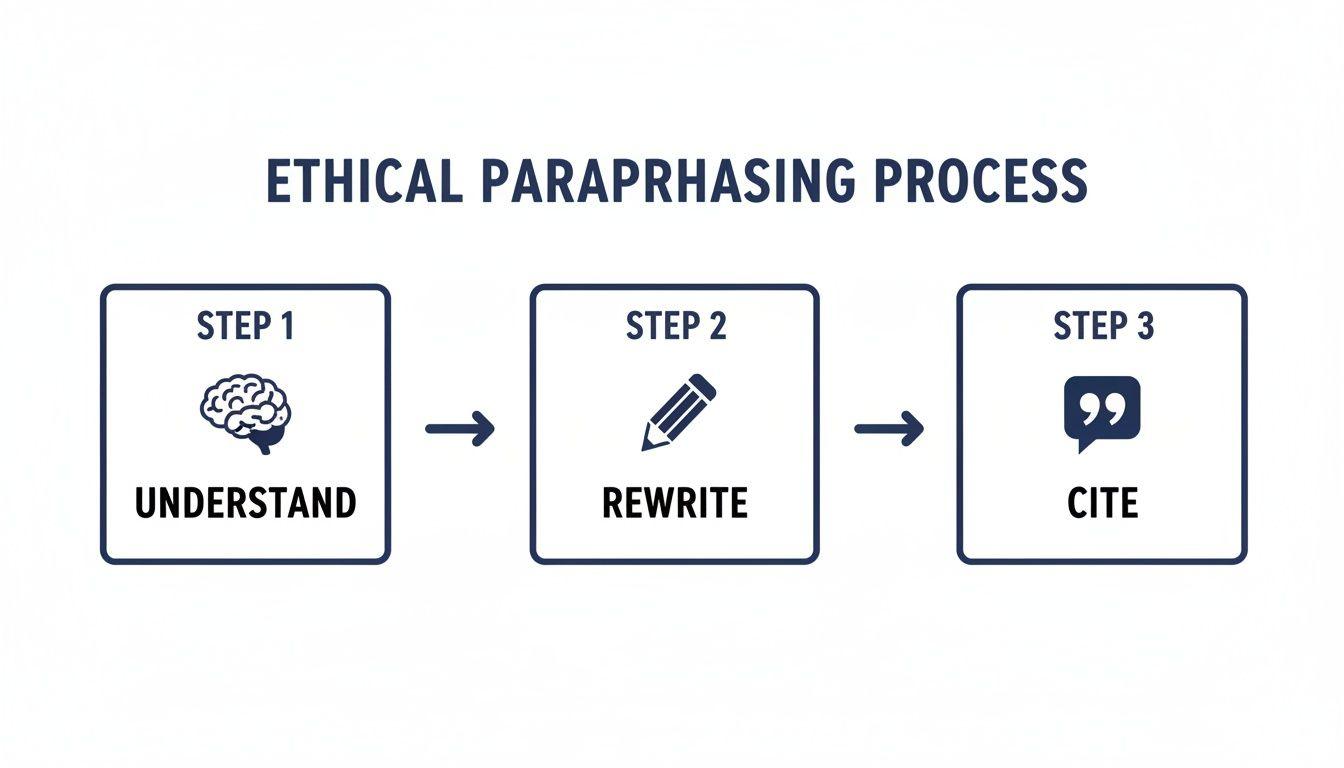
As the visual shows, comprehension is the foundation. The rewriting is the mechanical part. But the citation? That's the non-negotiable final step that ties it all together.
An Example in Action
Let's put this method to the test with a real academic sentence to see how it works.
Original Source Text:
"The proliferation of digital communication platforms has fundamentally altered traditional social structures, leading to the formation of online communities that transcend geographical boundaries and are predicated on shared interests rather than physical proximity."
Okay, first step: understand the core message. It's basically saying that digital tools let people form groups based on hobbies, not just where they live.
Next, rewrite from memory, focusing on a new structure and vocabulary. Remember, we're not just looking for synonyms; we're re-explaining the concept entirely.
Ethical Paraphrase (Before & After):
| Element | Original Sentence | Ethically Paraphrased Version |
| Structure | One long, complex sentence | Two shorter, distinct sentences |
| Vocabulary | "proliferation," "fundamentally altered," "predicated on" | "widespread use," "changed how people connect," "built around" |
| Focus | Starts with technology ("proliferation") | Starts with people ("The way people connect...") |
| Analysis | None, it's a statement. | Adds a bit of context ("This shift means...") |
Final Paraphrased Version:
The widespread use of digital platforms has changed how people connect with one another. Instead of being limited by location, individuals now form communities built around shared passions and hobbies. This shift means that social groups are no longer defined by geography but by mutual interests (Author, Year).
The key takeaway here: The final version isn't just a reworded sentence; it's a re-conceptualized idea. It's shorter, uses completely different sentence structures, and—most importantly—is capped off with a proper citation.
This process takes more mental energy than just plugging words into a thesaurus, but it’s the only reliable way to keep your work original and academically honest. It's a skill that pays dividends, especially for students exploring how to write essays faster by integrating sources correctly from the start. Over time, this becomes second nature, strengthening not just your writing but your critical thinking, too.
The Nuances of Paraphrasing: Avoiding Common Pitfalls
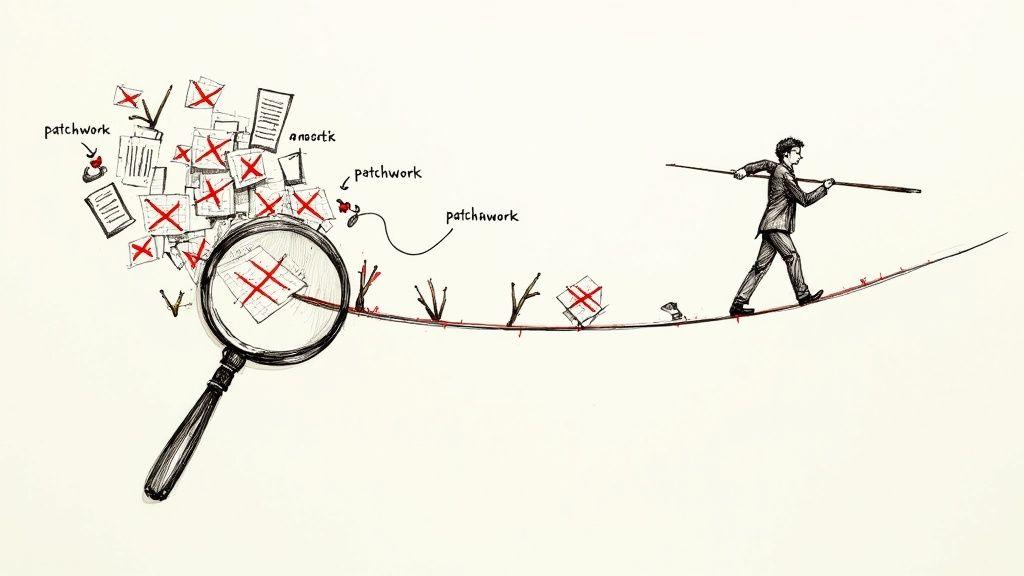
Once you've got the basics of rewriting and citing down, you start to see the finer details—the subtle traps that can still lead you into trouble. Even seasoned writers can stumble here, especially when navigating complex or highly technical source material. It's a real tightrope walk.
One of the sneakiest offenders is what's known as patchwork plagiarism (or mosaic plagiarism). This is where you grab key phrases from a source, stitch them together with a few of your own words, and maybe swap a few terms with a thesaurus. It looks different, sure, but the skeleton of the original—its structure and unique phrasing—is still there.
This shortcut feels productive, but it's a dead end. It doesn't prove you actually understand the material, and modern plagiarism checkers are getting incredibly good at sniffing out this kind of patchwork.
How to Handle Technical and Data-Heavy Content
Paraphrasing can feel almost impossible when you’re dealing with scientific, legal, or data-driven text. How are you supposed to rephrase a sentence that's packed with specific terminology, statistics, or established formulas? The short answer is: you don't.
Your goal shifts from rewording to explaining. Instead of trying to find a synonym for "p-value," focus on communicating the meaning of the data.
- Summarize the trend: Rather than listing every statistic from a study, explain what the numbers show collectively. Is there a clear pattern?
- Explain the finding: What's the "so what?" behind the data? Tell your reader what the information means for your argument.
- Quote where necessary: For precise definitions or non-negotiable terms, it’s far better to use a direct quote and then spend your energy explaining it in your own words.
Even advanced AI struggles with this. Research on detecting generative paraphrasing in scientific articles shows that rephrasing technical ideas without corrupting their meaning is a massive challenge.
Crucial Takeaway: When faced with dense information, your job isn't to rephrase every word. It's to interpret the core idea and its implications using your own analytical voice—and then give proper credit with a clear citation.
Common Paraphrasing Mistakes and How to Avoid Them
Even with the best intentions, it's easy to make small mistakes that can compromise your work. Knowing what to look for is half the battle. This table breaks down some of the most frequent errors I see and gives you straightforward ways to fix them.
| Common Mistake | Why It's a Problem | How to Fix It |
| The Thesaurus Trap | Swapping words without considering context can warp the original meaning, leading to awkward or nonsensical sentences. | Rewrite the sentence structure first. Then, only pick a synonym if it genuinely fits the specific context and tone you're aiming for. |
| Mirroring Sentence Structure | If you keep the original sentence patterns (clause order, sentence length), you're committing structural plagiarism, even with different words. | Break it up. Combine short sentences into a longer one, or split a complex sentence into two. Try switching from active to passive voice (or vice versa). |
| Forgetting to Cite After Rewriting | You put in the effort to rewrite, but if you don't cite, you're still presenting someone else's idea as your own. | Get into the habit of dropping in a placeholder citation like (Author, Year) the moment you finish paraphrasing a sentence or concept. |
By keeping these common missteps in mind, you can move from simply avoiding plagiarism to developing a strong, authentic academic or professional voice. It’s about more than just changing words; it's about making the ideas your own.
Why Citation is the Golden Rule of Paraphrasing
Let’s get one thing straight: even a perfectly rephrased sentence is still plagiarism if you don't credit the original source. It's a common mistake. Writers get so wrapped up in changing words and sentence structures that they completely forget the most critical step.
Citation isn't just about following picky academic rules. It's about honesty and building trust with your reader. Think of it as showing your work in a math problem—it proves you’ve done your homework and gives credit where it's due. You're essentially saying, "This idea helped shape my argument, and here's the person who came up with it."
The Building Blocks of a Good Citation
No matter what style guide you're using—APA, MLA, Chicago, or something else—every citation has the same job. It needs to answer three basic questions for your reader:
- Who came up with the idea? (The author's name)
- When was it published? (The date)
- Where can I find it myself? (The source, like a book title or journal name)
For a paraphrased idea, the in-text citation is usually pretty simple. You often just need the author’s last name and the year, like this: (Smith, 2023). That little tag is a powerful signal of academic integrity. For students trying to manage their sources, it’s worth checking out the best AI for writing papers to see how modern tools can help format these correctly.
Proper attribution is more important than ever, especially with AI's growing role in schoolwork. The numbers are pretty eye-opening: 95% of students have admitted to cheating, and a whopping 89% use ChatGPT for their assignments. This trend blurs the lines of originality and makes it crucial to remember that borrowing an idea without credit is a serious academic offense, whether that idea came from a textbook or was rephrased by an AI. You can dig deeper into how plagiarism and AI usage intersect in modern academics.
Here's the simplest rule to write by: When in doubt, cite it. It’s always better to give too much credit than to accidentally pass off someone else’s work as your own.
Citing a Paraphrase vs. Citing a Quote
It's also really important to know the difference between citing a paraphrased idea and a direct quote. They're close cousins, but not twins. Both need attribution, but direct quotes require one extra detail.
| Citation Type | An Example (APA Style) | Why It's Used |
| Paraphrased Idea | Modern social circles are often formed around shared hobbies rather than location (Smith, 2023). | To credit the source's concept while using your own unique wording and sentence structure. |
| Direct Quote | Smith (2023) notes that these communities now "transcend geographical boundaries" (p. 45). | To credit the source's exact phrasing and point the reader to the specific page where it can be found. |
See that small difference? The page number—(p. 45)—is the key. It tells your reader exactly where to find the quote. Leaving it out, even if you've included the author and year, is technically incorrect because you haven't given the full location.
Getting citation right is the final piece of the puzzle. It’s what elevates your paraphrasing from simple rewriting into a credible, well-supported piece of work.
Using Tools to Verify Your Originality
You've done the hard work of rewriting and citing, but there’s one final step you can't skip: verification. This isn't about finding a tech shortcut for lazy paraphrasing. Instead, think of it as a final quality check—a way to proofread for originality and catch any accidental overlaps you might have missed.
Plagiarism checkers are fantastic at what they do best: scanning for direct text matches against a colossal database of online content. They'll instantly flag any sentence or phrase that’s a little too close to the source, giving you a chance to fix it before you hit publish or submit.
But they aren't foolproof. Many traditional checkers can be fooled by more sophisticated paraphrasing where the sentence structure and word choice have been heavily reworked. This is exactly why mastering the hands-on techniques we've covered is so critical. Your brain is still the most powerful tool in your arsenal.
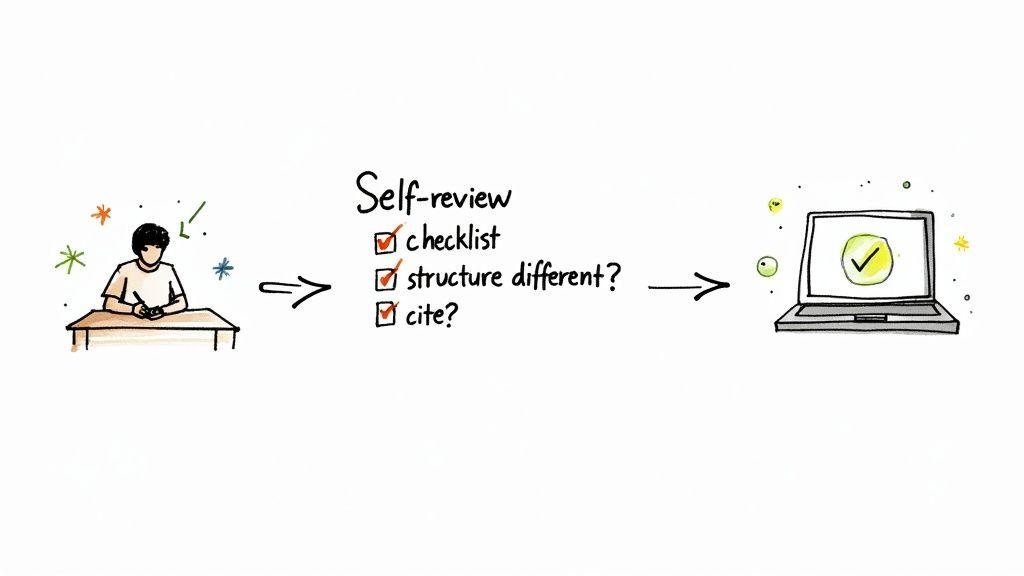
A Quick Self-Review Checklist
Before you hand your text over to any software, get into the habit of doing a quick manual review. It’s a great way to build your skills and spot issues that a tool might gloss over. Just ask yourself these four simple questions:
- Structure: Is the bone structure of my sentence completely different from the original?
- Wording: Did I truly use my own vocabulary, or did I just play a game of synonym-swap?
- Citation: Have I attributed every single idea that isn't either mine or common knowledge?
- Voice: Does this actually sound like me? Does it flow naturally with the rest of my writing?
Taking a moment for this honest assessment is a huge part of learning how to paraphrase correctly and confidently.
The Role of Automated Tools
The good news is that technology is getting much smarter at identifying plagiarism. For example, advanced AI-powered systems can now spot more subtle forms of copying. HackerRank's detection system boasts an impressive 93% accuracy rate by looking at multiple data points, a massive leap from older methods that only skimmed the surface for text similarity. You can learn more about the accuracy of modern plagiarism detectors to see just how sophisticated these systems have become.
Now, a word of caution on automated paraphrasing tools: tread very carefully. They can be a decent starting point for brainstorming a new way to phrase something, but you should never let them generate your final text. Relying on them completely often results in robotic-sounding content that strips out your unique voice—and it might still get flagged as unoriginal anyway.
The goal is to build a reliable workflow that marries your own critical thinking with the smart use of technology. Let the tools assist you, but never let them replace your own judgment and effort.
A solid process always involves your manual rewrite, followed by a personal self-check, and then a final scan with a trusted tool. For students, finding the right one is key. You might find our guide on choosing a free AI essay checker helpful for maintaining academic integrity without compromising privacy. This combination ensures your work is not only original but also a genuine reflection of your understanding.
Common Paraphrasing Questions Answered
Even when you know the ropes, some situations can feel a bit murky. Let's clear up a few of the most common questions that pop up when you're trying to paraphrase correctly in the real world. Think of this as your go-to guide for navigating those tricky gray areas with confidence.
Can I Weave Together Ideas From Multiple Sources in One Paragraph?
Not only can you, but you absolutely should! This is called synthesis, and it's what separates great writing from a simple book report. It shows you're engaging with the material, connecting the dots between different experts, and building your own informed argument.
The trick is to be incredibly clear with your citations. You have to guide your reader, showing them exactly which idea came from which source.
For instance, you might start a sentence with a key finding from one study (Author A, 2022). In the very next sentence, you could introduce a supporting point or even a conflicting view from another source (Author B, 2024). Doing this well proves you have a solid grasp of the conversation happening in your field.
If I Just Swap Out the Words, Is It Still Plagiarism?
This is a huge one, and the answer is a hard yes, it's still plagiarism. Just finding synonyms and plugging them into the original author's sentence structure is a classic mistake. It's often called "patchwriting," and it's a serious academic and professional issue.
Remember, changing the words is only part of the process. True paraphrasing means you've digested the idea and are now explaining it through your own lens, using your own sentence structure. The idea itself still belongs to the original author, and you have to give them credit.
The concept—the idea—is the intellectual property. If you're using it to build your case, you must cite the person who came up with it.
How Much Do I Need to Change for It to Be a Real Paraphrase?
Forget any "rule" you might have heard about changing 50% of the words. That's a myth, and a dangerous one at that. Focusing on a percentage just leads to that patchwriting we just talked about. The goal isn't a cosmetic change; it's a complete conceptual rewrite.
Instead of trying to hit a word count, try this instead:
- Read the original text a few times until you genuinely understand the point being made.
- Put the original text away. Seriously, hide it.
- Now, explain that idea out loud or write it down from memory, as if you were telling a colleague. Use your own natural voice.
- Finally, pull the original back out and compare. Does yours sound too similar in structure or rhythm?
If your version still feels like a close cousin to the original, you're not done. You haven't truly paraphrased it yet. It's time to take another stab at it from a completely different angle.