So, you've been assigned a 500-word essay. What does that actually mean in terms of pages?
It's simpler than you might think. A typical 500-word essay will be about one page when single-spaced or two pages when double-spaced. This assumes you're using a standard font like Times New Roman or Arial at a 12-point size.
This isn't just an arbitrary number your instructor picked out of a hat. A 500-word limit is a classic academic challenge designed to test your ability to make a clear, concise argument and stick to it.
What a 500-Word Essay Actually Looks Like
Think of a 500-word essay as a writing sprint, not a marathon. You have to get to your point quickly, back it up with solid evidence, and wrap things up neatly without any fluff. Every single sentence has a job to do.
The goal is to show you can build a well-supported argument within a pretty tight space. Seeing what this looks like on the page is the first step to getting it right.
While the word count is the main rule, formatting choices like line spacing will change how it fills the page. For a more detailed breakdown, you can explore our guide on how long 500 words really is.
To give you a quick visual, here’s a simple breakdown of how formatting affects the page count for a 500-word piece.
500 Word Essay Length at a Glance
This table gives you a clear picture of the approximate page count for a 500-word essay using standard 12-point font like Times New Roman or Arial.
| Formatting | Approximate Page Count |
| Single-Spaced | 1 Page |
| Double-Spaced | 2 Pages |
As you can see, double-spacing—which is very common for academic papers—instantly turns that single page of text into two. Always double-check your assignment's formatting requirements
The Blueprint for a Perfect 500-Word Essay
Every great piece of writing starts with a solid foundation. For a 500-word essay, that foundation is a tried-and-true structure that helps you deliver a powerful message without wasting a single word. Think of it less as a rigid formula and more as a strategic framework for getting your point across cleanly and effectively.
This classic structure is beautifully simple, breaking your essay into three key parts: the introduction, the body, and the conclusion. Each section has a specific job to do and a rough word count to keep everything balanced and focused.
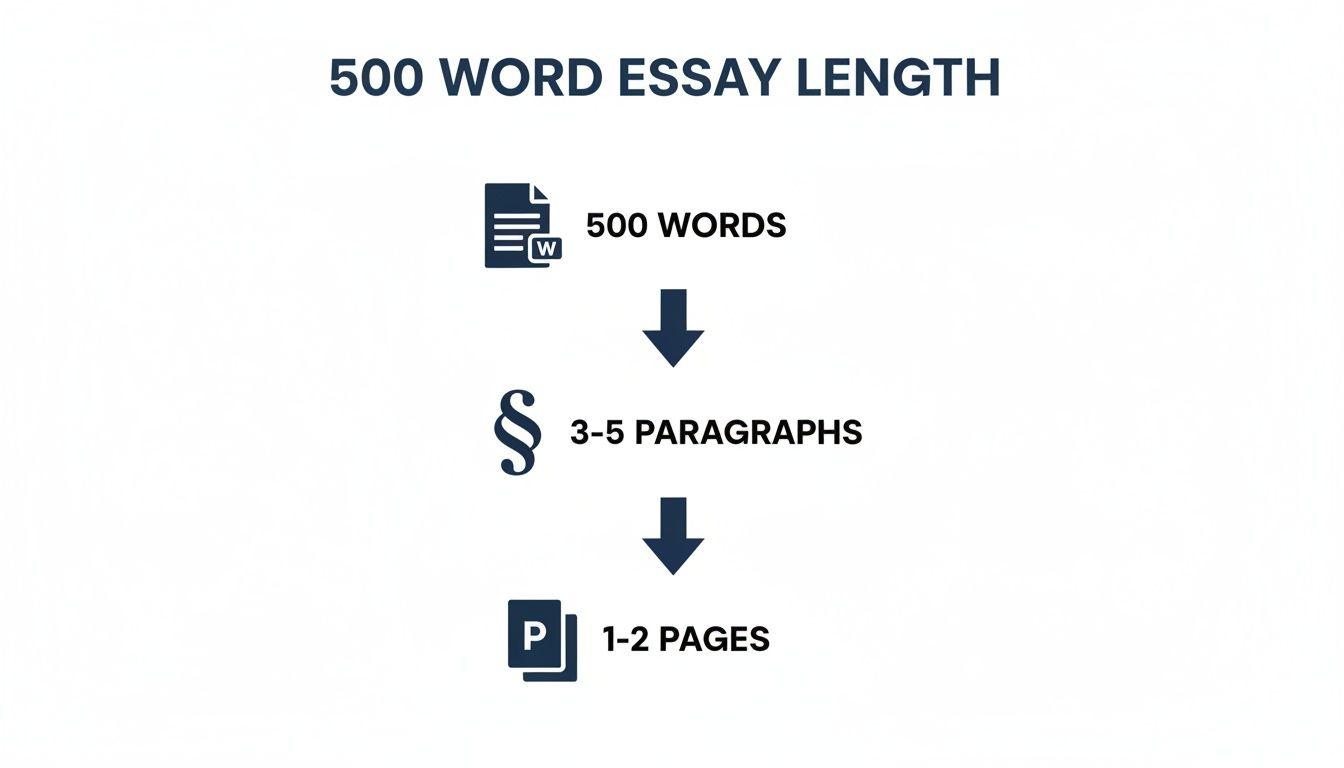
As you can see, the entire essay fits into just a handful of paragraphs, which usually means it will take up one or two pages, depending on your formatting. It's short, sweet, and to the point.
Mastering the Three-Part Structure
The 500-word essay is an academic staple for a reason. It teaches you to be concise and logical, a skill that’s highly valued everywhere from the classroom to the boardroom. This format is a cornerstone of an industry that was valued at USD 1.8 billion back in 2022. It's a skill that the 60% of UK undergraduates and the over 20 million college students in the U.S. have to master to keep up with their coursework.
So, how do you break down those 500 words for the biggest impact? Here’s a simple guide:
- The Introduction (Around 75 words): This is your hook. Your goal is to grab the reader's attention right away and clearly present your main argument, or thesis statement, in just a few powerful sentences.
- The Body Paragraphs (Around 350 words): This is where you build your case. The body is the heart of your essay and is usually made up of three separate paragraphs. Each one should tackle a single, specific point that supports your thesis, backed up with clear evidence or examples.
- The Conclusion (Around 75 words): Time to bring it home. The conclusion neatly wraps everything up by briefly summarizing your main points and leaving the reader with a final, memorable thought.
A well-structured essay acts like a good tour guide, leading your reader smoothly from your initial claim all the way to your final takeaway. It's like telling a short, compelling story where the beginning, middle, and end are all crucial to the plot.
Taking a few minutes to plan these sections is the secret to writing with clarity. For a more in-depth look at this planning stage, check out our guide on creating a detailed essay outline example—it can make the entire writing process feel much less intimidating.
How to Plan Your Essay Before You Write
Great writing always starts with a great plan. I can’t stress this enough. Jumping into a 500-word essay without an outline is like trying to build a house without a blueprint—sure, you might end up with something standing, but it’ll probably be a disorganized mess. A solid plan ensures every single word has a job to do.
Think of an outline as your strategic roadmap. It helps you organize your thoughts, cherry-pick your strongest arguments, and structure the essay for maximum impact. This planning stage is absolutely critical for maintaining the tight focus demanded by the 500 word essay length.
Create Your Essay Blueprint
Before you write a single sentence of your draft, seriously, take 15-20 minutes to map everything out. This small investment of time upfront will save you from huge headaches later. It’s the best way to prevent rambling and ensure you end up with a coherent, logical piece.
Start by just brainstorming all your ideas on the topic. Don't filter yourself yet—just get it all down on paper. Once you have a good list, you can start picking out the strongest, most relevant points that directly back up the main argument you want to make.
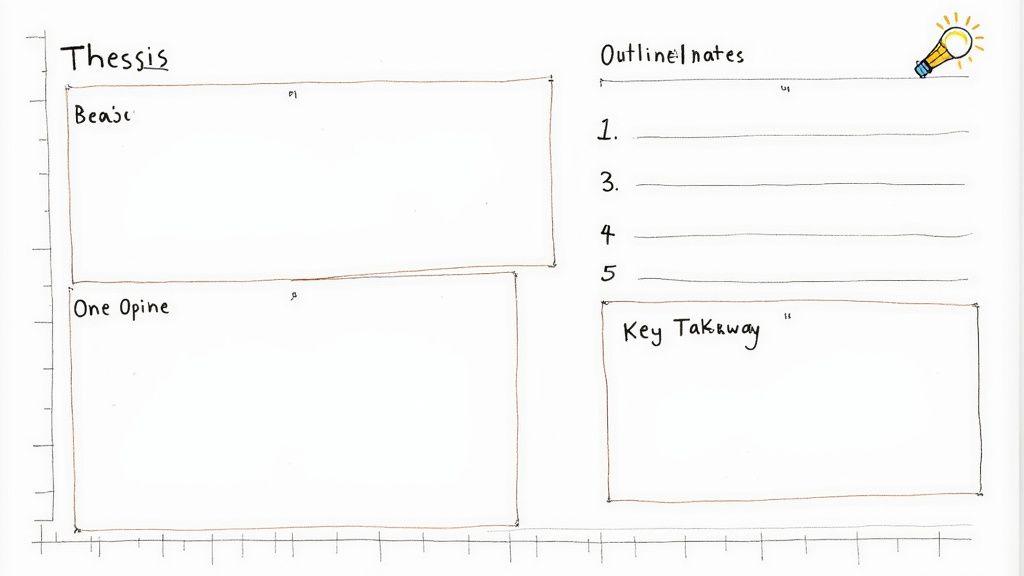
Here’s a simple, effective template I always recommend for structuring a plan:
- Thesis Statement: What’s your main argument? Nail it down in one clear, powerful sentence. This is the core idea your entire essay will defend.
- Body Paragraph 1: Jot down the main point for this paragraph. Then, list one or two key pieces of evidence or examples you'll use to support it.
- Body Paragraph 2: Same thing here. What's your second key point, and how are you going to prove it?
- Body Paragraph 3: And again for your third point. Note the argument and its supporting evidence.
- Conclusion Takeaway: What's the one thing you want your reader to remember after they finish? Write that down to guide your final sentences.
When you outline your essay, you're not just organizing your thoughts—you're strategically budgeting your very limited word count. This makes sure each section gets the space it deserves without one part hogging the whole piece.
Following a structured approach like this gives you a huge boost of confidence and clarity before you even start writing. It turns a daunting blank page into a much more manageable fill-in-the-blanks exercise, making the whole process feel smoother and way more efficient.
Writing Strategies to Nail the 500-Word Count
Trying to hit that 500-word target exactly can feel like walking a tightrope. A few words over, and you risk a penalty; too far under, and your argument might seem weak. The trick isn't just about adding or deleting words—it's about making smart edits that actually improve your essay.
If you find your essay is coming up short, the temptation is to just add "fluff." Resist it. Instead, go back to your main points and dig a little deeper. Have you fully explained why a piece of evidence matters? Often, adding just one more sentence of analysis or a second, related example can provide the substance you need.
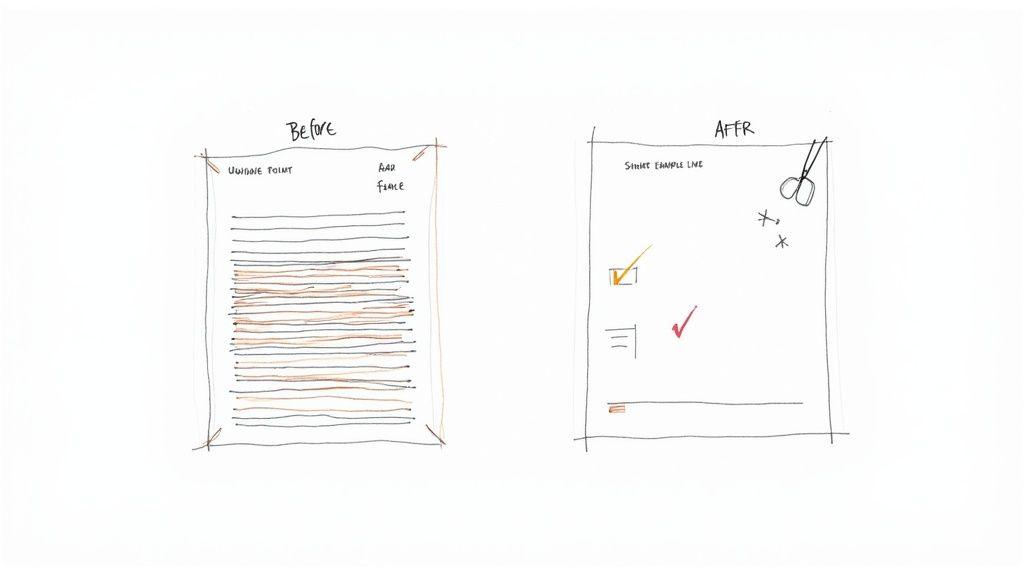
On the flip side, what if you've written too much? Now it's time to be your own toughest critic. Your mission is to cut out anything that doesn't directly serve your main argument. It's not just about deleting things; it's about making your writing more focused and powerful.
The secret to concise writing is to make every word work. If a word, phrase, or sentence doesn't add new meaning or strengthen your argument, it needs to go.
Strategies for Adjusting Essay Length
Whether you need to bulk up your essay or trim it down, a few reliable techniques can help you hit that sweet spot. Here's a look at some practical strategies for both situations.
| Goal | Technique | Example |
| Increase Word Count | Add analysis to your evidence. | Before: "The study showed a 20% increase." After: "The study showed a 20% increase, which highlights the direct impact of the new policy on public engagement." |
| Increase Word Count | Define a key term. | "This concept, known as 'cognitive dissonance'—the mental stress from holding conflicting beliefs—is central to understanding the character's motivation." |
| Decrease Word Count | Eliminate redundant phrases. | Before: "Due to the fact that she was late..." After: "Because she was late..." |
| Decrease Word Count | Combine choppy sentences. | Before: "The research was groundbreaking. It changed the entire field." After: "The groundbreaking research changed the entire field." |
Ultimately, these edits do more than just adjust your word count. They force you to clarify your thinking, strengthen your arguments, and make your writing more compelling for the reader. It's a win-win.
Managing Your Time for a 500 Word Essay
So, how long does it really take to write a 500-word essay? If you’re just talking about pure typing speed, a fast typist could knock it out in 15 minutes. But we all know there’s a lot more to it than that. A polished, well-argued paper isn’t born from a last-minute sprint; it’s built through a structured process.
The secret to managing your time and avoiding stress is to treat your essay like a mini-project with its own distinct stages. When you rush, you invite sloppy mistakes and weak arguments. By setting aside specific time for each task, you create a workflow you can count on—and you can finally say goodbye to that late-night panic.
A Realistic Timeline for Your Essay
A solid timeline is your best defense against having one stage, like research, completely hijack all your time. For a standard 500-word assignment, breaking down the work is the clearest path to a high-quality result. This is especially important given just how common this essay format is.
In fact, the 500-word essay length is so common that it accounts for roughly 35-40% of all requests in the global essay writing service market, which was valued at USD 1.97 billion in 2023. This demand, often fueled by tight academic deadlines, really underscores why efficient time management is so critical. You can learn more about these stats in the global essay writing service market report.
Here’s a sample schedule you can adapt to fit your own pace:
- Research and Brainstorming (1 hour): This is where you gather your sources and let your ideas flow. Don't censor yourself—just get everything down on paper.
- Outlining (30 minutes): Now, bring some order to the chaos. Create a clear blueprint for your introduction, three body paragraphs, and conclusion.
- Drafting (1.5 hours): It's time to write. Focus on getting your thoughts onto the page without agonizing over every single word. Perfection isn't the goal here; completion is.
- Editing and Proofreading (45 minutes): With the draft done, you can switch gears to polishing. Check for clarity, fix grammar, and make sure you’re sticking to the word count.
Total estimated time: 3 hours and 45 minutes. This structured approach turns a single, intimidating task into a series of small, manageable steps, helping you produce your best work every time.
How AI Is Changing the Game for Essay Writing
It's no secret that AI writing tools have become a go-to for students, especially when you're staring down the barrel of a 500-word essay deadline. These tools can be fantastic for getting the ball rolling—helping you brainstorm topics, spitball an initial draft, or tighten up your arguments so they land with more punch. Think of them as a personal assistant that can help you bust through writer's block and get your thoughts organized.
But here’s where it gets tricky. There's a fine line between getting a little help and committing academic dishonesty. Handing in an essay written entirely by AI is plagiarism, plain and simple. True academic integrity means using these tools as a sidekick, not as a stand-in for your own brainpower and critical thinking.
Finding the Sweet Spot with AI
Using AI for shorter essays isn't just a local thing; it's happening everywhere. In Northern Europe, the adoption rate is already at 32.1%, with Southeast Asia not far behind at 26.8%. Even in the U.S. and UK, roughly 25% of students have used AI tools for schoolwork, which really underscores why we need clear rules on how to use them ethically.
The real skill here is learning how to use AI to amplify your own voice, not silence it. Let it check your grammar, suggest a better word, or help you structure your outline. But the core ideas and the final text? That has to be all you.
At the end of the day, AI can be an incredibly helpful partner in building a great essay. For example, if you're just shy of the word count and need to flesh out a specific point, a tool like an AI paragraph writer can give you a solid starting point. The trick is to always maintain ownership, making sure the final essay is a genuine reflection of what you think and understand.
Your 500-Word Essay Questions, Answered
Even with a great plan in hand, you're bound to have a few nagging questions about writing a 500-word essay. It’s a classic format, but some of the details can be tricky. Let’s clear up some of the most common uncertainties right now.
How Many Paragraphs for 500 Words?
Most of the time, a 500-word essay breaks down into a neat, five-paragraph structure. It’s the standard for a reason: it works beautifully.
You’ll have one paragraph for your introduction, three body paragraphs to unpack your main points, and a final paragraph to wrap everything up in a strong conclusion.
How Long Will It Really Take to Write 500 Words?
Let's be realistic. Could a speed demon on a keyboard type out 500 words in 15 minutes? Sure. But that’s not writing, that’s just typing.
To produce a polished, well-argued essay, you should budget somewhere around three to four hours. That gives you the proper time for thinking, researching, outlining your ideas, drafting the content, and then circling back to edit it into shape. Rushing it is a recipe for a weak paper.
Can a 500-Word Essay Have 4 Paragraphs?
Absolutely. While the five-paragraph model is the go-to, a four-paragraph structure can be just as effective. This usually means an intro, two beefy body paragraphs, and a conclusion.
This approach works especially well when you have two very strong points that need more space to develop, rather than trying to stretch your topic into three separate, thinner arguments.
At the end of the day, what matters isn't hitting an exact paragraph count. It's about building a structure that logically supports your thesis. Whether you use four or five paragraphs, the goal is always clarity and a smooth, persuasive flow.
Is It Okay to Go Over 500 Words?
A little bit over is usually fine. Most instructors won't mind if you land within a 10% margin, meaning up to about 550 words. But—and this is a big but—always double-check your assignment guidelines.
Going way over the limit can signal that you struggled to edit your own work down to the essentials. On the flip side, falling too far short often means your ideas aren’t quite fleshed out yet. Hitting that sweet spot shows both depth and discipline.