Ever wondered how long 500 words actually is? It’s a number that pops up all the time, from school assignments to blog posts, but it can be hard to visualize.
As a rule of thumb, 500 words is about one single-spaced page or two double-spaced pages. That’s assuming you’re using a standard font like Arial or Times New Roman at a 12-point size. Think of it as the length of a short news article or a detailed answer on a homework assignment.
The 500-Word Sweet Spot
Why does 500 words matter so much? Think of it less as a rigid measurement and more as a foundational building block in writing. It’s just long enough to explore an idea with some depth but short enough to keep your reader hooked from start to finish.
While formatting choices can definitely change how it looks on a page, the real value of the 500-word count is in how it translates to time and structure. Whether you're a student trying to hit an essay requirement or a marketer crafting a landing page, getting a feel for this length is a huge advantage for planning your work.
500 Words by the Numbers
Let's break down what 500 words really means in practical terms.
- Reading Time: The average person reads at about 250 words per minute. That means a 500-word piece will take your audience roughly 2 minutes to get through.
- Speaking Time: If you're reading it aloud, like for a presentation or a video script, you’ll want to slow down. At a comfortable speaking pace of around 130 words per minute, it takes closer to 4 minutes.
- Paragraphs: Structurally, 500 words usually breaks down into 3 to 5 paragraphs. This is perfect for keeping your text organized and easy to scan.
At a glance, 500 words is a surprisingly versatile length. It’s the sweet spot for a focused blog post, a detailed product description, or a concise school essay.
What 500 Words Actually Looks Like on a Page
Saying 500 words is "about one page" is a decent rule of thumb, but it’s not the whole story. The reality of how long 500 words is can shift dramatically depending on how you format the text. It's a bit like packing a suitcase—the same number of clothes can look wildly different depending on how you fold and arrange them.
For instance, a document typed in a compact, 10-point Arial font might sit comfortably on a single page. But if you switch to a more spacious 12-point Garamond font and use double spacing, those exact same 500 words could easily spill over onto a second page.
How Formatting Changes Everything
These tweaks aren't just about looks. For a student, getting the formatting right is crucial for hitting assignment requirements. For a marketer or web designer, it directly affects how easily someone can read and engage with content on a screen.
Let's break down the key players:
- Font Choice: Fonts have different personalities and widths. Times New Roman is a classic for a reason—it’s fairly condensed. A font like Courier, on the other hand, gives each letter more breathing room.
- Font Size: The jump from an 11-point to a 12-point font might seem small, but it can easily add or subtract several lines from your page.
- Line Spacing: This is the big one. Single-spacing keeps your text tight and compact. Double-spacing, a favorite for academic papers, creates a lot of white space and can instantly double your page count.
The main thing to remember is that word count and page count aren't permanently linked. Formatting is the bridge between them, and it gives you complete control over how your work is presented.
If you ever need to generate perfectly structured text on the fly, a good AI paragraph writer can help you create content that fits specific length and formatting guidelines.
This visual guide neatly sums up how 500 words translates into pages, reading time, and even speaking time.
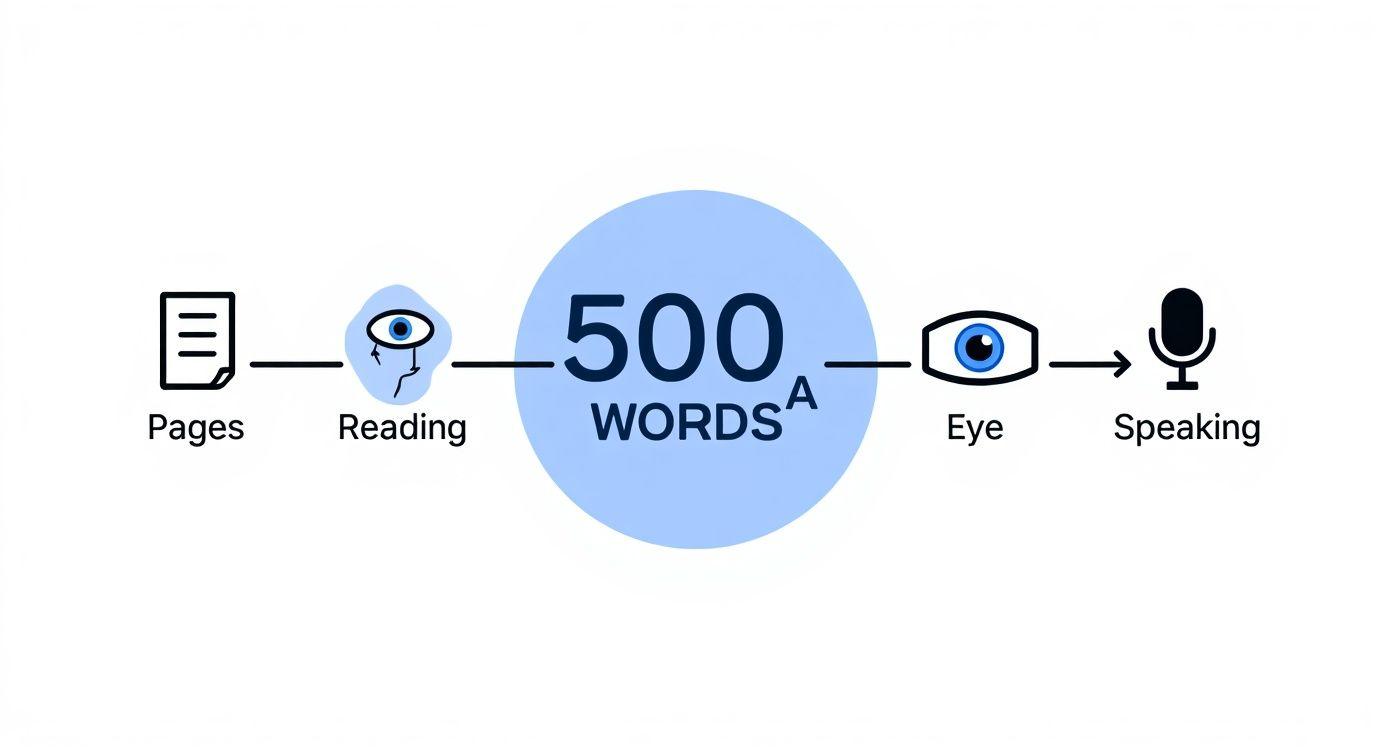
As you can see, the same chunk of text means something different depending on whether you're reading it silently, saying it out loud, or printing it out.
How Long It Takes to Read 500 Words
Beyond just page counts and paragraph breaks, one of the most practical ways to think about how long 500 words is comes down to time. How long does it actually take someone to absorb that information? The key metric is Words Per Minute (WPM), and that number changes quite a bit depending on whether you're reading silently or speaking aloud.
For most adults, silent reading is pretty zippy. We tend to cruise along at a pace of 200 to 300 WPM. This means a 500-word article, email, or report can be knocked out in just two to three minutes. It's no wonder 500 words is a sweet spot for so many blog posts and news updates—it’s just enough to deliver real value without demanding a huge time commitment.
But speaking those same words? That’s a whole different ball game.
The Difference Between Reading and Speaking
When you’re presenting a speech, recording a podcast, or narrating a video, your pace has to slow way down. You need to be clear, articulate, and give your audience time to process what you're saying. A comfortable speaking rate usually lands somewhere between 125 to 150 WPM.
At that more deliberate pace, reciting 500 words takes roughly 3.5 to 4 minutes. That’s a critical difference for anyone scripting content. A script that feels short and snappy on the page can easily balloon into a long, drawn-out segment when it's actually performed.
The gap between reading and speaking time is all about cognitive load. When you read silently, it’s a direct connection between your eyes and your brain. Speaking adds the extra layers of actually forming the words and pacing yourself for an audience.
Why This Matters for Your Projects
Getting a feel for these time estimates is a game-changer for effective communication. Whether you're a student timing a class presentation or a marketer scripting a short promotional video, these benchmarks help you hit your mark every time.
Here's a simple breakdown:
- For Silent Reading (e.g., Blog Posts, Emails): Expect your audience to spend 2-3 minutes with your content.
- For Speaking (e.g., Speeches, Videos): You'll need to budget 3.5-4 minutes of airtime.
Keep in mind that while the average reading speed is high, comprehension tends to be best around 300 WPM. That number can dip if the material is dense, technical, or totally new to the reader. It’s a constant trade-off between speed and genuine understanding.
You can find more helpful tools for converting words to speaking time over at Voices.com. Nailing your timing ensures your message lands exactly as intended, keeping your audience hooked from the first word to the last.
Why Is 500 Words Such a Magic Number?
Ever notice how the "500 words" target pops up everywhere? From high school essays to website blog posts, that number is no accident. It’s a powerful benchmark for a reason—it hits a strategic sweet spot that works beautifully for education, marketing, and media.
For students, the 500-word essay is a classic for a reason. It forces you to build a tight, focused argument without any fluff. You have to get straight to the point, support your thesis, and wrap it up cleanly. It’s a masterclass in concise writing and a fundamental skill for any academic work. If you're trying to nail a school assignment, figuring out the right length is crucial, and you can learn more about how many words an essay should be to match what your teachers are looking for.
That same principle carries over into the world of online content.
The Sweet Spot for Readers and SEO
When it comes to a blog post, 500 words is long enough to provide genuine value and sprinkle in the right keywords so Google can find you. At the same time, it’s short enough to respect your reader's attention span. No one feels overwhelmed, and the content is easy to digest, which keeps people on the page.
The power of 500 words lies in its efficiency. It’s long enough to be meaningful but short enough to be consumed in a single sitting, making it perfect for our fast-paced world.
This word count is also a big deal in media. In radio or podcasts, for example, a 500-word script translates to about 3.5 to 4 minutes of speaking time. This fits perfectly into the short segments that keep listeners from tuning out. It's a calculated choice designed to match modern attention spans and deliver a message with maximum impact. We'll dig deeper into how these calculations work and show you how long 500 words really is in different contexts later on.
Real-World Examples of 500-Word Content
Numbers and page counts are one thing, but the best way to really feel how long 500 words is comes from seeing it in the wild. You’ve probably read and written 500-word pieces more times than you can count without even thinking about it. It’s a surprisingly common and versatile length.
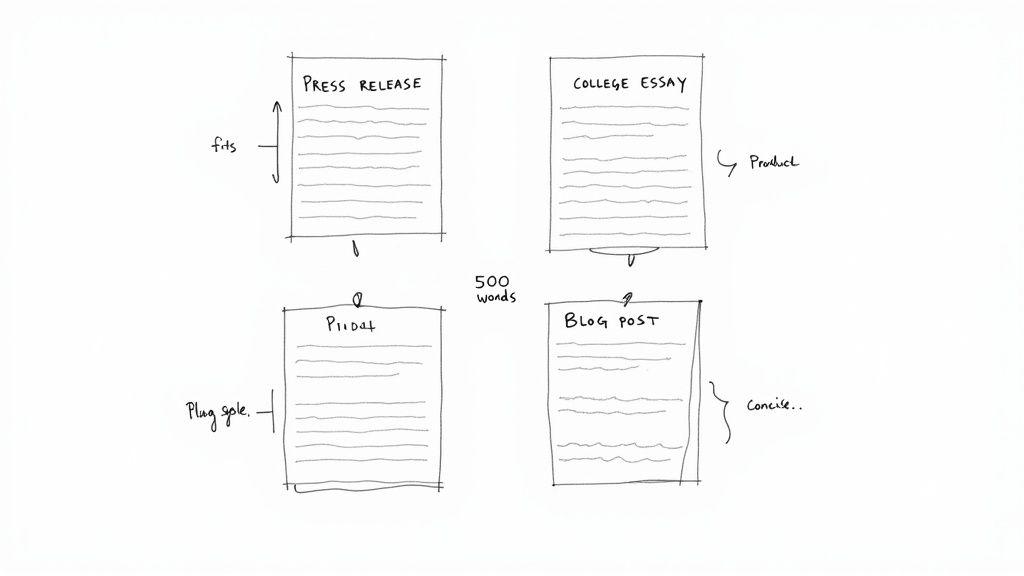
Ever read a press release announcing a new product or company update? They’re built to be quick, informative, and easy for a busy journalist to scan—which usually puts them right around the 500-word mark. The same is true for a lot of the short-and-sweet blog posts you see that answer one specific question.
Where You’ll Find 500 Words
This word count is a go-to standard in tons of professional and academic settings. It gives you just enough room to flesh out an idea without overwhelming your audience.
Here are a few places you’ll see it pop up all the time:
- College Application Essays: Many universities ask for a personal statement right in this range. It’s the perfect length to get a real sense of who you are without having to read a novel.
- E-commerce Product Pages: Think about the main descriptive text on a product page. It’s often around this size to cover all the key features and benefits.
- A Detailed Professional Email: That in-depth weekly update to your team or a formal follow-up with a new client can easily hit 500 words.
The bottom line? 500 words is the sweet spot for focused communication. It’s long enough to build a solid point but short enough that someone can read it in a couple of minutes, making sure your message actually gets heard.
For students, getting comfortable with this length is a game-changer. If you’re trying to figure out how to hit that target without all the stress, our guide on how to write essays faster has some great tips. Writing to a 500-word limit forces you to be disciplined and make every single sentence work for you.
Diving Deeper: Your Word Count Questions, Answered
Alright, so we've covered what 500 words looks like on the page and how long it takes to read or speak. But let's be honest, that often leads to more specific questions. Here are the answers to some of the most common ones I hear from students, business owners, and fellow writers.
How Many Paragraphs Should 500 Words Be?
Generally, you'll find that 500 words fits nicely into 3 to 5 paragraphs. There's no law against more or fewer, but this range hits the sweet spot for readability. It gives you enough space to introduce an idea, flesh it out, and move on without overwhelming your reader.
A simple, effective structure could be a 75-word intro, three body paragraphs of about 125 words each, and a 50-word conclusion. This approach keeps your thoughts organized and guides the reader smoothly from one point to the next—a huge plus when people are skimming online.
Remember, the point isn't just to fill the space. Breaking your text into smaller, focused paragraphs is about creating a clear and engaging reading experience. It’s what keeps people on the page.
How Long Does It Really Take to Write 500 Words?
This is the classic "how long is a piece of string?" question. The answer can be anything from 15 minutes to well over an hour. An experienced writer who knows their topic inside and out might hammer out 500 words in 20-30 minutes flat. But if you’re new to the subject and need to do some digging first, it could easily take an hour or more.
Your writing speed really boils down to a few key things:
- Your Typing Speed: It’s a simple factor, but a faster typist gets words on the page quicker.
- The Research Factor: If you need to stop and look up facts, figures, or quotes, your writing time will stretch out.
- Topic Familiarity: Writing about something you’ve mastered is always faster than trying to explain a concept you're still learning yourself.
Is a 500-Word Article Good for SEO?
In some cases, yes, but it’s complicated. A 500-word article can definitely rank for very specific, less competitive search terms. It’s a great length for a quick company update, a targeted product description, or an answer to a single, straightforward question.
However, the game has changed. Search engines like Google now tend to favor more in-depth, comprehensive content that completely resolves a searcher's query. This often means articles in the 1,500 to 2,000-word range perform better for more competitive topics.
At the end of the day, word count is secondary. The most important things are the quality of your information, its relevance to the reader, and how well you answer the question they typed into the search bar.