The truth is, there’s no single answer to "how many words should an essay be?" The right length depends almost entirely on where you are in your academic journey and what your instructor is asking for.
As a rule of thumb, a high school essay often lands somewhere between 300 and 1,000 words. Once you get to college, that expectation jumps significantly, with standard papers typically falling in the 1,500 to 2,500-word range. Think of these as starting points, not rigid rules.
Your Guide to Mastering Essay Length
Figuring out the ideal word count can feel like a guessing game, but it’s one of the most important parts of any assignment. Instructors don't just pull these numbers out of thin air to manage their grading load. Word limits are designed to test your ability to flesh out an idea with enough detail while staying focused and concise. A word count is really a roadmap for how deep your analysis should go.
This guide will give you a clear breakdown of what to expect at different academic stages. We'll explore:
- Why professors set specific length requirements in the first place.
- The typical word counts for various types of essays you'll encounter.
- Practical tips to either expand your writing or trim it down to hit that target perfectly.
Typical Word Counts by Educational Level
As you move from one academic level to the next, the required depth—and therefore, the word count—grows right along with you. This isn't an accident. Academic institutions set these guidelines to match your developing skills. High school essays are all about nailing the structure, while college papers demand much deeper research and more complex arguments. For a closer look at how these standards are developed, BachelorPrint.com offers some great insights.
Here’s a quick reference table that breaks down the typical word count ranges you can expect at each level of your education.
Typical Essay Word Counts by Educational Level
| Educational Level | Typical Word Count Range | Approximate Double-Spaced Pages |
| Middle School | 300–500 words | 1–2 pages |
| High School | 500–1,000 words | 2–4 pages |
| College | 1,500–5,000 words | 6–20 pages |
| Graduate School | 5,000–15,000+ words | 20–60+ pages |
As you can see, the expectations scale up pretty quickly. These ranges help you gauge the level of detail and research required for a successful paper.

This progression makes a lot of sense when you think about it. A shorter essay is like a snapshot—it captures a single, clear idea. A longer research paper, on the other hand, is like a documentary, weaving together multiple sources and complex arguments to tell a complete story.
Getting comfortable with both formats is a huge part of academic success. This guide will give you the tools to do just that.
Why Word Count Is More Than Just a Number
Have you ever gotten an assignment back and wondered why the professor settled on exactly 1,500 words? It can feel a little random, like they just picked a number out of a hat. But that word count is actually one of the most important clues in your entire assignment prompt. It’s not about hitting a quota; it’s about shaping how you think and write.
Think of it like this: a word count is the recipe for your essay. If you use too few ingredients, the final dish will be underdeveloped and bland. If you toss in too many, you’ll lose the main flavor. The word count gives you the structure you need to build a compelling argument without getting lost in the weeds.
It's a Framework for Focus and Depth
At its core, a word count is a teaching tool. It forces you to make tough decisions, figure out what’s truly important, and organize your ideas in a logical way. Without that target, it’s easy to ramble or throw in every thought you have on the topic. The limit acts as a container, pushing you to be selective with your evidence and sharp with your analysis.
For instance, a tight 500-word essay is a test of your conciseness. You have no choice but to get straight to the point, pick your absolute best evidence, and make every single sentence work hard. On the flip side, a 3,000-word research paper challenges your endurance. It tests your ability to sustain a complex argument, weave together multiple sources, and really dig into a topic from all angles.
A word count isn't just a limit; it's a guide. It signals the expected level of detail, research, and analysis you need to fully answer the prompt and show you've mastered the material.
When you hit that target, you’re sending a clear signal to your instructor that you can follow directions and manage the scope of a project. Those are skills that matter long after you’ve left the classroom.
The Link Between Length and Quality
Beyond being a helpful constraint, essay length often has a direct relationship with academic performance. Now, quality always beats quantity—a brilliant 800-word essay will always be better than a rambling 1,200-word one. But generally speaking, essays that meet or slightly exceed the minimum word count tend to score higher.
This isn't because instructors are impressed by sheer volume. It's because a well-developed argument simply takes up more space. Longer papers usually signal deeper research, more thoughtful analysis, and a willingness to explore counterarguments. Research has even backed this up. One study on SAT essays discovered that word count accounted for approximately 39% of the score variation, suggesting that evaluators often see length as a sign of a more developed response. You can dig into the findings in the full study on essay scores and word counts on pmc.ncbi.nlm.nih.gov.
So, what’s the takeaway here? Aiming for the suggested word count isn't just about avoiding a penalty. It’s about giving your ideas the room they need to breathe and be argued persuasively.
Mastering the Art of Precision
Ultimately, learning to write to a specific length is an exercise in discipline. It turns you into a better editor of your own work by forcing you to hunt down and eliminate the fluff that weakens your arguments.
Word limits are fantastic for honing these critical editing skills:
- Cutting Redundancy: You learn to say something once, and say it well, instead of repeating yourself in slightly different ways.
- Eliminating Filler: Flabby phrases like "due to the fact that" or "it is important to note that" get the chop in favor of more direct language.
- Strengthening Verbs: You start swapping out passive voice ("the decision was made by the committee") for a more direct, active voice ("the committee decided").
When you treat the word count as a creative challenge instead of a frustrating rule, you become a much more effective communicator. Learning to make every word count is one of the most valuable skills you'll take away from your academic career, and it's essential in any professional field where clarity is key.
Navigating Word Counts From High School to Grad School
As you move through your academic career, the question "how many words should an essay be?" gets a different answer at every stop. The expectations for a high school paper are worlds apart from a graduate seminar report, and that’s about more than just length. The word count is a clue, a signal from your instructor about the intellectual depth you need to reach.
Think of it like building with LEGOs. In high school, you’re handed a small kit with clear instructions to build a specific model—that's your classic 500-word, five-paragraph essay. In college, you get a much bigger box with more specialized pieces, and the goal is to design something more intricate and original. By grad school, you’re expected to invent your own pieces and build something entirely new.
High School Essays: The Foundation of Structure
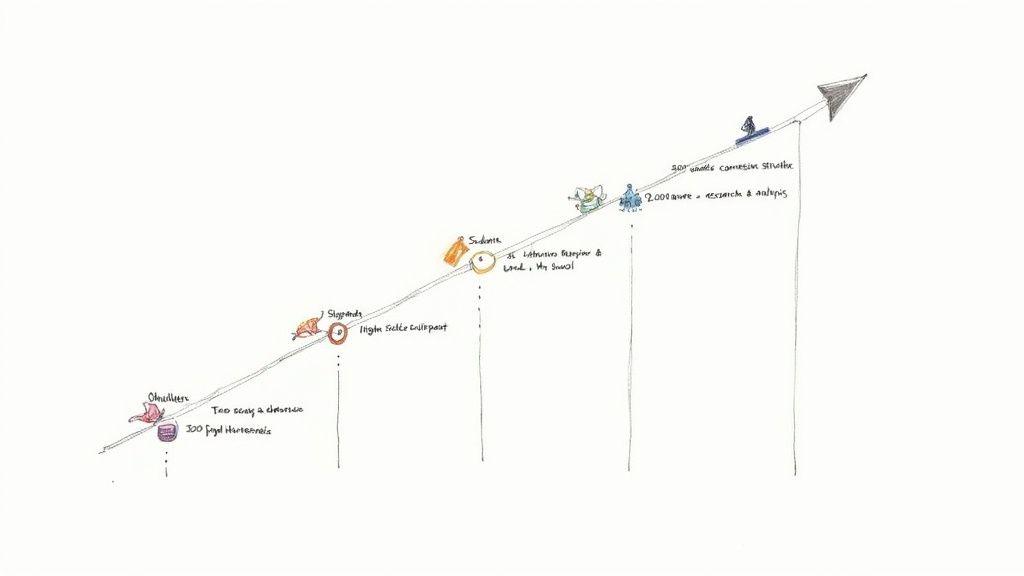
In high school, word counts are usually on the shorter side, typically falling somewhere between 300 and 1,000 words. The real goal here isn’t to produce groundbreaking research but to get the fundamentals of academic writing down cold.
These assignments are all about teaching you the essential skills that form the bedrock of everything you'll write later. When a teacher assigns a 500-word essay on The Great Gatsby, they want to see if you can build a clear thesis, back it up with a few solid pieces of evidence, and wrap it all up with a neat conclusion.
The focus is squarely on:
- Structure: Can you follow the classic intro-body-conclusion format?
- Clarity: Is your main point easy to understand and follow?
- Conciseness: Can you make your argument without adding a bunch of fluff?
At this stage, the word count is a training tool. It’s intentionally restrictive, forcing you to pick your strongest points and express them efficiently. It’s less about how many ideas you have and more about how well you can organize them.
Hitting that 750-word target shows your teacher that you can not only form an argument but also manage its scope—a critical first step toward more advanced academic work.
College and Undergraduate Papers: Demanding Deeper Analysis
The moment you step onto a college campus, the game changes. The expectations for both length and depth ramp up significantly, with undergraduate papers commonly ranging from 1,500 to 5,000 words. This jump isn’t random; it reflects a major shift in academic purpose.
College essays require you to move beyond just summarizing what you've read. You need to start contributing your own analysis to the conversation. A 2,000-word history paper isn't just about listing the causes of a war; it's about arguing which cause was the most significant and defending that position with evidence from multiple scholarly sources.
This extra length serves a few key functions:
- It gives you the space needed for in-depth research and proper citation.
- It lets you explore nuance and counterarguments, showing you’ve considered the topic from all sides.
- It challenges you to sustain a complex thesis over many pages without getting lost.
A professor might assign a 2,500-word essay to see if you can weave primary source documents together with secondary scholarly critiques to create an original interpretation. The length is a direct reflection of the task's complexity—you just can't dig that deep in 500 words.
Graduate School Writing: Contributing to the Field
At the graduate level, writing is no longer just a learning exercise. It becomes a professional act of creating new knowledge. Word counts for seminar papers, theses, and dissertations can be massive, often starting at 5,000 words and stretching far beyond that.
Here, length is directly tied to the scope of your original research. A grad school paper isn’t just an argument; it's a contribution to an ongoing scholarly dialogue. All that space is necessary to house critical components that are often minimal or completely absent in undergraduate work.
A typical graduate-level paper requires you to:
- Conduct a Comprehensive Literature Review: You have to prove you understand everything that's already been written on your topic, which takes up a lot of real estate.
- Establish a Unique Thesis: Your argument has to be an original contribution, not just a rehash of old ideas.
- Present Original Research: Whether it’s through textual analysis, lab experiments, or fieldwork, you need room to present and interpret your own findings.
- Engage with Complex Theory: You’re expected to apply and critique sophisticated theoretical frameworks, not just mention them.
A 10,000-word paper isn't long just for the sake of it. Every word is needed to build a robust, evidence-based case that can stand up to the scrutiny of experts in your field. At this level, the answer to "how many words should an essay be?" is simple: as many as it takes to make a real scholarly contribution.
Writing Your Future: Mastering the Admissions Essay Word Count
When it comes to college or scholarship applications, the essay isn't just another assignment—it's your one shot to speak directly to the admissions committee. The word count isn't a suggestion; it's a hard limit that shapes how you tell your story.
Unlike a history paper, where you're analyzing outside sources, this essay is all about you. It’s your chance to show who you are beyond the numbers, and you have to do it within a surprisingly small space.
Most application platforms, like the Common App, enforce strict limits, usually somewhere between 250 and 650 words. This isn't a guideline. In many cases, the text box will literally cut you off mid-sentence if you go over. This constraint is intentional; it forces you to be disciplined, focused, and incredibly thoughtful about every word you choose.
Why Every Single Word Matters
Think of your admissions essay like a short, powerful speech. You have just a few minutes to grab the audience and make them remember you. In this scenario, being brief is a test of your clarity and focus. Admissions officers read thousands of essays, so a story that is direct and impactful stands out immediately.
This tight word count pushes you to:
- Zoom in on one compelling story. Forget trying to cram your entire life into 600 words. Pick a single, meaningful moment and explore it deeply.
- Show, don’t just tell. Instead of saying you're "determined," use your limited space to tell a story that proves it through your actions.
- Edit without mercy. Every extra adjective, clunky phrase, or weak sentence has to go. Each word must earn its place.
Nailing this process shows the committee you can communicate effectively and make smart choices—skills that are essential for success in college and beyond.
In an admissions essay, a single, vivid sentence that reveals your character is far more powerful than a whole paragraph of vague claims. The goal is to create a memorable snapshot, not an exhaustive biography.
Strategies for Maximum Impact in Minimum Space
Hitting the word count for an application essay requires a different mindset. You can’t just write freely and trim it down later. You have to build your story with precision from the ground up, starting with a killer opening. For some great ideas, check out our guide on crafting good intros for essays with powerful examples.
Beyond a strong start, here are a few tips to stay on track:
- Outline with the Limit in Mind: Before you even start writing, sketch out your story. Assign a rough word count to your intro, the main body, and the conclusion. This keeps your narrative balanced and prevents you from running out of space before you’ve made your point.
- Lean on Strong Verbs and Nouns: Active verbs bring your story to life without needing a bunch of adverbs. For example, "I sprinted" is much more vivid and concise than "I ran very quickly."
- Read It Out Loud: This is the single best way to catch awkward phrasing and sentences that drag on. If a sentence feels clumsy when you say it, it’s a sign it needs to be simplified.
In the end, mastering the admissions essay is about making deliberate, powerful choices. The constraint isn't a burden; it's a challenge that pushes you to distill your experience into a story that is authentic, memorable, and uniquely yours.
How to Adjust Your Essay Length Without Sacrificing Quality
Hitting the word count on an essay can feel like trying to land a plane on a very specific, very short runway. Sometimes you come in way too short, and other times you overshoot it by a mile.
Don't worry, this is a totally normal part of writing. The trick is to see this adjustment not as a chore, but as a chance to make your essay even better. It’s all about editing with purpose—either by cutting the fluff or adding real substance.
Smart Ways to Adjust Your Essay's Word Count
When you're trying to hit a word count, it's easy to fall into bad habits. Padding your essay with useless words or gutting it without a second thought will almost always hurt your grade. The key is to be strategic.
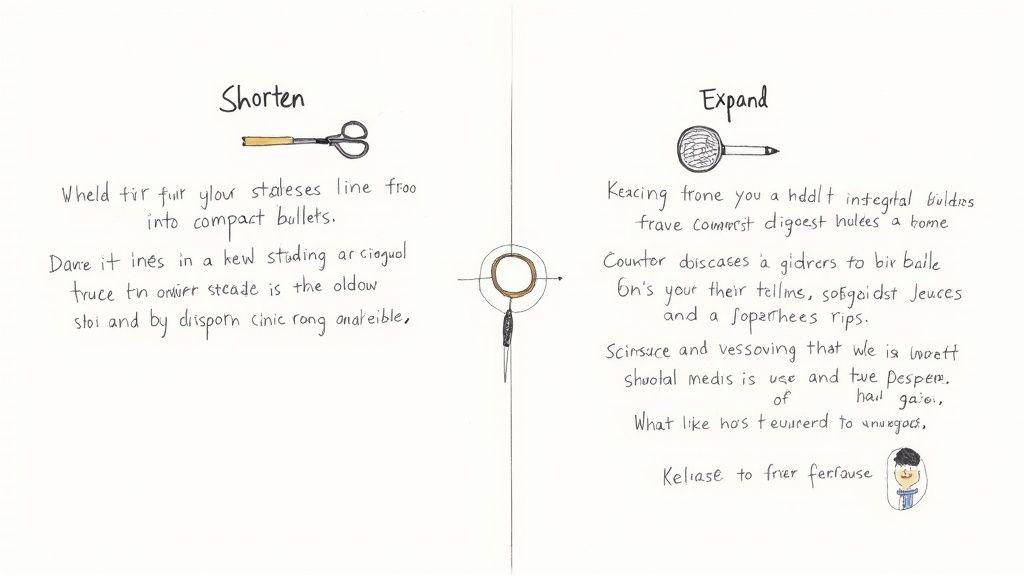
This table breaks down some of the best (and worst) ways to tweak your word count.
| Goal | Effective Strategy (Do This) | Ineffective Strategy (Avoid This) |
| Shorten Essay | Cut redundant phrases and find where one word can replace three. Hunt for passive voice and flip it to active. | Deleting whole paragraphs or random sentences without re-reading for flow. |
| Shorten Essay | Combine short, choppy sentences into a single, more elegant one. | Using overly complex words just to sound smart; clarity is key. |
| Lengthen Essay | Add a new piece of evidence, a quote, or an example to support an existing point. | Repeating the same idea over and over in slightly different ways. |
| Lengthen Essay | Introduce a counter-argument and then explain why your position is stronger. | Adding fluffy adjectives and adverbs that don't add real meaning. |
The best editing strengthens your argument, whether you're adding to it or trimming it down. Always focus on making your writing more clear, direct, and convincing.
Smart Strategies for Shortening Your Essay
If your essay is too long, think of yourself as a sculptor. You're not just hacking off pieces; you're carefully chipping away to reveal the masterpiece inside. Every word you cut should make the final piece sharper.
Here are a few targeted ways to do that:
- Hunt Down the Passive Voice: Passive voice often adds unnecessary words. Flipping a sentence from "The ball was hit by the boy" (7 words) to "The boy hit the ball" (5 words) makes it punchier and more direct.
- Eliminate Redundant Phrases: We all use filler phrases. Scan your draft for things like "due to the fact that" (just say "because"), "in order to" (use "to"), and "at this point in time" (use "now").
- Combine Choppy Sentences: Look for short, related sentences you can merge. "She studied for the exam. The exam was difficult. She passed it" can easily become, "She passed the difficult exam she studied for."
Tightening your writing like this doesn't just meet a word count; it makes your essay sound more professional and powerful.
How to Expand Your Essay with Substance
Finding yourself under the word count can feel way more intimidating than being over. The temptation to just add fluffy words or repeat yourself is strong, but that's a surefire way to weaken your argument. Instead, see this as an opportunity to add more depth.
The best way to lengthen an essay is to add more thinking, not just more words. Go back to your core arguments and ask yourself, "What else can I explore here?"
A solid outline is your best friend when you need to find places to add meaningful content. If you're stuck, take a look at an essay outline example. It can spark ideas for your own structure and show you where you might have missed a chance to go deeper.
Once you have your outline handy, try these strategies:
- Bolster Your Evidence: Revisit your main points. Could you add another example, a supporting statistic, or a relevant quote? Make sure you explain how this new evidence proves your thesis.
- Introduce and Refute a Counter-Argument: One of the most impressive ways to add depth is to acknowledge the other side. Introduce a potential objection to your argument, explain it fairly, and then show why your position holds up better.
- Explore the "So What?" Question: Go back to your conclusion. Have you really spelled out the bigger picture? Discuss why your argument matters, who it affects, and what questions it raises for the future.
This approach ensures you're not just padding your essay—you're enriching it. You’ll hit the length requirement while making your paper more thorough and persuasive.
Answering Your Top Questions About Essay Word Counts
It's one of the most common sources of student stress: the word count. Assignment prompts can feel a bit like a riddle, leaving you wondering what the instructor really wants. Let's clear up that confusion and tackle the questions that pop up right before a deadline.
Think of this as your go-to guide for hitting that sweet spot and submitting your work with confidence.
How Much Can I Go Over or Under a Word Count?
A good rule of thumb to live by is the 10% rule. If your target is a 1,000-word essay, this gives you a comfortable range of 900 to 1,100 words. This little bit of wiggle room allows for some natural variation in your writing without completely missing the mark.
But here’s the crucial part: this isn’t a universal law. Some professors are incredibly strict about length. More importantly, many online submission portals have hard cutoffs and will literally stop you from submitting if you’re a single word over. If the prompt says "maximum 500 words," it means 500 words. On the flip side, an instruction like "around 2,000 words" is a clear signal that you have more flexibility.
When in doubt, just ask. A quick email to your instructor can save you a lot of guesswork. Otherwise, sticking within that 10% range is always your safest bet.
Do Titles and Citations Count Toward the Total?
Almost never. The word count is meant to measure the substance of your argument—the body of your essay. This starts with the first word of your introduction and ends with the last word of your conclusion.
Typically, the following parts are not included in the official word count:
- The title page
- Your name, course number, and date
- In-text citations (like "Smith, 2021")
- Footnotes or endnotes
- The bibliography or works cited page
A word of caution: automated grading systems can be finicky. Some might just count every single word in the document, no matter what it is. Always check your assignment details or the required style guide (APA, MLA, etc.) for the final word. If the instructions are vague, just assume the count applies to the main text only. And for those tight on time, learning how to write essays faster can help you manage the whole process more efficiently.
What if No Word Count Is Given?
This is where you have to put on your detective hat. The assignment prompt is full of clues that reveal your instructor's expectations. A request for a "brief summary" is a world away from a prompt asking for a "detailed analysis using multiple scholarly sources." One implies a few paragraphs; the other, a few pages.
Another big clue is how much the assignment is worth. A major paper that’s 30% of your final grade is going to require a lot more depth and development than a weekly reflection that’s only worth 5%. Look for other hints, like a minimum number of required sources or a page limit. If you're still feeling lost, don't hesitate to ask your instructor for a target range. It shows you’re engaged and serious about getting it right.