At its heart, prompt engineering is really just the skill of writing clear instructions for an AI. It’s less about being a tech wizard and more about being a great communicator. Think of it like giving directions to an incredibly smart, but very literal, personal assistant. If you’re vague, they’ll get lost. But if you're crystal clear, they’ll bring you back exactly what you asked for—whether that's a perfect piece of code, a compelling email, or a beautiful image.
Unlocking AI's True Potential
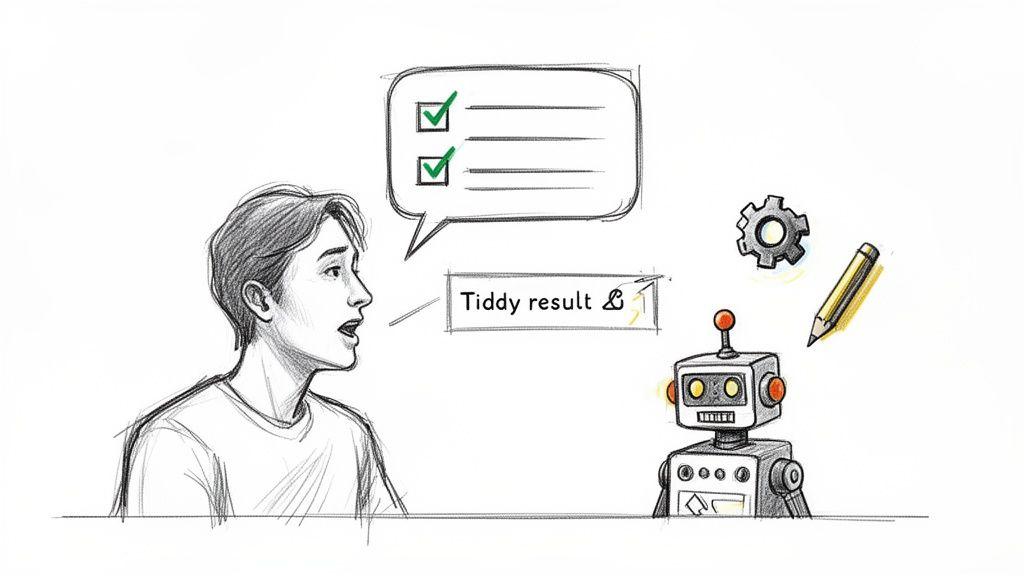
Prompt engineering is the key that unlocks what models like the ones in 1chat can really do. These AI systems are unbelievably powerful, but they aren't mind readers. A fuzzy, one-line request usually gets you a generic, uninspired response. But a carefully crafted prompt gives the AI the context, constraints, and clarity it needs to deliver something truly useful and high-quality.
What was once a niche skill for AI researchers is quickly becoming a fundamental ability for everyone. By 2026, knowing how to talk to an AI will be as essential as knowing how to use a search engine. It’s what turns a cool new gadget into a genuine partner for getting things done.
Why This Skill Matters Now
The gap between a novice AI user and an expert almost always comes down to the quality of their prompts. Someone just starting out might type, "Write about my new coffee shop." The AI has almost nothing to go on.
An experienced user, on the other hand, engineers their prompt with specific details: "Act as a marketing expert. Write three Instagram posts to announce the grand opening of 'The Daily Grind,' a new coffee shop in downtown Austin. Our target audience is young professionals, aged 25-40. The tone should be energetic and welcoming. End each post with a call-to-action inviting people to our launch event this Saturday."
This level of detail is precisely what separates a frustrating AI experience from a wildly successful one. It’s the difference between asking a question and giving a mission.
When you can provide instructions with that much precision, you gain incredible control over the final output. This is a game-changer for:
- Students who need to generate focused summaries for a complex research paper.
- Small businesses looking to create marketing copy or automate customer service replies.
- Families who want to dream up personalized bedtime stories or map out a detailed vacation.
To get started, it helps to understand the building blocks of a great prompt. The table below breaks down the key ideas you'll be working with.
Core Concepts of Prompt Engineering at a Glance
This table offers a quick snapshot of the essential ingredients that make up a successful prompt. Getting a handle on these simple concepts will immediately improve the quality of your AI-generated results.
| Concept | Simple Explanation | Why It Matters |
| Prompt | The text instruction you give to an AI. | This is your direct line of communication; the better it is, the better the result. |
| LLM | Large Language Model; the AI brain that processes your prompt. | Knowing it just predicts the next word helps you understand why directness is key. |
| Context | The background information you include in your prompt. | Gives the AI the crucial details it needs to produce a relevant, non-generic response. |
| Persona | Assigning a role to the AI (e.g., "Act as a professional chef"). | This guides the AI's tone, style, and knowledge base for a more tailored output. |
Mastering these four elements is the foundation of effective prompt engineering. It's how you go from being a casual user to someone who can confidently direct AI to tackle complex tasks.
From Code to Conversation: The Journey to Prompting
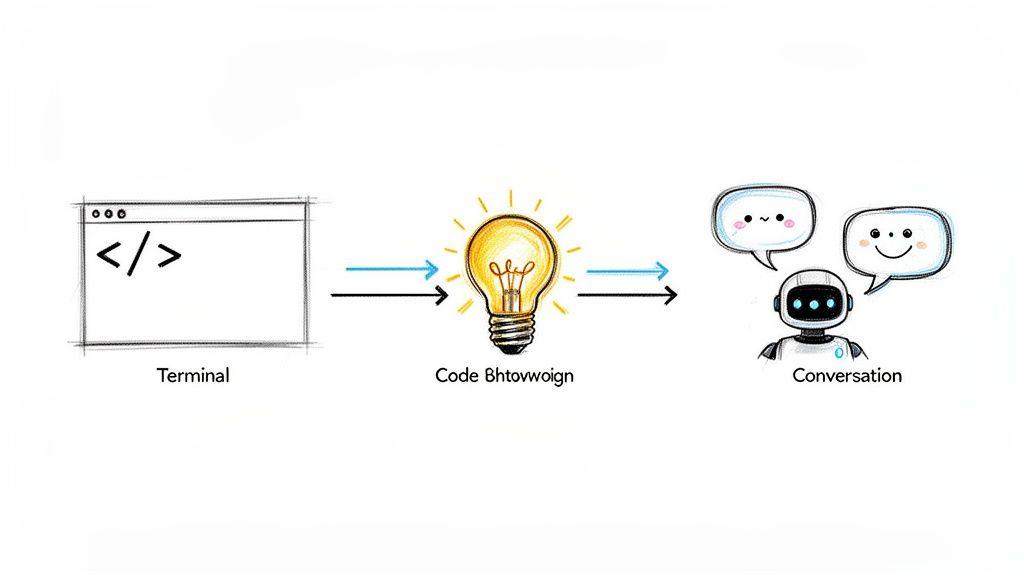
To really get why prompt engineering feels so simple today, it helps to look back at how incredibly complicated it used to be. For decades, getting a computer to do what you wanted meant speaking its language: code. If you weren't a programmer, you were on the outside looking in, unable to give direct, creative instructions.
The early days of natural language processing (NLP) in the 1990s were a start, but it was nothing like a conversation. We had models that could guess the next word in a sentence, but telling an AI what to do in plain English was pure science fiction. You needed serious technical chops to get even the most basic text-based results.
The real change started when researchers began building AI models that could juggle more than one task at a time. This was a huge leap. Instead of being a one-trick pony, AI was slowly becoming a generalist, able to understand different kinds of instructions without needing a total rewrite for every new problem.
The Dawn of Conversational AI
The big breakthrough moment came in 2018. Researchers had a brilliant idea: what if we treated every NLP task like a simple question-and-answer problem? That one shift in thinking opened the door for the incredibly flexible models we see today.
Then, in 2020, GPT-3 from OpenAI showed up and introduced a concept called "in-context learning." This was the game-changer. Suddenly, you could steer the AI's behavior just by giving it examples and instructions right inside the prompt. Just like that, prompt engineering was born.
This is the evolution that makes tools like 1chat possible. A task that once took a team of engineers can now be done by anyone who can write a clear sentence.
Prompt engineering's rise is a story of democratization. It transformed AI interaction from a highly specialized, command-line skill into an intuitive, creative dialogue accessible to everyone.
From Niche Skill to Everyday Tool
This shift from code to conversation has been massive. It’s why "prompt engineer" went from being an obscure, six-figure tech job to a practical skill for millions of people.
- Then: Talking to AI meant writing scripts and wrestling with statistical models.
- Now: It means asking, "Act as a travel agent and create a 5-day itinerary for a family trip to Rome."
This opens up a ton of creative and productive energy. Businesses can automate workflows, students can get a jumpstart on research, and families can create bedtime stories together. The power isn't locked behind a wall of code anymore—it's right there in our own words.
For anyone looking to run these powerful models on their own computer, figuring out the best local LLMs is a fantastic next step.
Ultimately, the history of prompt engineering is more than just a tech timeline. It’s a story about making powerful technology accessible to everyone. It’s how we went from typing cryptic commands into a terminal to having a fluid, natural conversation with an AI that's ready to help with just about anything.
The Four Pillars of an Effective Prompt
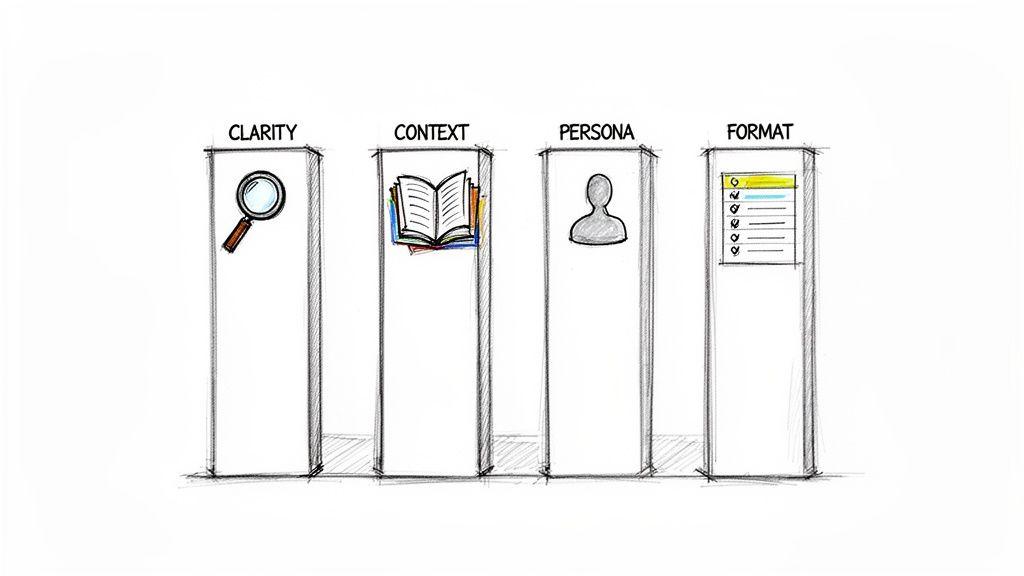
Getting great results from an AI isn't about memorizing some secret password. It’s about building a solid foundation for your request. Think of it like a house—a strong one needs four solid cornerstones. A great prompt works the same way, built on four essential pillars.
When you master these elements, you'll find your AI interactions go from simple questions to strategic commands that deliver precise, high-quality results every single time. These pillars work together to strip away any guesswork and give the AI a crystal-clear mission.
It’s like briefing a new team member. You wouldn’t just toss a topic at them and walk away. You’d explain the task, give them the necessary background, clarify their role, and tell them exactly what the final report should look like. Applying that same common sense to your prompts is the key to unlocking what these tools can really do.
Pillar 1: Clarity and Specificity
The number one reason prompts fail? Vagueness. An AI can't read your mind or guess what you mean, so your instructions have to be direct and leave no room for error.
Clarity means using simple, straightforward language. Specificity means giving the AI all the details it needs to nail the task. Instead of just giving it a broad topic, break down exactly what you’re looking for.
- Vague Prompt:
"Write about social media marketing." - Specific Prompt:
"Write a 500-word introduction for a blog post about why social media marketing is crucial for small businesses. Focus on Instagram and TikTok, and make sure to highlight the power of short-form video content."
See the difference? The second prompt gives the AI clear boundaries and a target, resulting in something you can actually use.
Pillar 2: Context
Context is the "why" behind your request. Without it, the AI is just pulling from its massive but generic training data. It’s like asking someone for directions without telling them where you're starting from.
Give the AI the background information it needs to understand the bigger picture. This could be anything from who your target audience is, what your brand's voice sounds like, or the ultimate goal of the content you're creating.
- Low-Context Prompt:
"Create an email to customers." - High-Context Prompt:
"Draft a friendly and apologetic email to our customers explaining a recent shipping delay. Our company is 'Cozy Candles,' and our brand voice is warm and personal. Explain that the delays are from a supplier issue and offer a **15%** discount on their next order to thank them for their patience."
Pillar 3: Persona
This one is a game-changer. Assigning the AI a persona is one of the fastest ways to shape its tone, style, and even the kind of knowledge it draws upon. When you tell an AI to "act as" a seasoned copywriter, a meticulous data analyst, or a patient high school chemistry tutor, you're telling it which mental toolkit to use.
This simple trick instantly refines the output, making it sound more authentic and suited to your needs. It’s a small command that delivers a huge improvement in quality. We explore this in more detail in our guide on how to humanize AI text.
By assigning a persona, you're not just asking for information; you're asking for a specific perspective. This transforms the AI from a simple answer machine into a specialized collaborator.
Pillar 4: Format
Finally, you have to tell the AI how you want the information delivered. Don't leave the final presentation to chance. If you need a bulleted list, a markdown table, or three short paragraphs, spell it out in your prompt.
This last pillar ensures the output is not only accurate but also immediately usable, saving you a ton of time on editing and reformatting. Be explicit about the structure you need.
- Poor Formatting Instruction:
"Summarize the main points." - Clear Formatting Instruction:
"First, summarize the main points in a bulleted list. Keep each bullet point under two sentences. Then, present the key statistics in a two-column table with 'Metric' and 'Value' as the headers."
Powerful Prompting Techniques You Can Use Today
Once you've got a handle on the basic ingredients of a solid prompt, it's time to dig into the techniques that take your instructions from good to great. These methods are your playbook for getting more nuanced, accurate, and creative results out of any AI model you work with.
Think of them less like rigid coding commands and more like different conversational strategies. Some jobs are simple and a direct question will do. Others are trickier and benefit from you showing the AI exactly what a good answer looks like. Knowing which approach to use is what separates a novice from an expert—it’s the difference between getting a generic summary and one that perfectly nails the tone and depth you were aiming for.
From Zero to Hero with Prompting Examples
The single fastest way to level up your results is to give the AI examples to follow. This whole idea is often called "in-context learning," and it comes in a few flavors. Each one gives the model a different amount of guidance, letting you nudge its output without needing any technical wizardry.
This approach really took off after OpenAI released GPT-3 back in May 2020. That model was a beast, with 175 billion parameters, and it introduced the world to the magic of few-shot prompting. For the first time, you could teach an AI a new trick just by showing it a couple of examples in the prompt itself. This was a massive shift from old-school machine learning that demanded huge, specially prepared datasets. You can get a deeper dive on this evolution in AI over on WeSkill's blog.
Let's break down the most common techniques you'll use.
- Zero-Shot Prompting: This is your starting point. You just give the AI a task cold, with no examples to guide it. It has to rely entirely on its built-in knowledge to figure out what you want. It's fast, easy, and perfect for simple requests like, "What is the capital of Australia?"
- One-Shot Prompting: Now you’re giving the AI a little help. You provide a single, high-quality example of what you're looking for. This acts as a clear template for the AI to copy, which is incredibly handy when you need it to match a specific format or style.
- Few-Shot Prompting: For more complex or subtle tasks, you'll want to provide a few examples (usually two to five is plenty). This gives the AI a much better feel for the pattern you want it to follow. The extra context leads to more consistent and reliable results, especially for things like analyzing customer feedback or classifying data.
By showing the AI examples, you're essentially helping it focus. You’re taking its vast, sprawling knowledge and narrowing its attention to the precise style and structure you need for that one specific task. It’s a simple trick that dramatically boosts the quality of what you get back.
Advanced Reasoning with Chain-of-Thought
What about when the AI needs to solve a puzzle or a math problem? For anything that requires logic, you need to go beyond just asking for the answer. That's where Chain-of-Thought (CoT) prompting comes in.
Instead of just asking for the final number, you tell the AI to "think step-by-step" or, even better, you show it an example where you've already broken down the reasoning. This simple tweak forces the model to slow down and work through the problem logically, piece by piece.
By making its "thought process" visible, the AI is far less likely to jump to the wrong conclusion. It’s like showing your work in math class—the process itself helps you find the right answer. This technique is a total game-changer for any task that involves true reasoning.
The table below breaks down these core techniques to help you pick the right one for the job.
Common Prompting Techniques Compared
Each prompting method has its own strengths. Think of them as different tools in your toolbox—you wouldn't use a hammer to turn a screw. This table will help you match the right technique to the right task.
| Technique | Best For | Example Prompt Structure |
| Zero-Shot | Simple, direct questions and common knowledge tasks where the AI already has expertise. | Translate the following sentence into French: "I need to buy some bread." |
| One-Shot | Tasks where style and format are important, like drafting a specific type of email. | Example: [Subject: Meeting Canceled] Body: Hi team, the 10 AM meeting is canceled. Reschedule coming soon. <br><br> Now, write a similar email for a product demo. |
| Few-Shot | Complex classification or creative tasks needing a clear pattern for the AI to follow. | Review: "Loved this movie!" -> Positive.<br>Review: "So boring." -> Negative.<br>Review: "It was okay, not great." -> Neutral.<br>Review: "Best film of the year!" -> |
| Chain-of-Thought | Math problems, logic puzzles, and multi-step reasoning tasks. | If a train leaves Station A at 2 PM traveling 60 mph... Explain your reasoning step by step to find the answer. |
As you can see, a little bit of structure goes a long way. By consciously choosing between these methods, you'll gain much more control over the AI's output and start getting consistently better results.
Starter Prompt Templates for Everyday Wins
The best way to get a feel for prompt engineering is to just dive in and try it. Moving from theory to practice can feel like a jump, but these ready-to-go templates are designed to make it easy. They solve real-world problems and show you the immediate power of a well-crafted prompt.
Think of these less as strict formulas and more as proven recipes for getting what you want from an AI. Each one is built around the core ideas of giving clear instructions, providing context, assigning a role, and defining the output format. Just copy the template that fits your situation, swap out the bracketed text with your specifics, and see what happens.
Prompts for Small Business Owners
If you're an entrepreneur or part of a small team, you know that time is everything. A good prompt can put marketing tasks on autopilot, help you draft clear communication, or brainstorm ideas in minutes. This frees you up to focus on what really matters: growing the business.
1. Create Compelling Social Media Content
Your Prompt: "Act as an expert social media marketer specializing in [Your Industry, e.g., artisanal coffee]. Draft three engaging Instagram posts for my brand, [Your Brand Name]. Our target audience is [Describe Your Audience, e.g., eco-conscious millennials aged 25-35]. The goal of these posts is to [Your Goal, e.g., announce our new sustainable packaging]. The tone should be [Choose a Tone, e.g., upbeat, informative, and friendly]. Include relevant hashtags and a call-to-action in each post."
2. Write a Professional Customer Email
Your Prompt: "You are a customer service manager for [Your Company Name], known for our [Key Brand Value, e.g., excellent and friendly support]. Draft a polite and helpful email responding to a customer who is asking about [Customer's Issue, e.g., the status of their recent order]. Mention that the order number is [Order Number] and it is expected to arrive by [Date]. Keep the tone professional but warm, and end by thanking them for their business."
Prompts for Students
Whether you're wrestling with a research paper or cramming for a final, prompt engineering can completely change how you study. Use these templates to organize messy information, get clarity on confusing topics, and just make learning more efficient.
1. Generate a Detailed Study Guide
Your Prompt: "Act as a history professor. Create a detailed study guide for my upcoming exam on [Subject, e.g., the American Civil War]. The guide should cover these key topics: [List 3-5 Main Topics, e.g., Causes of the War, Major Battles, and the Reconstruction Era]. For each topic, provide a bulleted list of the most important people, dates, and concepts. The format should be clear and easy to read."
2. Get Feedback on an Essay
Your Prompt: "You are a helpful writing tutor. Please review the following essay on [Essay Topic]. Provide constructive feedback on three areas: 1. Clarity of the main argument. 2. Strength of the supporting evidence. 3. Grammar and sentence structure. Present your feedback as a bulleted list with specific examples from the text. Here is the essay: [Paste Your Essay Text Here]."
Prompts for Families
AI can also be an amazing tool for getting organized and creative at home. From planning a weekend adventure to sparking a kid's imagination, the right prompt can make daily life a little bit easier and a lot more fun.
1. Plan a Fun Family Weekend
Your Prompt: "Act as a creative family activity planner. Generate a list of three fun, low-cost weekend activities for a family with [Number and Ages of Children, e.g., two kids, ages 6 and 9]. Our family enjoys [Family Interests, e.g., being outdoors and hands-on crafts]. The weather this weekend is expected to be [Weather, e.g., sunny and warm]. Please present the ideas in a numbered list with a brief description of each."
Putting Prompt Engineering to Work in 1chat
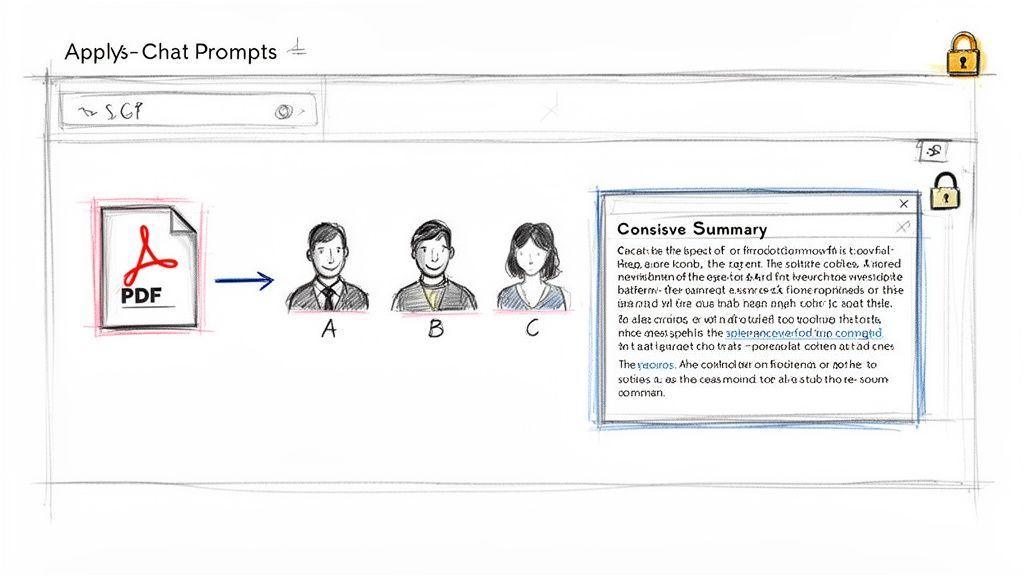
It’s one thing to understand the theory behind a good prompt, but the real magic happens when you apply those skills in a powerful tool. This is where a platform like 1chat becomes your hub, turning abstract ideas about prompt engineering into real-world results for your business, your studies, or even your family projects.
Instead of jumping between different apps for different AI tasks, 1chat brings everything you need under one roof. This means the prompting skills you’re learning can be used more creatively and in more places. You can dig into documents, create images, and chat with a whole range of AI models, all while using the same core principles: clarity, context, and a clear goal.
Supercharge Your Prompts with Multi-LLM Access
One of the best features is having access to multiple large language models (LLMs) from a single chat window. Why is that such a big deal for prompt engineering? Simple: different models have different strengths. One AI might be brilliant at creative storytelling, while another is a wizard with code and logical puzzles.
This setup lets you essentially A/B test your prompts by running the same request by different AIs and comparing the results side-by-side.
- For a Student: Imagine you've finished a draft. You could prompt: "Act as a critical writing instructor. Review my essay on the themes in '1984' and provide feedback on the clarity of my thesis statement. [Paste essay here]." By sending this to three different AIs, you can pull the most insightful feedback from each to build a much stronger final paper.
- For a Business Team: Let's say you need marketing copy. A prompt like, "Generate five catchy and professional taglines for a new project management app called 'FlowState.' The target audience is remote teams," will get you a variety of options. You can then see which AI best captures your brand's voice.
This multi-model strategy helps you quickly figure out which AI is the right tool for the job.
From Document Analysis to Image Creation
Beyond a simple chat, 1chat lets you apply your prompting skills to much deeper tasks, like analyzing PDFs or generating images. This is where giving the AI really rich context pays off big time.
For example, you could upload a dense, 20-page sales report and use a sharp prompt to pull out the most important takeaways in seconds.
Example Prompt for PDF Analysis: "You are a senior business analyst. I have uploaded our Q3 sales report PDF. Analyze the document and provide a concise executive summary in three bullet points. Then, create a two-column table highlighting the top three performing products and their corresponding revenue figures."
A task that used to take hours of manual work is now done in a flash. The same idea applies to creating visuals. Instead of a vague request like "an astronaut," you can engineer a much more detailed prompt to get exactly what you want: "Create a photorealistic image of a female astronaut floating in space, with the Earth visible in the background. The style should be cinematic with dramatic lighting, inspired by the film 'Gravity'."
For the small teams, families, and students using 1chat, this makes advanced AI genuinely accessible. It’s a single place to chat with all the major LLMs, analyze documents, and create images just by getting better at how you ask. In fact, recent findings show that businesses can cut down their workloads by 30-50% with well-crafted prompts, while kids can get family-safe homework help that sounds natural and human.
By bringing all these features together, 1chat gives you a practical and secure space to apply everything you've learned. It's an affordable tool for anyone looking to make prompt engineering a part of their daily workflow. You can learn more about how 1chat puts these features to work for you on our main site.
Your Questions on Prompt Engineering Answered
As you start exploring prompt engineering, a few questions are bound to come up. It's totally normal. This section is a quick FAQ to clear up those common sticking points and help you feel more confident as you begin. Let's tackle some of the most frequent queries with straightforward, practical answers.
Do I Need a Technical Background for Prompt Engineering?
Absolutely not. This is probably the single biggest myth out there. At its core, prompt engineering is all about clear communication, not coding. If you can write a detailed email to a coworker or give a friend solid directions to a new restaurant, you've already got the fundamental skills.
The "engineering" part isn't about circuits or software; it's simply about structuring your words thoughtfully to get a specific result. Modern AI platforms, especially intuitive tools like 1chat, are designed for everyone, regardless of their tech-savvy. It’s a skill that rewards creativity and clarity far more than a computer science degree.
The real power of prompt engineering is how accessible it is. It levels the playing field, letting anyone with a good idea and the words to describe it create amazing things with AI.
How Is This Different from Just Asking Google a Question?
Great question, because this really gets to the heart of what makes prompt engineering so different. The core distinction is creation versus retrieval.
When you search on Google, you’re retrieving information that already exists. You type in a query, and the search engine scours the web to find pages that already contain the answer. It’s an amazing tool for finding facts and data that are already out there.
Prompt engineering, on the other hand, is about creating something brand new. You aren't finding a pre-written answer; you are instructing an AI to generate a unique response, a custom solution built just for you.
Here’s an easy way to see the difference:
- Google Search: "What are common marketing strategies?" (This will find existing articles on the topic.)
- Engineered Prompt: "Act as a marketing strategist. Create a 3-step marketing plan for a new local bookstore that specializes in science fiction. Our target audience is college students, and the tone should be witty and engaging." (This will generate a custom plan from scratch.)
Think of it this way: one is a library, and the other is a workshop. Searching finds what is, while prompting creates what could be.
Will AI Make Prompt Engineering Obsolete?
It’s far more likely to evolve than to disappear. Sure, as AI models get smarter, they'll become better at figuring out what you mean, even from a vague request. But that doesn’t make the skill of giving clear, insightful direction any less valuable.
Instead, prompt engineering will probably shift from crafting basic instructions to directing more complex, multi-step creative or strategic work. Think of it like a manager leading a team. A good manager doesn't become obsolete just because their team members get more skilled. Their role just changes from micromanagement to setting a clear vision and guiding the high-level strategy.
The ability to articulate a clear goal, provide the right context, and steer a powerful tool toward a specific outcome will always be a critical skill.
What Is the Most Common Mistake Beginners Make?
Without a doubt, the most common mistake is being too vague. Newcomers often treat the AI like a mind reader, giving it a short, high-level command and then getting frustrated when the result isn't perfect.
Remember, the AI has zero personal context about you, your project, or your goals. A prompt like, "Write about my business," is doomed from the start. The model has no idea what your business does, who your customers are, what your brand voice sounds like, or even what format you want the text in.
The fix is surprisingly simple: be specific. The secret to getting great results is to give the AI all the crucial details upfront. The more context you provide in your prompt, the more tailored and useful the response will be. A good rule of thumb is to assume the AI knows absolutely nothing and that it's your job to give it a complete mission briefing.