To truly humanize AI text, you need to change how you think about it. Stop seeing it as "AI-generated" and start thinking of it as "AI-assisted, human-finished." This is all about a smart partnership: you use clever prompting to get a solid first draft, then apply your human touch to add personality, stories, and a natural rhythm that actually connects with people.
Why Raw AI Content Often Fails to Connect
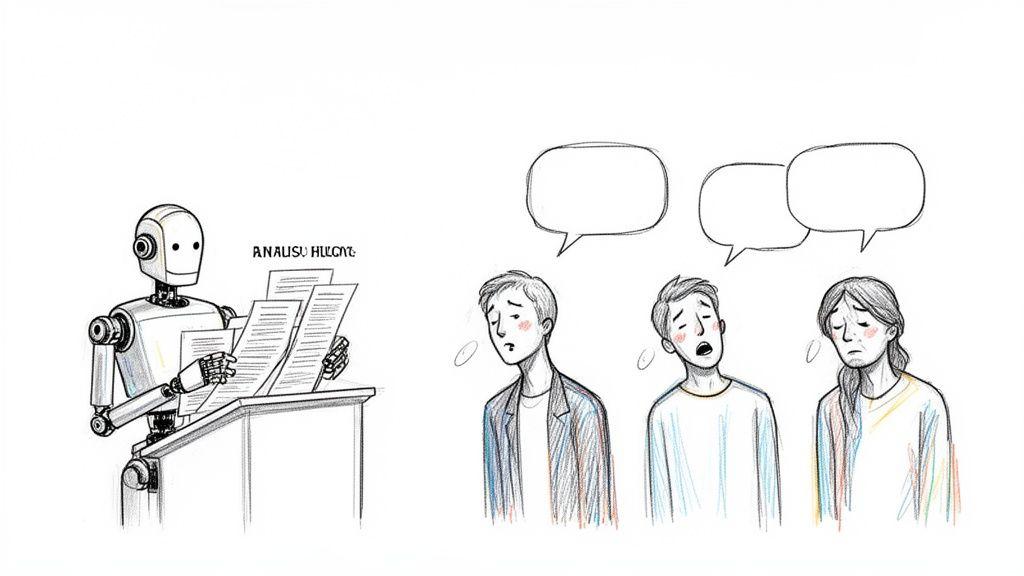
Let's be real—raw, unedited AI content often feels dead on arrival. It can sound stuffy and formal, repeat the same sentence structures over and over, and completely miss the subtle touches that build trust with a reader. This robotic output can easily damage your brand, making people tune out before you’ve even made your point.
As the internet becomes flooded with AI-generated content, your ability to add that human element is no longer just a nice-to-have. It’s your biggest competitive advantage.
The Rise of AI and the Humanization Gap
The sheer volume of AI content being created is mind-boggling. By November 2024, AI-generated articles on the web actually started to outnumber human-written ones.
By 2025, a whopping 90% of content marketers were using AI tools every day. But here's the catch: only 44% of them rated the output as 'good' without making significant changes. You can dig deeper into these content creation trends and their impact on graphite.io. That massive gap is exactly why learning to humanize AI text is such a critical skill.
This isn’t about fighting against AI; it’s about getting good at using it. The goal is to create authentic work without spending all your time on it, whether you're a small business owner trying to reach customers or a student trying to write a great essay.
Key Reasons AI-Generated Text Feels Off
So what are the dead giveaways of unedited AI writing? It usually comes down to a few common traits that just don't sit right with a human reader.
- Predictable Language: AI models often fall back on tired phrases, clichés, and filler words like "in conclusion" or "it is important to note." This makes the writing feel generic and totally uninspired.
- Lack of Personal Voice: Without personal stories, opinions, or unique examples, the content has no personality. It reads more like a dry encyclopedia entry than a genuine conversation.
- Perfect but Lifeless Grammar: AI rarely messes up grammar, but its sentence structures can be incredibly monotonous. It tends to avoid contractions (like "it's" or "don't") and sticks to a formal rhythm that just doesn't sound like a real person talking.
The new gold standard for creating high-quality, efficient content is to treat AI as a brilliant first-draft assistant, not the final author. Your expertise and personality are the finishing touches that make the work truly valuable.
Robotic vs Humanized AI Text at a Glance
Here’s a direct comparison of the characteristics that distinguish raw AI output from skillfully humanized content.
| Characteristic | Robotic AI Text | Humanized AI Text |
| Tone | Formal, generic, and overly polite. | Conversational, authentic, and matches a specific persona. |
| Sentence Structure | Repetitive, with similar length and rhythm. | Varied, with a mix of short, punchy sentences and longer, complex ones. |
| Word Choice | Often uses clichés, jargon, and "safe" vocabulary. | Uses specific, evocative language, slang, and analogies. |
| Flow & Rhythm | Abrupt transitions or overly formulaic phrases. | Natural, smooth transitions that guide the reader. |
| Personalization | Lacks personal stories, opinions, or emotion. | Includes anecdotes, unique insights, and a clear point of view. |
| Contractions | Tends to avoid them (e.g., "it is," "do not"). | Uses them naturally (e.g., "it's," "don't") to sound more human. |
Ultimately, the robotic version gives you the facts, but the humanized version makes you feel something. That's the difference that matters.
Crafting Prompts That Elicit a Human Voice
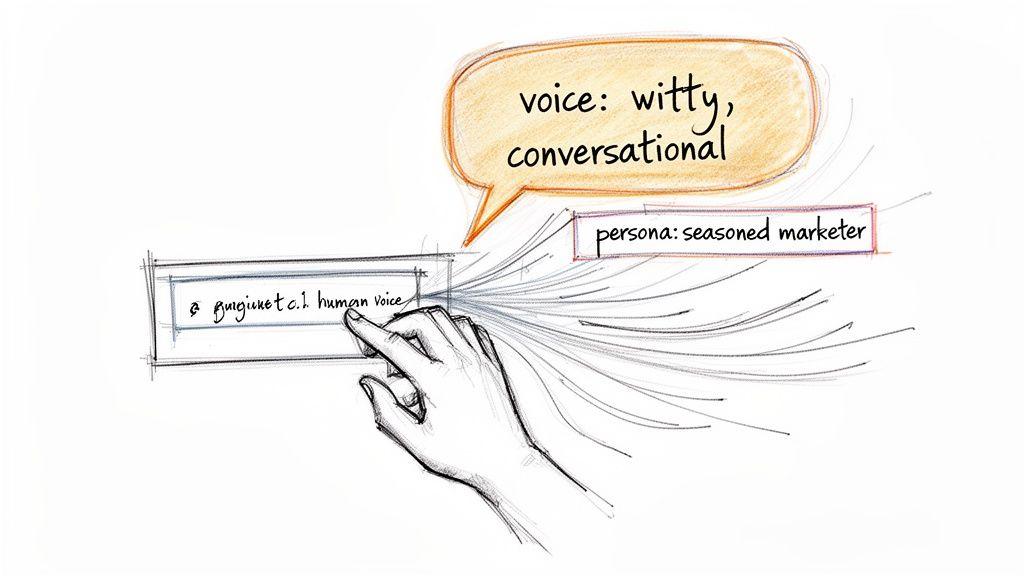
If you want better AI output, the secret isn't in the editing—it's in the prompt. Too many people make generic requests and then wonder why the result sounds so bland. You have to start thinking like a director guiding an actor. Your prompt is the script, and a detailed script gets a much more compelling performance.
Shifting your mindset this way is a game-changer. A lazy command gets you a vague, robotic draft that needs a ton of work. On the other hand, a specific, layered prompt guides the AI to write more like a person from the get-go, saving you a massive amount of editing time.
Define a Clear Persona
One of the quickest ways to inject personality into AI text is to give the model a clear persona to embody. Don't just ask for an article; tell the AI who is writing it. This simple step immediately frames the content with a specific point of view, vocabulary, and level of experience.
For example, instead of a flat request for a post on social media trends, try this:
"Write as a seasoned digital marketer sharing insider tips with a new generation of content creators. Your tone should be that of a helpful mentor who isn't afraid to be direct about what works and what doesn't."
This single instruction gives the AI all the context it needs. A "seasoned marketer" uses different language and offers different insights than a "tech journalist" or a "startup founder." By defining the voice and expertise upfront, you ensure the first draft already has a genuine personality baked in.
Set a Distinct Tone and Style
Beyond just the "who," you need to get specific about the "how." This is where you dial in the stylistic nuances that separate authentic writing from AI-generated fluff. By default, most models lean toward a formal, almost academic tone unless you explicitly tell them to loosen up.
Here are a few stylistic commands I’ve found work wonders:
- Use a witty, conversational, and slightly skeptical voice. This pushes the AI toward more engaging and less predictable word choices.
- Vary sentence length for a natural rhythm. This instruction is a direct counter to the monotonous sentence structure that screams "robot."
- Incorporate contractions like "it's," "you'll," and "don't." It’s a tiny tweak, but it instantly makes the text feel less stiff and more human.
- Avoid business jargon like "leverage," "synergy," and "streamline." Telling the AI what not to do is often just as powerful as telling it what to do.
When you need to apply these rules consistently across multiple paragraphs, a dedicated AI paragraph writer can be a fantastic way to keep the style on point.
Let’s look at a quick before-and-after to see what a difference this makes.
Basic Prompt:"Write a paragraph about the importance of email marketing."
Advanced Prompt:"As a savvy email marketer, write a short, punchy paragraph for a small business blog. Explain why email marketing is still crucial. Use a conversational tone, include contractions, and end with a question to engage the reader."
The output from these two prompts will be worlds apart. The first gives you a generic, textbook answer. The second delivers a targeted, engaging piece of content that sounds like it came from an expert with a real voice—and saves you from a brutal editing session.
Your Post-Generation Humanizing Checklist
Here’s a huge mistake I see all the time: treating the AI's output as the finished article. The real work—and the real magic—begins after you hit "generate." That robotic first draft is just your starting point; the editing phase is where you turn it into a trustworthy, polished piece of content.
It’s not just about fixing typos. It's about systematically injecting your unique human element.
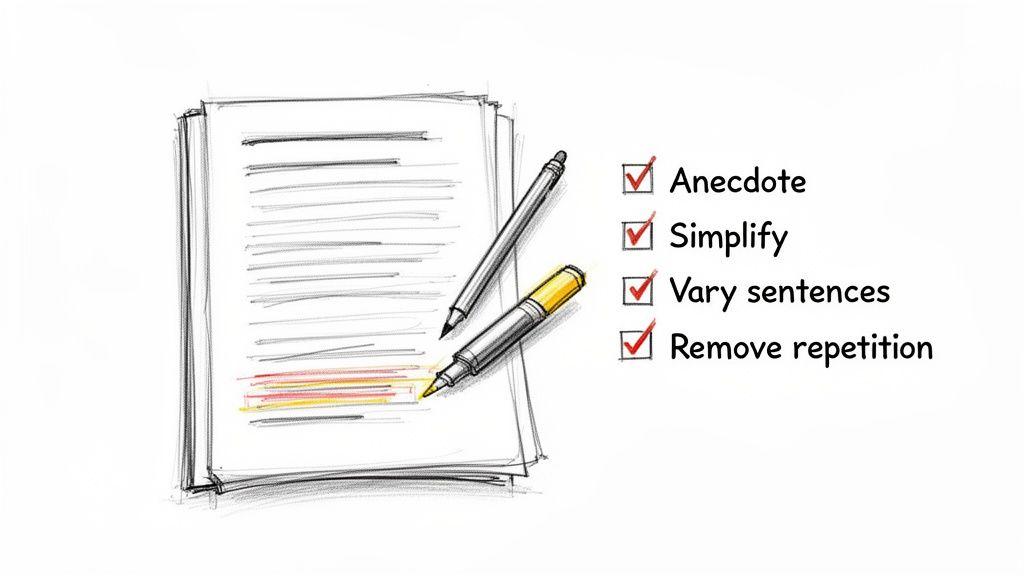
Having a go-to checklist makes this whole process so much faster and more effective. Instead of just tinkering with words here and there, you have a clear game plan to spot and fix those tell-tale AI giveaways.
Inject Your Unique Perspective
The absolute best way to humanize AI text is to add something the model could never come up with on its own. An AI can pull facts together, but it can't share a personal story, a hard-won lesson, or an opinion grounded in actual experience.
As you read through the draft, stop and ask yourself:
- Can I add a quick anecdote here? Even a simple line like, "I learned this the hard way on a project last year..." creates an instant connection with your reader.
- What do I really think about this? AI is designed to be neutral. You aren't. Don’t be afraid to take a clear stance and explain why you feel that way.
- Could I use a real-world example? Vague illustrations are a dead giveaway of AI writing. Swap them out for concrete scenarios that people can actually visualize.
Your personal experiences are your greatest asset. They add a layer of authenticity and authority that no algorithm can replicate, turning generic advice into a memorable lesson.
This human-AI collaboration is already paying off big time. The generative AI market skyrocketed to $44.89 billion in 2025, but it's the human touch that truly unlocks its value. A solid 41% of users only see major productivity gains after they humanize AI drafts, and 45% of marketers credit this partnership for their efficiency boosts. You can dig into more of these generative AI statistics from Mend.io.
Simplify and Streamline the Language
AI models have a bad habit of sounding like they swallowed a thesaurus. They lean on formal language and convoluted sentences, using words like "utilize" when "use" works just fine. Your job is to be the translator, turning that academic prose into clear, everyday language.
During your edit, be on the lookout for these opportunities:
- Cut the jargon. Unless you’re writing for a highly technical crowd, find simpler ways to say things.
- Chop up long sentences. My rule of thumb? If you can't say it in one breath, it's too long. Split it into two or three shorter, punchier sentences.
- Swap fancy words for simple ones. This isn’t about dumbing down your content; it’s about making it accessible. The goal is to sound smart and clear, not academic.
If you need more help with this, our guide on how to paraphrase without plagiarizing has some great techniques for putting ideas into your own words.
Polish the Flow and Readability
Finally, read the whole thing out loud and pay attention to its rhythm. AI often spits out dense walls of text and uses the same sentence starters over and over, making the content feel monotonous and clunky.
Keep an eye out for these classic AI quirks:
- Repetitive Sentence Starters: Does every paragraph kick off with "Additionally," "Moreover," or "Furthermore,"? Mix it up to keep things fresh.
- Walls of Text: If a paragraph is longer than three or four lines, it's time to break it up. Use bullet points, bold text, and subheadings to give your reader’s eyes a break.
- Lack of Contractions: A quick "Ctrl+F" for "it is" or "you will" can work wonders. Swapping them for "it's" and "you'll" instantly makes the tone more natural and conversational.
This final polish makes sure your content isn't just informative—it's actually enjoyable to read. That's how you keep people hooked from the first sentence to the last.
Going Deeper: Advanced Tactics for Truly Human-Sounding Content
Alright, let's move past the simple stuff. If you really want your AI-generated text to feel authentic—the kind of writing that both people and search engines trust—you need to go a level deeper. It's not just about cleaning up awkward phrases; it's about fundamentally changing the texture of the writing.
A lot of people are worried about their content getting flagged by AI detectors. These strategies tackle that concern head-on by building in layers of originality and nuance that algorithms struggle to mimic.
Ditch the Robotic Rhythm and Find Your Flow
One of the biggest tells of AI writing is its perfect, monotonous rhythm. Every sentence is roughly the same length, following a predictable structure. It’s too even. Human writing, on the other hand, has a natural ebb and flow. We use short, punchy sentences to make a point. Then we follow up with longer, more descriptive ones to explain it. This is called 'burstiness'.
Getting this right is easier than it sounds. When you get a draft from your AI, look for those long, clunky sentences and chop them up. Then, find a few short, related thoughts and weave them together into a single, more sophisticated sentence. This simple back-and-forth instantly makes the writing feel more dynamic and, well, human.
Another game-changer is to inject your own unique analogies or metaphors. An AI will almost always reach for the most tired cliché in the book, comparing a business strategy to a "well-oiled machine" or a "roadmap." You can do better. Why not compare it to "tending a garden"? This image is more original and memorable, suggesting that different elements require ongoing care to flourish.
The real objective here isn't just to trick a detector. It's about creating genuinely better, more engaging content. Authentic writing is unpredictable and adds real value, which is what actually makes you stand out.
Your Secret Weapon: Meticulous Fact-Checking
Here’s something AI is notoriously bad at: facts. It can, and often does, invent statistics, misattribute quotes, and just plain make things up with complete confidence. This is where you can add a massive layer of human authority.
When you personally verify every single statistic, quote, and claim, you're doing more than just ensuring accuracy. You're adding a stamp of human credibility that raw AI output will always lack. This is how you build trust with your readers.
This process has become so crucial that specialized tools have emerged to help. For example, a recent analysis of over 2 million texts revealed that AI humanizers can achieve a 98% success rate in bypassing detectors while maintaining 100% factual accuracy. Even more impressive, these tools can improve readability by 73% in a matter of seconds. It shows how you can use technology to help, not hinder, the humanization process. You can dig into the full statistics on AI humanizer performance on StudyDrop.io.
Here’s a quick breakdown of what this transformation looks like in practice:
| Tactic Applied | Before (Classic AI) | After (Human Touch) |
| Burstiness | Every sentence is a predictable, medium length. | A lively mix of short, direct points and longer, flowing explanations. |
| Analogy | Falls back on a stale cliché like "a roadmap to success." | Creates a fresh comparison, like "a compass for navigating uncertainty." |
| Fact-Checking | Drops in a fuzzy statistic with no source. | Provides a specific, verified data point with a link to prove it. |
By really leaning into these strategies, you stop being a simple editor of AI text and become its true author. The final piece feels genuine, authoritative, and far more compelling than anything a machine could produce on its own.
A Secure Workflow for Humanizing AI Content
Knowing how to coax human-like text from an AI is one thing, but where you do that work is just as important. Many public AI models learn from the prompts you feed them. This creates a huge privacy problem if you're working with sensitive business data, a student's homework, or even just personal family projects.
A secure, private workflow isn't just a nice-to-have; it's a must.
For small businesses, this means keeping your creative process in a controlled loop. Your team can use an AI assistant to get a first draft on the page, but the real magic—the humanizing step where you add proprietary data, client names, or strategic thinking—needs to happen in a secure, collaborative space. This simple practice ensures your confidential info never gets exposed to a public training model.
Keeping It Private for Families and Students
This same logic is crucial for personal use. A student drafting an essay or a family brainstorming vacation ideas shouldn't have to second-guess whether their personal details are being vacuumed up into a massive training dataset. A privacy-first platform means that everything from homework to creative writing stays exactly where it should: with you.
A contained workflow turns AI from a potential liability into a trusted assistant. It gives you a seamless hub for creating and editing while making sure your privacy is always protected.
This is especially true for more complex projects, like putting together detailed reports where confidentiality and accuracy are everything. If you're interested in that, we have a whole guide on using AI for effective report writing.
Building a Safe and Efficient Process
The good news is that a secure workflow doesn't have to be complicated. It all comes down to using a single, trusted platform that gives you both AI generation and collaborative editing tools under one roof.
Here's how that looks in practice:
- Generate in a Closed System: Always start with an AI tool that explicitly states it won’t use your data for training.
- Collaborate Securely: Instead of emailing attachments or creating public links, share drafts using the platform’s built-in sharing features.
- Humanize with Confidence: Feel free to add your unique insights, personal stories, and sensitive details, knowing the entire process is locked down.
By choosing a secure, all-in-one platform, you build an efficient and powerful system for creating authentic content. You get the speed of AI without ever compromising on the security of your information—truly the best of both worlds.
A Practical Blueprint for Humanizing AI Text
The secret to turning robotic AI output into genuinely compelling content isn't about ditching the technology. It’s about building a smart partnership between you and your AI. The whole process is surprisingly straightforward: start with a much better prompt, commit to a hands-on editing pass, and make sure you're working in a secure environment.
Think of the AI as your tireless first-draft assistant. It gets the words on the page. Your job is to be the creative director, weaving in the stories, insights, and personality that no algorithm can ever truly replicate. This is how you take back control, ensuring the final piece feels crafted, not just generated.
The 3 Pillars of Authentic AI Content
When you get down to it, successfully humanizing AI text relies on three core actions you can take every single time you create a piece of content.
- Smarter Prompting: You have to guide the AI from the very beginning. Give it a clear persona to adopt, a specific tone of voice to use, and even some stylistic rules to follow. A great prompt can get you 80% of the way to a solid draft.
- Hands-On Editing: This is where you inject your unique value. Add personal anecdotes, simplify jargon-filled sentences, and always read the text out loud to catch awkward phrasing and fix the rhythm. This is where you build a real connection with the reader.
- Privacy-First Workflow: Your ideas are your most valuable asset. Always use a self-contained platform where your sensitive data, client information, and creative strategies are never fed back into public models for training.
This workflow diagram shows you exactly what this secure process looks like, from initial generation all the way through to the final human polish.
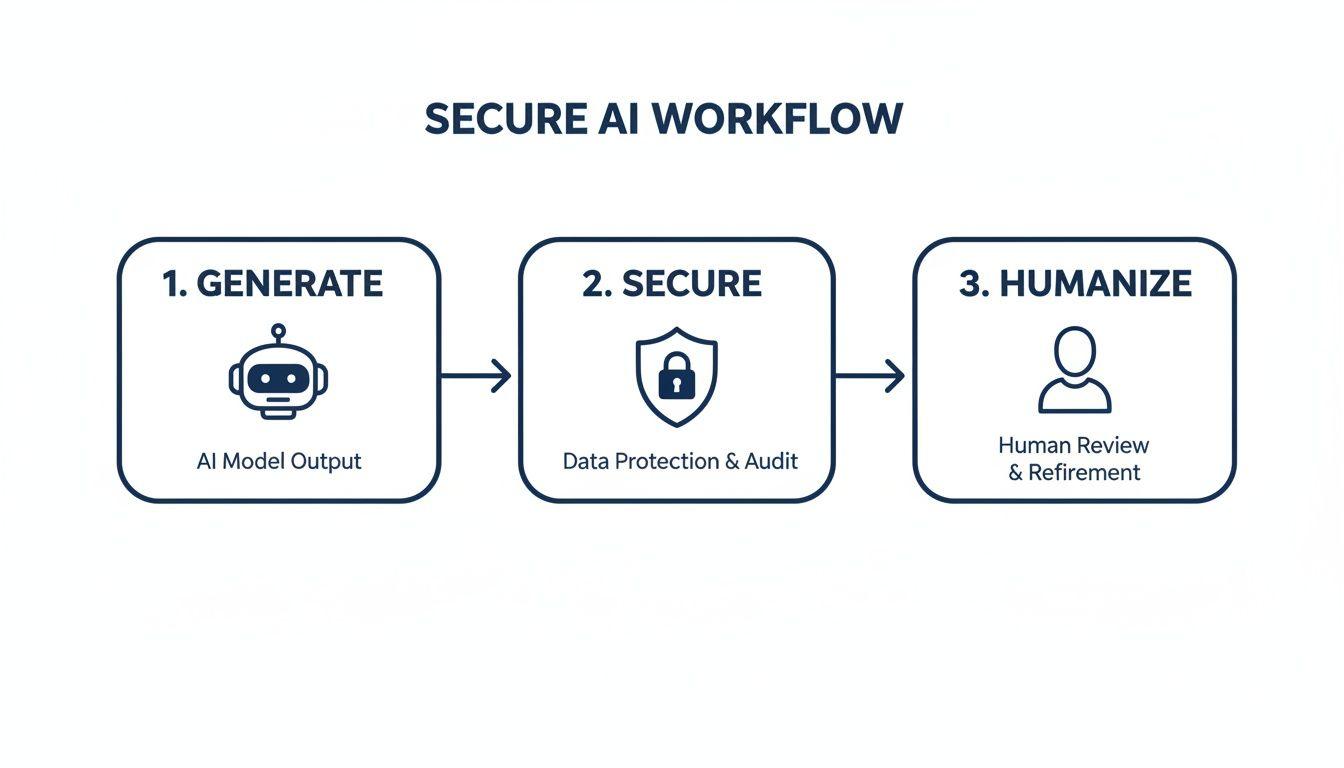
The key is that each step naturally builds on the last, creating an efficient and—most importantly—secure process.
AI is an incredible tool for getting things done faster, but your expertise and creativity are what create real value. The final piece of content should always be a reflection of your insight, making it something you can be genuinely proud to put your name on.
Got Questions? We've Got Answers
Wading into the world of AI-assisted writing can feel a little murky. It’s a new frontier, and it's totally normal to have questions about how to do it right. Here are some of the most common ones that pop up.
Is It Okay to Use AI-Humanized Text for School or Work?
Yes, as long as you're smart and transparent about it. Think of AI as a brainstorming partner or a co-pilot, not the pilot. Using it to kickstart ideas, draft an outline, or break through a nasty case of writer's block is a great use of the technology.
The ethical line is drawn at ownership. When you "humanize" the text—by weaving in your own experiences, fact-checking every claim, and polishing the voice—you are taking full responsibility for the final product. The goal isn't to pass off raw AI output as your own; it's to create "AI-assisted" work that is genuinely yours.
How Much Time Should I Actually Spend Editing This Stuff?
There's no magic number, but a solid benchmark is to spend 25-40% of your total project time on the editing and humanizing phase. So, if you block out two hours to write a blog post, plan on dedicating a good 30-45 minutes to refining the AI's first draft.
A little secret? The better your prompt, the less time you'll need for deep, structural edits. A well-crafted prompt gets you a much better starting point, letting you spend your time on the more creative, high-value tasks like adding personality and making sure the piece truly shines.
Will Humanizing AI Content Actually Help with SEO?
It absolutely will. In fact, it's becoming essential for modern SEO. Search engines like Google have made it crystal clear they want to reward helpful, reliable content created for people, not just for bots.
Humanizing your content directly feeds into this. When you add unique insights, smooth out the language to make it more readable, and triple-check your facts, you're creating something genuinely valuable for your audience. This is exactly the kind of effort and quality that search algorithms are built to find and promote, which can give your search rankings a serious boost over time.