Traditional lectures have a long history, but modern educational research points to a more effective path for deep, lasting comprehension. True understanding and retention are forged through action and engagement, not simply by hearing information. In an environment that increasingly values critical thinking, problem-solving, and collaboration, the move from passive reception to active participation is essential for academic and professional success. Students who actively engage with material don't just memorize facts; they learn to analyze, question, and connect concepts in meaningful ways.
This article serves as a comprehensive, practical guide to ten powerful active learning strategies for students. We're moving beyond abstract theory to provide a hands-on toolkit you can implement immediately. Whether you're a middle school student looking to improve your study habits, a high school teacher designing a more engaging lesson plan, or a college student aiming for better grades, these methods are designed for you.
Inside, you will find a curated list of evidence-backed techniques, including:
- Clear descriptions of each strategy.
- Step-by-step implementation guides for classroom and at-home use.
- Practical examples and adaptation notes for various age groups and learning environments (in-person, hybrid, or remote).
- Common pitfalls to avoid for successful execution.
Prepare to transform any learning environment from a one-way lecture into a dynamic, interactive experience. These strategies empower students to take ownership of their education, fostering skills that last a lifetime and making the process of learning more effective and enjoyable. Let's explore how to make learning an active pursuit.
1. Think-Pair-Share
Think-Pair-Share is a foundational collaborative learning strategy that transforms passive listening into active engagement. Developed by Professor Frank Lyman in 1981, this three-step process encourages all students to participate by lowering the anxiety associated with speaking in front of a large group. It begins with students taking a moment to think independently about a question posed by the instructor. This individual reflection is a crucial step for formulating initial thoughts without outside influence.
Next, students pair up to discuss their ideas, refining their understanding and learning from their partner's perspective. The final step involves the pairs sharing their combined insights with the larger class, enriching the group discussion with diverse, well-considered viewpoints. This structured approach is one of the most effective active learning strategies for students because it ensures every voice is part of the learning process.
How to Implement Think-Pair-Share
This strategy is highly adaptable for any subject, from debating the motivations of a character in literature to predicting the outcome of a science experiment.
Step-by-Step Guide:
- Think (1-3 minutes): Pose a specific, open-ended question. Give students quiet, individual time to process the prompt and gather their thoughts.
- Pair (3-5 minutes): Instruct students to turn to a partner. Encourage them to share their ideas, listen actively, ask clarifying questions, and build on each other's points.
- Share (5-10 minutes): Ask pairs to volunteer to share their key discussion points with the entire class. The instructor can record these ideas on a board to synthesize the collective knowledge.
Tips for Success
- Use Clear Prompts: Vague questions lead to unfocused discussions. Ask something specific, like "Based on this passage, what is one internal conflict the protagonist is facing?" instead of "What did you think of the chapter?"
- Manage Time: Stick to designated time limits for each phase to maintain momentum and keep the activity on track.
- Circulate and Listen: Walk around the room during the "Pair" phase. This allows you to check for understanding, listen in on conversations, and identify common themes or misconceptions to address during the "Share" phase.
2. Problem-Based Learning (PBL)
Problem-Based Learning (PBL) flips the traditional classroom model by placing a complex, real-world problem at the center of the learning process. Instead of first absorbing information and then applying it, students confront the problem from the outset. This approach, pioneered in medical schools like McMaster University, challenges learners to collaboratively identify what they need to know to find a viable solution, driving their own inquiry and research.
This method is one of the most powerful active learning strategies for students as it fosters a deep, contextual understanding of subject matter. By tackling authentic challenges, such as engineering design flaws or local environmental issues, students develop essential skills in research, collaboration, and self-directed learning. The focus shifts from memorizing facts to understanding and applying concepts in a meaningful context.
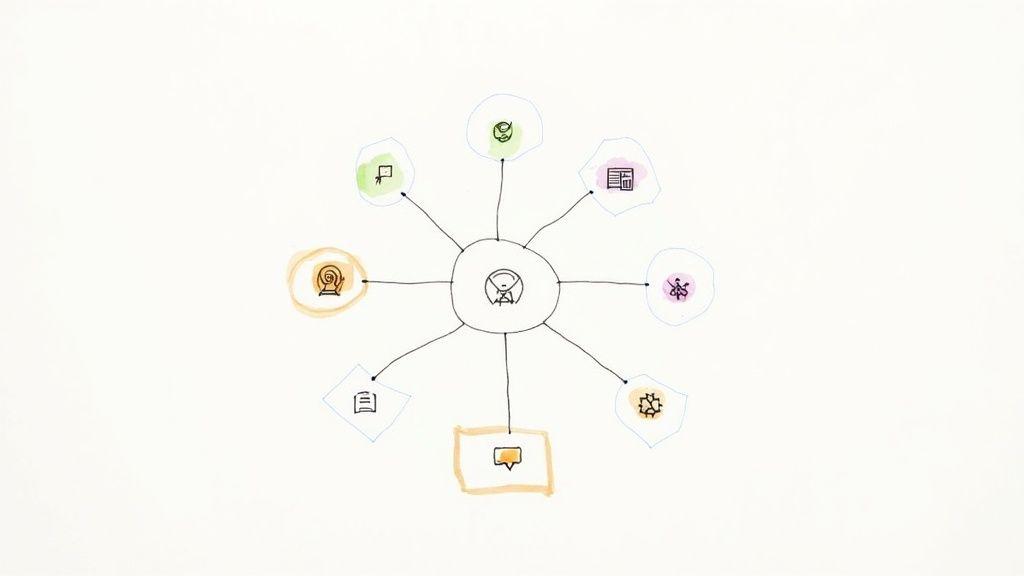
How to Implement Problem-Based Learning
PBL is highly effective for subjects where complex problems can be explored, from a business class developing a marketing plan for a struggling local shop to a history class determining the most significant factor leading to a historical event.
Step-by-Step Guide:
- Present the Problem: Introduce an ill-structured, authentic problem that has multiple potential solutions. The problem should be engaging and require more knowledge than students currently possess.
- Identify Knowns and Need-to-Knows: In small groups, students list what they already know, what they need to learn to solve the problem, and their initial ideas for a solution.
- Conduct Research: Students independently and collaboratively research the "need-to-know" items. This phase involves gathering information from various sources and synthesizing findings.
- Develop and Present Solutions: Groups reconvene to share their research, develop a solution, and present their findings and rationale to the class. This presentation often includes a debrief of their learning process.
Tips for Success
- Start with Structure: Begin with well-defined problems that have clear parameters before moving on to more complex, open-ended challenges. This provides scaffolding for students new to the process.
- Act as a Facilitator: Your role is to guide and probe, not to provide answers. Ask questions that push students' thinking and help them overcome obstacles without directing their solution.
- Assess the Process: Use rubrics that evaluate not just the final solution but also the group's research process, collaboration, and the development of their critical thinking skills.
3. Peer Teaching/Peer Instruction
Peer Teaching, also known as Peer Instruction, is a powerful strategy that flips the traditional classroom dynamic by having students teach concepts to one another. Popularized by educators like Eric Mazur in physics, this method is built on the "protégé effect," a cognitive phenomenon where the act of preparing to teach and explaining a concept to someone else significantly deepens one's own understanding. It empowers students to take ownership of their learning and articulate complex ideas in relatable terms.
This approach transforms students from passive recipients of information into active creators and communicators of knowledge. When a student explains a difficult math problem or a historical event to a peer, they must first organize their thoughts, identify key points, and anticipate potential questions. This process is one of the most effective active learning strategies for students because it solidifies the "teacher's" knowledge while providing the "learner" with an explanation from a relatable perspective.
How to Implement Peer Teaching/Peer Instruction
This method is incredibly versatile, working well for everything from computer science students debugging code together to language learners practicing conversation. It is especially useful for reinforcing foundational concepts before moving on to more complex topics.
Step-by-Step Guide:
- Introduce a Concept (5-10 minutes): The instructor presents a core concept or poses a conceptual question.
- Individual Assessment (1-2 minutes): Students individually answer the question, often using classroom response systems or simple hand-raising to commit to an answer.
- Peer Discussion (2-4 minutes): Students turn to a neighbor and discuss their reasoning. The goal is for students with the correct understanding to convince their peers.
- Re-assessment and Explanation (3-5 minutes): The instructor re-polls the students. Following the discussion, a much higher percentage typically gets the answer right. The instructor can then ask a student to explain the correct reasoning to the class.
Tips for Success
- Provide Structure: Use a clear protocol for the teaching interaction. Give students sentence stems or a checklist to guide their explanations, such as "First, you need to...," "The reason this works is...," or "A common mistake is..."
- Rotate Roles: Ensure that all students have opportunities to be both the teacher and the learner. This prevents the same students from always dominating the teaching role and ensures everyone benefits from the protégé effect.
- Monitor for Accuracy: Circulate during the peer discussions to listen for misconceptions. Be ready to intervene and provide clarification if you notice incorrect information being shared widely.
4. Case Studies
Case studies are a powerful active learning strategy that grounds abstract theories in real-world scenarios. This method involves an in-depth analysis of a specific event, problem, or situation, challenging students to apply their knowledge to solve complex, multifaceted issues. Popularized by professional programs like those at Harvard Business School and widely used in law and medicine, this approach moves students beyond memorization to higher-order thinking, such as analysis, synthesis, and evaluation.
By dissecting a realistic case, students learn to navigate ambiguity, weigh evidence, and make decisions with incomplete information. This process mirrors the challenges they will face in their future careers. Case studies stand out among active learning strategies for students because they bridge the gap between classroom concepts and practical application, forcing students to confront the complexities of real-life decision-making.
How to Implement Case Studies
This strategy is highly effective in fields like business, ethics, political science, and healthcare, but can be adapted for almost any subject by framing a topic as a problem to be solved.
Step-by-Step Guide:
- Select & Distribute (Preparation): Choose a case relevant to your learning objectives and students' interests. Distribute the case materials and any guiding questions ahead of time, allowing students to prepare a preliminary analysis. For research-heavy cases, students might need to find supplementary information from credible sources.
- Small-Group Discussion (Analysis): Divide students into small groups to discuss their initial findings. This allows them to challenge each other's assumptions and build a more robust, collective understanding of the case's key issues.
- Full-Class Debrief (Synthesis): Bring the class together for a facilitated discussion. Guide the conversation to connect the specific details of the case back to broader theoretical principles and learning goals. Explore different potential solutions and their consequences.
Tips for Success
- Use Guiding Questions: Provide a set of structured questions to focus student analysis on the most critical aspects of the case, such as identifying the core problem, stakeholders, and potential actions.
- Encourage Diverse Perspectives: Actively solicit different viewpoints during the discussion. A good case rarely has a single "right" answer, and the learning comes from exploring various valid interpretations.
- Debrief Effectively: Conclude by summarizing the key takeaways. Ask students what they learned from the process itself, not just the case's content, to reinforce the development of their analytical skills.
5. Concept Mapping
Concept Mapping is a powerful visual strategy that helps students organize and connect information. Developed by Joseph D. Novak, this technique involves creating a graphical diagram where nodes represent concepts and lines represent the relationships between them. This process externalizes a student's thinking, allowing them to structure knowledge hierarchically and identify complex connections they might otherwise miss.
By arranging ideas visually, students move beyond rote memorization to a deeper, more meaningful understanding of a subject. It forces them to analyze how individual pieces of information fit together to form a larger whole. As one of the most effective visual active learning strategies for students, concept mapping reveals a learner’s cognitive structure, making it an excellent tool for both study and assessment.
How to Implement Concept Mapping
This method is incredibly versatile and can be applied to nearly any subject. For instance, biology students can map the relationships within an ecosystem, while history students can chart the causes and effects of a major historical event.
Step-by-Step Guide:
- Identify a Core Concept: Start with a central topic or question. This focus point, such as "Photosynthesis" or "The Causes of the Civil War," will be the starting node of the map.
- Brainstorm Related Ideas: Have students list all key terms, concepts, and ideas associated with the central topic. This can be done individually or in small groups.
- Organize and Link: Students arrange the brainstormed ideas around the core concept, placing more general ideas higher up and more specific ones below. They then draw lines to connect related concepts, adding short linking phrases (e.g., "leads to," "is a type of," "is composed of") to describe the relationship.
Tips for Success
- Model the Process: Start by creating a concept map as a whole class. This demonstrates the thinking process and provides a clear example for students to follow.
- Provide Scaffolding: For beginners, offer a partially completed map or a list of key concepts to include. This reduces cognitive load and helps them focus on making connections.
- Encourage Revision: Treat concept maps as living documents. Encourage students to revisit and expand their maps throughout a unit as their understanding grows. This reinforces learning as an iterative process.
6. Gamification and Game-Based Learning
Gamification and game-based learning infuse educational activities with the motivational elements of games, such as points, badges, and leaderboards. This approach taps into students' natural desire for competition, collaboration, and achievement, transforming mundane tasks into engaging challenges. Unlike a simple reward system, it integrates game mechanics directly into the learning process to drive participation and mastery.
By framing learning as a quest or a challenge, this method makes the process more enjoyable and less intimidating. Platforms like Duolingo for language learning or Kahoot! for classroom quizzes have popularized this concept, showing how it can boost retention and motivation. These game-like environments provide immediate feedback and a clear sense of progress, making gamification one of the most powerful modern active learning strategies for students to encourage persistent effort and skill development.
How to Implement Gamification and Game-Based Learning
This strategy can be applied to almost any subject, from creating a historical simulation game to designing a math-based digital escape room.
Step-by-Step Guide:
- Define Clear Objectives: Start with the learning goal. What specific knowledge or skill should students master through the game?
- Select Game Elements: Choose mechanics that align with the objective. Use points for completing assignments, badges for mastering a concept, and leaderboards for friendly class-wide competitions.
- Create the Narrative: Frame the learning activities within a story or theme. Students could be "explorers" discovering new scientific principles or "detectives" solving grammatical mysteries.
- Launch and Monitor: Introduce the game to students, explaining the rules and goals. Monitor progress, provide feedback, and be prepared to adjust mechanics based on student engagement.
Tips for Success
- Align with Learning Goals: Ensure every game element serves a pedagogical purpose. Points and badges should signify genuine understanding, not just task completion.
- Balance Competition and Collaboration: While competition can be motivating, also include team-based challenges to foster collaboration and prevent discouragement among students who are falling behind.
- Embrace Productive Failure: Design games where mistakes are learning opportunities, not penalties. Allow students to try again, encouraging resilience and a growth mindset.
- Debrief the Experience: After a game or activity, hold a discussion to connect the gameplay back to the core academic concepts. Ask students what they learned and how the game helped them understand it.
7. Jigsaw Method
The Jigsaw Method is a highly effective cooperative learning technique that positions students as both learners and teachers. Developed by social psychologist Elliot Aronson in 1971, this strategy divides a complex topic into smaller, manageable pieces, much like a jigsaw puzzle. Each student becomes an "expert" on one piece and is responsible for teaching it to their peers, fostering both individual accountability and group interdependence.
Initially, students meet in "expert groups" with others assigned the same piece of information to master the material together. They then return to their original, mixed "jigsaw groups" to share their expertise, allowing the full picture of the topic to emerge. This peer-to-peer teaching model makes it one of the most powerful active learning strategies for students, as it ensures every individual's contribution is essential for the entire group's success and deepens comprehension through the act of explaining.
How to Implement the Jigsaw Method
This strategy excels in subjects where content can be segmented, such as a historical event studied from multiple perspectives (political, economic, social), a scientific concept broken into its core components, or a novel analyzed through different literary lenses (character, theme, symbolism).
Step-by-Step Guide:
- Divide and Conquer: Break a topic into 4-5 distinct subtopics. Divide students into "jigsaw groups" of the same size. Assign one subtopic to each person in the group.
- Form Expert Groups (10-15 minutes): Have students with the same subtopic gather in "expert groups." Provide guiding questions or a specific task to help them master their material and plan how they will teach it.
- Return and Teach (15-20 minutes): Students return to their original jigsaw groups. Each "expert" takes a turn teaching their subtopic to the rest of their group members, who listen, ask questions, and take notes.
Tips for Success
- Structure the Content: Ensure all subtopics are roughly equal in complexity and length to create a balanced workload. Provide clear, concise source materials for each expert group.
- Provide Teaching Tools: Give experts a simple template or a set of key points they must cover. This helps them organize their thoughts and ensures all critical information is shared.
- Monitor Both Groups: Circulate during both expert and jigsaw group discussions. In expert groups, check for understanding. In jigsaw groups, ensure students are explaining concepts clearly and that everyone is participating.
8. Muddiest Point/Minute Papers
The Muddiest Point, often used alongside Minute Papers, is a rapid feedback strategy that empowers students to pinpoint their confusion and guides instructors in adjusting their teaching. At the end of a lesson, students anonymously jot down the single concept or idea that was least clear to them: the "muddiest point." This technique gives every student a safe, low-stakes way to voice their learning gaps without the pressure of public speaking.
This approach transforms the final moments of a class from a passive conclusion into an active, metacognitive exercise. By reflecting on what they do and do not understand, students become more aware of their own learning process. For educators, the collected responses offer invaluable, immediate insight into common misconceptions, making this one of the most efficient active learning strategies for students and instructors alike.
How to Implement Muddiest Point/Minute Papers
This strategy is incredibly versatile, fitting perfectly at the end of a complex engineering lecture, a dense history reading, or a multi-step math problem.
Step-by-Step Guide:
- Prompt (1-2 minutes): Near the end of the lesson, give students a slip of paper or a digital form link. Ask a clear, direct question like, "What was the muddiest point for you in today's lesson?" or "What single question do you still have?"
- Reflect and Write (2-3 minutes): Give students a few minutes of quiet time to reflect on the session and write down their response. Emphasize that this is for feedback, not a grade, and anonymity is key.
- Collect and Review (Post-Class): Gather the responses. Quickly scan and categorize them to identify recurring themes or areas of widespread confusion.
- Address (Next Class): Begin the next class session by addressing the most common "muddiest points." You can clarify a concept, re-teach a specific part, or provide additional resources.
Tips for Success
- Be Specific with Prompts: A focused prompt yields better feedback. Instead of "Any questions?" ask "What was the most confusing part of the mitosis process we discussed today?"
- Ensure Anonymity: Use anonymous methods like small note cards or a Google Form to encourage honest and open responses from all students.
- Act on the Feedback: The strategy's value lies in closing the feedback loop. Show students you read their points by addressing them promptly in the next class. This builds trust and reinforces the value of their participation.
- Vary the Question: Occasionally use Minute Paper variations like "What was the most important thing you learned today?" or "What real-world example of this concept can you think of?" to assess different learning aspects. For students struggling to identify unclear points in readings, it may be helpful to improve their foundational understanding. Learn more about boosting reading comprehension skills.
9. Collaborative Learning/Cooperative Learning
Collaborative or Cooperative Learning is an umbrella strategy where students work together in small groups toward a shared academic goal. Pioneered by researchers like David and Roger Johnson and Robert Slavin, this method is more structured than simple group work. It is built on principles of positive interdependence, where students must rely on each other to succeed, and individual accountability, ensuring each member contributes meaningfully to the final outcome.
This approach transforms learning from a solitary pursuit into a dynamic, social process. By working as a team, students develop crucial communication, negotiation, and leadership skills alongside content knowledge. From project-based learning to structured activities like the Jigsaw method, cooperative learning is one of the most versatile active learning strategies for students because it enhances both academic achievement and essential interpersonal competencies.
How to Implement Collaborative Learning
This strategy can be applied across all disciplines, whether students are solving multi-step math problems, analyzing historical documents, or conducting a group science experiment.
Step-by-Step Guide:
- Form Groups: Create small, intentionally mixed groups (typically 2-4 students) with diverse skills and backgrounds.
- Assign Roles & Goals: Clearly define the group's objective and assign specific, complementary roles to each student (e.g., Facilitator, Recorder, Reporter, Timekeeper).
- Structure the Task: Design the activity to require positive interdependence. This means the task cannot be completed unless every member contributes their part.
- Monitor and Facilitate: As groups work, circulate to provide support, clarify instructions, and manage group dynamics.
- Assess and Debrief: Evaluate both the final product (group outcome) and the individual contributions. Facilitate a group reflection on their collaborative process, discussing what worked well and what could be improved.
Tips for Success
- Establish Clear Group Goals: Ensure every student understands what their team is trying to achieve and what the final product should look like.
- Teach Social Skills: Don't assume students know how to collaborate effectively. Explicitly teach skills like active listening, giving constructive feedback, and resolving disagreements respectfully.
- Use Individual and Group Grades: Combine a group grade for the final project with an individual grade based on quizzes, specific contributions, or peer evaluations to ensure individual accountability.
- Keep Groups Small: Smaller groups (3-4 members) are generally more effective, as they make it harder for students to hide and easier to coordinate tasks.
10. Simulations and Role-Playing
Simulations and Role-Playing are immersive, experiential strategies that plunge students into realistic or imaginary scenarios. By assuming specific roles, students move beyond theoretical knowledge to actively engage with concepts, develop practical skills, and explore the consequences of their decisions. This approach, rooted in experiential learning theory, creates a safe environment to practice complex tasks like a medical diagnosis or a business negotiation without real-world risk.
These activities transform the classroom into a dynamic laboratory for learning. Whether conducting a mock trial, participating in a Model UN debate, or managing a virtual business, students gain a deeper, more personal understanding of the subject matter. As one of the most hands-on active learning strategies for students, simulations bridge the gap between knowing and doing, fostering critical thinking, empathy, and problem-solving skills that are directly transferable to professional and real-life situations.
How to Implement Simulations and Role-Playing
This strategy is exceptionally versatile, applicable in history classes to reenact treaty negotiations, in language courses to practice conversational scenarios, or in science to simulate ecosystem management.
Step-by-Step Guide:
- Set the Stage: Introduce the scenario and the core learning objectives. Clearly explain the rules, constraints, and the goal of the simulation.
- Assign Roles: Distribute detailed role descriptions with specific objectives, resources, and perspectives for each participant. Roles can be assigned strategically or randomly.
- Run the Simulation (15-45 minutes): Allow students to fully engage in their roles and interact within the established framework. The instructor acts as a facilitator, offering clarifications and ensuring the scenario progresses.
- Debrief (10-20 minutes): This is the most critical step. Lead a structured discussion where students reflect on their experience, connect actions to outcomes, and link the simulation back to the course concepts.
Tips for Success
- Establish Clear Objectives: Define what you want students to learn or practice. Ensure every role and rule is designed to meet these objectives.
- Structure the Debrief: Use guiding questions to facilitate reflection. Ask, "What was your biggest challenge in your role?" or "How did this experience change your perspective on the topic?"
- Start Small: If students are new to role-playing, begin with shorter, lower-stakes scenarios to build comfort and confidence before tackling more complex simulations.
- Utilize Observer Roles: If there are more students than roles, assign some as observers with specific tasks, such as tracking negotiation tactics or identifying key decision points. This keeps everyone engaged.
10 Active Learning Strategies — Comparison
| Method | 🔄 Implementation Complexity | ⚡ Resource & Time | ⭐ Expected Outcomes | 📊 Ideal Use Cases | 💡 Key Advantages / Tips |
| Think-Pair-Share | Low — simple 3-stage routine; needs classroom management | Low resources; moderate time in very large classes | Good for participation, processing, and retention | Quick checks, discussions across ages and subjects | Set clear time limits, focused prompts, random pairing |
| Problem-Based Learning (PBL) | High — curriculum redesign and strong facilitation skills | High — instructor training, longer project time, materials | High for transfer, critical thinking, motivation | Complex, real-world problems; professional and interdisciplinary courses | Start structured, scaffold self-directed learning, use rubrics |
| Peer Teaching / Peer Instruction | Moderate — requires training and monitoring for accuracy | Low–moderate — minimal materials but instructor oversight | High for deeper understanding and confidence; risk of errors if unchecked | Tutorials, recitations, peer tutoring, conceptual clarification | Provide teaching protocols, rotate roles, monitor for misconceptions |
| Case Studies | Moderate–High — needs skilled facilitation and quality cases | Moderate — prep readings and class discussion time | High for application, analysis, and decision-making skills | Business, law, medicine, ethics, applied social sciences | Use pre-readings, structured discussion formats, link back to theory |
| Concept Mapping | Low–Moderate — teach conventions; can be individual or group | Low–moderate — paper/digital tools; time to construct maps | Good for revealing misconceptions and organizing knowledge | Complex systems, exam review, formative assessment, planning | Model maps, provide partial scaffolds, encourage revision over time |
| Gamification / Game-Based Learning | High — careful design to align mechanics with learning | High — development/platform costs; testing and iteration | High for engagement and motivation; variable learning gains if poor design | Practice, drills, language learning, motivation-driven content | Align mechanics to objectives, debrief, balance competition and collaboration |
| Jigsaw Method | Moderate — planning of subtopics and group sequencing | Moderate — prep of materials and class time for expert/home groups | High for participation, coverage, and accountability | Content divisible into subtopics (readings, multi-faceted topics) | Divide content evenly, provide expert-group supports, monitor teaching |
| Muddiest Point / Minute Papers | Very Low — minimal setup, quick to run | Very Low — 1–3 minutes; easy to collect (paper or digital) | Moderate–High for rapid formative insight and metacognition | End-of-class checks, quick misconceptions diagnosis, many disciplines | Use specific prompts, collect anonymously, act quickly on common issues |
| Collaborative / Cooperative Learning | Moderate–High — requires role structure and social-skill instruction | Moderate — time to form groups and manage dynamics | High for teamwork, engagement, and achievement when well-implemented | Long-term projects, labs, heterogeneous classrooms, social-skill goals | Teach social skills, assign roles, ensure individual accountability |
| Simulations & Role-Playing | High — complex design, clear rules, and debriefing needed | High — time, possible tech, facilitator expertise | High for experiential learning, decision-making, and empathy | Professional skills training, high-stakes practice, perspective-taking | Create clear objectives, start small, debrief extensively and sensitively |
Putting Active Learning into Practice: Your Next Steps
We've journeyed through a comprehensive toolkit of ten powerful active learning strategies for students, moving far beyond the traditional lecture model. From the quick, reflective power of the Muddiest Point technique to the intricate, collaborative worlds of Problem-Based Learning and Simulations, each strategy offers a unique pathway to transform passive information absorption into dynamic, meaningful engagement. You’ve seen how methods like the Jigsaw, Think-Pair-Share, and Peer Teaching can turn a classroom into a vibrant ecosystem of shared knowledge, where students build confidence and master content by teaching one another.
The core thread connecting all these approaches is a fundamental shift in the educational dynamic. Active learning places the student at the center of the learning process, repositioning them as creators, problem-solvers, and collaborators rather than mere recipients of information. This isn't just about making lessons more "fun"; it's a strategic move to cultivate the essential skills needed for success in higher education and the modern workforce: critical thinking, communication, teamwork, and adaptability.
From Theory to Action: Your Implementation Roadmap
Reading about these strategies is the first step, but true transformation happens through application. The prospect of overhauling your entire curriculum can feel daunting, so the key is to start small and build momentum. Here is a practical, step-by-step plan to begin integrating these powerful methods into your routine.
- Start with a Low-Stakes Strategy: Don't begin with a semester-long Problem-Based Learning project. Instead, pick a simple, low-preparation technique. Try using a Think-Pair-Share to kick off your next discussion or end a complex lesson with a Muddiest Point submission. These small wins build confidence for both you and your students.
- Align Strategy with Objective: Consider your immediate goal. Do you want to check for understanding of a difficult concept? Concept Mapping is an excellent choice. Need to make a dry topic more engaging? Gamification could be the perfect solution. By matching the tool to the task, you maximize its effectiveness.
- Prepare and Scaffold: Active learning is not unstructured chaos. Before deploying a Case Study or a Jigsaw activity, ensure your instructions are crystal clear. Provide necessary background materials, define roles, and establish clear expectations for the final outcome. Scaffolding the process is crucial for student success and prevents the activity from becoming derailed.
- Gather Feedback and Iterate: Your first attempt won't be perfect, and that's okay. The most valuable resource you have is your students' feedback. Ask them what worked, what was confusing, and what they learned. Use this input to refine your approach for the next time. Continuous improvement is the hallmark of an effective active learning environment.
The Lasting Impact of Active Engagement
Embracing this pedagogical shift does more than improve test scores. It fundamentally changes a student's relationship with learning. When students are empowered to ask questions, debate ideas, and construct their own understanding, they develop a sense of ownership over their education. They learn that their voice matters and that challenges are opportunities for growth, not failure.
These active learning strategies for students are not just isolated classroom activities; they are building blocks for lifelong inquiry and intellectual curiosity. By making the deliberate choice to move from monologue to dialogue, you are equipping your students with a versatile skill set that will serve them long after they've forgotten the specific facts of a single lesson. You are teaching them how to learn, a gift that will empower them to navigate an ever-changing world with confidence and ingenuity. The journey begins with one small, active step. Choose yours today.