Improving your reading comprehension is about making the leap from simply seeing words on a page to truly understanding what they mean. It's the difference between looking at the ingredients and actually tasting the dish. This skill is all about actively engaging with a text, connecting the dots, and making the information stick, and it's built through a mix of smart preparation, active reading techniques, and good old-fashioned practice.
Why Strong Reading Comprehension Is a Modern Superpower
Ever get to the end of a dense report for work or a long news article and realize you have no idea what you just read? You saw the words, but the core message is a total blur. It’s a frustratingly common feeling. We're all swimming in a sea of information, constantly hit with data, updates, and opinions from every direction.
Our old reading habits—just passively scanning text from start to finish—simply don't cut it anymore. They weren't designed for the sheer volume and complexity of information we juggle every single day. The result? We feel overwhelmed, unable to pull out the critical details we actually need.
More Than Just a School Skill
Let's be clear: true comprehension isn't just for passing exams. It’s a fundamental life skill. It’s the ability to filter out the noise and find the signal. Whether you're decoding a new company policy, following a complex set of instructions, or making a big decision based on conflicting reports, your ability to truly understand the text is everything.
In essence, strong reading comprehension is the bedrock of critical thinking. It empowers you to analyze arguments, spot bias, and connect seemingly unrelated ideas to build a more complete picture of the world.
This skill is a direct driver of personal and professional growth. Think about it: strong readers are better learners. They’re more effective communicators and more insightful problem-solvers. They can absorb new information quickly, adapt to change, and contribute in a more meaningful way, no matter the setting. It’s what fuels a lifetime of learning.
A Widespread Challenge
Struggling with comprehension isn't a personal failure; it's a global issue. The reality is that most of us were never explicitly taught the strategies needed to break down and internalize complex information. This gap is becoming more and more obvious.
A startling report found that nearly half of all teenagers worldwide—around 49%—cannot read with comprehension and fail to meet minimum proficiency levels. This highlights a massive need for better strategies that actually work in the real world. You can dive into the specifics in the full report on global literacy from Our World in Data.
And this isn't just a student problem. It affects professionals in every field. The ability to quickly and accurately grasp written communication gives you a huge competitive edge. Improving your reading comprehension is one of the most powerful investments you can make in yourself, opening doors to new career opportunities and personal growth. The rest of this guide will give you the practical, evidence-based tools to do exactly that.
Set the Stage for Success Before You Start Reading
Most of us treat reading like a cold start. We just open a book or an article and dive right in, hoping for the best. But from my experience, I can tell you that the best readers do the most important work before they even read the first sentence.
This isn't about adding more work to your plate. It's about a simple mindset shift: stop being a passive recipient of words and become an active participant in a conversation with the author. Think of it like warming up before a workout—it primes your brain, cuts down on confusion, and makes the whole experience feel smoother and more productive.
By taking just a few moments to prepare, you're essentially laying the groundwork for understanding. You create mental hooks where new information can attach, making it far more likely to stick.
Build Your Background Knowledge First
Have you ever tried to read a dense article on a topic you know nothing about, like quantum physics? It feels almost impossible. Your brain has no existing framework to connect the new ideas to, so the text just washes over you.
This is where building a little background knowledge becomes an absolute game-changer. Before you tackle something complex or unfamiliar, just spend five to ten minutes getting some context. This one small step can have a massive impact on your comprehension.
Here are a few quick ways to do this that I recommend to students:
- Watch a short explainer video. Find a quick, five-minute video on YouTube that covers the basics of the topic.
- Read a quick summary. Look up a simple encyclopedia entry or a "for beginners" article.
- Glance at the previous chapter's summary. If you're reading a textbook, this is a fantastic way to refresh your memory on what came before.
The goal isn't to become an expert beforehand. It's simply to build a foundational layer so the new information has something to anchor to.
Define Your Purpose for Reading
Why are you reading this, really? Your answer should completely change how you approach the text. Reading a novel for pleasure is a totally different mental activity than cramming for a final exam or hunting for a specific statistic in a technical manual.
Setting a clear purpose focuses your attention like a laser, helping you sift through the noise to find what’s truly important. Without a clear goal, your mind is far more likely to wander, and you'll struggle to hold onto the information that actually matters.
Before you start, just take a second to ask yourself:
- Am I trying to understand a core concept for a class?
- Do I need to find specific facts or figures for a report?
- Am I reading to form an opinion on a controversial issue?
- Is my goal simply to relax and enjoy a good story?
Your purpose acts as a filter for your brain. When you know what you’re looking for, you’re so much more likely to find it.
Create a Mental Roadmap
Okay, you've got your purpose. The last prep step is to give the material a quick scan. This is exactly like looking at a map before you start a road trip. You aren't memorizing every single turn, but you're getting the lay of the land.
This technique is all about creating a quick mental outline by surveying the text's structure. It only takes a minute or two, but it provides a powerful framework that makes everything easier to digest.
By previewing the text, you're essentially creating a mental roadmap. This structure helps your brain organize new information as you read, preventing you from getting lost in the details and allowing you to see how individual ideas connect to the bigger picture.
Here’s what to look for during your scan:
- Headings and Subheadings: These are your signposts. They reveal the main topics and how the argument flows.
- Images, Charts, and Graphs: Visuals are often cheat sheets that summarize key concepts or data.
- Introduction and Conclusion: Always read the first and last paragraphs. They give you the main idea and the key takeaways right up front.
- Bolded Words or Key Terms: The author is flagging these as essential vocabulary. Pay attention to them.
This quick preview gets your brain ready for what’s coming, making the actual process of reading far more efficient and effective.
Implement Active Reading Strategies That Actually Work
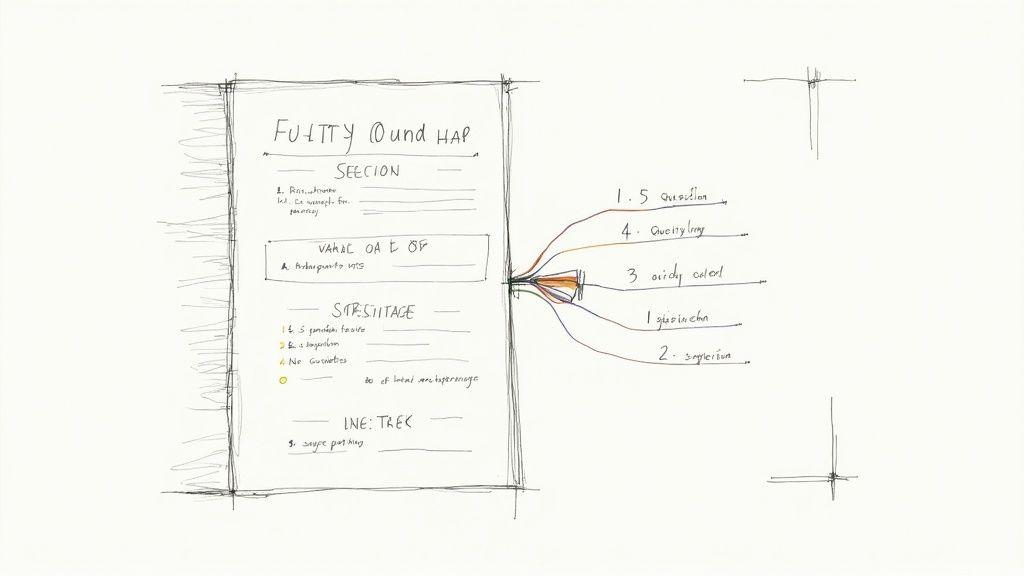
Alright, let's get to the heart of it. Improving reading comprehension means shifting from passively letting your eyes scan the page to actively engaging in a conversation with the text. If preparation is the warm-up, this is the main event.
Many of us were just taught to highlight or underline. The problem is, this can quickly become a mindless task where you’re just coloring lines instead of actually thinking. True active reading forces your brain to grapple with the material—to question, connect, and summarize as you go.
Turn Headings into Questions
One of the simplest, most powerful habits you can build is to approach every text with curiosity. Before you even start reading a new section, look at the heading and rephrase it as a question.
If a heading says, "The Economic Impact of Industrialization," stop and ask yourself, "So, what was the economic impact of industrialization?"
This tiny shift primes your brain. Suddenly, you're not just a passive receiver of information; you're an active hunter on a mission to find an answer. As you read, your mind will automatically start filtering for the key points that address your question, helping you cut through the noise.
Master the Art of Annotation
Forget everything you were told about keeping books pristine. The goal here is to have a dialogue with the author, and that means you need to write in the margins (or on a digital copy).
Effective annotation is so much more than highlighting. It’s about leaving a trail of your thoughts right there on the page.
Here are a few techniques I’ve found incredibly effective:
- One-Sentence Summaries: After each paragraph or section, pause. Can you boil down the main idea into a single sentence in the margin? This forces you to process what you just read and put it into your own words.
- Connect Ideas with Arrows: Notice a link between an idea on page 50 and something you read back on page 12? Draw an arrow. This physically maps out the author's argument and helps you see the underlying structure.
- Mark Your Confusion: It's completely fine to not understand something on the first pass. Use a simple question mark to flag sentences or concepts that are fuzzy. This creates a clear "to-do" list for you to revisit later.
Effective annotation transforms the physical act of reading into a mental dialogue. Each note, question, and summary you write in the margins serves as a footprint of your thinking process, making it easier to review, recall, and synthesize the material later on.
To give you a real-world example, when I read a dense medical study, my margins are filled with questions about the methodology and short summaries of the findings. The technique adapts to whatever you’re reading.
A Quick Guide to Choosing Your Strategy
Not every technique is perfect for every text. This table can help you match the right strategy to your reading goal.
Active Reading Techniques and Their Applications
| Technique | Best For | Example Application |
| Turning Headings into Questions | Textbooks, articles, reports | Turning "Causes of the French Revolution" into "What caused the French Revolution?" before reading the chapter. |
| Annotation & Summarizing | Dense, complex material (academic papers, legal documents) | Writing one-sentence summaries in the margins of a scientific journal article to distill key findings. |
| QAR Framework | Preparing for tests, group discussions | Identifying if a test question is a "Right There" fact or a "Think and Search" synthesis question. |
| Mind Mapping | Non-fiction books, complex subjects with many parts | Creating a visual map to connect the main themes and characters in a history book. |
Choosing the right tool for the job makes the entire process more efficient and effective.
Use the Question-Answer Relationship Framework
To really deepen your comprehension, it helps to understand what kind of questions you're trying to answer. The Question-Answer Relationship (QAR) framework is a brilliant tool for this. It teaches you to recognize that answers come from different places.
There are four basic types of questions in the QAR framework:
- Right There: The answer is spelled out in a single sentence.
- Think and Search: You have to piece the answer together from different parts of the text.
- Author and You: You need to combine what the author says with your own knowledge.
- On My Own: The answer comes almost entirely from your own experiences.
Knowing this helps you become a more strategic reader. When you’re stuck, you can ask yourself, "What kind of thinking does this question require?" which is a huge step toward getting unstuck.
And the research backs this up. One major study found that when students were directly taught strategies like questioning and summarizing, their comprehension scores jumped from an average of 58% to 73% in a single year. You can explore the research on reading strategy instruction to see the data for yourself.
Create Simple Mind Maps to Connect Ideas
When you're tackling a complex topic with lots of moving parts, a mind map is your best friend. This is just a simple visual diagram for organizing information. Start with the main topic in the center and draw branches for major ideas, supporting details, and examples.
The process forces you to see the hierarchy of information—what are the core concepts and what are the secondary details? This works wonders for textbooks, technical manuals, or any nonfiction where seeing the big picture is crucial.
You don't need fancy software; a pen and paper are perfect. The physical act of drawing the connections helps lock them into your memory. It’s a fantastic way to review material and confirm that you actually understand how the ideas relate to one another.
If you’re looking to speed up your summary process, a good AI paragraph writer can help you draft concise text summaries that you can then visually organize into your mind map. It's a powerful one-two punch for mastering complex info.
Build Your Vocabulary and Knowledge Base Intentionally
Ever tried to build a house without bricks or a clear blueprint? That's what reading can feel like when you don't have the right vocabulary and background knowledge. You can stare at the words all day, but true understanding—the actual construction of meaning—just won't happen.
Two of the biggest, yet most overlooked, roadblocks to comprehension are not knowing the words and lacking the context to place them in. The good news is, you don't need to rely on brute-force memorization. It’s all about building these two pillars with intention and strategy.
Learn New Words in Their Natural Habitat
Flashcards have their place, but they often teach words in a vacuum. A word's real power and meaning come from the sentences and ideas surrounding it. The best way I've found to actually grow your vocabulary is to learn new words right where you find them.
When you hit a word you don't know, fight the urge to google it immediately. Pause for a second. Read the sentence before and after. Are there any clues that hint at what it might mean? This little bit of detective work does wonders for locking the word into your memory—far more than just glancing at a definition ever could.
Learning a word in context is like meeting a person through a mutual friend. The introduction comes with a story and a connection, making it much more memorable than just seeing their name on a list.
You can also start looking at words like they're tiny puzzles. So many of our complex words are just built from smaller, reusable parts. Learning common prefixes (un-, re-, mis-), suffixes (-tion, -able, -ology), and a few Latin or Greek roots gives you a decoding toolkit. For instance, once you know "bio" means life and "logy" means study, a word like "biology" becomes instantly clear.
Go Beyond Rote Memorization
To really own a new word, you have to use it. Make it a personal challenge to slip new words into your own speaking and writing.
Here’s a simple, practical approach you can start today:
- Keep a Vocabulary Journal: Don't just list the word and its definition. Write down the sentence where you found it.
- Create Your Own Sentence: This is the most important step. Make a new sentence using the word that connects to your life or interests. That personal hook is key.
- Say It Aloud: Practice saying the word. Using it in conversation, even if you're just talking to yourself, helps make it a permanent part of your vocabulary.
This little routine transforms vocabulary building from a passive chore into an active, even creative, part of your learning.
Stack Your Knowledge Before You Read
Just as a weak vocabulary can stop you in your tracks, a lack of background knowledge can leave you feeling completely adrift. You simply can't grasp a text about a topic you know absolutely nothing about. My favorite solution for this is a strategy I call "knowledge stacking."
The idea is simple: you strategically consume easier-to-digest content before you tackle the main event. You're building a foundation of context, layer by layer, which makes that dense, complex text suddenly feel much more approachable.
Let's make this real. Imagine you want to read a popular but challenging book on astrophysics. Instead of just diving in cold and getting frustrated, you could stack your knowledge first:
- Start with a podcast: Find an interview where an astrophysicist explains core concepts like black holes and spacetime in plain English.
- Watch a documentary: Look for a great visual explainer, like something from PBS or Netflix, that uses animation to illustrate these complex ideas.
- Read a short article: Search for a "for beginners" article that summarizes the key theories you'll run into in the book.
After putting in just a couple of hours on this prep work, you'll open that book with a solid mental framework already in place. Now, when the author mentions "gravitational lensing," your brain won't hit a wall. It'll pull up the context you've already built, letting you focus on the new, more nuanced information the book is actually trying to teach you.
This proactive approach of building context is a cornerstone of improving reading comprehension. It turns a potentially frustrating slog into an engaging and successful journey by making sure you always have the right mental tools for the job.
Use Digital Tools to Support Your Reading Goals
Technology often gets a bad rap as a distraction, but when you're smart about it, it can be a fantastic partner in your quest for better comprehension. The trick is to pivot from passive scrolling to active, tech-supported learning. It’s all about choosing tools that help you dig into a text, not just skim it.
For a lot of us, the right digital tool can make a dense, difficult text feel much more approachable. The goal isn't to ditch physical books, but to enhance your reading with powerful supports that click with how you learn best.
Let Your Ears Do Some of the Work
Ever notice how a concept clicks when you hear someone explain it out loud? If that sounds like you, text-to-speech (TTS) readers could be a total game-changer. These tools simply read digital text aloud, letting you process the information with your ears.
And no, it’s not cheating—it’s just a different way to absorb information. When you listen while following along on the screen, you’re engaging two senses at once. This can seriously boost how much you remember and help you push through dense material without getting bogged down.
Most modern web browsers and operating systems have TTS features built right in, but dedicated apps usually offer more natural-sounding voices and better playback controls. Give one a try with your next long article or email and see what happens.
Using a text-to-speech tool turns reading from a purely visual task into a multisensory experience. This is especially powerful for auditory learners or anyone dealing with reading fatigue, helping make complex information finally stick.
Annotate and Organize Without Limits
Digital annotation apps take the classic move of jotting notes in the margins and put it on steroids. With tools like GoodNotes or Notability, you can highlight, draw, and type notes directly onto any document.
The real magic, though, is in the organization. Instead of having insights scattered across a dozen physical books, all your thoughts are in one place—centralized, searchable, and a breeze to review. You can color-code highlights by theme, drop in links to related articles, or even embed diagrams and images right where you need them.
Better yet, many of these platforms are built for collaboration. Imagine a group project where everyone can add their notes to a shared document in real-time. It’s like creating a collective brain, making it so much easier to build a shared understanding of tough material.
Engage with Interactive Reading Platforms
One of the most exciting things happening in educational tech is the boom in interactive reading platforms. These aren’t just static walls of text. They embed quizzes, questions, and instant feedback right into the reading experience itself.
Instead of waiting until the end of a chapter to find out if you really got it, these platforms might pop a quick question after a single paragraph. This forces you to pause, process what you just read, and lock in the key concepts right then and there. That kind of immediate feedback loop is incredibly effective.
And the research backs this up. A report from the National Literacy Institute found that students who regularly used digital reading platforms saw their comprehension scores jump by 8-12% compared to peers who stuck to print. You can read the full research about these comprehension findings to see the data for yourself.
Choose Your Tools Wisely
With so many options out there, it’s easy to get overwhelmed. The key is to be intentional. Before you download another app, ask yourself: "What specific reading challenge am I trying to solve with this?"
Here are a few smart ways to bring technology into your reading routine:
- For vocabulary: Find a dictionary app that doesn't just define words but shows you how they're used in different sentences.
- For focus: Try a browser extension that blocks distracting websites when you've carved out time for a dedicated reading session.
- For synthesis: Experiment with AI-powered tools that can summarize long articles or even generate practice questions about a text to test your understanding.
For students trying to make their study time count, a curated list of tools can make a huge difference. If you're curious, check out our guide on the best AI for students to explore some great options. By carefully picking tech that lines up with your goals, you can build a digital toolkit that makes you a better, more confident reader.
Create Your Personal Reading Comprehension Action Plan
Knowing the theory is great, but real, tangible progress only happens when you put those ideas into a consistent routine. All the strategies we’ve talked about are incredibly effective, but they only work if you actually use them. This final piece of the puzzle is all about creating a concrete plan that fits your life and your unique reading goals.
It’s time to bridge the gap between knowing what to do and actually doing it. A personalized plan helps you focus your efforts where they’ll make the biggest difference.
Start With a Quick Self-Assessment
Before building any kind of plan, you need to know your starting point. Take a minute for an honest check-in. What are your biggest hurdles when it comes to really understanding what you read?
Think about the last time you got bogged down in a text and ask yourself:
- Was it the vocabulary? Did unfamiliar words constantly trip you up and break your concentration?
- Was it your focus? Did your mind keep wandering, forcing you to reread the same paragraph over and over?
- Was it retention? Did you get to the end of a chapter and realize you couldn't recall the main arguments?
- Was it the speed? Did it take so long to get through the material that you just lost all momentum?
Nailing down your primary challenge is the most important first step. It lets you target your practice instead of trying to fix everything at once. Someone struggling with vocabulary needs a very different plan than someone whose mind wanders.
An effective action plan isn’t about adding more work to your day. It’s about doing the right work—targeting your specific weaknesses with focused, consistent practice to see the most improvement in the shortest amount of time.
Build Your Weekly Action Plan
Now, let’s turn that self-assessment into a practical weekly schedule. The key here is to be realistic. You're far more likely to stick with a plan that requires 15-20 minutes a day than an ambitious one that demands hours you simply don't have.
Here are a couple of sample plans you can steal from and adapt.
For the Busy Professional
Your goal is to quickly absorb dense reports, emails, and industry articles. Your biggest challenge is holding onto key information under pressure.
- Monday & Wednesday (15 min): Before reading a report, create a mental roadmap. Scan the headings and the executive summary, turning each heading into a question you want answered.
- Tuesday & Thursday (20 min): Practice active annotation on a key article. In the margins, jot down a one-sentence summary for each major section as you finish it.
- Friday (10 min): Quickly review your annotations from the week. Sketch out a simple mind map to connect the main ideas you've encountered.
For the Student Prepping for Exams
Your goal is to understand and retain complex textbook material. Your main challenge is connecting concepts across different chapters and lectures.
- Daily (10 min): Before diving into a new chapter, spend just ten minutes reviewing the summary and your notes from the previous one. This simple step primes your brain by activating what you already know.
- During Study Sessions (30 min): As you read, pause every 15 minutes to ask yourself a "Right There" question (something you can point to in the text) and a "Think and Search" question (something that requires connecting a few dots).
- Weekly Review (25 min): Pick one key concept from the week and try to explain it out loud to an empty room for five minutes without peeking at your notes. And for students looking to turn that comprehension into better grades, our guide on how to write essays faster shows how to apply these skills directly to your assignments.
This simple workflow shows how you can engage with digital texts by integrating listening, annotating, and interacting.
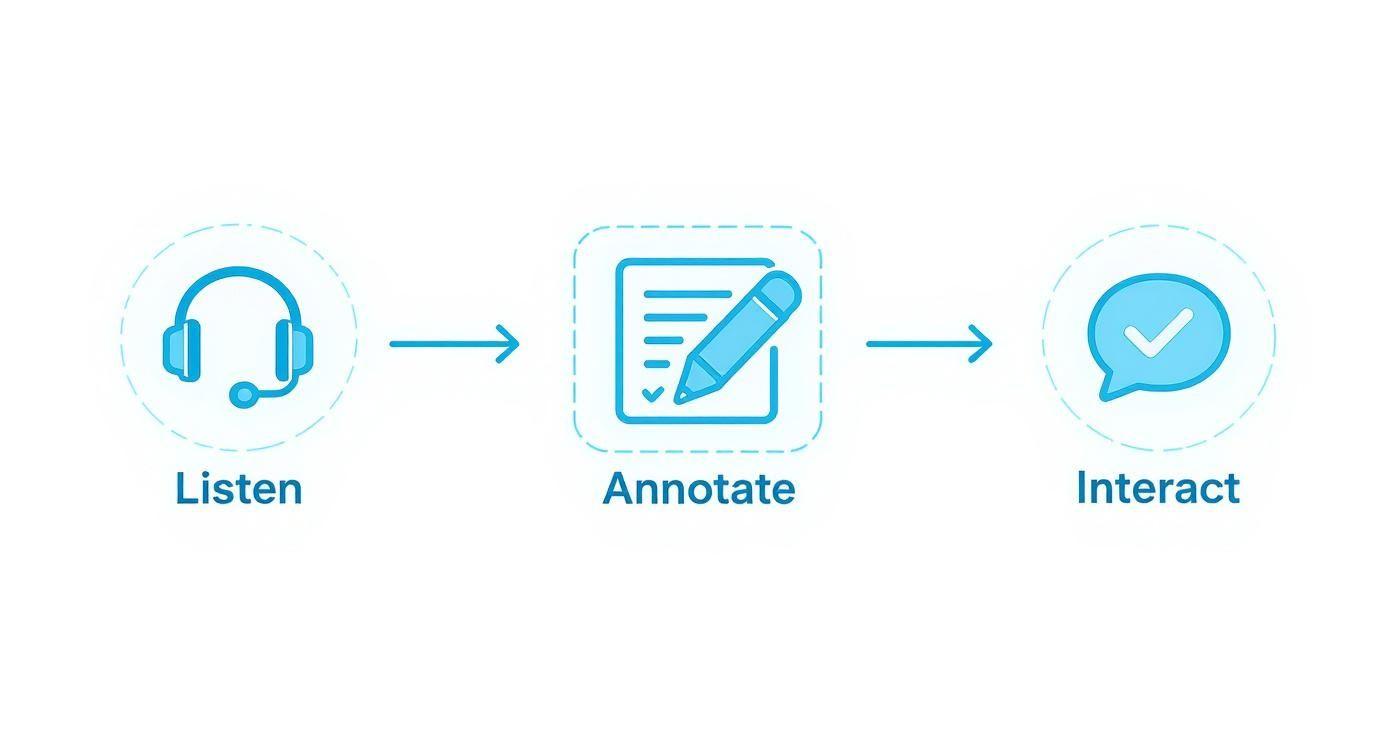
This visual highlights a powerful idea: layering different methods of engagement—auditory, written, and cognitive—cements your understanding. When you make reading a multi-sensory and interactive process, you're building much stronger neural pathways for both recall and true comprehension.