If you want to get better at research, you need more than just good Googling skills. It's about building a solid process—one that starts with smart planning, moves to critically judging your sources, and ends with weaving everything together into a clear, compelling story. This isn't just about finding information; it's about building real knowledge you can stand behind.
Why Mastering Research Is a Career-Defining Skill
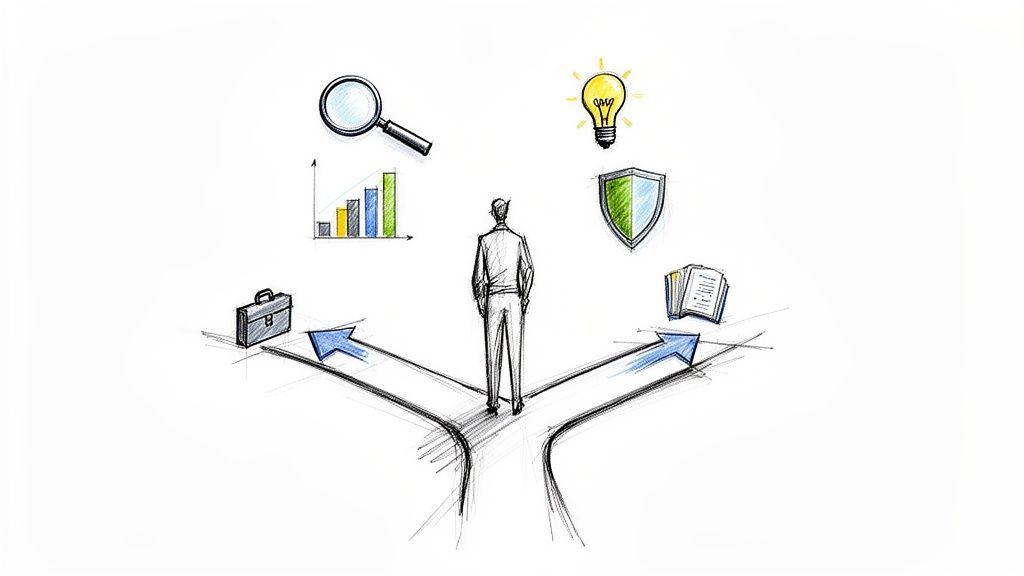
We're all swimming in a sea of information, and the ability to find what's true and what actually matters is a superpower. Strong research skills aren't just for academics anymore. They're a massive advantage for pretty much everyone—from professionals and students to founders trying to build something new.
This isn't about memorizing facts. It's about developing a reliable method for tackling complex problems and making decisions you can be confident in. When you invest in your research skills, you’re sharpening a core competency that makes you better at almost everything else you do. It's how you move past gut feelings and build arguments on a foundation of solid evidence.
Sharpening Your Analytical Edge
At its core, research is a workout for your brain. It forces you to question where information comes from, spot potential biases, and connect dots that other people miss. That kind of analytical mindset is exactly what employers are looking for right now.
The ground is constantly shifting under our feet at work. The World Economic Forum’s Future of Jobs Report projects that a staggering 39% of workers' core skills will change by 2030. This makes skills like analytical thinking, which is at the heart of good research, more critical than ever. You can dig into the full findings on future job skills to see just how much is changing.
The goal of great research isn't just to collect information, but to generate insight. It’s the bridge between knowing what happened and understanding why it matters.
This skill pays off directly in better problem-solving. A marketer digging into competitor strategies, a developer hunting down a tricky bug, or a student trying to understand a historical event—they all use the research process to break down big challenges into smaller, solvable pieces.
Building Confidence and Adaptability
Good research habits do more than just build knowledge; they build genuine confidence. When you know your conclusions are backed by carefully checked information, you can present your ideas with authority. That self-assurance makes all the difference in a meeting, a presentation, or any time you need to make your case.
Ultimately, mastering research is about becoming a lifelong learner. It gives you the toolkit to adapt to new industries, technologies, and roles because you have a structured way to get up to speed on anything. You become more versatile, more resilient, and ready for whatever comes next.
To get there, we'll focus on the fundamental skills that every great researcher needs. This guide will walk you through the essential pillars that turn simple searching into powerful understanding.
The Core Pillars of Effective Research
| Skill Pillar | Why It Matters | Key Takeaway |
| Strategic Planning | Avoids wasted time and rabbit holes. A clear plan ensures you're looking for the right information from the start. | Don't start searching until you know exactly what question you're trying to answer. |
| Critical Evaluation | Protects you from misinformation and weak arguments. Not all sources are created equal. | Question everything. Always ask who created the source, why they created it, and if it's backed by evidence. |
| Effective Synthesis | This is where true insight happens. It's about connecting ideas to form a new, coherent understanding. | Your job isn't to just list facts. It's to tell the story the facts reveal when you put them all together. |
By mastering these pillars, you’ll develop a reliable framework that you can apply to any topic or challenge that comes your way.
Building Your Strategic Research Plan
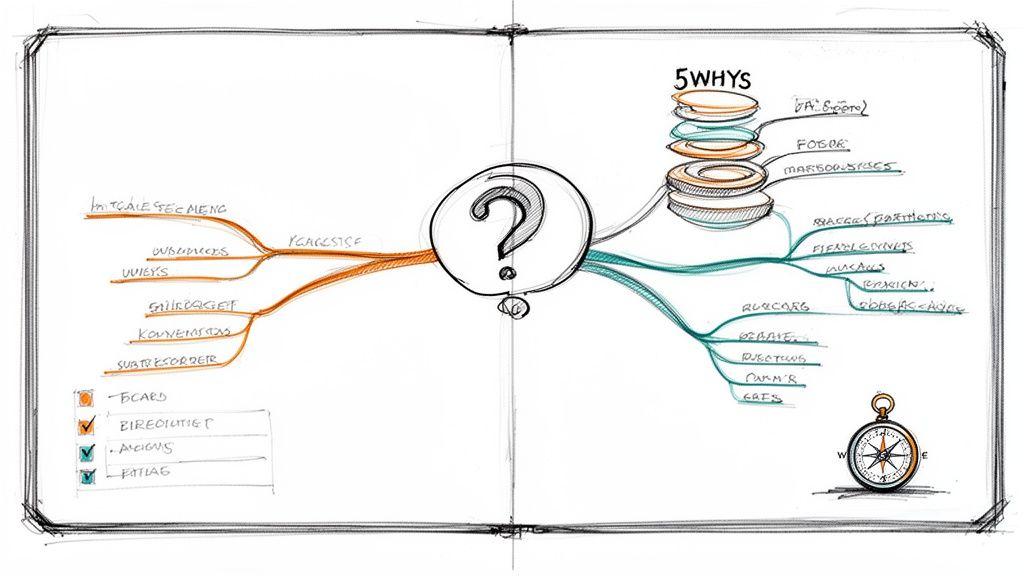
Here’s a hard-won lesson: great research almost never starts with a search engine. It starts with a question. A clear, focused question is your compass, guiding you through the noise and keeping you from getting lost in interesting—but irrelevant—details.
Without that North Star, it’s far too easy to waste hours chasing down rabbit holes. A well-formed question acts as your most powerful filter against information overload. It establishes boundaries, defines the scope of your work, and gives you a clear finish line. This is what separates aimless browsing from purposeful investigation.
From Broad Topic to Focused Question
We all start with a broad area of interest. That’s natural. The problem is staying there. To make real progress, you have to systematically narrow your focus until you land on a question that is specific, manageable, and actually answerable.
Let's take a common scenario: a small business owner interested in "sustainable packaging." This topic is a huge, sprawling territory. Where do you even begin? The trick is to drill down.
Two of my favorite techniques for this are incredibly simple but effective:
- Mind Mapping: Just grab a pen and paper (or an app). Put your core topic in the middle and start branching out with related ideas, questions, and subtopics. This visual approach is fantastic for seeing new connections and spotting more specific avenues to explore.
- The '5 Whys' Technique: This is my go-to for getting to the heart of the matter. You simply ask "why" over and over again. It forces you to peel back the layers of your initial curiosity to find the deeper, more specific question you’re really asking.
Let’s watch the '5 Whys' work its magic for our business owner.
- Start: "I want to research sustainable packaging."
- Why? "Because I want my business to be more eco-friendly."
- Why? "Because my customers are asking for greener options."
- Why? "They're worried about all the plastic waste from their online orders."
- Why? "Because they want packaging they can easily recycle or compost at home."
And there it is. In just a few steps, a vague idea transforms into a fantastic research question: "What are the most cost-effective, home-compostable packaging solutions for shipping small consumer goods in North America?"
This question is a world away from the original topic. It's specific, it’s actionable, and it gives you a clear direction. It defines the solution type (cost-effective, home-compostable), the use case (shipping small goods), and even the geography (North America).
Defining Your Research Parameters
Once you have that solid question, the next move is to set some ground rules. Think of these as the guardrails for your project. They keep your work manageable and on track.
Before you dive in, think through these key factors:
- Scope: What are you going to include? Just as importantly, what are you going to exclude? Our business owner might decide to ignore industrial composting solutions and focus only on options consumers can handle themselves.
- Timeline: How much time can you realistically give this? A deadline is your best friend—it stops the project from stretching on forever.
- Deliverable: What's the end goal here? Are you creating a simple report, a detailed spreadsheet comparing suppliers, or a slide deck for your team?
A clear plan doesn't just tell you where to start; it tells you when you're done. Defining your objective and parameters is the single most important step in conducting efficient and effective research.
By setting these boundaries, you build yourself a roadmap. You’ll know exactly what information you need, how deep to go, and what the final product should look like.
If you want a more structured way to tackle this, creating a formal document can be a huge help. You can learn more about how to structure this by exploring a sample research plan that you can easily adapt for your own projects. This little bit of planning upfront is the foundation for everything that follows.
How to Find and Vet Information Like a Pro
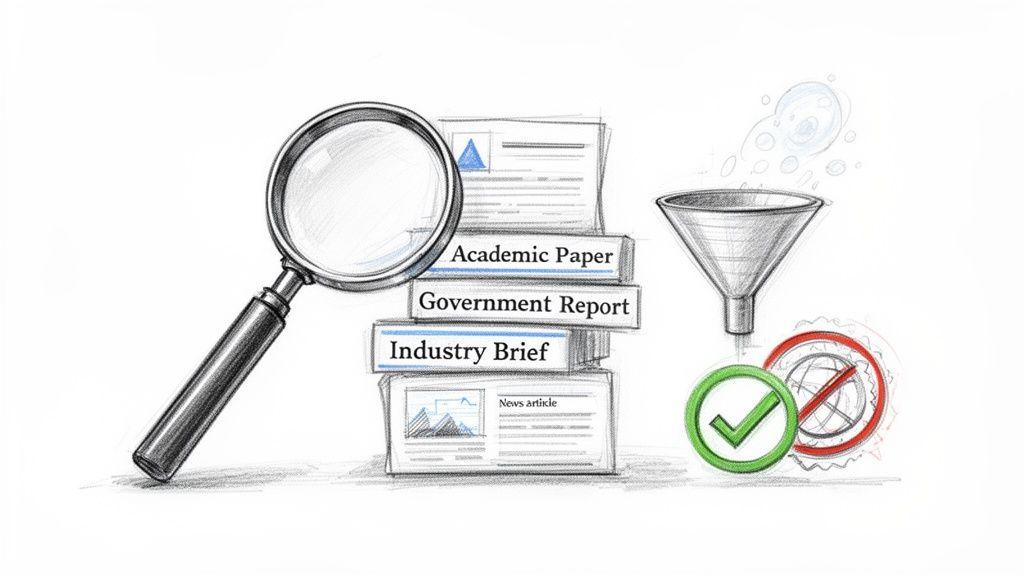
Now that you have a sharp research question as your north star, it’s time to start gathering information. But here's the thing: where you look is just as important as what you're looking for. The internet is a tangled web of high-quality data, well-intentioned opinions, and straight-up misinformation.
Knowing how to navigate that maze and evaluate sources is a game-changer. It’s what separates flimsy conclusions from rock-solid insights. Effective research means digging deeper than the first page of search results and pulling from a variety of sources to get a complete picture.
Expand Your Research Toolkit
A standard Google search is a decent starting point, but truly professional-grade research requires a broader net. Think of it this way: a general search engine shows you the landscape, while specialized databases are where you find the buried treasure.
To really level up your information gathering, start weaving these powerhouses into your workflow:
- Academic Databases: Platforms like Google Scholar, JSTOR, or PubMed are your direct line to peer-reviewed studies and scholarly articles. This is where you’ll find rigorous, evidence-backed research.
- Government Publications: Official sites like the Bureau of Labor Statistics or the World Health Organization are goldmines for reliable data, reports, and statistics that are typically well-vetted and impartial.
- Industry Reports and White Papers: Looking for business or tech insights? Reputable market research firms and trade organizations often publish detailed reports on trends and consumer behavior. They provide context you won't find anywhere else.
Comparing Information Source Types
Not all sources are created equal, and knowing which one to use for a specific task is a key skill. Here's a quick breakdown to help you choose the right tool for the job.
| Source Type | Best For | Potential Pitfall | Example |
| Academic Journals | Finding primary research, in-depth analysis, and evidence-based findings. | Can be highly technical and may have restricted access (paywalls). | A peer-reviewed study on consumer psychology from the Journal of Marketing. |
| Government Data | Sourcing objective statistics, demographic information, and public policy reports. | Data can sometimes be dated or presented in dense, hard-to-read formats. | The U.S. Census Bureau's latest report on population growth. |
| Industry Reports | Understanding market trends, business forecasts, and specific industry challenges. | Often created with a commercial goal; may be expensive or require a subscription. | A Gartner report on emerging AI technologies in the supply chain. |
| Reputable News | Getting up-to-date information on current events and expert commentary. | Can contain unintentional bias; the rush to publish may lead to errors. | An in-depth article from The Associated Press covering a new piece of legislation. |
Ultimately, a strong research project pulls from several of these categories to build a well-rounded and defensible argument.
Master Your Search with Boolean Operators
Are your search results too broad or just plain wrong? The problem might not be what you're searching for, but how. Boolean operators are a simple but incredibly powerful way to tell search engines exactly what you want.
Think of them as basic commands:
- AND: Narrows your search.
sustainable packaging AND e-commercewill only show results containing both phrases. - OR: Broadens your search. This is perfect for synonyms, like
compostable OR biodegradable. - NOT: Excludes a term. A search for
packaging NOT plasticfilters out anything focused on plastic.
Using these is a fundamental skill that helps you cut through the noise and get to the good stuff—fast.
Evaluate Sources with the CRAAP Test
Okay, so you've found a promising article. How do you know if it's actually any good? The CRAAP test is a fantastic mental checklist I've used for years to quickly vet any piece of information.
It’s an acronym that stands for:
- C - Currency: When was this published? For fast-moving fields like tech, a source from five years ago might as well be from the Stone Age.
- R - Relevance: Does this actually answer your question? Is it written for the right audience—not too basic, not too technical?
- A - Authority: Who wrote this? Look for credentials, expertise, and institutional backing. An anonymous blog post doesn't hold the same weight as a paper from a university professor.
- A - Accuracy: Can you verify the claims elsewhere? Good sources cite their own evidence. Be skeptical of anything that makes big claims without backup.
- P - Purpose: Why was this created? Is it trying to inform you, persuade you, or sell you something? Understanding the intent helps you spot potential bias.
Running every key source through this five-point check is one of the best habits you can build. It’s your first line of defense against bad information.
This skill has a real-world impact on your career. A report from ADP Research found that only 24% of global workers feel confident they have the skills needed for career advancement. Learning to find and validate information is a direct way to close that confidence gap, as highlighted in the ADP study on workforce skill confidence.
If you want to dig even deeper into this, our guide on what makes a credible source has more tips to help you distinguish solid facts from shaky claims.
From Piles of Data to Real Insight
Finding a stack of promising sources feels great, but it’s just the starting line. The real work—and the real breakthroughs—happen when you stop just collecting information and start wrestling with it. This is how you turn a messy folder of PDFs and bookmarks into your own personal knowledge base.
Without a system, you're basically guaranteed to drown in data. You’ll lose track of that one killer quote, miss a crucial connection between two papers, and end up frantically trying to stitch everything together when your deadline is staring you down. The goal is to build a system that captures not just facts, but your own questions and insights as they pop up.
Finding Your Note-Taking Groove
Look, there's no single "best" way to take notes. The perfect method is the one you'll actually stick with. Passive highlighting is a trap; it feels productive, but you're not actually processing anything. You need an active method.
Here are a couple of my favorite, field-tested approaches:
- The Cornell Method: This old-school system is still around for a reason—it works. You divide your page into three simple sections: a main area for notes, a side column for keywords and questions, and a summary section at the bottom. It forces you to distill the main ideas right away.
- Digital Mind Mapping: If you're a visual thinker, mind mapping can completely change your research game. Tools like Miro or Coggle let you build out from a central idea, connecting concepts, quotes, and sources in a non-linear way. It's fantastic for exploring complex topics where the relationships are everything.
Think of it this way: the Cornell Method is like building with LEGOs—structured and methodical. Mind mapping is more like painting—fluid and associative. Pick the one that fits how your brain works.
Don't Just Collect Facts—Capture Your Thoughts
Good researchers don't just copy and paste. They document their thinking about the information. Your notes should feel like a conversation between you and the source.
As you read, make a habit of capturing three things for every key point:
- Direct Quotes: Snag that perfect sentence or statistic, but always, always wrap it in quotation marks and jot down the source immediately. Don't tell yourself you'll find it again later.
- Paraphrased Summaries: In your own words, what is the author actually trying to say here? This is a gut check to make sure you truly understand the point.
- Your Own Insights: This is where the gold is. What does this make you think? Does it connect to that other article you read? Does it completely contradict your own assumptions? Write it down.
A great set of research notes isn’t just a collection of facts; it’s a record of your intellectual journey. It shows how your own understanding grew and changed.
This is what separates basic fact-finding from genuine knowledge building. If you want to dive deeper into structuring this process, our guide on how to organize your research notes effectively has a ton of other strategies.
Let Digital Tools Do the Heavy Lifting
While I love a good notebook, digital tools can give your research process a serious upgrade. The ability to search, tag, and link your notes is a lifesaver, especially on bigger projects.
Here are the two types of tools I think are essential:
- Note-Taking Apps: Forget basic word processors. Apps like Obsidian, Notion, or Evernote let you build a "second brain." You can create a web of interconnected notes, making it incredibly easy to spot connections you might have otherwise missed.
- Citation Managers: If you're doing any serious research, using a tool like Zotero or Mendeley is non-negotiable. They grab your sources, organize the metadata, and generate perfect citations and bibliographies on demand. Starting with one from day one will save you from a world of pain later.
The right combo of a solid note-taking method and a couple of smart tools turns a chaotic pile of research into a powerful, searchable asset. It makes the whole process less stressful and, honestly, a lot more fun.
Using AI to Supercharge Your Research
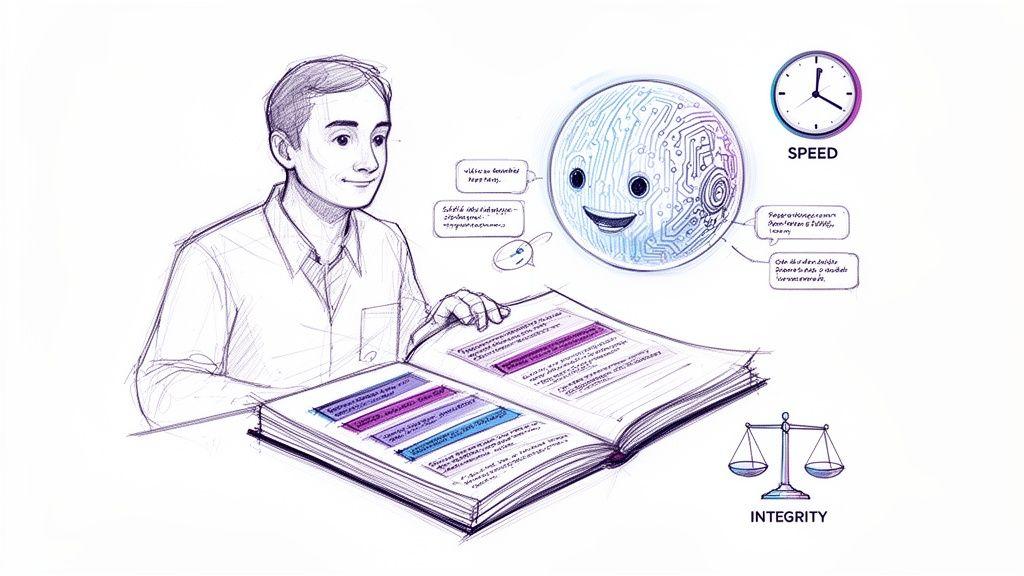
Artificial intelligence has moved from a sci-fi idea to a genuinely useful research assistant. If you use it smartly, AI can become an incredible partner. It can help you brainstorm new angles, make sense of dense material, and just generally speed things up—all without sacrificing the quality of your work.
The trick is to think of AI as an augment to your own brain, not a replacement for it. These tools can chew through huge amounts of text in seconds, pulling out summaries and themes that would take a human researcher hours to find. This frees you up to focus on what really matters: thinking critically and connecting the dots.
Your New AI Research Assistant
Imagine having a super-fast, multilingual research intern who never needs to sleep. That's essentially what a good AI chat tool is. It can't form its own opinions or fact-check its own work, but it can handle a ton of the grunt work that sets you up for success.
Here are a few ways I’ve found AI to be a game-changer in my own research workflow:
- Brainstorming and Sharpening Questions: Start with a broad topic, feed it to the AI, and ask for potential research questions. For instance, try a prompt like, "Give me five specific research questions about how remote work affects employee retention in small businesses." You can go back and forth, refining the ideas until you land on something solid.
- Decoding Dense Material: Staring at a long, jargon-heavy academic paper? Ask the AI to help. A simple "Summarize the key findings of this article in plain English" or "Explain this study's methodology like I'm a complete beginner" can save you a massive amount of time and confusion.
- Spotting Key Themes: Once you’ve gathered a few sources, ask the AI to connect them. A prompt like, "Based on these articles, what are the main recurring themes or points of debate about sustainable urban planning?" can instantly highlight the core arguments in the field.
Getting good results from AI is all about asking the right questions. Think of your prompts as direct instructions for your intern. The clearer you are, the better the output you'll get back.
Platforms that let you test prompts with different AI models are incredibly useful for this. You can see how one AI interprets your query versus another, helping you fine-tune your approach for the best possible results.
Staying Out of Trouble: The Pitfalls of AI Research
While AI is incredibly powerful, it comes with some serious risks you have to manage. These language models are built to generate text that sounds plausible, not text that is factually correct. If you aren't careful, this can lead you way off track.
The biggest problem is something called "hallucination." This is when an AI confidently makes up facts, stats, or even entire sources and citations that don't exist. It has no concept of truth; it only knows how to string words together in a convincing way.
Because of this, you have to treat every single piece of information you get from an AI as unverified until you've checked it yourself.
Here's how to use AI responsibly and keep your research credible:
- Always Verify Everything: Never, ever cite a fact or source provided by an AI without hunting down the original document and confirming it with your own eyes.
- Use It for Ideas, Not Answers: Lean on AI for brainstorming, outlining, and summarizing. But the real work—the critical thinking, analysis, and conclusions—has to be yours.
- Protect Your Data: Be very careful about pasting sensitive or private information into public AI tools. If you're working with confidential material, look for privacy-first platforms.
Knowing how to work with these tools is becoming a critical skill. According to the World Bank, from 2021 to 2024, job postings requiring AI skills grew, but they still only account for 1.5% of all online job ads worldwide. That gap highlights a huge opportunity for people who can master AI-assisted workflows. You can read the full World Bank analysis on AI in the job market for more on this trend.
At the end of the day, AI is just another tool in your research toolkit. Learn its strengths, understand its weaknesses, and you'll be able to work smarter, find deeper insights, and get more done.
Weaving It All Together: From Facts to Insight
You've gathered your notes, highlighted key articles, and organized everything. That’s the heavy lifting, but it’s not the end of the road. The real breakthrough moment in any research project is synthesis. This is where you stop being a collector of facts and start becoming a creator of knowledge.
Think of it like this: you've gathered all the individual threads. Synthesis is the act of weaving them into a coherent tapestry—a new picture that didn’t exist before. It's about spotting the patterns, connections, and even the friction between different pieces of information to form your own unique take.
Find the Patterns (and the Gaps)
Start by spreading out your key findings. I’m a big fan of visual methods here. You could use a whiteboard, sticky notes, or a digital tool, but the goal is to see everything at once. A more structured approach is a synthesis matrix. It’s just a simple table: list your sources down the side and your main themes or questions along the top.
As you fill out the cells with notes, you’ll start to see the landscape of the conversation.
This process forces you to ask the right questions:
- Where's the common ground? When you see multiple, unrelated sources pointing to the same conclusion, you know you're onto something solid.
- Where's the debate? Pay close attention to where the experts disagree. These points of tension are often the most interesting areas for exploration.
- What about the outliers? If one source makes a claim that flies in the face of everything else, dig in. Is it based on groundbreaking new data, a flawed method, or a specific bias? Don't just dismiss it.
Synthesis isn’t about forcing your sources to agree. It’s about understanding the conversation they’re having with each other, including the arguments and disagreements. This is how you develop a nuanced perspective.
Construct Your Own Take
With the relationships between your sources mapped out, you can now build your own argument. This is more than just sharing your opinion—it’s about constructing a logical case that stands firmly on the evidence you’ve painstakingly gathered. Your job is to tell the story the data reveals and explain why it’s significant.
A strong argument doesn't ignore the opposition. In fact, it's the opposite. Make sure you address any major counterarguments or limitations in what you found. Acknowledging a different viewpoint doesn't weaken your position; it makes it stronger. It shows you’ve done your homework and considered the topic from all angles, which gives your own conclusions far more weight and credibility. This is what truly separates good research from great research.
Common Questions About Research Skills
You've got a plan, you've got your tools, but let's be honest—research is rarely a straight line. Sticking points are a natural part of the process, and knowing how to navigate them is what separates the pros from the novices. Let’s tackle a couple of the most common hurdles you'll likely face.
How Can I Avoid Information Overload?
Feeling like you're drowning in information is a classic research problem. The best life raft you can build is a laser-focused research question before you start searching.
Seriously, define exactly what you need to know and, just as crucial, what you can safely ignore for now. This question becomes your ultimate filter. As you scan a new source, ask yourself one simple thing: "Does this directly help me answer my specific question?" If it's a "maybe" or a "not really," bookmark it for later if you must, but move on.
Another great trick is to use a timer. Setting a 25-minute Pomodoro session forces you to stay on task and stops you from falling down an endless rabbit hole of interesting-but-irrelevant articles.
Your research question isn't just a starting point. It's the rudder for your entire project, keeping you from getting lost in a sea of information. A tight focus is your best defense against feeling overwhelmed.
What Is the Difference Between Primary and Secondary Sources?
Getting this right is absolutely fundamental to building a credible argument. It's the difference between hearing a story from a witness versus hearing it from someone who read about it in the news.
- Primary sources are the raw ingredients. They are the original, firsthand accounts and direct evidence. Think of things like interview transcripts, original scientific studies, historical documents, or your own survey data.
- Secondary sources are one step removed. They analyze, interpret, or summarize the primary stuff. A textbook explaining a historical event, a documentary, or a literature review that synthesizes multiple studies are all perfect examples.
The magic happens when you use them together. Lean on primary sources for your core evidence—the proof. Then, use secondary sources to understand what others have said about it and to place your topic in a broader context. They give you the complete picture.